The short answer is that John Deere 100 Series maintenance is simple, mostly do-it-yourself work, and far cheaper than maintaining a farm tractor. These residential lawn tractors have small gasoline engines, hydrostatic transmissions, and stamped-steel decks. This guide covers the full John Deere 100 Series maintenance routine: oil and filters, blades and belts, the problems that actually occur, and what to check before buying used. One caution: intervals vary slightly by model year, so your own operator’s manual is the final word.
John Deere 100 Series Maintenance Schedule and Service Costs
Good John Deere 100 Series maintenance starts with the schedule under your own mower’s hood. John Deere puts a service-interval decal inside the one-piece hood: quick checks before each mow, an early break-in oil change, then service at 25-, 50-, and 100-hour marks or once a season. John Deere publishes operator’s manuals for every model on its manuals site.
Engine Oil, Filters, Spark Plugs and Air-Cooling Checks
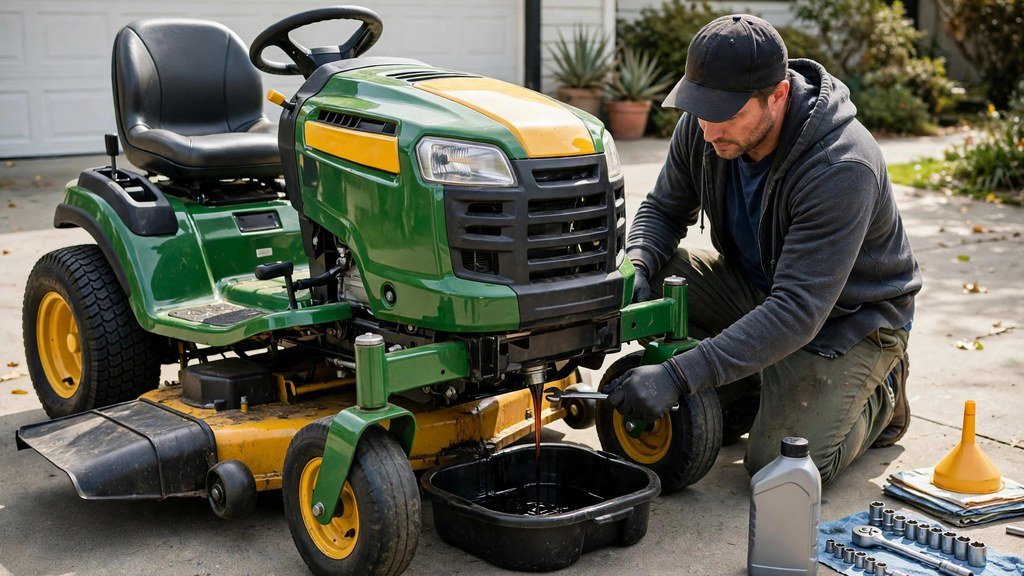
Engine oil is the single most important item in John Deere 100 Series maintenance. Check the level before each use, and change the oil early: manuals call for a break-in change after the first 5 hours, while some newer guides stretch that to 8 hours — follow your manual’s figure. After break-in, the older schedule changes oil every 25 hours, while newer guides commonly say every 50 hours or once a season. Both agree on fresh oil once a season at minimum.
How you change the oil depends on the model. The S120, S130, S160, S170, and S180 use John Deere’s Easy Change 30-Second Oil Change System, a twist-off cartridge holding 2.8 quarts with no drain pan. The S100 and S110 use a conventional drain with a replaceable filter (1.5 quarts); the S140 uses a no-tools drain with a replaceable filter (2.0 quarts). Fill to the full mark, not by guesswork. Note: some blogs wrongly credit the S140 with Easy Change; dealer sheets list the no-tools drain — check your hood decal before ordering.
Filters and ignition parts follow a simple pattern in any John Deere 100 Series maintenance routine. Clean the air filter’s foam precleaner every 25 hours, and replace the paper element every 100 hours or once a year if very dirty. A clogged filter quietly costs power and fuel, and owners often blame the carburetor when the filter is the real problem. Replace the fuel filter yearly and the spark plug every 100 hours or once a year. Before each mow, clear debris from the muffler, the engine cooling fins, and the deck, and test the safety systems. Air-cooled engines need that airflow.
Mower Blades, Deck Belts, Spindles and Lubrication
The cutting deck is where most John Deere 100 Series maintenance time goes, because blades dull, belts stretch, and spindles wear. Check blade bolt tightness every 25 hours, sharpen blades at least once a season, and replace them every year or two if nicked, bent, or worn thin. A 42-inch deck runs two blades; the 48- and 54-inch decks run three. Dull blades tear grass and leave brown tips, and an unbalanced blade damages spindle bearings over time. Disconnect spark-plug wires before working under the deck, and scrape the underside clean after mowing. The washout port lets you flush it with a hose, preventing rust-causing buildup.
Belts deserve the same attention in your John Deere 100 Series maintenance routine. Check drive and deck belts every 25 hours for cracks, glazing, fraying, and tension. When replacing a belt, note the routing first and use the correct John Deere belt — a near-miss belt will slip or jump off. Grease the spindle and front-axle fittings every 25 hours, and spin each spindle by hand with the belt off: gritty or wobbly means the bearing is failing. The video below walks through a deck rebuild on S100, S120, and S130 mowers — spindles, idlers, and belt replacement:
Budgeting for John Deere 100 Series maintenance stays simple because the parts are small and most jobs are DIY. A season’s routine parts — oil, filter, air filter, spark plug, fuel filter, blades — cost far less than one farm-tractor dealer visit, and the work takes an hour or two across the season. A yearly dealer visit covers valve-clearance checks and special-tool jobs like pressing in a spindle bearing. The full annual budget picture — parts, dealer visits, and the jobs worth paying for — is broken down in the ownership-cost figures.
| When | What to do | Notes |
|---|---|---|
| Before each use | Check oil level, clear debris from muffler and cooling fins, test safety systems | Prevents overheating |
| Break-in (first 5–8 hours) | Change engine oil | 5 hours in older manuals, 8 in some newer guides — follow yours |
| Every 25 hours | Oil change (older schedule), clean air-filter precleaner, check blade bolts, clean belt area, grease spindles and axles | The busiest service stop of the season |
| Every 50 hours or once a season | Oil and filter change (newer schedule), fuel filter | Most homeowners hit the calendar limit first |
| Every 100 hours or once a year | Spark plug, air-filter paper element | Do both at winterizing time if hours are low |
| Once a year (dealer) | Valve-clearance check and full inspection | The one routine job most owners leave to the shop |
| Model | Oil system | Crankcase capacity with filter |
|---|---|---|
| S100, S110 | Standard drain, replaceable filter | 1.5 quarts (1.4 L) |
| S140 | No-tools drain, replaceable filter | 2.0 quarts (1.9 L) |
| S120, S130, S160, S170, S180 | Easy Change 30-Second Oil Change System | 2.8 quarts (2.6 L) |
| All models | Fuel tank | 2.4 gallons (9 L) |
John Deere 100 Series Reliability and Long-Term Durability
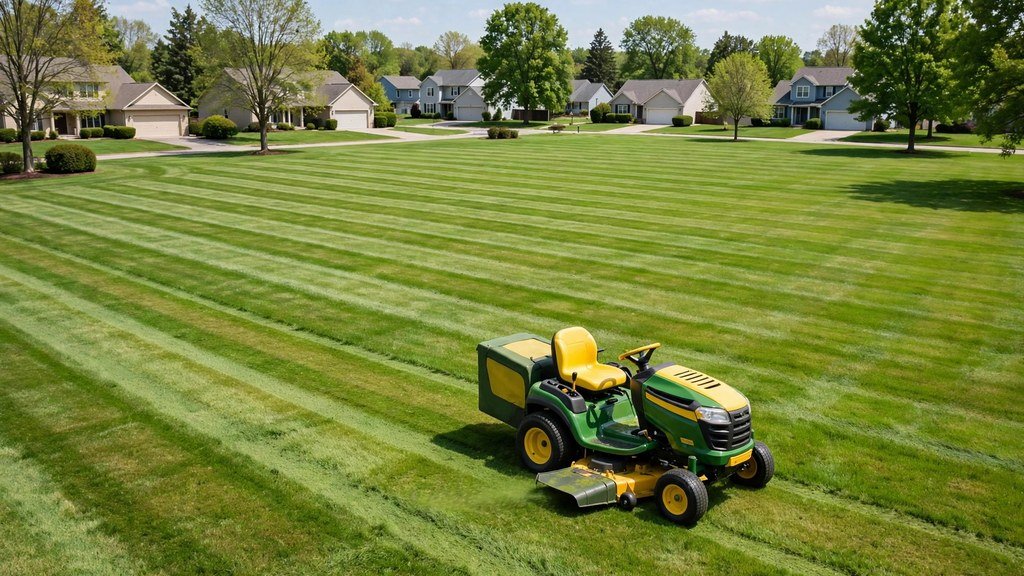
For a homeowner mower, John Deere 100 Series reliability is genuinely good — and routine John Deere 100 Series maintenance is what keeps it that way, with one honest caveat. These are residential machines built for roughly half an acre to two acres of weekly mowing. They are not commercial mowers; commercial-scale work wears belts, spindles, and transmissions far sooner than intended.
Engine, Hydrostatic Transmission and Mower Deck Durability
The engines are the strongest part of the package, and regular John Deere 100 Series maintenance is what lets them reach high hours. The S100 runs a 17.5-hp single-cylinder, while S120–S180 run 22- to 24-hp V-twins with cast-iron liners, overhead valves, and full-pressure lubrication and filter. Every model uses a hydrostatic transmission with side-by-side foot pedals — no clutch to wear, no gears to grind. Lower models use the TLT200 transaxle; the S170 and S180 step up to a heavy-duty unit (K46 on 2026 dealer pages). Stamped-steel decks with a wash port hold up well if kept clean and dry.
How long does one last? With this guide’s John Deere 100 Series maintenance schedule followed, several hundred hours is realistic, and higher-hour machines still sell well with service records. The hour meter makes that easy to verify when buying used. The parts that usually end a mower’s life are not the engine but the deck (rusted through from packed clippings), the transmission (overheated or overloaded), or simple economics: once a deck shell or a transaxle costs more than the mower is worth, most owners replace the machine. Keeping the deck clean and the transmission cool is the real durability strategy.
Factors Affecting Service Life and Repair Costs
Five habits decide whether your mower lasts five years or fifteen, and all five sit inside routine John Deere 100 Series maintenance. First, fuel: ethanol gasoline goes stale in weeks, so use fresh fuel and stabilize any tank sitting over a month. Second, grass conditions: tall, wet, or heavy grass at full speed loads the engine, belts, and deck far more than a weekly cut, so slow down in tough conditions — heavy grass and bagging also raise fuel use, as the performance figures show. Third, slopes and towing strain the fin-and-fan-cooled hydrostatic transmission. Fourth, storage: a mower kept in a dry garage, cleaned before winter, battery removed and stored warm, outlasts one left outside under a tarp. Fifth, tire pressure: 14 psi front and 10 psi rear on S100–S160, 12 psi all round on S170/S180 — uneven pressure tilts the deck and scalps one side. None of these habits costs much, which is the point of John Deere 100 Series maintenance: small, regular attention prevents the big bills, since belts, blades, batteries, and filters are cheap while a transaxle or deck shell is not — which is exactly why John Deere 100 Series maintenance focuses on prevention.
John Deere 100 Series Common Problems and Warning Signs
Most John Deere 100 Series maintenance problems are small, cheap, and diagnosable in the driveway: a mower that will not start in spring, a cut that turns uneven mid-season, or a belt slipping on hills. Work through simple causes first — fuel, battery, filter, belt, tire pressure — because the simple cause is the usual one.
Starting Issues, Uneven Cutting and Blade Engagement Problems
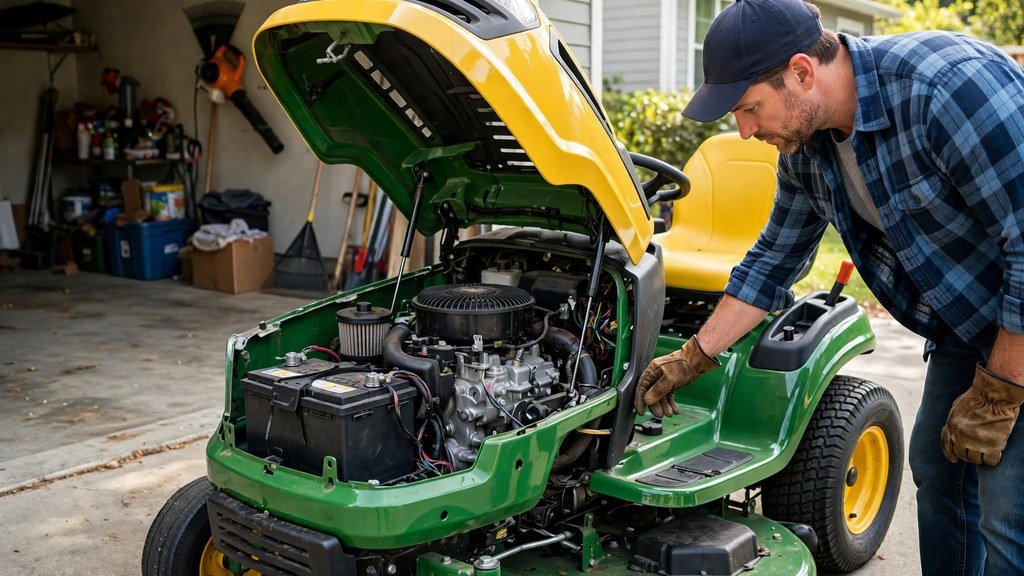
When it will not start or only clicks, check in order: battery and terminals, safety-interlock switches (seat, brake, blade engagement must all agree), solenoid and wiring, then fuel. A weak battery is the most common spring problem, and dirty terminals mimic one, so clean them before buying a replacement. If it cranks but will not fire, suspect stale fuel first, then a restricted fuel filter, fouled plug, or dirty air filter. Some owners report a mower that runs fine, then will not restart when hot; check fuel delivery and the carburetor bowl for flooding, and try fresh fuel with stabilizer before replacing parts — the cheapest John Deere 100 Series maintenance fix there is.
Uneven or ragged cutting usually traces back to the deck, not the engine, and it is one of the most common John Deere 100 Series maintenance complaints because the fix is usually in the deck, not the motor. Dull, bent, or unbalanced blades tear grass and leave strips; an unlevel deck scalps high spots; worn spindle bearings let a blade wobble; wrong tire pressure tilts the deck; mowing too fast in tall grass leaves uncut patches. Check tire pressure first because it is free, then blade sharpness, then deck level. Blade engagement problems — blades that will not spin up or stop under load — point to the engagement lever or cable, the electric PTO clutch where fitted, or a worn or misrouted belt.
Belt Wear, Steering, Battery and Transmission Symptoms
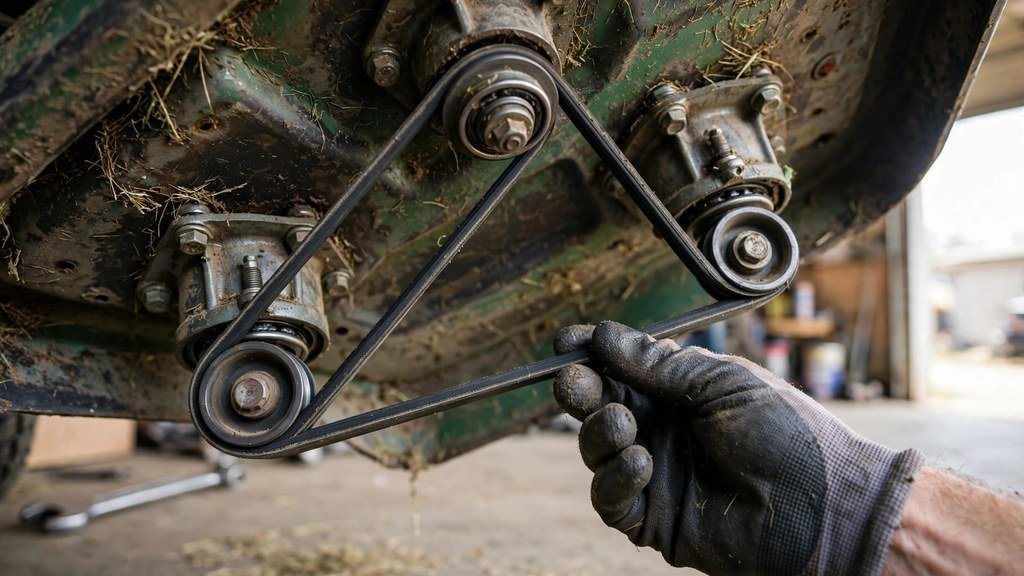
In John Deere 100 Series maintenance, belts give plenty of warning before they fail. Look for rib cracks, a glazed surface, frayed edges, and slack the tensioner cannot take up. A belt that repeatedly jumps off usually has a routing problem, a damaged pulley or idler, a missing or bent guard, or debris around the pulleys — check all four before fitting another, or the new one fails the same way. Always verify routing against the diagram on the deck or in the manual. The photo below shows what to look at: the belt, the idlers, and the spindle housings on the underside of a deck.
Loose or wandering steering usually means worn linkage, a dry sector gear, or low grease at the front-axle fittings; grease first, then check tie rods and steering shaft. Batteries here are small 12-volt units (the S140 lists 300 cold-cranking amps, 8-amp charging), and slow spring cranking is the usual sign of replacement time. Transmission symptoms deserve more respect: a mower that struggles on hills, loses drive when hot, or jerks after storage may have a slipping drive belt, a damaged or blocked hydro cooling fan, air in the system, or the bypass control not fully in drive. Check belt, fan, and bypass rod first — basic John Deere 100 Series maintenance that resolves most drive complaints without a dealer visit. Persistent hot drive loss points to internal hydrostatic wear — a dealer job that sometimes ends an older machine’s economic life.
John Deere 100 Series Used-Mower Inspection
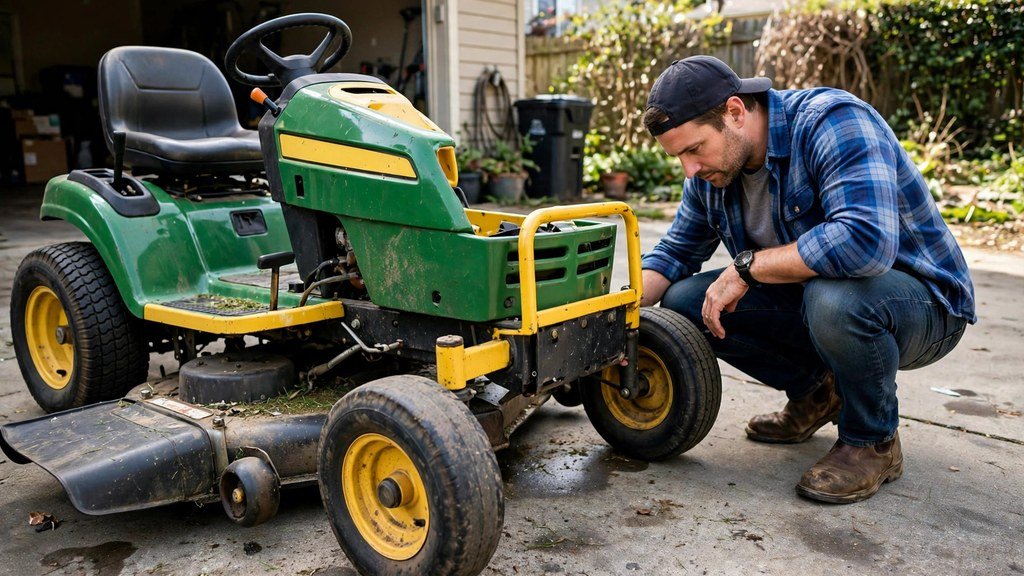
A used 100 Series mower can be excellent value — simple machines, widely available parts — but only if you inspect it properly. The hour meter, deck, and cold start tell you most of what you need in fifteen minutes. A pre-purchase check is really just John Deere 100 Series maintenance in reverse: the same items you service are the items you inspect.
Checking Service Records, Engine Condition and Operating Hours
Start with the hour meter and any service records. A mower with a few hundred hours and a folder of John Deere 100 Series maintenance receipts is a far better buy than a low-hour machine with no history — hours without maintenance wear faster than hours with it. Ask when the oil was last changed, whether the transmission was ever serviced, and whether it was stored indoors. Then inspect the engine cold: oil level and color (milky means water contamination; black and gritty means neglected changes), leaks, and a cold start by you. It should start easily, idle smoothly, and run without blue or white smoke once warm. As a pricing reference, a 2025 S100 with 5 hours was listed by a New York dealer in October 2026 at $2,299 against a new-machine quote of about $2,399 — near-new examples hold their value, so a listing priced far below market deserves skepticism. Model-by-model prices are compared in ProToolReviews’ John Deere lawn tractor comparison, and the S100 through S180 are compared side by side in the review.
Inspecting the Deck, Blades, Tires, Belts and Safety Features
The deck is where used mowers hide their worst news. Look underneath for rust-through, cracks, and old weld repairs, and rock each blade to check spindle play — any wobble means bearing work. Examine blades for bends, nicks, and thin edges; check the belt for cracks and routing. Tire condition is part of John Deere 100 Series maintenance too: tires should match side to side, hold the manual’s pressures (14 psi front and 10 psi rear on most models, 12 psi all round on S170/S180), and show no dry-rot cracking. Finally, test every safety feature before paying: the engine should stop or refuse to start with the seat unoccupied and blades engaged, and the brake should hold on a slope. A seller who will not let you test these, or who has disabled a safety switch, is telling you to walk away. Any mower that passes all of this — clean deck, quiet spindles, good tires, working safeties, honest hours — is a solid buy, and routine John Deere 100 Series maintenance will keep it that way.
John Deere 100 Series Maintenance FAQs
These are the questions owners actually ask about John Deere 100 Series maintenance, answered directly.
How often does John Deere 100 Series maintenance call for an oil change?
After the first 5 to 8 hours as a break-in change, then every 50 hours or once a season (older manuals say every 25 hours).
Does my mower use the Easy Change oil system?
S120, S130, S160, S170, S180: Easy Change system (2.8 quarts). S100, S110: standard drain with filter (1.5 quarts). S140: no-tools drain with filter (2.0 quarts).
What tire pressure do 100 Series mowers need?
S100–S160: 14 psi front, 10 psi rear. S170, S180: 12 psi all round. Check monthly — uneven pressure tilts the deck and causes an uneven cut.
How long do mower belts last?
Inspect belts every 25 hours for cracks, glazing, and fraying. There is no fixed hour rating, but a belt typically lasts several seasons; replace it at the first sign of damage.
Why won’t my 100 Series mower start?
Simple causes first: weak battery or dirty terminals, an interlock switch not engaged, stale fuel, clogged fuel filter, fouled plug, or dirty air filter. If it cranks but will not fire, fuel delivery and the carburetor are next.
Why is my cut uneven?
Tire pressure first, then blade sharpness and balance, then deck level. Dull or bent blades, worn bearings, or mowing too fast in tall grass leave strips or scalped patches.
How do I make the hydrostatic transmission last?
Keep fins and fan clean, avoid heavy towing and steep slopes, mow sensibly in heavy grass, and always return the bypass control fully to drive after pushing by hand.
What is the warranty on a 100 Series mower?
A 2-year / 120-hour bumper-to-bumper warranty in the US, whichever limit comes first. Keeping up with John Deere 100 Series maintenance protects that coverage, so keep your receipts.
Can I tow things with a 100 Series mower?
Light-duty attachments — tow carts, spreaders, lawn rollers — are fine. Heavy loads and commercial-scale towing are not; they overload the hydrostatic transmission.
How should I store my mower for winter?
Winterizing is the most overlooked part of John Deere 100 Series maintenance: clean the deck and machine, change oil and filter, stabilize a full tank (or drain it if your manual prefers), remove the battery to somewhere warm, and cover the mower.
What should I check before buying a used 100 Series mower?
Hour meter and service records, a cold start (listen for smoke or knocking), deck underside for rust and spindle play, tires and belts, and every safety feature.
How many hours will a 100 Series mower last?
With regular John Deere 100 Series maintenance and homeowner use, several hundred hours is realistic, and many machines run well beyond that. Deck and transmission usually end its life, not the engine.
Can I do John Deere 100 Series maintenance myself?
Yes, for almost all of it: oil, filters, plugs, blades, belts, greasing, and deck cleaning are owner-level jobs with basic tools. Leave valve-clearance checks and internal transmission work to a dealer.
Where can I find the official service schedule for my model?
John Deere publishes operator’s manuals for every model on its manuals site, and your mower carries a service-interval decal under the hood. When this guide and your manual disagree, follow your manual. Official Deere videos covering John Deere 100 Series maintenance are collected in MachineFinder’s riding-mower maintenance video guide.