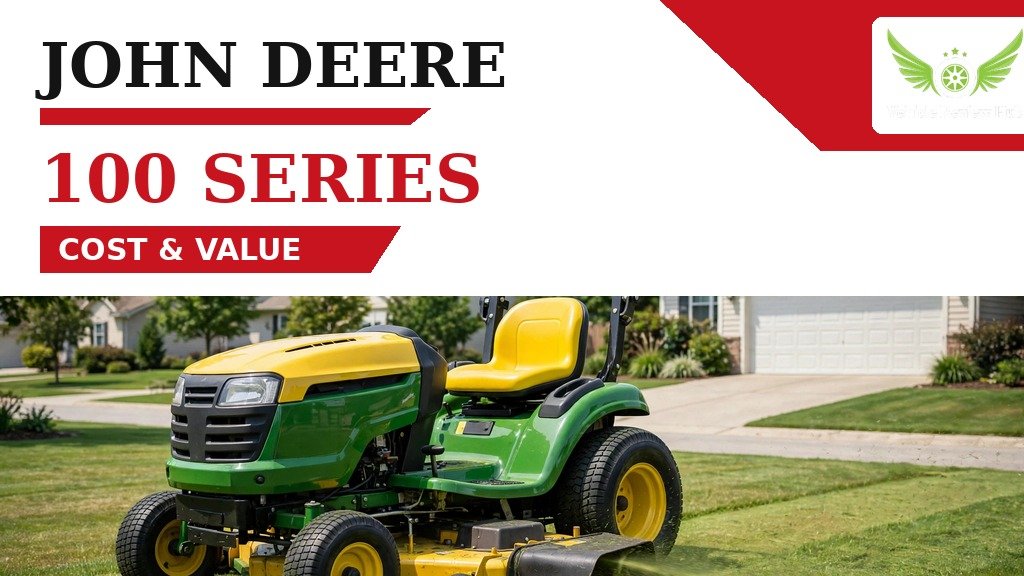
Here is the straight answer: a new John Deere 100 Series lawn tractor costs roughly $2,399 to $3,699 before tax, and the John Deere 100 Series ownership cost over five seasons usually lands between $3,800 and $4,900 all-in for a mid-range S130 or S140 — purchase included, resale subtracted. The mower itself is the big number. Gas, oil, blades, and a battery every few years add just $200 to $360 a year DIY. Where owners get surprised is extras: a bagger, mulch kit, snow blower, and cover can add $600 to $1,500 in year one. This guide covers the full John Deere 100 Series ownership cost picture — fuel, maintenance, accessories, depreciation, and used prices — with prices checked in October 2026.
John Deere 100 Series Total Cost of Ownership
John Deere 100 Series ownership cost breaks into three buckets: day-one price, seasonal running costs, and resale value. For a homeowner mowing half an acre to two acres, the middle bucket is smaller than expected: simple gasoline machines with small tanks and parts any dealer stocks. The purchase price still dominates, so buying the right model — not the biggest one — best keeps John Deere 100 Series ownership cost under control.
Fuel, Routine Maintenance and Seasonal Operating Expenses
Fuel is the smallest line in the John Deere 100 Series ownership cost budget. The S100 carries a 2.4-gallon tank, and a typical homeowner mowing an acre or so burns roughly 20 to 30 gallons a season. At around $3.50 a gallon, that is about $70 to $105 a season — a fill-up costs under $9. The V-twin models drink a little more, but the seasonal difference is tens of dollars, not hundreds. Our 100 Series performance and fuel usage guide breaks consumption down by model.
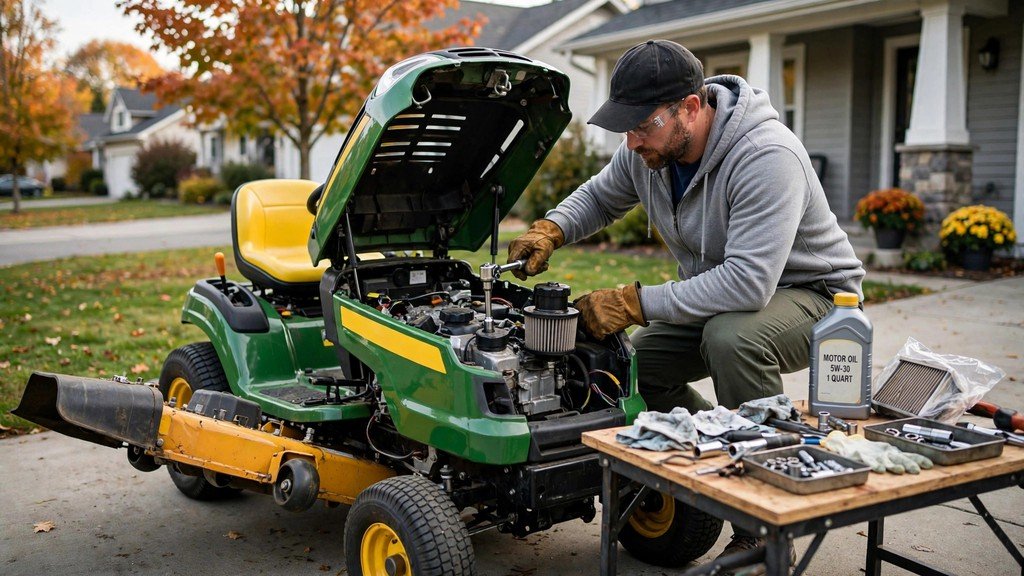
Routine maintenance is the second seasonal line, and DIY pays. A spring oil change on the S100 takes 1.5 quarts with the filter, plus air and fuel filters and a spark plug every season or two. Deere’s home maintenance kit (AUC13706) lists at $74.04 (November 2025 price page). A full dealer tune-up runs $125 to $175 at retail; parts alone cost $30 to $50, per a 2026 small-engine pricing guide. Blade sharpening runs $50 to $70 at a shop; a replacement blade set is $25 to $50 in parts. Allow $90 to $140 a season for routine maintenance DIY, or $175 to $275 if the dealer does it.
Repairs, Replacement Parts and Annual Ownership Budget
After the warranty ends, the John Deere 100 Series ownership cost pattern stays gentle as long as deck and transmission are healthy. The wearing parts are predictable: drive belts ($20 to $45 in parts, $75 to $130 fitted), batteries ($30 to $60 in parts, $65 to $100 fitted, every three to four years), starters ($40 to $80 in parts, $120 to $180 fitted), and carburetor service on machines that sat with stale gas ($85 to $130 fitted). The outlier is hydrostatic transmission work at $250 to $500+, quoted case by case — hence the transmission check when buying used. Annual budget for a mid-range 100 Series mower:
| Annual cost item | DIY owner | Dealer serviced |
|---|---|---|
| Fuel (20–30 gallons) | $70–$105 | $70–$105 |
| Oil, filters, spark plug | $40–$70 | $125–$175 (full tune-up) |
| Blades (sharpen or replace) | $25–$50 | $65–$100 |
| Belt, battery, misc. (amortized) | $40–$75 | $60–$110 |
| Fuel stabilizer, cleaning supplies | $15–$25 | $15–$25 |
| Typical annual total | $190–$325 | $335–$515 |
Over five seasons, the DIY-versus-dealer difference is roughly $700 to $950 — still smaller than the price gap between an S100 and an S180. That is the key lesson of the John Deere 100 Series ownership cost story: the model you choose matters more than the maintenance path. A five-year view for an S130 bought new at $2,799:
| Five-year view (S130 example) | Amount |
|---|---|
| Purchase price (new, before tax) | $2,799 |
| Fuel, five seasons | $400–$550 |
| Routine maintenance, five seasons (DIY) | $450–$700 |
| Repairs and contingency (belt, battery, one surprise) | $300–$600 |
| Less: resale value after five seasons | −$1,400 to −$1,700 |
| Net five-year John Deere 100 Series ownership cost | $2,550–$3,950 |
John Deere 100 Series Accessories and Ownership Expenses
Accessories are where John Deere 100 Series ownership cost quietly grows: a bagger changes leaf handling, a mulch kit removes the stop-and-empty routine, a tow cart turns the mower into a yard hauler, a snow blower turns it into a winter machine. None is required — mow one full season with the standard deck first, then buy only the attachment that solves a problem you actually had.
Baggers, Mulching Kits, Tow Carts and Snow Attachments
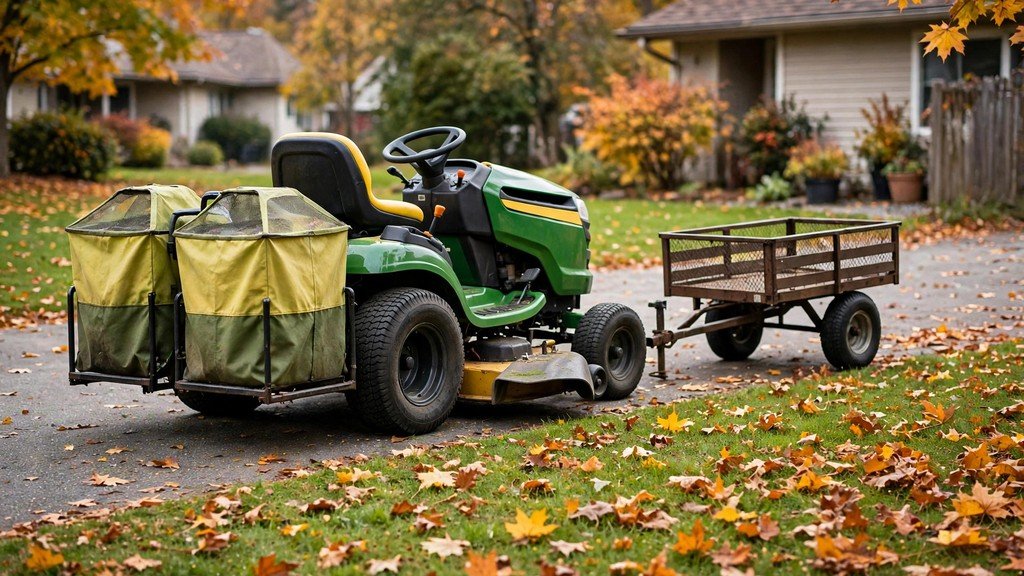
The twin-bag rear bagger is the most popular 100 Series accessory. The 42-inch twin bagger (BG20776) runs roughly $379 to $404 in secondary listings. A mulch kit is cheaper and, for most lawns, the better buy: the 54-inch TriCycler mulch kit (BG20304) lists at $379.86 at GreenPartStore; smaller-deck kits cost less. Mulching returns clippings to the lawn, feeding the grass and ending the emptying routine. Heavy October leaf fall favors the bagger; weekly mowing on an open lawn favors the mulch kit.
Tow-behind tools are the cheapest way to extend the mower’s usefulness. The S100’s 1-pin rear hitch accepts carts, spreaders, and aerators, and a basic poly cart costs far less than any powered attachment. Keep loads modest — these are lawn tractors, not garden tractors, and are not built for ground-engaging work. For winter, the S100 accepts an optional 44-inch front-mount snow blower and a 46-inch front blade. One older listing showed the blower (BM27737) at $1,749 — a dated reference; get a fresh dealer quote. Small accessories add up too: the home maintenance kit ($74.04), bucket holder ($79.99), S100 front bumper ($90.96), and seat cover ($54.99) land near $280 together — which is why accessories deserve their own row in any John Deere 100 Series ownership cost plan.
Storage, Battery Care and Winter Preparation
Storage costs almost nothing and saves more than any other ownership habit. A 100 Series mower lives best in a garage or shed, under a cover if the building is dusty. Deere’s covers list at $103.99 (standard medium) and $157.99 (deluxe) on the November 2025 price page, and $171.99 for a tractor with a collection system. A mower stored outside under a tarp ages faster — faded seat, deck rust, cracked tires — each a resale deduction. Without indoor storage, a cover is the cheapest resale protection you can buy.
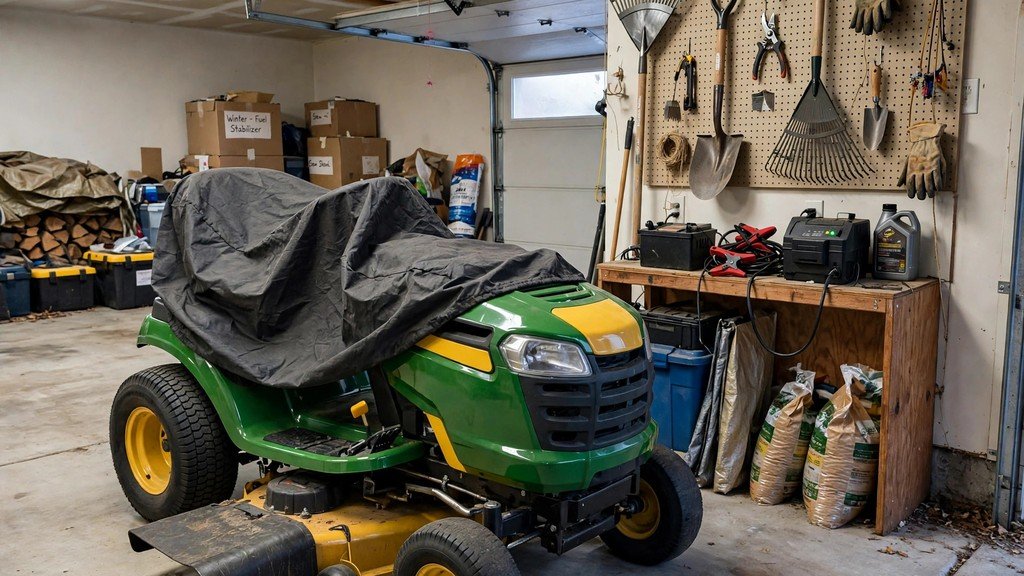
Battery care prevents the spring’s most common frustration. The S100 uses a 12-volt, 300 cold-cranking-amp battery; one left discharged in a cold garage sulfates and dies. Disconnect it or hook up a maintainer, and charge fully before the first mow. A replacement runs $30 to $60 in parts, $65 to $100 fitted, so a $30 maintainer that stretches a battery from three years to five pays for itself at the first prevented dead spring start. Otherwise: add fuel stabilizer and run the engine to circulate it, change the oil before storage, and clean the deck so wet clippings do not sit against steel all winter. A mower that goes into winter clean and stabilized is one you do not pay a shop $85 to $130 to revive in spring, which keeps John Deere 100 Series ownership cost down year after year.
John Deere 100 Series Depreciation and Resale Value
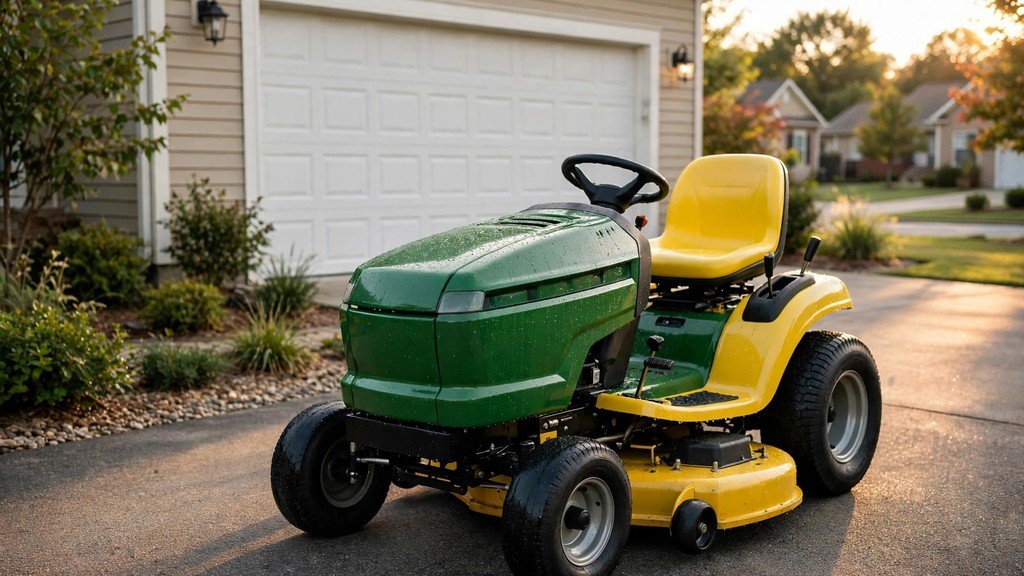
Depreciation is the part of John Deere 100 Series ownership cost owners feel only once — at sale time — and it is kinder than the car world trains you to expect. A clean, low-hour 100 Series mower holds value well, because every suburb has homeowners who want a Deere but do not want to pay new prices. Expect the steepest drop in the first year or two, roughly 20 to 30 percent for a clean machine, then about 5 to 10 percent a year. A clean five-year-old S130 that sold new for $2,799 can still bring $1,400 to $1,700 private-party.
How Model, Age, Hours and Mower Deck Condition Affect Price
Four things set a used 100 Series price, and they are not equal. Hours matter more than age: a three-year-old mower with 80 hours beats a two-year-old one with 250 hours, because hours are the honest odometer. Model matters next — mid-range V-twins (S130, S140) hold value best, because most buyers want them. Deck condition is the swing factor owners underestimate: a straight, rust-free deck with no welded patches can be worth $200 to $300 more than a bent or rusted one. Age matters least, as long as the mower looks and runs like its hours suggest.
A used 2026 S180 was listed at $3,799 through a Florida dealer on Equipment Trader after 120+ days — basically new money. At the other end, a nearly new S140 with just 3.2 hours went to auction in Georgia in January 2026 with bidding at $1,230 — a bid, not a sale price, but proof that even a nearly new machine can trade far below list. Between those extremes, realistic private-party planning bands for October 2026 (estimates, not comps):
| Used model (typical condition) | Planning band, Oct 2026 | Notes |
|---|---|---|
| S100, 3–6 years, 200+ hours | $900–$1,500 | Most common; condition varies |
| S130 / S140, 2–4 years, low–mid hours | $1,200–$2,000 | Strongest demand |
| S170 / S180, recent, low hours | $1,800–$2,800 | Check new pricing first |
| General used Deere rider range | $1,500–$4,000 | Secondary guide range |
Private Sale, Dealer Trade-In and Used-Mower Preparation
Private sale almost always beats trade-in by roughly 15 to 25 percent, because a dealer must recondition and retail the machine. For a clean machine, a private listing with good photos and an honest hour reading is worth the effort — the difference on an S140 can be $300+. Preparation is cheap and pays directly: wash the mower, clean under the deck, sharpen blades, inflate tires to book pressures (S100: 14 psi front, 10 psi rear), charge the battery, and photograph the hour meter, deck underside, and engine. Keep manual and receipts together — buyers pay for evidence. Our 100 Series maintenance and problems guide covers the jobs that matter most to a buyer — and a maintained mower costs less to run and sells for more, which is the heart of the John Deere 100 Series ownership cost story.
Buying a Used John Deere 100 Series Lawn Tractor
Buying used is where John Deere 100 Series ownership cost gets interesting: the spread between a smart buy and a careless one can be $500+ on the same model. The used market is deep — dealers, Marketplace, Craigslist, auctions, listing sites — and these machines are simple enough to judge in twenty minutes.
Choosing Between the S100, S130, S140, S170 and S180
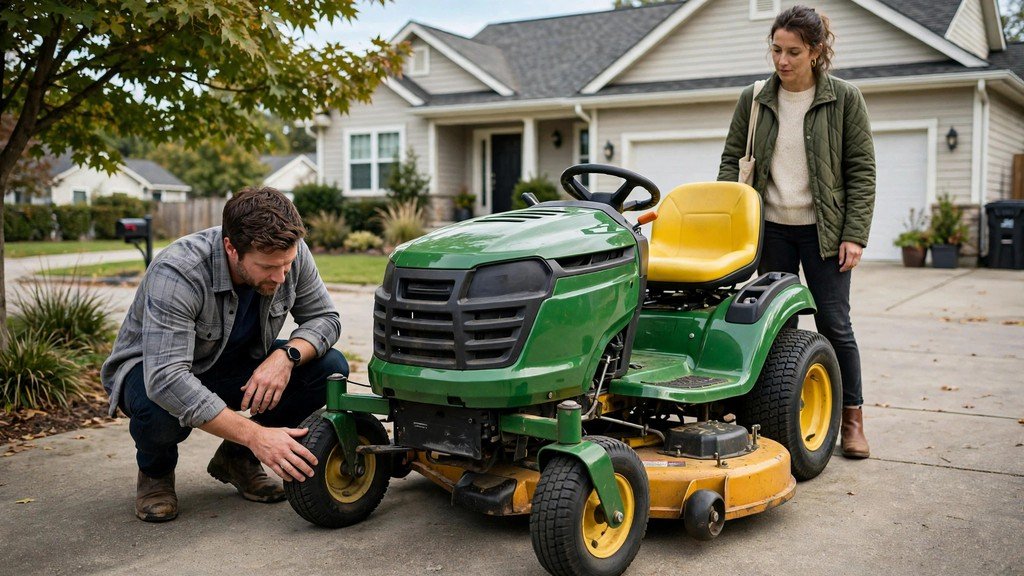
The five models form a simple ladder: more money buys a smoother V-twin, a wider deck, and heavier running gear. The S100 is the budget pick — a 17.5-horsepower single-cylinder with a 42-inch deck, best for flat lots up to ~1.5 acres. The S130 is the sweet spot: a 22-horsepower V-twin, 42-inch deck, electric PTO, and cruise control, under $2,800 new. The S140 keeps the V-twin and steps up to a 48-inch deck for lots over an acre. The S170 and S180 share a 24-horsepower V-twin ELS engine and heavy-duty hydrostatic transmission, with 48-inch and 54-inch decks. Our 100 Series review covers every model in detail. New prices checked in October 2026, with used bands from the previous section:
| Model | Engine / deck | New price, Oct 2026 | Used planning band |
|---|---|---|---|
| S100 | 17.5 hp single, 42 in. | $2,399 street / $2,499 list | $900–$1,500 |
| S130 | 22 hp V-twin, 42 in. | $2,799 | $1,200–$2,000 |
| S140 | 22 hp V-twin, 48 in. | $2,799 | $1,200–$2,000 |
| S170 | 24 hp V-twin ELS, 48 in. | $3,299 dealer / $3,399 list | $1,800–$2,800 |
| S180 | 24 hp V-twin ELS, 54 in. | $3,599 street / $3,699 list | $1,800–$2,800 |
Two notes. First, street and Deere list prices differ by about $100 on the models checked — Deere’s November 2025 page lists the S100 at $2,499 and the S180 at $3,699 before a $100 destination charge, while dealer and comparison listings show $2,399 and $3,599 — so compare out-the-door figures. Second, the wider retail range also includes the S110 (19 hp, 42 in.) between the S100 and S120. Before shopping, the dealer walkaround below is worth a few minutes:
The video below is a dealer walkaround and review of the 2023 S130 from Western Equipment. Not a used-buying guide, but it shows deck, controls, and size better than any spec sheet.
Inspection Checklist, Price Negotiation and Alternatives
Inspect in this order: cold start, deck, transmission, tires, paperwork. A cold start tells the truth about battery, starter, and carburetor — a warm mower may hide a hard start, so ask the seller not to run it beforehand. Look under the deck for rust-through, cracks, and bent blades, and spin the blades by hand to feel for rough bearings. Drive it on grass: the transmission should move smoothly from a stop with the side-by-side pedals, without jerking, whining, or fading on a slope. Check tires, look for leaks, read the hour meter, and ask for the manual and service records.
Negotiation follows the inspection, not the asking price. Start from the planning bands, deduct for a rusted deck, weak battery, worn tires, or missing parts, and pay top-of-band only for a clean machine with records and fresh service. Offer in person after a test drive, and bring a trailer or ramps — deals stall on transport more often than price. If the transmission fails or the deck is rusted through, walk away; enough clean 100 Series mowers are available. Alternatives include the Cub Cadet XT1 and XT2, the Husqvarna TS series, and, for wide-open lots, a residential zero-turn such as the Toro TimeCutter — but none matches the 100 Series for dealer support and resale depth, which is why John Deere 100 Series ownership cost holds up so well over five years.
John Deere 100 Series Ownership Cost FAQs
The questions buyers and owners ask most about John Deere 100 Series ownership cost — annual costs, five-year totals, resale, warranties, used buying checks — answered directly.
How much does it cost to own a John Deere 100 Series mower per year?
For a mid-range S130 or S140, John Deere 100 Series ownership cost runs roughly $190 to $325 a year DIY, or $335 to $515 dealer-serviced — fuel, oil and filters, blades, and an amortized share of belts and batteries. That figure is the running half of John Deere 100 Series ownership cost; the purchase price is the other half.
What is the total John Deere 100 Series ownership cost over five years?
For an S130 bought new at $2,799, net five-year John Deere 100 Series ownership cost — purchase plus five seasons of fuel, maintenance, and repairs, minus resale — lands around $2,550 to $3,950, roughly $500 to $800 a year. Resale value is what keeps John Deere 100 Series ownership cost in that range; a neglected mower sells for far less.
How much does a new John Deere 100 Series mower cost in 2026?
Street prices checked in October 2026 run $2,399 (S100) to $3,599 (S180); Deere’s November 2025 list prices run about $100 higher ($2,499 S100, $3,699 S180, before a $100 destination charge). S130/S140 sit at $2,799; S170 lists at $3,399, dealer pricing around $3,299. That $100 gap is a small but real part of John Deere 100 Series ownership cost — always compare out-the-door figures.
What is the warranty on a John Deere 100 Series mower?
Every model carries a 2-year / 120-hour bumper-to-bumper warranty, whichever comes first. Most homeowners hit two years before 120 hours, so John Deere 100 Series ownership cost rises from year three, when repairs come out of pocket. That cliff is where John Deere 100 Series ownership cost stops being just fuel and filters.
How much is a used John Deere 100 Series mower worth?
October 2026 planning bands: older S100s with 200+ hours, $900–$1,500; clean S130/S140 with low–mid hours, $1,200–$2,000; recent low-hour S170/S180, $1,800–$2,800. Always check current local listings — deck condition and hours matter more than model year. These bands are the starting point for judging John Deere 100 Series ownership cost used.
Do John Deere 100 Series mowers hold their value?
Yes, better than most riding mowers: a 20–30 percent drop in year one or two, then about 5–10 percent a year for a clean machine. Strong resale is the main reason John Deere 100 Series ownership cost stays low over five years, and private sale beats trade-in by 15–25 percent. Mid-range V-twins hold value best, which is why John Deere 100 Series ownership cost is lowest on the S130 and S140.
What should I check before buying a used 100 Series mower?
Start it cold, inspect under the deck for rust and bent blades, test the transmission on grass, check tires and leaks, and read the hour meter. A failed transmission or rusted-through deck should end the deal — one such repair can double John Deere 100 Series ownership cost in one shop visit.
Is it better to buy a used S130 or a new S100?
For most buyers, a clean used S130: you get the V-twin, electric PTO, and cruise control for roughly new-S100 money, with stronger resale. Buy the new S100 only for the full warranty and lowest price on a flat lot under an acre and a half. On balance, John Deere 100 Series ownership cost favors the clean used S130.
How much do 100 Series accessories add to ownership cost?
Common first-year accessories run $600–$1,500: a bagger around $379–$404, a mulch kit around $380 for a 54-inch deck, a cover at $104–$172, plus a seat cover ($54.99) and bumper ($90.96). A snow blower is the big-ticket item — get a fresh quote. Buy the mower first, mow a season, then spend: that discipline alone can cut first-year John Deere 100 Series ownership cost by hundreds.