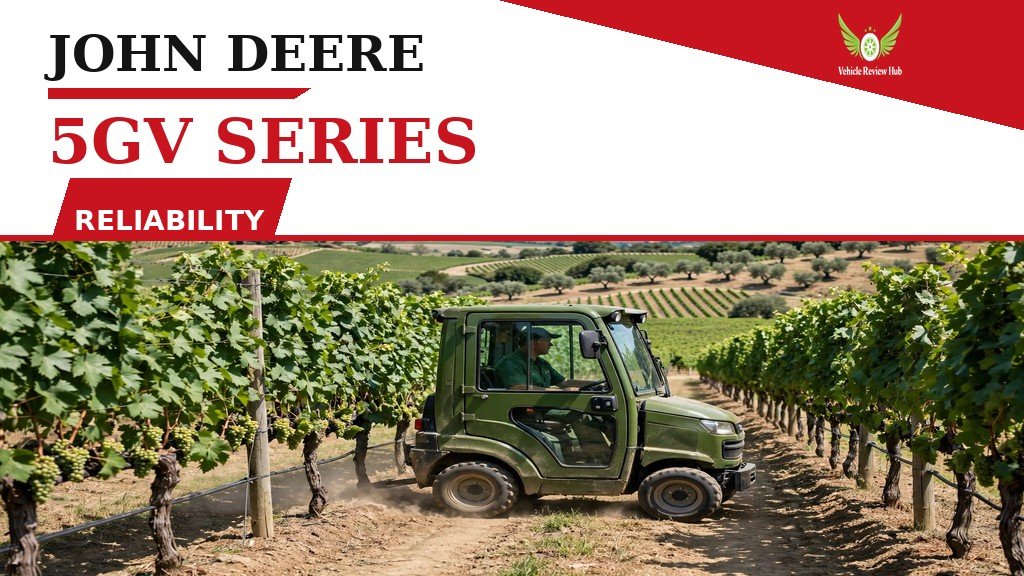
The short answer is that a John Deere 5GV Series tractor is a low-drama machine to own, as long as you respect its service schedule. The 5075GV and 5090GV are small, narrow vineyard tractors built around a 3.4-litre Final Tier 4 diesel, and most expensive problems trace back to skipped filter changes, dusty cooling packs, or ignored exhaust-filter warnings. Good John Deere 5GV Series maintenance is mostly routine work: oil and filters on time, clean air and cab filters, fresh transmission and hydraulic oil at set intervals, and a careful look at the front axle, steering, and tyres.
This guide covers the service schedule, costs, reliability, common problems, and a used-tractor inspection checklist. Figures come from dealer pages and Deere 5G service tables; model-year differences are flagged, not smoothed over.
John Deere 5GV Series Maintenance Schedule and Service Costs
The 5GV rewards owners who treat the hour meter as a calendar. Vineyard work is dusty, stop-start, and seasonal — exactly the use that punishes late oil changes and clogged filters. The schedule below is the backbone of John Deere 5GV Series maintenance.
Engine Oil, Filters, Cooling System and Routine Service
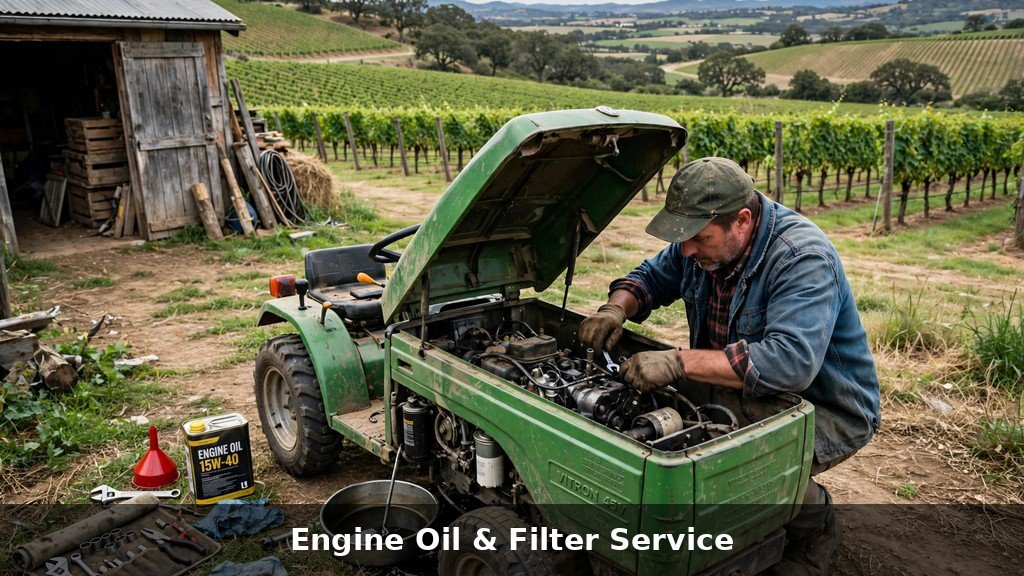
John Deere 5GV Series maintenance starts with the daily walk-around, and Deere made that easy: engine oil, hydraulic oil, coolant, and the fuel water separator are within reach without tools, and the one-piece hood opens on a single-point latch.
Engine oil and filter are due annually or every 750 hours, whichever comes first, under the current 5G service table. Transmission and hydraulic filters follow the same 750-hour rhythm, or sooner on a yellow caution-light filter message. One honest conflict: some earlier 5G manuals list a 500-hour engine-oil and fuel-filter interval instead of 750 hours. If your manual says 500, follow 500 — your manual always wins.
The cooling system deserves special attention on a vineyard tractor. Leaves, vine debris, and dust pack into the radiator screen and cooling fins, and a partly blocked cooling pack is the most common cause of a 5GV running hot in summer. Clean the screen as required and keep the viscous fan and its bimetallic spring clean. The aftertreatment needs respect: the diesel particulate filter is a dealer-replacement item triggered by the exhaust-filter indicator, the DEF screen should be cleaned as required, and full DEF service falls due at 4,500 hours.
The video below walks through an engine oil and filter change on a John Deere compact utility tractor — a useful visual companion to John Deere 5GV Series maintenance, matching the 5GV’s annual service.
| Service item | Interval | Notes |
|---|---|---|
| Daily checks: engine oil, hydraulic oil, coolant, water separator | Before work | Tool-free |
| Engine oil and filter | Annually or every 750 hours | Some earlier manuals say 500 hours |
| Transmission and hydraulic oil filters | Every 750 hours or on caution light | Or sooner on warning |
| Primary engine air filter | Every 1,500 hours | Clean as required |
| Cab air and recirculation filters | Every 1,500 hours or 2 years | Spraying safety |
| Coolant, drive belt, hoses, seat belt | Annually | Test strips annually |
| DEF system service (dealer) | Every 4,500 hours | Tank, dosing-unit filter, suction screen |
| Wheel bolt torques after a wheel change | After 4 and 8 hours, then to 100 hours | Wheel disks, rims, and weights |
Transmission, Hydraulic Oil, Front Axle and Lubrication
Transmission and hydraulic care sits at the centre of John Deere 5GV Series maintenance, because both systems share one oil supply. Dirty oil hurts shifting and implement response at the same time, so check the level daily and top up only with the grade your manual specifies.
Front-axle care is where vineyard tractors differ: every 5GV is four-wheel drive, so the front axle, pivot pins, and steering spindles carry real load in tight turns. Lubricate grease points on schedule, check front-axle oil level, and re-grease after pressure washing, which strips grease from pins and joints. Note the PowrReverser safety: after each start, press the clutch pedal once before the transmission will operate, and the reverser must be in neutral to start. If a 5GV refuses to move after starting, that override — not a fault — is the first check.
Service costs for a small tractor like this are modest next to row-crop machines, but dealer labour is the swing factor. The estimates below are planning figures for the United States, not quotes.
| Service job | Estimated cost (USA, planning figure) | What it covers |
|---|---|---|
| Annual routine service | $350–$650 | Oil and filter, checks, greasing, inspections |
| Transmission/hydraulic service | $600–$1,100 | Oil, filters, screen, leak checks |
| Air and cab filter set | $150–$350 | Air and cab filters |
| DPF replacement (dealer only) | Varies widely — get a dealer quote | Most expensive routine aftertreatment job |
Owners who do their own oil, filters, and greasing can cut the annual bill roughly in half, keeping only DPF work, DEF service, and Service ADVISOR diagnostics on the shop invoice. That split is the practical core of affordable John Deere 5GV Series maintenance: owner labour for the routine, dealer expertise for the emissions and electronics.
John Deere 5GV Series Reliability and Long-Term Durability
The 5GV has a reputation as a durable specialty tractor. It is heavy for its size — 5,577 lb open-station, 6,051 lb with a cab — and that weight keeps implements in the ground. Nothing about the platform is exotic: a proven four-cylinder diesel, simple reverser transmissions, and a straightforward hydraulic system any Deere dealer can support — part of the long-term payoff of steady John Deere 5GV Series maintenance.
Engine, Transmission, PTO and Hydraulic System
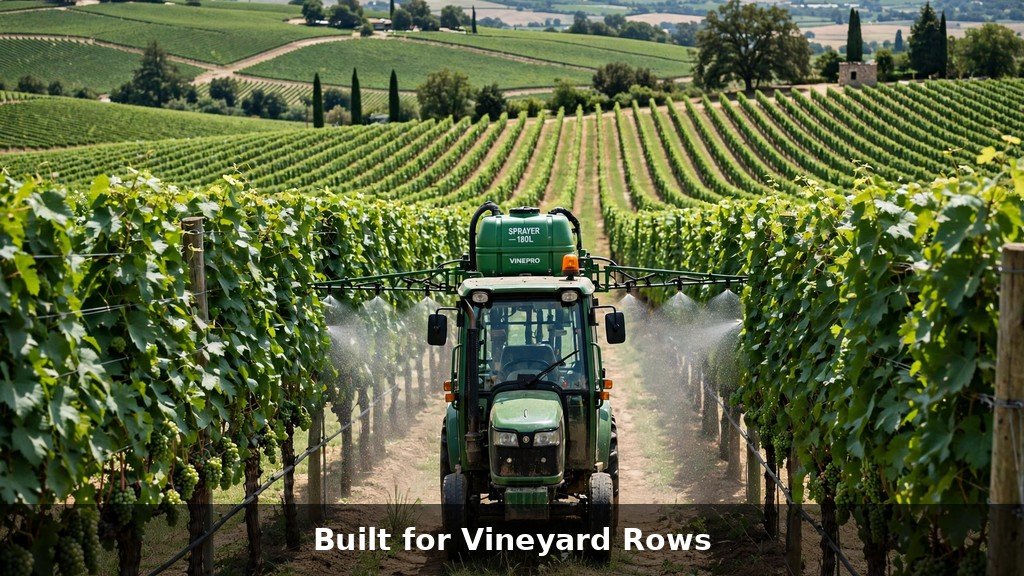
Both 5GV models use the same FPT Industrial four-cylinder 3.4-litre (207.5 cu in) Final Tier 4 diesel: 75 hp with 61 hp at the PTO for the 5075GV, 90 hp with 76 hp at the PTO for the 5090GV. The compact engine fits inside the narrow 42.8-inch working width that lets the 5GV pass between rows where the wider 5GN, with its 50.2-inch cab, cannot. The 90 hp model offers Intelligent Power Management, and every 5G gets Economy PTO as standard, cutting rpm about 15 percent for lighter PTO jobs.
The 12F/12R SyncReverser suits simple mechanical shifting, while the 24F/12R PowrReverser adds clutch-free direction changes, electrohydraulic Hi-Lo, and a creeper range for slow spraying passes, with transport speeds up to 24.9 mph. The PTO is an independent live 540/540E shaft, the hitch lifts 5,710 lb at the ball ends, and Category 1 and 1N implements fit directly. Hydraulics deliver 7.9 gpm for steering and transmission, 17.6 gpm for valves and hitch, and 33.4 gpm in total with the optional third pump — and the separate steering supply means headland turns do not steal oil from the implement.
None of that durability is automatic. The aftertreatment — the diesel particulate filter and the DEF system — is where neglect turns into a large bill, and vineyard duty cycles are hardest on it: short runs and low loads interrupt the regeneration the filter needs. A 5GV that gets regular sustained work will look after its filter far better than one that only putters between sheds. That is why John Deere 5GV Series maintenance pays close attention to aftertreatment, a lesson repeated in the maintenance schedules for the 9620RX and 9RX 590, even though those are vastly bigger machines.
Factors Affecting Service Life, Downtime and Repair Costs
Three things decide whether a 5GV is cheap or expensive to keep. First, dust and debris: vineyards are dusty in summer and leafy at harvest, so filters and screens load up faster than the hour meter suggests. Second, seasonality: a tractor that sits for months needs storage preparation, or the first week of the season becomes a repair week. Third, who does the work: Deere’s base warranty is 24 months or 2,000 hours, and warranty repairs must go through a dealer, so dealer records during the warranty period protect coverage and resale value. Keeping those records is part of warranty-safe John Deere 5GV Series maintenance.
Downtime on a vineyard tractor is seasonal: a spray window lost to a breakdown cannot be recovered, because disease pressure does not wait for parts. That is why the most valuable habit in John Deere 5GV Series maintenance is pre-season preparation — a full service, a cooling-pack clean, a hydraulic leak check, and a test of every warning light and the PTO before the first pass. Spare filters and correct oils on the shelf turn a mid-season service into an evening job.
John Deere 5GV Series Common Problems and Warning Signs
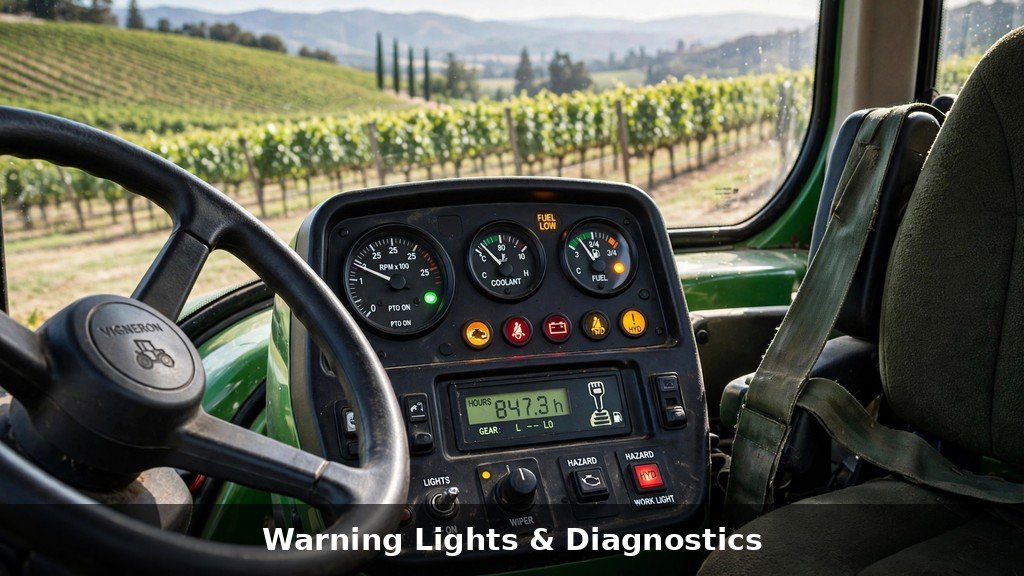
No tractor is problem-free, and the 5GV’s watch-items are mostly the ordinary weaknesses of a small Final Tier 4 diesel in dusty, tight conditions. Most announce themselves early through warning lights, gauges, or behaviour changes. This section is a symptom guide, not a fault-code manual: for any active derate, use the dealer diagnostic system, and catching these signs early is exactly what John Deere 5GV Series maintenance is for.
Engine, Electrical, Hydraulic and Transmission Symptoms
Engine trouble is where John Deere 5GV Series maintenance earns its keep, and it usually starts with the aftertreatment. A heavily loaded diesel particulate filter shows up as an exhaust-filter indicator, a parked-regeneration request, and eventually derate if regeneration keeps being interrupted. Short, low-load running is the usual cause; let a requested regeneration complete and give regular sustained work. Contaminated DEF, a dirty filler-neck screen, or a failing dosing component will bring DEF warnings and can push the engine toward derate — never top up DEF from an open container, and never ignore a DEF warning through a spray week.
Other engine symptoms have simpler causes. Hard starting or rough running points first at fuel: a clogged filter, water in the separator, or air in the system after a filter change. Overheating points at the cooling pack — blocked screens, a dirty viscous fan spring, or low coolant — before anything internal. Black smoke under load with falling power suggests a restricted air filter or intake. On the electrical side, check the battery, grounds, and fuses first — seasonal machines suffer drain and corrosion before sensor faults. A tractor that will not start with the reverser out of neutral, or will not move until the clutch pedal has been pressed once after starting, is behaving exactly as designed — those are the neutral-start and engagement-override safeties, not faults.
Hydraulic symptoms are usually oil problems in disguise. A slow or jerky hitch, weak SCV response, or noisy operation points at low oil level, contaminated oil, or a filter due for change — the yellow caution light is the tractor asking for the 750-hour service. Fix leaks at couplers and hoses promptly. Transmission symptoms follow the same logic: harsh PowrReverser shifts or Hi-Lo that will not engage usually trace to oil condition, a filter, or a control issue, and the dealer’s diagnostic system reads fault codes directly. That is the kind of detail John Deere 5GV Series maintenance checklists exist to catch before it becomes a bill.
| Symptom | Likely cause | First action |
|---|---|---|
| Exhaust-filter light, regen request, power loss | DPF soot load from short, low-load running | Complete regeneration; sustained work |
| DEF warning or derate | Contaminated DEF, dirty screen, dosing fault | Check DEF and screen; dealer diagnosis |
| Running hot | Blocked screen, dirty viscous fan | Clean cooling pack; check coolant |
| Hard starting, rough running | Fuel filter, water, air in system | Drain separator, check filters, vent |
| Slow hitch or weak SCV | Low or dirty oil, overdue filter | Check level, condition; 750-hour filters |
| Battery flat after storage | Seasonal drain, corroded grounds | Charge and clean connections |
Steering, Front Axle, Brakes and Implement Connection Checks
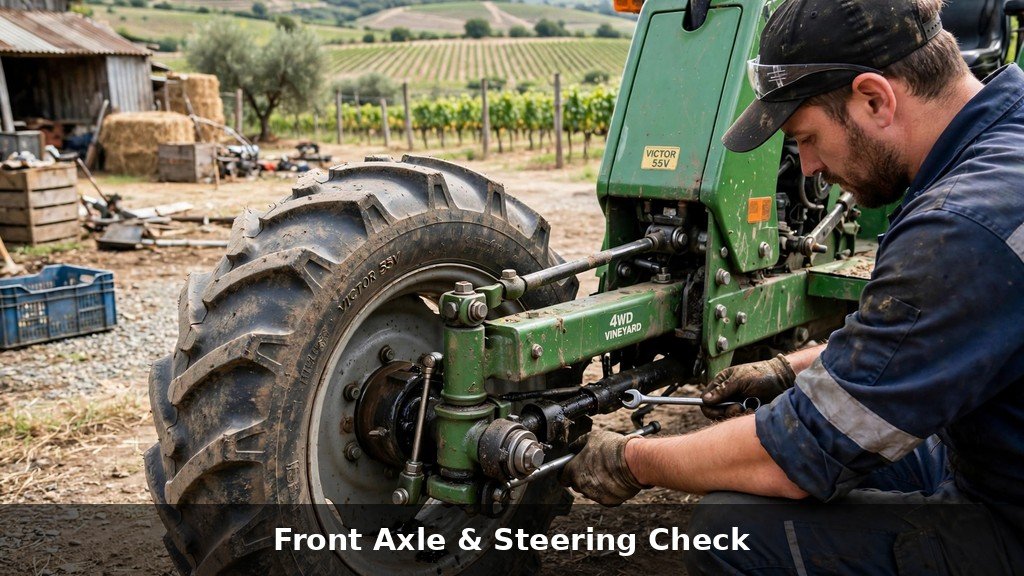
Front-end checks belong on every John Deere 5GV Series maintenance list, because the front end takes the hardest wear on a narrow tractor. Tight turns load the steering spindles, pivot pins, and MFWD components, and narrow tyres run close to posts and wires that cut sidewalls. Check steering play, grease spindles and pins, watch for front-axle oil leaks, and inspect tyre sidewalls at every service — a sidewall cut on a narrow vineyard tyre is a blowout waiting for a headland turn.
Check brake pedal free play on schedule and test the park brake before slope work. Check hitch wear at the ball ends and lift rod, lubricate the PTO stub shaft support, and confirm Category 1 or 1N implements sit correctly rather than assuming Category 2 gear will fit. Keep dust caps on mid-mount couplers when disconnected; one grain of grit can score a valve. Finally, cab care is part of John Deere 5GV Series maintenance too: check door seals, cab filters, and optional Category 4 filtration, because a leaking cab is not protecting the operator.
John Deere 5GV Series Used-Tractor Inspection
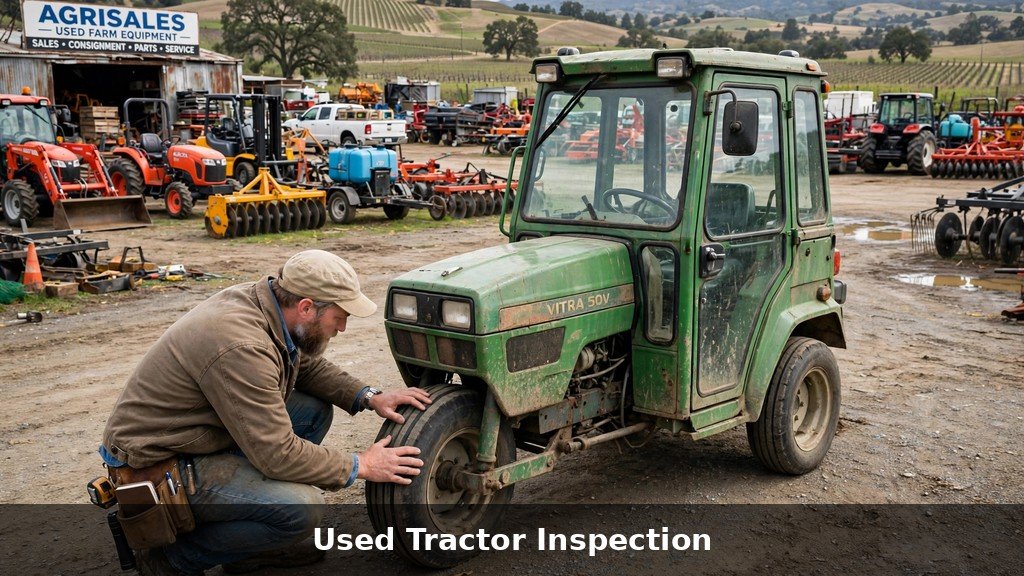
Buying a used 5GV is usually sound — simple, well-supported tractors — but inspection must match the machine’s life. A low-hour machine with skipped filter changes can be worse than a higher-hour one with full history. A used buyer’s version of John Deere 5GV Series maintenance starts with paperwork, not paintwork.
Checking Service Records, Hours and Applicable Recalls
Start with the paperwork. A full service history — dealer invoices showing oil, filter, and DEF/DPF work — beats a polished paint job, and gaps around the 750-hour and 1,500-hour services are a negotiating point. Compare the hour meter against the records: a mismatch is a walk-away signal. Check the serial number with a dealer for open recalls and exact specification. Service records are the proof that John Deere 5GV Series maintenance actually happened.
Recent listings: a 2023 5075GN at $58,999 with 29 hours in Oregon, a 2019 5090GV at CAD $57,600 with 923 hours in Nova Scotia, and a $61,792 new base on Deere’s August 2022 list. Low-hour cab PowrReverser machines with full histories command strong money, and that premium follows documented John Deere 5GV Series maintenance. The 9RX 590 ownership guide covers the record-checking habit in more depth.
Inspecting Tyres, Narrow-Row Clearance and Safety Equipment
Check tread depth, sidewall cuts from posts and wires, and mismatched sizes across the axle, and confirm the rear tyre width still gives the narrow working width the vineyard needs — oversized tyres may no longer fit its rows. Measure overall width against row spacing; the 42.8-inch minimum working width is why most buyers choose a 5GV. Tyre and width checks complete the John Deere 5GV Series maintenance picture for buyers.
Then check safety equipment: ROPS or cab structure, seat belt, lights, SMV emblem, cab seals and filters. Test-drive cold: watch for excess smoke, engage the PTO, work hitch and SCVs through full stroke, shift reverser and Hi-Lo both ways, and drive a tight turn for steering play or front-axle noise. Any warning light or derate on the test drive is a John Deere 5GV Series maintenance item for the dealer to diagnose before money changes hands. For the wider story, see the 5GV review, the 5GV performance guide, and the 5GV ownership-cost guide.
John Deere 5GV Series Maintenance FAQs
Direct answers to the questions owners ask most about John Deere 5GV Series maintenance.
How often should the engine oil be changed on a John Deere 5GV?
Annually or every 750 hours, whichever comes first. Some earlier manuals say 500 hours — follow yours. That on-time change is the core of John Deere 5GV Series maintenance for the engine.
What is the transmission and hydraulic service interval on the 5GV?
Filters every 750 hours, or sooner on a caution-light message. Oil itself is a longer-interval change; check the level daily. Clean oil is central to John Deere 5GV Series maintenance for shifting and response.
How do I know if the DPF needs attention on a 5GV?
The exhaust-filter indicator and a display warning will tell you, and the tractor may request a parked regeneration. Let it complete and give sustained work. Consistent John Deere 5GV Series maintenance is what keeps the DPF healthy.
Does the 5GV use DEF, and what DEF service does it need?
Yes. Clean the filler-neck screen as required, use only good-quality DEF from sealed containers, and have the dealer do full DEF service at 4,500 hours. DEF care is a fixed part of John Deere 5GV Series maintenance.
Why won’t my 5GV move right after starting?
Usually the engagement-override safety, not a fault. Press the clutch pedal once after each start, and keep the reverser in neutral to start. Check both before calling the dealer.
How often should cab filters be changed on a cab 5GV?
Cab air and recirculation filters every 1,500 hours or two years; activated-carbon follows its own schedule. Good John Deere 5GV Series maintenance treats the cab as safety equipment on a spraying tractor.
What are the most common problems on the John Deere 5GV?
DPF soot load from short, low-load running, DEF warnings from contaminated fluid, overheating from blocked cooling packs, hydraulic sluggishness from overdue filters, battery drain after storage, and tyre sidewall cuts. All are cheaper caught early — the reason John Deere 5GV Series maintenance matters more than any single repair.
What should I check when buying a used 5GV?
Service records first, then hours against those records, then the serial number with a dealer for recalls and specification. On the machine, check tyres and width, cab or ROPS, seat belt, lights, PTO and hitch, reverser and Hi-Lo, steering play, and test-drive warning lights. A full John Deere 5GV Series maintenance history is worth more than a polish.
What is the difference between the 5075GV and 5090GV for maintenance?
Very little. Both share the same 3.4-litre platform, transmissions, hydraulics, and intervals; the 5090GV simply makes more power — 90 hp and 76 hp at the PTO against 75 hp and 61 hp. John Deere 5GV Series maintenance does not change between the two models.
Done on time, John Deere 5GV Series maintenance keeps a 5GV earning season after season. External references: United Ag & Turf, the Deere 5G service tables, the Papé listing, the TriGreen page, and the Tidal listing.