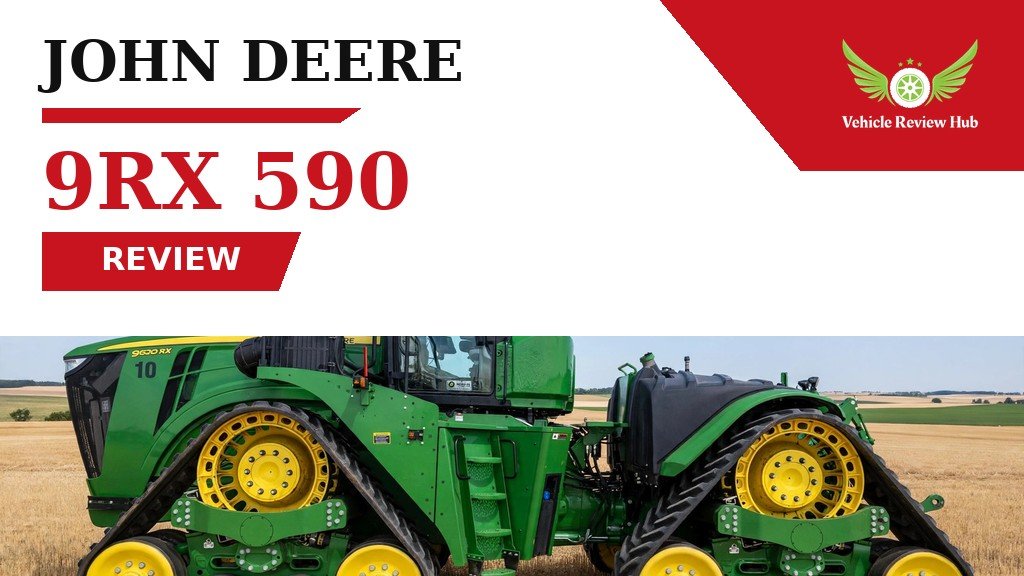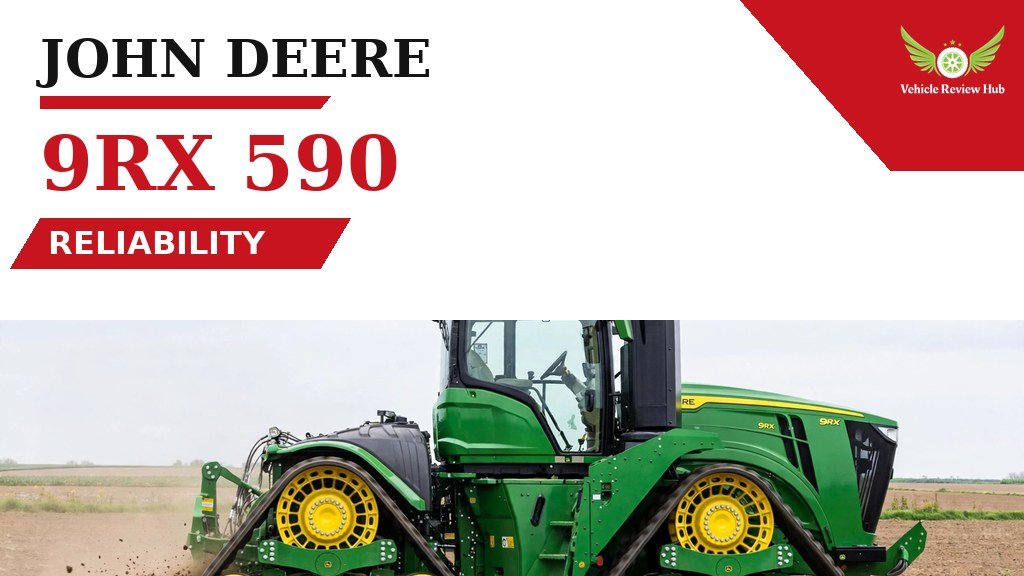
John Deere 9RX 590 maintenance is the difference between a 590-horsepower four-track flagship that earns for another decade and one that eats its purchase price in track and repair bills. The 9RX 590 is Deere’s newer-generation four-track tractor — a JD14-powered machine built for the biggest tillage, seeding, and scraper work — and this guide covers the full John Deere 9RX 590 maintenance schedule, service costs, long-term reliability, common problems, and how to inspect a used machine before money changes hands.
Short version of John Deere 9RX 590 maintenance: engine oil and filters every 500 hours, transmission and hydraulic oil every 1,500 hours, coolant at 6,000 hours, daily track inspection. Tracks are the big-ticket item — a full set can cost more than a good used row-crop tractor — so track discipline matters most here.
John Deere 9RX 590 Maintenance Schedule and Service Costs
The John Deere 9RX 590 maintenance schedule follows the rest of Deere’s 9 family: short daily checks, a 500-hour engine service, a 1,500-hour transmission and hydraulic service, and a 6,000-hour coolant service. Because used 9RX 590 tractors now carry anywhere from under 400 to over 1,400 hours, the schedule below is written for the used buyer.
Engine Oil, Filters, Cooling System and Routine Service
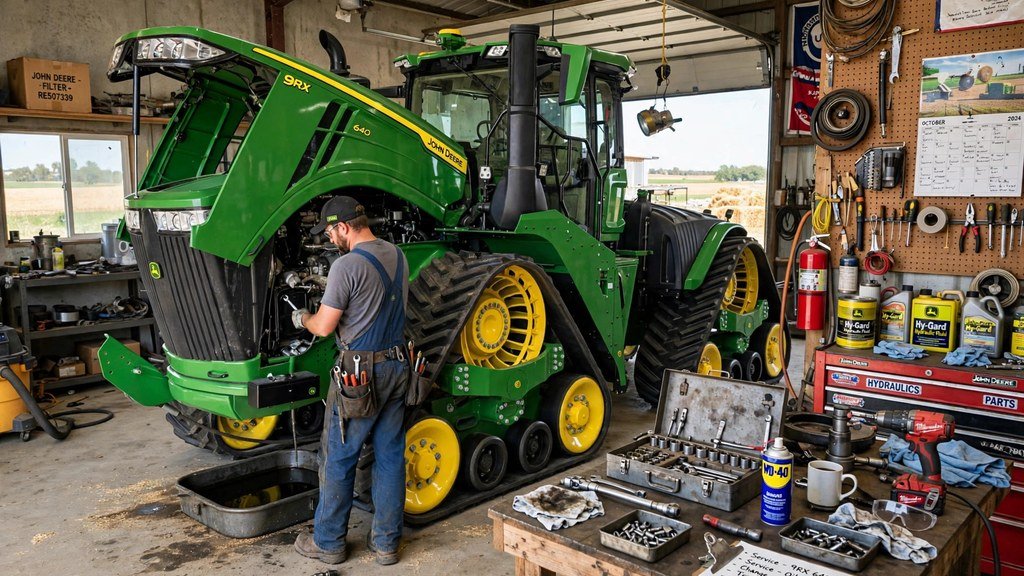
John Deere 9RX 590 maintenance starts with engine oil and filter service every 500 hours when using John Deere Plus-50 II oil; with other CJ-4 oils the interval drops to 250 hours, which is why most owners stick with the factory oil. Change both fuel filters at the same 500-hour visit and drain the water separator daily — the JD14’s high-pressure fuel system does not forgive dirty diesel or water. A dealer 500-hour service typically runs $1,800–$3,000 (estimate); doing it yourself with factory filters and oil lands around $700–$1,200 (estimate). Inspect the dual-stage air filter annually, far more often in dusty conditions — a restricted filter costs power and fuel before it triggers a warning. The cooling system runs a 6,000-hour drain interval — check coolant level and radiator core daily in harvest dust, since a plugged core is the most common cause of load-related overheating. If you are comparing service demands across the range, our 9RX 590 review and specs guide lays out the full specification, and the 9RX 590 performance and fuel usage guide covers what the engine drinks under load.
Transmission, Hydraulic Oil, Tracks and Lubrication
In the John Deere 9RX 590 maintenance schedule, transmission and hydraulic oil plus filters go every 1,500 hours — a dealer visit typically costing $3,000–$5,000 (estimate) given oil volume: 58 gallons without a hitch and PTO, 60 with them. Grease on schedule, not on memory: hinge pins and track hardware at 50 hours, brakes, neutral-start, park brake, and driveshafts at 250 hours. Tracks get a daily walk-around — tension, guide lugs, tread bars, cuts, debris packed between belt and wheels — because catching a failing belt early is worth thousands. The table below summarizes the schedule and the typical costs.
| Service item | Interval | Typical cost (est.) |
|---|---|---|
| Daily checks (fluids, tracks, leaks, belts, hoses) | Daily / 10 hours | Operator time only |
| Engine oil + filter (Plus-50 II) | 500 hours | $1,800–$3,000 dealer / $700–$1,200 DIY |
| Fuel filters + water separator | 500 hours | Included in 500-hour service |
| Track + hinge-pin service | 50 hours | Shop time + grease |
| Brakes, neutral start, park, driveshafts | 250 hours | Inspection labor |
| Transmission + hydraulic oil + filter | 1,500 hours | $3,000–$5,000 dealer (est.) |
| Coolant drain | 6,000 hours | Dealer service (est.) |
| Replacement track belt (each, installed) | As needed | $10,000–$15,000+ per belt (est.) |
John Deere 9RX 590 Reliability and Long-Term Durability
The record on John Deere 9RX 590 maintenance is strong where it counts — engine, transmission, and frame — and expensive exactly where you would expect on a four-track machine: the undercarriage. Built for the heaviest draft work, well-kept examples routinely pass 5,000 hours on original major components. The weak points are not mysterious: tracks and running gear, the aftertreatment system, and the electronics managing both.
JD14 Engine, e18 Transmission and Hydraulic System
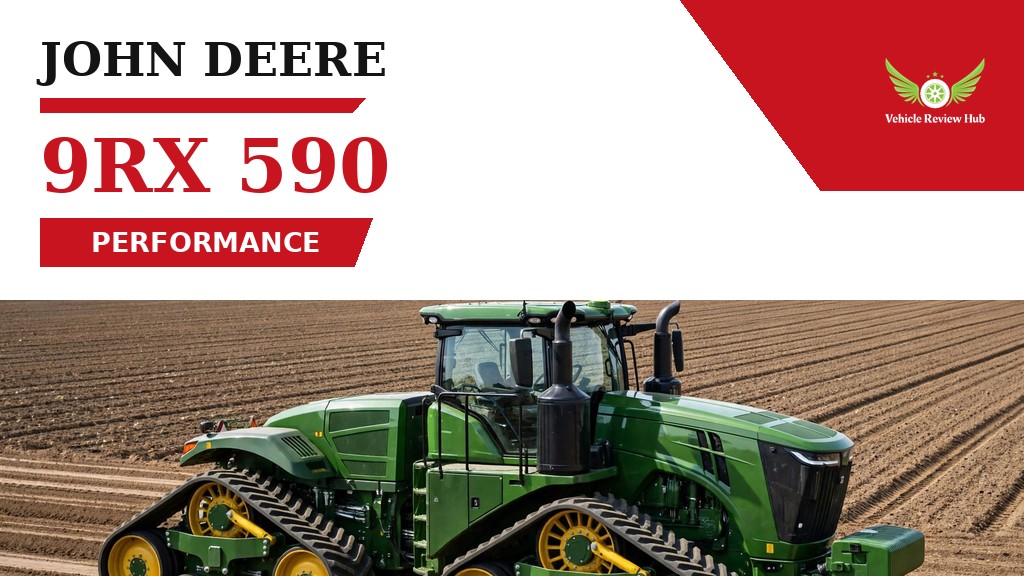
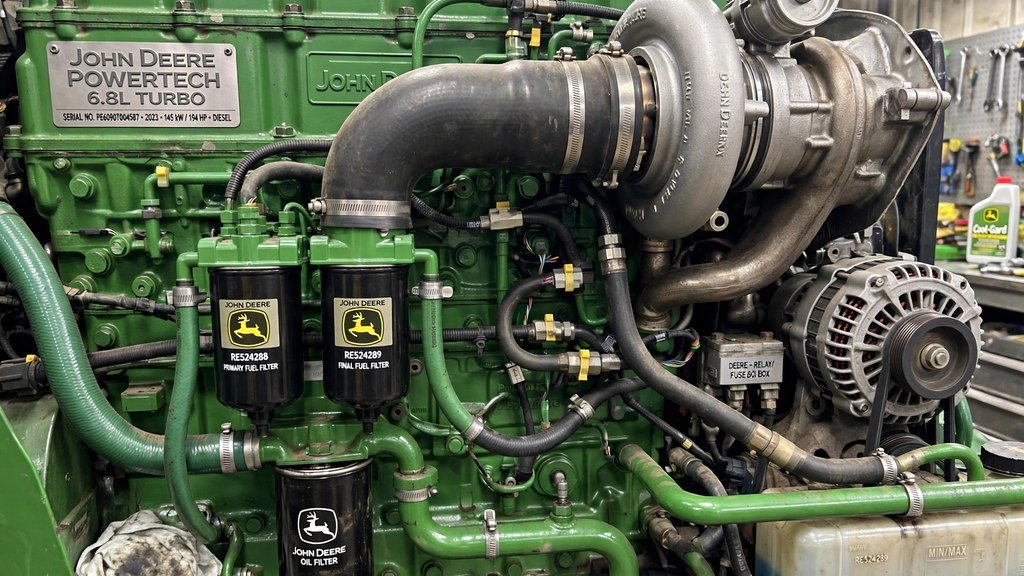
Here the John Deere 9RX 590 maintenance record needs a clear statement, because this engine is often confused with older 9RX powerplants: the 9RX 590 uses neither the Cummins QSX15 of the 9570RX and 9620RX nor the 13.5-liter PowerTech of the smaller original 9RX models. It uses Deere’s JD14, a 13.6-liter (827 cu in) inline six with wet-sleeve liners, four valves per cylinder, dual series turbocharging, air-to-air aftercooling, cooled EGR, and DOC/SCR aftertreatment for Final Tier 4. Rated output is 590 hp at 2,100 rpm with a 10 percent power boost to 649 hp, peak torque of 2,723 Nm (2,008 lb-ft) at 1,550 rpm, 38 percent PTO torque rise, and 335 hp at the PTO. Note the torque figure carefully: it is specific to the JD14 and not interchangeable with the older family’s figures — check the engine badge and serial plate, because that distinction drives parts, filters, and service procedures. The dealer spec sheet for the 9RX 590 confirms the JD14, the 590 hp rating, and the hydraulic figures used here.
The e18 is the same well-proven 18-speed PowerShift with Efficiency Manager found across the 9RX line, with full AUTO, custom, and manual modes and a 25 mph top road speed. Hydraulics run a closed-center, pressure-and-flow-compensated system at 55 gallons per minute standard or 110 with the optional high-flow pump — the Scraper Special fits the 110-gallon pump as standard — with four to eight rear SCVs and 35 or 42 gallons per minute at a single SCV depending on coupler size. That hydraulic spread is why John Deere 9RX 590 maintenance costs vary between machines: a scraper-spec tractor with the big pump and eight SCVs has more valves, lines, and couplers to service than a base drawbar machine.
Factors Affecting Service Life, Downtime and Repair Costs
Three things decide John Deere 9RX 590 maintenance outcomes — how long a 9RX 590 lasts and what it costs to keep: hours, track history, and software. Hours alone mislead — a 1,000-hour tractor that lived on road transport and scraper work can need tracks sooner than a 2,000-hour tillage machine that never left the field. Second is electronics: owner reports put software and sensor faults — code cascades, guidance gremlins, aftertreatment sensors — ahead of hard mechanical failures as the most common surprise repairs, and dealer diagnostic time is expensive. Third is parts scale: everything on a 590-horsepower four-track machine costs more than the same job on a row-crop tractor, from the 60-gallon transmission service to a single track belt. Budget a track reserve from day one. For the ownership-cost math behind these reserves, see our 9RX 590 ownership cost and resale guide.
John Deere 9RX 590 Common Problems and Warning Signs
No used 9RX 590 is problem-free, and John Deere 9RX 590 maintenance is mostly about catching problems early — read this section as a checklist, not a warning against the model. Most issues announce themselves early — a CommandCenter code, a slow hydraulic function, a belt starting to chunk — and the expensive failures are almost always the ones ignored for a season.
Track Wear, Alignment and Undercarriage Inspection
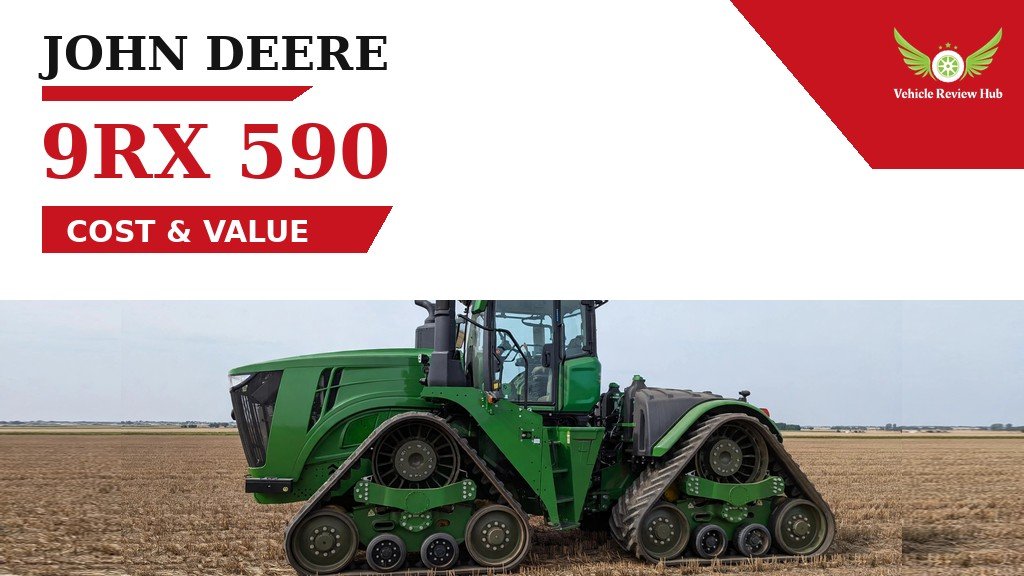
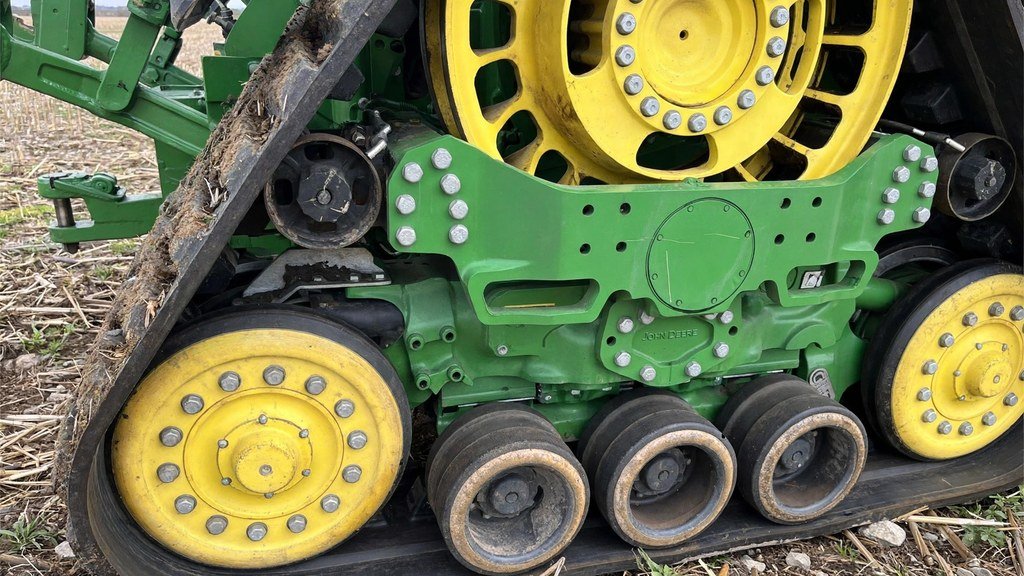
Track wear is where John Deere 9RX 590 maintenance either saves or costs five figures. Belts do not fail suddenly on a well-kept machine — they telegraph it: chunking tread bars, exposed cords, cracks at the guide horns, uneven wear across the belt width, and idler or midroller wear patterns that point to misalignment. Check tension with the factory gauge, not by eye, and check it hot and cold — a belt set too tight eats idlers, a belt set too loose derails and chunks. The video below walks through the track alignment check that catches the expensive problems early.
Engine, Aftertreatment and Software Problems
John Deere 9RX 590 maintenance on the JD14 is dominated by fuel and aftertreatment discipline. Dirty fuel, missed filter changes, and water in the separator shorten injector life and trigger derates; DPF and SCR faults — sensor failures, DEF quality issues, and forced regens that do not complete — are the most common reason a 9RX 590 shows up at the dealer with no mechanical failure at all. Software is the other repeat offender: guidance, display, and transmission-control updates that were never installed cause intermittent faults that look like hardware problems. Before any used purchase, insist on a full code history and proof that software is current — a tractor with cleared codes and no service records is a risk, not a bargain. Related model guides on the same platform — including the 9620RX maintenance guide, the 9570RX maintenance guide, and the 9520RX maintenance guide — show the same pattern: aftertreatment and electronics first, hard parts second.
Hydraulic, Transmission and Cab Problems
Hydraulic problems on the 9RX 590 usually start small: a slow SCV, a hitch that drifts, a coupler that weeps under load. Causes run from low or contaminated oil to a failing pump or a valve that needs calibration — check oil level and condition first, then test every SCV under load, not just at idle. Transmission complaints are rarer and usually software or calibration, not clutch packs — harsh shifts or a refusal to hold AUTO mode point to a calibration or sensor issue first. Cab problems are comfort and electronics: CommandCenter freezes, camera dropouts, HVAC that cannot hold temperature, and seat air-ride failures. None of these stop the tractor, but all of them cost dealer diagnostic time, and a cab full of active codes is a negotiating point, not a deal-breaker.
John Deere 9RX 590 Safety Checks and Used-Tractor Inspection
Safety checks on a 9RX 590 are not paperwork — a 590-horsepower four-track machine with a failed park brake or a cracked track belt is a genuine hazard. Before any test drive, confirm park brake hold on a slope, neutral-start function, steering response at low speed, and that all four tracks track straight with no derailment tendency. Check the ROPS structure, seat belt, steps, and handrails, and confirm the fire extinguisher is present and charged.
Used-Tractor Inspection Checklist
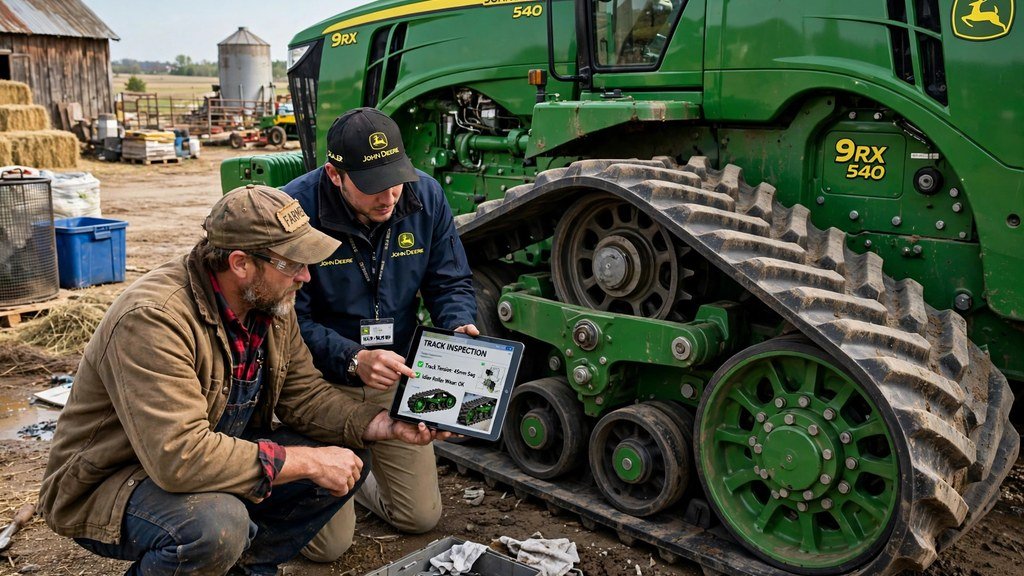
Use this John Deere 9RX 590 maintenance inspection checklist on any used machine, and walk away from any seller who will not let you complete it:
- Tracks: measure tread depth at all four corners, check for chunking, cord exposure, guide-horn cracks, and uneven wear; price a full set into your offer if any belt is below 50 percent.
- Undercarriage: idlers, midrollers, drive wheels, and tensioners — look for play, leaks, and wear patterns that signal misalignment.
- Engine: cold start, smoke color, oil condition, coolant condition, blow-by, and a full code scan — no cleared-code surprises.
- Aftertreatment: DEF quality, DPF regen history, SCR sensor codes, and proof of completed regens.
- Transmission and hydraulics: test every SCV under load, check hitch drift, test AUTO and manual shift modes, and inspect oil condition.
- Service records: 500-hour and 1,500-hour services documented, with filter part numbers — gaps in records are gaps in maintenance.
- Cab and electronics: CommandCenter function, guidance accuracy, camera function, HVAC, seat, and a software-version check.
- Frame and hitch: cracks, welds, drawbar wear, and three-point hitch condition.
Frequently Asked Questions About John Deere 9RX 590 Maintenance
These are the questions every 9RX 590 buyer and owner asks — answered against the service schedule, not guesswork.
How often does a John Deere 9RX 590 need service?
Engine oil and filters every 500 hours with Plus-50 II oil, fuel filters at the same visit, transmission and hydraulic oil every 1,500 hours, coolant at 6,000 hours, and a daily track and fluid walk-around. Grease hinge pins and track hardware every 50 hours.
What are the most common John Deere 9RX 590 problems?
Track wear and undercarriage costs, aftertreatment and DEF sensor faults, software and guidance glitches, and hydraulic SCV wear. Hard engine and transmission failures are rare on maintained machines — the expensive problems are almost always tracks, electronics, or neglected service.
How long do John Deere 9RX 590 tracks last?
Track life varies enormously with use — road transport, scraper work, and abrasive soils shorten it sharply — but well-kept belts on tillage and seeding duty commonly last several thousand hours. Budget a full-set reserve from day one and measure tread depth at every inspection, because a single belt installed runs $10,000–$15,000+ (estimate).
Is the John Deere 9RX 590 reliable?
Yes — for the heaviest draft work, the JD14 engine, e18 transmission, and frame are proven, and well-kept machines pass 5,000 hours on original major components. Reliability risk concentrates in tracks, aftertreatment, and electronics, which is why service history and code history matter more than hours alone.
What should I check before buying a used John Deere 9RX 590?
Tracks and undercarriage first, then a full code scan, aftertreatment history, 500-hour and 1,500-hour service records, every SCV under load, and software version. Price any missing service or worn belt into the offer — do not accept a seller’s assurance in place of records.
Can I do John Deere 9RX 590 maintenance myself?
Daily checks, greasing, filters, and oil changes are straightforward owner work with factory parts and the operator’s manual. Transmission service, track replacement, aftertreatment repair, and software updates belong at the dealer — the oil volumes, tooling, and diagnostic access make DIY false economy there.
What does John Deere 9RX 590 maintenance cost per year?
Routine service alone runs a few thousand dollars a year at dealer rates, but the honest annual figure must include a track reserve — a full set installed can exceed $40,000–$60,000 (estimate) — plus aftertreatment and electronics contingency. Our 9RX 590 ownership cost guide builds the full five-year budget.