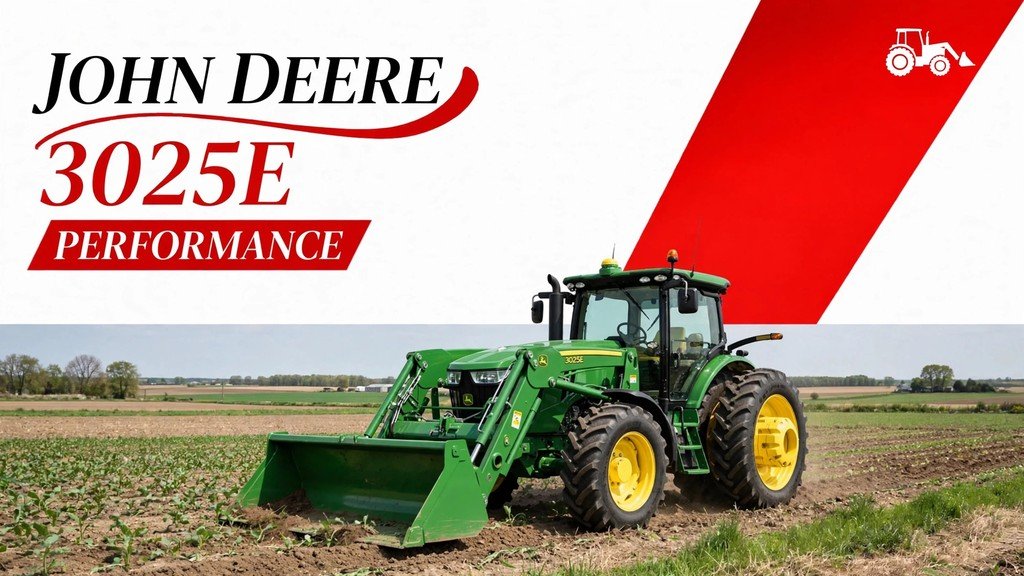
The short answer: John Deere 3025E performance is built around doing everyday work efficiently rather than showing off raw muscle. The 3025E pairs a 24.4-horsepower Yanmar three-cylinder diesel, rated at 2,400 rpm, with a two-range hydrostatic transmission and standard mechanical front-wheel drive. In real use, owners report burning roughly 0.9 to 1.2 gallons of diesel per hour while mowing, and the 7.5-gallon fuel tank stretches to about six to eight hours of mowing before a refill. The 300E loader lifts 1,186 pounds at the pivot pin at full height — enough for mulch, gravel, firewood, and pallets of bagged material, but not for moving round bales or digging in dense wet clay all day. For 2-to-20-acre properties focused on mowing, landscaping, and loader work, it is the right amount of tractor with the right amount of John Deere 3025E performance at the right price.
This guide covers John Deere 3025E performance from every angle: fuel consumption by task, the factors that stretch or shrink runtime per tank, how the 3025E handles mowing, grading, and loader work, its handling and honest limits, and what owners report after hundreds of hours. Spec figures come from Deere; fuel and workload observations are owner-reported ranges, not lab measurements.
John Deere 3025E Fuel Consumption and Runtime
Fuel is the running cost owners praise most often. The naturally aspirated 1.642-liter Yanmar diesel meets Final Tier 4 without a diesel particulate filter or DEF — no regen cycles, no aftertreatment service. That simplicity is a big part of real-world John Deere 3025E performance: the engine sips fuel and keeps cost per hour among the lowest in the 3-series lineup.
Fuel Usage During Mowing, Loader Work and Idling
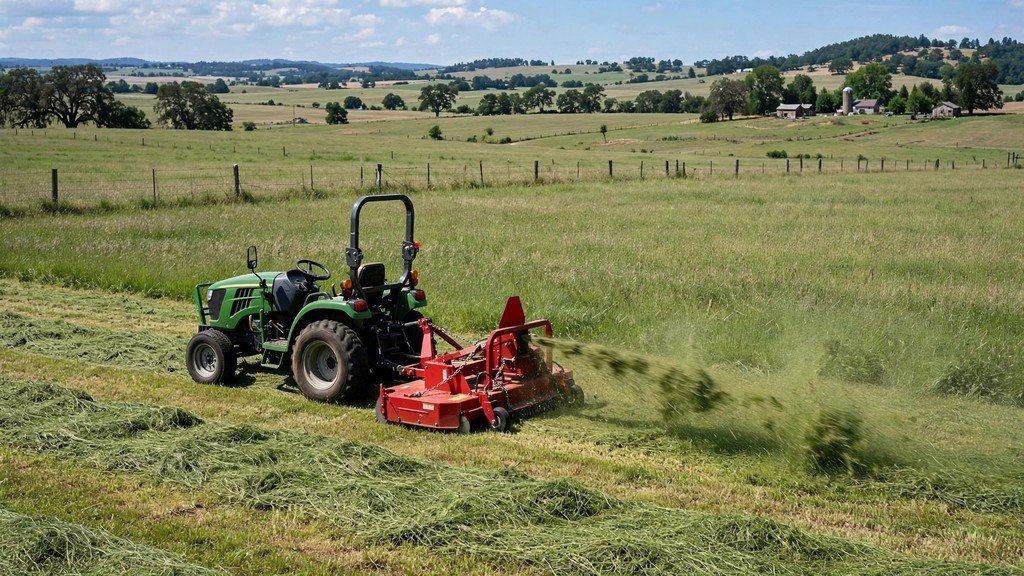
Owners discussing John Deere 3025E performance consistently call the 3025E frugal. Finish or rough mowing with a five-foot cutter at rated rpm typically uses about 0.9 to 1.2 gallons per hour (owner-reported range). Loader work runs roughly 0.9 to 1.4 gallons per hour, since hydrostatic and loader demand come in bursts. Light chores drop to about 0.5 to 0.8 gallons per hour, and warm-up idling sits near 0.3 (estimates). Deere publishes no official consumption figures for this machine.
The table below converts John Deere 3025E performance numbers into runtime on the 7.5-gallon tank.
| Task | Owner-Reported Fuel Use (gal/hr) | Runtime on a 7.5-Gallon Tank |
|---|---|---|
| Finish or rough mowing | 0.9–1.2 | About 6–8 hours |
| Loader work | 0.9–1.4 | About 5–8 hours |
| Light chores, raking, transport | 0.5–0.8 | About 9–15 hours |
| Warm-up idling | About 0.3 | Over 20 hours |
These numbers match the wider class: on TractorByNet’s fuel consumption threads, owners of 26-horsepower machines report a little under 1 gallon per hour doing loader work and slightly more while mowing — right where 3025E owners land. That is why real-world John Deere 3025E performance feels cheap to feed: a full day of property work rarely needs more than one tank.
Factors Affecting Fuel Economy and Runtime per Tank
Six habits decide whether your tank lasts six hours or ten. First, run PTO implements only at the rpm the implement needs. Second, use the range lever properly: low range for heavy drawbar or loader loads, high range for transport and light work — lugging heavy loads in high range wastes fuel and strains the transmission. Range management matters for both John Deere 3025E performance and fuel burn.
Third, disengage MFWD on hard, dry ground — it adds rolling resistance you do not need on pavement. Fourth, keep rear ballast on during loader work; slipping tires burn diesel for zero work. Fifth, keep tire pressures at spec and the air filter clean. Sixth, cut idle time: long warm-ups and lunch-break idling are the easiest fuel to save. All six habits together define everyday John Deere 3025E performance.
The 3025E also benefits from simple physics: it burns less than its bigger 3-series siblings because it has less engine to feed. The turbocharged 3038E does more work per gallon when fully loaded, but at mixed, part-load chores the naturally aspirated 3025E is the efficiency winner (estimate). That part-load efficiency is a defining trait of John Deere 3025E performance. Compare with the larger sibling’s numbers in our 2032R performance and fuel usage guide.
John Deere 3025E Performance for Everyday Work
The 3025E exists to make small acreages manageable. With about 17.4 PTO horsepower (some dealer sheets list up to 19), a Category 1 hitch lifting 1,356 pounds at 24 inches behind the link arms, and the factory 300E loader, it covers mowing, grading, landscaping, material handling, and light tillage — without the price, weight, or complexity of the bigger 3-series machines. Those headline John Deere 3025E performance figures say light compact; this section shows what a light compact actually gets done.
Mowing, Landscaping, Grading and Property Maintenance
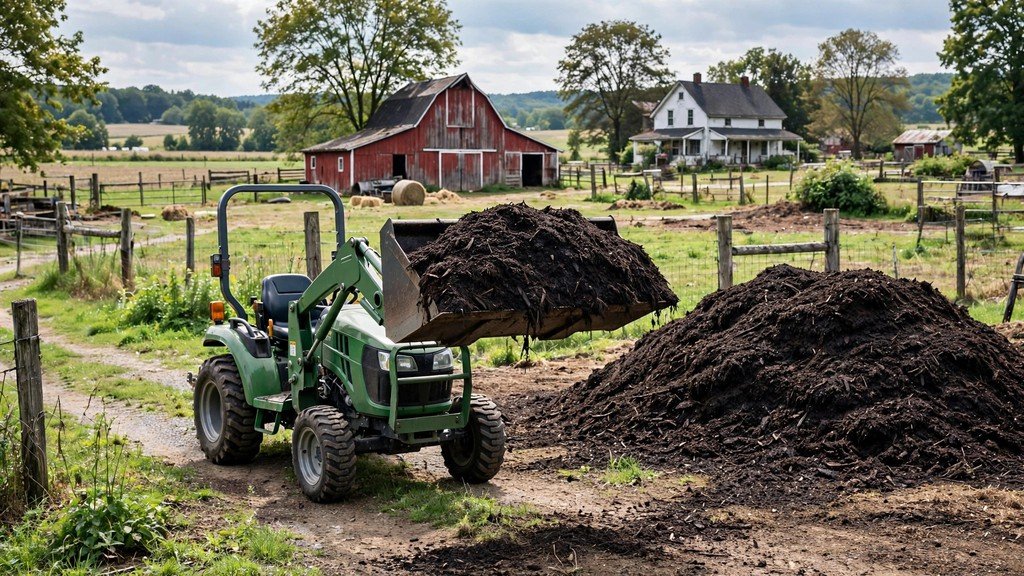
Mowing is where John Deere 3025E performance shines brightest for most buyers. The independent 540-rpm rear PTO with its wet-disk clutch runs a five-foot rotary cutter comfortably in typical pasture grass, and owners report it will pull a six-foot brush hog in lighter growth without complaint (owner reports). For manicured ground, a rear finish mower or grooming mower gives a clean cut, and the tractor’s weight and wheelbase keep it stable on rolling ground where lighter sub-compacts feel tippy.
Landscaping and grading are the 3025E’s second home. A five- or six-foot box blade levels driveways and spreads gravel, a landscape rake preps seedbeds, and position control holds depth. At 2,603 pounds plus ballast, it grades firmly without churning soft turf like heavier utility tractors. Power steering and the tight turning circle make fence-line and around-the-barn work genuinely pleasant.
One note for former 1-series owners: the 3E line offers no drive-over AutoConnect mid-mount deck, so finish mowing means a rear-mount mower — cheaper than a mid-mount deck, detached in about a minute, and just as clean on open ground.
Loader Work, Material Handling and Light Tilling
The 300E loader defines the 3025E for many owners, and Deere’s published John Deere 3025E performance figures are honest working specs: 1,186 pounds of lift capacity at the pivot pin at full height, 845 pounds measured 500 mm ahead of the pivot, 1,704 pounds of boom breakout force, and 84 inches of maximum lift height (per Deere dealer spec sheets). Koenig Equipment’s 300E loader spec page lists the full geometry for owners sizing forks or grapples.
In practice: full buckets of mulch or topsoil, loads of firewood, or pallet forks with a few hundred pounds of bagged material — while a bucket of wet gravel or dense clay hits the limit fast. Owners learn quickly: take partial bites, keep the bucket low, and never lift heavy without rear ballast. A ballast box or filled rear tires is the difference between a stable lift and a light rear end. The optional third-function kit opens up grapple work, which many owners call the most useful upgrade.
Tillage is honest light-duty territory. The 3025E runs a four- or five-foot rotary tiller in prepared or medium soil; owners report a five-foot tiller works fine in previously worked ground but bogs in dense, unbroken clay (owner reports). Treat tilling as something the tractor can do, not something it lives for — and read our 3038E performance and fuel usage guide if regular tillage is on your chore list.
John Deere 3025E Handling, Comfort and Operating Limitations
Peak John Deere 3025E performance numbers tell half the story — how the tractor feels across a long Saturday decides whether owners love it or list it. The 3025E earns consistent praise for easy operation, and its limits are the predictable ones of a light compact: steep ground, maximum loads, and sustained heavy work. This section covers the comfort that builds loyalty and the limits that decide whether you need the next model up.
Maneuverability, Operator Comfort and Ease of Use
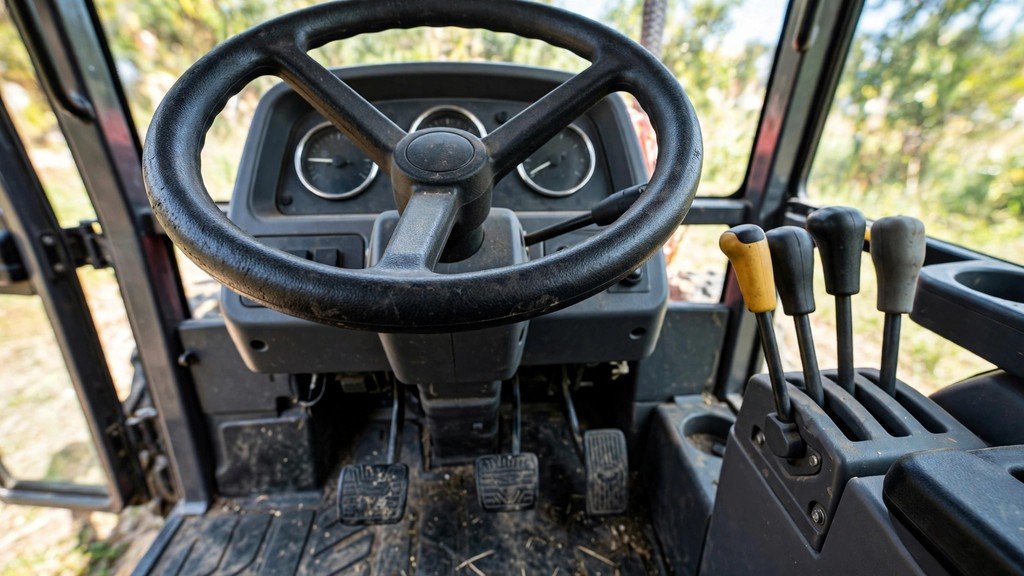
The headline handling figure is a 9.4-foot turning radius without brakes — one of the tightest in its horsepower class, and owners notice it immediately around barns, gates, and trees. The two-range hydrostatic transmission with Twin Touch pedals gives automobile-like forward/reverse control with no clutching, and new operators routinely report being comfortable within an hour. Ease of use is a genuine part of what owners mean by John Deere 3025E performance: a tractor anyone in the family can run safely is a tractor that gets used more.
The operator station is simple by design: an easy-entry straddle platform, a left-hand range lever, and a loader joystick on the loader stanchion. Cruise control is optional for long mowing passes. The contoured seat suits multi-hour days, visibility over the low hood is excellent, and the foldable ROPS clears standard garage doors. Travel speed runs about 12 to 14 mph depending on the spec sheet — plenty for moving between fields.
Traction, Stability, Terrain and Workload Limitations
Traction hardware is a 3025E strong point: standard MFWD, a mechanical rear diff lock, power steering, and wet-disk brakes. At 2,603 pounds plus ballast and implements, it stays planted on rolling ground, with R4 industrial tires the common choice for mixed properties. On slopes: keep the bucket low, travel straight up and down, and let the diff lock and low range work. Careful operation preserves John Deere 3025E performance instead of testing it.
The honest limits are workload-based: a five- or six-foot tiller in dense soil, a rotary cutter buried in thick brush, or hours of steep-hillside mowing push the 3025E harder than it prefers. It will bog where the 3032E or 3038E keep a comfortable reserve. That is the clearest boundary of John Deere 3025E performance. As Koenig Equipment’s 3-series comparison puts it: for loader work, mowing, and occasional light tillage the 3025E is not underpowered, but regular large-implement work deserves the step up. Know which side of that line your property sits on.
John Deere 3025E Real-World Owner Experience
The spec sheet promises economy and simplicity; owners report on whether it delivers. Across dealer reviews, forum threads, and long-term ownership videos, the verdict on owner-experienced John Deere 3025E performance is consistent: easy to learn, cheap to run, dependable, and honest about its limits. Below: the recurring praise, the recurring complaints, and the setup choices that separate happy owners from frustrated ones.
Owner-Reported Benefits, Complaints and Practical Trade-Offs
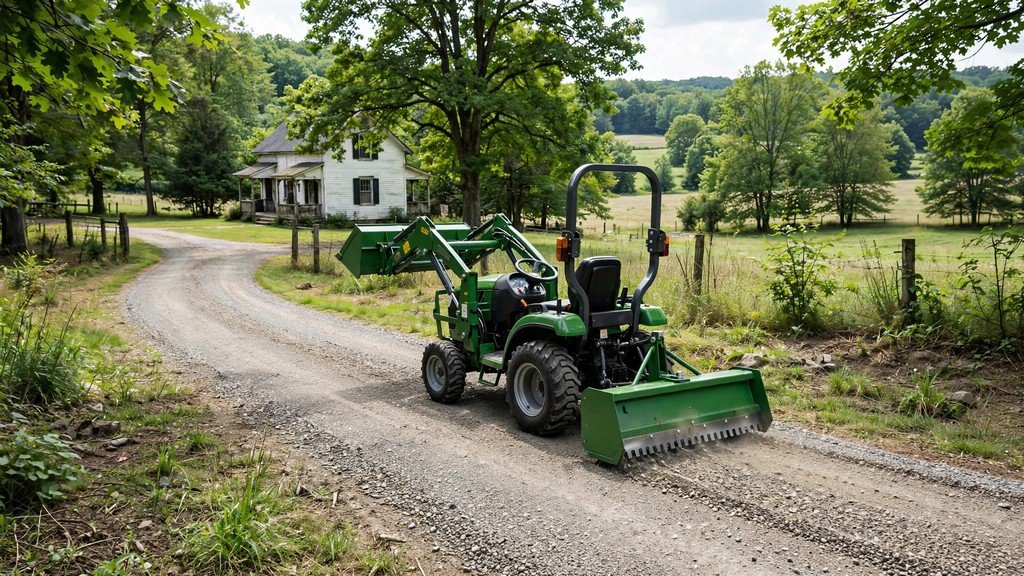
The benefits owners repeat most: ease of use, reliability, and fuel economy. First-time buyers report being productive within an hour of delivery, and long-term owners describe machines with several hundred hours that still start instantly. The fuel economy behind John Deere 3025E performance keeps costs low, and the no-DPF, no-DEF setup means one fewer system to think about. John Deere’s dealer network and parts availability get frequent praise — valuable the first time you need a filter on a Saturday morning.
Complaints are mostly about expectations, not defects. Most common: the 3025E feels underpowered for heavy-duty tasks — big tillers, thick brush — where owners wish they had bought the 3032E or 3038E. Some note the hydrostatic transmission whines under heavy load (normal for the design), a few find two ranges limiting next to three-range rivals, and the base price sits above some competitors. Long-term John Deere 3025E performance reviews, like the 600-hour, four-year ownership video below, show the trade-off: the tractor does everything its class promises, nothing more, and asks very little in return.
The practical takeaway: buy the 3025E for the work it is built for — mowing, landscaping, grading, loader chores on up to about 20 acres — and its John Deere 3025E performance feels like a bargain. Buy it hoping for a 40-horsepower tractor’s output, and the limits above will annoy you by month three.
Choosing the Right Setup for Your Property
Setup is the biggest lever on everyday John Deere 3025E performance, starting with ballast. Serious loader work needs rear ballast — a ballast box, filled rear tires, or wheel weights — to keep the rear end planted and the front axle within its 1,940-pound rating. Next, tires: R4 industrials for mixed dirt and turf, R1 ag tires for mud and field work, turf tires for finished lawns. Match the tire to where the tractor spends its hours.
Size implements to the PTO: a five-foot rotary cutter, a five-foot box blade or landscape rake, and a four- or five-foot tiller for prepared soil. Add the iMatch quick-hitch and implement swaps stop being a chore. If grapple work is in your future, order the third-function kit from day one — owners call it the most useful upgrade. For pricing and model comparisons, read our 3025E review and buying guide; service intervals are in our 3025E maintenance and reliability guide, and five-year budget math in our 3025E ownership cost guide. Match the setup to your property and the 3025E rewards you with years of low-cost, low-drama John Deere 3025E performance.
Frequently Asked Questions About John Deere 3025E Performance
These are the questions buyers ask most often about John Deere 3025E performance and fuel usage, answered from published specs and owner-reported experience.
How much fuel does a John Deere 3025E use per hour?
Owners report about 0.9 to 1.2 gallons per hour while mowing, 0.9 to 1.4 during loader work, and 0.5 to 0.8 for light chores, with idling near 0.3 (owner-reported ranges). That economy is central to John Deere 3025E performance — most owners spend well under $10 on diesel for a full day of typical property work at current prices.
How long will the 7.5-gallon tank last?
At about a gallon per hour mowing, a full tank delivers roughly six to eight hours of mowing. Loader work drains it a little faster — five to eight hours — while light chores stretch a tank past a full day. Most owners refuel once per workday at most. That runtime is one of the most practical measures of John Deere 3025E performance.
Can the 3025E handle a 6-foot bush hog?
In light grass, owners report the 3025E pulls a six-foot rotary cutter acceptably (owner reports). In heavy brush, the five-foot cutter is the safer match for 17-to-19 PTO horsepower. If most of your mowing is heavy brush, the 3032E’s extra power is worth the step up.
Is the 3025E good for loader work?
Yes, within its class. The 300E lifts 1,186 pounds at the pivot at full height with 1,704 pounds of breakout force — strong for a 25-horsepower-class machine. With rear ballast, owners move mulch, soil, gravel, firewood, and palletized material all day — solid John Deere 3025E performance for the class. Limits: dense wet material in full buckets, and the 84-inch lift height, which will not clear high-sided trucks.
How does 3025E fuel economy compare to the 3032E and 3038E?
The 3025E burns the least fuel overall — less displacement to feed at part load (estimate). The turbocharged 3038E can be more efficient per unit of work when fully loaded, but for mixed chores the 3025E wins on total gallons. Pricing shows the gap: Greenway Equipment recently advertised the 3025E with loader at $19,999 cash, versus $26,149 for the 3032E and $28,692 for the 3038E.
Does the 3025E have a DPF or use DEF?
No. The naturally aspirated Yanmar meets Final Tier 4 without a diesel particulate filter and without DEF — no regen cycles, no parked-cleaning requests, no aftertreatment service. That is a meaningful difference from larger compacts like the 2032R with its DOC/DPF system, and one of the quiet advantages behind the 3025E’s low-maintenance reputation and overall John Deere 3025E performance.