The short answer on John Deere 5M Series maintenance: change the engine oil and filter after the first 100 hours and then every 500 hours, replace the fuel filters every 500 hours, service the air filters every 1,200 hours or annually, replace the hydraulic oil filter after the first 100 hours and then every 600 hours, change the transmission-hydraulic oil every 1,200 to 1,500 hours, and flush the coolant every six years. Current US Final Tier 4 models run DOC plus SCR aftertreatment — they use DEF but have no DPF and no parked regeneration — and Deere backs the 5M with a 24-month/2,000-hour base warranty (whichever comes first), with paid PowerGard extended plans available.
This John Deere 5M Series maintenance guide covers the full service schedule with Deere filter part numbers, the 5M family’s reliability record, the most commonly reported problems and warning signs, recall checks, and a used-tractor inspection checklist — every interval drawn from Deere’s 5M Series documentation.
John Deere 5M Series Maintenance Schedule and Service Costs
John Deere 5M Series maintenance follows Deere’s utility-tractor rhythm: daily fluid and safety checks, a 100-hour break-in service, then repeating 500-hour engine cycles with 600- and 1,200-hour driveline intervals on top. Deere’s official 5M Series filter overview lists every filter by part number and interval, and dated service records protect both the powertrain warranty and resale value.
Engine Oil, Filters, Cooling System and Routine Service
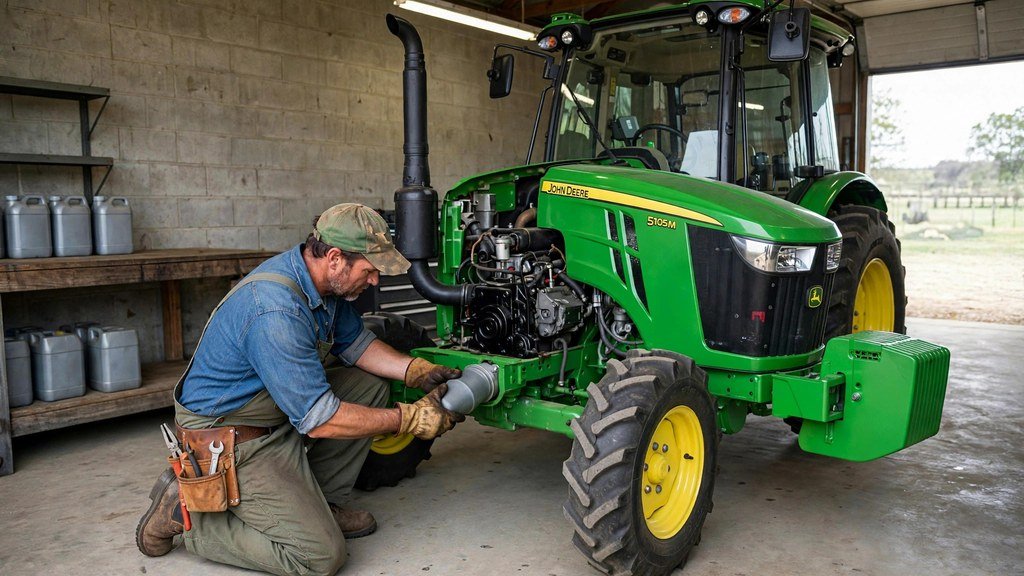
Engine oil and filter are due after the first 100 hours and then every 500 hours in any John Deere 5M Series maintenance routine — Deere specifies oil filter RE504836 with Plus-50 II 15W-40. Skipping this interval is the fastest way to shorten the life of the PowerTech 4045: the one piece of John Deere 5M Series maintenance no owner should stretch.
The video below walks through an oil change and no-primer fuel filter change on a 5085M — the same 5M-family service points your tractor has:
Fuel filtration deserves respect on the 5M: the primary fuel filter (RE541922) and final fuel filter (RE544394) are both due every 500 hours, and the water separator should be drained during daily checks. Clogged fuel filters are the most common cause of hard starting and low-fuel-pressure faults on 5M tractors — including a documented 5100M case where cold-weather fuel delivery problems traced back to the tank pickup and filter.
The dual-element air cleaner uses primary filter SU20768 and secondary element RE253519, serviced every 1,200 hours or annually — or sooner when the restriction indicator trips. Cab models add a fresh-air filter (RE198488) to clean every 600 hours or annually.
Transmission, Hydraulic Oil, Axles and Lubrication
In John Deere 5M Series maintenance, the hydraulic oil filter (SJ11784) is replaced after the first 100 hours and then every 600 hours. The shared system runs on Hy-Gard; low fluid or an overdue filter is the usual suspect behind weak lift or slow SCV response.
The MFWD front axle gets fresh oil every 600 hours, and greasing is the quiet hero of John Deere 5M Series maintenance: hit every fitting on the loader pivots, steering spindles, front axle pivot pin, and 3-point hitch every 50 hours. Five minutes with a grease gun prevents the worn pins and sloppy linkages that show up on neglected used tractors.
DEF is a consumable: the SCR system uses roughly 2 to 4 percent of diesel consumption, so keep the DEF tank filled with API-certified fluid and never let it run dry — the tractor will derate. Our 5M Series performance and fuel usage guide turns consumption into annual operating numbers.
| Service Interval | What to Do | Key Part Numbers |
|---|---|---|
| Daily / every 10 hours | Check engine oil, coolant, transmission oil, DEF level; drain fuel water separator; clean grille screens | — |
| Every 50 hours | Grease all fittings; check MFWD axle oil level and tire pressure | — |
| After first 100 hours | Change engine oil and filter; replace hydraulic oil filter | RE504836, SJ11784 |
| Every 500 hours | Change engine oil and filter; replace primary and final fuel filters | RE504836, RE541922, RE544394 |
| Every 600 hours | Replace hydraulic oil filter; change MFWD front axle oil; clean cab fresh-air filter | SJ11784, RE198488 |
| Every 1,200 hours / annually | Service or replace primary and secondary air filter elements | SU20768, RE253519 |
| Every 1,200–1,500 hours | Change transmission-hydraulic oil and filter; clean pickup screen (confirm in your operator manual) | Hy-Gard |
| Every 6 years / 6,000 hours | Flush cooling system; refill with COOL-GARD II | — |
| Typical annual service cost | Roughly $150–$300 in parts for DIY oil, fuel, and air filter service, or $500–$900 at a dealer (estimates; vary by region and model) | |
John Deere 5M Series Reliability and Long-Term Durability
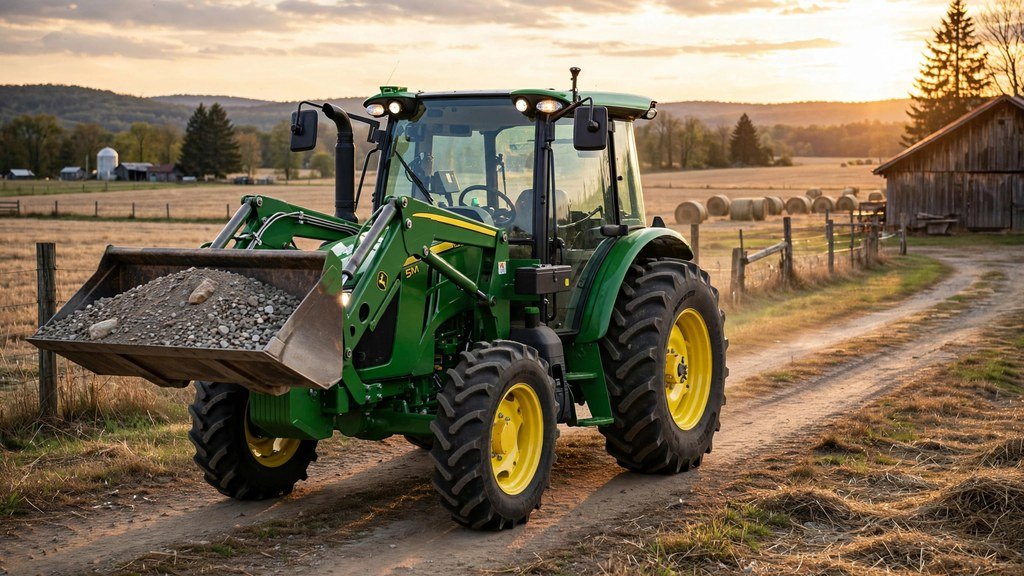
In production since 2008, the 5M’s reliability record is one reason the series holds its value: the wet-sleeved PowerTech 4045 — a 4-cylinder, 4.5-liter turbocharged and aftercooled diesel — a mid-frame cast-iron chassis built for loader work, and transmissions proven across hundreds of thousands of units. Most owner complaints are maintenance-adjacent annoyances, and 5M tractors with 3,000-plus hours of documented John Deere 5M Series maintenance still do daily farm work.
Engine, Transmission and Hydraulic System Reliability
The wet-sleeved PowerTech 4045 is rebuildable in-frame, and its bottom end has a reputation for outlasting the rest of the tractor when oil changes stay on schedule. The 5075M makes about 75 horsepower, the 5090M about 89, the 5100M 100, and the 5115M 115, all from the same 4.5-liter architecture.
Final Tier 4 compliance comes from DOC plus SCR with DEF — no DPF and no parked regeneration on current US models, which removes the soot-management headaches that dominate compact-tractor forums. One used-buyer note: early interim Tier 4 5M models (roughly 2008–2013) did carry a DPF (filter RE551147), so a pre-FT4 machine needs DPF service history in a way current models don’t. Our 5090M maintenance and reliability guide covers the same-family service rhythm in single-model detail.
The transmissions — PowrReverser 12F/12R on current machines, PowrQuad PLUS 16F/16R and Powr8 32F/16R on older ones — are proven designs with wet clutches and electrohydraulic reversers. With John Deere 5M Series maintenance done on schedule, drivetrain complaints are rare. The open-center hydraulic system delivers 24.9 to 25.6 gallons per minute depending on model.
Factors Affecting Service Life, Downtime and Repair Costs
Clean fuel is the first rule of John Deere 5M Series maintenance longevity: the high-pressure common-rail injection system has no tolerance for water or contamination, so buy from high-turnover stations, keep the tank full to limit condensation, and change fuel filters on schedule. Genuine Deere filters matter more here than on older mechanical-injection tractors — a few dollars saved on a will-fit filter can cost an injector.
DEF discipline is the second rule: use only API-certified DEF, keep the tank above a quarter, and never ignore derate warnings. Load discipline is the third: proper rear ballast for loader work and implements sized to the model’s PTO rating. The 5M is a mid-frame utility built for real farm work, and tractors used within their rating with documented John Deere 5M Series maintenance routinely pass 5,000 hours with only wear-item replacements.
John Deere 5M Series Common Problems and Warning Signs
The 5M has a well-documented set of owner-reported quirks. Below are the problems owners report most often and the warning signs that separate a five-minute fix from a dealer visit during John Deere 5M Series maintenance.
Engine, Electrical, Hydraulic and Transmission Symptoms
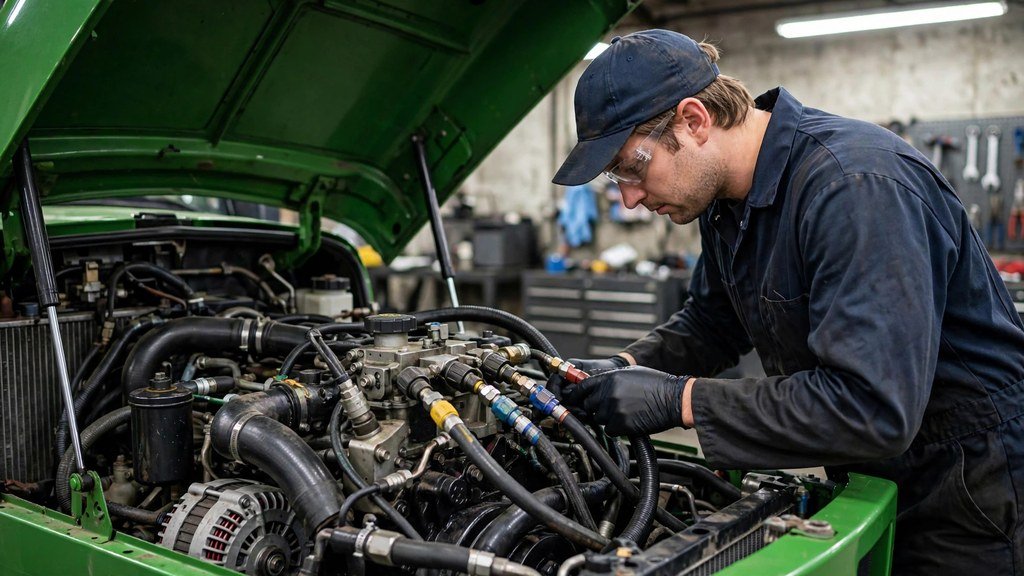
Fuel delivery complaints top owner discussions of John Deere 5M Series maintenance: hard starting, low-fuel-pressure fault codes, and engines that start then stall. The usual causes are clogged fuel filters, water in the separator, or a restricted tank pickup that only shows up in cold weather. If it cranks but won’t catch, check the filters and separator first; if it starts then dies, suspect the fuel shutoff solenoid or a crankshaft position sensor fault.
Electrical niggles are the next most reported category: battery drain on tractors that sit, corroded grounds, and intermittent sensor faults. A weak battery causes more 5M no-starts than any mechanical failure — load-test it before chasing anything exotic, and clean every ground connection during annual service.
Hydraulic complaints follow a familiar pattern: a loader that drifts down, slow SCV response, or weak power steering — usually low or incorrect oil, a clogged filter, or a quick coupler not fully seated. Owners who stay current on the John Deere 5M Series maintenance filter schedule rarely see these.
Steering that feels loose or suddenly tight usually traces to the steering cylinder, the steering pump, or low hydraulic oil level; check the level first, since it’s the cheapest fix.
Transmission symptoms on high-hour machines include harsh shifting, slipping under load, and unusual noises from the front axle area — the clutch packs in PowrQuad boxes wear with hours, and a rebuild is a dealer job costing several thousand dollars, which is why clutch feel is a key used-buyer check. Cooling complaints round out the list: water pump failures and overheating from clogged radiator screens. On the emissions side, the SCR system is generally trouble-free — but a tractor run with the DEF tank dry or with contaminated DEF will derate, and clearing that derate takes a dealer visit.
Diagnosing Issues and Evaluating Repair Needs
Smart John Deere 5M Series maintenance troubleshooting is symptom-first: work from the simplest cause outward. The dash display shows service alerts and diagnostic trouble codes, and Deere’s 5M operator manual has separate troubleshooting charts for the engine, electrical system, and machine.
DIY-safe jobs: oil and filter changes, fuel and air filters, greasing, batteries, belts, DEF handling, and cab filter service. Dealer jobs: fuel injector replacement and calibration (new injectors require the dealer’s laptop), clutch pack rebuilds, transmission internal work, and SCR/DEF system diagnosis. A good John Deere 5M Series maintenance rule: if a repair quote exceeds half of one year’s depreciation and the tractor is tired, price a replacement — otherwise fix it. Stop using the tractor immediately for fuel or hydraulic leaks under pressure, overheating, loss of braking, derate warnings that don’t clear, or major driveline noise.
John Deere 5M Series Safety Checks and Used-Tractor Inspection
Buying used is where careful shoppers get the best value in the 5M line: somebody else absorbed the first years of depreciation, and a well-kept 5M has decades of work left. The series’ large installed base means plenty of choice — but you need a sharp eye, and John Deere 5M Series maintenance records are the first thing to ask for.
Checking Service History, Updates and Applicable Recalls
Start with the service folder. A 5M with 1,500 documented hours is a better buy than a 700-hour machine with no records. Ask for receipts for oil changes, filter replacements, clutch work, and any dealer service — including DEF-system work and, on interim Tier 4 machines, DPF service. Ask whether the tractor’s software is current — a dealer can verify update status from the serial number.
The honest recall picture for John Deere 5M Series maintenance: we could not verify any model-specific CPSC safety recall covering the 5M Series in the records we checked. The widely reported September 2024 brake-linkage recall covered the 1023E, 1025R, and 2025R compact tractors only — not the 5M line. Still, checking costs nothing: run the tractor’s serial number through Deere’s recall lookup or call 800-537-8233, and ask the seller for any recall or update paperwork.
One more serial-number check for used buyers: confirm whether the machine is interim Tier 4 or Final Tier 4. Early iT4 5Ms carry a DPF that needs ash-service history; current FT4 models run DOC plus SCR with no DPF. The emissions label under the hood settles it in seconds.
Inspecting Brakes, Tires, Hydraulics and Transmission Operation
Walk the tractor cold. Start it and listen for knocking or hard cranking — then run every function: cycle the loader through full lift, curl, and dump looking for cylinder drift or weeping seals; engage the PTO and listen for bearing noise; shift through the ranges and test the reverser in both directions, feeling for slip or harsh engagement; test the brakes individually and confirm it stops straight; and raise the 3-point hitch through its full travel, watching for smooth, quiet operation.
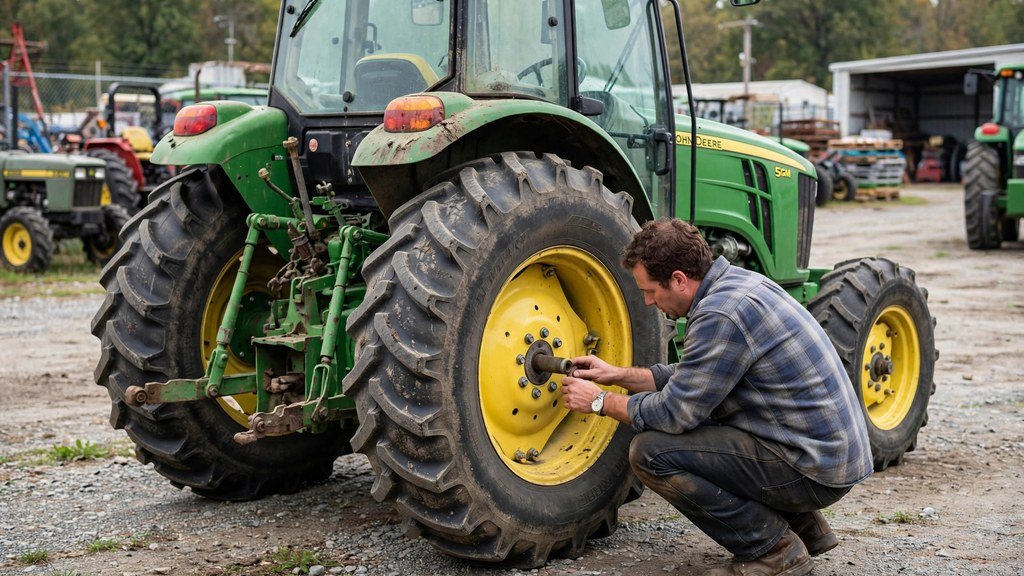
Inspect the wear items that price a used 5M: tire tread and sidewall cracking (a full set of rears is a four-figure bill), loader pins and bushings for play, hydraulic hoses for cracking, the seat and cab interior, and every light and gauge. Check the hour meter against the tractor’s condition — a 900-hour tractor with a worn-through seat has a story the meter doesn’t tell. Skipping this walkaround is the fastest way to inflate your John Deere 5M Series maintenance budget after purchase. For the full ownership picture, see our 5M Series ownership cost guide, and compare notes with the 5075E maintenance guide if you’re cross-shopping the E series.
Frequently Asked Questions About John Deere 5M Series Maintenance
The John Deere 5M Series maintenance questions owners ask most, answered from Deere service documentation and documented owner experience.
How often should I change the oil in my 5M Series tractor?
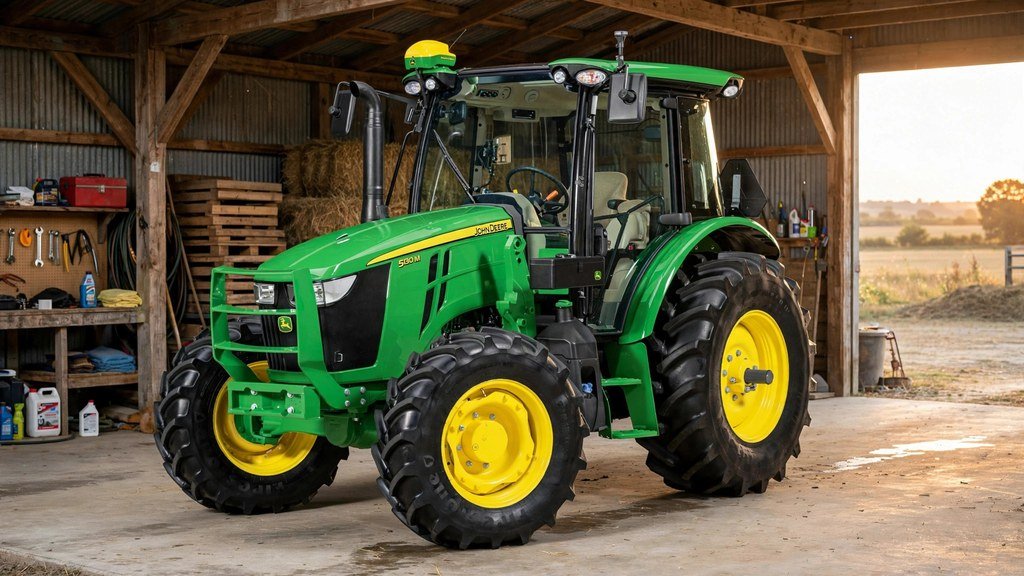
Change the engine oil and filter after the first 100 hours, then every 500 hours — Deere specifies oil filter RE504836 with Plus-50 II 15W-40. This is the single most important item in John Deere 5M Series maintenance; the PowerTech 4045’s wet-sleeved bottom end will outlast everything else on the tractor if oil changes stay on schedule.
Does the 5M Series have a DPF?
Current US Final Tier 4 models do not — they meet emissions with DOC plus SCR, using DEF with no DPF and no parked regeneration. Early interim Tier 4 5M tractors (roughly 2008–2013) did carry a DPF, so if you’re buying used, check the emissions label under the hood and ask for DPF ash-service records as part of the John Deere 5M Series maintenance history.
How much DEF does a 5M Series tractor use?
Roughly 2 to 4 percent of diesel consumption — a 5M burning 3 gallons of diesel per hour uses about a gallon of DEF every 8 to 15 hours. Use only API-certified DEF, keep the tank above a quarter full, and never run it dry: the tractor will derate, and clearing that derate takes a dealer visit.
When is the transmission and hydraulic service due?
The hydraulic oil filter (SJ11784) is due after the first 100 hours and then every 600 hours; the transmission-hydraulic oil and filter change falls at 1,200 to 1,500 hours depending on your model year’s operator manual. The MFWD front axle gets fresh oil every 600 hours. An overdue filter often shows up as weak loader lift — mistaken for serious transmission trouble in many John Deere 5M Series maintenance calls.
What warranty covers the John Deere 5M Series?
Deere’s agricultural warranty covers 5M tractors for 24 months or 2,000 hours basic (whichever comes first) — not the 6-year/2,000-hour compact-tractor figure quoted for the 1–4 Series. Your own John Deere 5M Series maintenance does not void coverage if you use proper parts and fluids and keep dated records. Save receipts and log hours.
What should I check before buying a used 5M?
Service records first — a documented machine beats a low-hour mystery every time. Cold-start it, cycle the loader and 3-point through full travel, test the reverser and every range for slip or harsh shifts, check the brakes individually, inspect tires and hoses, and verify whether it’s interim or Final Tier 4. Run the serial number through Deere’s recall lookup or call 800-537-8233. Disciplined pre-purchase inspection is the cheapest John Deere 5M Series maintenance you’ll ever do.