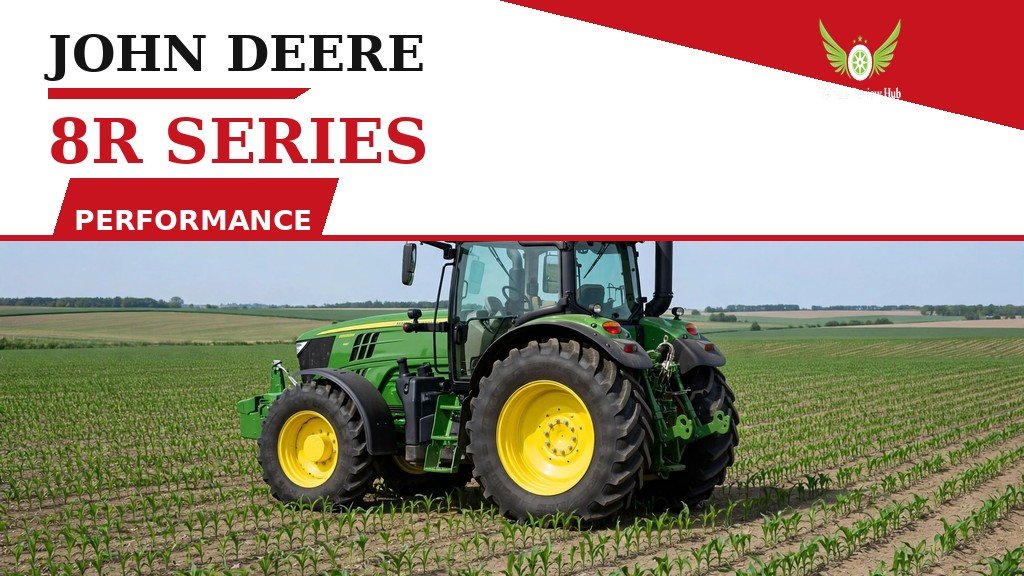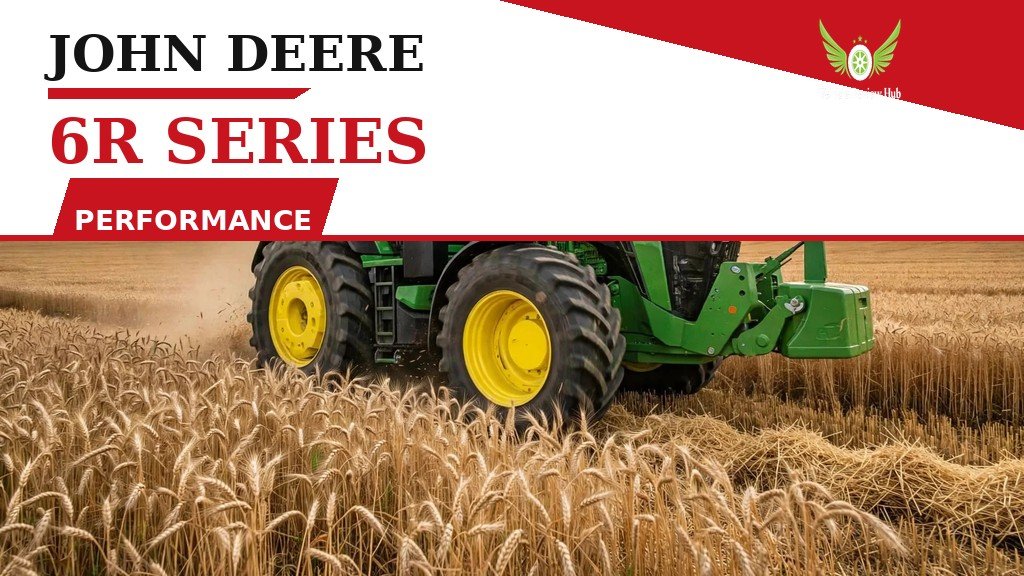
The short answer on John Deere 6R Series performance: this is the line where Deere’s row-crop tractors stop feeling like big utility machines and start feeling like proper field tractors. Seven models from the 145-hp 6145R to the 250-hp 6250R share a 6.8-liter six-cylinder PowerTech engine, closed-center hydraulics up to 42 gpm, and your choice of AutoQuad, DirectDrive, or AutoPowr IVT transmissions. In independent testing, a 6215R burned just 19.2 liters per hour — about 5 gallons — in mixed work, while full-power OECD testing sets the ceiling near 10.5 gph. Real owners report 3.5–6 gph for everyday mowing, hay, and loader work, rising toward 8–10 gph only under sustained heavy draft.
This John Deere 6R Series performance guide breaks down fuel usage by task and model, how the three transmission families change both the driving experience and the fuel bill, what John Deere 6R Series performance looks like in tillage, hay, and loader work, where its limits sit, and what owners say after thousands of hours. Every figure below comes from Deere specs, independent OECD/DLG test data, or documented owner experience — owner-reported numbers are labeled as such.
John Deere 6R Series Fuel Consumption and Runtime
Fuel is the first question every 6R buyer asks, because at this size the gallons add up fast. The good news for John Deere 6R Series performance is a genuine efficiency reputation: the DLG-PowerMix test measured just 274 grams of diesel per kilowatt-hour with only 8 g/kWh of DEF, and testers have called the 6215R one of the most efficient tractors in its class. The honest answer is that consumption depends more on the job than the badge — a 6145R on a tedder and a 6250R on a 7-shank ripper live in different fuel worlds.
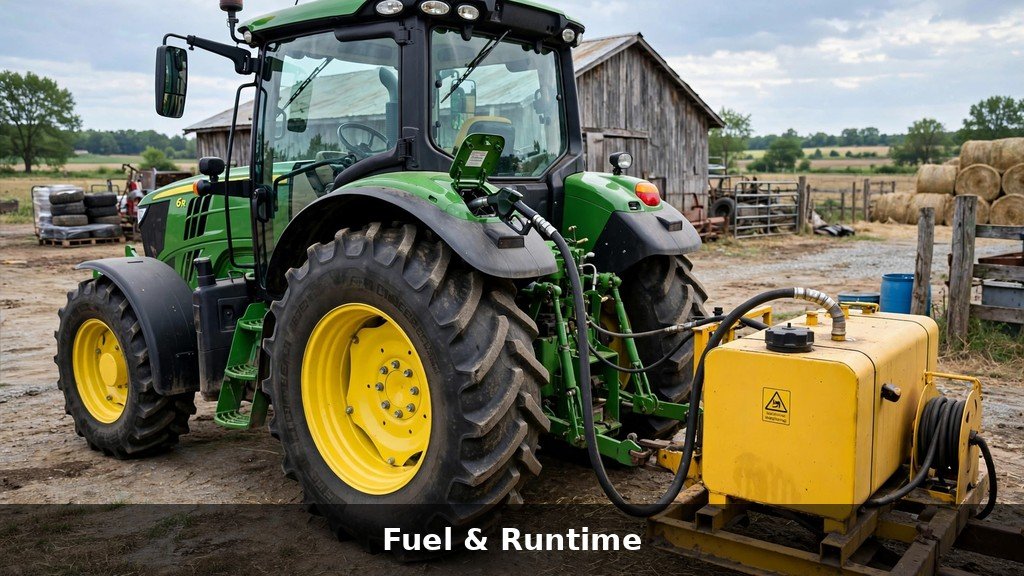
Fuel Use During Fieldwork, Loader Work and Idling
Start with the tested extremes. In OECD testing, a 6215R at maximum power drank 10.5 gallons per hour — the absolute ceiling. In the DLG field-applications test, the same class of machine averaged 19.2 liters per hour, roughly 5.1 gph, in mixed work. Those two numbers — 5 gph working normally, 10.5 gph flat out — are the honest brackets for John Deere 6R Series performance at the fuel pump.
Owner-reported figures fill in the middle. Light work — road transport, tedding, augers — typically lands at 2.5–4 gph. Loader work and mowing sit around 4–6 gph. Heavy PTO work like a big square baler pushes 5–7 gph. Sustained heavy draft — ripping, deep discing, heavy trailers — is where John Deere 6R Series performance shows 7–10 gph. One published summary put a 6195R at roughly 13–15 liters per hour (3.4–4.0 gph) in typical mixed farming, lining up with the DLG numbers.
Idling deserves mention because 6R owners idle a lot. The 6.8L at low idle sips roughly 0.8–1.2 gph, but the DPF aftertreatment dislikes extended idling — a small but real John Deere 6R Series performance consideration: cool exhaust slows soot burn-off and brings parked regenerations sooner. Sitting more than a few minutes? Shut it down. DEF runs about 2–4 percent of diesel use — at 5 gph of diesel, roughly a tenth to two-tenths of a gallon of DEF per hour.
| Task | Typical fuel use (gph) | Source |
|---|---|---|
| Road transport, light PTO | 2.5–4.0 | Owner-reported range |
| Loader work, mowing, tedding | 4.0–6.0 | Owner-reported range |
| Heavy PTO (baler, mower-conditioner) | 5.0–7.0 | Owner-reported range |
| Heavy draft tillage, max load | 7.0–10.0 | Owner-reported range |
| DLG field average (6215R) | ~5.1 | DLG-PowerMix test |
| OECD max power (6215R) | 10.5 | OECD Test 2106 |
| Planning figure, mixed farm work | 4.5–6.0 | Blended estimate |
How Model, Workload and Transmission Affect Fuel Economy
Three things move the needle most for John Deere 6R Series performance at the pump. First, transmission: the AutoPowr IVT holds the engine at its most efficient rpm for any ground speed, and in variable-load work it consistently beats a stepped gearbox by 5–15 percent on fuel, per owner comparisons. DirectDrive is the efficiency king in steady transport; AutoQuad sits in the middle. Second, ballast and tire pressure: under-ballasted, a 6R spins wheels and turns diesel into dust; over-ballasted, it hauls dead weight. Set axle load to the job and run the lowest pressure the load allows.
Third, engine-speed discipline. The 6.8L makes peak torque at just 1,600 rpm, and the 540E/1000E PTO modes let implements run at 1,761/1,756 engine rpm instead of 1,950 — that drop is worth roughly 10 percent in fuel on PTO work. Tank size helps John Deere 6R Series performance runtime: a 6145R carries 71.3 gallons and big-frame models hold over 100 gallons (a 6195R lists 104.4), so even at 6 gph you get 12–17 hours between fills. DEF tanks (4.2 gallons on a 6145R) need topping every few diesel fills.
John Deere 6R Series Performance for Farm Work
This is where John Deere 6R Series performance earns its premium over the 6M: more weight, more hydraulic flow, more PTO power, and a chassis built for full days of draft work. The 6145R weighs 15,212 lb and the 6250R 20,503 lb before ballast — traction comes from iron, not wheel slip. Intelligent Power Management adds up to 40 hp in transport and mobile PTO, so a 6215R can call on 233 hp and a 6250R up to 275 hp when the job allows. For the smaller-frame comparison, see our 6M Series performance and fuel usage guide.
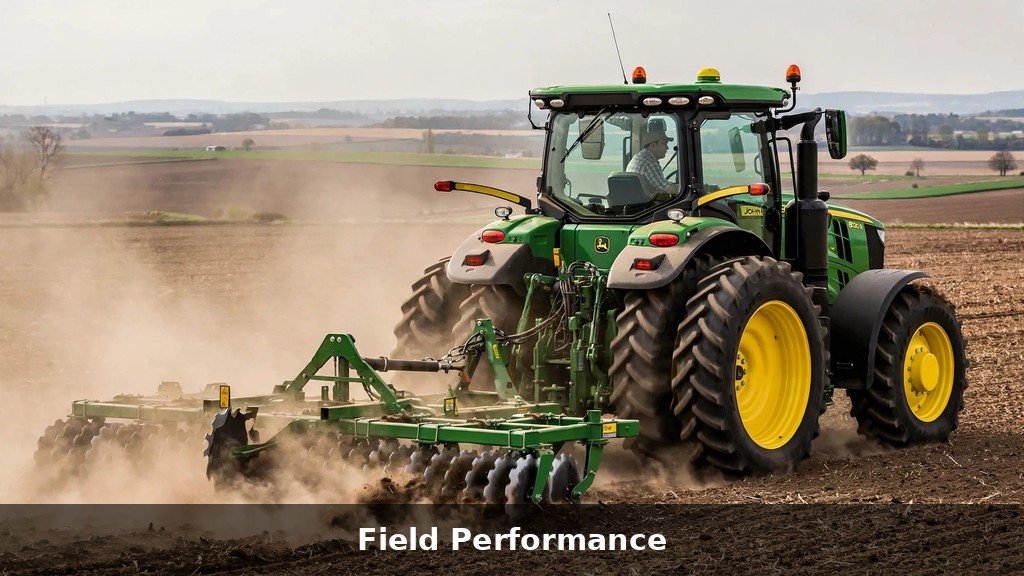
Tillage, Mowing, Hay Work and Material Handling
In tillage, the 6R’s signature John Deere 6R Series performance trait is torque rise: 40 percent, with peak torque at 1,600 rpm. When the implement hits hard ground, the engine lugs down and pulls through instead of forcing a downshift — the trait owners name most when coming from smaller tractors. A 6195R with 672 lb-ft handles a 7-shank ripper or 30-foot cultivator; the 6215R’s 740 lb-ft and the 6250R’s 860 lb-ft step into genuine primary-tillage territory. A 6215R tested at 19,897 lb of maximum drawbar pull backs up the feel.
For mowing and hay, the 540E/1000E economy PTO modes are the headline of John Deere 6R Series performance in PTO work: run a disc mower or tedder at reduced engine speed and pocket roughly 10 percent fuel savings with no implement penalty. The closed-center hydraulics — 41 gpm on the 6195R/6215R, 42 gpm on the 6250R — run hydraulic-driven implements without starving steering. The Cat 3/3N hitch lifts 9,259 lb behind the points on a 6145R and up to 22,900 lb max on a 6250R. The owner video below — a two-year review of a 6R 215-class machine on a working livestock farm — shows this mixed tillage and slurry work firsthand:
Loader Work, Hauling and Heavy-Load Performance
The 6R pairs with the 663R and 683R loaders, and John Deere 6R Series performance as a loader platform is among Deere’s best: closed-center PFC hydraulics deliver full flow at low engine speeds for fast, strong cycles without revving. The optional TLS front axle transforms loader work — absorbing bucket bounce, cutting spillage and operator fatigue, per owner reports. Electronic SCVs with programmable detents and return-to-position make repetitive cycles nearly automatic.
Hauling is where transmission choice shows in John Deere 6R Series performance. AutoPowr IVT suits operations living on the road between fields: seamless speed, 26 mph standard (31 mph optional), engine always at its sweet spot. DirectDrive is the efficiency pick for steady transport. IPM’s extra 40 hp in transport keeps a loaded grain cart moving up grades. High permissible gross weights keep heavy trailer work legal and stable on the big models.
John Deere 6R Series Handling, Comfort and Limitations
A 6R is a big tractor — 18,739 lb for a 6215R, over 20,500 for a 6250R — but John Deere 6R Series performance in handling belies the size. The ComfortView cab, CommandARM/CommandPRO layouts, and well-sorted manners earn consistent owner praise. Physics still applies, so here is what the 6R does well and where to size expectations honestly.
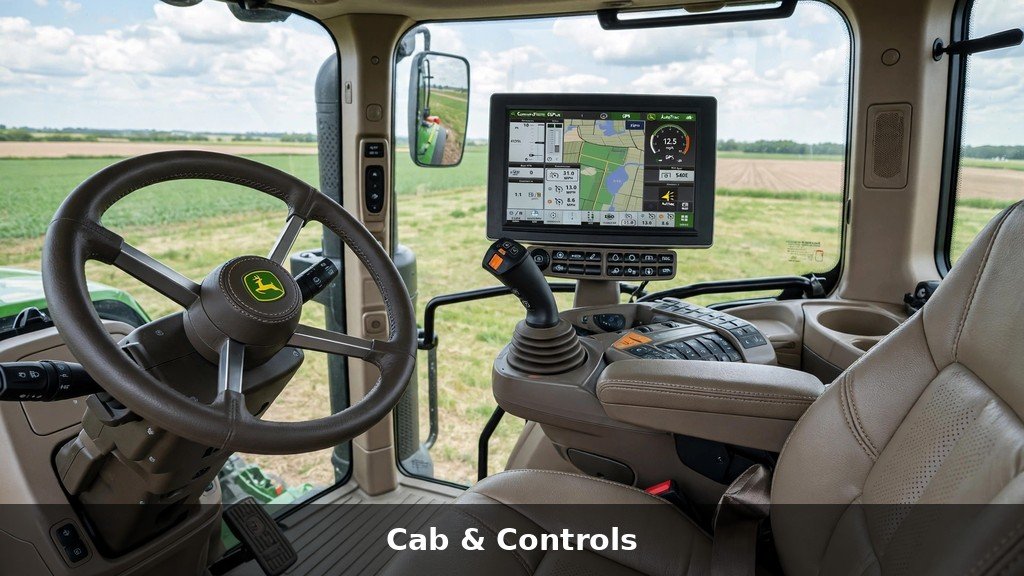
Cab, Controls and Operator Comfort
The ComfortView cab defines John Deere 6R Series performance from the operator’s seat: excellent visibility (30-degree right-hand seat swivel on CommandARM cabs), low noise, and automotive fit and finish. CommandPRO puts transmission, hydraulics, PTO, and guidance in the right hand — owners switching from lever layouts rarely go back. AutoTrac readiness, up to six electronic rear SCVs, and ISOBUS control make the cab an office as much as a workstation.
Worthwhile options: active air seat, cab suspension, panoramic visibility, and LED lighting that turns night into day. The electronics run deep — programmable headland sequences, iTEC automation — a benefit once learned, a complaint until it is. Get real seat time or a dealer walkthrough before the busy season; owner threads describe the first month as “drinking from a fire hose” followed by genuine enthusiasm.
Traction, Stability, Terrain and Workload Limits
Traction is a John Deere 6R Series performance strength: MFWD standard, electrohydraulic front and rear diff locks, and real weight. On steep ground or soft soils, tire choice and ballast matter more than the badge. Size is the limitation in tight spaces — barnyards and narrow lanes favor the smaller-frame 6145R/6155R, and low sheds demand a cab-height check.
Workload limits are honest. A 6145R will not replace a 7R on a 40-foot air seeder, and IPM’s extra 40 hp applies only in transport and mobile PTO — not steady draft. Conversely, a 6250R on light chores wastes fuel, DEF, and rubber. Match the model: 6145R–6175R for mixed livestock and hay farms, 6195R–6215R for heavy tillage and big PTO loads, 6230R–6250R for operations nearing 7R needs. Our 5M Series performance guide covers the step below for smaller operations.
John Deere 6R Series Real-World Owner Experience
Specs say what a tractor can do; owners say what it is like to live with. Across forums, dealer reviews, and long-term tests, John Deere 6R Series performance earns a consistent reputation: excellent cabs, strong lugging torque, better-than-expected fuel economy, and electronics that reward the learning curve. The complaints are consistent too — worth hearing before buying, because all are manageable once known.
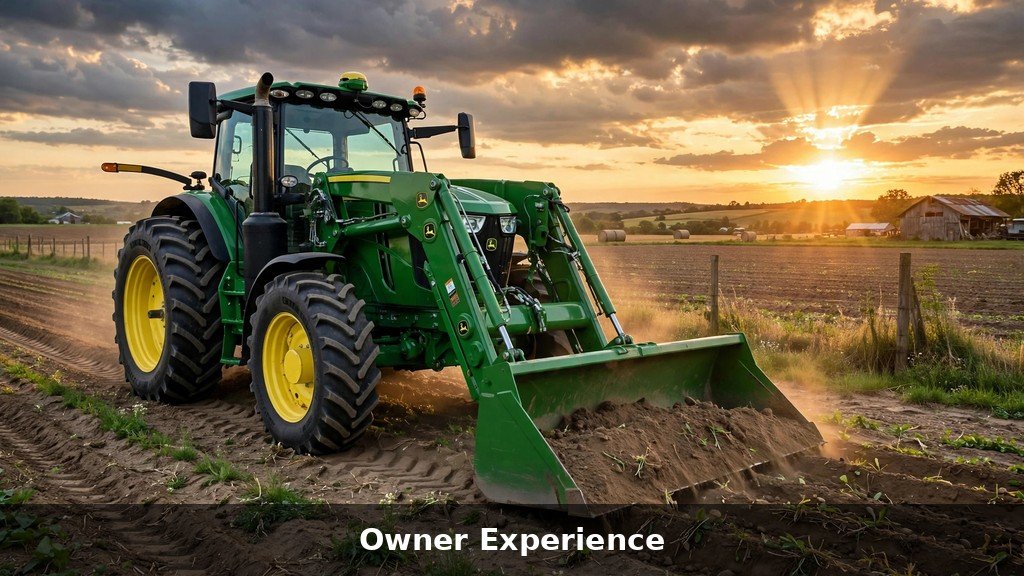
Owner-Reported Benefits, Complaints and Trade-Offs
Most-named benefits: torque and lugging ability (“pulls like a much bigger tractor”), cab comfort on long days, IVT smoothness in loader and PTO work, and fuel economy beating expectations — several owners match the DLG-style 5 gph in real mixed work. CommandPRO and AutoTrac integration earn special praise from row-crop operators. Reliability reports are generally strong, with thousands of relatively trouble-free hours commonly described.
The complaints, all owner-attributed: the electronics learning curve; DEF/DPF awareness — the 6R runs DOC+DPF+SCR, so parked regenerations and DEF quality matter, and neglect means derates; purchase and parts prices; and compaction on smaller farms. Some owners find the base 30-gpm pump on smaller models limiting with big hydraulic motors — spec the 41/42-gpm pump for hydraulic-intensive implements. None are deal-breakers; each is a real consideration. The 6R Series maintenance and reliability guide covers the service side.
Choosing the Right Model and Transmission for Your Work
Size for your heaviest regular job, not your dream job — that is the core of smart John Deere 6R Series performance buying. A 6145R (145 hp, 113 PTO) covers most 500–1,000-acre mixed operations; the 6195R (195 hp, 158 PTO) is the sweet spot for heavy tillage and big square balers; the 6215R–6250R (215–250 hp) serve operations flirting with 7R territory. Size the base rating for draft work and let IPM cover the road.
Transmission: choose AutoPowr IVT for loader work, varying PTO loads, or heavy road transport — easiest to drive, most efficient in variable work. Choose DirectDrive for steady-state transport and field cruising with maximum efficiency. Choose AutoQuad PLUS for the lowest purchase price and simplest long-term care. All three are proven; the best matches your work mix and operators. For pricing context, see our John Deere 6R Series review and 6R Series ownership cost guide.
Frequently Asked Questions About John Deere 6R Series Performance
Buyer questions about real-world John Deere 6R Series performance — answered from Deere specs, independent test data, and documented owner experience.
How much fuel does a John Deere 6R use per hour?
Plan on 4.5–6 gph for mixed farm work — the central planning figure for John Deere 6R Series performance. DLG testing measured about 5.1 gph on a 6215R; owners report 2.5–4 gph light, 4–6 gph loader/mowing, and 7–10 gph under sustained heavy draft. The 10.5 gph OECD max-power figure is a ceiling you will only see at full song.
Which 6R transmission is most fuel efficient?
AutoPowr IVT in variable-load work — it holds the engine at optimal rpm for any ground speed, typically 5–15 percent better than a stepped box there, per owner comparisons. DirectDrive leads in steady transport. AutoQuad PLUS is simplest and cheapest at a small efficiency cost. Transmission choice is one of the biggest levers on John Deere 6R Series performance economy.
Does the 6R have a DPF and use DEF?
Yes to both. The US Final Tier 4 6R runs DOC+DPF+SCR with DEF at roughly 2–4 percent of diesel use. The DPF regenerates automatically during worked cycles; let parked regenerations finish when requested. Deere’s manual suggests DPF ash service around 4,500 hours for engines at or above 175 hp. Keep DEF fresh and never ignore a derate warning.
How much can a John Deere 6R lift and pull?
A 6145R’s Cat 3/3N hitch lifts 9,259 lb behind the lift points; a 6250R manages 16,300 lb standard, up to 22,900 lb max. A 6215R tested at 19,897 lb maximum drawbar pull. Pair with the 663R or 683R loader — the closed-center hydraulics and optional TLS front suspension make John Deere 6R Series performance as a loader platform excellent.
Is the 6R worth it over the 6M?
If your work regularly exceeds 150 PTO horsepower, needs more than 30 gpm of hydraulic flow, or involves long days where cab comfort and automation pay — yes. John Deere 6R Series performance brings 15–100+ more horsepower per step, a heavier chassis, up to 42 gpm hydraulics, and the CommandPRO/AutoTrac ecosystem. For lighter mixed farming, the 6M does the same jobs for less, as our 6M performance guide shows.
What size farm is a John Deere 6R right for?
Roughly: 6145R–6175R for 500–1,500-acre mixed and livestock operations; 6195R–6215R for 1,000–3,000-acre row-crop operations with serious tillage; 6230R–6250R for large operations nearing 7R-class needs. Implement size and annual hours matter more than acreage — the real sizing inputs for John Deere 6R Series performance.