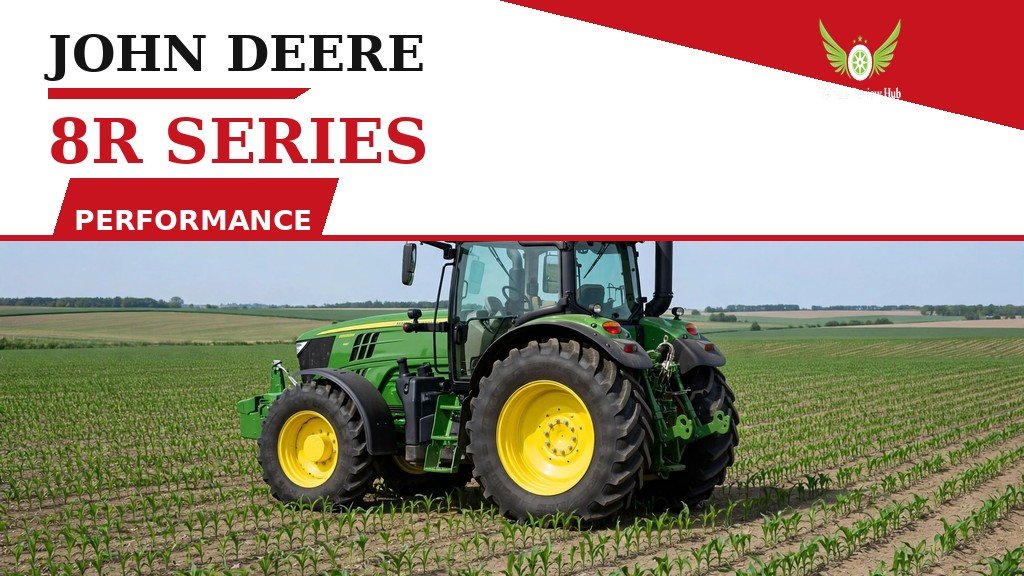
The John Deere 8R Series is the big row-crop workhorse: seven wheeled models from the 230-hp 8R 230 to the 410-hp 8R 410, all on the same PowerTech 9.0-liter six-cylinder. The honest headline on John Deere 8R Series performance is torque — up to 1,365 lb-ft at 1,600 rpm on the 8R 410 — delivered through transmissions and hydraulics that put it to the ground without wasting fuel.
This guide breaks down John Deere 8R Series performance the way it matters in real field work: fuel use by task, what each model can pull, how the e23, 16-speed PowerShift, and IVT transmissions compare, how the cab and chassis handle long days, and what owners report from real seasons.
John Deere 8R Series Fuel Consumption and Runtime
Fuel is the biggest running cost on a tractor this size. The independent labs have recorded some of the best specific-consumption numbers in this power class for the 8R family — but the gap between light road work and heavy draft is wide, and workload matters more than the model badge.
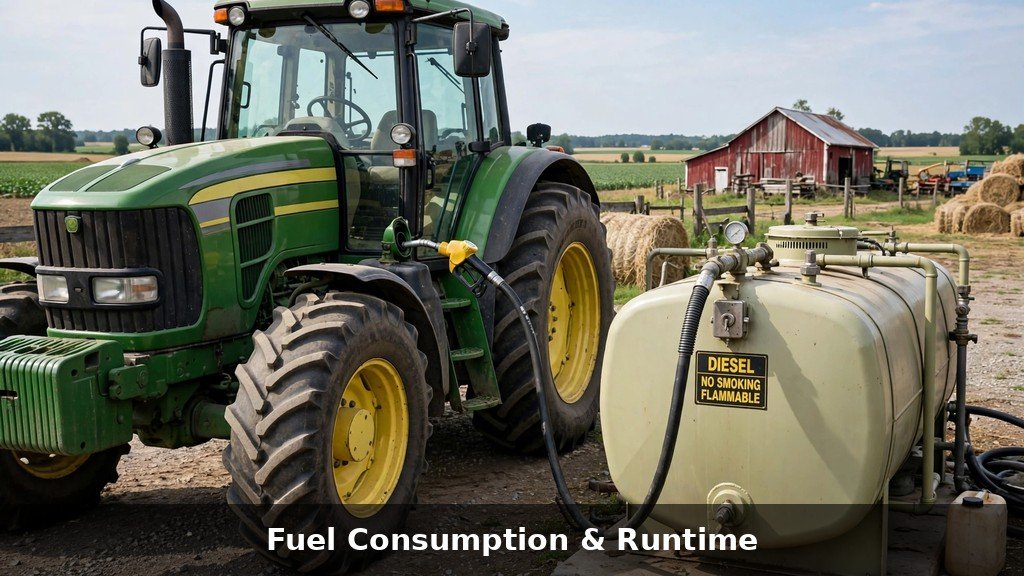
Fuel Use During Fieldwork, PTO Operation and Transport
The hardest data on John Deere 8R Series performance at full load comes from the test labs. Nebraska’s OECD Tractor Test 2131 on the 8370R (the previous-generation 370-hp model) measured 361.8 hp at standard PTO speed burning 18.95 gallons per hour, and 375.3 hp at maximum power at 19.5 gph. Under varying loads it recorded 291.1 hp at 15.35 gph, 219.5 hp at 11.95 gph, and 73.9 hp at just 6.22 gph — showing how the 9.0L sips fuel when the load lightens. A DLG PowerMix test on the 8400R measured roughly 230 g/kWh.
Translated to the current lineup, owner reports cluster in predictable bands (all owner-reported, never engineering data): light duty and transport 6–9 gph, general farm work 8–11 gph, PTO field work 10–14 gph, and heavy draft 12–18 gph depending on model. A Farmers Weekly driver review of the tracked 8RX 370 (same powertrain family, not a wheeled 8R) noted about 60 liters per hour — roughly 16 gph — in sustained heavy cultivation, a good ceiling for John Deere 8R Series performance planning.
Runtime math is simple. The 8R fuel tank holds 192 gallons (172 gallons with central tire inflation, which borrows some tank space). At a blended 12 gph — a realistic full-day average — that is 16 hours of run time; at 15 gph in heavy draft, about 12.8 hours. Either way, one fill covers a long working day, and the 9.8-gallon DEF tank lasts between fuel fills since DEF runs roughly 2–3 percent of diesel.
How Model, Workload and Transmission Affect Fuel Economy
Model choice shapes fuel use because seven models span 230 to 410 rated hp — match the tractor to the implement and fuel per acre stays in line. Oversizing by two or three models costs fuel on every pass, not just on purchase day.
Transmission choice matters too. The e23 PowerShift’s Efficiency Manager matches engine rpm to the load automatically — owners running it consistently report meaningfully lower fuel use in variable-load work than with older fixed-step shifting. The 16-speed PowerShift is simpler and cheaper but relies on the operator to pick the right gear. The AutoPowr IVT (and the newer eAutoPowr electric variable transmission on the larger models) keeps the engine in its sweet spot continuously — a real advantage in John Deere 8R Series performance for mixed work. Deere’s engineering target was maintaining the previous generation’s 94 percent overall tractor efficiency, and the PowerMix and OECD numbers suggest they hit it.
John Deere 8R Series Performance for Farm Work
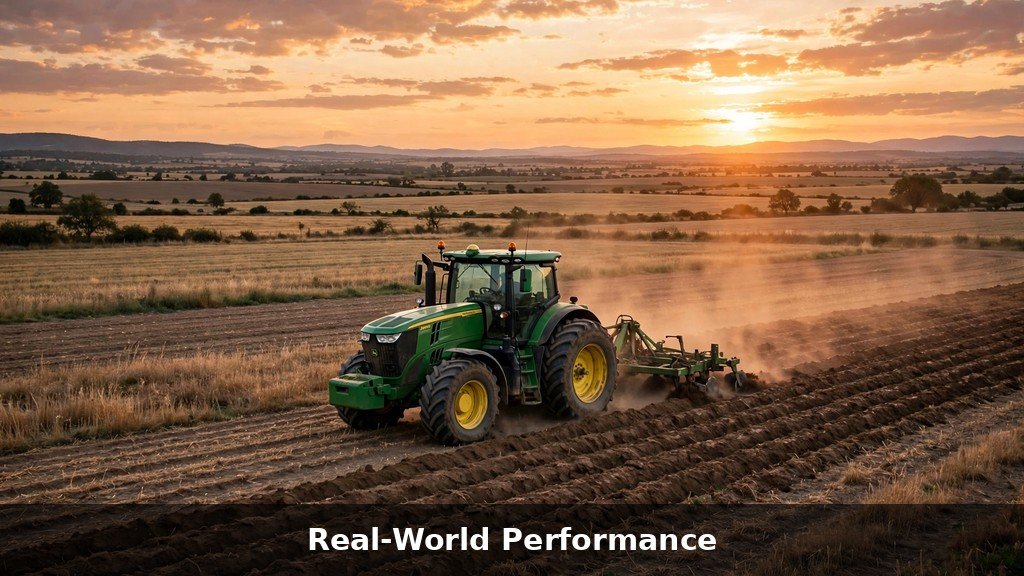
The 8R exists for pulling big implements across big acres. John Deere 8R Series performance in the field comes down to torque at low rpm, weight on the ground, and hydraulics that keep up.
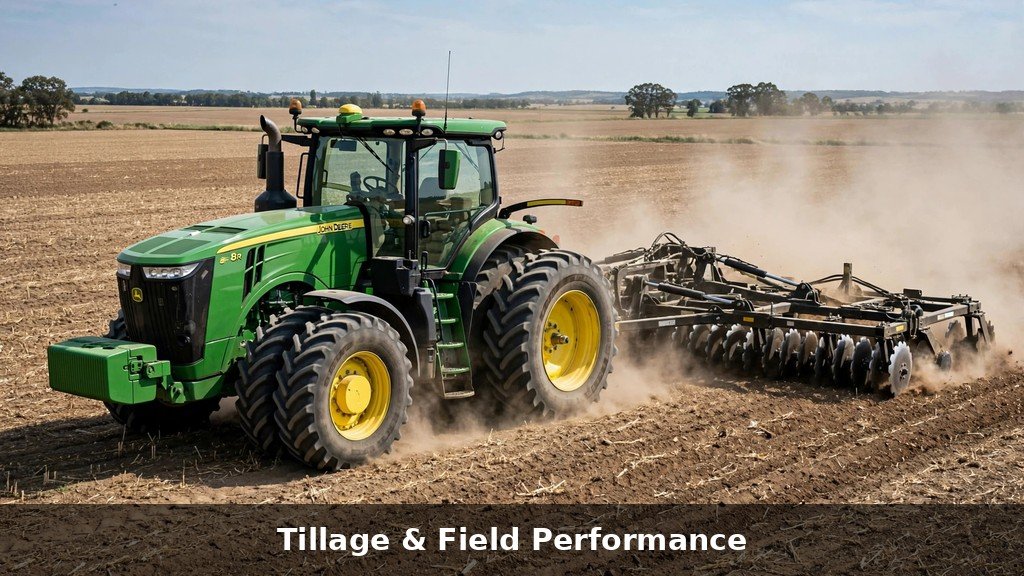
Tillage, Planting, Seeding and Heavy Implement Operation
Every 8R runs a John Deere PowerTech 9.0-liter in-line six (549 cu in.) with dual turbochargers — a variable-geometry turbo plus a fixed-geometry turbo in series — air-to-air aftercooling, cooled EGR, and wet-sleeve liners. US Final Tier 4 aftertreatment is DOC + DPF + SCR with DEF, verified on US-spec machines (engine family MJDXL09.0333). Rated speed is 2,100 rpm; peak torque arrives at 1,600 rpm — 1,277 lb-ft on the 8R 370, 1,365 lb-ft on the 8R 410 — with 40 percent PTO torque rise and a 10 percent power bulge. That torque rise lets the tractor lug down under load instead of forcing a downshift mid-pass.
Intelligent Power Management adds roughly 35 hp (FT4/Stage V) or 10 percent power boost — up to 407 hp maximum on the 8R 370, 443 hp on the 8R 410 — engaging during transport above about 14 mph and mobile PTO work. The PTO is a 1,000-rpm 1.75-inch 20-spline shaft standard, with 1,000/1,000E economy options shiftable from the cab and an optional 1,000-rpm front PTO. Rated PTO power runs 182 hp (8R 230) to 310 hp (8R 370 and 410).
Hydraulics are a genuine strength here, and a big part of what buyers mean by John Deere 8R Series performance. The standard 85-cc pump delivers 60 gpm and the optional dual-pump system reaches 84 gpm, with six rear SCVs and two front SCVs available. The 3/4-inch high-flow coupler option pushes up to 42 gpm to a single output for the hungriest implements, and take-out oil capacity is 10.6 gallons standard or 23.8 gallons with the auxiliary tank — real capacity for air seeders and big planters. The system makes its full 60 gpm at just 1,500 engine rpm, so the engine can loaf while the hydraulics work.
The video below shows an 8R-series tractor at work in the field — the kind of sustained heavy-draft operation that defines John Deere 8R Series performance:
Drawbar Pull, Hauling and High-Load Performance
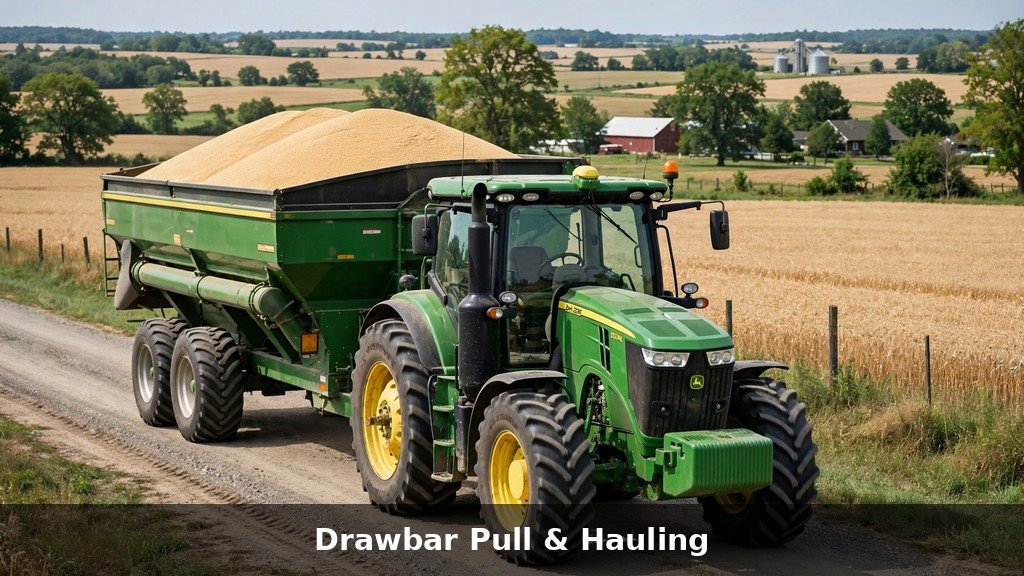
Drawbar work is built around ballast and traction. Base machine weight is 25,800 lb on an 8R 230 (28,000 lb with ILS and e23), and maximum ballast level is 44,100 lb — enough weight to use every horsepower. The rear hitch is Category 3/3N on the smaller models (14,000 lb standard, up to 20,000 lb with options) and Category 4N/3 standard at 20,000 lb on the big end, with an optional front hitch rated at 11,464 lb. The drawbar is a heavy-duty Category 4 with up to 11,000 lb maximum vertical load.
In transport, the 8R benefits from the same things that make it good in the field — another side of John Deere 8R Series performance: IPM’s power boost at road speeds, the e23’s 31-mph (50K) option or the IVT’s stepless road speed, and front suspension (ILS or Triple-Link) that keeps the ride civilized at speed. Owners describe the engine as willing to pull down and recover without shifting — the current 8R’s 40 percent PTO torque rise and 10 percent power bulge at work.
John Deere 8R Series Handling, Comfort and Operating Limits
A 400-hp tractor is only as good as its operator, and John Deere 8R Series performance across real seasons depends heavily on the cab. Deere knows this — the 8R cab is the flagship of the row-crop line, and its comfort is a genuine part of John Deere 8R Series performance, showing in the details that matter after hour ten.
Cab Comfort, Suspension, Controls and Visibility
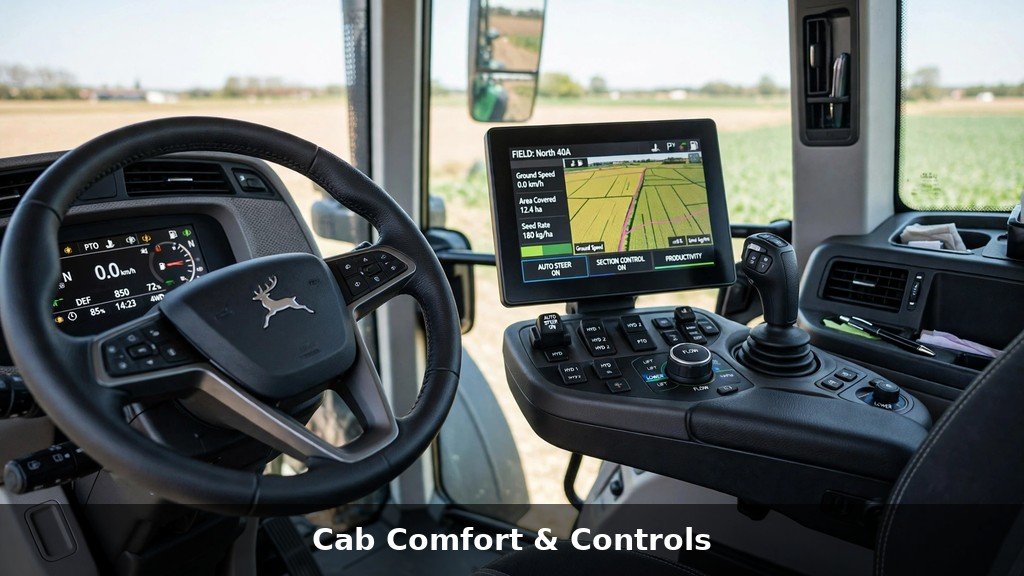
The CommandView cab offers 114 cubic feet of space with 70.6 square feet of glass — visibility in every direction is genuinely good, which matters when watching a 60-foot toolbar or backing under a grain cart. The CommandARM console puts transmission, hydraulics, PTO, and hitch under your right hand, and the CommandCenter display (4600, or the newer G5 12.8-inch) runs AutoTrac guidance, section control, and machine monitoring. Three comfort packages (Select, Premium, Ultimate) step up from a good air seat to the ActiveSeat II, and the ILS or Triple-Link front suspension smooths rough headlands and road travel. For the full spec sheet and pricing picture, our John Deere 8R Series review covers every model in detail.
Lighting is serious: 18 to 24 LED work lights depending on package, fed by 200-amp standard or 330-amp optional alternators and a 1,900-CCA battery bank. CommandPRO — the joystick driving control — is the feature reviewers single out most for loader and transport work.
Traction, Stability, Ballast and Field Conditions
Traction is where ballast strategy makes or breaks John Deere 8R Series performance. The chassis is rated for up to 44,100 lb ballasted, and Deere’s guidance is to ballast for the job: heavy for primary tillage, lighter for planting and transport. Wheel slip in the 5–8 percent range is the target for maximum pull efficiency — below that you carry dead weight, above it you burn fuel spinning tires, and getting this right is a big part of John Deere 8R Series performance. The ILS front suspension option improves traction over rough ground by keeping tires in contact.
Operating limits are honest ones. The 8R is big and heavy: 261 inches long, 121 inches of wheelbase, up to 44,100 lb ballasted. Tight headlands, narrow gates, and soft wet ground are its natural enemies — on wet ground the weight that gives traction in dry conditions becomes compaction. The other limit is fuel: at 12–18 gph in heavy draft, a long day is 150–250 gallons, so the 192-gallon tank and the job’s economics need to pencil out together. Our John Deere 8R Series ownership cost guide runs the full per-hour math.
John Deere 8R Series Real-World Owner Experience
Lab numbers tell half the story. The other half of John Deere 8R Series performance lives in owner reports — what delights, what breaks, and what owners would change. The consistent theme across forums and dealer conversations: the powertrain is the strong suit of John Deere 8R Series performance; complaints center on complexity and cost rather than capability.
Owner-Reported Benefits, Complaints and Trade-Offs
On the benefit side, owners praise the 9.0L’s torque and the e23’s shifting — the Efficiency Manager’s automatic rpm matching gets specific callouts from operators who came from older fixed-step tractors. The cab gets near-universal praise for long days. Several owners say their 8R does more work per gallon than the tractor it replaced — exactly the John Deere 8R Series performance the lab numbers predict.
On the complaint side, the themes are familiar for any modern high-horsepower tractor: DEF-system faults and derates (usually stale DEF or sensor issues, per owner reports), DPF regeneration frequency at light load, and the sheer cost of parts and dealer service at this size. A few owners mention the e23 shifting harshly until recalibrated, and that software updates matter — keeping the machine current is not optional. Our John Deere 8R Series maintenance guide walks through each one with service intervals and costs.
Choosing the Right Model and Transmission for Your Work
When it comes to John Deere 8R Series performance, model choice comes down to implements. Matching implements to models is the first rule of John Deere 8R Series performance: the 8R 230 and 250 suit 12- to 24-row planters, mid-size grain carts, and secondary tillage; the 280 and 310 cover heavy secondary tillage and large planters; the 340, 370, and 410 are primary-tillage and big-air-seeder territory. Do not buy horsepower you cannot use, but do not undersize either: a 230 straining at full load all day drinks nearly as much as a 310 loafing.
Transmission choice is the other big decision. The e23 PowerShift is the default: 23 forward speeds with 15 percent steps, Efficiency Manager, and 26 or 31 mph road speeds. The 16-speed PowerShift is the value play — simpler, cheaper, fine for steady draft work where you set a gear and stay in it. The AutoPowr IVT (and eAutoPowr EVT on the larger models) is the pick for mixed work and transport-heavy operations; it costs more up front but owners report it pays back in fuel and ease. For the smaller row-crop line, see our John Deere 7R Series performance guide and 6R Series performance guide.
Frequently Asked Questions About John Deere 8R Series Performance
Quick answers to the performance questions 8R shoppers ask most.
How much fuel does a John Deere 8R use per hour?
Independent OECD testing of the previous-generation 8370R measured 18.95 gph at standard PTO power (361.8 hp) and 19.5 gph at maximum power — the ceiling for John Deere 8R Series performance fuel use. Owner-reported figures for the current 8R: 6–9 gph light duty and transport, 8–11 gph general farm work, 10–14 gph PTO field work, and 12–18 gph heavy draft. Plan on a blended 10–14 gph for a mixed working day when budgeting John Deere 8R Series performance.
Which 8R transmission is best for heavy tillage?
For steady, heavy draft work the e23 PowerShift and the 16-speed PowerShift both do the job for John Deere 8R Series performance — the e23’s Efficiency Manager gives it an edge in variable loads because it manages engine rpm automatically. For mixed work with lots of transport and headland turns, the AutoPowr IVT (or eAutoPowr EVT) keeps the engine in its efficiency sweet spot and is the easiest to operate. The 16-speed is the simplest and cheapest option and suits operators who set a gear and stay in it.
What is Intelligent Power Management and when does it work?
IPM is Deere’s power boost: roughly 35 hp (FT4/Stage V) or 10 percent depending on model — up to 407 hp maximum on the 8R 370 and 443 hp on the 8R 410. It engages during transport above about 14 mph and during mobile PTO applications — a useful but situational slice of John Deere 8R Series performance. It does not add power in steady draft work at field speeds, so buy the model whose rated power covers your heaviest draft implement.
Does the 8R’s DEF and DPF system affect day-to-day performance?
In normal operation, no. The US Final Tier 4 system (DOC + DPF + SCR with DEF) regenerates the DPF automatically, and the 9.8-gallon DEF tank is sized to last between 192-gallon fuel fills, so aftertreatment never interrupts John Deere 8R Series performance in normal work. The only performance impact owners report is when something goes wrong — stale DEF or a sensor fault can trigger a derate that cuts power until the fault is cleared. Use fresh DEF, keep the tank reasonably full, and the system stays invisible — no impact on John Deere 8R Series performance.
What can an 8R actually pull?
With up to 44,100 lb of ballast capacity, a Category 4N/3 rear hitch lifting up to 20,000 lb, and 1,277–1,365 lb-ft of torque at 1,600 rpm on the big models, the 8R handles the largest wheeled-tractor implements made: 60-foot air seeders, 24-row and larger planters, big discs and rippers, and the heaviest grain carts. The practical limit is usually traction and soil conditions, not power — ballast for the job and keep wheel slip in the 5–8 percent range.
How does 8R field performance compare to the 7R?
The 8R picks up where the 7R leaves off: roughly 20–80 more rated horsepower at the top end, a clear step up in John Deere 8R Series performance, a heavier chassis (25,800–28,000 lb base versus the 7R’s 22,000 lb), higher hydraulic flow (60/84 gpm versus 43/59 gpm), and bigger hitch and drawbar capacity. For 1,500–3,000-acre row-crop operations the 7R is often the sweet spot; the 8R earns its keep on bigger acreage and bigger implements where the extra weight and power translate directly into acres per hour.