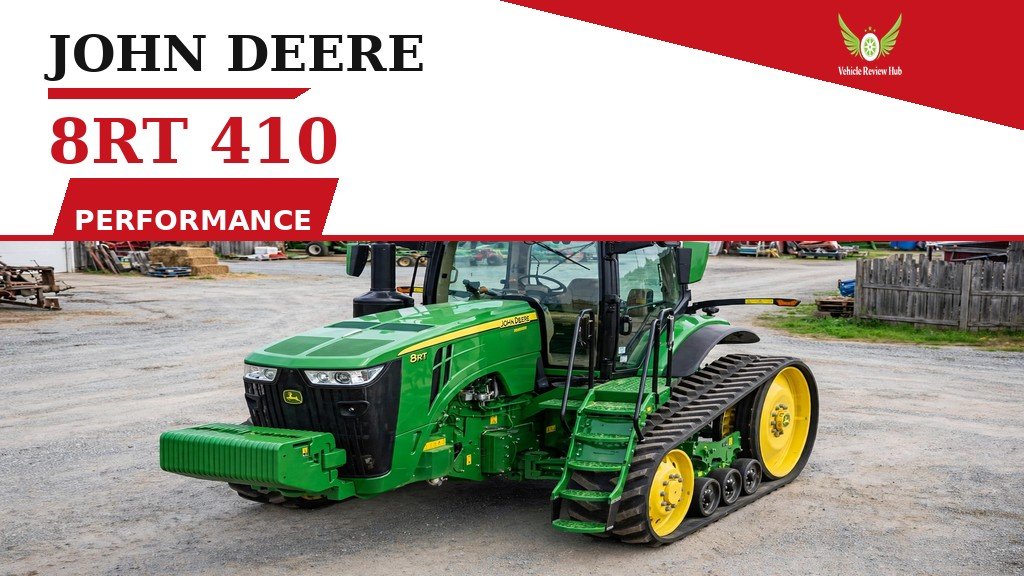
The short answer on John Deere 8RT 410 performance is that this two-track tractor turns a 410-horsepower rating into usable field work: a 9.0-liter PowerTech diesel, 310 rated PTO horsepower, a 60-gallon-per-minute hydraulic system, and two wide rubber tracks that put power on the ground with far less slip than wheels. This guide to John Deere 8RT 410 performance covers fuel use, drawbar power, track traction, operator comfort, and the real strengths and limits of running a 410-horsepower tracked tractor on a large farm.
One honest note frames this John Deere 8RT 410 performance guide. No Nebraska or OECD tractor test report specific to the 8RT 410 could be retrieved at the time of writing, so no tested PTO, fuel, or drawbar figures for this model are quoted here. The power and capacity figures below are the manufacturer’s rated specifications, and every gallons-per-hour number is a labeled planning estimate, not a test result.
John Deere 8RT 410 Fuel Consumption and Operating Efficiency
Fuel is the largest running cost on any 410-horsepower tractor, and John Deere 8RT 410 performance here is two stories: how much diesel the 9.0-liter engine burns under load, and how the transmission keeps that burn low.
Nebraska Tractor Test Results at Maximum PTO Power
Readers looking for Nebraska Tractor Test results at maximum PTO power deserve a straight answer: no Nebraska test report for the John Deere 8RT 410 specifically was found in the published test library, and no OECD test summary for this exact two-track model was retrievable either. The University of Nebraska-Lincoln test laboratory publishes its reports through its digital archive, and a search of that archive turned up tests for other John Deere models but nothing specific to the 8RT 410. Any article quoting “tested” fuel or PTO numbers for the 8RT 410 is likely quoting a wheeled 8R 410 test or a dealer figure dressed up as a test result. This John Deere 8RT 410 performance guide will not do that.
What can be stated with confidence is the rated side of John Deere 8RT 410 performance. The PowerTech PSS 9.0-liter six-cylinder is rated at 410 horsepower at 2,100 rpm, with maximum power of 443 horsepower under the 8 percent Intelligent Power Management boost, and rated PTO power of 310 horsepower SAE, as listed on the dealer specification page for the 8RT 410. Peak torque is 1,365 lb-ft at 1,600 rpm, with a 40 percent PTO torque rise. Anyone comparing John Deere 8RT 410 performance with a tested rival should compare rated against rated, or tested against tested, and not mix the two.
How Implement Load, Engine Speed and Field Conditions Affect Fuel Use
Fuel use on a tractor of this size swings far more with the job than with the tractor itself, and that is the central fact of John Deere 8RT 410 performance in daily work. A light road transport run, a medium-load planting pass, and a full-depth ripping pass can differ by a factor of two or more in gallons per hour, because the engine only burns what the load demands.
Engine speed is the lever the operator actually controls, and it matters as much as load in John Deere 8RT 410 performance. The e23 PowerShift’s Efficiency Manager and the eAutoPowr continuously variable transmission both let the engine drop to a more efficient speed while ground speed stays where the implement needs it. Do not run a planting pass at 2,100 rpm out of habit: dropping several hundred rpm at part load is where the real fuel savings live. The eAutoPowr’s stepless range, from 0.03 to 26 mph, makes that speed matching finer than any stepped gearbox.
Field conditions add the third variable to John Deere 8RT 410 performance. Wet, soft ground increases rolling resistance and slip, which burns fuel without doing useful work; dry, firm ground lets the tracks grip and the same pass costs less. Match the track setup to the job, avoid unnecessary high rpm, minimize idle time, and learn from the tractor’s own fuel-use display.
| Job type (planning estimates only) | Estimated fuel use | Hours per 202-gallon tank |
|---|---|---|
| Light work, road transport, idling | 6–9 gal/hr | Roughly 22–34 hours |
| Planting, spraying, medium draft | 9–13 gal/hr | Roughly 15–22 hours |
| Heavy tillage, ripping, high draft | 14–19 gal/hr | Roughly 11–14 hours |
| Blended season example (900 hrs at ~12 gal/hr) | ~10,800 gallons per season | ~$37,800 at $3.50/gal (estimate) |
Those bands explain why John Deere 8RT 410 performance feels so different from farm to farm.
John Deere 8RT 410 Field Performance and Drawbar Power
Drawbar performance is where a tracked tractor earns its price, and John Deere 8RT 410 performance here is about traction as much as horsepower. The rated figures behind this section are the 310-horsepower PTO rating, the 1,365 lb-ft torque peak, and a base weight of 34,400 pounds that can be ballasted to a maximum permissible weight of 40,100 pounds, all detailed in the full 8RT 410 specification review.
Heavy Tillage, Planting and High-Demand Implement Work
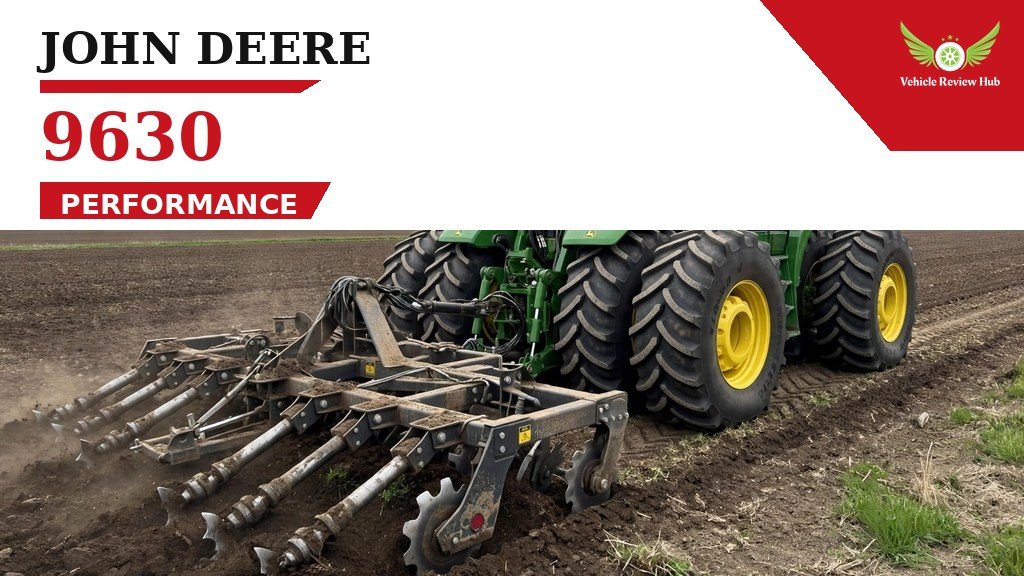
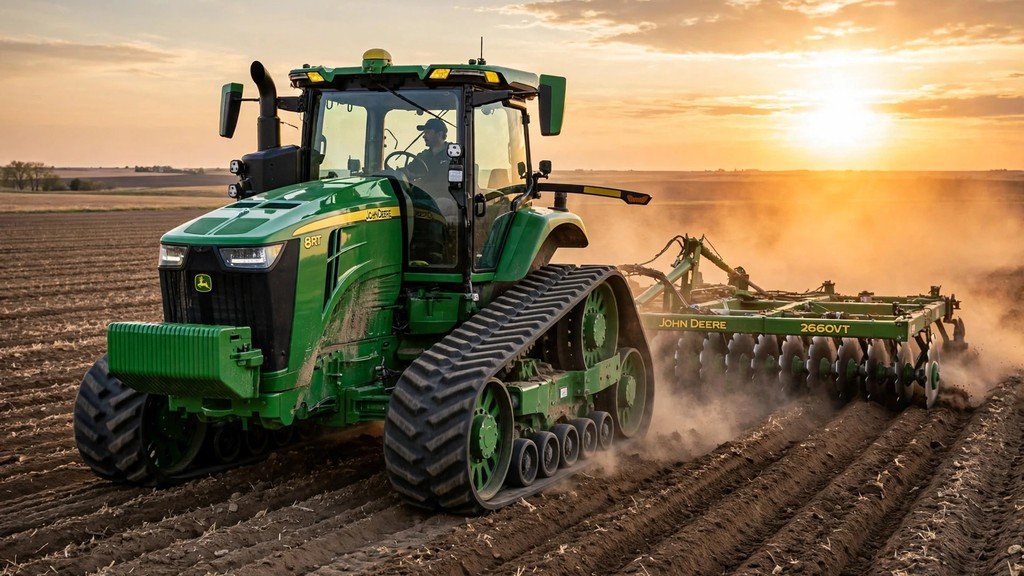
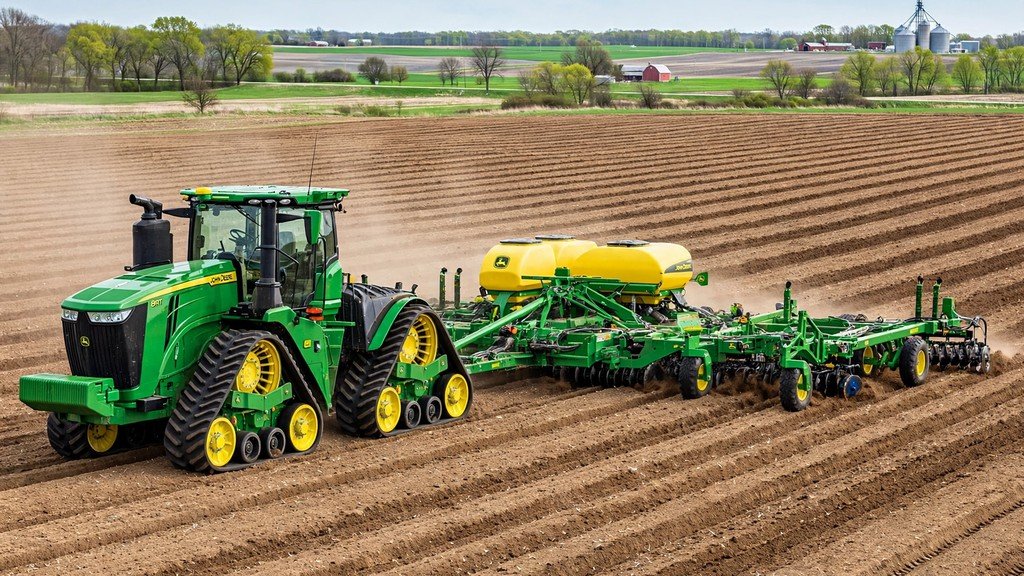
Heavy tillage is the natural home of John Deere 8RT 410 performance. Deep ripping and heavy cultivators are the high-draft jobs where a tracked tractor’s long footprint pays off, turning engine power into forward motion instead of wheelspin. The 40 percent PTO torque rise absorbs draft spikes without forcing a gear change.
Planting is the other flagship job for John Deere 8RT 410 performance, rewarding precise speed control and the ability to carry a large planter plus its seed and fertilizer load. The eAutoPowr’s stepless control holds an exact planting speed across varying soil while engine speed floats to the load. The 60-gallon-per-minute pump, with 35 gallons per minute at a single rear valve through half-inch couplers (42 through three-quarter-inch), runs the fans, markers, and downforce large planters demand.
The video below shows a four-track sibling, the 8RX 410, working with a 24-row ExactShot planter — the same power class at work, not this exact two-track model:
High-demand PTO work rounds out John Deere 8RT 410 performance in the field. A 310-horsepower PTO rating covers large rotary tillers, big mowers, and heavy forage equipment. Sizing the implement to the tractor, not the other way around, is the core discipline of John Deere 8RT 410 performance.
Tested PTO Output, Drawbar Pull and Track Traction
On tested output, the honest position of this John Deere 8RT 410 performance guide is the same as in the fuel section: no tested PTO output or drawbar pull figure specific to the 8RT 410 was retrievable, so none is quoted here. No drawbar horsepower, maximum pull, or slip figure appears here, because borrowing those numbers from a wheeled 8R 410 test would mislead a buyer sizing implements. Base weight is 34,400 pounds on 25-inch tracks, ballastable to 39,000 pounds, with a 40,100-pound maximum permissible weight. That weight over two long tracks converts engine power into pull: more grip before slip means more of each gallon becomes acres covered.
Track traction also changes how John Deere 8RT 410 performance behaves in marginal conditions. In wet ground where a wheeled tractor would stop on wheelspin, a tracked tractor typically keeps moving, extending the workable window — and a day gained at planting or harvest is worth more than a few extra horsepower on a dry day. John Deere 8RT 410 performance should be judged on the ground you actually farm.
John Deere 8RT 410 Track System and Operator Comfort
The track system is the defining hardware of this tractor, and John Deere 8RT 410 performance cannot be understood without it. Comfort is the other half of this section, because a 410-horsepower tractor that runs 14-hour days lives or dies on its cab.
Track Width, Ground Contact and Soil Compaction Considerations
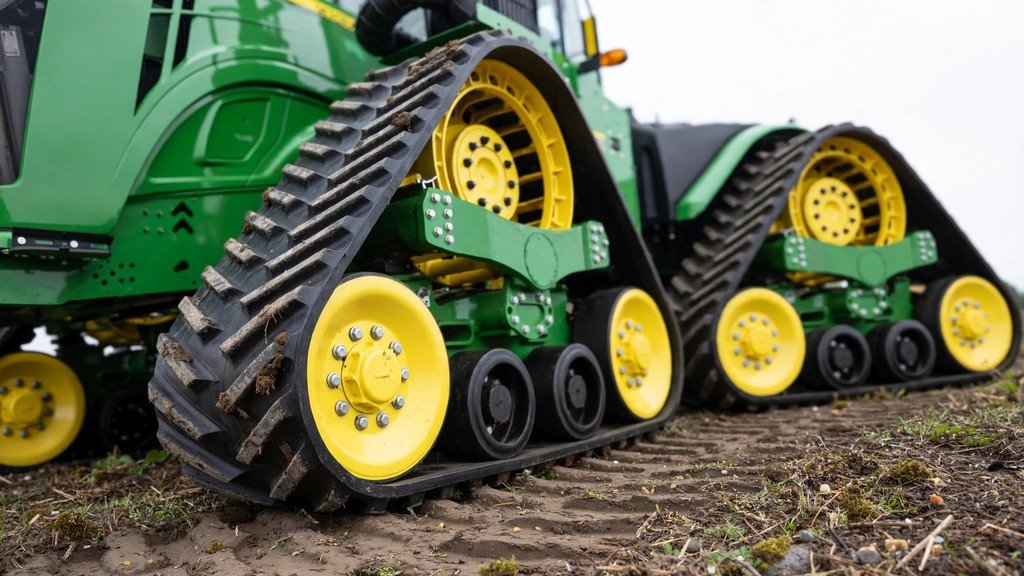
Track width choice is the most consequential configuration decision in John Deere 8RT 410 performance after transmission. The standard width is 25 inches, with 16.5-inch, 18-inch, 24-inch, and 30-inch options available, as shown on the dealer track and capacity listing for the 8RT 410. Narrow tracks suit row-crop work; wide tracks suit tillage and soft ground, where the larger footprint spreads 34,400-plus pounds over more soil and reduces ground pressure. That long-term soil benefit is part of John Deere 8RT 410 performance that never appears on a spec sheet, but it shows up in yields years later.
Ground contact length matters as much as width in John Deere 8RT 410 performance. A track’s footprint is long as well as wide, so the total contact area is far larger than four tires of comparable size, and the weight is distributed along that length rather than concentrated under four round patches. Track selection should follow your soil: wet heavy clay argues for wider tracks, firm ground and narrow rows for narrower ones. Most buyers land on 24- or 25-inch tracks, usually right for mixed work. Tracks do not eliminate compaction — a 40,000-pound tractor still loads the soil — but they reduce peak pressure and spread the load.
Cab Suspension, Visibility and Long Working Days
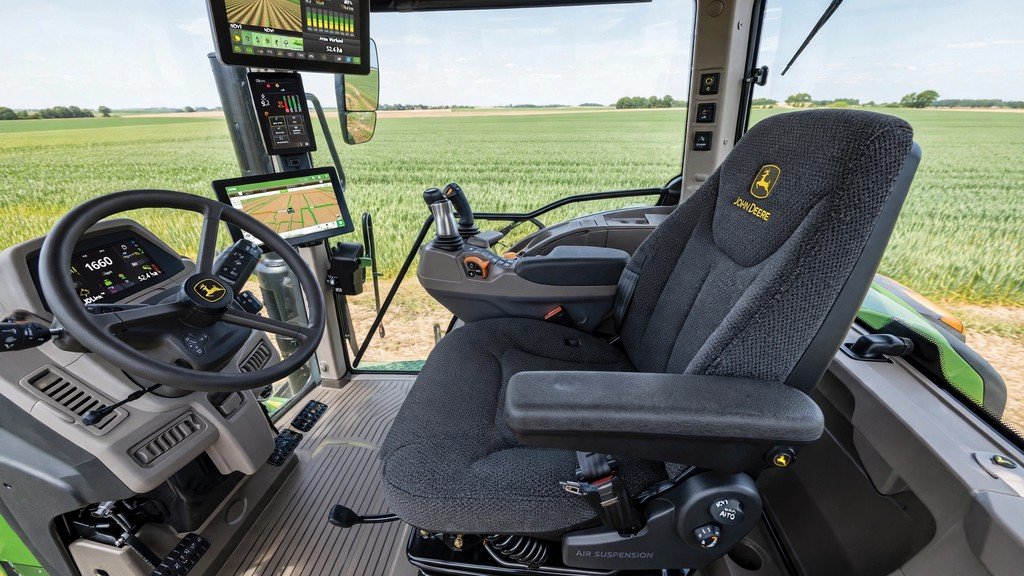
Long days are where cab design stops being a luxury and becomes part of John Deere 8RT 410 performance, because a tired operator makes slower, less precise passes. The cab rides on a standard four-post suspension, isolating the operator from much of the vertical movement tracks transmit, and the air-suspension seat adds a second layer. The seat swivels 25 degrees left and 40 degrees right, reducing neck and back strain on days spent glancing back at the implement. The cab offers 114 cubic feet of volume and 70.18 square feet of glass, so visibility is genuinely panoramic.
Controls and displays complete the comfort picture in John Deere 8RT 410 performance. The standard 10-inch 4600 CommandCenter display carries guidance, implement control, and machine monitoring, with integrated AutoTrac and JDLink hardware standard. AutoTrac guidance reduces overlap on every pass, saving real money in seed, chemical, and fuel across thousands of acres. 18 halogen work lights are standard, with 18- or 22-LED options, because the working day does not end at sunset during planting and harvest.
John Deere 8RT 410 Real-World Farm Experience
This section of the John Deere 8RT 410 performance guide pulls together what the rated figures, the track system, and the cab mean on a large farm across a full season.
Strengths and Limitations in Large-Scale Field Operations
The clearest strength in real-world John Deere 8RT 410 performance is traction in difficult conditions. Wet springs, soft headlands, and heavy draft work are where the two-track design earns its keep. The second strength is stability of output: torque rise and the IPM boost hold speed through load spikes, keeping implement depth and seed placement consistent. The third strength is versatility — the same tractor rips in autumn, plants in spring, and runs a large sprayer in summer, with hitch lift of 20,000 pounds standard (26,729 maximum) and a Category 4 drawbar.
The limitations are equally real in John Deere 8RT 410 performance. Road transport is the first: a tracked tractor is slower on the road, and frequent road moves add undercarriage wear. Track replacement cost is the second — a full set is a major expense to budget from day one, as the ownership-cost figures for the 8RT 410 will show. Undercarriage maintenance is the third: track tension, alignment, and roller condition all need regular attention. Finally, the Final Tier 4 DOC/DPF/SCR system with its 8.3-gallon DEF tank adds a maintenance layer older tractors never had. None of these limitations disqualifies the tractor, but all belong in a realistic John Deere 8RT 410 performance assessment.
Service intervals frame the ownership rhythm behind John Deere 8RT 410 performance: engine oil changes at 500 hours, hydraulic and transmission oil at 1,500 hours, and engine coolant at 6,000 hours, according to dealer specification data. The full service picture is in the 8RT 410 maintenance schedule and inspection checks: a well-kept track system holds traction and efficiency, a neglected one quietly costs fuel, speed, and soil.
Matching Tractor Power, Ballast and Implement Requirements
Matching is the skill that turns rated John Deere 8RT 410 performance into actual acres per hour. The rule is to size the implement to the tractor’s traction and hydraulic capacity, not just its horsepower. Soil type decides more than any table: heavy ground narrows the right implement, light ground widens it — calibrate with a test pass in your own field.
Ballast tuning is the second half of matching in John Deere 8RT 410 performance. Base weight of 34,400 pounds is a starting point: add ballast toward the 39,000-pound maximum for heavy draft work, remove it for lighter work. Track width and transmission choice complete the setup: wider tracks for soft ground, narrower for row work; the e23 PowerShift for a familiar stepped gearbox, the eAutoPowr for precision speed control. The buyers who get the most from John Deere 8RT 410 performance treat all four adjustments — implement, ballast, track width, and transmission mode — as a single setup decision for each job.
John Deere 8RT 410 Performance: Frequently Asked Questions
Questions buyers and operators actually ask about John Deere 8RT 410 performance, answered from the rated specifications and the honest limits noted in this guide.
How much horsepower does the John Deere 8RT 410 have?
John Deere 8RT 410 performance starts with a rated 410 horsepower at 2,100 rpm from the 9.0-liter PowerTech diesel, rising to 443 horsepower maximum under the 8 percent Intelligent Power Management boost. Rated PTO power is 310 horsepower SAE.
Is there a Nebraska Tractor Test for the John Deere 8RT 410?
No Nebraska or OECD test report specific to the 8RT 410 could be retrieved at the time of writing, so this John Deere 8RT 410 performance guide quotes no tested PTO, fuel, or drawbar figures for this model. Rated manufacturer figures are used instead, and fuel numbers are labeled planning estimates.
How much fuel does the 8RT 410 use per hour?
There is no verified tested figure for John Deere 8RT 410 performance, so use planning estimates only: roughly 6–9 gallons per hour for light work and transport, 9–13 for planting and medium draft, and 14–19 for heavy tillage. Actual use depends on implement, depth, speed, and soil.
How far will the 202-gallon tank take the 8RT 410?
At the planning estimates in this John Deere 8RT 410 performance guide, a full 202-gallon tank covers roughly 11–14 hours of heavy tillage, 15–22 hours of planting, or 22–34 hours of light work.
What engine does the 8RT 410 use?
The John Deere PowerTech PSS 9.0-liter inline six-cylinder diesel, with dual turbochargers, air-to-air aftercooling, cooled exhaust gas recirculation, and Final Tier 4 aftertreatment (DOC, DPF, and SCR). It is B20 biodiesel compatible, and it is the heart of John Deere 8RT 410 performance.
What is the difference between the e23 and eAutoPowr transmissions?
The standard e23 PowerShift in this John Deere 8RT 410 performance guide offers 23 forward and 11 reverse speeds to 24.9 mph with Efficiency Manager, which drops engine speed at part load. The optional eAutoPowr is a stepless EVT from 0.03 to 26 mph that holds any exact ground speed at the most efficient engine speed.
How much can the 8RT 410 lift and pull?
The Category 4N/3 hitch lifts 20,000 pounds standard at 24 inches behind the hitch point (26,729 maximum), and the Category 4 drawbar carries 4,950 pounds vertical load standard (11,000 optional). No tested drawbar pull figure for John Deere 8RT 410 performance was retrievable, so none is quoted.
What track widths are available on the 8RT 410?
Five widths: 16.5, 18, 24, 25 (standard), and 30 inches, on Camso friction-drive track belts with three mid-rollers per side. Wider tracks lower ground pressure and suit soft ground and tillage; narrower tracks suit row-crop work, and track choice is a key part of John Deere 8RT 410 performance.
Do tracks really reduce soil compaction?
They reduce peak ground pressure by spreading weight over a much longer footprint, helping root growth and water infiltration, but they do not eliminate compaction. Controlled-traffic farming pairs well with John Deere 8RT 410 performance because compaction stays in known lanes.
How much does the 8RT 410 weigh, and how much ballast can it carry?
Base weight is 34,400 pounds on 25-inch tracks, maximum ballast 39,000 pounds, maximum permissible weight 40,100 pounds, all confirmed on the dealer weight and ballast listing for the 8RT 410. Ballast should be tuned to the job: heavy for ripping, lighter for planting and spraying, to keep John Deere 8RT 410 performance efficient.
What implements suit the 8RT 410 best?
Large-scale tillage tools, wide planters, big sprayers, and high-demand PTO implements — where traction, 310 PTO horsepower, and 60 gallons per minute of flow all matter at once. Size the implement to your soil and depth with a test pass, rather than buying on horsepower alone, for the best John Deere 8RT 410 performance.
Is the 8RT 410 good for long working days?
Yes, by design: four-post cab suspension, air-suspension swivel seat, 114 cubic feet of cab volume, 70.18 square feet of glass, AutoTrac guidance, and LED work lights all support 12- to 16-hour days. Operator fatigue is the hidden cost in John Deere 8RT 410 performance, and this cab is built to limit it.
What are the main limitations of the 8RT 410?
Road transport is slower and harder on the undercarriage, track replacement is a major periodic cost, the undercarriage needs regular tension and alignment attention, and the Final Tier 4 system with its 8.3-gallon DEF tank adds maintenance older tractors never had. All are manageable, but all belong in any honest John Deere 8RT 410 performance assessment.
Does the 8RT 410 use DEF?
Yes. The Final Tier 4 aftertreatment system uses selective catalytic reduction, fed by an 8.3-gallon DEF tank. DEF consumption is a small but real running cost in John Deere 8RT 410 performance, and the tank should be checked as part of the daily routine during heavy work.