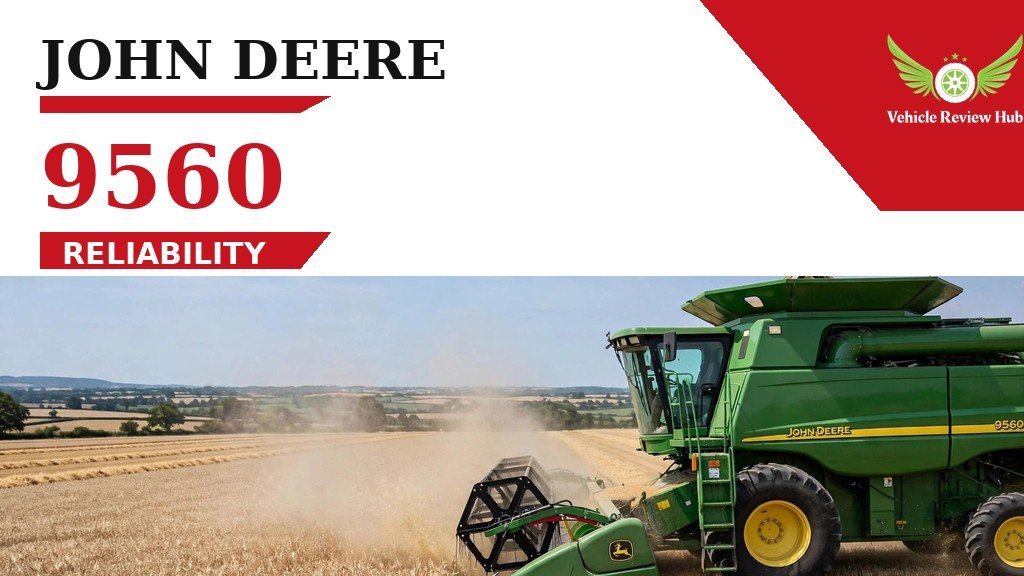
A used John Deere 9560 combine can be a smart harvest buy or an expensive lesson, and the difference is almost always John Deere 9560 combine maintenance. This guide covers John Deere 9560 combine maintenance for both machines that wear the badge: the conventional straw-walker 9560 and the 9560 STS single-rotor combine. Good John Deere 9560 combine maintenance starts with that identification.
The short version of John Deere 9560 combine maintenance is this: the machine runs on two hour meters, not one. Engine hours count all running time, while separator hours count only the time the threshing system actually worked. Greasing discipline, clean fuel, and a clean cooling package matter more than any single repair in John Deere 9560 combine maintenance.
John Deere 9560 Combine Maintenance Schedule and Service Costs
John Deere 9560 combine maintenance begins with the right manual. The conventional 9560 walker (6.8L, 220 or 240 horsepower, 204-bushel grain tank) is covered by Deere operator manual OMH215826. The 9560 STS (8.1L, 265 horsepower, 220-bushel grain tank) is covered by manual OMH215847. Later STS production switched to a 6.8L PowerTech Plus engine with the Bullet Rotor for model-year 2007. Confirm the engine by the serial plate, since John Deere 9560 combine maintenance intervals depend on which engine you actually own.
Engine Oil, Fuel Filters, Air Filters and Cooling System
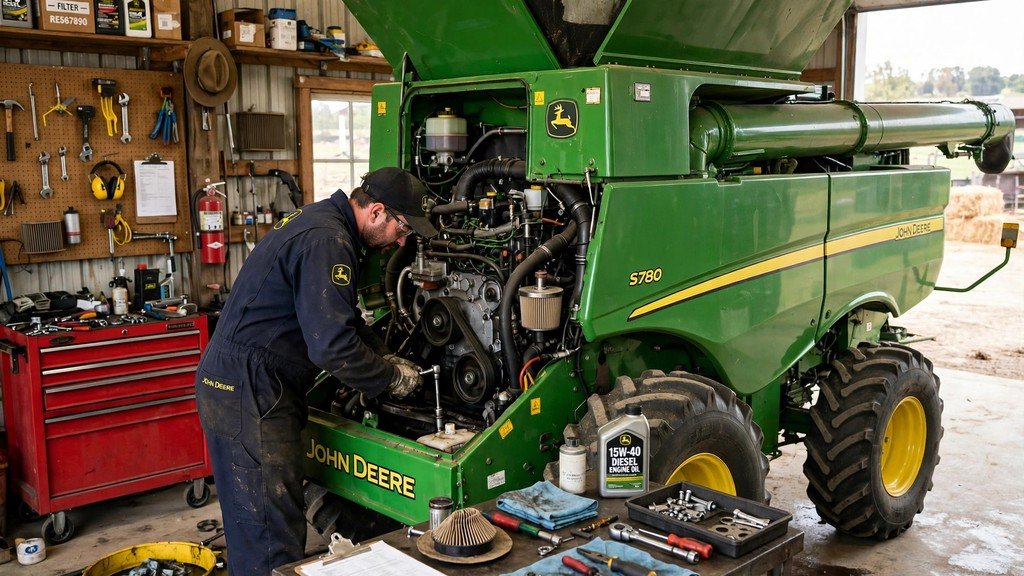
On the walker 9560, Deere’s operator manual sets the first oil change at 100 hours, then 250 hours with TORQ-GARD SUPREME oil, extended to 375 hours with PLUS-50 oil and a John Deere filter. If fuel sulfur exceeds 0.5 percent, the interval drops to 100 hours. For John Deere 9560 combine maintenance, change oil and filter at least once a year before harvest regardless of hours.
Fuel filters deserve special attention in any John Deere 9560 combine maintenance routine. Owners of 60 Series combines report fuel filters plugging often, and one long-term owner solved it by fitting a 2-micron filter on the farm supply tank. That is an owner workaround, not a factory instruction, but it points at the real lesson of John Deere 9560 combine maintenance: dirty fuel is the most common preventable cause of a combine stopping in the field.
The cooling package is the third daily check in John Deere 9560 combine maintenance and the one most often skipped. The STS specification sheet lists 10.6 gallons of cooling system capacity. Blow the cooling package out from the clean side every day during harvest.
Hydraulic Filters, Feederhouse and Harvesting-System Service
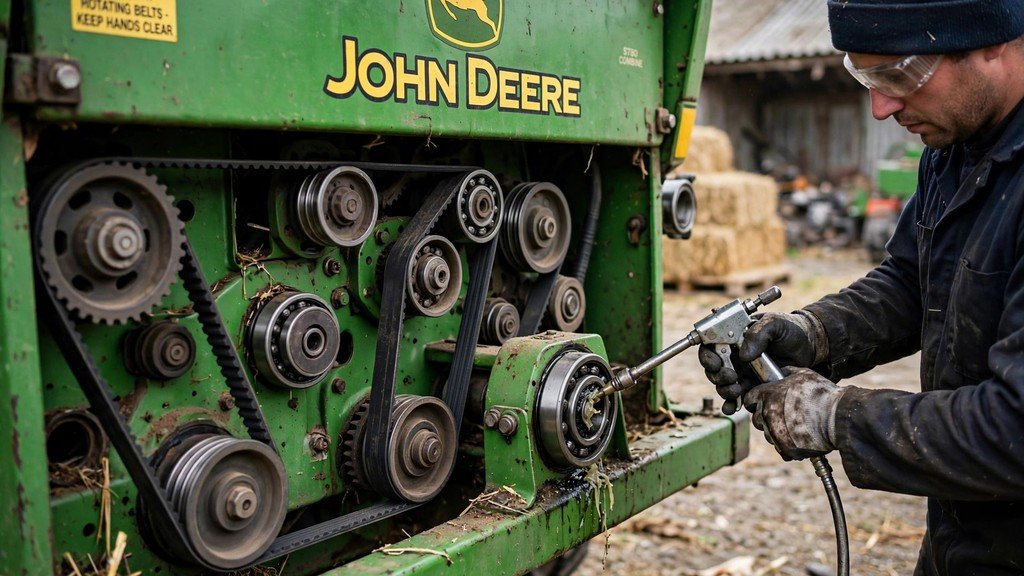
Greasing is where John Deere 9560 combine maintenance succeeds or fails. On both the walker and the STS, final drive outer bearings and rear axle spindle bearings are greased every 50 hours normally but every 10 hours in mud and water. The feederhouse reverser gearcase follows the same pattern in John Deere 9560 combine maintenance: grease each fitting 10 to 15 times every 50 hours normally, but 2 to 3 times every 10 hours in severe conditions or high-yielding corn, then cycle the sheave. The STS operator manual adds 200-hour service for the cab filter, tire pressure, and bolt torque, and 400-hour service for the unloading auger gearcases, separator U-joint, chopper and beater bearings, feed accelerator bearing, and chopper rotor bearings. Miss the 400-hour round in your John Deere 9560 combine maintenance schedule and you gamble with the parts that stop a harvest when they fail.
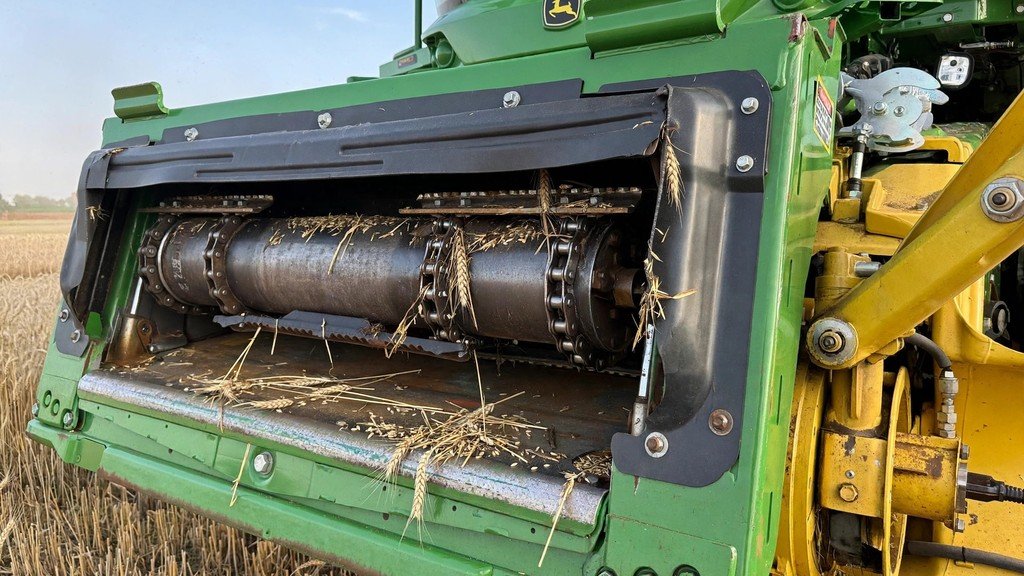
The feederhouse needs a hands-on check before every season as part of John Deere 9560 combine maintenance. Raise it, set the safety stop, and inspect the chain tension, slats, and top shaft sprockets for wear. Model-year 2007 STS machines gained bolted feederhouse slats instead of riveted ones for easier service. For the harvesting system, John Deere 9560 combine maintenance diverges by machine type. On a walker, inspect the walkers, walker bearings, and the shoe: chaffer, sieve, and shaker pan arms. On an STS, inspect the rotor, threshing elements, tines, and concaves, and check cap screw torque to the manual’s 90 N·m (66 lb-ft).
Service costs in John Deere 9560 combine maintenance are planning estimates unless your dealer quotes the job. Budget $1,500 to $3,000 a year for routine parts and fluids DIY, and $3,000 to $6,000 a year with a dealer.
| Service item | Walker 9560 | 9560 STS |
|---|---|---|
| First engine oil and filter change | 100 hours | 100 hours |
| Engine oil and filter, standard interval | 250 hours (375 with PLUS-50) | Per manual; shorten in dusty work |
| Engine oil interval, fuel over 0.5% sulfur | 100 hours | Shorten interval; check manual |
| Bearing and reverser grease | 50 hours; 10 hours in mud/water | 50 hours; 10 hours in mud/water |
| Cab filter, tires, bolt torque | Per manual schedule | Every 200 hours |
| Auger gearcases, separator U-joint, chopper bearings | Per manual schedule | Every 400 hours |
| Preseason rule, both machines | Full preseason service every year | Full preseason service every year |
John Deere 9560 Combine Reliability and Long-Term Durability
The 9560 family has a reputation for doing honest work for a long time, but that reputation belongs to machines that were serviced, not to the badge itself. John Deere 9560 combine maintenance records are the best predictor of how many more seasons a used machine has in it. The 60 Series launched for 2004.
Engine, Hydrostatic Drive and Separation-System Care
Engine care in John Deere 9560 combine maintenance is conventional diesel care done consistently. The early STS runs the 8.1L 6081HH six-cylinder rated at 265 horsepower with a boost to about 284 horsepower, while the walker runs a 6.8L six-cylinder at 220 or 240 horsepower, and the later STS runs a 6.8L PowerTech Plus. All three are turbocharged, air-to-air aftercooled diesels. For John Deere 9560 combine maintenance, an oil analysis at the annual service is cheap insurance on a used machine.
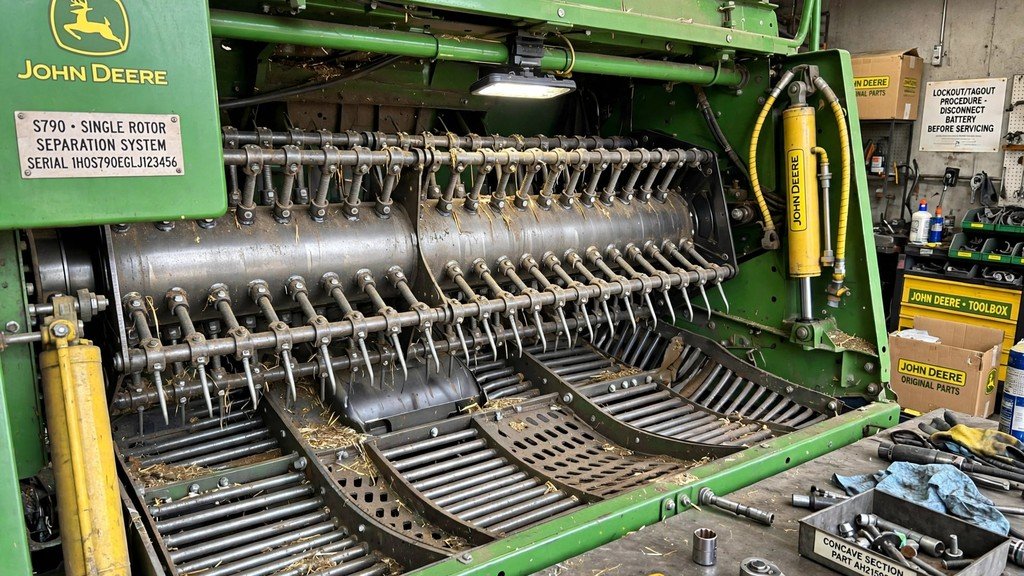
The hydrostatic ground drive is the second system that rewards routine John Deere 9560 combine maintenance. Check the oil level and condition, listen for whine under load, and confirm the three-speed drive shifts cleanly. On the separation side, John Deere 9560 combine maintenance differs by machine: walkers wear bearings and shoe parts, showing noise and rising grain loss, while STS machines wear threshing elements, tines, and concaves, showing poor threshing and cracked grain.
How Engine Hours, Separator Hours and Service History Affect Reliability
Every 9560 buyer must understand the two hour meters, because John Deere 9560 combine maintenance is judged against separator hours as much as engine hours. Engine hours count all running time, including road travel, idling, and unloading. Separator hours, sometimes called thresher hours, count only the time the separator was engaged and threshing. A 2005 9560 STS listed for sale at $44,900 showed 4,049 engine hours but only 2,576 separator hours. A machine where the two numbers are nearly equal has spent almost its whole life threshing, which means more wear on the rotor or walkers, concaves, sieves, and bearings than the engine hours alone suggest. If a seller quotes only one number, ask for the other before you negotiate.
John Deere 9560 Combine Common Problems and Warning Signs
No used combine is trouble-free, and the 9560 family has a well-known list of weak points. Most give warning before they fail outright, but the warnings are easy to miss during harvest. John Deere 9560 combine maintenance means learning the symptoms for your machine type and stopping to check them.
Engine, Cooling, Fuel-System and Hydraulic Symptoms
Hard starting, smoke, and power loss under load usually trace back to fuel or air before they trace back to the engine itself, and systematic John Deere 9560 combine maintenance checks them in that order. Start with the fuel filters and water separator, then the air filter, then the turbocharger hoses and clamps. Owners report fuel filter plugging as a recurring complaint on 60 Series machines, and the practical fix in John Deere 9560 combine maintenance is clean supply fuel plus spare filters on the machine. Overheating usually traces back to the cooling package: a chaff-packed radiator or a slipping rotary screen belt.
Hydraulic symptoms in John Deere 9560 combine maintenance show up as slow header lift, a feederhouse that drifts down, an unloading auger that engages slowly, or a hydrostatic drive that feels weak or noisy. One known wear point is the belt-driven hydraulic pump running off the feederhouse flat belt: owners report its bearings failing when under-greased, a small part that can stop the whole machine. Electrical symptoms deserve the same systematic John Deere 9560 combine maintenance approach. A no-start with no lights or controls usually points at battery connections, grounds, fuses, or relays before it points at a control module. Grain loss monitor sensor pads are a known consumable frustration: owners report them failing repeatedly at more than $100 each, so budget for replacements.
Walker or Rotor Wear, Belts, Bearings and Grain-Loss Checks
On a walker machine, rising grain loss, unusual vibration, or a rattling shoe points at walker bearings, shaker pan arms, or sieve and chaffer adjustment, and John Deere 9560 combine maintenance means inspecting those parts before changing settings. Inspect the shaker pan arms for cracks or broken bolts, a known repair on this family. On an STS, grain loss can come from the rotor or the shoe, and the machine runs out of separating or cleaning capacity before it runs out of power. Owner experience reports that the STS does well in soybeans and shells corn acceptably, but struggles in hard-threshing cereals, and that the FAST beater ahead of the rotor is too aggressive in standard form, causing grain damage in corn. Deere offers beater kits for sensitive crops.
Belts and bearings are the daily wear items in John Deere 9560 combine maintenance on both machines. Check every drive belt for cracks and correct tension, and spin every accessible bearing by hand with the machine shut down and locked out. Chopper knives throw when they are run until worn out, so replace them as a set on schedule rather than one at a time after a failure. The grain-loss check itself is a diagnostic tool in John Deere 9560 combine maintenance: stop in the field, check what is coming out the back and what is in the tank, and adjust settings one at a time. One more check from the wider 60 Series STS family: a farm-shop report on a 9760 STS found the bottom sieve support ledge peeling away, with parts alone reported at roughly $10,000 to $15,000.
John Deere 9560 Combine Used-Machine Inspection
Buying a used 9560 is where all of this knowledge pays for itself. John Deere 9560 combine maintenance history is the first thing to verify.
Checking Engine Hours, Separator Hours and Repair Records
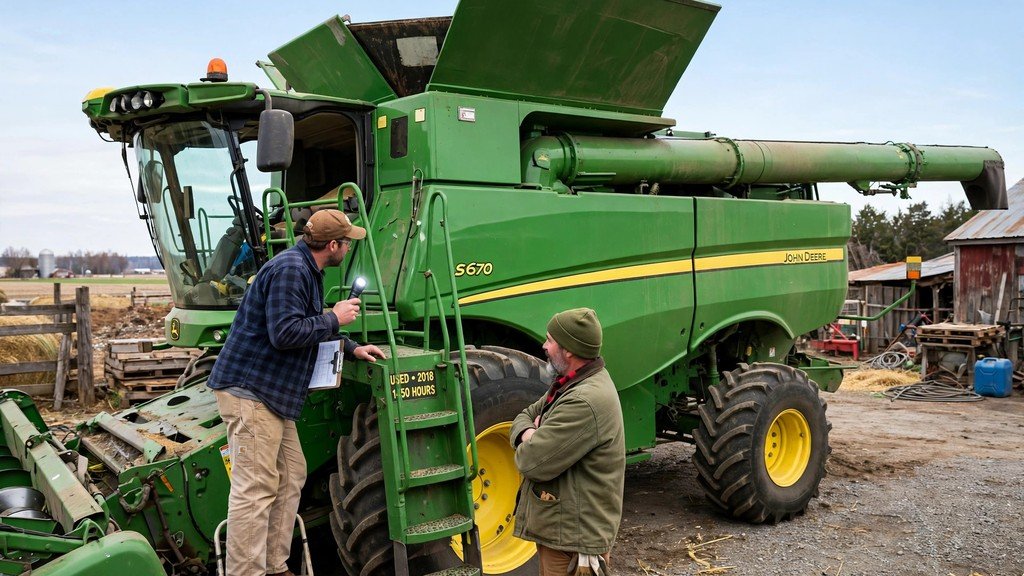
Start with both hour meters and the serial plate in any John Deere 9560 combine maintenance inspection. Confirm the machine is a walker or an STS, confirm the engine by its plate, and compare engine hours against separator hours as described above. Ask for the full service history: oil changes, rotor or walker work, feederhouse work, and hydrostatic service. If the seller cannot produce records, price the machine as though the next major service is yours to pay for. A 2006 9560 STS at auction drew bidding to $25,000 with 4,480 engine hours and 3,234 thresher hours.
Run the machine if the seller allows it, since a John Deere 9560 combine maintenance inspection should include a working test. Engage the separator and listen for rough bearings, cycle the header lift, reverser, and unloading auger, and check that the cab controls and monitors all respond.
Inspecting the Feederhouse, Unloading Auger, Grain Tank and Electronics
Inspect the feederhouse with the header off if you can, as John Deere 9560 combine maintenance inspections always should. Check the conveyor chain and slats for wear, the top shaft sprockets for hooked teeth, the drum and bearings for play, and the stone trap for damage. Look at the unloading auger from the grain tank to the spout: check the vertical and cross augers for wear, the swing mechanism, and the spout for damage. The STS unloads at 2.2 bushels per second, so a slow or noisy unload usually means auger or drive wear. Open the grain tank and check for rust or grain left from last season.
Finish with the electronics and the cab in your John Deere 9560 combine maintenance inspection. Confirm the corner post display, engine monitor, and header controls work, and check wiring harnesses for chafing and corroded connectors. Finally, compare the machine against the wider picture for the model: the John Deere 9560 combine review explains the walker-versus-STS choice in full, the 9560 performance and fuel usage guide covers what these machines do in the field, and the 9560 ownership cost guide puts the purchase price together with the running costs described here.
Frequently Asked Questions About John Deere 9560 Combine Maintenance
These are the questions owners and buyers ask most often about John Deere 9560 combine maintenance, answered directly. If your question is not covered here, the answer is almost always in your machine’s operator manual, identified by serial number.
What is the difference between the 9560 walker and the 9560 STS?
The walker uses a conventional cylinder and straw walkers, a 6.8L engine at 220 or 240 horsepower, and a 204-bushel grain tank. The STS uses a single tine-separator rotor, an 8.1L engine at 265 horsepower on early machines, and a 220-bushel grain tank. Later STS production switched to a 6.8L PowerTech Plus engine with the Bullet Rotor. They share the 60 Series cab and feederhouse design but have different service manuals and wear parts, so John Deere 9560 combine maintenance always starts by identifying which machine you own.
How often should I change the engine oil on a 9560 combine?
On the walker, Deere specifies the first change at 100 hours, then 250 hours with standard oil or 375 hours with PLUS-50 oil. If fuel sulfur exceeds 0.5 percent, the interval drops to 100 hours. On the STS, follow the interval in manual OMH215847 for your serial range, and change oil at least once a year before harvest regardless of hours. That annual change is a basic rule of John Deere 9560 combine maintenance.
What are separator hours, and why do they matter more than engine hours?
Separator hours count only the time the separator was engaged. Engine hours count all running time. The gap between them shows how much of the machine’s life was spent actually threshing versus traveling and idling. A machine with nearly equal engine and separator hours has far more separator wear than one with a wide gap, so John Deere 9560 combine maintenance inspections always check both meters before buying.
How often should I grease a 9560 combine?
Final drive bearings, rear axle spindle bearings, and feederhouse reverser fittings are greased every 50 hours normally and every 10 hours in mud and water. The STS adds 200-hour and 400-hour grease rounds for the cab filter, tires, unloading auger gearcases, separator U-joint, and chopper bearings. Use the grease type specified in your manual, and do not over-grease beyond the manual’s instruction. Follow the manual exactly for John Deere 9560 combine maintenance.
What causes high grain loss on a 9560 STS?
Loss can come from the rotor or the cleaning shoe, since the STS runs out of separating or cleaning capacity before power. Check rotor speed, concave clearance, fan speed, and sieve settings one at a time, and inspect threshing elements, separator tines, and concaves for wear. In corn, the FAST beater ahead of the rotor is a common source of grain damage, and Deere offers beater kits for sensitive crops.
What causes high grain loss on a 9560 walker?
On a walker machine, check walker bearings, shaker pan arms, and shoe settings first. Worn walker bearings cause vibration and loss, broken shaker pan bolts cause uneven shaking, and wrong chaffer and sieve settings throw good grain out the back. Inspect the machine before changing settings, since a worn part will not be fixed by adjustment alone.
How much does annual maintenance cost on a 9560 combine?
As a planning estimate, budget roughly $1,500 to $3,000 a year for routine parts and fluids if you do the work yourself, and roughly $3,000 to $6,000 a year if a dealer handles the annual service and preseason inspection. Major work such as a rotor rebuild, feederhouse rebuild, or hydrostatic repair costs several thousand dollars more and should be budgeted separately from routine John Deere 9560 combine maintenance.
What should I check on the feederhouse before harvest?
Check chain tension, slats, top shaft sprockets, drum bearings, the stone trap, and the feedplate seal, and test the reverser from the cab. Grease the reverser gearcase on the manual’s schedule, and confirm the header hookup, including the single-point hydraulic and electrical connection, engages cleanly before harvest.
Are parts still available for the 9560 combine?
Yes. The 9560 shares many parts with the wider 60 Series family, and dealers, aftermarket suppliers, and salvage yards stock common wear items such as belts, bearings, filters, and concaves. Model-specific electronics and some STS rotor parts can take longer to source, so check availability for anything unusual before harvest rather than during it, as part of John Deere 9560 combine maintenance planning.
What is the most expensive maintenance mistake on a 9560?
Skipping the preseason inspection. A combine that enters harvest with worn belts, dry bearings, a dirty cooling package, and old filters will fail at the worst moment, when parts and labor cost the most and every lost day costs crop. The preseason service is the cheapest major repair a 9560 will ever need. Skipping it is the costliest John Deere 9560 combine maintenance mistake.
How do I know if a used 9560 has been maintained well?
Ask for dealer invoices, oil change records, and repair history, and compare engine against separator hours. A machine with documented service, recent wear-part replacement, and clean fluids is worth more than a cosmetically fresh machine with no records. Run the separator, cycle the hydraulics, and inspect the feederhouse, unloading auger, and grain tank before you pay.