A used John Deere 9630 is a 530-horsepower commitment, and John Deere 9630 maintenance is what decides whether that commitment pays off or turns into a string of breakdowns in the busiest weeks of the year. This is an articulated four-wheel-drive tractor from the 9030 Series, built from 2007 to 2011 in Waterloo, Iowa, and every used example today has years of hard work behind it. That scale shapes John Deere 9630 maintenance: 14-plus gallons of engine oil, a 350-gallon tank, and eight big tires.
The short version of John Deere 9630 maintenance is this: follow the hour-based service chart, not the calendar alone; keep fuel clean, because the electronic unit injectors on the 13.5L engine are expensive; grease the articulation and steering joints on schedule; and test the PowerShift, hydraulics, and differential lock before you buy, not after. Do those four things and John Deere 9630 maintenance stays routine.
John Deere 9630 Maintenance Schedule and Service Costs
John Deere 9630 maintenance follows an hour-based chart that runs from a daily walkaround to 750-hour filter rounds and annual air-filter changes. The 9630 covered here is the wheeled 9030 Series flagship, and its full specification set is laid out in the John Deere 9630 review. The intervals below come from the 9030 Series filter and capacity document, with serial-number splits stated where they apply.
Engine Oil, Fuel Filters, Air Filters and Cooling System
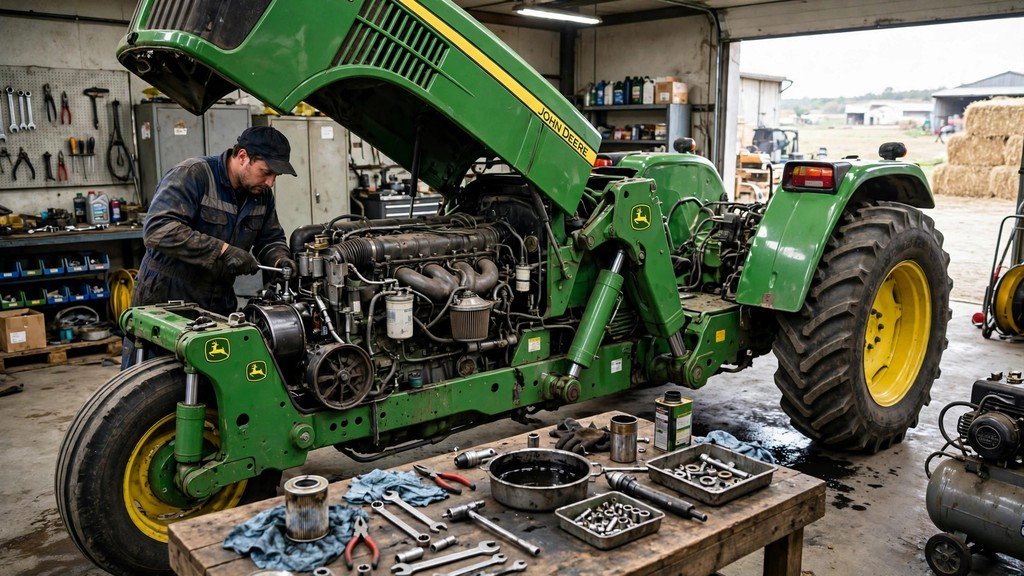
Engine oil is the first item in any John Deere 9630 maintenance routine. The initial change is due at 100 hours maximum, then every 250 hours with standard oil and a Deere filter, or 375 hours with Plus-50 oil and a Deere filter. The oil filter for the 9330 through 9630 range is part RE572785. Crankcase capacity is 56 litres (14.8 gallons) from serial number 022000 onward, and 60 litres (15.8 gallons) earlier, so check the serial plate before ordering oil. An annual oil change before the heavy season is cheap insurance in John Deere 9630 maintenance.
Fuel filters deserve equal attention in John Deere 9630 maintenance. The 13.5L PowerTech Plus engine uses electronic unit injectors, and dirty fuel is the fastest way to hurt them. Primary filter RE532952 and secondary RE533910 change after 100 and 250 hours, then every 250 hours. The self-priming fuel system does not forgive water or dirt: drain the separator daily. One dealer invoice for a 2007 9630 at 3,274 hours shows where neglect ends: injectors and cups replaced after the engine started missing.
Air filters and cooling follow a simpler rhythm in John Deere 9630 maintenance. Primary air filter RE261960 is replaced annually or as required; secondary element RE230985 after every second primary change. Cooling capacity is 53 litres (14 gallons) of COOL-GARD II; the Vari-Cool fan drive only helps if the radiator is blown out regularly. A 9630 that runs hot under load usually has a cooling package problem first, and John Deere 9630 maintenance treats a daily blowout in dusty work as mandatory.
Transmission, Axle, Hydraulic Filters and Fluid Service
The 18-speed Automatic PowerShift transmission and the axles run on a 750-hour rhythm in John Deere 9630 maintenance. The axle filter (YZ502378) and transmission oil filter (RE174130) change after 100 and 750 hours, then every 750 hours. The hydraulic oil filter shares the RE174130 number and pattern, and the reservoir air filter (AT101565) is replaced every 750 hours. Hydraulic capacity is 27 gallons without a hitch and 28 with one (30 and 31 on high-flow), so confirm the pump before ordering fluid. The standard pump delivers 48 gallons per minute at 2,900 psi, with 30 at one valve; high-flow raises total flow to 78.
The video below is an official John Deere film about the 500-hour service interval for its Plus-50 II oil. It is general Deere service content, not 9630 footage, but it explains the interval logic behind the 250-hour versus 375-hour choice in John Deere 9630 maintenance.
Service costs in John Deere 9630 maintenance are planning estimates unless a dealer quotes the job, because fluid volumes make every service bigger than on a row-crop tractor. Budget roughly $1,500 to $3,000 a year for routine fluids and filters if the work is done on the farm, and roughly $3,000 to $6,000 a year with dealer labor, before tires and before any major repair. A full set of eight 800/70R38 dual tires is a five-figure purchase, which is why John Deere 9630 maintenance puts tire condition in every pre-purchase inspection.
| Service item | Interval | Part or capacity |
|---|---|---|
| Engine oil and filter (initial) | 100 hours maximum | Filter RE572785 |
| Engine oil and filter (standard) | Every 250 hours | 14.8 gal (SN 022000+) / 15.8 gal (earlier) |
| Engine oil and filter (Plus-50 + Deere filter) | Up to 375 hours | Plus-50 oil + RE572785 |
| Fuel filters (primary + secondary) | After 100 and 250 hours, then every 250 hours | RE532952 / RE533910 |
| Transmission and axle filters | After 100 and 750 hours, then every 750 hours | YZ502378 / RE174130 |
| Hydraulic oil filter + reservoir air filter | After 100 and 750 hours, then every 750 hours | RE174130 / AT101565 |
| Rule for John Deere 9630 maintenance | Hours govern; calendar is the backstop | Confirm capacities by serial number |
John Deere 9630 Reliability and Long-Term Durability
The 9630 has a reputation as a durable, straightforward big tractor: a Tier 3 engine with no particulate filter or exhaust fluid to service, and a frame built for scraper work. But John Deere 9630 maintenance records separate a 6,000-hour tractor with life left from a 3,000-hour tractor run hard and put away dirty.
13.5L PowerTech Plus Engine and PowerShift Maintenance
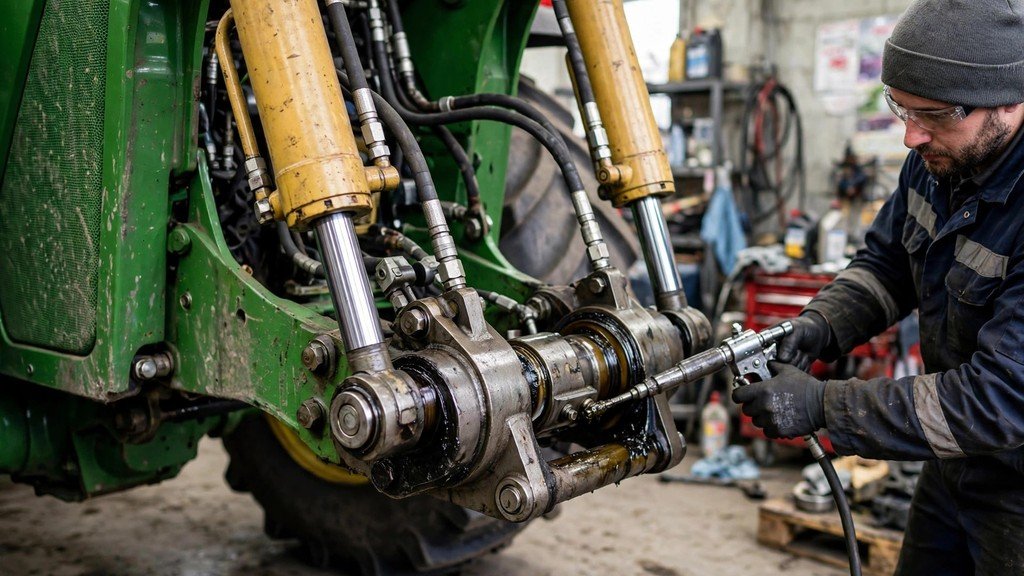
The 13.5L PowerTech Plus six-cylinder is the heart of John Deere 9630 maintenance. It is turbocharged with a variable-geometry turbocharger, air-to-air aftercooling, exhaust gas recirculation, and a 16:1 compression ratio, rated at 530 hp at 2,100 rpm with a peak near 583 hp and a 38 percent torque rise, per Deere’s 9030 Series launch specifications. Peak torque is 1,848 lb-ft at 1,600 rpm. For John Deere 9630 maintenance, the engine asks for clean fuel, clean air, and clean oil, in that order. The variable-geometry turbo and EGR system suffer when filters or oil are stretched, and both cost far more than the filters protecting them.
The 18-speed Automatic PowerShift is the second system that rewards routine John Deere 9630 maintenance. It gives 18 forward and 6 reverse speeds, and its health shows in shift quality: firm, consistent shifts, no flare or hunting under load. Sample transmission and axle oil annually: rising wear metal shows in analysis long before it is felt in the seat.
How Operating Hours, Workload and Service History Affect Longevity
Hours alone do not price a used 9630, and John Deere 9630 maintenance history matters more than the hour meter. A 9630 that spent 6,000 hours on heavy tillage has lived a harder life than one with the same hours on light carting work, and that workload difference shows up in the John Deere 9630 performance record for the model. Scraper work is hardest: constant high draft and frame loading farm tillage rarely matches. A scraper-model 9630 deserves a closer frame and articulation inspection than a farm-only machine with the same hours.
Service history is the best predictor in John Deere 9630 maintenance. Look for dated invoices: oil changes at 250 or 375 hours, fuel filters every 250, transmission and axle filters every 750, and articulation greasing on schedule. A tractor with full dealer history is worth more than a tidy tractor with no records: the next service is already priced in.
Weight and ballast also shape longevity in John Deere 9630 maintenance. Weight depends on fitted tires, duals, and weights: unballasted around 37,300 pounds, operating near 39,500 pounds in one specification compilation, and fully ballasted 45,800 to 50,000 pounds.
John Deere 9630 Common Problems and Warning Signs
No used tractor in this class is trouble-free, and John Deere 9630 maintenance means knowing the model’s known weak points before they strand a 60-foot implement in the field. The problems below are owner- and dealer-reported patterns, not recalls, and each gives warning first.
Engine, Cooling, Fuel-System and Starting Symptoms
Hard starting, smoke, and power loss under load usually trace back to fuel or air before they trace back to the engine itself, and systematic John Deere 9630 maintenance checks them in that order. Start with the fuel filters and water separator, then the air filter, then the turbocharger hoses and clamps. A dealer invoice for a 2007 9630 shows the next step: injectors and cups replaced, plus a turbo oil drain line resealed. Injector work is a multi-thousand-dollar parts job, which is why the 250-hour fuel-filter interval is not a suggestion.
EGR coolers are a known recurring item in John Deere 9630 maintenance. Owners running 9630 scraper tractors report their share of EGR cooler problems alongside other high-hour repairs, and the symptoms are coolant loss with no visible leak, white smoke, or coolant in the exhaust stream. An internally leaking cooler turns a cooling problem into an engine problem, so unexplained coolant loss should be diagnosed, not topped up. The variable-geometry turbo is the other item to watch: codes, sticking vanes, and wiring faults can all present as a turbo problem, and one documented history shows a code chased through a vane sensor before the fault was found in the wiring. Diagnose before replacing parts.
Overheating usually traces to a chaff-packed radiator or a failed Vari-Cool fan drive in John Deere 9630 maintenance: check the fan drive, belt, and gauge behavior under sustained load, not just at idle.
Transmission, Hydraulic, Differential Lock and Steering Checks
Transmission symptoms in John Deere 9630 maintenance show up as flared shifts, harsh engagement, slipping under load, or a gear that will not hold. Check oil level and condition, filter history, and whether the PowerShift was recalibrated after clutch work. A transmission that shifts well cold and badly hot points at oil condition or internal wear. Never buy a 9630 without a loaded shift test through the working gears.
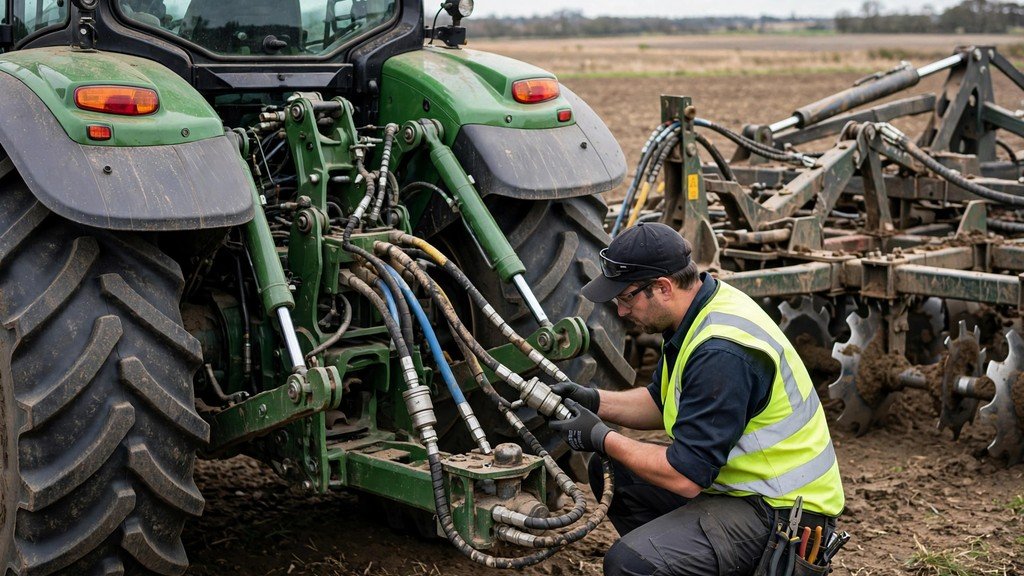
Hydraulic symptoms are equally direct in John Deere 9630 maintenance: slow hitch lift, a selective control valve that drifts or leaks, or an implement that will not hold position. The 9630 carries four selective control valves as standard, with a fifth and sixth available; SCV rebuilds are a known used-tractor expense. Check every valve under load, look for weeping at couplers and the valve stack, and confirm the high-flow pump if the listing claims 78 gallons per minute, since the standard pump is 48.
Steering and differential lock checks complete the drivetrain inspection in John Deere 9630 maintenance. The 9630 steers hydrostatically through its articulation joint, so steering should be smooth and equal both ways, with no jerking or drift. Grease the articulation and steering pins on schedule and check for play: worn pins show as sloppy steering long before they become structural. Test the hydraulic differential lock in a soft spot, not on pavement, and confirm it engages and releases cleanly. One rare documented failure deserves a look on any scraper-history machine: a casting break at the articulation joint, where a small rust spot marked a crack that had been working for a while. Inspect the casting for cracks, rust lines, or fresh paint hiding a repair.
John Deere 9630 Used-Tractor Inspection
Buying a used 9630 is where this knowledge pays for itself. John Deere 9630 maintenance history is the first thing to verify, and the inspection below is the order to do it in. A 2011 9630 with 2,988 hours sold at auction in Reynolds, North Dakota, in July 2024 for $209,000, a reference for what a clean, mid-hour example brings, though hours, tires, hydraulics, and records move the number more than the year.
Checking Engine Condition, Fluid Leaks and Maintenance Records
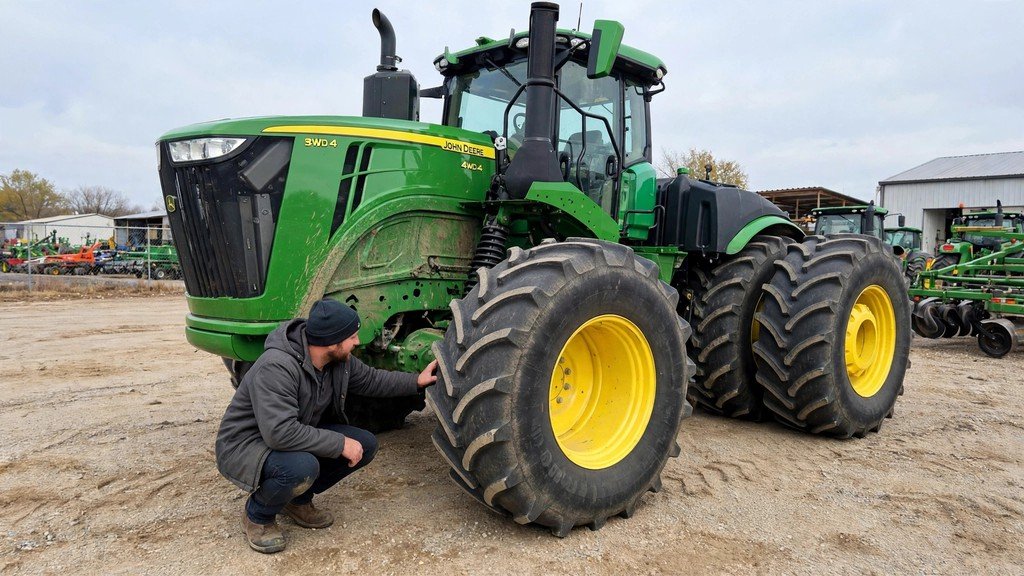
Start cold if the seller allows it: John Deere 9630 maintenance inspections learn most from cranking speed, smoke color, and oil pressure. Check engine oil for fuel or coolant contamination, coolant for oil sheen, and transmission and hydraulic oil for burnt smell or metal. Walk the machine for leaks at the engine, articulation joint, axle seals, valve stack, and steering cylinders. A dry 9630 is well kept; a wet machine has a backlog, not one seal to replace.
Ask for full service history in any John Deere 9630 maintenance inspection: oil, fuel, transmission and axle filters, articulation greasing, and any injector, turbo, EGR cooler, or clutch work. Confirm the serial number against the capacity split in this guide, since crankcase capacity differs by serial range. Without records, price the machine as though the next major service is yours to pay for.
Testing PowerShift, Articulation, Hydraulics and Differential Lock
Run the machine under load if the seller allows it: a John Deere 9630 maintenance inspection should include a working test. Shift through the PowerShift gears under draft, not just on the road, and listen for flare or harsh engagement. Articulate fully both ways and feel for binding, jerking, or play in the joint. Cycle every valve with an implement attached, raise and lower the hitch, and confirm the optional Category 4/4N hitch lifts its rated 15,300 pounds without drift. The standard Category 5 drawbar carries a 12,000-pound vertical load on a 2.75-inch pin, so check the drawbar, its support, and the pin bore for wear or egging.
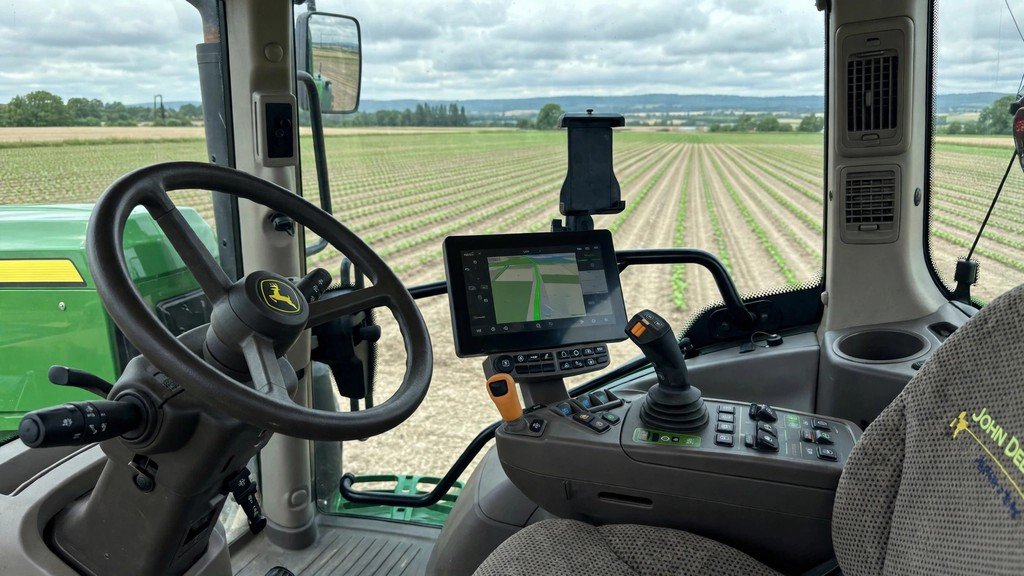
Finish with tires, cab, and electronics in your John Deere 9630 maintenance inspection. Measure tread on all eight tires and price replacements before offering: tires are the largest single wear item here. Confirm the CommandView cab controls, air conditioning, and GreenStar display work, and check the articulation-joint harness for chafing, since it flexes every turn. Finally, a failed EGR cooler or worn clutch pack is not just a repair, it changes what the tractor is worth, which is why the John Deere 9630 ownership cost picture belongs in the same buying decision.
| Inspection item | Pass signs | Walk-away or price-down signs |
|---|---|---|
| Cold start and engine | Quick start, clean exhaust, steady oil pressure | Flare, harsh engagement, slipping in draft |
| PowerShift under load | Firm consistent shifts, no flare or slip | Flare, harsh engagement, slipping in draft |
| Articulation and steering | Smooth both ways, tight pins, no drift | Jerking, play, cracked casting, rust lines |
| Hydraulics and SCVs | Fast lift, no drift, dry couplers | Slow lift, drifting implement, weeping stack |
| Tires and ballast | Even wear, matched duals, weights present | Bald or mismatched tires, missing weights |
| Records | Dated invoices matching the hour chart | No records, or records that stop years ago |
Frequently Asked Questions About John Deere 9630 Maintenance
These are the questions owners and buyers ask most often about John Deere 9630 maintenance, answered directly. Anything else is usually in the 9030 Series operator manual for your serial range.
How often should I change the engine oil on a John Deere 9630?
The initial change is due at 100 hours maximum, then every 250 hours with standard oil and a Deere filter, or up to 375 hours with Plus-50 oil and a Deere filter. That interval is the backbone of John Deere 9630 maintenance.
How often do the fuel filters need changing on a 9630?
After 100 and 250 hours, then every 250 hours, using primary filter RE532952 and secondary filter RE533910. Drain the water separator daily: water hurts the injectors faster than dirt does.
Does the John Deere 9630 have a DPF or use DEF?
No. The 9630 is a Tier 3 machine, so John Deere 9630 maintenance includes no DPF ash service, no DEF tank, and no regeneration cycle. Its emissions hardware is the EGR system and variable-geometry turbo: watch those instead.
What is the most common engine problem on a 9630?
Owner and dealer reports point most often at the fuel system and the EGR system: injectors and cups, EGR cooler leaks, and turbo or turbo-wiring faults. All three give early symptoms in John Deere 9630 maintenance checks, so none should arrive as a surprise.
How often should the transmission and hydraulic filters be changed?
After 100 and 750 hours, then every 750 hours, for the axle, transmission, and hydraulic oil filters. The hydraulic reservoir air filter is replaced every 750 hours. Skipping the 750-hour round is how John Deere 9630 maintenance backlogs start.
What should PowerShift shifts feel like on a healthy 9630?
Firm, consistent, and predictable, with no flare between gears, no harsh engagement, and no slipping under draft. A transmission that shifts well cold and badly hot, or hunts under load, needs diagnosis before purchase: John Deere 9630 maintenance treats shift quality as pass-or-fail.
How much does annual maintenance cost on a 9630?
As a planning estimate, roughly $1,500 to $3,000 a year for routine fluids and filters done on the farm, or roughly $3,000 to $6,000 a year with dealer labor, before tires and before any major repair. Injector, EGR cooler, clutch, or tire work sits outside that range and is budgeted separately in John Deere 9630 maintenance planning.
What tires does a 9630 use, and why do they cost so much?
The standard fitment is 800/70R38 duals, eight tires in total, and a full set is a five-figure purchase. That is why John Deere 9630 maintenance inspections measure tread on all eight tires before offering.
What is the difference between the wheeled 9630 and the 9630T for maintenance?
The engine, transmission, and hydraulics are shared, but the running gear is not: the wheeled 9630 runs dual tires and a 350-gallon tank, while the 9630T runs tracks and a 330-gallon tank. Track tension, idlers, and rollers replace tire work in John Deere 9630 maintenance on the tracked machine.
How do I know if a used 9630 has been maintained well?
Ask for dated invoices that match the hour chart, check the fluids for contamination, run the PowerShift under load, articulate fully, cycle every hydraulic valve, and inspect the tires and the articulation casting. A machine with documented service and clean fluids is worth more than a fresh-looking machine with no records: that discipline is the whole of John Deere 9630 maintenance.