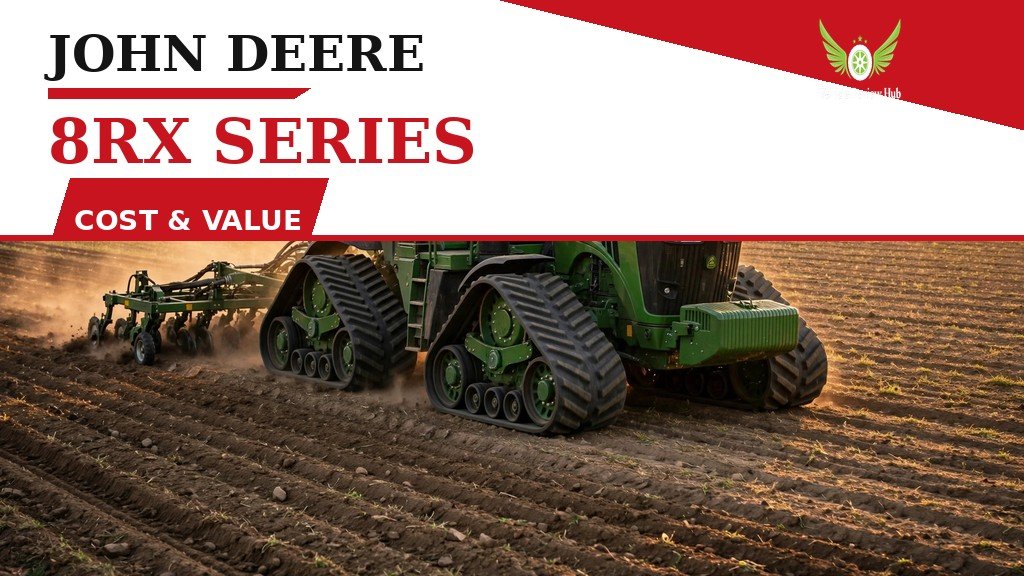
The John Deere 8RX Series ownership cost picture starts with a simple truth: a four-track row-crop tractor costs more to buy and more to keep than its wheeled twin, but it earns that premium back in traction, flotation, and resale. Plan on roughly $309,000–$401,000 in operating costs over five years at 800 hours per year, depending on the model — fuel alone is about three-quarters of that total, and the tracks are the single biggest cost variable after fuel in this John Deere 8RX Series ownership cost guide.
This John Deere 8RX Series ownership cost guide breaks down the real numbers for US owners: fuel, routine maintenance, track operating expenses, repairs, insurance, depreciation, and resale. Every figure below is either verified from current dealer listings and Deere specs or clearly labeled as an estimate.
John Deere 8RX Series Total Cost of Ownership
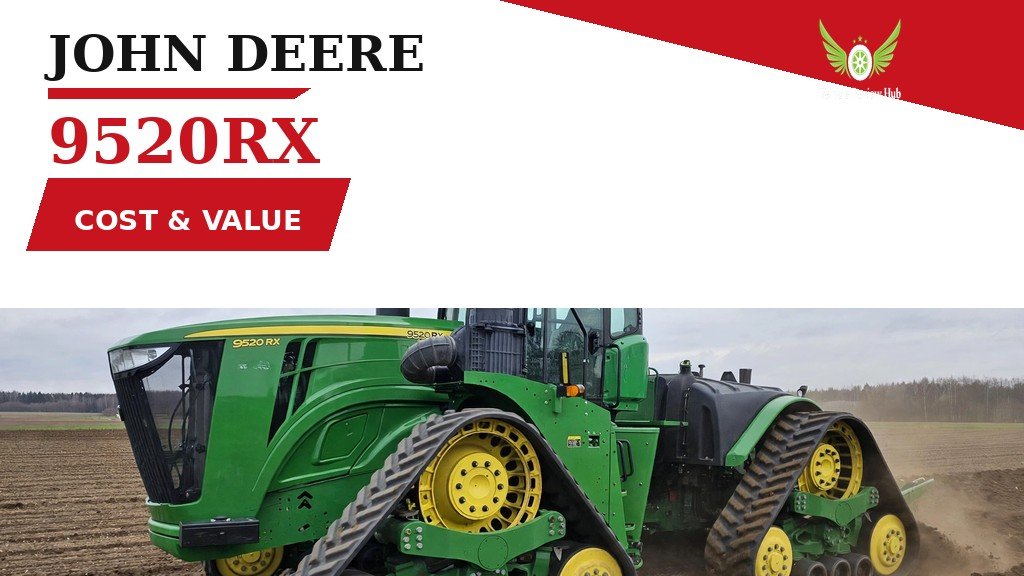
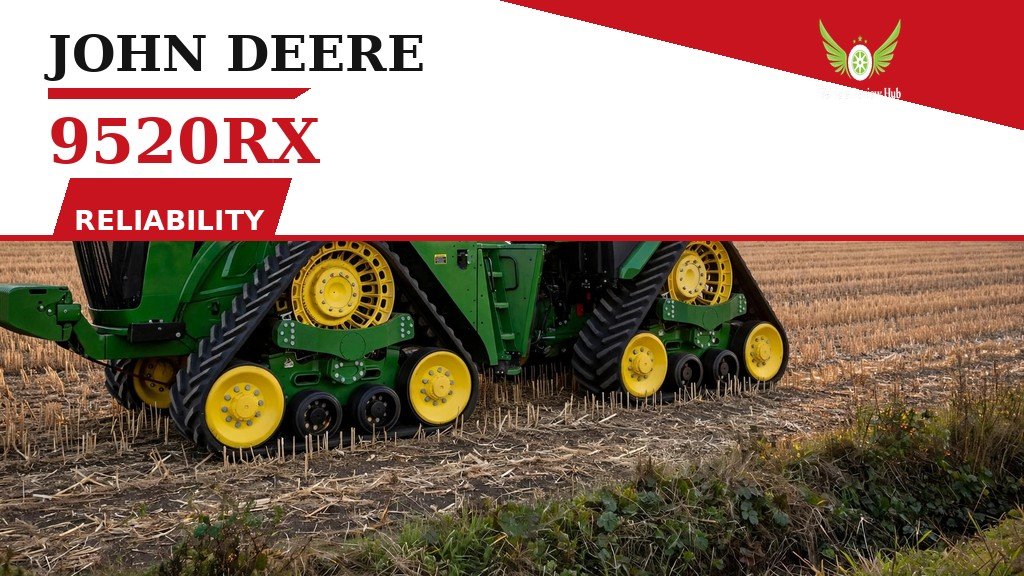
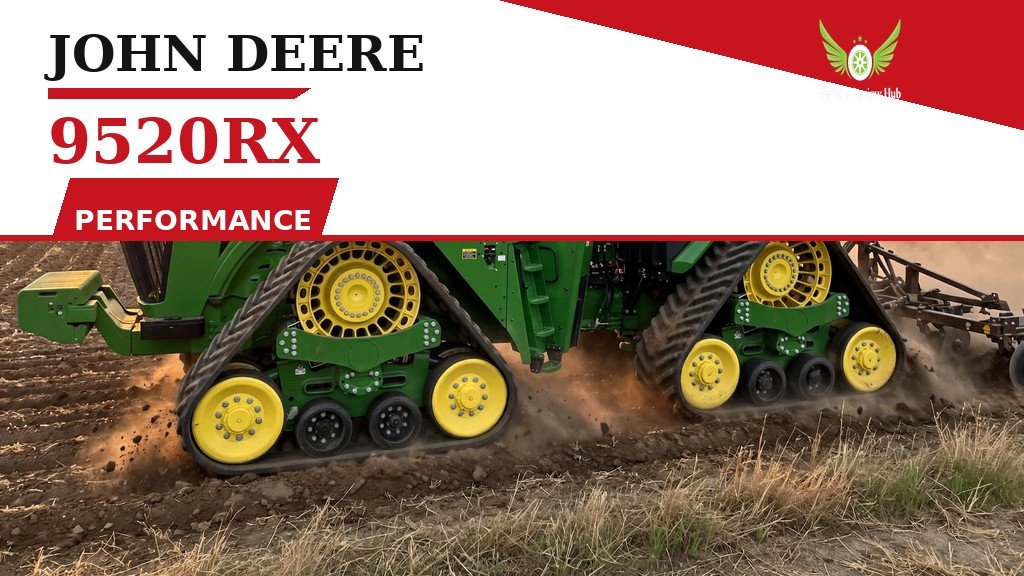
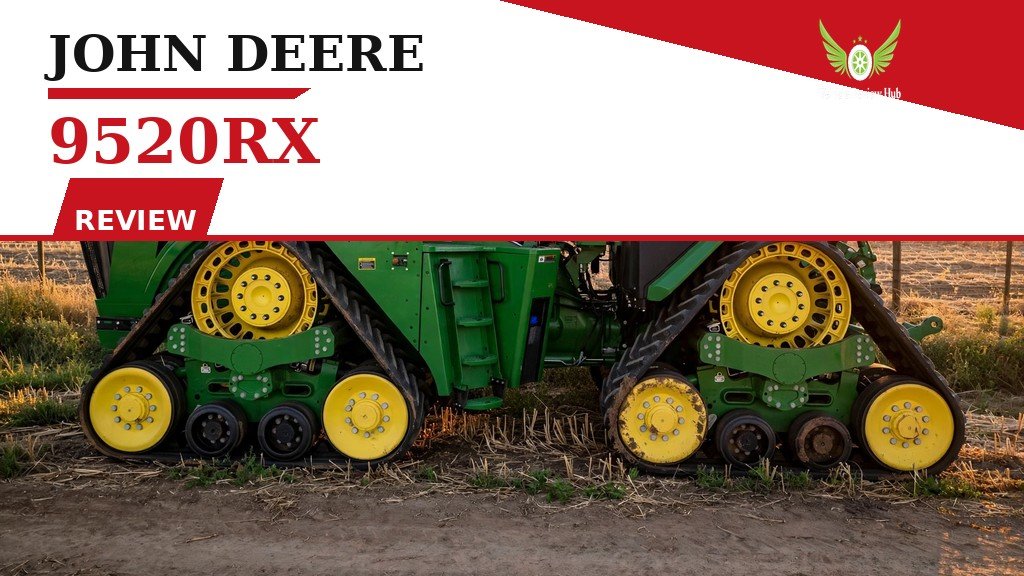
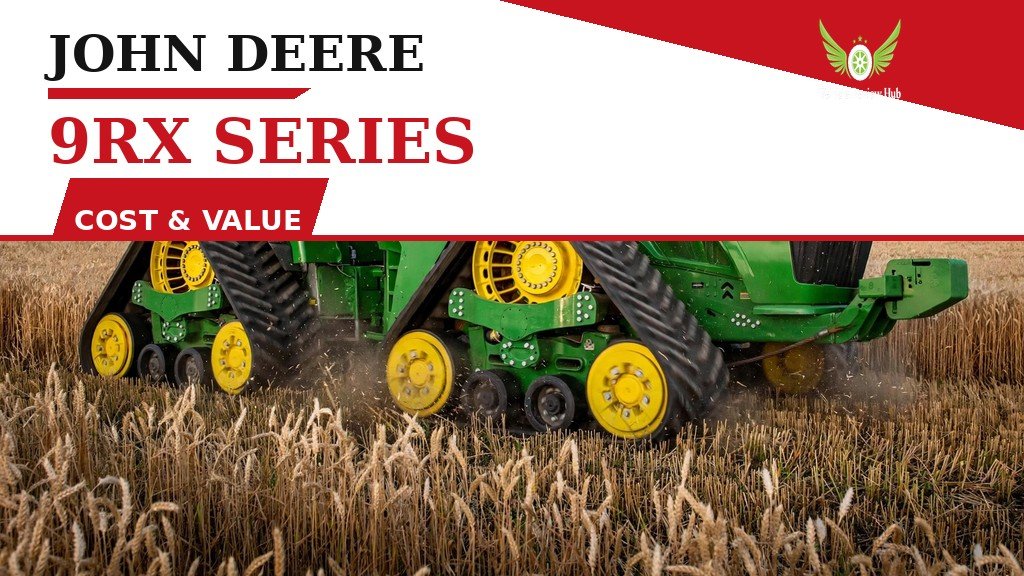
Understanding John Deere 8RX Series ownership cost starts with the machine itself. The 8RX family — 8RX 310 through 8RX 410, rated 310 to 410 hp — runs the same PowerTech 9.0L six-cylinder as the wheeled 8R (549 cu in., dual turbochargers in series, cooled EGR, B20 compatible), with US Final Tier 4 aftertreatment of DOC + DPF + SCR and DEF. The difference is the running gear: four rubber belt tracks on AirCushion suspension instead of wheels. Base weight is 43,300 lb (e23, 18-in. tracks, 120-in. tread), and the newest generation’s track system gives a contact area up to 4.87 m². Track widths run 18, 24, and 30 inches (16-inch narrow tracks appear on some configurations), and the newest 8RX machines use low-tension Soucy CustomFit P-series belts designed to reduce belt stress and extend operating life.
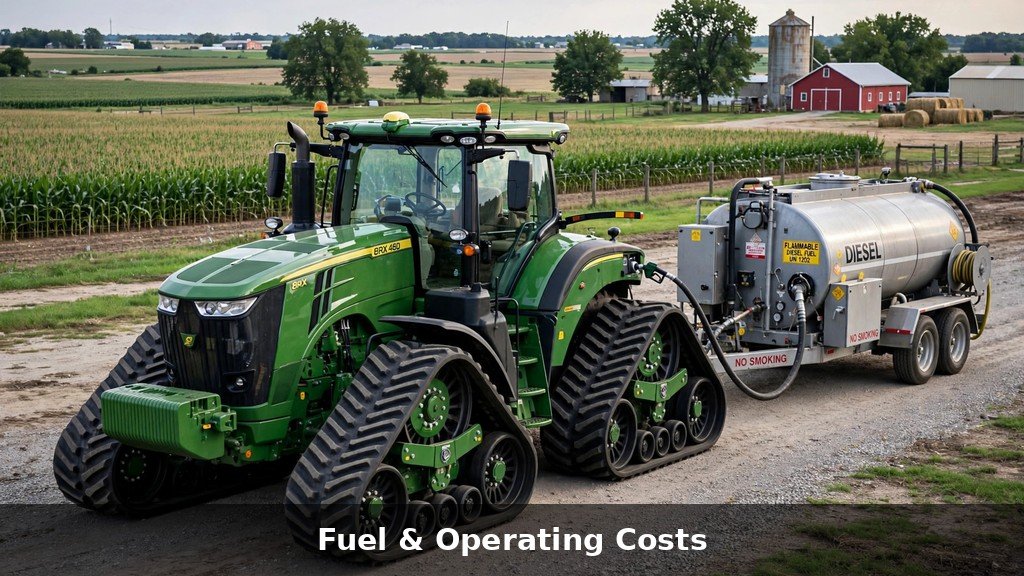
Fuel, Routine Maintenance and Track Operating Expenses
Fuel is the biggest single line in any John Deere 8RX Series ownership cost calculation — roughly three-quarters of the five-year total. The US on-highway diesel average was $6.179 per gallon in the EIA weekly update for the week of October 12, 2026, and row-crop diesel budgeting should start there. Owner-reported fuel use on the 8RX runs roughly 5–7 gph for light transport work, 8–12 gph for general field and PTO work, and 12–18 gph for heavy draft tillage. For planning, use 9.5 gph (8RX 310), 10.25 gph (8RX 340), 11 gph (8RX 370), and 12.5 gph (8RX 410) at 800 hours per year — the math on those figures is shown line by line in the budget table below. DEF consumption runs about 2.5% of diesel volume at roughly $3.00 per gallon (estimate).
Routine maintenance is the most predictable part of John Deere 8RX Series ownership cost. The 8RX follows the 8R program owners know well: engine oil and filters every 500 hours, fuel filters every 500 hours, transmission-hydraulic filters at 750 hours, transmission-hydraulic oil at 1,500 hours or two years, and coolant at 6,000 hours or six years. Budget roughly $3,000–$4,000 yearly in filters, fluids, and wear parts at 800 hours (estimate) — the track system adds its own line: belt inspection, tension checks, and undercarriage greasing a wheeled tractor skips. Our John Deere 8RX Series maintenance guide walks through the full service schedule and the track-specific checkpoints that protect the undercarriage.
Repairs, Unexpected Costs and Five-Year Budget
The repair wildcard in this John Deere 8RX Series ownership cost breakdown is the track system. Belts are consumables: owner-reported belt life commonly runs 3,000–5,000+ hours depending on how much roading the tractor does, and road miles are what eat belts. Dealer quotes for a single replacement belt commonly land in the low five figures installed, and a full four-corner belt replacement plus idlers and mid-rollers can approach $50,000 at dealer labor rates (estimate). That is why used-8RX buyers price track condition first — a machine at 2,500 hours with 80% belt life remaining is worth meaningfully more than an identical machine with belts at the wear bars. Soucy’s prorated replacement warranty program on its rubber tracks is worth reading before you buy, since it can offset early belt failures.
The five-year budget below uses the fuel math above at $6.179/gal diesel, DEF at $3.00/gal, routine maintenance of $16,000–$18,500 over five years, a repairs-and-track-reserve line of $25,000–$35,000 (estimates — the single largest uncertainty in this John Deere 8RX Series ownership cost analysis), and insurance of $30,000–$35,000. Fuel math, shown line by line: 8RX 310 burns 9.5 gph × 800 hrs = 7,600 gal/yr × $6.179 = $46,960/yr × 5 yrs = $234,802; 8RX 340: 8,200 gal/yr × $6.179 = $50,668/yr × 5 = $253,339; 8RX 370: 8,800 gal/yr × $6.179 = $54,375/yr × 5 = $271,876; 8RX 410: 10,000 gal/yr × $6.179 = $61,790/yr × 5 = $308,950. All figures are estimates; run your own fuel numbers against your actual hours.
| Cost item (5 years, 800 hrs/yr) | 8RX 310 | 8RX 340 | 8RX 370 | 8RX 410 |
|---|---|---|---|---|
| Fuel (diesel @ $6.179/gal) | $234,802 | $253,339 | $271,876 | $308,950 |
| DEF (~2.5% of diesel @ $3.00/gal) | $2,850 | $3,075 | $3,300 | $3,750 |
| Routine maintenance (filters, fluids) | $16,000 | $16,500 | $17,500 | $18,500 |
| Repairs + track-system reserve | $25,000 | $27,500 | $30,000 | $35,000 |
| Insurance (5 years) | $30,000 | $31,000 | $32,500 | $35,000 |
| Total estimated 5-year operating cost | $308,652 | $331,414 | $355,176 | $401,200 |
John Deere 8RX Series Insurance and Financial Considerations
Insuring a half-million-dollar tracked tractor is a different exercise than insuring a utility machine, and insurance belongs in any honest John Deere 8RX Series ownership cost plan. Equipment insurance for an 8RX typically runs $5,500–$7,000 per year (estimate), scaled to the machine’s insured value and your deductible. Lenders will require full coverage for the life of the loan, so get the quote before you sign — the insurance line alone can exceed $30,000 over five years on a 410. Our John Deere 8RX Series review covers the model lineup and new pricing these premiums are based on.
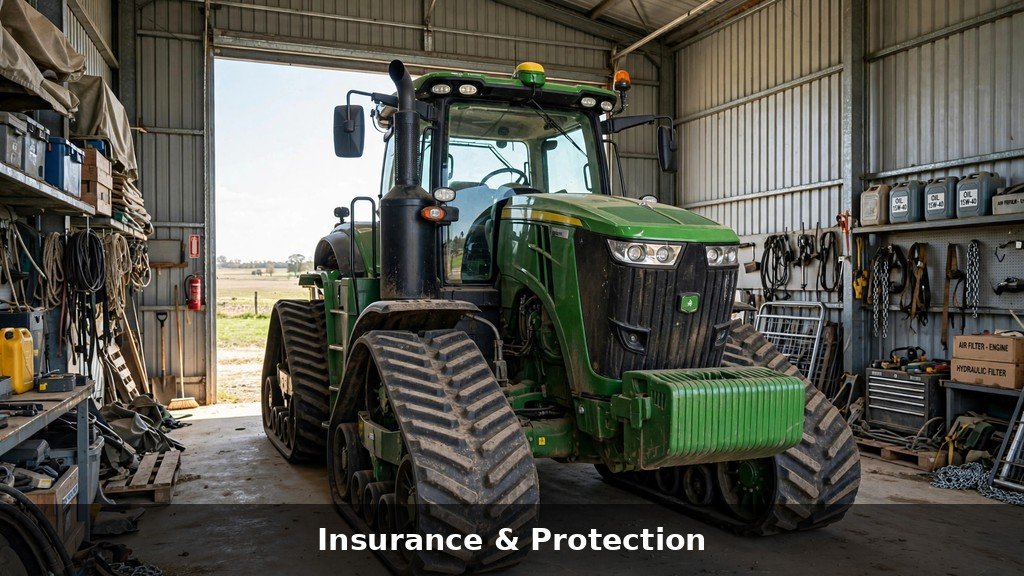
Equipment Insurance and Liability Coverage
Beyond the machine itself, liability coverage is a real line item in John Deere 8RX Series ownership cost because an 8RX works around hired hands, custom operators, and public roads. A farm liability umbrella that covers a 43,000-lb tracked tractor is not the same policy that covers the pickup — talk to an ag-specialist agent, not a generalist. If you do custom work or rent the tractor out, disclose it; undeclared commercial use is a classic claim-denial trigger. Keep the policy aligned with the machine’s current value: an 8RX 370 bought new at over $600,000 configured will be over-insured within a few years if you never adjust the stated value downward, and that is money straight off your John Deere 8RX Series ownership cost bottom line.
Storage, Theft and Damage Protection
Tracks hate UV and weather-checking, so indoor storage is not a luxury on an 8RX — it is belt-life protection and a direct input to long-term John Deere 8RX Series ownership cost. A machine shed that keeps a $25,000 set of belts out of the sun pays for itself in extended belt life. For theft, the 8RX’s size is its own deterrent, but JDLink telematics with geofencing adds a real layer: you get movement alerts and location history, and recovery rates on telematics-equipped machines are far better. Budget for comprehensive (not just collision) coverage if the tractor ever sits outside, and photograph the undercarriage at purchase — belt serial numbers and wear documentation are what an adjuster asks for after a track-damage claim.
John Deere 8RX Series Depreciation and Resale Value
The 8RX holds value better than most high-horsepower tractors, and that resilience is central to the John Deere 8RX Series ownership cost story: demand for four-track machines outruns supply on the used market. But John Deere 8RX Series ownership cost math only works if you understand what moves the needle on resale. Hours matter, track condition matters more, and configuration (track width, transmission, guidance) decides how many buyers your machine appeals to when you sell.
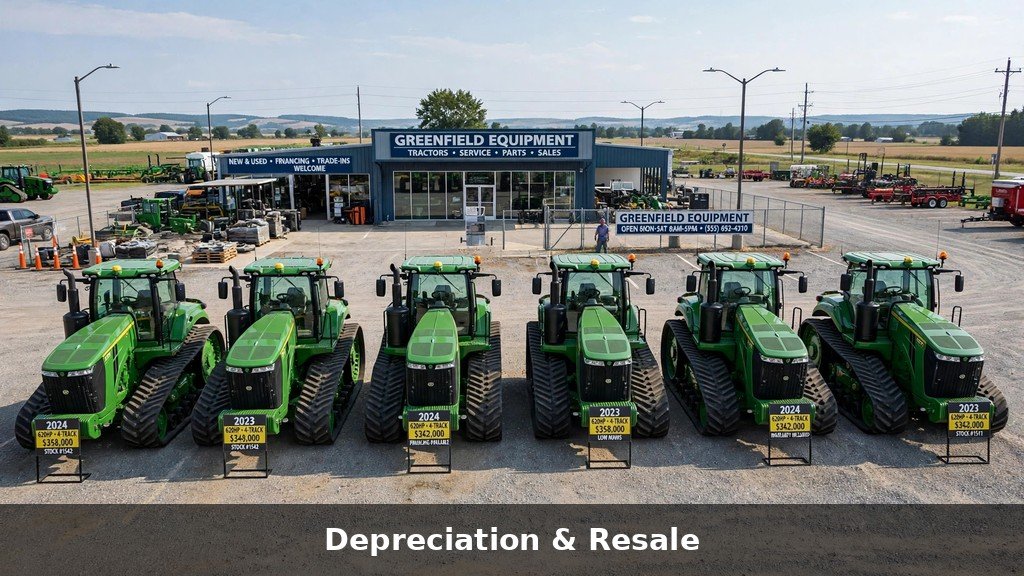
How Model, Year, Hours and Equipment Affect Resale Price
Current used listings tell the story. A 2024 8RX 370 with 723 hours listed at $510,000 at LandMark Implement in Smith Center, Kansas, against a 2022 8RX 370 with 697 hours at $466,999 at Papé Machinery in Lynden, Washington — two model years and similar hours separate the pair by roughly $43,000. At the top end, a 2025 8RX 410 with 310 hours listed at $579,900 (LandMark, Beatrice, Nebraska) versus a 2023 8RX 410 with 1,400 hours at $393,900 (LandMark, Phillipsburg, Kansas): two years and 1,100 hours cost about $186,000. Aggregator data puts the 8RX 370 range at roughly $416,000–$476,000 and the 8RX 410 at $520,000–$627,000 depending on year and condition. The pattern is consistent with the wheeled 8R — see our John Deere 8R Series ownership cost guide for the direct comparison — except the 8RX carries a persistent premium over the equivalent 8R at every hour band.
Track width is a genuine value variable in John Deere 8RX Series ownership cost: 18-inch tracks are the volume configuration and the easiest to resell; narrow-track setups suit controlled-traffic row-crop buyers; 24- and 30-inch tracks are flotation setups with a smaller buyer pool. e23 versus eAutoPowr/IVT, guidance receiver and display inclusion, and front suspension all move the number. And nothing tanks an 8RX’s price faster than worn belts: budget-minded buyers will discount a machine by the full cost of a belt replacement if the tracks are at the wear bars.
Private Sale, Dealer Trade-In and Resale Preparation
Private sale consistently beats dealer trade-in on an 8RX by a meaningful margin — dealers need their margin on a $450,000+ machine, and that margin comes out of your trade number. But private sale means you handle the tire-kickers, the financing contingencies, and the transport logistics for a 43,000-lb machine. For resale preparation — the last lever in John Deere 8RX Series ownership cost — the checklist is: fresh service with dated records, belt tread-depth measurements documented with photos, undercarriage inspection report, software updates current, DEF system fault-free, and the cab detailed. Machines with complete dealer service histories and documented belt life sell faster and closer to asking price — that documentation is the cheapest resale investment in this John Deere 8RX Series ownership cost guide.
Buying a John Deere 8RX Series Tractor
Buying right is the highest-leverage move in John Deere 8RX Series ownership cost control, The spread between a well-bought used 8RX 370 and a new one can exceed $150,000 — more than the entire five-year operating budget of a smaller tractor. Match the model to your acres, the tracks to your rows, and the transmission to your operators, and verify everything before money moves.
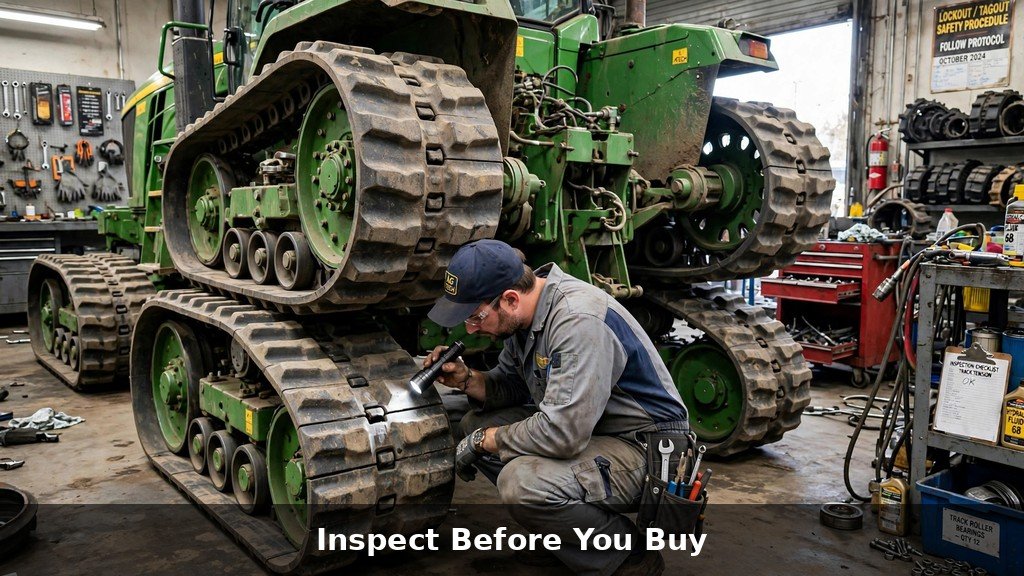
Choosing the Right Model, Track Width and Transmission
Model choice is acres-driven, and it anchors your John Deere 8RX Series ownership cost for the next decade. The 8RX 310 and 340 suit large row-crop operations running planters, grain carts, and tillage; the 8RX 370 and 410 are primary-tillage and heavy draft machines. New list pricing (aggregator data) runs roughly $529,000 for the 8RX 370 and $609,000 for the 8RX 410 before options, with configured machines commonly adding $50,000–$100,000 — check current dealer quotes, as Deere’s price pages move. Track width follows row spacing: 18-inch for 30-inch rows, wider for flotation and controlled traffic. Transmission: the e23 PowerShift is the proven, lower-cost choice; eAutoPowr/IVT adds seamless speed control that operators love in varying conditions. If your operators are hired hands, the IVT’s simplicity has real value — fewer shift-quality complaints, less driveline abuse.
Used-Tractor Inspection, Price Negotiation and Alternatives
Inspect a used 8RX like the tracks are half the machine — because in John Deere 8RX Series ownership cost terms, they nearly are. Check all four belts for cuts, chunking, and lug wear; measure tread depth and compare corner to corner; look for uneven wear that signals alignment or tension problems; check idlers and mid-rollers for play and seal leaks; and road-test for vibration that indicates undercarriage trouble. Pull the service history, check for stored fault codes (DEF/SCR faults are the common ones), verify software is current, and run the serial number through Deere for recall status. On price, anchor to comparable listings with similar hours and belt life — belt condition is your strongest negotiation lever. Alternatives worth pricing: the wheeled 8R (lower purchase and running costs, less flotation), the two-track 8RT, and Case IH’s Steiger Rowtrac. The video below is a real owner’s comprehensive 8RX review — the kind of long-term perspective that spec sheets never give:
Warranty note: Deere’s agricultural warranty statement covers tractors for 24 months or 2,000 hours, whichever comes first — the 60-month/2,000-hour powertrain extension is listed specifically for 5E Series tractors in the statement. Paid PowerGard extended plans are available and worth pricing on a machine this expensive; confirm current terms with your dealer. No 8RX-specific CPSC recall is verified — treat any recall claim you hear as reported rather than confirmed unless you can find the original CPSC release, and check your serial number with Deere or at 800-537-8233.
Frequently Asked Questions About John Deere 8RX Series Ownership Cost
These are the questions US buyers actually ask about John Deere 8RX Series ownership cost, answered with the numbers from this John Deere 8RX Series ownership cost guide.
How much does it cost to run an 8RX per year?
At 800 hours per year, total John Deere 8RX Series ownership cost runs roughly $62,000–$80,000 per year depending on the model — $308,652 over five years for the 8RX 310 up to $401,200 for the 8RX 410 in the table above (all estimates). Fuel is about three-quarters of the total, so your actual hours and diesel price move the number more than anything else.
How long do 8RX track belts last?
Owner-reported belt life commonly runs 3,000–5,000+ hours, with road miles being the biggest life-killer. Inspect belts for cuts, chunking, and lug wear before buying used, and budget a track-system reserve from day one — belts are consumables, not lifetime components.
Does an 8RX cost more to own than a wheeled 8R?
Yes — and the gap is measurable in John Deere 8RX Series ownership cost terms: higher purchase price plus the track system’s belt and undercarriage costs. What you get is superior traction, lower ground pressure (contact area up to 4.87 m² on the newest generation), and stronger resale. For compaction-sensitive soils and heavy draft work, owners consistently report the premium pays back; for transport-heavy operations, the wheeled 8R’s lower John Deere 8R Series ownership cost may win. Compare both in our 8R ownership cost guide and 7R ownership cost guide.
What should I check on a used 8RX before buying?
Belt condition on all four corners (tread depth, cuts, chunking, even wear), idler and mid-roller play, service history with dated records, stored fault codes, software currency, DEF system health, and the serial-number recall check with Deere. Belt condition is the single biggest price variable — price it like a $25,000–$50,000 line item (estimate).
Does the 8RX need DEF and DPF regeneration?
Yes. US Final Tier 4 8RX tractors use DOC + DPF + SCR with DEF (engine family MJDXL09.0333). Regeneration is automatic with parked cleaning available, and the DEF gauge lives on the cornerpost display. Stale DEF and interrupted regens are the most common owner-reported aftertreatment complaints — keep DEF fresh and let parked regens finish.
How fast does an 8RX depreciate?
Recent listings show a 2023 8RX 410 with 1,400 hours at $393,900 versus a 2025 with 310 hours at $579,900 — roughly $186,000 over two years and 1,100 hours. Low-hour, well-optioned machines with good belts hold value best; high-hour machines with worn tracks fall fastest. Track condition is the depreciation lever most buyers underestimate.