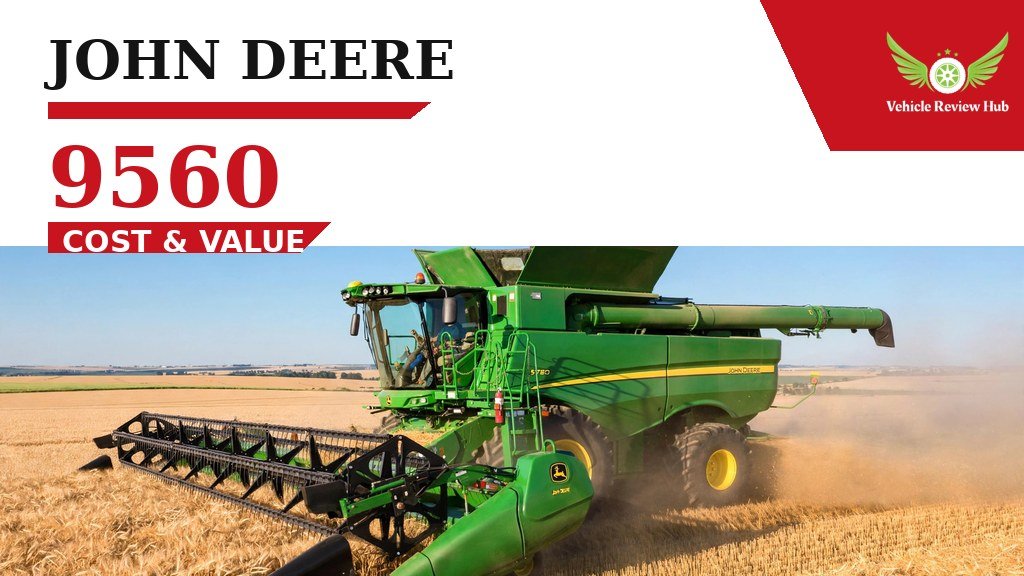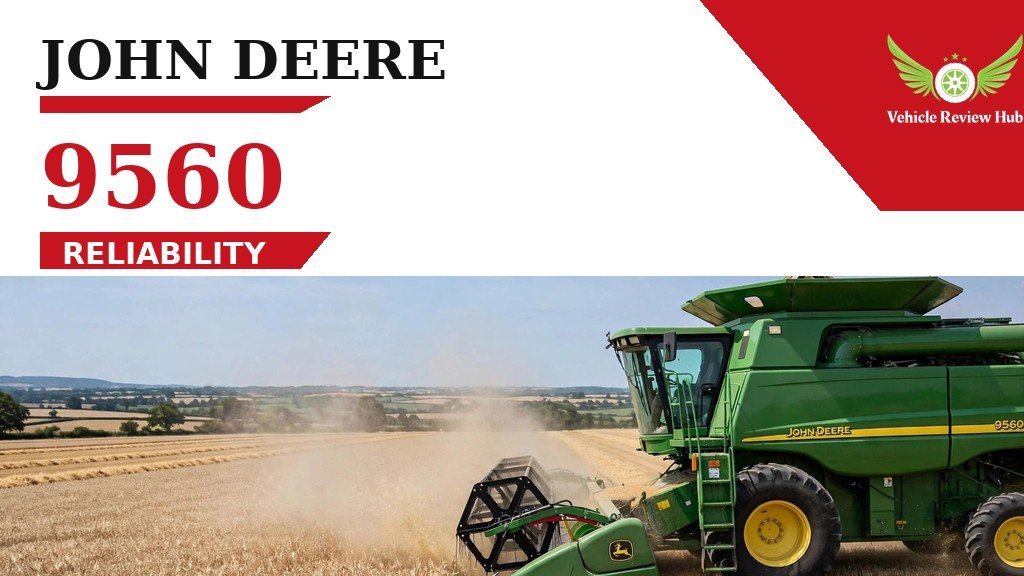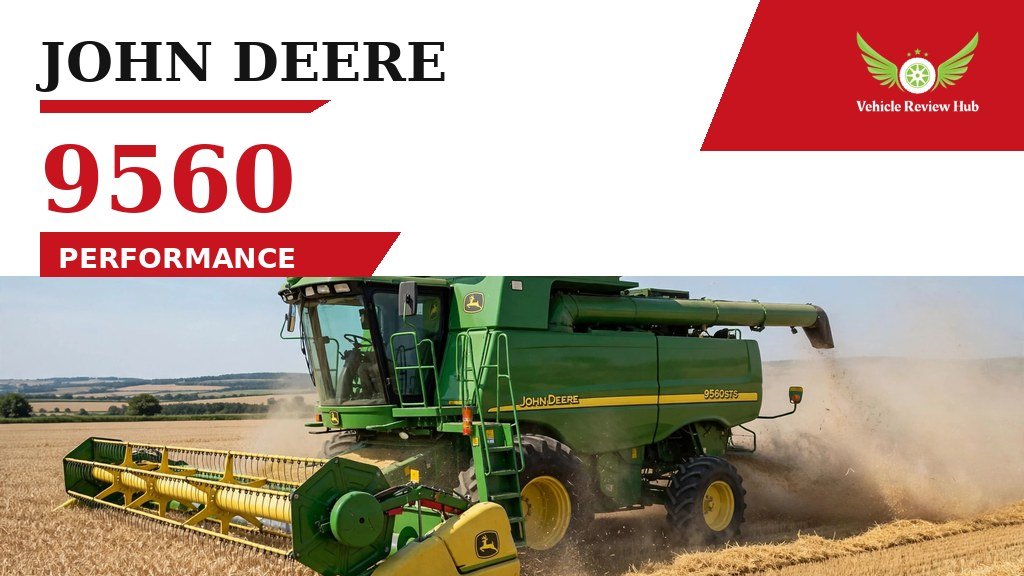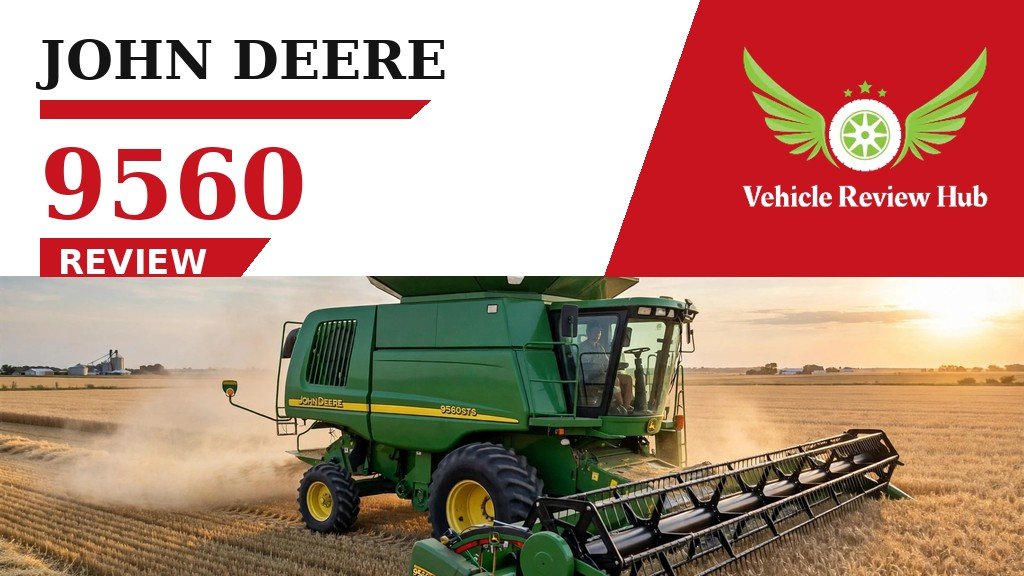
This John Deere 9560 combine review starts with the fact that trips up more buyers than any other: one badge covers two different machines. The conventional walker threshes with a cylinder and straw walkers, while the STS separates with a single tine-separator rotor, and the two differ in engine, grain tank, and field strengths. This John Deere 9560 combine review keeps every figure tied to the machine it belongs to, so a walker price never gets compared with an STS specification.
The short version of this John Deere 9560 combine review, is that the walker is the simpler, usually cheaper buy for small-grain farms that value clean straw, while the STS is the higher-capacity machine for corn and soybean country where throughput matters more than straw quality. Both are 60 Series combines from the 2004 model year, now bought on hours, separator condition, and header package rather than year alone.
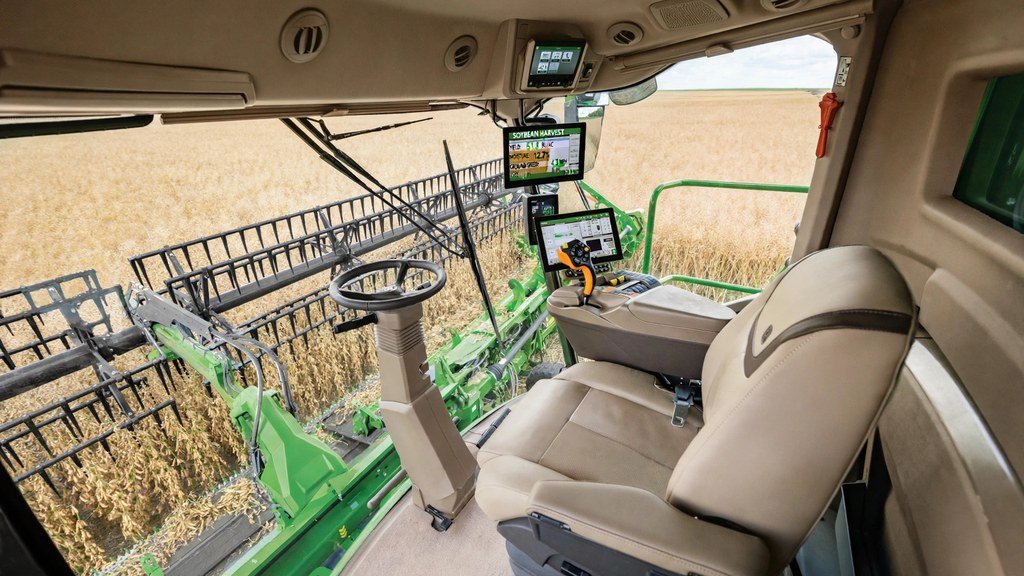
One buying rule runs through this John Deere 9560 combine review: always read engine hours and separator hours as two separate figures. Separator hours count only engaged threshing time, so they run below engine hours and guide wear on the rotor or walkers, concaves, and cleaning shoe. A machine showing 4,000 engine hours but only 2,500 separator hours has spent much of its life idling or road-traveling.
John Deere 9560 Combine Review, Features and Used Price
The 9560 sits at the bottom of the 60 Series range, the smallest and most affordable way into that generation. It is a Class V combine below the 9660, suited to mid-size farms, and this John Deere 9560 combine review positions it as the affordable 60 Series entry. As this John Deere 9560 combine review shows, the walker and the STS share the 60 Series cab and header hookup, but differ once crop enters the machine.
9560 Walker vs. 9560 STS: Main Differences
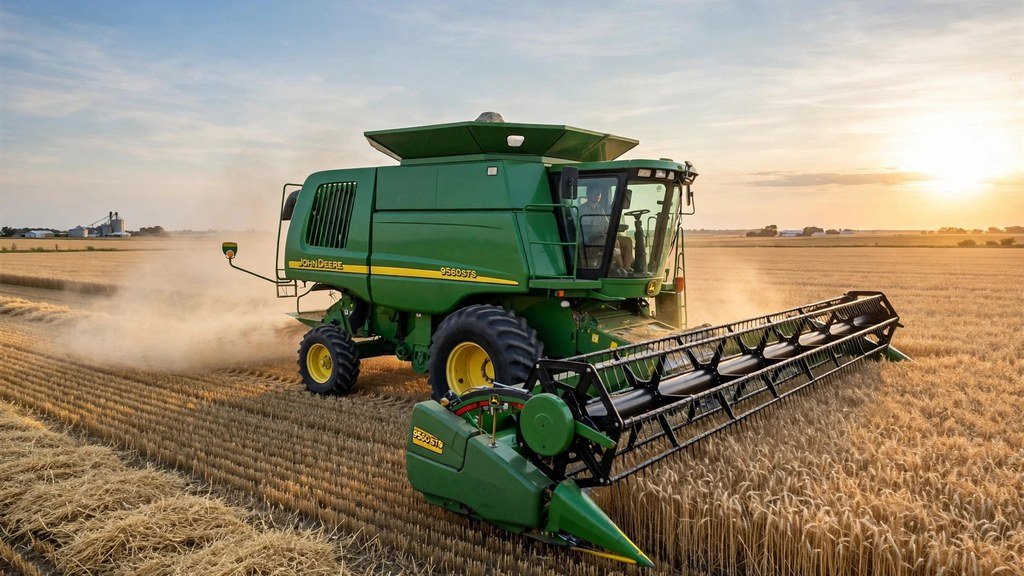
The walker uses a cylinder and straw walkers: the cylinder threshes, and walkers shake remaining grain free as straw moves rearward. That gentle handling, highlighted in this John Deere 9560 combine review, is why walkers still have fans among wheat growers, because straw comes out in better shape for baling. The trade-off is capacity: walkers reach their limit sooner in heavy corn or tough green-stem soybeans.
The STS replaces walkers with a single tine-separator rotor, introduced on the 50 Series in 1999 and expanded across the 60 Series. The rotor threshes and separates in one motion, giving the STS more throughput in corn and soybeans. The trade-off, as this John Deere 9560 combine review notes, runs the other way: the rotor is harder on straw, so growers who bale straw often prefer the walker. That rotor-versus-walker trade-off is the central theme of this John Deere 9560 combine review. Deere’s own 60 Series announcement put the mid-size STS at 265 hp, as the new entry point to the STS range alongside the larger 9660, 9760, and 9860 STS models.
Both versions share the 60 Series updates, treated in this John Deere 9560 combine review as shared features. The feederhouse gained a 17-degree tilt frame, header hookup became single-point, and the reverser became electro-hydraulic from the armrest console. The 60 Series also brought a power bulge for tough patches, plus a power boost while unloading on the go.
The video below shows a 9560 STS at corn harvest in Ohio, field footage rather than a dealer walkaround, for readers of this John Deere 9560 combine review.
Used Prices by Model Year, Hours and Condition
Used 9560 prices are driven by separator hours first, condition second, and model year a distant third. A dealer listing in Kewanee, Illinois, put a 2005 STS at $44,900 with 4,049 engine and 2,576 separator hours, with Contour Master feederhouse and chopper. An auction lot for a 2006 John Deere 9560 STS with 4,480 engine and 3,234 separator hours closed with bidding at $25,000, a bid level, not a confirmed sale. Separator hours and condition move the price more than the year on the serial plate.
The planning bands below in this John Deere 9560 combine review are estimates from those anchors, not quoted prices. Always price the header separately: a good 630F platform or clean 8-row corn head can be worth several thousand dollars alone.
| Condition band | Typical separator hours | Planning price range |
|---|---|---|
| Rough or high-hour machine | 3,000+ separator hours, visible wear | $25,000–$40,000 |
| Average, field-ready machine | 2,000–3,000 separator hours | $40,000–$60,000 |
| Clean, low-separator-hour machine | Under 2,000 separator hours, good records | $60,000–$80,000+ |
| STS vs. walker note | Comparable condition | Expect walkers to list below comparable STS machines (planning estimate) |
Detailed fuel and throughput figures are covered in the John Deere 9560 combine performance analysis, which is where this John Deere 9560 combine review sends readers testing whether a 9560 has enough capacity.
John Deere 9560 Combine Engine, Horsepower and Specifications
Engine figures are where the variants diverge most, so this section of this John Deere 9560 combine review keeps them strictly separate. Headline numbers come from Deere’s 60 Series lineup announcement and a published STS specification chart, with single-variant figures labeled as such.
Engine Options, Rated HP and Maximum Power
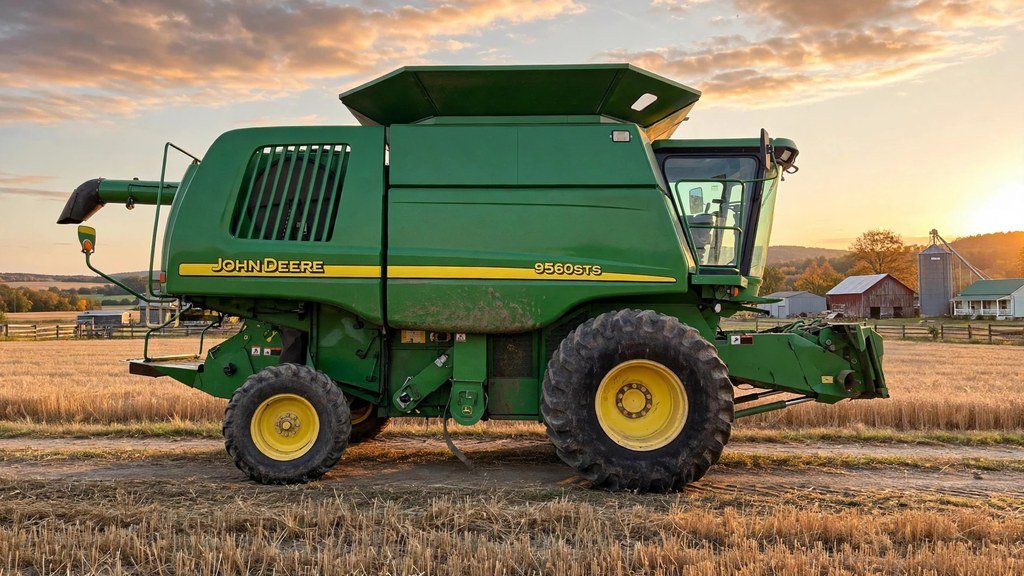
The 9560 walker runs a 6.8L PowerTech six-cylinder rated at 220 or 240 hp, the Sidehill walker at 240 hp. The 9560 STS runs a larger 8.1L PowerTech six-cylinder, model 6081HH, rated 265 hp at 2,200 rpm with a boost figure near 284 hp when unloading on the go. That 45 hp gap, central to this John Deere 9560 combine review, is the simplest explanation for the capacity difference, and why the STS carries a bigger tank and faster unloading.
One caution belongs in any honest John Deere 9560 combine review: later STS machines do not all carry the 8.1L engine. Owner discussion among 9560 STS operators reports later production, including a 2007 machine bought new. That owner-reported change is not a factory specification, so this John Deere 9560 combine review states no changeover year. Read the engine tag on the actual machine; do not assume an STS badge guarantees an 8.1L engine.
| Specification | 9560 Walker | 9560 STS (early 60 Series) |
|---|---|---|
| Engine | 6.8L PowerTech, 6-cylinder | 8.1L PowerTech 6081HH, 6-cylinder |
| Rated power | 220 or 240 hp (Sidehill: 240 hp) | 265 hp at 2,200 rpm |
| Power boost | Power bulge under load | About 284 hp when unloading on the go |
| Grain tank | 204 bushels | 220 bushels |
| Separation | Cylinder and straw walkers | Single tine-separator (STS) rotor |
| Note | Later STS machines may carry a 6.8L engine — check the engine tag | Fuel and unloading figures below are STS figures |
Fuel Capacity, Grain Tank and Unloading Rate
The 9560 STS carries 200 gallons of fuel, a 220-bushel grain tank, and unloads at 2.2 bushels per second, figures this John Deere 9560 combine review returns to in the capacity comparison through its standard system. That combination matters in this John Deere 9560 combine review on long days: the 220-bushel tank holds roughly a fifth more than the walker’s 204-bushel tank, and clears a full tank in about 100 seconds. Note that the faster 3.3-bushel-per-second system was standard on the 9860 STS and optional on the 9760 STS, not a 9560 STS feature.
The walker’s 204-bushel tank is the smaller of the two, which fits its lower-capacity role. Fuel capacity for the walker is not stated in the sources used for this John Deere 9560 combine review, so no walker fuel figure is quoted here. On either machine, plan fuel around long days: heavy corn empties any tank faster than dry wheat.
John Deere 9560 Combine Harvesting System and Header Compatibility
A combine is only as good as its header match, and this John Deere 9560 combine review treats header choice as a top reason the machine still earns its keep. The 60 Series arrived alongside Deere’s 600 Series Grain Platforms, and the single-point header hookup makes header changes far quicker. The wrong header punishes you all season: too wide a platform causes slugging, too narrow a corn head wastes hours.
Straw Walkers vs. STS Single-Rotor Separation
The walker system is simple: a cylinder threshes, walkers shake grain free, and the cleaning shoe finishes the job. Its wear points are walker bearings and blocks; its weakness is capacity in heavy material. The STS runs crop through a single rotor with tines, and this John Deere 9560 combine review cites Deere’s operator manual for the 9560 STS, which gives the dual-range tine separator drive as 480–1,300 rpm high and 230–600 rpm low, advising the slowest workable speed for large-seed crops. That speed range, documented in this John Deere 9560 combine review, is the operator’s main tool for balancing threshing quality against grain damage,
For crop fit, the pattern in this John Deere 9560 combine review is consistent. The STS earns its premium in corn and soybeans, where its rotor keeps capacity up when green stems slow a walker down. The walker earns its keep in wheat and small grains, where gentle handling protects grain quality and leaves straw worth baling. The wrong choice is the one mismatched to the crop mix that fills most of your harvest days. The wear items to inspect follow the same split, and they are set out in the John Deere 9560 combine maintenance checklist that this John Deere 9560 combine review points buyers toward.
Corn, Soybean and Small-Grain Header Options
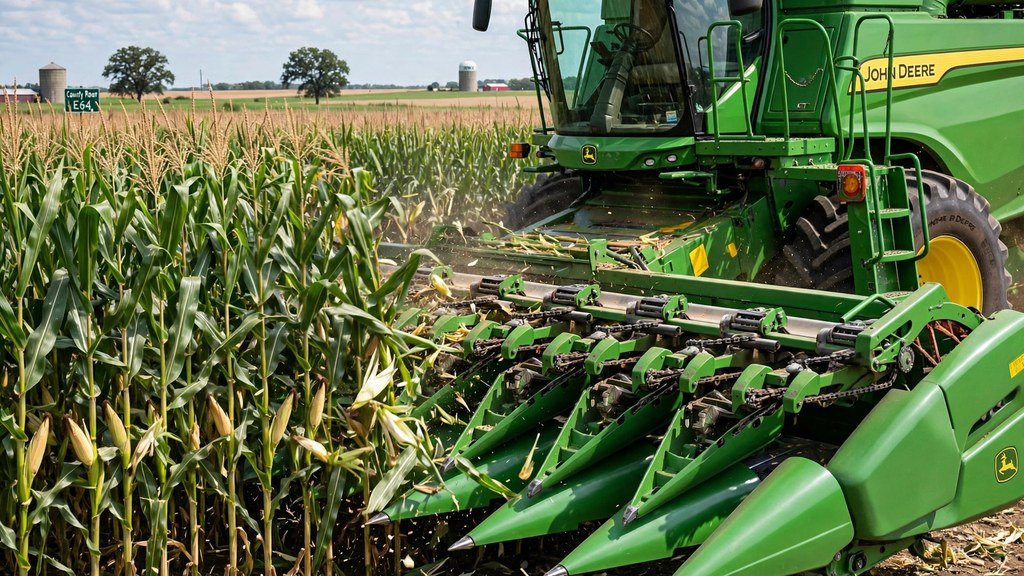
For soybeans and small grains, the natural partner is a 600 Series HydraFlex flex platform, built in widths from 15 to 35 feet, with rigid platforms from 18 to 30 feet. The model number reflects true cutting width, so a 630F is a 30-foot flex platform, and field reports show 9560 STS machines working wheat with one. For corn, this John Deere 9560 combine review lists the era-correct 693 and 694 corn heads, with the 694 offering hydraulic deck plates. For windrowed crops, a belt pickup head is the fourth header type recognized.
Header width deserves a deliberate decision rather than a “bigger is better” reflex. A 9560 STS handles a 30-foot flex platform and a 6- or 8-row corn head comfortably, while a 35-foot platform or 12-row corn head belongs on the larger 9660 and 9760 machines. When a used machine is sold with a header, check its wear: knife sections and guards, stalk rolls and deck plates, and reel condition. A cheap combine with a worn-out header is not a cheap harvest package.
John Deere 9560 Combine vs. Similar Models
The 9560 does not compete with new combines; this John Deere 9560 combine review compares it with its own bigger brother and with the previous generation. The comparison that matters most for buyers in this John Deere 9560 combine review is the one inside the 60 Series, because a 9660 often costs only modestly more. The second is against the 50 Series machines, which trade lower but give up feederhouse and header hookup improvements.
9560 vs. 9660: Power and Harvesting Capacity
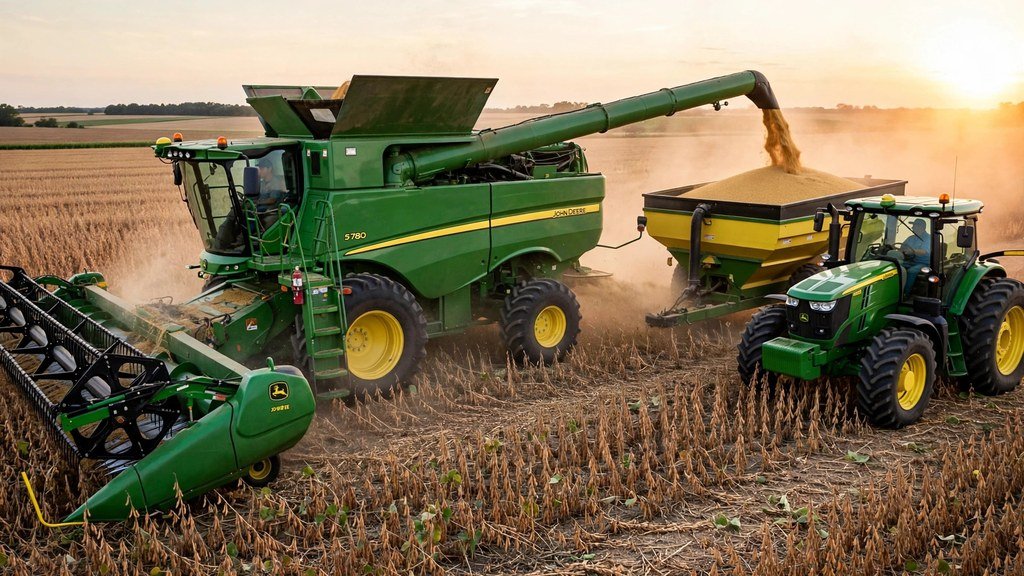
The 9660 is the next step up, and the gap is meaningful. The 9660 walker makes 285 hp from an 8.1L engine with a 240-bushel tank, and the 9660 STS makes 305 hp with a 250- or 300-bushel tank, against the 9560 STS at 265 hp and 220 bushels. In practical terms for this John Deere 9560 combine review, the 9660 STS carries roughly 15 percent more power and up to 36 percent more tank capacity, which means fewer unload stops in heavy corn. The 9660 also offers the 3.3-bushel-per-second unloading option, which the 9560 does not.
| Model | Engine | Power | Grain tank |
|---|---|---|---|
| 9560 Walker | 6.8L | 220–240 hp | 204 bu |
| 9560 STS | 8.1L (early) | 265 hp | 220 bu |
| 9660 Walker | 8.1L | 285 hp | 240 bu |
| 9660 STS | 8.1L | 305 hp | 250–300 bu |
| Gap in one line | Same generation, same headers | 9660 STS: +40 hp over 9560 STS | Up to +80 bu over 9560 STS |
Whether that gap is worth paying for depends on acres and crop. A farm on 500–800 mixed acres will rarely feel the 9560’s limit, while a farm past 1,000 acres of corn and soybeans will feel it daily. Resale follows the same logic in this John Deere 9560 combine review: the 9660 STS holds a premium, but the 9560 STS holds its value among mid-size farms as the cheapest STS machine in the 60 Series. Running costs and resale are set out in the John Deere 9560 combine ownership cost breakdown that this John Deere 9560 combine review recommends before making an offer.
Choosing the Right Combine for Your Farm
Choose the walker if wheat and small grains dominate, you bale straw, and simplicity and price matter more than throughput. Choose the STS if corn and soybeans dominate and you need rotor capacity in tough conditions. Choose the 9660 if your acres are growing toward four figures and the price gap is small. In every case, buy on separator hours and inspection, not the year on the serial plate. That decision framework is the practical core of this John Deere 9560 combine review.
The bottom line of this John Deere 9560 combine review is straightforward. The 9560 remains a sensible used buy for mid-size farms, provided the buyer respects the walker-versus-STS split, checks both hour meters, verifies the engine tag, and prices the header in the deal. Bought that way, it is a capable harvester with deep parts support. Bought on price alone, without inspection, it can become the most expensive machine on the farm.
Frequently Asked Questions About the John Deere 9560 Combine
These answers in this John Deere 9560 combine review cover the questions buyers actually ask, from the walker-versus-STS choice to hours, headers, and inspection. Each answer states which machine it applies to.
What is the difference between the John Deere 9560 walker and the 9560 STS?
The walker threshes with a cylinder and straw walkers, giving gentler handling, and this John Deere 9560 combine review rates that gentleness as its main advantage and a simpler machine, while the STS uses a single tine-separator rotor for higher throughput. The walker makes 220–240 hp from a 6.8L engine with a 204-bushel tank, and the early STS makes 265 hp from an 8.1L engine with a 220-bushel tank.
How much horsepower does a John Deere 9560 combine have?
It depends on the variant: the walker is rated at 220 or 240 hp, the Sidehill walker at 240 hp, and the early STS at 265 hp with a boost near 284 hp when unloading on the go. Later STS machines may carry a 6.8L engine, so this John Deere 9560 combine review advises checking the engine tag.
What years was the John Deere 9560 combine made?
The 9560 is a 60 Series machine that arrived for the 2004 model year, and most listings run from 2004 through 2007. The 50 Series carried different badges, such as the 9550 and 9650, so a “9560” badge always means the 60 Series generation covered by this John Deere 9560 combine review.
How many bushels does a John Deere 9560 grain tank hold?
The walker holds 204 bushels and the STS holds 220 bushels, and this John Deere 9560 combine review uses those figures whenever tank capacity enters a buying decision. The STS unloads at 2.2 bushels per second, so a full tank clears in about 100 seconds.
What do engine hours and separator hours mean on a 9560?
In this John Deere 9560 combine review, engine hours count all running time, while separator hours count only engaged threshing time. Separator hours are the better guide to wear on the rotor or walkers, concaves, and cleaning shoe, and the two figures should always be read together. A wide gap usually means much idling, road travel, or unloading time.
How much does a used John Deere 9560 combine cost?
Planning bands in this John Deere 9560 combine review run roughly $25,000–$40,000 for rough or high-hour machines, $40,000–$60,000 for average field-ready machines, and $60,000–$80,000 or more for clean, low-separator-hour machines. Anchors include a 2005 STS at $44,900 with 4,049 engine and 2,576 separator hours, and a 2006 STS auction lot that closed with bidding at $25,000.
Is the John Deere 9560 STS good for corn and soybeans?
Yes, and this John Deere 9560 combine review rates corn and soybeans as the crops where the STS earns its premium, because the single-rotor separator holds capacity better than walkers in heavy crops and tough conditions. Pair it with a 6- or 8-row corn head for corn and a flex platform for soybeans.
Is the John Deere 9560 walker good for wheat?
Yes, and this John Deere 9560 combine review calls wheat and small grains the walker’s home ground. The cylinder-and-walker system handles straw gently, leaves straw worth baling, and produces a clean sample.
What headers fit a John Deere 9560 combine?
This John Deere 9560 combine review lists the 600 Series HydraFlex flex platforms from 15 to 35 feet and rigid platforms from 18 to 30 feet for soybeans and small grains, with a 30-foot flex platform a sensible match for a Class V machine. For corn, the era-correct 693 and 694 corn heads fit, and a belt pickup head covers windrowed crops.
Should I buy a 9560 or spend more on a 9660?
Buy the 9560 if your acres are modest, and this John Deere 9560 combine review frames that call around acres, not badge prestige: and your crop mix fits its capacity, and buy the 9660 if your acres are growing toward four figures or heavy corn dominates your harvest. The 9660 STS adds about 40 hp and up to 80 bushels of tank over the 9560 STS, but it also costs more to buy and to keep fed.
What should I check before buying a used John Deere 9560?
Check engine hours and separator hours separately, as this John Deere 9560 combine review advises throughout, read the engine tag, inspect the rotor or walkers, concaves, and cleaning shoe, test the feederhouse reverser and header hookup, and price the header separately. Service records matter more than the model year.