
When you move up to a premium garden tractor, the question is no longer whether it will cut the grass. It is how fast it cuts, how the finish looks, how much fuel it drinks, and whether it keeps its grip on steep or soggy ground. That combination is John Deere X700 Signature Series performance in everyday use.
In short, John Deere X700 Signature Series performance is built for larger properties, not small lots. With 48-, 54- and 60-inch decks, speeds up to 8.5 mph and available four-wheel drive and four-wheel steering, these tractors mow big lawns faster with fewer uncut patches than entry machines, while a 5.2-gallon tank and the diesels’ frugal burn stretch time between fill-ups.
This guide judges John Deere X700 Signature Series performance as an owner experiences it: cut quality, mowing time, fuel use, traction, handling and comfort. Owner-reported figures are labeled estimates.
John Deere X700 Signature Series Mowing Performance
Mowing is the job these tractors are bought for, so it is the fairest test of John Deere X700 Signature Series performance. Two things decide it: the deck underneath and how the tractor moves. Three deck widths, shaft drive, hydraulic lift and a deep-forged shell show up in the finish.
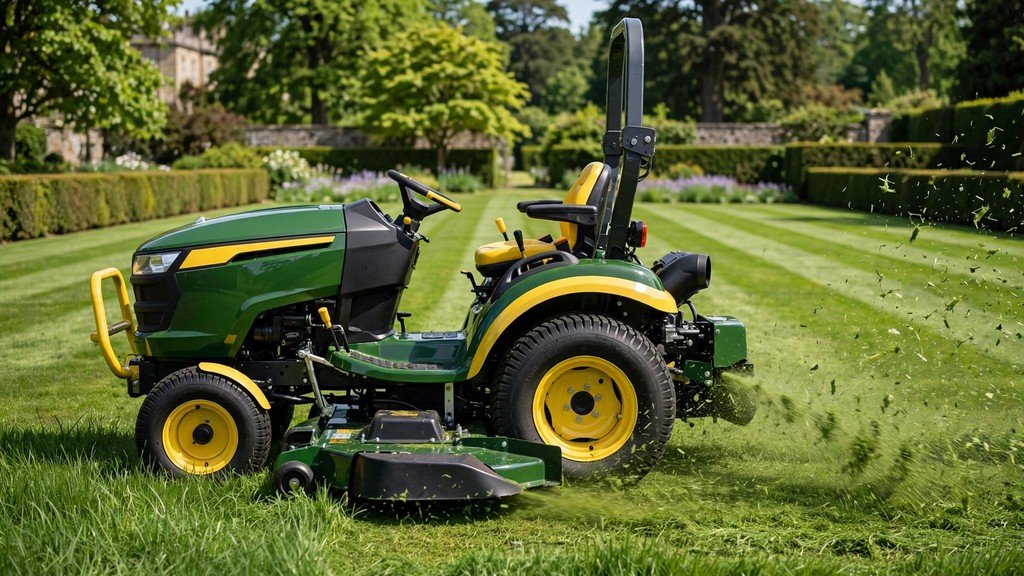
Cutting Quality, Deck Width and Grass Discharge
The decks come in three sizes: a 48-inch Accel Deep deck, and 54- and 60-inch High-Capacity (HC) decks. The 54- and 60-inch HC decks are drive-over decks with AutoConnect, so you drive on and off them for removal, while the 48-inch deck is shaft-driven and rolls out from underneath. The 48-inch deck uses 10-gauge steel; the HC decks use a 9-gauge forged shell with a 5.5-inch deep dome and 1-inch cold-forged spindles. That depth lets clippings exit without being recut — central to John Deere X700 Signature Series performance at higher ground speeds.
The HC decks’ large, high and wide discharge opening spreads clippings evenly instead of windrowing them, and the raised front edge lets tall grass feed in cleanly. Cut height runs 1 to 5.25 inches in quarter-inch steps. MulchControl and Power Flow collection are available for mulching or bagging. Blade and deck care matter as much as width — dull blades tear grass tips brown — and the John Deere X700 Signature Series maintenance guide covers the upkeep that keeps John Deere X700 Signature Series performance consistent.
A dealer walkthrough shows the buying side of John Deere X700 Signature Series performance. Quality Equipment compares the X730 with the 1023E compact utility tractor and walks through the X730’s mowing setup for owners mowing up to about six acres. It is a comparison, not a field-mowing demo, but it shows why the X730 suits a mowing-first buyer. The written version is on the Quality Equipment X730 vs 1023E page.
Mowing Time, Turning Ability and Lawn-Finish Consistency
Deck width is the simplest lever on mowing time: a 60-inch deck is 25 percent wider than a 48-inch deck, so it needs roughly a fifth fewer passes, and at up to 8.5 mph the Signature tractors cover open ground quickly. But trees, beds, gates and slopes eat into any theoretical pace, so the honest measure of John Deere X700 Signature Series performance on time is passes plus turns, not top speed.
That is where steering earns its keep. Two-wheel-steer models turn in 25 inches; four-wheel-steer models (X734, X739, X754) turn in 21 inches. The sharper number is the uncut circle around an obstacle: with a 60-inch deck, 28 inches on two-wheel steer but just 6 inches on four-wheel steer, and 10 inches for an X739 with the 54-inch HC deck. Add standard hydraulic power steering, hydraulic lift and cruise control, and the result is the steady, even finish that defines John Deere X700 Signature Series performance on three- to six-acre properties. That steadiness is John Deere X700 Signature Series performance at its most visible.
John Deere X700 Signature Series Fuel Usage and Runtime
Fuel is where the gasoline and diesel models split, and careful reading matters: Deere publishes no gallons-per-hour rating, so every consumption figure below is an owner-reported estimate, not a factory claim. What John Deere X700 Signature Series performance looks like at the fuel pump depends on engine choice, grass condition and deck width — the three variables behind real-world John Deere X700 Signature Series performance at the pump.
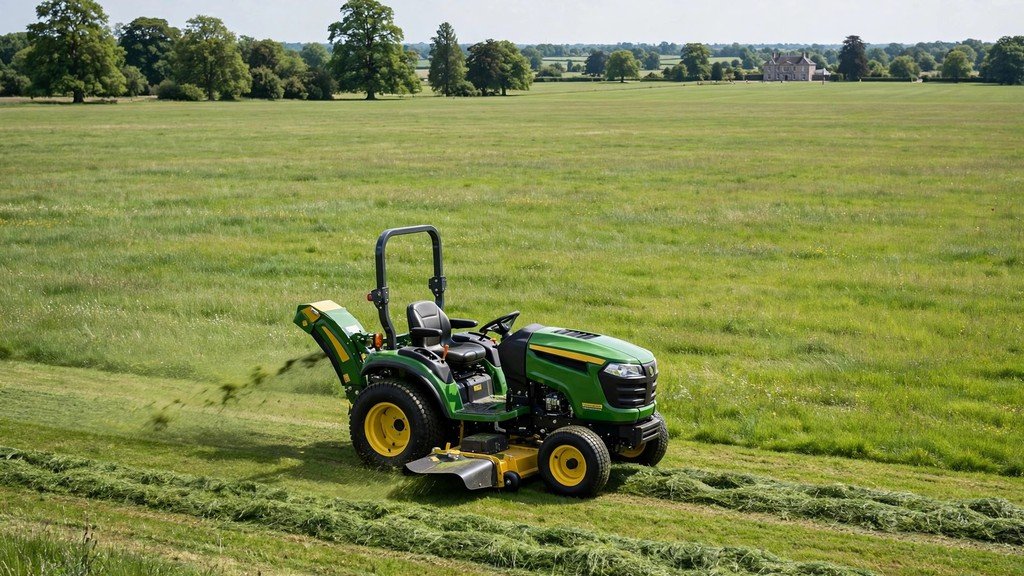
Gasoline EFI vs. Diesel Fuel Use During Mowing
The gasoline models (X730, X734, X738, X739) run a 25.5-hp Kawasaki FD750D EFI V-twin of 745 cc; the diesels (X750, X754, X758) run a 24-hp Yanmar 3TNM74F three-cylinder diesel of 993 cc. EFI helps the gasoline engines start cleanly, but on consumption, John Deere X700 Signature Series performance favors diesel: owner reports put the gasoline X738 at 1.2 to 1.3 gallons per hour while mowing, and the diesel X758 at roughly 0.8 to 0.9 in heavy grass at wide-open throttle. One diesel owner mowed 7 acres in 4.5 hours on one tank — evidence that makes John Deere X700 Signature Series performance figures trustworthy where no factory rating exists.
Run the tank math and the fuel side of John Deere X700 Signature Series performance becomes plain. All models carry the same 5.2-gallon tank, filled from the left fender. At about 1.25 gallons per hour, a gasoline model gives four hours per tank; at about 0.85 gallons per hour, a diesel gives six hours. That is why John Deere X700 Signature Series performance on runtime favors diesel for owners mowing five or more acres in one session: fewer stops. Gasoline still has its logic — lower price and simpler servicing — but one Koenig owner review complains that the X738 “burns a lot of gas or needs a bigger gas tank.” Diesel economy is a headline point on the official John Deere X758 page, which also lists the 4-year/700-hour warranty — backing that adds to the value behind John Deere X700 Signature Series performance.
| Model group | Engine | Owner-reported burn (planning estimate) | Approx. runtime per 5.2-gal tank |
|---|---|---|---|
| Gasoline (X730, X734, X738, X739) | 25.5-hp Kawasaki EFI V-twin, 745 cc | ~1.2–1.3 gal/hr mowing | ~4 hours |
| Diesel (X750, X754, X758) | 24-hp Yanmar 3-cyl diesel, 993 cc | ~0.8–0.9 gal/hr mowing heavy grass | ~6 hours |
How Grass Conditions, Deck Size and Engine Load Affect Runtime
Three things move fuel use more than the badge on the hood. First, grass condition: tall, thick or wet grass loads the deck and engine, so burn rate climbs and ground speed must drop — a wet spring lawn can use a third more fuel per acre than the same lawn dry in summer. Second, deck size: a 60-inch deck cuts more per pass but demands more power per pass, so some time saved is paid back in fuel. Third, load beyond mowing: hills, a bagger or a loaded cart all draw power that shows up at the tank. All three are why published John Deere X700 Signature Series performance figures never tell the whole story without context — and why your own John Deere X700 Signature Series performance will vary with the season.
Four-wheel drive deserves a note because buyers often assume it drinks fuel, but owners report the penalty as barely noticeable — and the practical advice for stretching John Deere X700 Signature Series performance per tank is unglamorous but effective: mow dry grass, keep blades sharp, don’t let the lawn get overgrown, and match deck width to the property. Owners comparing with a smaller machine can see the contrast in the John Deere 100 Series performance and fuel guide.
John Deere X700 Signature Series Traction and Handling
Traction and handling are where the Signature range justifies its price over a basic lawn tractor, because a big property is rarely flat, dry and open. Slopes, wet grass and tight landscaping punish a machine that only drives and steers with two wheels. John Deere X700 Signature Series performance here comes from three systems: full-time four-wheel drive on three models, four-wheel steering on three models, and a heavy chassis underneath both.
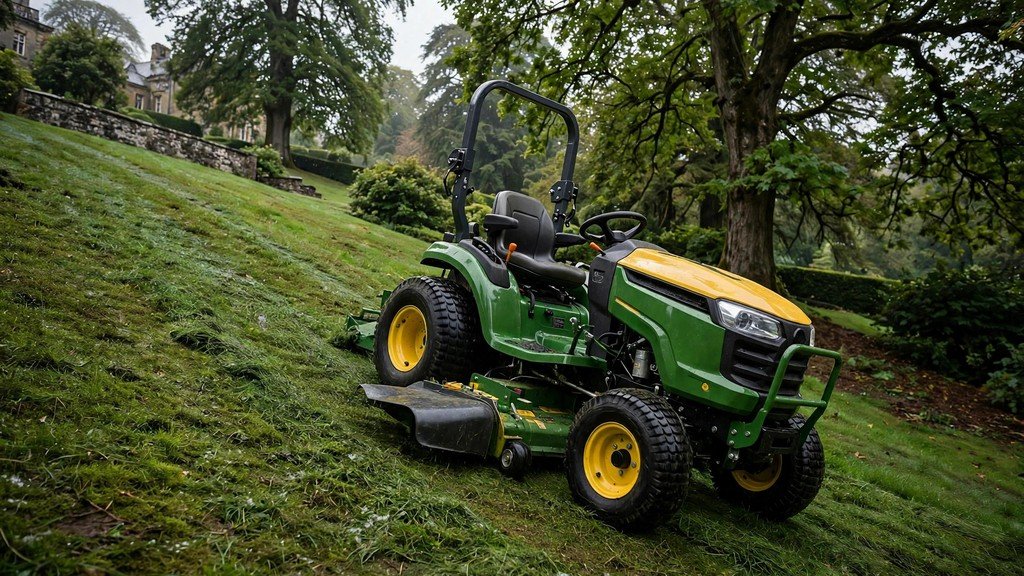
Four-Wheel Drive on Slopes, Wet Grass and Uneven Ground
The X738, X739 and X758 carry full-time four-wheel drive. Unlike a mechanical 4WD system that locks the axles together, this one powers each front wheel with its own hydraulic motor fed by pressurized fluid from the rear transaxle in parallel, so each front wheel gets the flow it needs. Two practical results follow. First, turning radius matches the two-wheel-drive models — much tighter than a mechanical 4WD machine — so John Deere X700 Signature Series performance does not trade maneuverability for grip. Second, it works in forward and reverse and does not rip up lawns in turns like a locked mechanical system can. That combination is a core part of John Deere X700 Signature Series performance on real properties, where the same machine must climb a damp bank and leave a clean striped lawn.
On slopes, the rest of the chassis helps: weights with the deck fitted run from 1,078 lb on the X730 to 1,255 lb on the X739, and that mass, plus a low center of gravity and 26×12-12 rear turf tires, keeps it planted. A foot-operated differential lock on the left footrest is standard — press it when one wheel spins. Note: one aggregator lists the X758 at 1,036 lb without the deck; the dealer figures above include it. For ballast, owners add up to four 42-lb Quik-Tatch weights up front and up to six at the rear — a cheap way to sharpen John Deere X700 Signature Series performance on slopes. Buyers on hilly or wet properties should weight this part of John Deere X700 Signature Series performance heaviest: you can change a deck, but you cannot retrofit factory four-wheel drive.
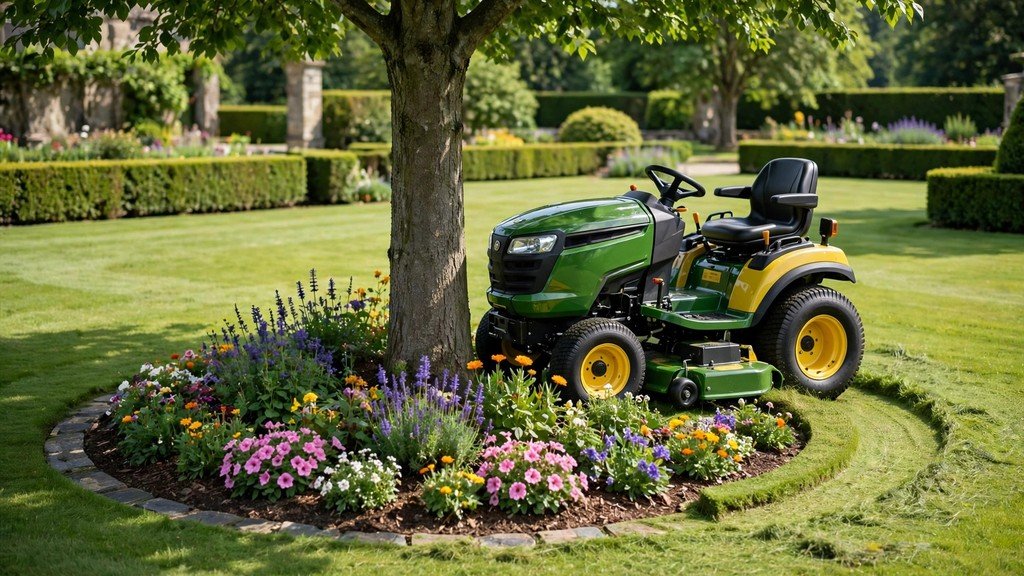
Four-Wheel Steering Around Trees, Beds and Tight Corners
Four-wheel steering, fitted to the X734, X739 and X754, steers the rear wheels, and its benefit shows up wherever the lawn is broken up by obstacles. The headline numbers tell the story: a 21-inch turning radius against 25 inches for two-wheel steering, and with a 60-inch deck an uncut circle of 6 inches around a tree against 28 inches without it. On a property with a dozen trees, a winding bed edge and a narrow gate, that difference removes follow-up trimming — a direct, visible gain in John Deere X700 Signature Series performance.
Trade-offs exist: four-wheel-steer models cost more, and the rear steering linkage is one more system to maintain. The X739 pairs four-wheel steering with four-wheel drive, making it the most capable handler in the range and the most expensive gasoline model. For a wide-open property with few obstacles, two-wheel steering delivers perfectly good John Deere X700 Signature Series performance and the money is better spent on the wider deck or diesel engine. For a landscaped property full of trees and beds, four-wheel steering changes the weekly mowing experience, because it changes every turn you make.
John Deere X700 Signature Series Real-World Experience
Spec sheets do not mow lawns; people do, for hours at a time. The real-world side of John Deere X700 Signature Series performance is whether the tractor stays comfortable and useful across a long session and all four seasons, because a machine that only mows well in May is a poor buy for a property needing work in January too — and that year-round test defines John Deere X700 Signature Series performance.
Comfort, Noise, Visibility and Year-Round Property Work
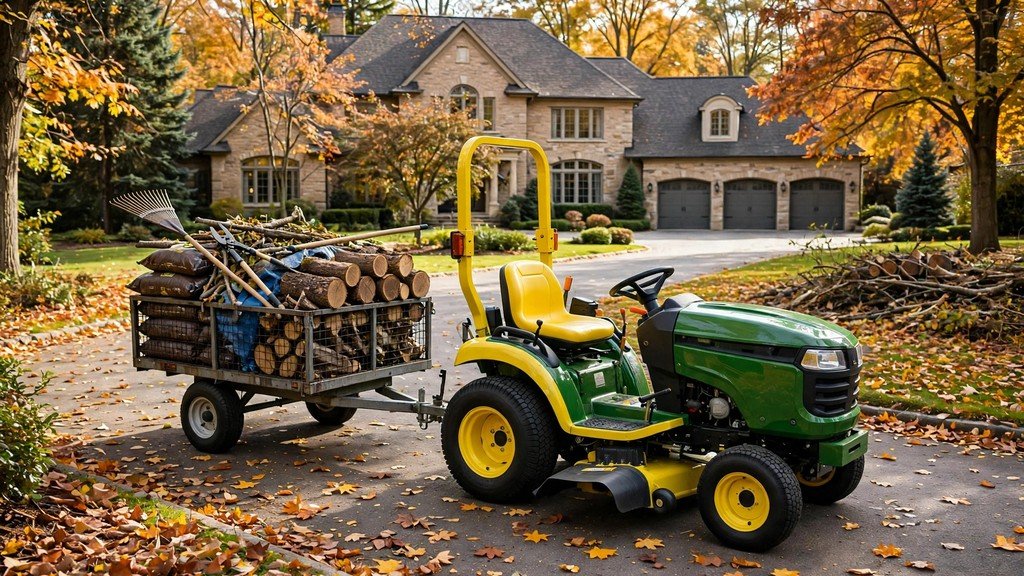
The operator station is the most obviously premium part of the range, and a big reason John Deere X700 Signature Series performance feels premium rather than bigger: a two-piece adjustable seat with brand embroidery, a 21-inch back, a 14-position 7-inch slide that works while seated, and six-position suspension, with armrests optional. Hydraulic power steering, a six-position tilt wheel and Twin Touch pedals with cruise control keep speed control effortless. Over a three-hour mow, that combination is the difference between getting off fresh and getting off stiff — and that comfort is part of John Deere X700 Signature Series performance, not a luxury extra.
On noise, treat any decibel number in a classified ad with suspicion: Deere publishes no consistent operator-ear rating across these listings. Owners describe the diesels as smooth and quiet for a diesel, with the gasoline EFI models sharper-sounding under load. Visibility is good from the high seat, helped by halogen headlights and backup lights. Year-round, the two-function hydraulic lift with four outlets and a float position runs a snow blower, blade or rotary broom through the front quick-hitch, and an optional Category 1 limited hitch opens up tillers and box blades. Rated towing is 1,000 lb on the base X730 per its dealer sheet, with some Signature listings up to 1,200 lb. Batteries are 340 cold-cranking amps on gasoline models, 500 on diesels, with a 40-amp alternator on diesels, 20 amps on gasoline models — another quiet way John Deere X700 Signature Series performance stretches beyond mowing season.
Choosing the Right Model for Mowing, Hauling and Snow Removal
Choosing well means matching drivetrain to property, not buying the most expensive model — and that match is the core of John Deere X700 Signature Series performance.
| Model | Engine | Drive / steering | Best for |
|---|---|---|---|
| X730 | 25.5-hp gas EFI | 2WD / 2WS | Open lawns |
| X734 | 25.5-hp gas EFI | 2WD / 4WS | Trees, tight beds |
| X738 | 25.5-hp gas EFI | 4WD / 2WS | Slopes, snow work |
| X739 | 25.5-hp gas EFI | 4WD / 4WS | Hilly, landscaped |
| X750 | 24-hp diesel | 2WD / 2WS | Long sessions |
| X754 | 24-hp diesel | 2WD / 4WS | Diesel, tight handling |
| X758 | 24-hp diesel | 4WD / 2WS | Do-everything: hills, snow |
On price, 2025 United Ag & Turf tractor-only figures ran from $12,243 for the X730 to $14,940 for the X758, with decks adding $2,220–$3,260 by size; a Weingartz X730/60-inch at $15,389, a Koenig X758 at $17,249, and an Ag-Pro 2025 X738 at $16,499. Those bands are why the John Deere X700 Signature Series review and price guide is worth reading before visiting a dealer: the review covers the price ladder, while this guide covers what the money buys in John Deere X700 Signature Series performance. If the budget does not stretch to Signature money, the John Deere 100 Series review covers the entry range. For Signature buyers the sweet spot is the X738 for gasoline or the X758 for diesel, and that choice is where John Deere X700 Signature Series performance meets real budgets: both add the four-wheel drive that transforms slope and snow work, and the diesel X758 adds one-tank runtime for big properties. The Koenig Equipment X758 page and MachineFinder X700 Series overview are good second sources.
John Deere X700 Signature Series Performance FAQs
These are the questions buyers actually ask about John Deere X700 Signature Series performance once they move past the brochure: speed, fuel use, traction, steering and model choice.
How fast can a John Deere X700 Signature Series tractor mow an acre?
There is no single factory figure: time depends on deck width, obstacles and grass condition. With a 60-inch deck at up to 8.5 mph, open ground goes quickly, but trees and slopes slow any tractor down. Judge John Deere X700 Signature Series performance on your own property’s obstacles, not open-field speed alone.
How much fuel does the X738 use per hour?
Owner reports put the gasoline X738 at 1.2 to 1.3 gallons per hour while mowing. Deere publishes no gallons-per-hour rating, so treat that as a planning estimate. With the 5.2-gallon tank, that is four hours per tank — the tightest side of John Deere X700 Signature Series performance on fuel.
How much fuel does the X758 diesel use per hour?
Owner reports put the diesel X758 at 0.8 to 0.9 gallons per hour in heavy grass at wide-open throttle, giving six hours per tank. One owner reported 7 acres in 4.5 hours on one tank. Diesel John Deere X700 Signature Series performance on runtime is the range’s strongest fuel story, and for big properties it is John Deere X700 Signature Series performance at its most practical.
Is four-wheel drive worth it on a garden tractor?
Yes, if your property has slopes, wet areas or snow work. The full-time 4WD system drives each front wheel with its own hydraulic motor, keeps the same turning radius as two-wheel drive, and does not tear up lawns in turns like a locked mechanical system can. That grip is the heart of John Deere X700 Signature Series performance on difficult ground. On flat, dry lawns, two-wheel drive is cheaper.
How good is the cut quality in wet or tall grass?
Better than most lawn tractors — and a good example of John Deere X700 Signature Series performance in difficult conditions — thanks to the deep-dome forged deck shell and the wide, high discharge opening that moves clippings out without recutting them. Wet or overgrown grass still costs speed and fuel, and clumping appears if the deck is packed or blades are dull. Mowing dry grass and keeping blades sharp keep John Deere X700 Signature Series performance consistent.
Gasoline or diesel: which is better for performance?
Diesel wins on fuel economy, runtime and low-end pulling feel — the core measures of John Deere X700 Signature Series performance — and its 500-CCA battery and 40-amp alternator suit winter attachment work. Gasoline wins on purchase price and simpler servicing, and EFI starts cleanly. Under about three acres the difference in John Deere X700 Signature Series performance is small; over five acres or with regular snow work, the diesel’s runtime advantage is hard to ignore.
Which X700 Signature model should I buy?
Buy the X730 or X750 for open lawns on a budget, adding four-wheel steering (X734/X754) for tree-filled lawns or four-wheel drive (X738/X758) for slopes and snow. Buy the X739 if the property is both hilly and landscaped, and the X758 for diesel economy with four-wheel drive — the widest-ranging John Deere X700 Signature Series performance in the lineup. For multi-acre properties, John Deere X700 Signature Series performance is in a different class from a basic lawn tractor.