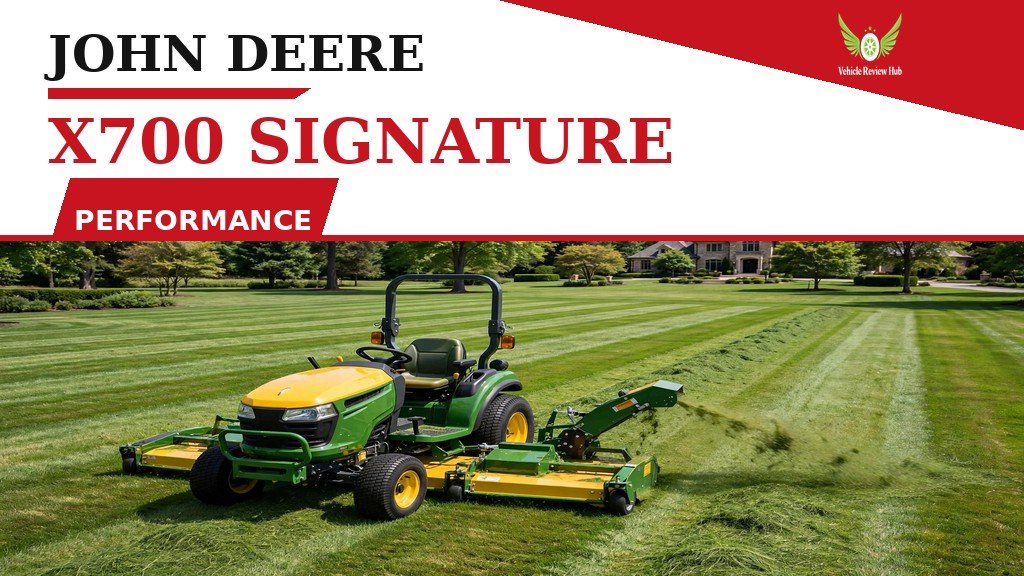
The short answer is that John Deere X700 Signature Series maintenance is heavier-duty work than entry lawn-tractor care, but it follows a simple pattern: short break-in services, regular engine and transaxle oil changes, and close attention to cooling screens, fluid, and the deck. These are premium garden tractors, so John Deere X700 Signature Series maintenance costs more per visit than a 100 Series service, yet the 4-year/700-hour warranty and long service life make it worth following.
This guide covers the full John Deere X700 Signature Series maintenance schedule for both engine types, what wears out, common problems, and what to inspect before buying used. Intervals vary slightly by manual and model year, so your own operator’s manual is the final word.
John Deere X700 Signature Series Maintenance Schedule and Costs
Good John Deere X700 Signature Series maintenance starts with two schedules, not one: gasoline and diesel models share transaxle and chassis service, but their engine-oil and coolant intervals differ — so John Deere X700 Signature Series maintenance always starts by identifying your engine. The table below follows the published Deere gasoline service-interval table and companion diesel table; where they differ, both are shown.
Engine Oil, Filters, Cooling System and Routine Service
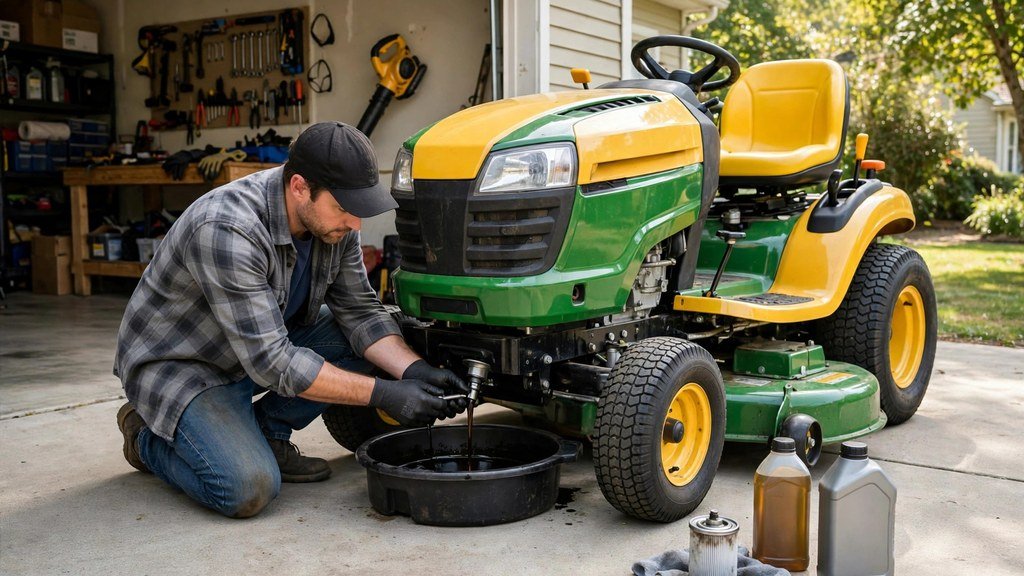
Engine oil is the first item in any John Deere X700 Signature Series maintenance routine, and the break-in change matters more here than on a small mower. On gasoline models, change the engine oil and filter after the first 8 hours; on diesel models, the first change falls at 50 hours with the transaxle service. After break-in, gasoline engines take fresh oil and a filter every 100 hours or annually, diesel engines every 200 hours.
Filters follow the same 200-hour rhythm in John Deere X700 Signature Series maintenance. Change the fuel filter and air cleaner elements every 200 hours or annually on both engine types, and spark plugs on gasoline models then. Diesel models have no spark plugs, but their fuel system hates water and stale fuel: drain the water separator as directed, and never let diesel sit over winter untreated. Valve lash is checked every 300 hours on both engines — a dealer job.
Cooling is where John Deere X700 Signature Series maintenance separates careful owners from the rest. Both engines are liquid-cooled, and both manuals call for cleaning the radiator and hydraulic cooler screens and fins every 200 hours or annually, plus checking clamps. A clogged screen is the most common cause of summer overheating: the gauge climbs, power drops, and the fix is usually a brush. Coolant changes fall every 400 hours or 24 months on gasoline models, every 1,000 hours or 2 years on diesel models — another place where the two John Deere X700 Signature Series maintenance schedules genuinely differ.
Transaxle Oil, Mower Blades, Belts and Lubrication
The transaxle is the most expensive single component in John Deere X700 Signature Series maintenance. Change the transaxle oil and filter after the first 50 hours, then every 200 hours. The transaxle is a Tuff Torq K90 hydrostatic unit with an oil cooler and a 10-micron suction filter, taking Low Viscosity Hy-Gard (J20D), about 6.6 liters. Use the specified oil, not a generic hydraulic fluid: the wrong viscosity shows up as slow response when hot and, over time, as wear in a unit that costs far more than the oil — which is why John Deere X700 Signature Series maintenance is strict about J20D.
Blades and belts are the wearing parts of John Deere X700 Signature Series maintenance. The shaft-driven 48-, 54-, and 60-inch decks run two or three blades; sharpen them once a season, replace them when nicked or bent, and check bolt tightness. A dull blade tears grass, and an unbalanced blade wears spindle bearings. Check fan belt tension every 200 hours, and the deck belt for cracks and fraying whenever the deck is off. The video below is John Deere’s guide to installing and removing the 54HC and 60HC drive-over decks:
Lubrication rounds out John Deere X700 Signature Series maintenance: every 200 hours or annually, grease the steering spindles, axle pivot, and steering cylinder, and check MFWD oil level on 4WD models, tire pressure, and wheel bolt torque (also at 50 hours). See our X700 Signature Series ownership cost guide for the annual budget.
| When | Gasoline (X730–X739) | Diesel (X750–X758) |
|---|---|---|
| Break-in | Engine oil + filter at 8 hrs; transaxle oil + filter at 50 hrs | Engine oil + filter, transaxle oil + filter at 50 hrs |
| Every 100 hrs or annually | Engine oil + filter | — |
| Every 200 hrs or annually | Fuel filter, air cleaner, spark plugs, belt tension, battery, lubrication, MFWD oil, cooler screens, tire pressure, clamps | Engine oil + filter, fuel filter, air check, belt tension, battery, lubrication, MFWD oil, cooler screens, tire pressure, clamps |
| Every 200 hrs | Transaxle oil + filter | Transaxle oil + filter |
| Every 300 hrs | Check/adjust valve lash | Check/adjust valve lash |
| Coolant | Every 400 hrs or 24 months | Every 1,000 hrs or 2 years |
John Deere X700 Signature Series Reliability and Durability
Routine John Deere X700 Signature Series maintenance is what keeps X700 reliability strong, with one caveat: these machines are built for estate lawns and year-round utility work, not commercial mowing.
Gasoline EFI vs. Diesel Engine Maintenance
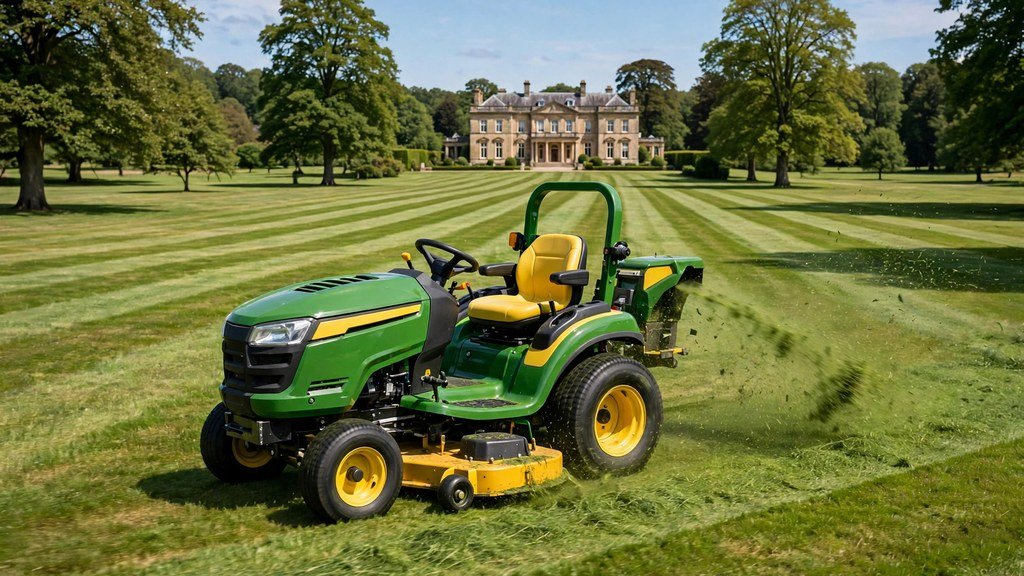
The gasoline models use a liquid-cooled Kawasaki FD750D EFI V-twin, 25.5 hp and 745 cc, with electronic fuel injection — no choke, no carburetor to gum up. Its maintenance is familiar: oil, filter, air cleaner, fuel filter, and spark plugs per the schedule. EFI faults are rare, but when they occur they are usually a sensor, fuel pump, or wiring connector, needing a dealer scan tool.
The diesel models use a liquid-cooled Yanmar 3TNM74F three-cylinder, 24 hp and 993 cc. Diesel John Deere X700 Signature Series maintenance is less frequent on oil — every 200 hours instead of 100 — but stricter on fuel: water in diesel damages injectors, so the water separator and fuel filter matter more, and cold starts depend on glow plugs and a 500-CCA battery (gasoline: 340 CCA). The classic diesel trade is better fuel economy and torque against a louder engine and higher price — the X700 Signature Series performance guide breaks down the fuel gap, while dealer spec sheets for the X758 confirm the 24-hp rating and 5.2-gallon tank. That distinction is the heart of gasoline-versus-diesel John Deere X700 Signature Series maintenance, and should drive the buying choice.
Hydrostatic Transmission, Steering and Mower Deck Longevity
The K90 hydrostatic transaxle is the durability centerpiece of John Deere X700 Signature Series maintenance: an integrated, shaft-driven unit with Twin Touch foot pedals, cruise control, an oil cooler, and a differential lock, built for heavier loads than entry lawn-tractor transaxles. Its enemies are heat, dirty oil, and overload — skipped oil changes, a blocked cooler, and heavy towing beyond its rating. Keep the oil fresh and the cooler clean, and the transaxle is usually the last component to need attention.
Steering and deck longevity follow the same logic in John Deere X700 Signature Series maintenance. Power steering is standard, and four-wheel-steer models (X734, X739, X754) add rear linkage needing grease and play checks. The shaft-driven decks — 48-inch Accel Deep and 54/60-inch high-capacity with AutoConnect — last well when kept clean and level. The deck shell itself is the usual life limiter: packed wet clippings rust a deck from the inside, so scraping the underside clean after mowing is a highest-value habit in John Deere X700 Signature Series maintenance.
John Deere X700 Signature Series Common Problems and Warning Signs
Most John Deere X700 Signature Series maintenance problems are small, cheap, and diagnosable in the driveway: a tractor that will not start in spring, a cut that turns uneven, a belt that slips, or steering that goes stiff. Work through simple causes first — battery, fuel, filter, belt, tire pressure, fluid level.
Starting Issues, Uneven Cutting and Blade Engagement Symptoms
When it will not start or only clicks, John Deere X700 Signature Series maintenance diagnosis follows a fixed order: battery and terminals, safety-interlock switches (seat, brake, PTO must agree), fuel delivery, then ignition or glow plugs. A weak battery is the most common spring problem, and dirty terminals mimic one — clean them first. On gasoline models, stale fuel and a clogged fuel filter are the usual suspects when it cranks but will not fire; on diesel models, check glow plugs, the water separator, and fuel freshness first.
Uneven or ragged cutting usually traces back to the deck, not the engine, and it is one of the most common John Deere X700 Signature Series maintenance complaints because the fix is simple. Dull, bent, or unbalanced blades tear grass and leave strips; an unlevel deck scalps high spots; worn spindle bearings let a blade wobble. Check tire pressure first because it is free, then blade sharpness, then level. Blade engagement problems — blades that will not spin up, or that stop under load — point to the electric PTO clutch, engagement switch, or a worn belt. On AutoConnect decks, owners also report fiddly alignment on the drive-over ramps; the fix is usually a level surface and correct tire pressure.
Belt Wear, Hydraulic Lift, Steering and Drivetrain Checks
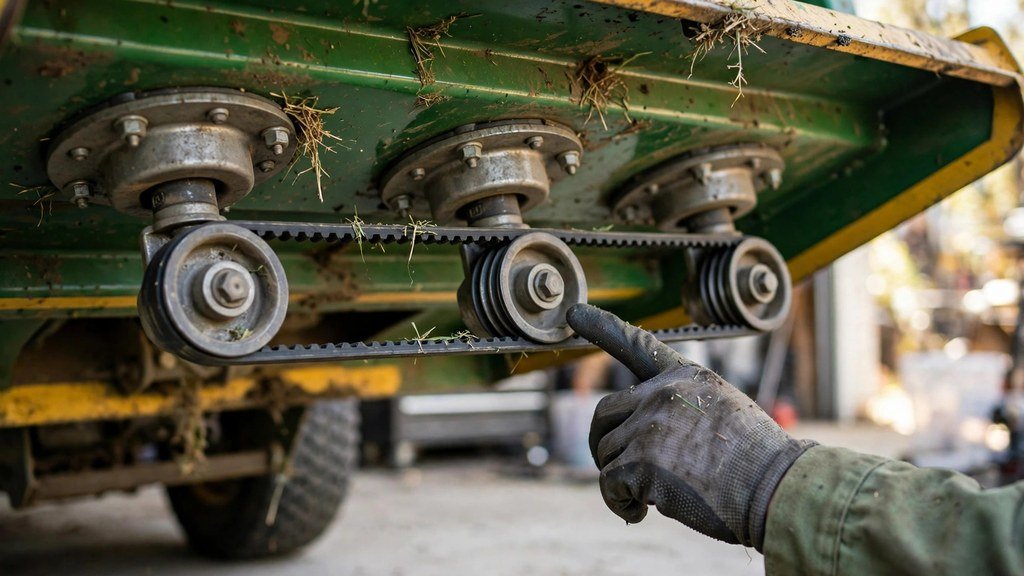
In John Deere X700 Signature Series maintenance, belts give plenty of warning before they fail: rib cracks, a glazed surface, frayed edges, and slack the tensioner cannot take up. A belt that repeatedly jumps off usually has a routing problem, a damaged pulley or idler, a missing or bent guard, or debris packed around the pulleys — check all four before fitting another. Vibration that grows over a season usually means the same thing: a worn belt, debris in the sheaves, or unbalanced blades. The photo below shows the hydraulic side:
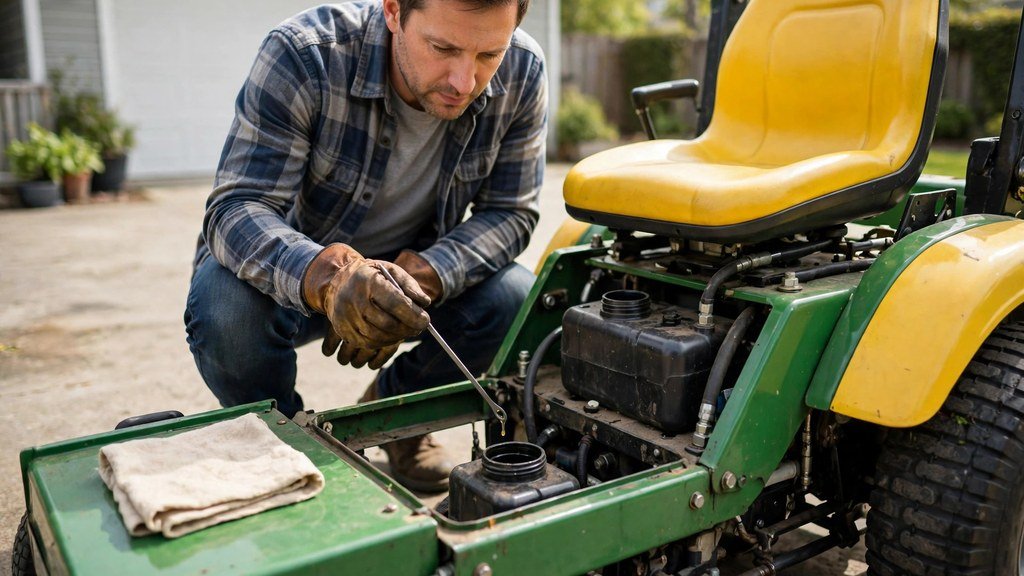
Hydraulic lift trouble in John Deere X700 Signature Series maintenance usually starts with fluid level, not the pump. If the deck or an attachment lifts slowly, jerks, or drifts down, check the fluid level and transaxle filter first, then look for weeping fittings and a blocked cooler. Escaping hydraulic fluid under pressure can penetrate skin, so never check for leaks with your hand — use cardboard, as the manual instructs. Hard steering has a similar check order: fluid level, air trapped after a repair, tire pressure, then steering seals and linkage. On four-wheel-steer models, add the rear linkage: worn joints show up as wander or a clunk.
Drivetrain symptoms deserve more respect in John Deere X700 Signature Series maintenance. A tractor that struggles on hills, loses drive when hot, or jerks after storage may have a slipping drive belt, a blocked hydro cooling fan, air in the system, or the bypass not fully returned. Check belt, fan, cooler screens, and bypass rod first. On 4WD models, also check the MFWD oil level, listed every 200 hours. Persistent hot drive loss points to internal hydrostatic wear — a dealer job, and the main reason a used-buyer test drive must include a hot hill climb.
John Deere X700 Signature Series Used-Mower Inspection
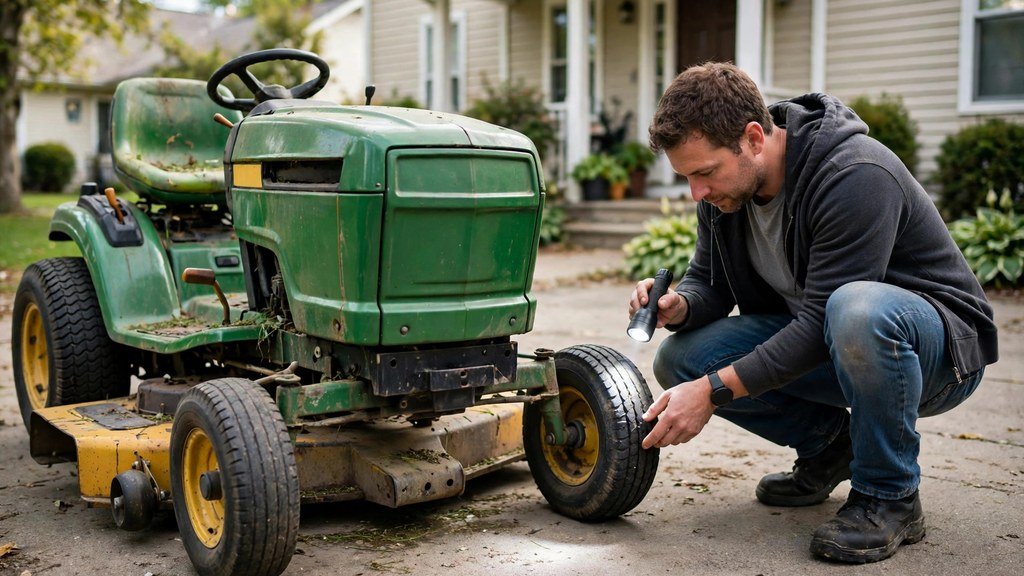
A used X700 Signature Series tractor can be excellent value — simple by premium standards, with widely available parts — but only if inspected properly. The hour meter, deck, transaxle, and cold start tell you most of what you need: a pre-purchase check is really just John Deere X700 Signature Series maintenance in reverse.
Checking Service Records, Engine Condition and Operating Hours
Start with the hour meter and service records. A tractor with several hundred hours and a folder of John Deere X700 Signature Series maintenance receipts beats a low-hour machine with no history — hours without maintenance wear faster. Ask when engine oil, transaxle oil, and filters were last changed, and whether coolant was ever done. Then inspect the engine cold: oil level and color (milky means water; black and gritty means neglected changes), leaks, and a cold start. It should start easily and run without blue or white smoke once warm. On diesel models, watch for hard cold starts and black smoke under load; on gasoline EFI models, watch for hunting idle or a fault only a dealer tool can read.
Recent October 2026 listings show the spread clearly: a 2013 X730 with 1,672 hours was listed by a Nebraska dealer at $4,950, while a 2020 X758 with 120 hours was listed in Michigan at $15,000, and a near-new 2025 X750 with 2 hours was listed in Oregon at $17,500–$17,999. Hours, records, and deck condition explain that whole range — and reading them is basic John Deere X700 Signature Series maintenance applied to buying. Model-by-model new prices are compared in our X700 Signature Series review, and the 100 Series maintenance guide shows how much simpler smaller machines are to keep.
Inspecting the Deck, Transaxle, Tires and Safety Systems
The deck is where used tractors hide their worst news. Look underneath for rust-through, cracks, and old weld repairs, and rock each blade to check spindle play. Check the belt for cracks and routing, and on AutoConnect decks, drive the deck on and off once: it should connect smoothly at correct pressure. The transaxle check is next in any John Deere X700 Signature Series maintenance inspection: drive it until warm, then climb a slope. Fading, jerking, or whining when hot is a walk-away sign. Check the hydraulic lift under load, and look underneath for weeping fittings.
Tire condition is part of John Deere X700 Signature Series maintenance too: tires should match side to side, hold the manual’s pressures, and show no dry-rot cracking — and heavy-duty tread on 4WD models wears differently from turf tires. Finally, test every safety feature before paying: the engine should stop or refuse to start with the seat unoccupied and the PTO engaged. A seller who will not let you test these, or who disabled a safety switch, is telling you to walk away. Any tractor that passes all of this — clean deck, quiet spindles, strong warm drive, working safeties, honest hours — is a solid buy, and routine John Deere X700 Signature Series maintenance will keep it that way.
John Deere X700 Signature Series Maintenance FAQs
These are the questions owners actually ask about John Deere X700 Signature Series maintenance, answered from the schedules and checks above.
How often does John Deere X700 Signature Series maintenance call for an oil change?
Gasoline models: after the first 8 hours, then every 100 hours or annually. Diesel models: after the first 50 hours, then every 200 hours.
How often does John Deere X700 Signature Series maintenance call for a transaxle oil change?
John Deere X700 Signature Series maintenance calls for transaxle oil and filter after the first 50 hours, then every 200 hours, using Low Viscosity Hy-Gard (J20D). Skipping this service is the most expensive mistake.
What is the warranty on an X700 Signature Series tractor?
Deere lists a 4-year/700-hour bumper-to-bumper warranty for current US X700 models, whichever limit comes first, with terms varying by model — the same warranty Weingartz lists on its X730-60S page. Keeping up with John Deere X700 Signature Series maintenance protects that coverage.
Gasoline or diesel — which needs less maintenance?
Diesel John Deere X700 Signature Series maintenance has longer oil intervals (200 vs. 100 hours) but stricter fuel care; gasoline maintenance is more frequent on oil but simpler at home. Choose on fuel habits, not just the interval table.
Why is my X700 overheating?
Usually a clogged radiator or hydraulic cooler screen. John Deere X700 Signature Series maintenance lists screen cleaning every 200 hours, but dusty mowing can demand it sooner — clean the screens before suspecting the thermostat or water pump.
Why is my cut uneven?
Tire pressure first, then blade sharpness and balance, then deck level. Dull or bent blades, worn spindle bearings, or mowing too fast in tall grass leave strips or scalped patches, and John Deere X700 Signature Series maintenance starts every uneven-cut diagnosis with those checks.
Why does my hydraulic lift move slowly?
John Deere X700 Signature Series maintenance starts with the hydraulic fluid level and the transaxle filter, then looks for weeping fittings and a blocked cooler. Never check for hydraulic leaks with your hand — escaping fluid under pressure can penetrate skin.
What causes hard steering on an X700?
Low hydraulic fluid, air trapped after a repair, low tire pressure, or worn steering cylinder seals. On four-wheel-steer models, John Deere X700 Signature Series maintenance also checks the rear linkage for play.
How do I make the K90 transaxle last?
Fresh Low Viscosity Hy-Gard every 200 hours, a clean oil cooler, no overloading beyond its rating, and a fully returned bypass control after pushing by hand. Heat and dirty oil are what kill it — and avoiding both is the core of John Deere X700 Signature Series maintenance.
What should I check before buying a used X700?
Hour meter and service records, a cold start, deck underside for rust and spindle play, a warm hill-climb test, hydraulic lift under load, tires, and every safety feature. John Deere X700 Signature Series maintenance records are the best predictor of a good used buy.
Can I do John Deere X700 Signature Series maintenance myself?
Yes, for almost all of it: oil, filters, plugs (gasoline), blades, belts, greasing, deck cleaning, and fluid checks are owner-level jobs. Leave valve-lash checks, EFI diagnosis, and internal transaxle work to a dealer.
How should I store my X700 for winter?
Winterizing is the most overlooked part of John Deere X700 Signature Series maintenance: clean the deck and machine, change the oil and filter, stabilize a full tank (diesel: treat the fuel and drain the water separator), keep the battery warm, and cover it.
Are X700 parts expensive compared with a 100 Series?
Yes, moderately: bigger filters, more oil per change, shaft-drive deck parts, and hydraulic components all cost more than 100 Series parts. That is the honest trade in John Deere X700 Signature Series maintenance — heavier hardware, heavier parts bills, but a much longer service life.