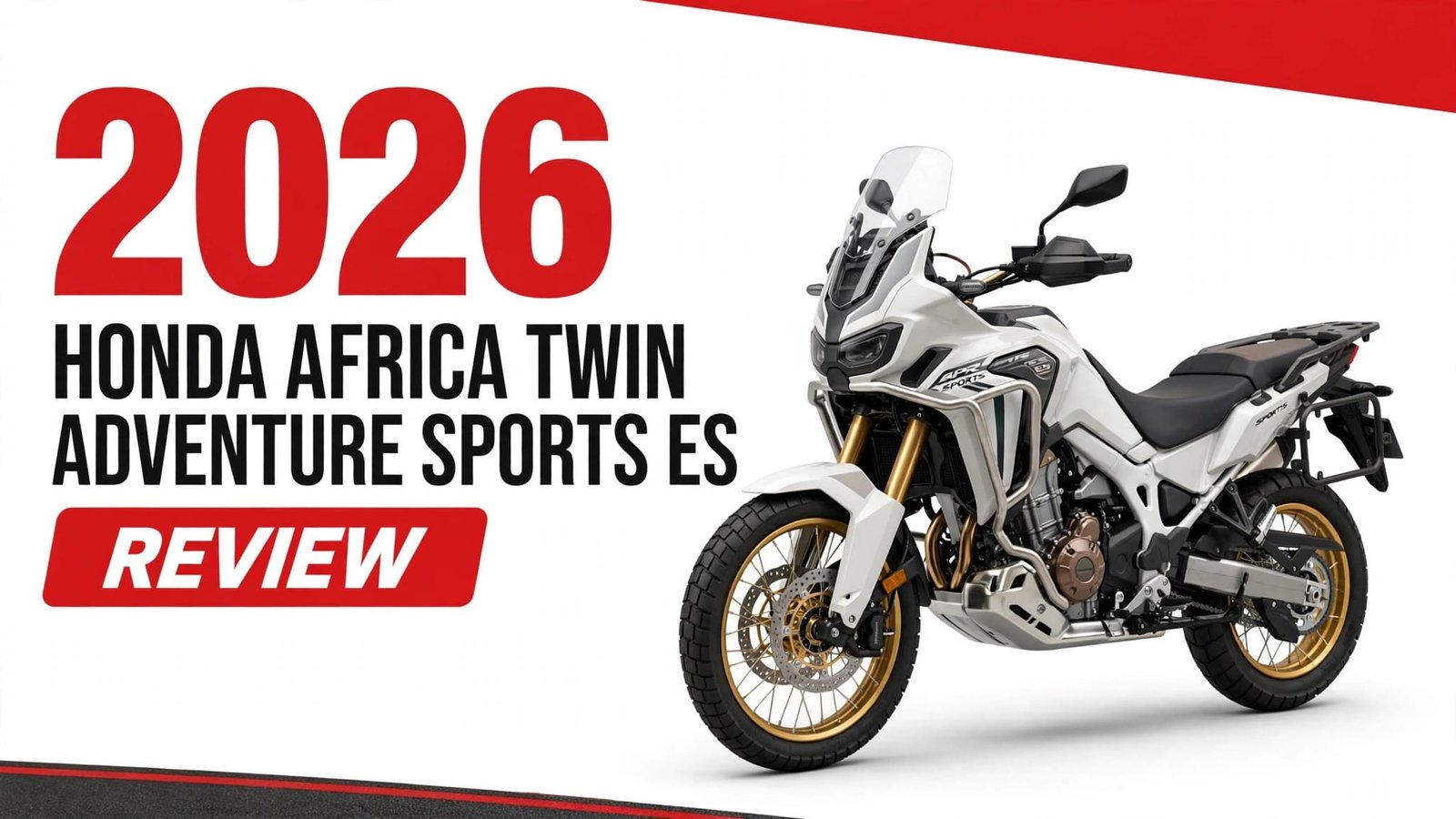
The Honda Africa Twin Adventure Sports ES is the road-going, long-distance version of Honda’s big adventure bike, and for 2026 it costs $17,799 manual or $18,599 DCT, plus $775 destination. This Honda Africa Twin Adventure Sports ES review gives you the direct answers first: it shares the standard Africa Twin’s 1084cc twin but adds a bigger 6.6-gallon tank, a 19-inch front wheel, Showa electronic suspension, heated grips and a taller touring fairing, in Pearl White only. This Honda Africa Twin Adventure Sports ES review covers history, engine, prices, technology, comfort and verdict.
The short version of this Honda Africa Twin Adventure Sports ES review is simple. If most of your miles are pavement, two-up touring and long highway days with some dirt roads, the ES is the Africa Twin to buy. If hard off-road riding is the priority, the lighter standard model with its 21-inch wheel makes more sense. Either way, this Honda Africa Twin Adventure Sports ES review insists you judge the ES on its 2024-on specification, because the pre-2024 ES was a different, taller, more off-road bike.
Honda Africa Twin Adventure Sports ES Overview and Model-Year Updates
The Adventure Sports ES is Honda’s flagship Africa Twin: the standard bike’s 1084cc engine and frame, dressed for distance. This Honda Africa Twin Adventure Sports ES review treats it as a touring adventure bike first and an off-road bike second, as Honda repositioned it for 2024.
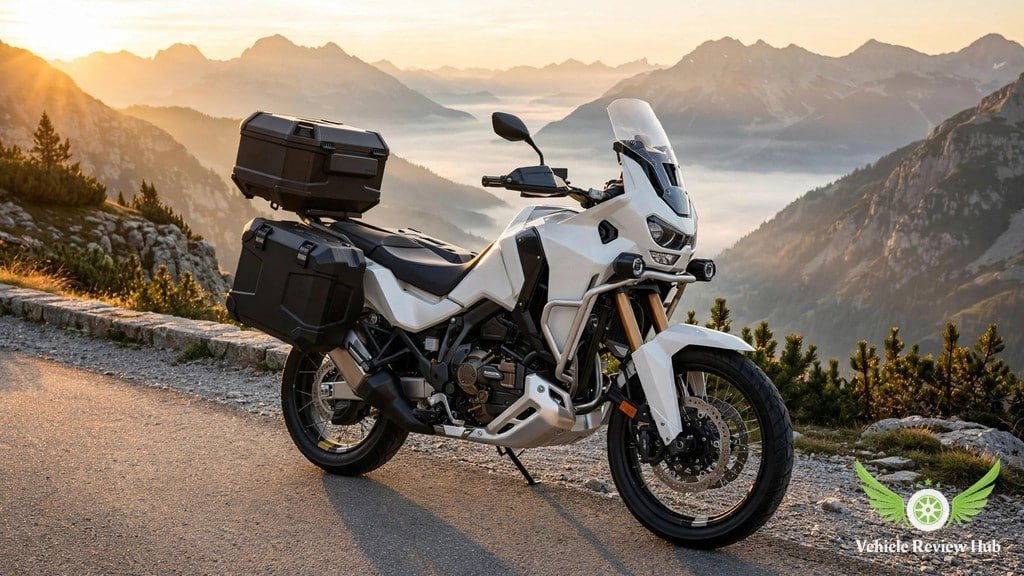
What Is the Honda Africa Twin Adventure Sports ES and Who Is It Designed For?
The ES badge stands for electronic suspension, and that is the heart of this model. This Honda Africa Twin Adventure Sports ES review describes it as the Africa Twin for riders who want one bike for commuting, weekend tours and cross-country trips: a 6.6-gallon tank, tall adjustable windscreen, larger fairing, heated grips, cruise control and a 6.5-inch touchscreen with Apple CarPlay and Android Auto. It is not a lightweight trail bike, and this Honda Africa Twin Adventure Sports ES review does not pretend otherwise: at 535 pounds manual, it is a substantial machine that rewards stability and comfort over agility in deep dirt, a balance this Honda Africa Twin Adventure Sports ES review returns to in the verdict.
US History: 2018 Debut, 2020 ES Arrives, No 2023 Model and 2024 Repositioning
The Adventure Sports line began in 2018 on the older 998cc CRF1000L platform, announced by Honda at $14,999 manual and $15,699 DCT. That Adventure Sports was tall and off-road leaning, with a 35.4- or 36.2-inch seat, longer-travel suspension, a 6.4-gallon tank and a 21-inch wheel, but no electronic suspension and tube-type tires. The ES name arrived with the 1084cc CRF1100L generation in 2020 at $17,199 manual and $17,999 DCT, bringing Showa EERA electronic suspension, a 6.5-inch TFT display, tubeless tires and a lower 34.3- or 33.5-inch seat, keeping the 21-inch wheel. Prices moved only slightly after that: $17,199 and $17,999 for 2021, $17,299 and $18,099 for 2022. Honda sold no 2023 Africa Twin in the United States, and the lineup returned for 2024 with a new identity, as Rider’s 2024 first look reported. This Honda Africa Twin Adventure Sports ES review keeps that history straight because used buyers will meet all three eras, and they ride very differently. That three-era split is something this Honda Africa Twin Adventure Sports ES review keeps in view in every section below.
Honda Africa Twin Adventure Sports ES Engine and Specifications
The ES uses the standard Africa Twin’s liquid-cooled 1084cc Unicam parallel twin, with a 270-degree crankshaft for its characterful pulse, as this Honda Africa Twin Adventure Sports ES review notes.
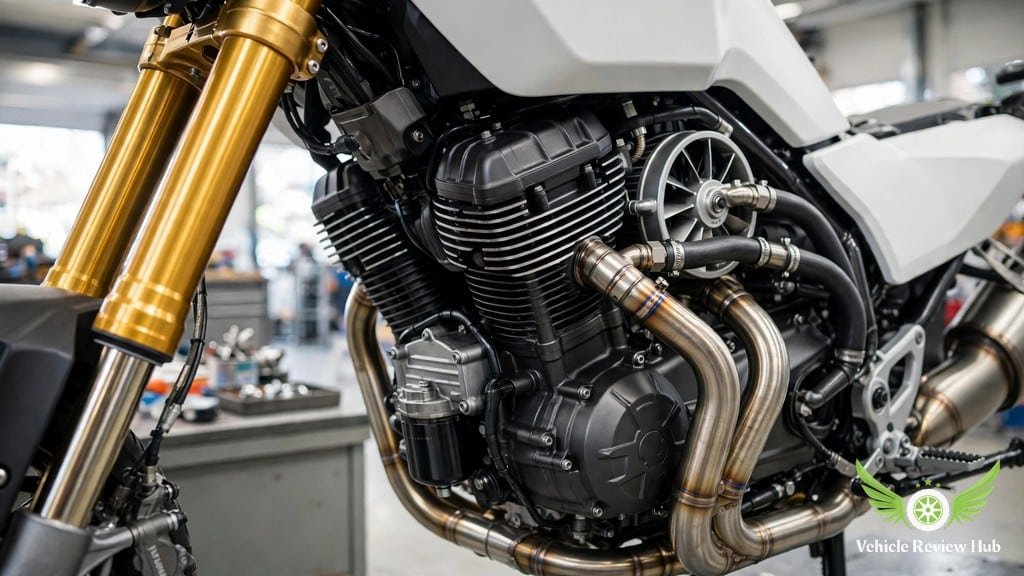
1084cc Unicam Parallel Twin, Manual Gearbox and DCT Options
The engine displaces 1084cc from a 92.0mm bore and 81.5mm stroke, runs a 10.5:1 compression ratio on 2024-on bikes, and breathes through a 46mm throttle body with programmed fuel injection and throttle-by-wire. Honda’s European claim is 100.6 horsepower at 7,500 rpm and 82.6 lb-ft at 5,500 rpm at the crankshaft; an independent rear-wheel dyno run recorded 92.0 horsepower at 7,600 rpm. this Honda Africa Twin Adventure Sports ES review keeps crankshaft and rear-wheel figures separate, since they are never directly comparable. Buyers choose between a conventional six-speed manual and Honda’s Dual Clutch Transmission, which shifts automatically or by handlebar paddles in Drive or three Sport modes. The DCT costs $800 more and adds 24 pounds on the current bike, and this Honda Africa Twin Adventure Sports ES review recommends testing both: the manual suits off-road control, the DCT removes clutch fatigue in traffic and on tours. Throttle-by-wire brings four power modes, seven levels of Honda Selectable Torque Control, wheelie control and cornering ABS, managed with help from a six-axis inertial measurement unit, as this Honda Africa Twin Adventure Sports ES review notes.
Weight 535 lb Manual and 559 lb DCT, Seat Height and Specifications
Honda lists the 2026 ES at 535 pounds manual and 559 pounds DCT, measured with fluids and a full tank, and the seat adjusts between 33.7 inches standard and 32.9 inches low. Those weights run 25 and 24 pounds heavier than the equivalent standard Africa Twin — the price of the bigger tank, fairing and electronic suspension. This Honda Africa Twin Adventure Sports ES review notes the 2024 repositioning made those seat heights possible: the 2020 to 2022 ES sat at 34.3 or 33.5 inches, and the original 2018 Adventure Sports was taller still. The table below gathers the current specification, confirmed for 2026 on the Honda USA specification page.
| Specification | 2026 Africa Twin Adventure Sports ES |
|---|---|
| Engine | 1084cc Unicam parallel twin |
| Compression ratio | 10.5:1 |
| Claimed output (crankshaft) | 100.6 hp @ 7,500 rpm; 82.6 lb-ft @ 5,500 rpm |
| Gearbox | Six-speed manual or DCT; #525 chain |
| Curb weight | 535 lb manual; 559 lb DCT |
| Seat height | 33.7 inches standard; 32.9 inches low |
| Tires | 110/80-19 front; 150/70R-18 rear, tubeless |
| Brakes | Dual 310mm front; single 256mm rear; ABS |
| Suspension | 45mm Showa EERA fork, 8.3 in; Pro-Link rear shock, 7.9 in |
| Warranty | Transferable one-year limited warranty; HondaCare available |
Honda Africa Twin Adventure Sports ES Price and Market Availability
The ES has always been the expensive Africa Twin, as this Honda Africa Twin Adventure Sports ES review shows. This Honda Africa Twin Adventure Sports ES review puts the current premium at $2,600 over the standard manual model, which buys electronic suspension, bigger tank, larger fairing, heated grips and touring bodywork.
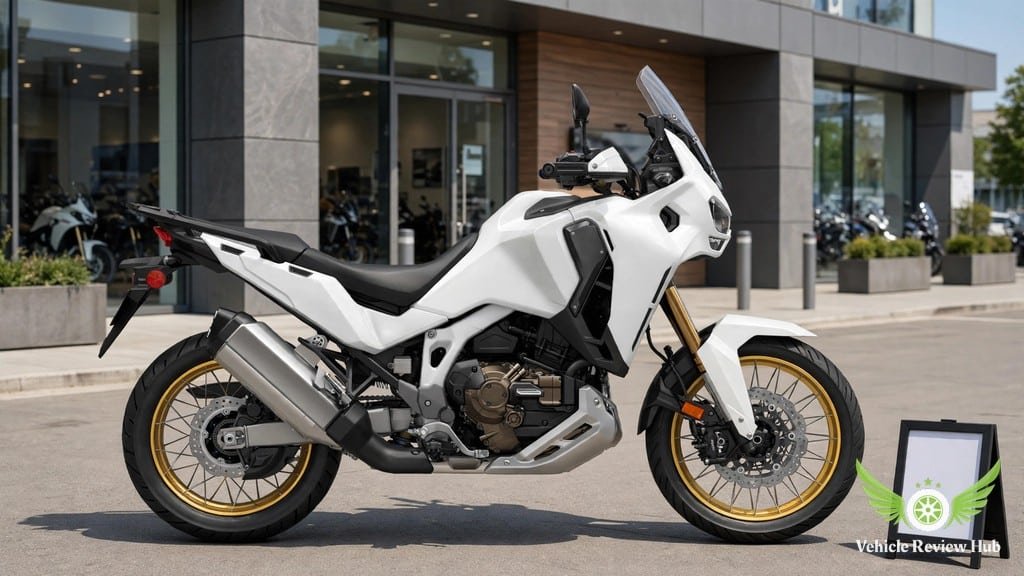
Honda Africa Twin Adventure Sports ES Price by Year in the USA: 2024 to 2026
The repositioned ES listed at $17,599 manual and $18,399 DCT for 2024; 2025 carried those prices forward, and 2026 raised both by $200 to $17,799 and $18,599, plus $775 destination. The table below shows the recent run, and this Honda Africa Twin Adventure Sports ES review notes the DCT premium has held at exactly $800 across all three years. For used buyers: the 2020 ES started at $17,199 and $17,999, repeated for 2021, and the 2022 bike listed at $17,299 and $18,099. The 2024 buyer’s guide from Ultimate Motorcycling confirms the 2024 pricing and Pearl White color.
| Model year | Manual MSRP | DCT MSRP | Color |
|---|---|---|---|
| 2024 | $17,599 | $18,399 | Pearl White |
| 2025 | $17,599 | $18,399 | Pearl White |
| 2026 | $17,799 | $18,599 | Pearl White |
Pearl White Only for 2026 and Official US Dealer Availability
For 2026, the ES comes in Pearl White only for both gearboxes; the standard Africa Twin also offers Matte Black Metallic. That single-color policy holds since 2024, so a 2024-on ES in any other color should prompt questions about repainting or mislabeling. The ES is a current part of Honda’s US powersports lineup, available through any authorized Honda Powersports dealer, with 2026 availability from February 2026 according to Honda’s US announcement. This Honda Africa Twin Adventure Sports ES review recommends confirming stock before travelling, since the ES is a lower-volume trim and dealers may hold only one example.
Honda Africa Twin Adventure Sports ES Design, Features and Technology
The ES looks like a bigger, more finished Africa Twin, with a larger fairing, taller screen and bigger tank for a substantial touring presence — the point this Honda Africa Twin Adventure Sports ES review stresses. This Honda Africa Twin Adventure Sports ES review finds the 2024 design changes matter most, because they changed how the bike rides, not just how it looks.
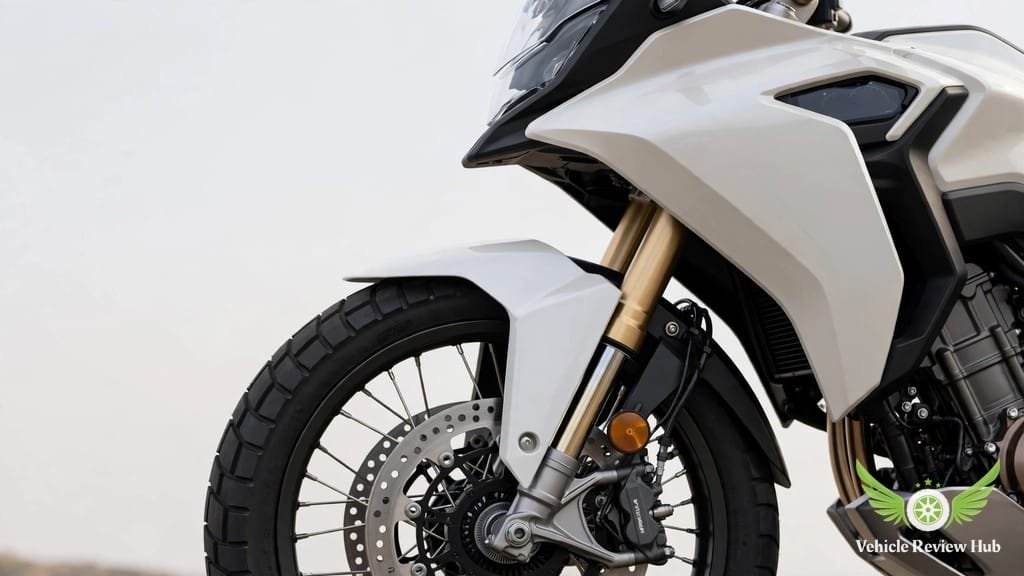
19-Inch Front Wheel From 2024, 6.6-Gallon Tank and Touring Bodywork
The single most important design fact in this Honda Africa Twin Adventure Sports ES review is the wheel change: the 19-inch front wheel arrived ONLY with the 2024 repositioning, while the 2020 to 2022 ES and 2018 to 2019 Adventure Sports both ran a 21-inch wheel, so any pre-2024 ES described as a 19-inch bike is wrong. The 2024-on front tire is a wider 110/80-19 on a wider rim, paired with a 150/70-18 rear, and both wire-spoked wheels are tubeless, so a roadside puncture can usually be plugged. The 6.6-gallon tank is the other touring headline: it stretches range well past the standard model’s 5.0 gallons, and the reshaped 2024 fairing with its five-position windscreen and lower center vent cuts turbulence. The seat was also redesigned for 2024 with thicker padding and a larger area, as RevZilla’s 2024 coverage describes.
Showa EERA Electronic Suspension, Heated Grips, Cruise and TFT Features
Showa EERA, or Electronically Equipped Ride Adjustment, is the ES badge’s reason for existing: five damper settings — hard, medium, soft, off-road and a customizable user setting — plus electronic rear preload adjustment, all changed from the handlebar, with the 2024 system reading inertial and stroke-sensor data to adjust damping. Honda lists 8.3 inches of front travel and 7.9 inches at the rear for the 2026 bike, shorter than the standard model’s travel and part of why the ES sits lower. Heated grips are standard on the ES, cruise control is standard across Africa Twin models, and the 6.5-inch touchscreen supports Apple CarPlay, Android Auto and Bluetooth. Two honest caveats from this Honda Africa Twin Adventure Sports ES review: the menu system and left switchgear take real learning time, and touchscreen trouble in cold weather is a documented niggle, so a cold-weather screen test belongs in any used inspection. The full reliability record covers that check in detail.
Honda Africa Twin Adventure Sports ES Riding Experience and Comfort
On the road, the ES feels like a big touring bike that happens to carry an adventure badge: calm, planted and comfortable — the calm this Honda Africa Twin Adventure Sports ES review finds defining. This Honda Africa Twin Adventure Sports ES review bases its riding impressions on published road tests and owner feedback rather than a personal test ride.
Riding Position, Handling and Low-Speed Maneuverability
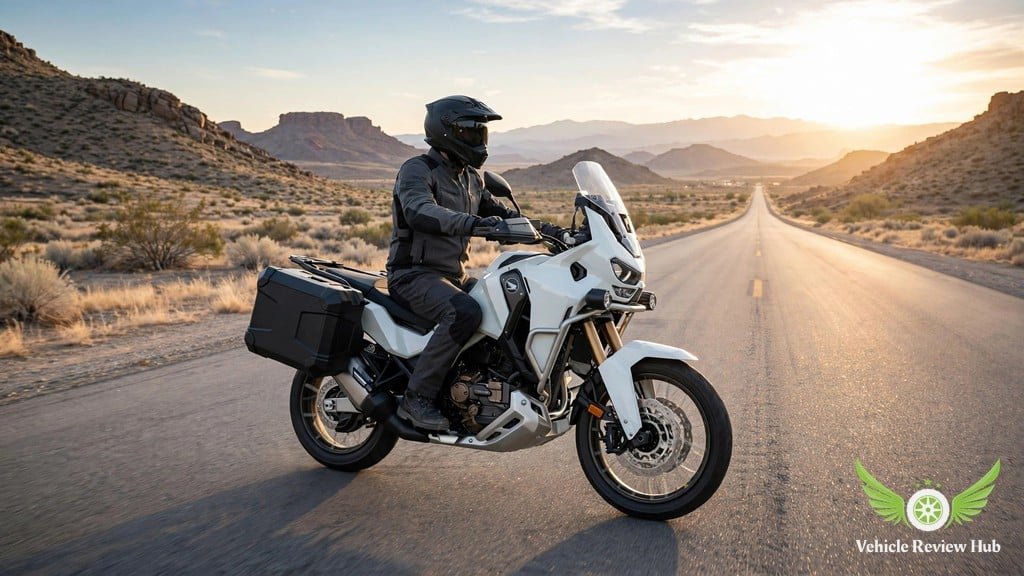
In this Honda Africa Twin Adventure Sports ES review, the riding position is upright and roomy, with a wide handlebar, a narrow waist at the tank-seat junction, and footpegs placed for long days, not aggressive cornering. The 2024 changes help at low speed: the 19-inch wheel, lower center of gravity, shorter suspension and 33.7- or 32.9-inch seat make the ES easier to manage at parking-lot speeds than the taller pre-2024 bikes, and 2026 reviewers call it instantly manageable and confidence-inspiring. That said, at 535 pounds before luggage, the ES needs care on loose surfaces and cambered stops, and shorter riders should try both seat positions. The video below shows the DCT version on a ride review, useful for the riding position and the way the bike carries its size, though the manual version is lighter and simpler.
Highway Comfort, Long-Distance Riding and Everyday Practicality
Highway comfort is where the ES earns its premium — this Honda Africa Twin Adventure Sports ES review rates it the bike’s strongest suit. The larger fairing and five-position screen cut wind blast, the thicker 2024 seat supports long days, cruise control eases the right hand, and the electronic suspension softens for rough highways or firms up for loaded mountain roads. Honda USA publishes no official miles-per-gallon figure, so this Honda Africa Twin Adventure Sports ES review will not invent one: Fuelly’s owner-logged average of 47.8 miles per gallon for the 2017 CRF1000L ABS gives roughly 315 miles from the 6.6-gallon tank as pure arithmetic, and real range varies with speed, luggage and wind. For everyday use, the ES is comfortable and reliable, but its size and weight make it a poor choice for tight city filtering or short urban hops. The used prices picture is covered in the companion guide.
Honda Africa Twin Adventure Sports ES Review: Pros, Cons and Verdict
After weighing the specification, price history and published road tests, this Honda Africa Twin Adventure Sports ES review lands in a clear place: the ES is the best Africa Twin for the rider it was redesigned for, and a compromised one for the rider it was not — the conclusion this Honda Africa Twin Adventure Sports ES review defends below.
Main Advantages and Limitations of the Africa Twin Adventure Sports ES
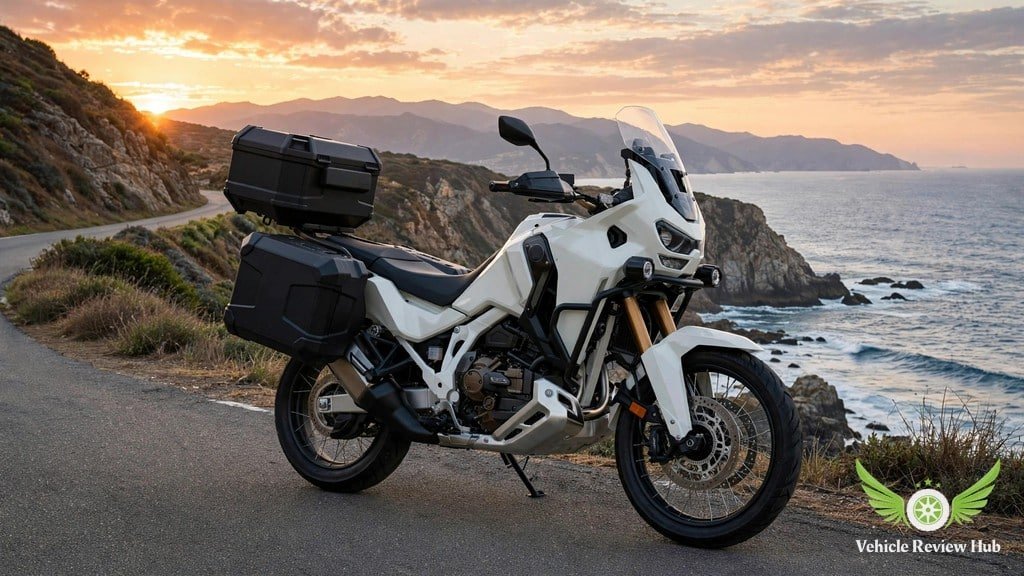
In this Honda Africa Twin Adventure Sports ES review, the advantages start with the touring package: electronic suspension that genuinely changes the bike’s character, a 6.6-gallon tank, heated grips, cruise control, a big touchscreen with phone integration and a comfortable, well-protected riding position, all for $17,799 in 2026. The limitations are equally real: 535 pounds is a lot to manage off-road or at a standstill, the menu and switchgear take time to learn, some reviewers report slight throttle lag and invasive-feeling traction control, and the touchscreen can misbehave in cold weather. Owner data for this variant is too small to quote as a rating — the strongest owner samples for the Adventure Sports line run to a handful of reviews — so this Honda Africa Twin Adventure Sports ES review presents no star score. Buyers should also run the VIN for recall completion, since the Adventure Sports line carries fuel-filter recall history alongside the shared ECU and switch-harness campaigns.
Who Should Choose the ES Over the Standard Africa Twin?
This Honda Africa Twin Adventure Sports ES review says: choose the ES if your riding is mostly pavement, you tour two-up or loaded, you value electronic suspension and long range, and the $2,600 premium fits. Choose the standard Africa Twin if hard off-road riding matters more than touring comfort, or if you want the lighter bike with the 21-inch wheel and longer travel. The verdict of this Honda Africa Twin Adventure Sports ES review is that the 2024-on ES is a genuinely good touring adventure bike, provided you buy it for the road-focused job Honda redesigned it to do.
Honda Africa Twin Adventure Sports ES Review: Frequently Asked Questions
These direct answers cover the questions buyers ask most often after reading this Honda Africa Twin Adventure Sports ES review.
How much does a 2026 Honda Africa Twin Adventure Sports ES cost?
The 2026 ES lists at $17,799 manual and $18,599 DCT, plus $775 destination, in Pearl White only; this Honda Africa Twin Adventure Sports ES review notes the DCT premium is $800.
What is the difference between the ES and the standard Africa Twin?
This Honda Africa Twin Adventure Sports ES review sums up the difference: the ES adds a 6.6-gallon tank instead of 5.0 gallons, a 19-inch wheel instead of 21 inches on 2024-on bikes, Showa EERA electronic suspension, heated grips, a larger fairing and a taller windscreen. It weighs 535 pounds manual against the standard bike’s 510 pounds, with a lower 33.7- or 32.9-inch seat.
Does the Adventure Sports ES have a 19-inch front wheel on all years?
No — and this Honda Africa Twin Adventure Sports ES review stresses it: the 19-inch front wheel arrived only with the 2024 repositioning; the 2020 to 2022 ES and 2018 to 2019 Adventure Sports both used a 21-inch wheel, so a pre-2024 ES described with a 19-inch wheel is mislabeled.
Was there a 2023 Honda Africa Twin Adventure Sports ES in the USA?
No. Honda sold no 2023 Africa Twin in the United States; the lineup returned for 2024 with the repositioned ES. This Honda Africa Twin Adventure Sports ES review treats any claimed 2023 US ES as a mislabeled 2022 or 2024.
What engine does the Adventure Sports ES use?
This Honda Africa Twin Adventure Sports ES review confirms the engine: a liquid-cooled 1084cc Unicam parallel twin, 270-degree crankshaft, 10.5:1 compression ratio on 2024-on bikes, and a manual or DCT gearbox. Honda’s European claim is 100.6 horsepower at 7,500 rpm at the crankshaft; an independent rear-wheel dyno run recorded 92.0 horsepower at 7,600 rpm.
How heavy is the Adventure Sports ES and how tall is the seat?
This Honda Africa Twin Adventure Sports ES review lists the 2026 ES at 535 pounds manual and 559 pounds DCT, measured with fluids and a full tank, with the seat adjusting between 33.7 inches standard and 32.9 inches low, below the 2020 to 2022 ES at 34.3 or 33.5 inches.
Is the Adventure Sports ES good for off-road riding?
It handles dirt roads and light trails, but the 2024-on ES is road-focused by design, with a 19-inch wheel and shorter suspension travel than the standard bike. For riders who prioritize hard off-road use, this Honda Africa Twin Adventure Sports ES review recommends the standard Africa Twin with its 21-inch wheel and longer travel.
Should I buy the manual or the DCT version?
Buy the manual for off-road control, lower weight and simpler servicing, and the DCT for commuting and touring, where automatic shifting removes clutch fatigue. The DCT costs $800 more and adds 24 pounds; this Honda Africa Twin Adventure Sports ES review recommends riding both before deciding.
Is the Adventure Sports ES worth the premium over the standard Africa Twin?
Yes if you tour mostly on pavement and value electronic suspension, long range and wind protection, : the $2,600 premium buys a complete touring package — the verdict of this Honda Africa Twin Adventure Sports ES review. No if hard off-road riding is the priority, where the standard bike’s lighter weight, 21-inch wheel and longer travel serve better.