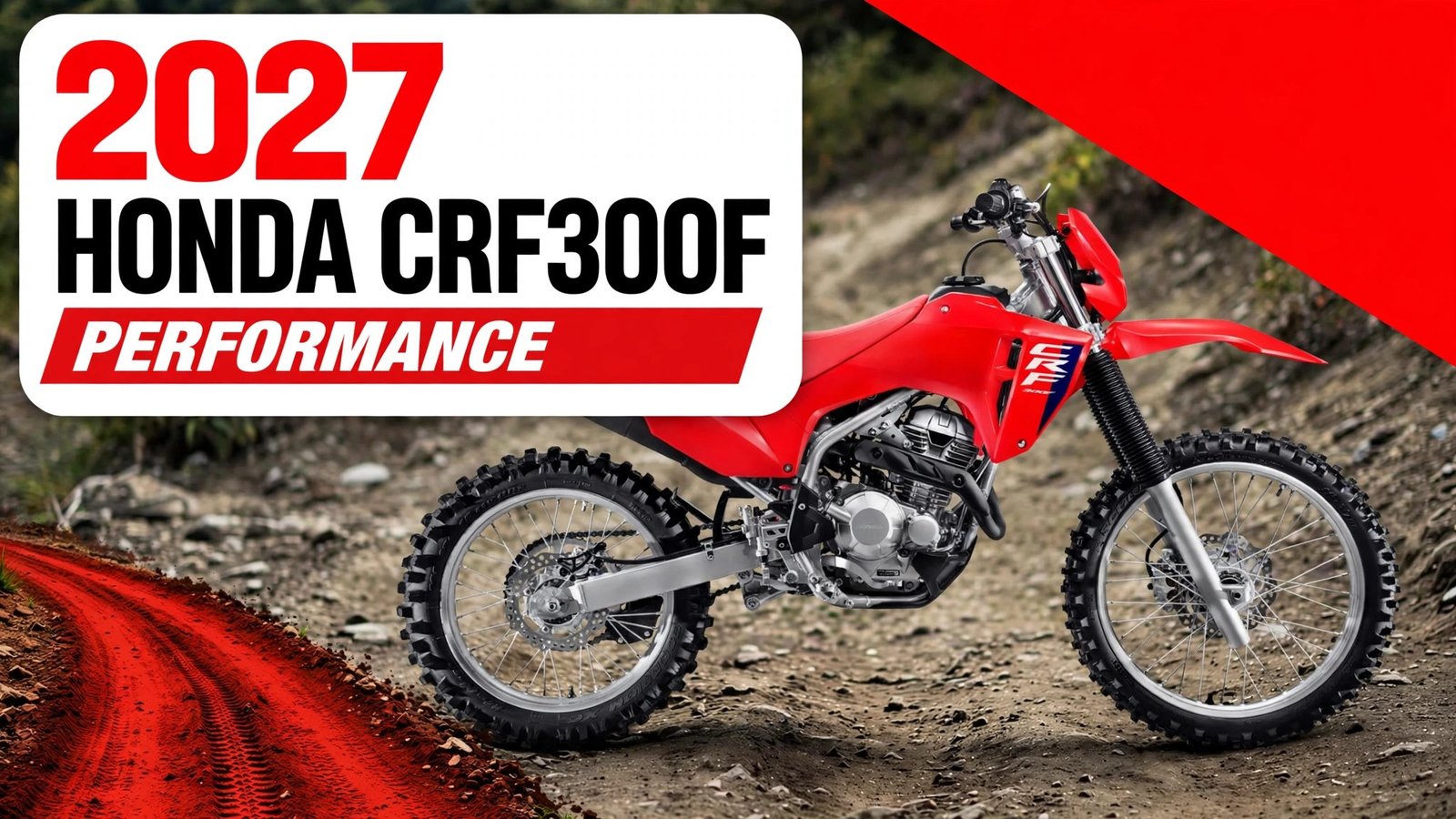
Short answer: Honda CRF300F performance is about usable trail power, not numbers on a chart. The 2026 CRF300F replaces the CRF250F with a bigger 294cc air-cooled single, a new six-speed gearbox, and firmer Showa suspension — all for the same $4,999 price. Honda publishes no horsepower figure for this bike, no top speed exists because no speedometer is fitted, and no fuel-economy rating exists either. This Honda CRF300F performance guide explains what the bigger engine actually feels like on the trail, why the missing numbers are a feature of the bike’s honesty rather than a gap in the testing, and how the new six-speed changes everyday riding.
That framing matters because Honda CRF300F performance is easy to misread. Search results full of 80 mph claims and horsepower estimates mostly belong to other motorcycles — the CRF300L dual-sport, the CRF250F predecessor, or Brazilian-market estimates never measured on a dyno. This Honda CRF300F performance guide separates what testers actually felt from what aggregators copied, and it keeps every unverified figure labelled as exactly that.
Honda CRF300F Engine Performance and Power Delivery
The engine is the heart of Honda CRF300F performance: a 294cc air-cooled, four-valve, single-cylinder four-stroke with programmed fuel injection, built for tractable trail power rather than peak output.
18 Percent More Displacement and What Testers Felt From It
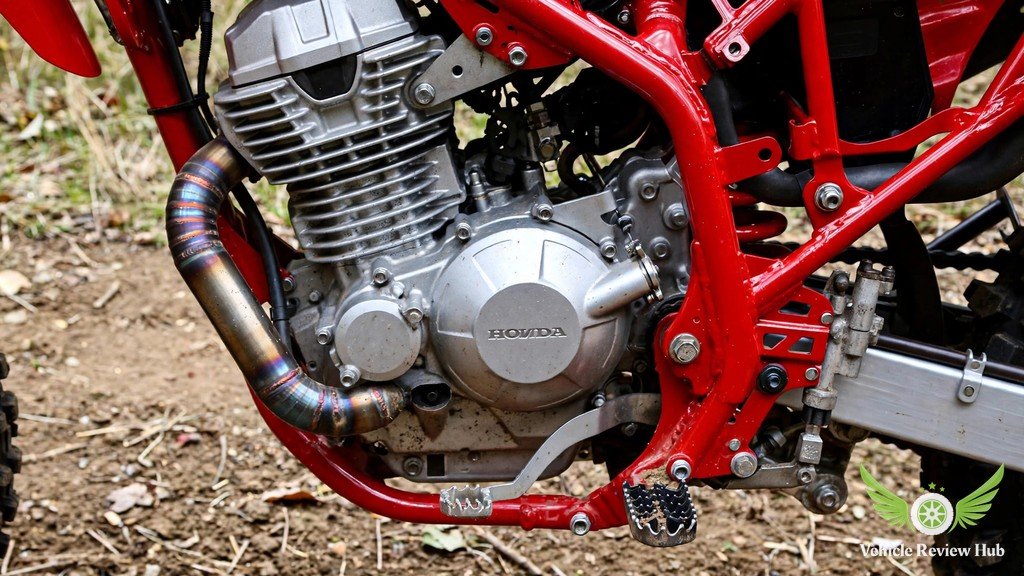
Honda CRF300F performance starts with displacement: 294cc against the CRF250F’s 249cc, an 18 percent jump achieved by enlarging the bore while keeping the stroke unchanged at 63.0mm, with bore now 77.0mm. Honda’s own 2026 specification page lists a 294cc air-cooled single with a 34mm PGM-FI throttle body and 9.3:1 compression. The character of Honda CRF300F performance did not change with the bore job — testers at the Chocolate Mountain Ranch launch consistently described power delivery as smooth, steady, and familiar from idle, with the extra capacity showing up where it matters: stronger mid-range pull and easier acceleration in taller gears. Dirt Bike Magazine’s launch report put it plainly: off idle, the new bike does not feel all that different from the old one, but as speeds rise and riders work through the gears, the extra cubic centimetres make themselves felt. Cycle News noted roughly four more horsepower felt on the trail, with significantly improved torque for tight, twisty trails and slow technical terrain. That is the honest shape of Honda CRF300F performance — not a drag-race bike, but a lazier, more forgiving one on a climb. The new oil cooler and heat-resistant clutch discs serve the same goal: keeping Honda CRF300F performance consistent on a long, slow trail day.
Why Around 24 HP Estimates Are Unmeasured and Brazil-Sourced
Here is where Honda CRF300F performance coverage needs care. Figures around 24 horsepower circulate online for this bike, and they are unmeasured estimates traced to Brazilian-market material — not dyno results, not Honda claims, and not independent tests. Honda publishes no horsepower figure for the CRF300F at all, and the first-ride test sheets from Cycle Gear and RevZilla list claimed horsepower as “N/A” for exactly that reason. This Honda CRF300F performance guide therefore quotes no horsepower number for the F itself: not 24, not 25, and not any other estimate dressed up as a measurement. What can be said honestly is comparative: testers felt about four more horsepower than the 250F, torque improved noticeably, and the powerband stayed beginner-friendly. Until an independent dyno run exists, the launch-test verdict is the only evidence worth quoting.
Honda CRF300F Top Speed and Acceleration
Top speed is the shortest section of any honest Honda CRF300F performance guide, because there is nothing to report — and saying so plainly is more useful than inventing a number.
No Speedometer Fitted, So No Indicated or Tested Top Speed Exists
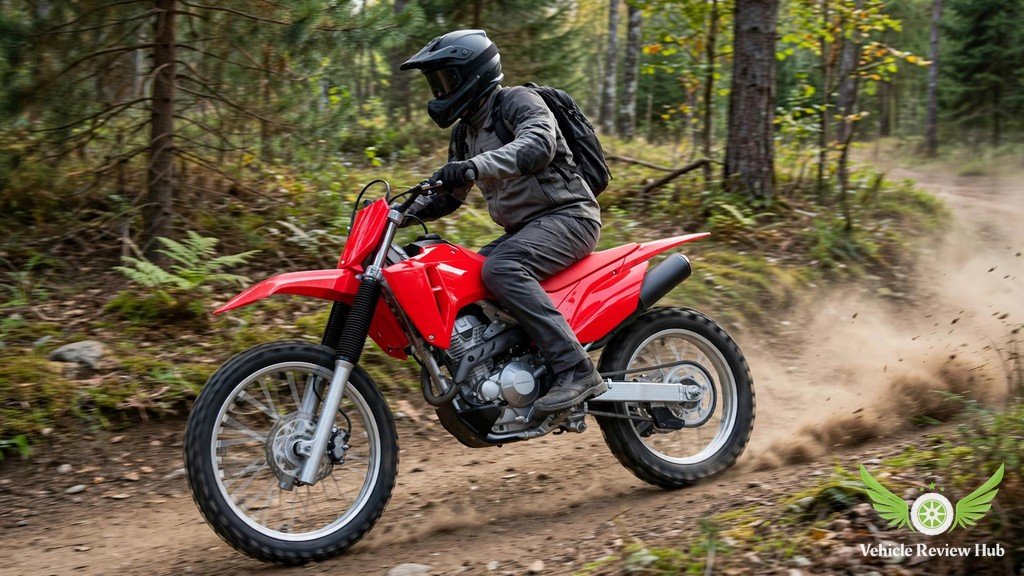
The CRF300F has no speedometer. Its cockpit is a start button, a kill switch, and a low-fuel light — nothing else. That single fact settles Honda CRF300F performance top speed: with no instrument to read, there is no indicated top speed, and no outlet has published a GPS-verified top speed or an instrumented 0-60 or quarter-mile time for the stock bike. Honda CRF300F performance acceleration must therefore be described in feel, not figures: the bike pulls cleanly from low revs, tractors up hills in second and third gear, and carries momentum through technical singletrack without stalling. On wider fire roads, the new sixth gear lets the engine relax rather than scream. Any article giving a precise Honda CRF300F performance top speed is guessing.
Why 80 MPH Search Results Belong to the CRF300L and Rally
Search “CRF300F top speed” and figures around 80 mph appear quickly. They belong to the CRF300L dual-sport and the CRF300L Rally — different motorcycles with liquid-cooled 286cc engines, six-speed gearboxes, full instrumentation, and highway-capable gearing. The F shares only a similar badge and displacement number. Quoting an L or Rally top speed for the F would imply the trail bike has a speedometer it does not have and gearing it was never built with. Honda CRF300F performance should be judged on the terrain the bike was built for: the woods, not a speed run.
Honda CRF300F Mileage and Fuel Economy
There is no fuel-economy rating for this motorcycle, and Honda CRF300F performance fuel discussion has to be framed as trail planning, not miles per gallon.
No EPA MPG and No Tested Fuel Range Published Yet
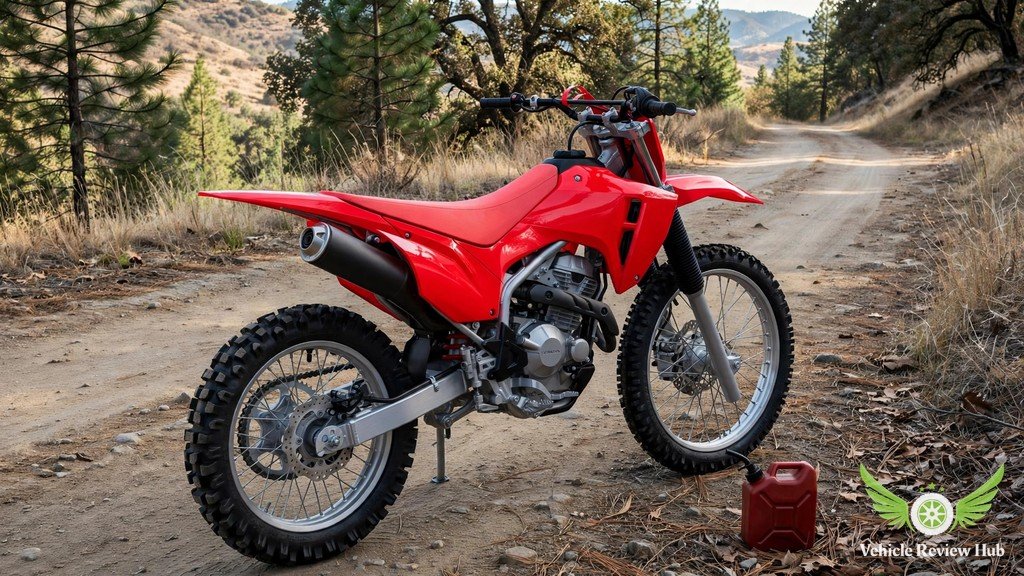
The honest Honda CRF300F performance fuel statement: no EPA MPG exists, Honda publishes no MPG claim, and no outlet has published a tested fuel range for the F. The bike meets EPA and CARB off-road standards and is green-sticker legal in California, but emissions compliance is not a fuel-economy rating. What testers did note is that fuel injection helps cold starts and keeps fuelling clean across altitudes — a practical benefit on a trail bike ridden in different places. For Honda CRF300F performance planning, the useful question is not “how many miles per gallon” but “how far will this tank take me on the trails I ride.” Until a tester runs the tank dry and reports the distance, any range number quoted for the F is arithmetic dressed as a test.
The 1.6-Gallon Tank With 0.34-Gallon Reserve and Trail Planning
Honda’s specification page lists fuel capacity at 1.6 gallons for the CRF300F, and the doc’s framing adds a 0.34-gallon reserve within that total — so roughly 1.26 gallons of main supply plus reserve, a small tank by any standard. Honda CRF300F performance trail planning therefore starts with the tank: on a bike this light and this frugal, a full tank covers a morning of trail riding for most riders, but a long day in the desert or a remote loop demands a fuel plan — a topped tank at the truck, a buddy carrying extra, or a route that passes the staging area. The low-fuel light is the only gauge, so riders learn to watch it. Honda CRF300F performance trades range for lightness and agility, and for a trail bike ridden from a truck, that is the right trade. Riders needing all-day range without a fuel stop should look at the dual-sport line instead.
| Honda CRF300F performance item | Figure | Note |
|---|---|---|
| Engine | 294cc air-cooled single, 77.0 x 63.0mm, 9.3:1 | PGM-FI 34mm throttle body |
| Gearbox / final drive | 6-speed, #520 O-ring chain 14T/50T | 250F had a 5-speed |
| Seat / clearance / wheelbase | 35.0 in / 11.4 in / 55.8 in | Honda 2026 spec page |
| Curb weight | 271 lb (Honda page) vs 273 lb (dealer/test sheets) | Conflict reported, not resolved |
| Fuel capacity | 1.6 gal incl. 0.34-gal reserve | No EPA MPG, no tested range |
| Suspension | 41mm Showa fork 9.5 in / Pro-Link rear 9.1 in | Firmer settings than 250F |
| Top speed / horsepower | None published | No speedometer; no dyno; no Honda hp claim |
Honda CRF300F Real-World Riding Performance
On the trail, Honda CRF300F performance is about confidence: a bike that lets beginners ride further and lets experienced riders relax, on terrain that would punish a sharper machine.
Beginner Trails, Fire Roads and Everyday Off-Road Acceleration
Everyday Honda CRF300F performance looks like this: second- and third-gear hill climbs, rocky descents, sandy singletrack, and muddy rollers — the exact mix Honda laid out on the 3.5-mile Chocolate Mountain Ranch loop for the launch tests. Testers found the bike tractored up hills, trudged over rock gardens, and paddled through deep sand without drama, and its everyday acceleration is willing rather than wild: roll the throttle open and the bike pulls cleanly, without the snap that throws a beginner off balance. The low 35.0-inch seat helps here — riders with a 28-inch inseam can touch the ground, which matters more for real-world Honda CRF300F performance than any horsepower figure. Larger riders may feel slightly cramped, and the suspension can still be overwhelmed as speeds rise. The video below shows Motorcycle.com’s first-ride review of the 2026 bike: a simple, friendly trail bike doing exactly what it was built to do.
Well-Spaced Six-Speed Gearing Against the 250F Five-Speed
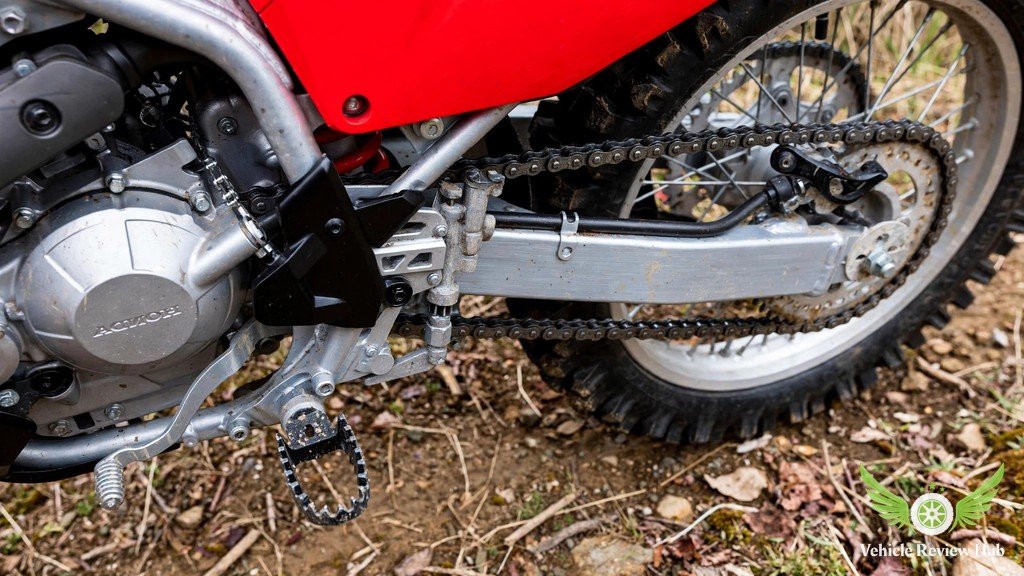
The new six-speed gearbox is the single most useful Honda CRF300F performance upgrade over the 250F, and testers singled it out as the transmission’s most beneficial change. The 250F’s five-speed forced a compromise: low gearing buzzed on fire roads, tall gearing bogged in the woods. The F’s six speeds spread the ratios wider, so first gear stays low enough for technical work while sixth gear lets the engine relax on open dirt roads and desert stretches without winding out. Cycle News noted the bike responds more quickly and predictably at lower speeds and carries more revs on wider-open fire roads. For Honda CRF300F performance, the sixth gear is not about going faster; it is about going further without fatigue, and about a beginner never feeling trapped between gears on a hill. Final drive is a #520 O-ring chain, 14-tooth front and 50-tooth rear, per dealer specification sheets.
Honda CRF300F Handling, Braking and Stability
Handling is where Honda CRF300F performance earns its reputation among trail riders. The steel perimeter frame, firmer Showa suspension, and low centre of gravity favour planted, predictable manners over sharp race-bike reactions.
41mm Showa Fork With 9.5 Inches and Pro-Link Rear With 9.1 Inches
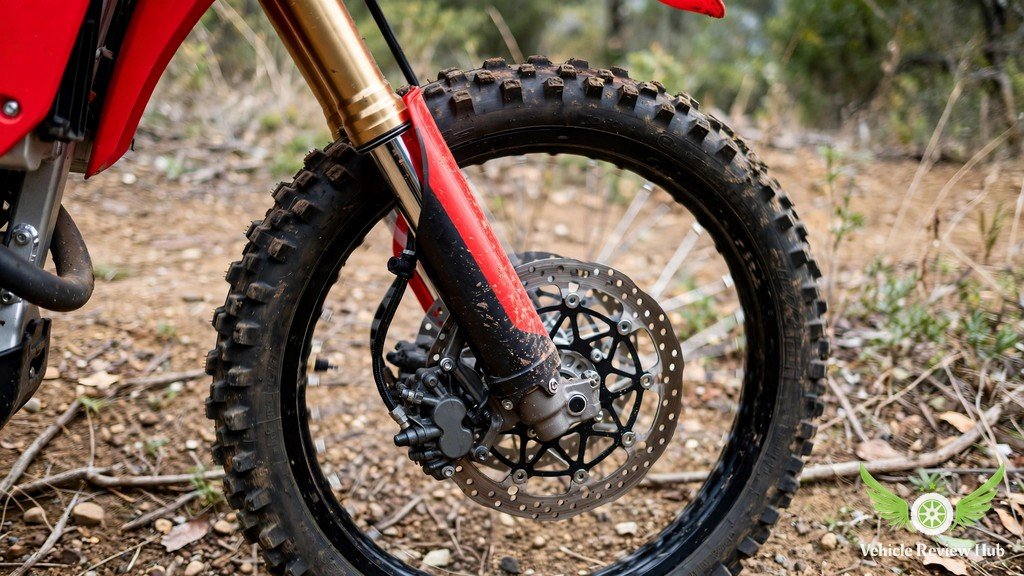
The front suspension is a 41mm Showa fork with 9.5 inches of travel, and the rear is a Pro-Link Showa single shock with 9.1 inches, both figures verified against Honda’s 2026 CRF300F specifications. That travel, plus firmer settings than the 250F, an aluminium bottom triple clamp, and a revised engine-hanger shape, gives Honda CRF300F performance a planted feel: the low centre of gravity keeps the bike stable even in off-camber corners. The bike is not quite full-size — about seven-eighths of a competition dirt bike — and that is deliberate: a machine that feels familiar the first time a new rider throws a leg over it. Pirelli Scorpion XC mid-hard tyres gave testers sure-footed traction across hardpack, loose fire roads, and soft singletrack alike.
Rear Brake Verdicts Conflict: Perfectly Dialed vs Drum-Like Feel
Here Honda CRF300F performance coverage honestly splits, and both verdicts deserve reporting. Ultimate Motorcycling’s launch report called the brakes “perfectly dialed”: a Nissin caliper on the 240mm front disc with appropriately soft initial engagement for newer riders, and a rear brake with good feel that is not too touchy, delivering huge confidence on tricky downhill trails. Cycle World’s first ride agreed the brakes were just about perfect — not sensitive or touchy, great for beginners, with responsive modulation and plenty of stopping power through the lever stroke, helped by smaller-diameter hydraulic brake lines. RevZilla’s testers, riding the same launch loop, found the opposite at the rear: hauling into a sharp turn exposed the rear brake’s lack of bite, feel, and response, providing “about as much stopping power as a drum brake,” forcing them to lean on the front brake and occasionally overload the front end. The front brake is a 240mm petal disc with a dual-piston caliper; the rear is a 220mm petal disc with a single-piston caliper; there is no ABS. The fair reading of Honda CRF300F performance braking is that the front brake is consistently praised while the rear brake divides testers, and buyers who brake hard into corners should test the rear brake themselves and budget for more aggressive pads if needed.
Honda CRF300F Performance Compared With Other Trail Bikes
Comparison is where Honda CRF300F performance numbers need the most care, because the rival set is small and prices carry different equipment levels. The honest set is the Kawasaki KLX230R and the Yamaha TT-R230, both genuine air-cooled trail bikes.
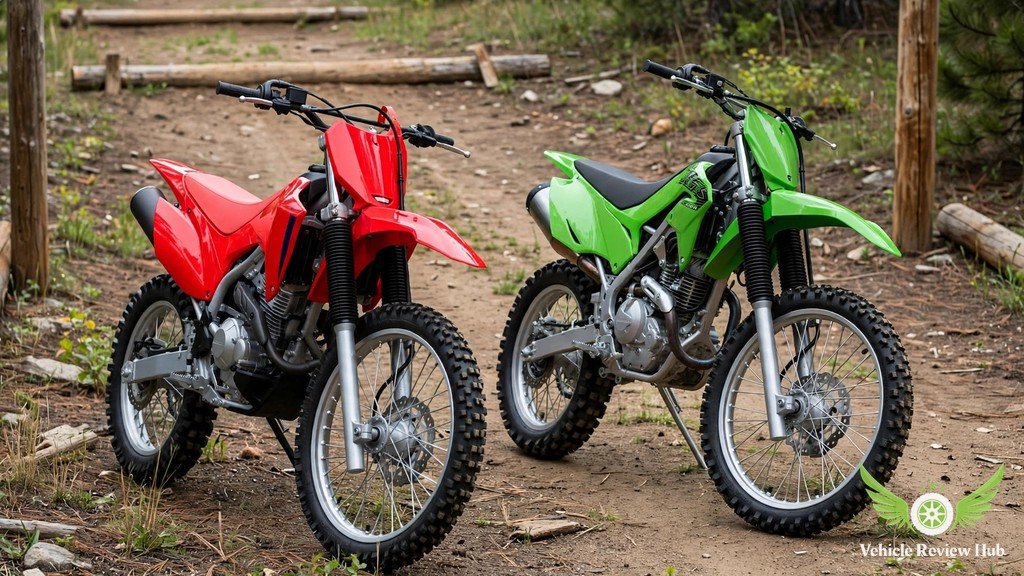
Honda CRF300F vs Kawasaki KLX230R and Yamaha TT-R230
The Kawasaki KLX230R is the closest rival on paper: a 233cc air-cooled single with a six-speed gearbox, listed at $4,999 in 2026 dealer brochures — the same price as the Honda before destination charges. The Yamaha TT-R230 is the cheaper, simpler alternative: a 223cc air-cooled single, listed at $4,699 retail in 2026 dealer listings, $300 less than the Honda. The Honda CRF300F performance case against both is displacement and equipment: 294cc against 233cc and 223cc, fuel injection against the Yamaha’s carburettor, and a 41mm Showa fork with 9.5 inches of travel. The KLX230R counters with its own six-speed; the TT-R230 counters with simplicity and price. For Honda CRF300F performance buyers, the deciding test is a back-to-back ride: the Honda’s extra capacity shows on hills and in taller gears, while the Yamaha’s lighter, simpler package appeals to riders who want the least bike that still does the job.
| Model | Price | Key performance note |
|---|---|---|
| Kawasaki KLX230R (2026) | $4,999 dealer-listed | 233cc, 6-speed, same price as the Honda |
| Yamaha TT-R230 (2026) | $4,699 dealer-listed | 223cc, simpler and cheaper, $300 less |
Predecessor Context Only: CRF250F Dyno 20.1 HP at the Rear Wheel
The doc’s predecessor-context figure deserves its own careful paragraph, because it is the only dyno number anywhere near this article — and it does not belong to the F. The CRF250F, the F’s direct predecessor, recorded 20.1 horsepower at the rear wheel on a dyno in published testing. That figure is included in this Honda CRF300F performance guide for one reason only: it gives readers a measured baseline for the old bike, so the felt improvement of the new bike has context. It must never be quoted as a CRF300F figure, and it must never be averaged with the unmeasured ~24 hp estimates into a fake F dyno number. For the full model story, see our Honda CRF300F review, and for servicing and ownership costs, see our Honda CRF300F reliability guide and our Honda CRF300F buying guide.
Honda CRF300F Performance FAQs
Direct answers to the Honda CRF300F performance questions trail riders and buyers ask most often.
How much horsepower does the Honda CRF300F make?
Honda publishes no figure, and no dyno test exists for the F. Estimates around 24 horsepower circulate, but they are unmeasured and Brazil-sourced, not measurements. This Honda CRF300F performance guide quotes no horsepower number for the F itself.
What is the top speed of the Honda CRF300F?
There is none published, and none can be measured from the bike itself: no speedometer is fitted, so no indicated top speed exists, and no GPS-verified figure has been published. Figures around 80 mph belong to the CRF300L and Rally, not the F.
Does the Honda CRF300F have a 0-60 mph time?
No instrumented 0-60 mph or quarter-mile figure has been published for the stock bike. Honda CRF300F performance acceleration is best judged by its trail manners, not by a drag-strip number.
What MPG does the Honda CRF300F get?
There is no EPA figure and no Honda MPG claim for Honda CRF300F performance, because the F is an off-road trail bike. Plan fuel by the 1.6-gallon tank and your own trail consumption, not by a mileage rating.
How far can the Honda CRF300F go on a tank?
No tested range has been published. The tank holds 1.6 gallons including a 0.34-gallon reserve, which covers a morning of trail riding for most riders; longer days need a fuel plan.
Is the Honda CRF300F street-legal?
No. For Honda CRF300F performance use, the F is an off-road trail bike only. It is green-sticker legal in California for off-highway areas, but it cannot be plated or ridden on public roads.
What is the difference between the CRF300F and the CRF300L?
The F is an air-cooled off-road trail bike with no speedometer and no street equipment. The L is a liquid-cooled dual-sport with instrumentation and road legality. For Honda CRF300F performance buyers, never quote L figures for the F.
What gearing does the Honda CRF300F use?
The Honda CRF300F performance gearbox is a new six-speed with a #520 O-ring chain running 14-tooth front and 50-tooth rear sprockets. The 250F had only five speeds.
How much does the 2026 Honda CRF300F cost?
The 2026 model costs $4,999 plus a $300 destination charge, in Red only. The 2027 carryover is announced at $5,099 plus destination, a key Honda CRF300F performance fact for shoppers choosing between model years.
How does the Honda CRF300F compare with the Kawasaki KLX230R?
The KLX230R lists at $4,999 in 2026 dealer brochures, the same price as the Honda. The Honda CRF300F performance case against it is displacement: 294cc against 233cc, with fuel injection and a 41mm Showa fork.
What suspension does the Honda CRF300F have?
The Honda CRF300F performance suspension is a 41mm Showa fork with 9.5 inches of travel up front, and a Pro-Link Showa single shock with 9.1 inches of travel at the rear.
Does the Honda CRF300F have ABS?
No. The F has no ABS, which suits Honda CRF300F performance trail use. Braking is a 240mm front petal disc with a dual-piston caliper and a 220mm rear petal disc with a single-piston caliper.
Is the Honda CRF300F good for beginners?
Yes — that is its core mission. Honda CRF300F performance is built around a low 35.0-inch seat, smooth tractable power, and a forgiving chassis.