Short answer: Honda CB500 Hornet reliability is one of the strongest selling points of this motorcycle, with one condition — buy the right generation, check its recall paperwork, and keep the simple service routine. The Hornet is the CB500F under a new name, a 471cc parallel twin sold in America since 2013, and this Honda CB500 Hornet reliability guide finds no documented chronic engine failure pattern for it. The watch list is short: corrosion, chain and brake wear, the 16,000-mile service, and older-bike recalls. For 2026, the US bike costs $5,899 plus a $600 destination charge, in Black only, with a transferable one-year limited warranty.
That identity point governs everything in this Honda CB500 Hornet reliability guide. Europe renamed the CB500F as the CB500 Hornet for 2024, American Honda kept the CB500F name for 2024 and 2025, and the Hornet name only arrived in the United States for 2026. The model code is still CB500FA and the engine is still the same 471cc twin, so this Honda CB500 Hornet reliability guide never treats the Hornet as a different motorcycle from the F. Used buyers should search both names plus the CB500FA code. For the full model story, see our Honda CB500 Hornet review.
Honda CB500 Hornet Reliability Overview
The short version of Honda CB500 Hornet reliability is reassuring: a thoroughly proven middleweight twin with a long American history, a small set of known wear items, and no engine horror stories. The chassis was updated in 2022 with the SFF-BP fork and dual front discs, and the electronics in 2024 with a TFT display and HSTC, but neither changed the fundamental Honda CB500 Hornet reliability picture — a simple, understressed engine in a naked frame.
MCN Owners Rate Reliability 4.3 to 4.7 Out of 5 by Generation
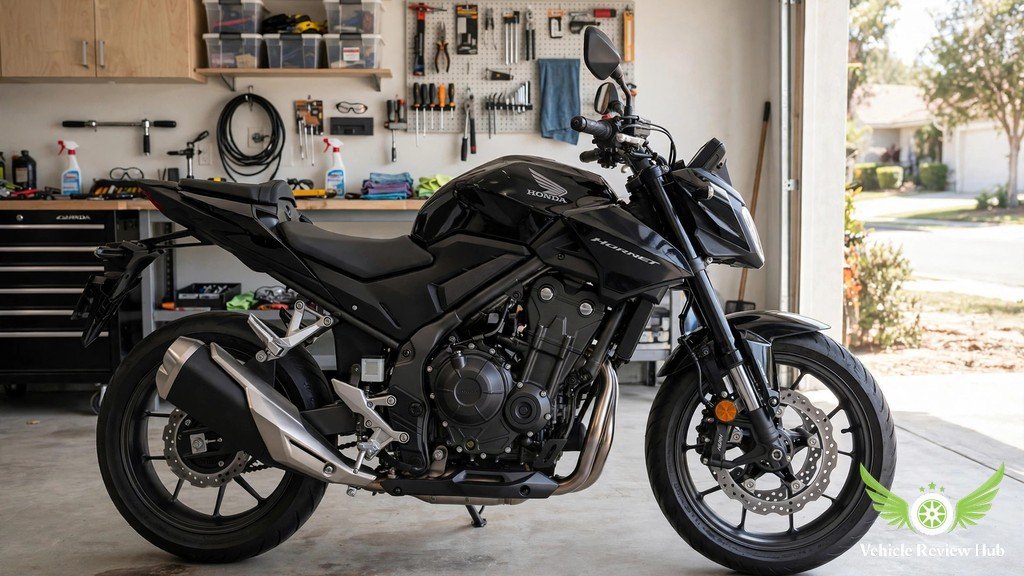
Owner evidence for Honda CB500 Hornet reliability is thin in sample size but consistent in direction, and this guide labels the scores correctly. The doc’s “4.3 to 4.7” figure is the MCN reliability and build-quality sub-score range by generation, not an overall score. Owners rate reliability 4.3 out of 5 (2019–2021, 12 owners), 4.7 out of 5 (2022-on, 6 owners), and 4.6 out of 5 (2016–2018, 9 owners), per MCN owner reviews. Note: the 2022-on overall score is 4.2 out of 5, and reviewer scores must never be mixed with owner scores.
How Mileage, Storage and Previous Care Affect Reliability
Mileage alone tells a buyer very little about Honda CB500 Hornet reliability. A 20,000-mile bike with a complete service book, a clean chain, and no crash history beats a 3,000-mile bike that sat outside for two winters. A garaged bike keeps its finish; one left outdoors grows corrosion. Previous care shows up in the service book first, and in details like tyre age and fork seal condition second. Honda CB500 Hornet reliability rewards the buyer who reads the history, not the odometer. The video below is Motorcyclist Magazine’s 2016 MC Commute on a CB500F: a commuting review, not a service tutorial.
Honda CB500 Hornet Common Problems and Wear Items
Honest Honda CB500 Hornet reliability coverage names watch items with their evidence level attached. Beyond later recall items, no chronic engine failure pattern was found for the 471cc twin. The watch list is finish, chain, tyres, brakes, fork seals, and electrics — wear and exposure items, not design defects — and that distinction is central to Honda CB500 Hornet reliability.

Fastener and Finish Corrosion and ABS Sensor-Ring Checks
Finish corrosion is the most consistently reported Honda CB500 Hornet reliability complaint, and it is a cosmetic and fastener issue, not an engine issue. MCN owners and the Bennetts used review both note corrosion on exposed areas — headlight mount, bottom yoke, and fasteners around the motor — with Bennetts calling the finish “a little substandard in areas.” Check those spots and treat heavy corrosion as a price item and a storage-history clue. The ABS sensor ring belongs in the same category: inspect the pulser ring and wheel-speed sensor for damage or dirt, because the 2022 manual warns against damaging them during chain work. The sensor ring is an inspection item here, not a proven defect pattern.
Chain, Sprockets, Tires, Fork Seals, Brakes and Electrical Checks
Wear items on the Hornet match every chain-drive naked bike, made visible by the lack of fairings. Check the O-ring chain (DID520V0 on the 2016 manual) and both sprockets for tight spots, hooked teeth, and missing O-rings, replacing chain and sprockets as a set when adjustment runs out. Check tyres for pressure, tread depth, and age — a stored bike can have old, hard tyres with plenty of tread. Check fork seals, stanchions, brake pads and discs, and confirm the ABS self-test completes with no warning light. Check battery, charging, lights, indicators, horn, and the TFT display on 2024-on bikes. None of this is exotic: the checks are ordinary, the parts are widely available, and a bike that passes them is a safe buy.
Honda CB500 Hornet Maintenance Schedule and Servicing
This section is the core of Honda CB500 Hornet reliability: Honda’s published schedule is simple, with one service that costs real money. Oil every 8,000 miles, valves and plugs every 16,000, chain care every 600 — the rest is calendar items. The schedule follows the CB500F manuals, and it flags year differences instead of giving one number for all years.

First Service at 600 Miles, Oil Every 8,000 Miles or One Year
Honda’s schedule starts with a first service at 600 miles, then oil and filter every 8,000 miles or 12 months, whichever comes first, per the CB500F maintenance schedule summaries. Recommended oil is SAE 10W-30 meeting JASO MA, and the first service must never be skipped. One figure this Honda CB500 Hornet reliability guide does not assert is a single oil capacity, because secondary figures disagree — 2.7 litres in one guide, 3.2 in the Bennetts review, 3.4 in a 2017 manual summary. Use your own year manual and the level check. That 8,000-mile interval is a US-schedule figure, not a UK one. For tested power and economy figures, see our Honda CB500 Hornet performance guide.
Spark Plug Replacement at 16,000 Miles: US Manual Differs by Year
The 16,000-mile service is the big-ticket item in Honda CB500 Hornet reliability, and the doc heading’s year warning deserves a straight answer. The 2019–2021 and 2022-on schedule summaries agree: at 16,000 miles, change the oil filter and spark plug and check the valve clearances. On this guide’s evidence, the 16,000-mile plug replacement holds across both groups. Buyers should still check their year manual before paying. This guide prints no F plug part number or gap, which was not separately verified against an F manual. Valve clearance is inspected every 16,000 miles, a dealer job. Price that service into any deal near 16,000 miles, where Honda CB500 Hornet reliability meets its largest single routine bill.
| Service item | Hornet / CB500F interval | Note |
|---|---|---|
| First service | 600 miles | Oil + checks; never skip |
| Engine oil + filter | Every 8,000 miles / 12 months | SAE 10W-30, JASO MA |
| Valve clearance | Inspect every 16,000 miles | Dealer job; price it into the deal |
| Spark plugs | Replace every 16,000 miles | 2019–21 and 2022-on summaries agree |
| Drive chain | Lube + slack check every 600 miles | Slack spec is year-split — see below |
| Brake fluid | Replace every 2 years | Calendar item, regardless of miles |
| Coolant | Replace every 3 years | Check level cold between changes |
| Summary | 8,000-mile oil, 16,000-mile valves and plugs | Check your year manual before paying |
Honda CB500 Hornet Tires, Brakes and Suspension Maintenance
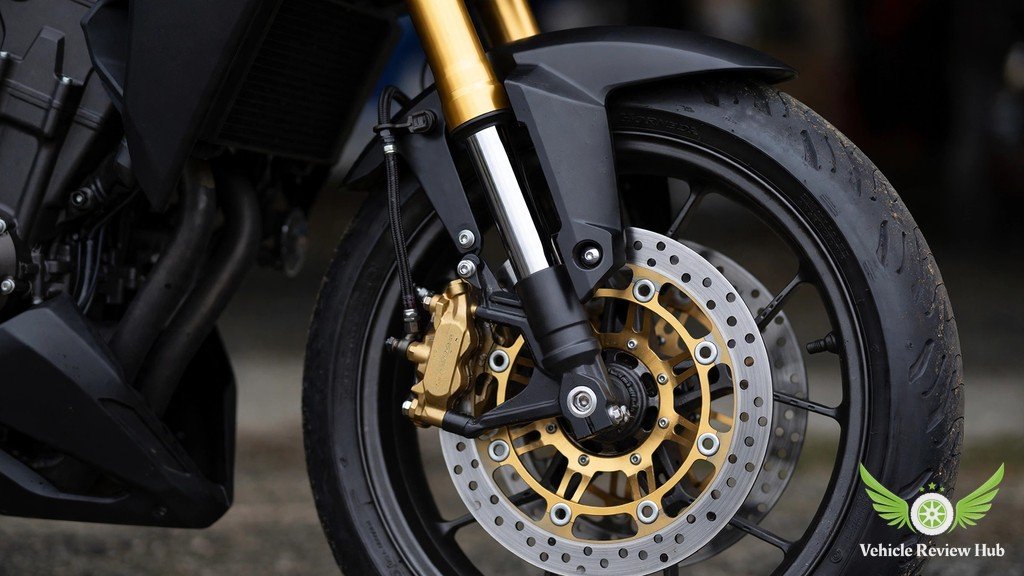
Tyres, brakes, and suspension are where Honda CB500 Hornet reliability meets the road. Pre-2022 bikes carry a single front disc; 2022-on bikes carry dual 296mm discs, radial calipers, and a 41mm Showa SFF-BP fork. That generation split is a buying tell as much as a maintenance note, and it is why Honda CB500 Hornet reliability advice must always carry its year-group with it.
Chain Lube and Slack Check Every 600 Miles Explained
Chain care is the highest-value job in Honda CB500 Hornet reliability, and it is also the easiest to get wrong by quoting one number for all years. The routine is the same every 600 miles: check slack at several points, in the lower half midway between the sprockets, clean and lubricate with an O-ring-safe product, and adjust equally on both sides. The numbers, however, are year-split. The 2016 manual specifies 35 to 45 mm (do not ride past 60 mm); the 2022 manual specifies 25 to 35 mm (do not ride past 50 mm). Applying the wrong year-group figure runs the chain too loose or too tight. Also check that slack is constant — a varying chain has kinked links and needs dealer inspection — and do not damage the ABS sensor or pulser ring. Replace chain and sprockets as a set, never a new chain on worn sprockets.
Brake Fluid Every Two Years and Coolant Every Three Years
Brake fluid every two years and coolant every three years are calendar items in Honda CB500 Hornet reliability, and they are the two items owners most often forget because the bike still feels fine without them. Brake fluid absorbs moisture over time, so the two-year change matters even on a low-mileage bike. Coolant follows the same logic on a three-year cycle, with the level checked cold between changes. Brake pads wear fast under hard or city use: check thickness before buying, replace before they score the discs, and note the 2022-on dual-disc setup doubles the pad count. Air filter inspection every 12,000 miles is a secondary-schedule figure — verify it in your year manual. Fork seals are a wear item to price in.
Honda CB500 Hornet Maintenance and Ownership Costs
Ownership costs are where Honda CB500 Hornet reliability becomes a budget question, and the answer is good news: this is one of the cheapest modern motorcycles to keep, with no semi-active suspension or exotic brake package — just a twin, a chain, and ordinary consumables. That simplicity is central to Honda CB500 Hornet reliability.
Fuel, Routine Servicing, Tires and Replacement Parts
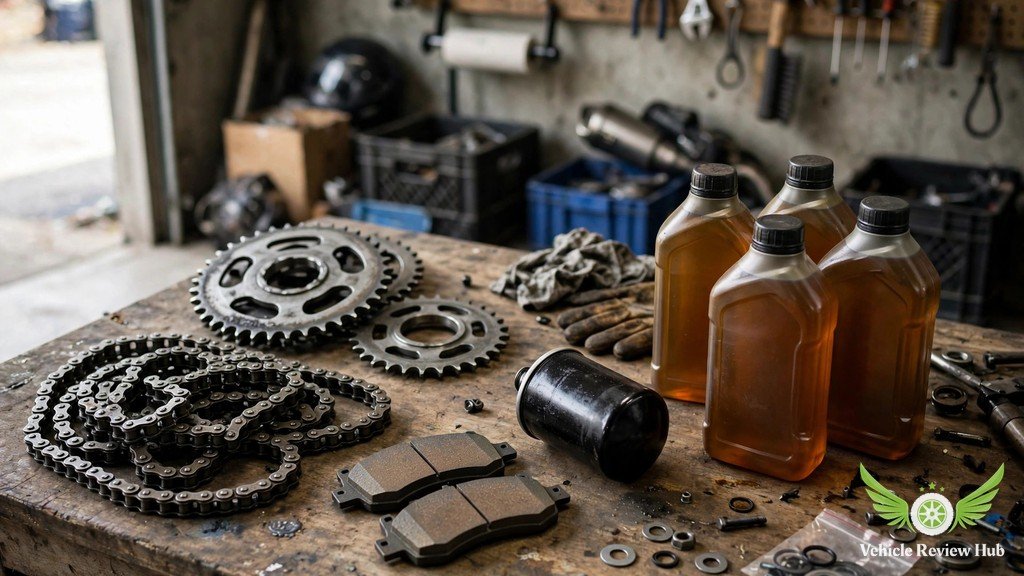
Fuel is the easiest cost to estimate honestly in this Honda CB500 Hornet reliability guide. The tank holds 4.5 gallons on current bikes, and American testing puts economy in the high-50s to low-60s miles per gallon. Routine servicing is oil and filter every 8,000 miles, a chain and sprocket set when adjustment runs out, and the 16,000-mile valve and plug service as the one large bill. No published US servicing-cost figure was found, so this guide quotes none — the Bennetts UK figures (around £250 minor, £500 for the 16,000-mile service) are UK prices only. Parts availability is good: the platform has run in the US since 2013.
Repair Expenses, Parts Availability and Long-Term Ownership Costs
The big repair expense on a Hornet is crash damage, not mechanical failure, and that is the honest long-term picture for Honda CB500 Hornet reliability. Bennetts notes lots of these bikes get dropped, so a used buyer should price bar ends, levers, engine cases, fork stops, and radiator condition. Owner examples past 80,000 miles with routine care are anecdotes, not guarantees. Long-term, the risk is specification drift: pre-2022, 2022–2023, and 2024-on bikes are not the same maintenance proposition. The US warranty is a transferable one-year limited warranty with an optional HondaCare plan; the two-year warranty sometimes quoted online is the UK warranty, not the US warranty. For the buying picture, see our Honda CB500 Hornet buying guide.
How to Keep a Honda CB500 Hornet Reliable
Keeping a Hornet reliable is disciplined, not complicated: chain routine, complete service book, recall paperwork in writing, and generation tells checked first. That is the simplest summary of Honda CB500 Hornet reliability in practice.

Preventive Maintenance, Service Records and Regular Inspections
Start with the chain, the highest-value job in Honda CB500 Hornet reliability: clean and lubricate every 600 miles, check slack against your year-group figure, and replace chain and sprockets as a set. Before every ride, inspect tyres, brakes, chain, lights, and controls, and store the bike right — a tender, wash, and cover prevent a dead battery and corroded fasteners. Keep service records: proof of the 16,000-mile service, fluid changes, and tyre and chain work is worth money at resale. Learn the generation tells: dual discs and the SFF-BP fork mean 2022-on, TFT and HSTC mean 2024-on, and a claimed US 2024 Hornet or US 2020 F is mislabelled. An E-Clutch lever or badge on a claimed US bike is another mislabel tell: the US bike is manual only. For the sibling-model picture, the CB500F reliability guide covers the same platform under its older name.
Recalls: 21V-690 Does Not Name the F, 21V-382 Covers 2021 Only
The recall picture is the spine of Honda CB500 Hornet reliability for used buyers. First, 21V-382, Honda campaign KM3, covers the F for 2021 only — 256 units within a 28,528-unit multi-model campaign — for a rear reflector, remedied free. The 28,528 figure is the campaign total, never the F count, and “2020–2021 CB500F” claims are wrong for the F. Second, 21V-690, the ABS modulator campaign, does not name the F at all: it covers the CB500X and CBR500R (262 units combined, never an F figure). The NHTSA document for 21V-382 confirms the F’s 2021-only population. The full pre-2022 F picture also includes three older campaigns, all VIN-first: 14V056 (2013 rocker-arm bolts, 6,954 multi-model); 15V475/JT1 (2013–2015 fuel sensors, 14,575 R + F); and 15V439 (2014–2015 starter relays, multi-model, no F-only count). One honest gap: this guide did not verify 2022–2026 NHTSA counts, so it claims none — run the VIN before buying.
| Recall | Bikes covered | Fix |
|---|---|---|
| 21V-382 / KM3 — rear reflector | F for 2021 ONLY, 256 units | Replace reflector, free |
| 21V-690 / KM6 — ABS modulator | Does NOT name the F (X + R only, 262 total) | Not an F campaign |
| 14V056 — rocker-arm bolts | 2013, 6,954 multi-model | Dealer remedy, VIN-check |
| 15V475 / JT1 — fuel sensor | 2013–2015, 14,575 R + F | Dealer remedy, VIN-check |
| 15V439 — starter relay | 2014–2015, multi-model, no F-only count | Dealer remedy, VIN-check |
| Summary | All named F campaigns are pre-2022 — the Honda CB500 Hornet reliability rule | Always VIN-check before buying |
Honda CB500 Hornet Reliability FAQs
Direct answers to the questions buyers ask most about Honda CB500 Hornet reliability.
Is the Honda CB500 Hornet reliable?
Yes. Honda CB500 Hornet reliability rests on a proven 471cc twin with no documented chronic engine failure pattern, MCN owner reliability scores of 4.3 to 4.7 by generation, and a simple service schedule.
Is the Hornet the same bike as the CB500F?
Yes. Honda CB500 Hornet reliability covers the same motorcycle: Europe renamed the F as the Hornet for 2024, the US kept the F name for 2024–2025, and the Hornet name arrived in the US for 2026 (model code still CB500FA).
How often should I change the oil?
For Honda CB500 Hornet reliability, change oil and filter at 600 miles first, then every 8,000 miles or 12 months, using SAE 10W-30 meeting JASO MA.
When does it need a valve check?
For Honda CB500 Hornet reliability, valve clearance is inspected every 16,000 miles — a dealer job, priced into any deal near that mileage.
When do the spark plugs need replacing?
For Honda CB500 Hornet reliability, spark plugs are replaced every 16,000 miles, on both the 2019–2021 and 2022-on schedule summaries. Check your year manual before paying.
How often should I clean and lube the chain?
For Honda CB500 Hornet reliability, clean and lubricate the chain every 600 miles, checking slack at several points, and replace chain and sprockets as a set.
What is the correct chain slack?
For Honda CB500 Hornet reliability, chain slack is year-split: 35 to 45 mm, do not ride past 60 mm, on the 2016 manual; 25 to 35 mm, do not ride past 50 mm, on the 2022 manual. Use your year-group figure.
How often should brake fluid and coolant be changed?
For Honda CB500 Hornet reliability, brake fluid is replaced every two years and coolant every three years, regardless of mileage.
What are the common problems?
For Honda CB500 Hornet reliability, the watch list is short: corrosion, chain and sprocket wear, tyre age, fork seal weeping, brake wear, and crash damage — not engine failure.
Has the CB500F or Hornet been recalled in the US?
Yes, for older bikes only. For Honda CB500 Hornet reliability checks, the named F campaigns are 21V-382 for 2021 only (256 units) plus 14V056, 15V475, and 15V439. Run the VIN.
Does the 21V-690 ABS recall cover the CB500F?
No. For Honda CB500 Hornet reliability buyers, 21V-690 covers the CB500X and CBR500R only, 262 units combined. It does not name the F.
Does the Hornet have E-Clutch in the US?
No. For Honda CB500 Hornet reliability readers, the US bike is six-speed manual only. E-Clutch for 2026 is a European option, not a US feature.
Is there a 2020 US CB500F or a 2024 US Hornet?
No to both. For Honda CB500 Hornet reliability shoppers, there is no 2020 US F model year, and the US 2024 bike is a CB500F — the Hornet name arrived in the US for 2026.
What should I check first on a used Hornet or CB500F?
For Honda CB500 Hornet reliability, check VIN recall completions, proof of the 16,000-mile service, chain slack for your year-group, tyre age, fork seals, pads, corrosion, and crash damage — in that order.
Is the US warranty two years?
No. For Honda CB500 Hornet reliability buyers, the US warranty is a transferable one-year limited warranty with an optional HondaCare plan. The two-year warranty in some coverage is the UK warranty.
How long will a CB500 Hornet last?
For Honda CB500 Hornet reliability, owner reports of 80,000-plus miles with routine care are common, but they are anecdotes, not guarantees.