Short answer: the Honda CB300R review verdict is that Honda’s smallest naked is one of the smartest beginner bikes on sale in America — a 286cc single with premium looks, a 316-pound curb weight, and a 2026 price of just $4,499 plus $600 destination. This Honda CB300R review covers the current US bike, not a discontinued model: Honda still lists the CB300R for 2026, and the American run stretches unbroken from 2019 to 2026. It is not a twin, not the old CB300F, and not the faired CBR300R — it is a Neo Sports Café naked that trades horsepower for lightness, economy, and fun.
One framing fact belongs up front in any honest Honda CB300R review: this bike wins on feel, not figures. Honda USA publishes no horsepower figure for it, no American magazine has measured a 0-60 or quarter-mile time, and its top speed is only a 90–95 mph band from European and British sources. Judged on paper alone, the CB300R looks modest. Judged on the road, where its weight and handling matter more than its dyno sheet, this Honda CB300R review finds a motorcycle that makes slow-bike-fast riding genuinely delightful.
Honda CB300R Overview and Model-Year Updates
The CB300R arrived in America for 2019 as the replacement for the CB300F, and this Honda CB300R review starts with its staying power: seven model years with no skipped year, no redesign, and a price that just fell instead of rising. For a first bike, that combination of price, weight, and simplicity is rare, and it explains why the little naked keeps earning recommendations from reviewers who have ridden everything in the class.

Still on Sale: 2026 Model Listed by Honda USA Today
Still on sale: the 2026 model is listed by Honda USA today at $4,499 plus $600 destination, and this Honda CB300R review treats that as the headline, because a $650 cut from the 2025 price of $5,149 is rare in any segment. The 2026 bike comes in Matte Black Metallic or Pearl Dusk Yellow, carries the model code CB300RA(T), and keeps the same 286cc single, steel frame, and full-LED lighting as before. For a buyer comparing new against used, the new-bike price now caps every used ask — a point this Honda CB300R review returns to in the verdict. For the measured performance behind this Honda CB300R review, see our Honda CB300R performance guide.
US Run 2019 to 2026 With No Skipped Model Years
The US run from 2019 to 2026 has no skipped model years, and the price ladder tells the bike’s story in numbers. The 2019 bike asked $4,649 without ABS or $4,949 with it; 2021 and 2022 held at $4,949; 2023 crossed $5,000 for the first time at $5,049; 2024 and 2025 sat at $5,149; and 2026 drops to $4,499. Early colours included Chromosphere Red and Matte Gray Metallic, while recent years settled on Matte Black Metallic and Pearl Dusk Yellow. The bike is built in Thailand, and its Neo Sports Café styling — round LED headlight, sculpted tank, exposed frame — is borrowed from the CB1000R look, which is why this Honda CB300R review calls it the best-dressed bike in its price class.
Honda CB300R Engine and Specifications
The engine is the heart of this Honda CB300R review, and it is also where the most confusion lives. Five different power figures circulate for this bike, and they are not interchangeable — this Honda CB300R review keeps every one in its own labelled box.
286cc DOHC Single at 10.7:1 With 38mm Throttle Body
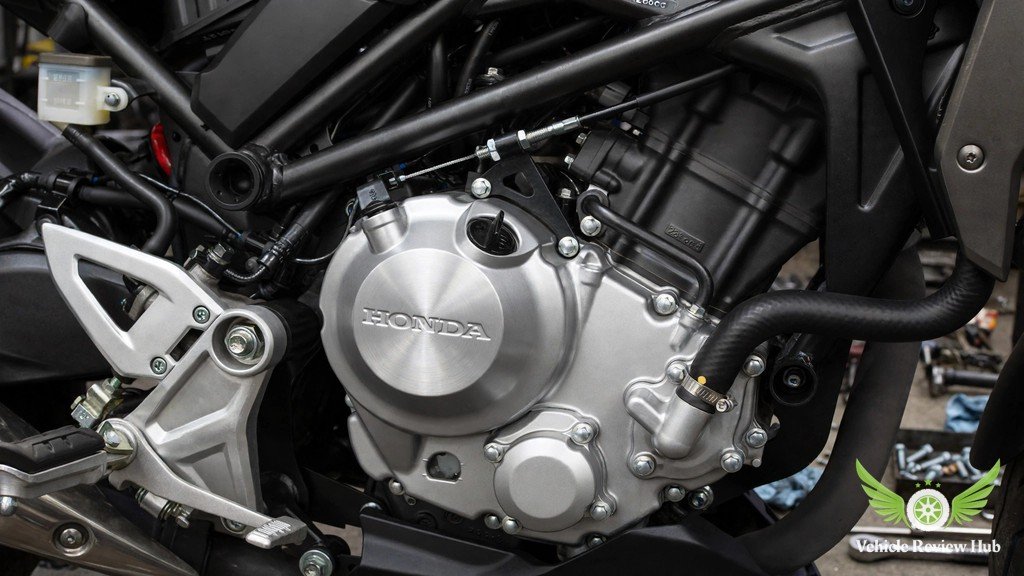
The Honda CB300R review engine is a 286cc liquid-cooled DOHC single — 76.0 by 63.0 mm bore and stroke, 10.7:1 compression, PGM-FI through a 38 mm throttle body, six-speed gearbox, and a #525 O-ring chain running 14T/36T sprockets on the 2026 bike. It shares its engine family with the CBR300R and the Rebel 300, but this Honda CB300R review never borrows their test numbers: the faired CBR300R’s old quarter-mile time belongs to that bike, not this one. On power, the boxes stay separate: Honda USA publishes no figure; Rider’s 2024 review reports a factory claim of 31 hp at 9,000 rpm and 20.2 lb-ft at 8,000 rpm; Cycle World’s dyno measured 27.5 hp at 8,300 rpm and 18.72 lb-ft at 6,550 rpm at the rear wheel; a Honda rep once mentioned 28.5 hp at the crank; and the same engine in the CBR300R made 27.6 hp at the rear wheel in Rider’s test. RevZilla’s first ride confirms the engine’s character: direct, predictable throttle with only so much to rip before it stops giving more.
Specs Split by Era: 317 lb and 2.7 Gallons Against 316 and 2.6
Specs split by era, and this Honda CB300R review labels them rather than merging them. Early bikes weighed 317 lb with a 2.7-gallon tank — Rider’s 2019 ABS test bike weighed 318 lb wet — while current bikes weigh 316 lb with a 2.6-gallon tank. The rest of the 2026 specification sheet reads: 41 mm inverted fork with 5.1 inches of travel, Pro-Link single shock with 5.2 inches of travel, 296 mm front disc and 220 mm rear disc with ABS, 110/70-17 front and 150/60-17 rear Dunlop GPR-300 tyres, 24.7 degrees of rake, 3.7 inches of trail, a 53.2-inch wheelbase, and a 31.6-inch seat height. Range math must use the matching tank: the 2024 Rider test averaged 73.5 mpg on the 2.6-gallon tank for roughly 190 miles, with the fuel light around 130 miles.
Honda CB300R Price and Market Availability
Price is where this Honda CB300R review turns enthusiastic, because the 2026 cut makes an already cheap bike cheaper — and it reframes every used listing in the country.

Honda CB300R Price in the USA: $4,499 Plus $600 for 2026
The Honda CB300R review price in the USA is $4,499 plus $600 destination for 2026, for $5,099 before tax and dealer fees. That undercuts the Yamaha MT-03 at $4,999 plus $600 by $500, the Kawasaki Z500 ABS at $5,699 by $1,200, and even the CFMOTO 300NK’s 2025 figure of $4,199 only narrowly misses it — while offering Honda’s dealer network and a transferable one-year limited warranty with HondaCare extended coverage available. The 2020 US price was not pinned in research for this Honda CB300R review, so no figure is printed for that year rather than guessing one from the 2021–2022 price. For the servicing costs behind the sticker, see our Honda CB300R reliability guide.
A $650 Cut From 2025 and Matte Black or Pearl Dusk Yellow
A $650 cut from 2025 and a two-colour choice — Matte Black Metallic or Pearl Dusk Yellow — is the whole 2026 story, and this Honda CB300R review calls that a good thing. There is no new engine, no new chassis, and no new electronics for 2026, because the bike did not need them; the cut alone is the news. Pearl Dusk Yellow is the eye-catching option that photographs beautifully and stands out in traffic, while Matte Black Metallic suits the bike’s stealth-fighter look. Either way, the buyer gets full-LED lighting, a clear LCD dash, and the gold-anodised fork that makes the bike look far more expensive than it is — a point every Honda CB300R review since 2019 has made, and one this Honda CB300R review repeats because it is still true.
Honda CB300R Design, Features and Technology
Design and technology are where the CB300R punches above its price, and this Honda CB300R review rates the hardware highly — with two honest electronics caveats that buyers must understand.

IMU-Based Two-Channel ABS Explained: Not Cornering ABS
IMU-based two-channel ABS explained plainly: the CB300R’s ABS uses an inertial measurement unit to distribute braking force between the front and rear, but that does NOT make it cornering or lean-sensitive ABS, and this Honda CB300R review will not let any listing claim otherwise. The hardware is a 296 mm front disc with a radial-mount Nissin four-piston caliper — the doc heading’s figure, though one outlier source describes a two-piston caliper, a wording this Honda CB300R review notes without adopting — plus a 220 mm rear disc. ABS was optional in 2019 only and standard from 2020 on in the US, so every 2020-on bike a buyer meets will have it. What the bike does not have is traction control, ride modes, ride-by-wire, or a quickshifter — and this Honda CB300R review counts that simplicity as a feature for beginners, not a gap.
The EU Slipper Clutch and SFF-BP Fork Never Reached the US
The EU slipper clutch and SFF-BP fork never reached the US, and this Honda CB300R review keeps that boundary firm. European and global copy sometimes credits the CB300R with an assist-and-slipper clutch and a Showa SFF-BP fork; American bikes have neither, and a buyer who pays extra for a “slipper clutch” CB300R in the US is paying for something that is not there. The same caution applies to the gear-position indicator: doc headings say US bikes never got one, while Rider’s 2024 review text lists one among the LCD items — this Honda CB300R review reports both wordings and resolves neither, since early US reviews describe no gear indicator and the 2024 text may be a syndication error. The US dash is an LCD with clock, tach, fuel gauge, economy readout, trips, and a sidestand indicator — enough information, and nothing to distract a new rider.
Honda CB300R Riding Experience and Comfort
On the road, this Honda CB300R review finds a bike that is brilliant in town and on back roads, and merely adequate on the highway — a split verdict that matches every professional test of it.
Riding Position, Handling and Low-Speed Maneuverability
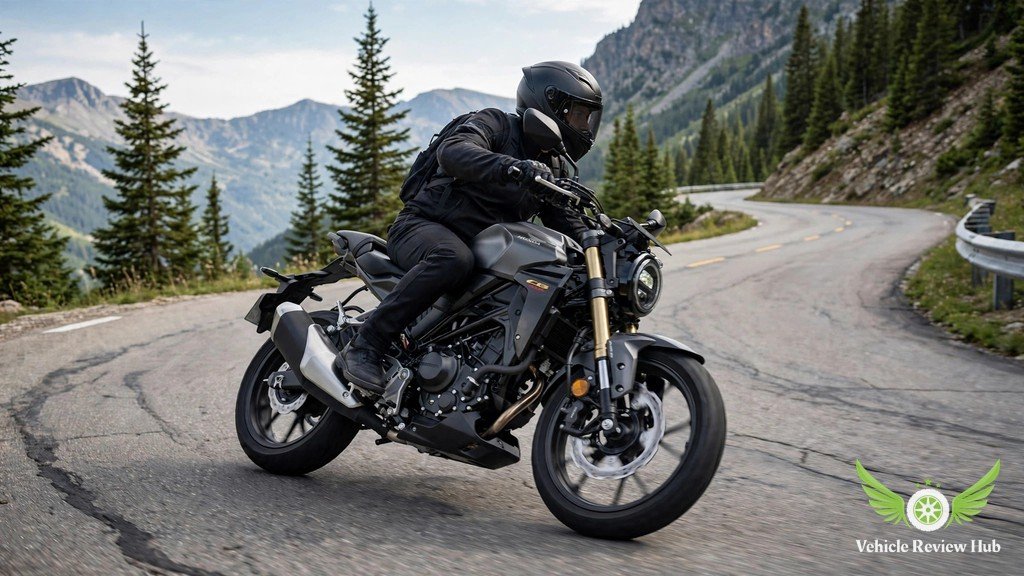
Riding position in this Honda CB300R review is upright and roomy: a 31.6-inch seat, mid-set pegs, and wide bars give an easy reach and plenty of leg room, even for taller riders, and the 316-pound weight makes low-speed manoeuvres and tight U-turns nearly effortless. The 53.2-inch wheelbase and quick steering mean the bike falls into turns with little input, and testers consistently praise its flickable, confidence-inspiring character in town and on winding roads. The video below is DukeOfDC’s 2020 first ride review of the real CB300R, honestly labelled as a 2020 review — the bike is essentially unchanged since, so its impressions still hold, but treat its $4,949 price as a 2020 figure, not today’s $4,499.
Highway Comfort, Passenger Use and Everyday Practicality
Highway comfort is the weaker half of this Honda CB300R review. The bike keeps up with interstate speeds of about 75 to 80 mph with minimal fuss, but wind buffeting above roughly 75 mph tires the rider, the thin seat goes numb after about 40 freeway miles per Rider’s first ride, and the small tank means planning fuel stops — roughly 190 miles of range on the current 2.6-gallon tank, less when ridden hard. The passenger pad is best described as an afterthought, and there is precious little storage under the seat. Everyday practicality is better: the light weight, the forgiving clutch, the excellent fuel economy in town, and the simple LCD make commuting effortless. Just do not buy this Honda CB300R review bike as a two-up tourer — it is a solo back-road and city bike that commutes brilliantly, not a highway machine.
For daily ownership, the small details matter as much as the headline numbers. The clutch pull is light enough for stop-and-go traffic, the gearbox shifts cleanly once broken in, and the narrow profile slips through gaps that would stop a bigger naked. Servicing is straightforward: the single cylinder means one spark plug, one throttle body, and easy access to most maintenance items, which keeps dealer bills modest and home maintenance realistic for a careful owner. Fuel stops come often because the tank is small, but each fill costs little, and the bike sips gently enough in town that a week’s commuting rarely needs more than one visit to the pump.
Honda CB300R Review: Pros, Cons and Verdict
The verdict in this Honda CB300R review is an easy yes for the right buyer — one of the best beginner bikes and best-value small nakeds on sale, held back only by its highway limits and its small tank.

Main Advantages and Limitations of the Honda CB300R
Advantages first in this Honda CB300R review: the $4,499 price, the 316-pound weight, the premium Neo Sports Café looks, the superb fuel economy, the standard ABS, and Honda’s reliability record — MCN owners rate reliability and build quality 4.8 out of 5, though from only 13 UK owners, a small sample this Honda CB300R review flags as such. Limitations, stated with equal weight: the modest power, the hard seat, the small tank, the basic preload-only rear shock, the firm ride, and the lack of wind protection. MCN’s CB300R review calls it charming, good looking, and fun to ride, and this Honda CB300R review agrees — while noting that MCN’s 95 mph top-speed figure is a UK figure, part of the 90–95 mph band, never a US test. The value case is echoed by TopSpeed’s case for the CB300R as the Honda new riders actually need, which singles out its light weight and low running costs. For the buying decision in full, see our Honda CB300R buying guide.
ABS Optional in 2019 Only and Standard From 2020 in the US
The final verdict note in this Honda CB300R review is the ABS story, which is also a buying tip. ABS was optional in 2019 only — $4,649 without it, $4,949 with it — and standard from 2020 on, so a non-ABS bike a buyer meets today is necessarily a 2019, and should be priced as the older, lesser-equipped machine it is. Combined with the 2026 price cut, the advice of this Honda CB300R review is simple: buy new at $4,499 if you can, buy a 2020-on ABS bike used if you cannot, and check any 2019 for its recall status before paying. Buy the CB300R if you want the lightest, cheapest, best-looking way into motorcycling with Honda reliability behind it; buy the MT-03 if you want twin-cylinder speed for $500 more; and buy neither without sitting on both. That is the honest close of this Honda CB300R review.
| Honda CB300R at a glance | Figure | Label |
|---|---|---|
| US price, 2026 | $4,499 + $600 destination | $650 cut from 2025 |
| Engine | 286cc single, 10.7:1, 38 mm TB | Honda USA publishes no hp figure |
| Curb weight / tank | 316 lb / 2.6 gallons | Current; early bikes 317 lb / 2.7 gal |
| Brakes / ABS | 296 mm front disc, IMU-based ABS | ABS standard from 2020; not cornering ABS |
| Summary | Best beginner value; check 2019 recalls by VIN | US run 2019–2026, no skipped years |
Honda CB300R Review FAQs
Direct answers to the Honda CB300R review questions buyers ask most.
How much does the Honda CB300R cost in the USA?
$4,499 plus $600 destination, says this Honda CB300R review — $5,099 before tax and fees, for the current 2026 model.
Is the Honda CB300R still sold new?
Yes, says this Honda CB300R review. Honda USA lists the 2026 model today; the bike was never discontinued, and the US run is 2019 to 2026 with no skipped years.
What engine does the Honda CB300R have?
A 286cc liquid-cooled DOHC single, says this Honda CB300R review, with 10.7:1 compression, a 38 mm throttle body, and a six-speed gearbox.
How much horsepower does the Honda CB300R make?
It depends on the box, says this Honda CB300R review: Rider reports a factory claim of 31 hp, Cycle World measured 27.5 hp at the rear wheel, and Honda USA publishes no figure.
What colours does the US Honda CB300R come in?
Matte Black Metallic or Pearl Dusk Yellow for 2026, says this Honda CB300R review. Earlier years offered Chromosphere Red and other colours.
Does the Honda CB300R have ABS?
Yes on every 2020-on bike, says this Honda CB300R review. ABS was optional in 2019 only, so a non-ABS bike is necessarily a 2019.
Is the Honda CB300R good for beginners?
Yes, says this Honda CB300R review. At 316 lb with a 31.6-inch seat, predictable power, and standard ABS, it is one of the best beginner bikes on sale.
Does the Honda CB300R have a slipper clutch?
No, not in the US, says this Honda CB300R review. The EU slipper clutch never reached American bikes, whatever global copy claims.
How far can the Honda CB300R go on a tank?
Around 190 miles from the 2.6-gallon tank, says this Honda CB300R review, based on Rider’s measured 73.5 mpg average — with the fuel light around 130 miles.
What is the top speed of the Honda CB300R?
A 90–95 mph band from European and British sources, says this Honda CB300R review. No US instrumented top-speed test exists.
Is the Honda CB300R worth it?
Yes, says this Honda CB300R review. At $4,499 new with Honda reliability and standard ABS, it is one of the best-value small nakeds in America.