The short answer: Honda CB300R performance is modest on paper and fun on the road. The 286cc single puts 27.5 horsepower to the rear wheel on Cycle World’s dyno, cruises at 75 to 80 mph, and returns 65 to 75 mpg mixed. No American instrumented 0-60 or quarter-mile test exists, and top speed sits in the 90 to 95 mph band from European and British sources. Every Honda CB300R performance number here is labelled by source, so you can tell a factory claim from a dyno run and a test result from an estimate.
Honda CB300R Engine Performance and Power Delivery
Any honest Honda CB300R performance account starts with a warning: no single horsepower number exists. Honda USA publishes no power figure, and online numbers measure different things.

Cycle World Dyno: 27.5 HP at 8,300 RPM at the Rear Wheel
The hardest Honda CB300R performance number is the Cycle World dyno result: 27.5 horsepower at 8,300 rpm at the rear wheel, as reported by MotorBeam. Rear-wheel figures read lower than crankshaft figures, so this is the honest number. Against it sit two boxes that must never be merged with it: the factory claim as reported by Rider’s 2024 review, 31 horsepower at 9,000 rpm, and a Honda representative’s spoken quote of 28.5 horsepower at the crank. Averaging those three into one invented figure would be wrong. The engine is a liquid-cooled, dual-overhead-cam single, four valves, 10.7:1 compression, 38mm throttle body, shared with the faired CBR300R and the cruiser-styled Rebel 300. The Cycle World dyno comparison also puts the Honda beside the KTM 390 Duke, and no fair Honda CB300R performance account hides the KTM’s large power advantage.
Torque 18.72 lb-ft at 6,550 RPM and Single-Cylinder Character
Torque is where Honda CB300R performance actually lives. Cycle World’s dyno measured 18.72 lb-ft at 6,550 rpm at the rear wheel, right where everyday riding happens, and because the bike weighs only 316 pounds in current form, that modest torque has little mass to move. The result feels responsive at city speeds without hard revs, which is why beginners and returning riders like it. The single brings trade-offs: buzz through bars and pegs above 6,000 rpm, and linear, predictable delivery rather than bursts. That linearity is a genuine Honda CB300R performance strength, even if it will never win a drag race.
| Power figure | Value | What it actually is |
|---|---|---|
| Honda USA published figure | None published | US specs page lists no power or torque |
| Factory claim, as reported by Rider | 31 hp at 9,000 rpm | Claim attributed to Honda by Rider’s 2024 review |
| Cycle World dyno, rear wheel | 27.5 hp at 8,300 rpm | Measured at the wheel, not the crank |
| Honda representative quote | 28.5 hp at the crank | Spoken quote, not a published spec |
| Torque, Cycle World dyno | 18.72 lb-ft at 6,550 rpm | Measured at the rear wheel |
Honda CB300R Top Speed and Acceleration
Top speed and acceleration need the most care in any Honda CB300R performance guide: the internet is full of confident numbers no test supports. No American magazine has published an instrumented 0-60 mph or quarter-mile time, and the top-speed band in Honda CB300R performance comes from British and European sources.
No US Instrumented 0-60 or Quarter-Mile Test Exists
No US instrumented 0-60 or quarter-mile test exists for the Honda CB300R; pages claiming under seven seconds to 60 mph are aggregator estimates, not tests. Equally, the one real quarter-mile figure for this engine family, a 15.15-second run, belongs to the faired CBR300R, not the CB300R, and must not be transferred across models. A serious Honda CB300R performance guide leaves the acceleration box marked untested rather than filling it with borrowed numbers. Rider reports agree qualitatively: brisk to about 60 mph, clean through the gears, eager in the first three gears where city riding happens. Above 60 mph acceleration tapers, and 50 to 60 mph overtakes usually need a downshift to fifth. That is normal for a 27.5-rear-wheel-horsepower single; buyers needing strong 70-to-90 mph passing power should look at a twin.
Top Speed in the 90 to 95 MPH Class From EU-UK Sources
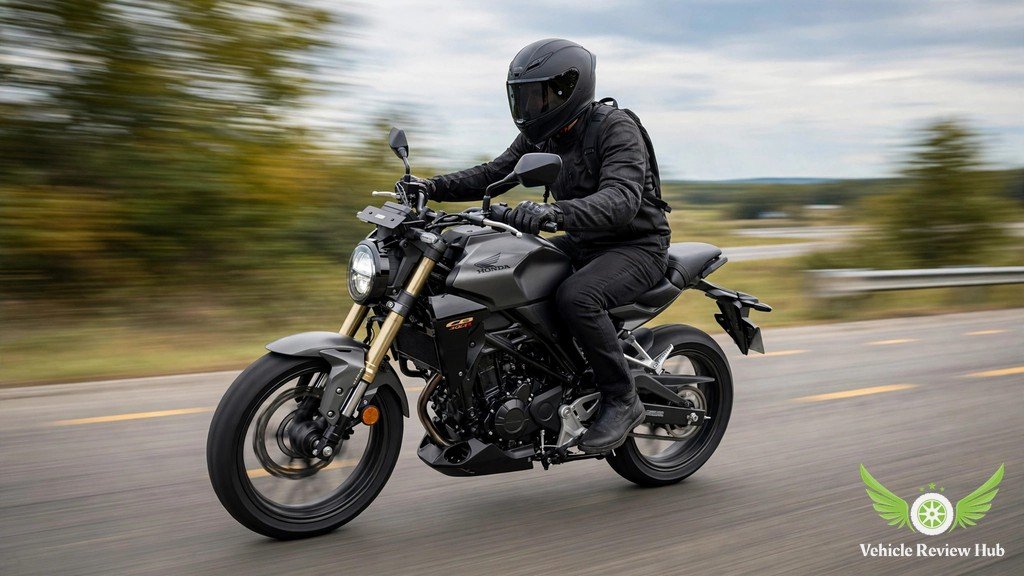
Honda CB300R performance at the top end sits in the 90 to 95 mph class, every figure from European or British sources. MCN lists 95 mph in the UK, TopSpeed reports 93 mph speedometer-indicated, and one aggregator cites about 90 mph. Together they form a band, not a precise number. The MCN CB300R review also notes a happy indicated 75 mph cruise but a needed downshift for 50 to 60 mph overtakes, matching American reports. TopSpeed’s fuel-economy analysis adds roughly 190 miles of range in ideal conditions at that speed. Speedometers commonly read a few percent optimistic, so 93 mph indicated may mean the high 80s true. Practically, Honda CB300R performance reaches and holds interstate speed, with little reserve above 80 mph.
The video above is an honest owner review of the CB300R plus a highway ride, showing Honda CB300R performance in real traffic and at cruising speed — honestly named as an owner review, not an instrumented test.
Honda CB300R Mileage and Fuel Economy
Fuel economy is where Honda CB300R performance genuinely shines, and why many owners forgive the small tank and modest power. The bike sips fuel in city and canyon riding, drinks far more at wide-open freeway speed, and lands in the high 60s on average, which is why Honda CB300R performance ownership stays cheap.
Rider Tested 73.8 MPG in City and Canyon Riding
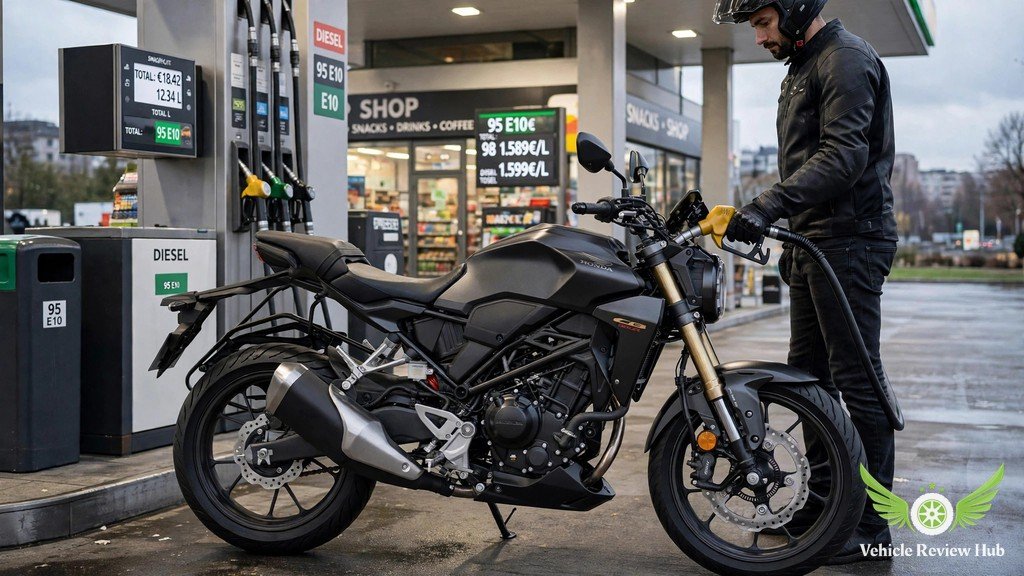
Rider’s first-ride test produced the strongest Honda CB300R performance economy figure: 73.8 mpg city and canyon, with almost 200 miles calculated from the early bike’s 2.7-gallon tank. Rider’s spec box lists a 64.6 mpg average, and its 2024 review of the current bike reports 73.5 mpg with the smaller 2.6-gallon tank, about 190 miles with the fuel light around 130 miles. Those two Rider data points tell a consistent story: ridden gently, this is a 70-plus mpg motorcycle. The Rider first-ride review also supplies the most important economy caveat. The same tester watched economy fall to 54.5 mpg during a wide-open-throttle freeway sprint home. That 19 mpg swing explains why two owners report wildly different mileage: a commuter at 45 to 60 mph sees the 70s, a rider holding 80 mph sees the 50s, and both tell the truth about Honda CB300R performance.
Freeway MPG Falls to 54.5 and Cycle World Measured 54.1
The freeway side of Honda CB300R performance is confirmed by a second source. Cycle World measured 54.1 mpg for the CB300R, a doc figure not re-verified in this pass. It lines up almost exactly with Rider’s 54.5 mpg freeway figure. Together they show sustained high-speed running costs roughly a quarter of gentle-riding economy. Range math must use the right tank: early bikes carried 2.7 gallons, so Rider’s near-200-mile figure belongs there, while current bikes carry 2.6 gallons, giving about 190 miles at 73.5 mpg. At 54 mpg, practical range drops to roughly 140 miles. Superb economy, small tank: the real Honda CB300R performance compromise.
| Economy figure | MPG (US gallons) | Source and conditions |
|---|---|---|
| City and canyon riding | 73.8 | Rider first ride, tested |
| Wide-open freeway sprint | 54.5 | Rider first ride, tested |
| Current bike average | 73.5 | Rider 2024 review, tested average |
| Cycle World measured | 54.1 | Doc figure, not re-verified this pass |
| Owner average | 68.7 | Fuelly owner reports, doc figure |
| Realistic planning range | 65 to 75 mixed | Use this band for purchase decisions |
Honda CB300R Real-World Riding Performance
Honda CB300R performance in daily use is better than the dyno sheet alone suggests. At 316 pounds, roughly 11 pounds per rear-wheel horsepower, with quick steering and a short 53.2-inch wheelbase, it feels alert exactly where most riders ride.

City Riding, Traffic Performance and Everyday Acceleration
In the city, Honda CB300R performance is at its best. The upright position gives a clear view over traffic, the clutch is light, throttle response is clean, and the narrow profile slips through gaps. Low-speed maneuverability is a genuine strength: the 31.6-inch seat lets most riders flat-foot at lights, steering is quick without feeling nervous, and U-turns are easy at this weight. Everyday acceleration, 0 to 45 mph between lights and short expressway merges, feels brisk and confident. Two caveats: the throttle can feel slightly snatchy at very low speed in first gear, and the seat is firm, Rider’s tester finding it wanting after a 100-plus-mile press ride plus 110 freeway miles home.
Highway Riding Limits and Fuelly Owners Averaging 68.7 MPG
On the highway the Honda CB300R performance story changes. The CB300R keeps up with 75 to 80 mph interstate speeds with minimal fuss, in Rider’s words, but that is not where it feels at home. Wind buffeting grows above roughly 75 mph with no windscreen or fairing, and the seat goes numb after about 40 freeway miles per Rider’s first ride. Passing needs planning and usually a downshift, and a strong headwind can hold the bike below 80 mph. None of this makes the bike unsafe, but long highway days tire in a way a 500cc twin does not. Fuelly owners, reporting their own fill-ups, average 68.7 mpg, a doc figure, an owner-reported average, not a test result. That sits neatly between Rider’s 73.8 and the freeway 54.5, exactly where a mixed-use average should land. Budget 65 to 70 mpg mixed, the low 50s on fast highway runs, and fuel stops around 130 miles.
Honda CB300R Handling, Braking and Stability
Handling is where Honda CB300R performance most exceeds its price, and why experienced riders recommend the bike despite modest power. A light chassis, quality suspension, and strong brakes combine into Honda CB300R performance that feels planted and precise.
Light 316 to 317 lb Weight and Quick Steering Behaviour
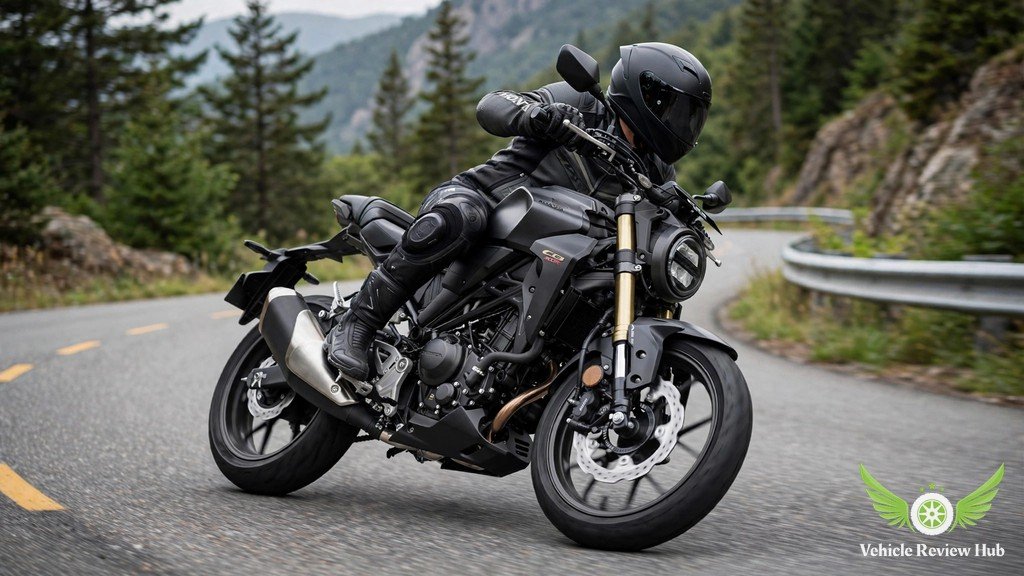
The current CB300R weighs 316 pounds at the curb per Honda’s 2026 specifications; early bikes were listed at 317, and Rider’s 2019 ABS test bike weighed 318 wet. Whatever the exact figure, this is one of the lightest street bikes sold in America, and the lightness transforms handling. The bike changes direction with a touch and holds a line through corners without fuss. MCN’s reviewers call it remarkably assured in bends. The steel diamond frame’s 24.7-degree rake, 3.7 inches of trail, and 53.2-inch wheelbase explain the quick but stable steering. The 41mm inverted fork offers 5.1 inches of travel; the Pro-Link shock 5.2 inches, preload-only. Note: the European bike’s Showa SFF-BP fork never reached the United States. The full CB300R review covers Honda CB300R performance chassis detail.
296mm Front Disc With Radial Nissin Four-Piston Caliper
Braking is the other half of the Honda CB300R performance handling story: a 296mm front disc, radial-mount Nissin four-piston caliper, and 220mm rear disc. Two-channel ABS is standard from 2020 onward and was optional on the 2019 model only, covered in the companion CB300R buying guide. The doc heading frames the ABS as IMU-based, but that does not make it cornering or lean-sensitive ABS, and riders should not expect lean-angle braking protection. It is conventional two-channel ABS, well calibrated, and plenty for this bike. Reviewers praise the brakes for feel and stopping power, with one reservation: the front brake can feel slightly wooden, lacking initial bite. That is pad and master-cylinder tuning, not a safety concern, and most owners adapt within a few rides. For a beginner, light weight, predictable brakes, and standard ABS make Honda CB300R performance approachable rather than intimidating.
Honda CB300R Performance Compared With Other Small Naked Bikes
Comparisons are where Honda CB300R performance either makes sense or falls apart: this bike does not compete on power. It competes on lightness, economy, price, and ease of use, and against the right rivals it wins on those terms.

Honda CB300R vs Yamaha MT-03 and CFMOTO 300NK
The Yamaha MT-03 is the rival most buyers cross-shop. The 2026 MT-03 costs $4,999 plus $600 destination, exactly $500 more than the CB300R’s $4,499 plus $600, and its 321cc parallel twin makes far more power: Cycle World’s dyno for the MT-03 reads 37.07 rear-wheel horsepower against the Honda’s 27.5. On any road where acceleration matters, the Yamaha is simply faster. The Honda gives back roughly 30 pounds less weight, better gentle-riding economy, and a low-running-cost reputation. City riders who value lightness and economy have a real case for the Honda; regular highway riders should pay the extra $500 for the Yamaha. The CFMOTO 300NK is the budget alternative at a 2025 American price of $4,199 (2026 United States price unverified). The 300NK undercuts the Honda on price but cannot match Honda’s dealer network or resale confidence in America. In short, Honda CB300R performance is not class-leading on power, but at $4,499 it is the lightest, simplest, most economical Japanese option.
| Bike | Engine | Rear-wheel dyno hp | 2026 US price | Weight |
|---|---|---|---|---|
| Honda CB300R | 286cc single | 27.5 | $4,499 + $600 | 316 lb |
| Yamaha MT-03 | 321cc twin | 37.07 | $4,999 + $600 | ~373 lb |
| CFMOTO 300NK | 292cc single | Not cited | 2025 $4,199 (2026 unverified) | ~333 lb |
| Kawasaki Z500 ABS | 451cc twin | Not cited | $5,699 | ~368 lb |
Is the Honda CB300R Suitable for Beginner Riders?
Yes, and this is one of the least controversial claims in the Honda CB300R performance story. Light weight, predictable power, upright position, low seat, and standard ABS make a textbook beginner package, and reviewers from Rider to MCN to the Best Beginner Motorcycles guide agree. New riders report high confidence in dense traffic, a light clutch prevents hand fatigue, and the linear delivery means no sudden surges. Beginner suitability does not mean beginner-only. Experienced riders often keep a CB300R as a second bike or commuter for its lightness and economy. The limits are the same as for everyone: firm seat, small tank, no wind protection, modest highway reserve. A new rider planning mostly city and backroad riding may outgrow the bike’s power but never its convenience — a strong Honda CB300R performance endorsement. The companion CB300R reliability guide covers the service schedule in full.
Honda CB300R Performance FAQs
These questions buyers actually ask about Honda CB300R performance are answered with the same labelled-source discipline. Where no test exists, the answer says so.
What is the top speed of the Honda CB300R?
Honda CB300R performance at the top end sits in the 90 to 95 mph band from European and British sources: MCN 95 mph, TopSpeed 93 mph speedometer-indicated, one aggregator about 90 mph. No American instrumented test exists, so treat the band as the answer.
How fast is the Honda CB300R from 0 to 60 mph?
No American instrumented 0-60 mph test exists, so no verified figure exists. Pages claiming under seven seconds are estimates, not tests. Qualitatively, Honda CB300R performance feels brisk to 60 mph, then tapers, matching the 27.5-horsepower dyno result.
How much horsepower does the Honda CB300R make?
It depends on the box. Honda USA publishes no figure. Rider reports the factory claim as 31 horsepower at 9,000 rpm. Cycle World’s rear-wheel dyno measured 27.5 horsepower at 8,300 rpm. A Honda representative once quoted 28.5 at the crank. Never average these; quote the dyno figure. Those are the Honda CB300R performance power boxes.
What is the Honda CB300R quarter-mile time?
There is no verified quarter-mile time in Honda CB300R performance testing. The 15.15-second figure sometimes attached here belongs to the faired CBR300R from an old Cycle World comparison and must not be transferred.
What mileage does the Honda CB300R get?
Rider tested 73.8 mpg city and canyon and 54.5 mpg in a wide-open freeway sprint, with a 73.5 mpg average on the current bike. Cycle World measured 54.1 mpg, Fuelly owners average 68.7 mpg. For Honda CB300R performance planning, use 65 to 75 mpg mixed, low 50s at sustained highway speed.
How far can the Honda CB300R go on a full tank?
About 190 miles on the current 2.6-gallon tank at 73.5 mpg average, fuel light around 130 miles. Early 2.7-gallon bikes could approach 200 miles gently ridden. At mid-50s freeway economy, plan stops around 120 to 140 miles. That range shapes Honda CB300R performance touring.
Is the Honda CB300R good on the highway?
Adequate, not comfortable. Honda CB300R performance at 75 to 80 mph is fuss-free, but buffeting, buzz, a firm seat, and limited passing reserve tire on long days. Short hops are fine; cross-state touring is not its strength.
Is the Honda CB300R faster than the Yamaha MT-03?
No. The MT-03’s 321cc twin dynos at 37.07 rear-wheel horsepower against the CB300R’s 27.5, and costs $500 more at $4,999 plus $600. The Honda answers with lower weight, better gentle-riding economy, and a lower price, but the Yamaha wins clearly on acceleration.
Does the Honda CB300R have good brakes?
Yes. A 296mm front disc, radial-mount Nissin four-piston caliper, and standard two-channel ABS from 2020 onward give strong, predictable stopping. Some find initial bite slightly wooden, but stopping and stability are consistently praised. That is dependable Honda CB300R performance braking.
Is the Honda CB300R good for beginners?
Yes, one of the best beginner bikes in the class. Light weight, linear power, a low 31.6-inch seat, upright position, and standard ABS build confidence fast, and Honda CB300R performance stays useful as a commuter long after.
Why does Honda CB300R fuel economy vary so much between owners?
Speed is the dominant variable. Rider’s testing shows a 19 mpg swing between gentle city and canyon riding at 73.8 mpg and a wide-open freeway sprint at 54.5 mpg. Owners reporting 74 and 55 mpg are both correct; they ride at different speeds. That spread is central to Honda CB300R performance ownership.
Is the 2026 Honda CB300R still on sale in the USA?
Yes. The CB300R is current, listed by Honda USA for 2026 at $4,499 plus $600 in Pearl Dusk Yellow and Matte Black Metallic. Reports of discontinuation after 2022 are wrong, and any guide framing Honda CB300R performance as used-only is out of date.