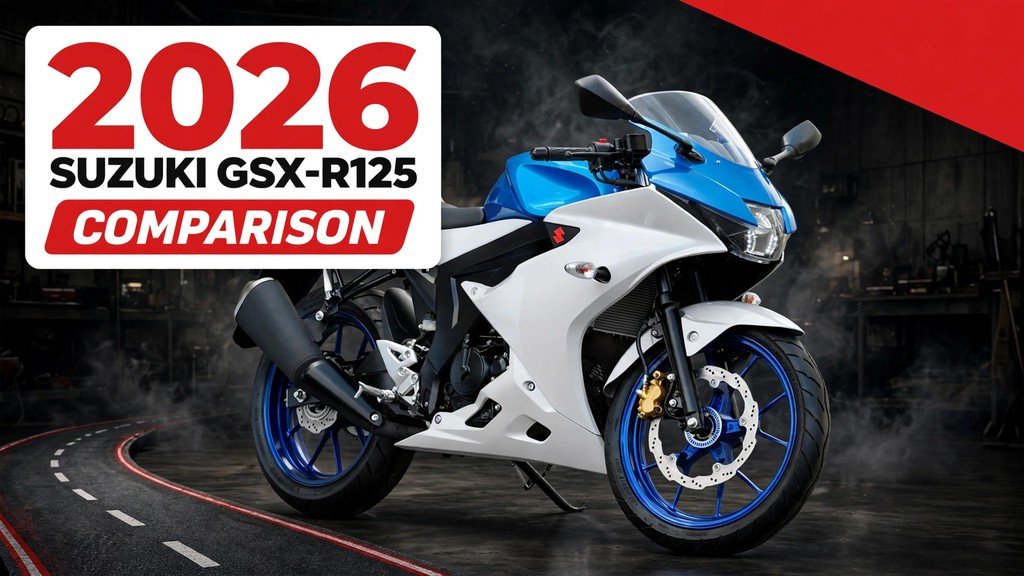
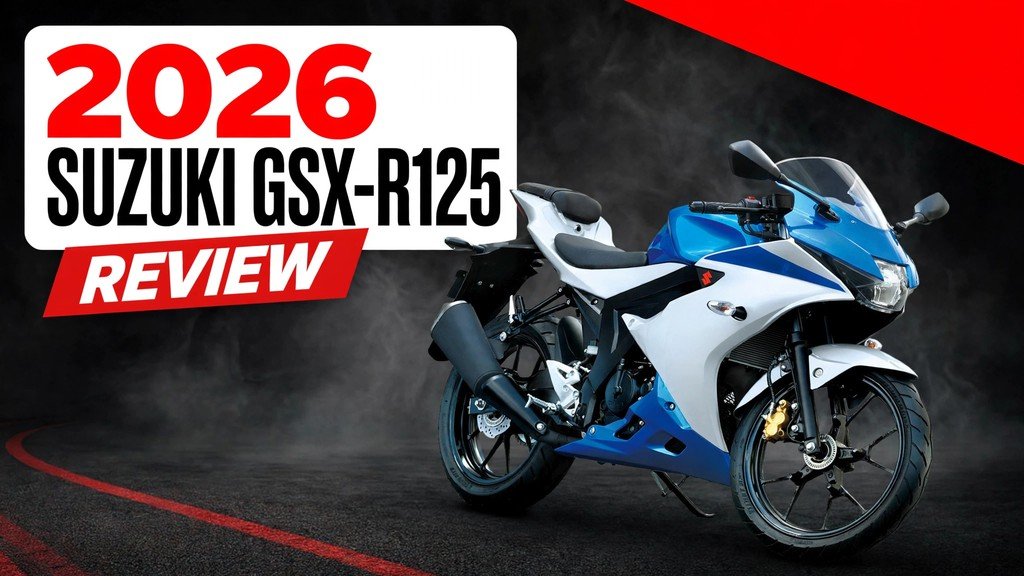
The 2027 Suzuki GSX-8S costs $8,749 before destination, or $9,499 delivered — $825 more than a 2027 Yamaha MT-07 delivered, $900 more than a Honda CB750 Hornet at its current US price, and $209 more than a 2027 Triumph Trident 660 delivered. Yet it won Motorcycle.com’s 2025 three-bike shootout. This Suzuki GSX-8S comparison measures the 8S against all three rivals on price, power, electronics and everyday value, then against the in-house alternatives.
Suzuki GSX-8S Overview and Its Closest Rivals
The 8S is the naked version of Suzuki’s 776cc parallel-twin platform, shared with the faired GSX-8R and the V-Strom 800DE. It makes a claimed 81.8 hp and 57.5 lb-ft, weighs 445 lb ready to ride, and carries a 5-inch TFT dash, three ride modes, traction control and a standard bi-directional quickshifter. It has no IMU, no cornering ABS and no cruise control. Each rival beats the 8S on something real: the MT-07 is the lightest, the Hornet is the cheapest and most powerful on paper, and the Trident is the only one with an IMU.

Why These Three Rivals: Benchmark, Threat, Tech
The MT-07 is the benchmark: a 689cc CP2 twin, 403 lb wet, and the cheapest price here. The Hornet is the threat: $7,999 with more claimed power than any of the other three — 90.5 hp — and an E-Clutch that doubles as a quickshifter. The Trident is the tech leader: the only bike here with a six-axis IMU, which brings cornering ABS, lean-sensitive traction control and standard cruise control. A fourth bike, the CFMOTO 800NK, was left out even though it beat the 8S on a dyno: that two-bike story is already covered in the GSX-8S performance guide.
How the Four Bikes Differ at a Glance
The table below lines the four bikes up on the figures that matter most. Claimed power is the factory figure, not a dyno result.
| Bike | Engine | Claimed power | Weight | Delivered price |
|---|---|---|---|---|
| 2027 Suzuki GSX-8S | 776cc parallel twin | 81.8 hp @ 8,500 rpm | 445 lb curb | $9,499 |
| 2027 Yamaha MT-07 | 689cc CP2 twin | 73.4 hp @ 8,750 rpm | 403 lb wet | $8,674 |
| 2026 Honda CB750 Hornet E-Clutch | 755cc parallel twin | 90.5 hp @ 9,500 rpm | 432 lb curb | $8,599 |
| 2027 Triumph Trident 660 | 660cc inline triple | 94 hp @ 11,250 rpm | 429.9 lb wet | $9,290 |
Suzuki GSX-8S vs Yamaha MT-07
The MT-07 is the bike the 8S has to beat, and on paper it is the hardest rival to argue against: 42 lb lighter, $825 cheaper delivered, and the best fuel economy in Motorcycle.com’s test. The 8S answers with more torque, a bigger engine and the shootout win. Visordown’s verdict: by most measures, the Suzuki is the better bike.

Engine, Specs and Performance Side by Side
The 8S has the bigger engine and the stronger mid-range. Its 776cc twin claims 81.8 hp at 8,500 rpm and 57.5 lb-ft at 6,800 rpm, against the MT-07’s 689cc CP2 twin at 73.4 hp at 8,750 rpm and 49.4 lb-ft at 6,500 rpm. On Motorcycle.com’s same-day dyno the gap held: the 8S made 73.5 hp at 7,900 rpm and 53.4 lb-ft at 5,400 rpm, the MT-07 made 65.1 hp at 8,500 rpm and 46.3 lb-ft at 6,300 rpm. The 8S made the most torque in that test and was strongest below 7,500 rpm. The MT-07 answers with weight: 403 lb wet against the 8S at 445 lb curb. Both bikes use a 270-degree crank, a 5-inch TFT and ride-by-wire with three ride modes. The 8S has a standard bi-directional quickshifter; the MT-07 offers only an upshift-only accessory. The MT-07’s rear shock has rebound adjustment, unlike the 8S’s, but its fork is non-adjustable like the 8S’s. Neither bike has an IMU, cornering ABS or cruise control. Seat height is 31.7 inches, a touch lower than the 8S’s 31.9. Fuel economy favours the Yamaha: 47.7 mpg in Motorcycle.com’s test against 40.8 mpg for the 8S, and Yamaha estimates 57 mpg against the 8S’s long-term 66.4 mpg Imperial, about 55 mpg US, from MCN’s 7,690-mile test.
Price, Equipment and Which Suits Which Rider
The MT-07 is $7,999 for 2027 with a $675 destination charge, $8,674 delivered — $750 less than the 8S on MSRP and $825 less delivered. Yamaha cut the price $600 from the 2026 bike’s $8,599, and the 2027 bike is a mechanical carryover with only a new Redline colourway. The 8S costs more and gives you more engine and torque, a standard quickshifter and the shootout win. The MT-07 suits the rider who wants the lightest, cheapest bike in the class and does not mind paying extra for a quickshifter. The 8S suits the rider who wants more mid-range pull and a more complete standard equipment list. The GSX-8S review covers the 8S’s price history, including the $500 MSRP cut for 2027.
Suzuki GSX-8S vs Honda CB750 Hornet
The Hornet is the cheapest bike in this comparison and the most powerful on paper. Honda sells the 2026 E-Clutch Hornet for $7,999, $750 less than the 8S on MSRP and $900 less delivered. It claims 90.5 hp, the highest of the four. The 8S answers with more torque, a smoother engine, a standard quickshifter, and the shootout win.

Engine, Specs and Performance Side by Side
The Hornet’s 755cc parallel twin claims 90.5 hp at 9,500 rpm and 55 lb-ft at 7,250 rpm — the US figure, not the Euro bike’s 92 hp. The 8S claims 81.8 hp at 8,500 rpm and 57.5 lb-ft at 6,800 rpm, so the Honda wins on peak power and the Suzuki on torque. On Motorcycle.com’s same-day dyno the pattern held: the Hornet made 76.6 hp at 8,200 rpm and 50.9 lb-ft at 7,200 rpm, the 8S made 73.5 hp at 7,900 rpm and 53.4 lb-ft at 5,400 rpm. Testers called the Hornet sleepy around town until the tach climbs past 4,600 rpm. The Hornet weighs 432 lb curb with the E-Clutch, 13 lb less than the 8S, with the lowest seat in the group at 31.3 inches. Its 4.0-gallon tank is the largest here, against the 8S’s 3.7. The Hornet’s 41mm Showa SFF-BP fork is the best fork hardware here, with 4.7 inches of travel per Honda — Motorcycle.com’s table says 5.1, but Honda’s figure is the one to use. Both have a 5-inch TFT, ride-by-wire, three ride modes and three-level traction control, plus user modes on the Honda. The Hornet’s E-Clutch doubles as a bi-directional quickshifter. Neither bike has an IMU, cornering ABS or cruise control.
Price, Equipment and Which Suits Which Rider
The Hornet is $7,999 with a $600 destination charge, $8,599 delivered. The gap is $750 on MSRP and $900 delivered, because Suzuki’s destination is $150 higher. One caveat: Honda USA had not announced a 2027 Hornet at research time, and its site still lists the 2026 E-Clutch model only. The $7,999 figure is the 2026 US price, so read the gap as “at its current US price”. The Hornet suits the rider who wants the most peak power per dollar and is happy with an automated clutch. The 8S suits the rider who wants more low-end torque, a conventional clutch with a standard quickshifter, and the shootout winner.
The video below is RideFast’s 2023 Hornet vs 8S head-to-head from South Africa, with 2023 Euro bikes and a manual Hornet — a two-bike comparison, not a four-way shootout. Watch it for the drag and top-speed runs: the Suzuki recorded 215 km/h indicated and the Honda 222 km/h.
Suzuki GSX-8S vs Triumph Trident 660
The Trident is the only rival that beats the 8S on electronics. For 2027 Triumph cut the Trident’s price $400, back to $8,595, so it undercuts the 8S by $154 on MSRP and $209 delivered. It has the most claimed power at 94 hp, the only IMU, and the only standard cruise control. The 8S answers with more torque and a bigger engine — and no named dyno test exists for its 94 hp engine.

Engine, Specs and Performance Side by Side
The Trident’s 660cc triple claims 94 hp at 11,250 rpm and 50.2 lb-ft at 8,250 rpm — the highest claimed power and the lowest claimed torque of the four. The 8S claims 81.8 hp at 8,500 rpm and 57.5 lb-ft at 6,800 rpm, so the Suzuki makes 7.3 lb-ft more torque and makes it 1,450 rpm lower. The honest gap is the dyno: no named outlet has published a rear-wheel test of the 94 hp Trident, so there is no measured figure to set against the 8S’s 73.5 hp. The Trident weighs 429.9 lb wet, 15 lb less than the 8S, with the same 31.9-inch seat height. Both bikes have a 3.7-gallon tank. The Trident’s Showa SFF-BP fork is preload- and rebound-adjustable with 4.7 inches of travel, better hardware than the 8S’s non-adjustable KYB fork, and its rear shock is preload-adjustable — rebound adjustability is disputed between sources. Its brakes are Nissin twin 310mm front discs with two-piston sliding calipers and a 255mm rear, with cornering ABS and braided lines. The triple revs to 12,650 rpm and sounds like a triple, while the 8S’s twin is all mid-range pull.
Price, Equipment and Which Suits Which Rider
The Trident is $8,595 for 2027 with a $695 destination charge, $9,290 delivered. The destination figure is dealer-listed, not factory-confirmed — Triumph USA lists MSRP only The price history is the story: the 2025 Trident was $8,595, the updated 2026 model with the 94 hp engine launched at $8,995, and for 2027 Triumph cut the price $400 back to $8,595. No 2027-specific mechanical changes were found in any source; the 2026 update carries over and the 2027 news is the price cut. The Trident suits the rider who wants the most electronics in the class, plus the triple’s sound and the highest claimed power. The 8S suits the rider who wants more torque and a simpler electronics package with nothing to go wrong. The Trident’s IMU is not new for 2027, and it was not new for 2026 either: it has been standard since the 2025 model year. Any claim that it arrived in 2026 or 2027 is wrong.
Suzuki GSX-8S Price and Value Compared
On delivered price the 8S is the most expensive bike here: $9,499, $825 more than the MT-07, $900 more than the Hornet at its current US price, and $209 more than the Trident.

Hornet Undercuts the 8S by $750
The Hornet’s $750 undercut is real on MSRP and bigger delivered: $8,749 against $7,999 is $750, and $9,499 against $8,599 is $900. The MT-07’s undercut is the same $750 on MSRP but $825 delivered, because Yamaha’s $675 destination sits between Honda’s $600 and Suzuki’s $750. The Trident undercuts the 8S by only $154 on MSRP and $209 delivered. Two gaps need labelling: the Hornet’s $7,999 is the 2026 US price, since no 2027 US Hornet had been announced, and the Trident’s $695 destination is dealer-listed rather than factory-confirmed. The 8S’s own price moved in the buyer’s favour for 2027: Suzuki cut the MSRP $500 from the 2026 bike’s $9,249, and the delivered price fell $450. The Motorcycle.com 2025 comparison tested the three bikes when the 8S was the most expensive at $9,209, and it still won.
| Bike | MSRP | Destination | Delivered | vs 8S delivered |
|---|---|---|---|---|
| 2027 Suzuki GSX-8S | $8,749 | $750* | $9,499 | — |
| 2027 Yamaha MT-07 | $7,999 | $675 | $8,674 | −$825 |
| 2026 Honda CB750 Hornet E-Clutch† | $7,999 | $600 | $8,599 | −$900 |
| 2027 Triumph Trident 660 | $8,595 | $695‡ | $9,290 | −$209 |
| 2026 Suzuki SV650 ABS (last model year) | $8,149 | $600 | $8,749 | −$750 |
| 2027 Suzuki GSX-8R | $9,199 | $750* | $9,949 | +$450 |
* Suzuki USA prints no destination figure; $750 is dealer- and Motorcycle.com-sourced. † No 2027 US Hornet announced; $7,999 is the 2026 US E-Clutch price. ‡ Trident destination is dealer-listed, not factory-confirmed.
Running Costs and Resale Value Compared
Running costs favour the Yamaha. The MT-07 returned 47.7 mpg in Motorcycle.com’s test against 40.8 mpg for the 8S and 40.3 for the Hornet, and Yamaha estimates 57 mpg. The 8S’s long-term figure is about 55 mpg US from MCN’s 7,690-mile test, and the Trident is rated 44.8 mpg combined. Servicing is where the 8S is cheap to own: oil every 3,750 miles, the filter only at 600 and 11,250 miles, and the valve inspection at 15,000 miles, as the GSX-8S reliability guide shows. The Trident has the longest service intervals at 10,000 miles and a 24-month warranty, double the 8S’s. Tyres are a real cost on the 8S: the stock Dunlop Roadsport 2 rear starts to square off around 2,500 miles. On resale, the 8S has two things in its favour: no recall names it, and its owners rate it five out of five — though that is exactly five owners, a thin sample. None of the four is a bad buy on running costs; the differences are tens of dollars a year, not hundreds.
Suzuki GSX-8S Comparison Verdict and US Alternatives
The 8S is not the cheapest, lightest, most powerful or most electronic bike here — and it still won the only three-bike test against two of its rivals. It wins on torque, on refinement, on the completeness of its standard equipment, and on a reliability record no recall has touched. The rider who buys on a spreadsheet buys the Hornet or the MT-07; the rider who buys on the test result buys the 8S.

Trident’s IMU Makes It the Electronics Leader
The Trident is the only one of the four with an IMU, and that one sensor unlocks cornering ABS, lean-sensitive traction control and standard cruise control. The other three run conventional ABS and wheel-speed traction control, which work well but cannot see lean angle. The Trident’s IMU has been standard since the 2025 model year, alongside the standard quickshifter and cruise control — so it is not a 2026 or 2027 addition. The 8S’s electronics are deliberately simple: ride-by-wire, three SDMS modes, three-level traction control plus off, a bi-directional quickshifter and a 5-inch TFT. That simplicity suits the rider who wants fewer things to go wrong. The MT-07’s electronics are the thinnest here after the 8S: ride-by-wire, three modes and switchable traction control, but no standard quickshifter and no cruise on the manual bike. The Hornet sits between the 8S and the Trident, with the E-Clutch quickshifter and user modes, but no IMU and no cruise.
| Feature | GSX-8S | MT-07 | CB750 Hornet | Trident 660 |
|---|---|---|---|---|
| IMU | No | No | No | Yes, 6-axis (since 2025) |
| Cornering ABS | No (standard ABS) | No (standard ABS) | No (standard ABS) | Yes, OCABS |
| Cornering traction control | No (3-level standard TC) | No (switchable TC) | No (3-level HSTC) | Yes, lean-sensitive TC |
| Ride modes | 3 (SDMS A/B/C) | 3 (Sport/Street/Custom) | 3 + 2 User | 3 (Rain/Road/Sport) |
| Quickshifter | Standard, bi-directional | Accessory, up-only | Via E-Clutch (up/down) | Standard, bi-directional |
| Cruise control | No | No (Y-AMT only) | No | Yes, standard |
| TFT display | 5-in colour TFT | 5-in colour TFT | 5-in TFT + RoadSync | LCD + integrated colour TFT |
| Ride-by-wire | Yes | Yes (YCC-T) | Yes | Yes |
SV650 and GSX-8R In-House Alternatives
Two Suzuki alternatives sit on either side of the 8S. The SV650 ABS is the step down: 2026 is its last model year, there is no 2027 SV650 in the USA, and the 2026 bike costs $8,149 plus $600 destination, $8,749 delivered — exactly $750 less than the 8S delivered. It has a 645cc V-twin making about 75 hp and 47 lb-ft, weighs 437 lb, and has the lowest seat here at 30.9 inches — but also the thinnest equipment list: ABS only. It is a known quantity with a 25-year proven platform. Its successor, the SV-7S, was revealed for Europe in late 2026, but Suzuki has not confirmed US availability or pricing, so it is not a 2027 US buyable alternative. The GSX-8R is the step up: $9,199 plus $750 destination, $9,949 delivered, $450 more than the 8S. It is the same bike in a fairing — same engine, electronics, TFT and quickshifter — with a Showa SFF-BP fork, clip-on bars and rearset pegs, and 7 lb more weight at 452 lb. The GSX-8R comparison guide covers that bike’s own rival set. Buy the SV650 for the cheapest Suzuki twin, the 8R for the faired version of this exact bike, and the 8S for the naked one.
Suzuki GSX-8S Comparison: Frequently Asked Questions
Direct answers to the questions riders ask about this Suzuki GSX-8S comparison.
Which is better, the GSX-8S or the MT-07?
On the test evidence, the 8S. It won Motorcycle.com’s 2025 three-bike comparison, 88.8 percent against the MT-07’s 85.9, and Visordown’s two-bike verdict said the Suzuki is the better bike by most measures. The 8S makes more torque (53.4 lb-ft against 46.3 on the same dyno) and has a standard quickshifter, but costs $825 more delivered. The MT-07 is lighter at 403 lb wet and returns better fuel economy.
Is the GSX-8S faster than the CB750 Hornet?
It depends what you mean by faster. The Hornet makes more peak power — 76.6 hp on Motorcycle.com’s dyno against the 8S at 73.5 hp. The 8S makes more torque, 53.4 lb-ft against 50.9, and is strongest below 7,500 rpm. The 8S won the shootout, 88.8 percent against 86.8. In RideFast’s 2023 top-speed runs the Honda recorded 222 km/h indicated and the Suzuki 215 km/h.
Is the GSX-8S better than the Trident 660?
On electronics, no — the Trident is the only bike here with an IMU, cornering ABS, lean-sensitive traction control and standard cruise control. On torque and simplicity, the 8S: 57.5 lb-ft against the Trident’s 50.2, and no lean-angle electronics to maintain. No four-bike test with the Trident exists, and no named dyno test exists for its 94 hp engine, so its power advantage is a factory claim rather than a measured result.
How much does the GSX-8S cost compared to its rivals?
The 8S is $8,749 before destination and $9,499 delivered. The MT-07 is $8,674 delivered, the Hornet $8,599 at its current US price, and the Trident $9,290.
Does the GSX-8S have an IMU?
No. The 8S has no IMU, no cornering ABS and no cruise control, and its traction control works from wheel speed only. Only the Trident 660 has an IMU here, standard since the 2025 model year.
Which middleweight naked is cheapest?
The Honda CB750 Hornet, at $7,999 MSRP and $8,599 delivered at its current US price. The MT-07 is the same $7,999 on MSRP but $8,674 delivered, and the Trident is $8,595 MSRP and $9,290 delivered.
Is the GSX-8S good for beginners compared to the MT-07?
Both are excellent first big bikes and step-up bikes, not first-ever motorcycles. MCN calls the 8S novice friendly, and Rider Magazine says it is for a newer rider who prioritises smoothness and refinement. The MT-07 is lighter and cheaper, but the 8S has smoother low-rpm manners and a standard quickshifter and traction control. A total novice should start smaller and come back to either bike.
Which bike has the best fuel economy?
The MT-07. It returned 47.7 mpg in Motorcycle.com’s test against 40.8 mpg for the 8S and 40.3 for the Hornet, and Yamaha estimates 57 mpg. The 8S’s long-term figure is about 55 mpg US from MCN’s 7,690-mile test, and the Trident is rated 44.8 mpg combined.
Should I buy the GSX-8S or the GSX-8R?
Buy the 8S for the naked bike and the 8R for the faired version of the same bike. The 8R costs $450 more — $9,949 delivered — and buys a full fairing, a Showa SFF-BP fork, clip-on bars and rearset pegs, with 7 lb more weight at 452 lb.
Is the SV650 still worth buying in 2027?
Yes, if you can find a 2026 bike on a dealer floor. The 2026 SV650 ABS is the last model year — there is no 2027 SV650 in the USA — and it costs $8,749 delivered. It is $750 cheaper delivered than the 8S, 8 lb lighter, with the lowest seat at 30.9 inches, but it has ABS only — no ride modes, traction control, quickshifter or TFT. Its successor, the SV-7S, has not been confirmed for the US.
Does the GSX-8S have cruise control?
No. Of the four bikes here, only the Trident 660 has standard cruise control. The MT-07 has cruise only on the Y-AMT version, which has not been confirmed for the US in 2027, and the Hornet has none either.
Which bike won the 2025 middleweight comparison test?
The Suzuki GSX-8S. Motorcycle.com’s 2025 three-bike comparison was won by the Suzuki with 88.8 percent, against the Hornet’s 86.8 and the MT-07’s 85.9. Both Nic de Sena and Ryan Adams ranked the 8S first, and it won the brakes and comfort categories outright.