The 2027 Suzuki GSX-S1000 is the cheapest way into a litre naked that still feels like a superbike engine in a simple chassis — $10,798 before destination, or $11,548 delivered. This Suzuki GSX-S1000 comparison lines it up against the three bikes a buyer actually cross-shops: the Honda CB1000 Hornet SP ($226 more delivered), the Yamaha MT-10 ($4,226 more) and the Kawasaki Z900 (cheapest of the four, now with an IMU). The short answer: the Suzuki wins on engine honesty and price, the Z900 wins on equipment per dollar, the Hornet SP wins on suspension hardware, and the MT-10 wins on electronics — if you are willing to pay for them.
Suzuki GSX-S1000 Overview and Its Closest Rivals
The GSX-S1000 sits in a class that has quietly split in two. On one side are the simple litre nakeds — the Suzuki and the Honda — big fours, conventional ABS, no IMU, and a price that starts with a one. On the other side are the electronic flagships — the MT-10 and, since 2025, the Z900 — with lean-sensitive everything and cruise control as standard. The Suzuki is the cheapest of the simple pair and the oldest design in the set, a K5-derived 999cc four that has been on sale in the USA since 2016. For 2027 Suzuki cut the MSRP by $1,191 — the first cut in the line’s history — and changed nothing else on the bike.

Why These Three Rivals: Value, Default, Undercutter
The Hornet SP is here because it is the default rival: the closest bike on price and the one Cycle News tested head-to-head against the Suzuki in September 2025 — a test the Suzuki won. The MT-10 is here because it is the electronics benchmark: a 6-axis IMU, cornering ABS and cruise control all standard on the base bike, and the most expensive by a wide margin. The Z900 is here because it is the undercutter: the cheapest delivered bike of the four, and since 2025 it brings the same IMU-based electronics as the MT-10 for $4,735 less delivered. Full pricing detail is in the GSX-S1000 review.
How the Four Bikes Differ at a Glance
The table below lines up the four bikes on the figures that matter.
| Item | Suzuki GSX-S1000 | Honda CB1000 Hornet SP (2026) | Yamaha MT-10 | Kawasaki Z900 |
|---|---|---|---|---|
| Engine | 999cc inline-four | 999cc inline-four | 998cc crossplane four | 948cc inline-four |
| Claimed power | 150 hp @ 11,000 rpm (global) | 129 hp @ 9,000 rpm (US; 155 hp Euro) | 163.6 hp @ 11,500 rpm (global) | 123 hp @ 9,500 rpm (US) |
| Rear-wheel dyno | 136 hp (Rider / Jett) | 116 hp (Cycle News / Rottweiler) | None named (base bike) | None named |
| Curb weight | 472 lb | 465 lb | 467 lb (wet) | 467.5 lb |
| Seat height | 31.9 in | 31.9 in | 32.9 in | 31.9 in (US) |
| Delivered price (US) | $11,548 | $11,774 (2026) | $15,774 | $11,039 |
| IMU / cornering ABS | No | No | Yes | Yes (from 2025) |
| Cruise control | No | No | Yes | Yes |
The video below is a four-bike supernaked head-to-head — but read the badges first: the Kawasaki in it is the Z1100, not the Z900, and the Honda is the base CB1000 Hornet, not the SP. It still shows three of this blog’s four bikes ridden back to back; the Z900 comparison lives in the text below, and no English multi-rival video with the Z900 in it was found.
Suzuki GSX-S1000 vs Honda CB1000 Hornet SP
The Hornet SP is the closest fight here — two 999cc Japanese inline-fours, the same 31.9-inch seat height, identical 25-degree rake and 3.9-inch trail, and only two-tenths of an inch between their wheelbases. Cycle News tested them head-to-head in September 2025 and gave the nod to the Suzuki.

Engine, Specs and Performance Side by Side
The Honda’s engine comes from the 2017 CBR1000RR Fireblade, and Honda claims 155 hp and 78.9 lb-ft for it in Europe. The US bike is a different animal: US filings put it at 129 hp at 9,000 rpm, and on the dyno it made just 116 hp at 8,780 rpm and 71 lb-ft at 8,220 rpm on Rottweiler Performance’s dyno in Cycle News’s test — against the Suzuki’s 130 hp at 10,200 rpm on the same test. The gap is emissions: the Honda’s torque has a flat spot just after 4,000 rpm, jumps at 5,000, falls again at 6,000, and drive falls off a cliff after 9,000 rpm. The Suzuki’s K5-derived four, by contrast, pulls cleanly through the midrange — Rider Magazine’s dyno run of the 2022 naked made 136 hp at 10,200 rpm, and the global claim is 150 hp at 11,000 rpm with 78 lb-ft at 9,250 rpm. Do not compare MCN’s Euro-bike dyno figure (144.6 bhp) with the US bike’s 116 hp as if they were the same motorcycle. The quarter-mile belongs to the faired F, not the naked bike: Cycle World recorded 10.82 seconds at 132.8 mph for the F in 2016, and Suzuki’s own 10.15-second figure is a manufacturer claim, not a test. No instrumented acceleration, top-speed or braking test of the naked bike exists; MCN lists its top speed at 145 mph, listed not tested.
Price, Equipment and Which Suits Which Rider
Here is the $226: the 2027 GSX-S1000 is $10,798 plus a $750 destination charge (per dealer listings; Suzuki USA lists MSRP before destination), $11,548 delivered. The Hornet SP is $10,999 plus $775 destination, $11,774 delivered — $226 more. Label the Honda’s price carefully: it is the 2026 model, because no 2027 US Hornet SP has been announced. For that $226 the Honda gives you the best suspension hardware here — a fully adjustable 41 mm Showa SFF-BP fork, an Öhlins TTX36 rear shock, Brembo Stylema calipers on 310 mm discs and gold five-spoke wheels — plus a bi-directional quickshifter, five ride modes, three-level traction control and a 5-inch TFT with Honda RoadSync. What it does not give you is an IMU, cornering ABS or cruise control — neither bike has those. The Suzuki answers with a stronger engine, a bigger tank and a simpler ownership story — exactly one recall in ten years and a 12-month unlimited-mileage warranty. Cycle News concluded the Suzuki wins on the dyno gap and smoother torque — while noting the Honda’s brakes and Öhlins shock would cost serious money to add afterwards. MCN’s group test went the other way, calling the Hornet “still king” — but the Kawasaki in it was the Z1100, not the Z900. Choose the Honda for the best chassis hardware; choose the Suzuki for the stronger engine, the bigger tank and the lower price. The full service picture is in the GSX-S1000 reliability guide.
Suzuki GSX-S1000 vs Yamaha MT-10
The MT-10 is the performance rival that shows what money buys — and, on the dyno, what it does not. Its 998cc crossplane four claims 163.6 hp at 11,500 rpm, about 14 hp more than the Suzuki’s global claim, and its electronics are a generation ahead.

Engine, Specs and Performance Side by Side
On claimed power the Yamaha leads: 163.6 hp against the Suzuki’s 150 hp, both global claims. At the rear wheel the gap vanishes — because no named dyno exists for the base MT-10. The closest figures are previous-generation: the 2017 FZ-10 put down 137.7 hp at 9,400 rpm and 77.3 lb-ft at 9,200 rpm on Jett Tuning’s dyno, and Cycle World’s MT-10 SP made 134.4 hp. Against the Suzuki’s 136 hp on the same Jett Tuning dyno, the two bikes are effectively equal at the rear wheel. The Yamaha’s advantage is not power but control: a 6-axis IMU with lean-sensitive traction control, Slide Control, Lift Control, engine-brake management and lean-sensitive ABS, plus cruise control and an up/down quickshifter, all standard on the base bike — the only rival that offers the full set. The Suzuki has none of that — no IMU, no cornering ABS, no cruise — though it does have a bi-directional quickshifter, ride-by-wire, three SDMS modes and five STCS traction-control modes plus off. The MT-10 stops with dual 320 mm discs and a Brembo radial master cylinder. Top speed is listed at 155 mph for the Yamaha; the Suzuki’s naked top speed is listed at 145 mph by MCN, listed not tested. The full dyno record is in the GSX-S1000 performance guide.
Price, Equipment and Which Suits Which Rider
The MT-10 is $14,999 plus $775 destination, $15,774 delivered — $4,226 over the Suzuki’s $11,548. The SP is $17,499 before destination. For that money you get the electronics suite and the crossplane character — but you do not get a faster bike at the rear wheel or a bigger tank. The MT-10 wins on electronics and top-end character; the Suzuki wins on price and on the honesty of a bike that does less, for less. Riders who want lean-sensitive safety nets should buy the Yamaha — or read the Z900 section below first. Riders who want the engine should keep the $4,226.
Suzuki GSX-S1000 vs Kawasaki Z900
The Z900 is the bike that changes this comparison: the cheapest here, and since 2025 it carries the same IMU-based electronics as the MT-10 — the one thing the Suzuki cannot match at any price.

Engine, Specs and Performance Side by Side
The Z900’s 948cc inline-four claims 123 hp at 9,500 rpm and 73.1 lb-ft in the USA (ISO-measured), against the Suzuki’s 150 hp global claim at 11,000 rpm — a 27 hp gap on paper. In practice the gap is smaller than the numbers suggest: no named dyno exists for the 2025 or 2027 Z900. Do not quote the Euro figure of 124 PS (122.3 hp) as the US claim. The Z900 is 4.5 lb lighter at 467.5 lb and shares the Suzuki’s 31.9-inch seat height on the US spec sheet; European sources list 830 mm, a 20 mm gap that is unresolved. The Z900 stops with dual 300 mm discs and Nissin four-piston calipers. Both bikes run a 5-inch TFT; the Kawasaki’s adds RIDEOLOGY connectivity, which the Suzuki’s TFT does not have — mySPIN is a GT+ feature.
Price, Equipment and Which Suits Which Rider
The Z900 is $10,199 in standard colours or $10,399 in the special colour, plus $840 destination — $11,039 or $11,239 delivered, the cheapest of the four and $509 under the Suzuki. The SE is $12,199 plus $840, $13,039 delivered, adding Brembo M4.32 calipers, an Öhlins S46 rear shock, gold fork tubes and a USB-C outlet — same engine, same electronics. The electronics are the story: the Z900 gained a 6-axis IMU for 2025, the first time any Z900 has had one, bringing cornering ABS and cornering traction control (KCMF), KTRC, power modes, cruise control and a dual-direction quickshifter, all standard. That is the MT-10’s electronics set for $4,735 less delivered than the Yamaha. Against the Suzuki, the Z900 gives up 51 cc and the bigger tank, and gains an IMU, cornering ABS, cruise control and $509 in your pocket. Choose the Z900 for electronics and price; choose the Suzuki for the bigger engine and the bigger tank. The GSX-8S comparison covers Suzuki’s middleweight take on the same value-versus-electronics question.
Suzuki GSX-S1000 Price and Value Compared
Price is where this comparison is decided. The Suzuki’s 2027 cut — $1,191 off the MSRP, the first in the line’s history — moved it from the middle of this set to the value pick, and the destination charges matter as much as the MSRPs.
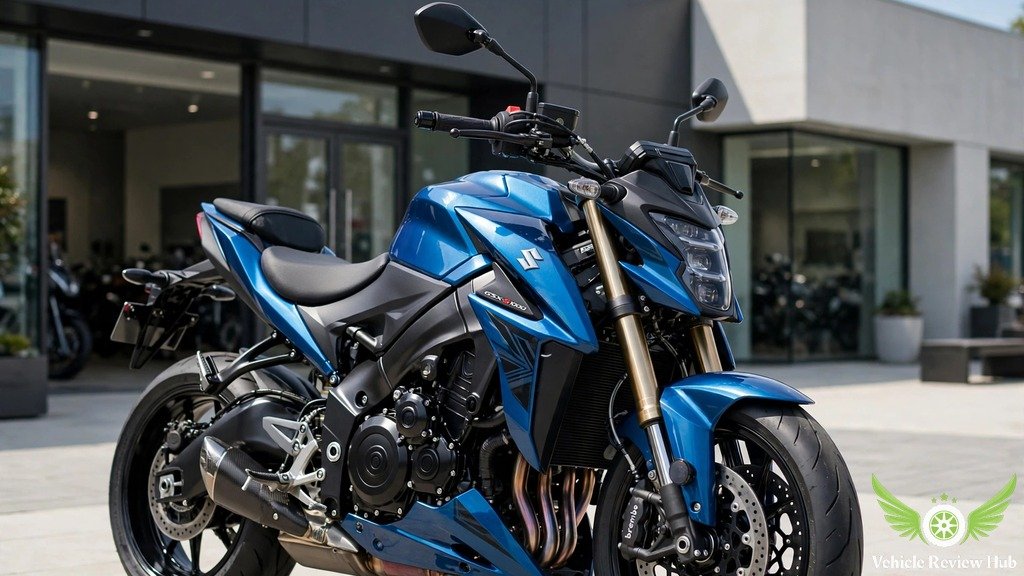
Just $226 Apart Delivered, Very Different Kit
The Suzuki is $11,548 delivered; the 2026 Hornet SP is $11,774, exactly $226 more; the Z900 is $11,039, $509 less; and the MT-10 is $15,774, $4,226 more. That $226 buys the Honda’s Öhlins shock, Stylema calipers and gold wheels — hardware that would cost far more fitted afterwards. It does not buy an IMU, cornering ABS or cruise control, because the Honda has none of those either. The Z900’s $509 saving buys the opposite: less engine, more electronics. And the MT-10’s $4,226 premium buys the full electronics suite and the crossplane engine, but no rear-wheel power advantage any named dyno can show.
| Bike | MSRP | Destination | Delivered | Notes |
|---|---|---|---|---|
| Suzuki GSX-S1000 (2027) | $10,798 | $750 (dealer-sourced) | $11,548 | First price cut in the line’s history |
| Honda CB1000 Hornet SP (2026) | $10,999 | $775 | $11,774 | $226 over the Suzuki; no 2027 US model announced |
| Yamaha MT-10 (2027) | $14,999 | $775 (dealer-sourced) | $15,774 | SP $17,499; $4,226 over the Suzuki |
| Kawasaki Z900 (2027) | $10,199 / $10,399 | $840 (dealer-sourced) | $11,039 / $11,239 | Cheapest delivered of the four; SE $12,199 |
What the money buys is best seen in the electronics table. The split is clean: the two old-school litre bikes have no IMU and no cruise; the two newer designs have both.
| Feature | Suzuki GSX-S1000 | Honda CB1000 Hornet SP (2026) | Yamaha MT-10 | Kawasaki Z900 |
|---|---|---|---|---|
| IMU | No | No | Yes (6-axis) | Yes (6-axis, from 2025) |
| Cornering ABS | No | No | Yes | Yes (KCMF) |
| Cornering traction control | No | No | Yes | Yes (KCMF) |
| Ride modes | 3 (SDMS A/B/C) | 5 (2 user-programmable) | 4 power modes | Power + integrated modes |
| Quickshifter | Yes (bi-directional, from 2022) | Yes (bi-directional, SP) | Yes (up/down QSS) | Yes (dual-direction KQS) |
| Cruise control | No | No | Yes | Yes |
| TFT display | 5-inch (from 2025) | 5-inch (RoadSync) | 4.2-inch | 5-inch (RIDEOLOGY) |
| Ride-by-wire | Yes | Yes | Yes (YCC-T) | Yes |
Running Costs and Resale Value Compared
Fuel is the biggest running cost: the Suzuki averaged 33.4 mpg US on Rider’s 2022 test and 43.3 mpg US in Cycle News’s 2025 test, against the Hornet’s 38.9 mpg US. Servicing is light: oil every 3,750 miles, filter only at 600 and 11,250, plugs at 7,500 and 15,000, valves at 15,000. No US dealer service price was found for the Suzuki — the only hard figure is Cycle World’s 2016 long-term test, where the 7,500-mile service cost $455 in 2017 prices. UK owners report about £200 a year for gen one and £230 for gen two. The Suzuki also has the shortest recall record here: exactly one US recall, NHTSA 15V-788, covering 600 bikes from 2016 whose front brake calipers could leak. Do not attach the Katana’s 25V505 headlamp recall to this bike. On resale, no hard figures exist for any of the four bikes, so none are printed here; the Suzuki’s 2027 price cut puts pressure on used 2026 bikes, and the MT-10’s premium price is the hardest to recover. The Suzuki’s one outright win is OVERDRIVE’s Performance Bike of the Year 2016; MCN’s 2026 group test gave it four stars and third place, and the 1000PS five-bike test in July 2025 put the Hornet SP first, the GSX-S1000 third and the Z900 SE fourth, with no MT-10 in the test. No four-way shootout with all four of this blog’s bikes exists.
Suzuki GSX-S1000 Comparison Verdict and US Alternatives
The verdict depends on what you value. The Suzuki is the pick for the rider who wants the strongest engine for the least money. The Z900 is the pick for the most equipment per dollar. The Hornet SP is the pick for the best chassis hardware. The MT-10 is the pick for the full electronics suite — if you are willing to pay $4,226 for it.
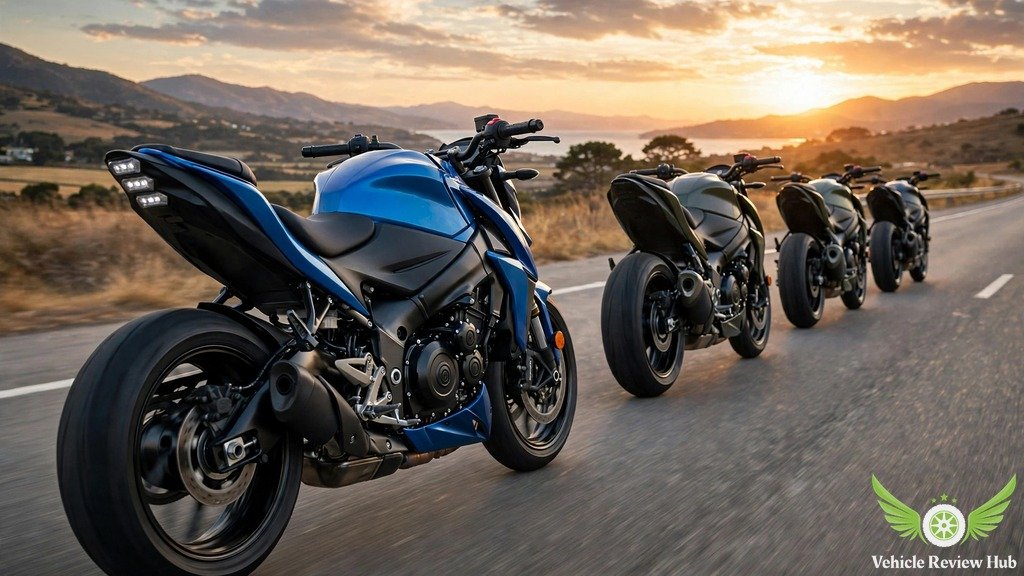
Z900 Now Brings an IMU for Less Money
The Z900 is the single biggest threat to the Suzuki’s value case. Before 2025 it had no IMU, and the Suzuki’s simplicity was a defensible trade. Since 2025 the Z900 has a 6-axis IMU, cornering ABS, cornering traction control, cruise control and a quickshifter — the MT-10’s set — for $11,039 delivered, $509 less than the Suzuki. The Suzuki’s answers are real but narrow: a bigger engine, a bigger tank and the K5 four’s midrange character. If you ride in the wet or commute in traffic, the Z900’s electronics are worth more than the Suzuki’s extra 51 cc. If you ride for the engine alone, the Suzuki still wins.
GT+ and S 1000 R Alternatives
Two bikes sit outside this comparison but inside the same buying decision. The faired sibling, the GSX-S1000GT+, is $14,599 plus $750 destination, $15,349 delivered — the same 999cc platform with a fairing, a 6.5-inch TFT with mySPIN, Smart Cruise and panniers, the features the naked bike does without. Note that Rider’s 2022 Motorcycle of the Year award went to the GT+, not the naked bike. The premium alternative is the BMW S 1000 R at $15,475 plus $995 destination, $16,470 delivered — the most expensive bike here. Neither changes the verdict, but both show why the Suzuki’s $11,548 delivered price matters: $3,801 less than its faired sibling and $4,922 less than the BMW, for the same engine.
Suzuki GSX-S1000 Comparison: Frequently Asked Questions
Direct answers to the questions riders ask about this Suzuki GSX-S1000 comparison.
Which is better, the GSX-S1000 or the CB1000 Hornet SP?
Cycle News’s September 2025 head-to-head gave the nod to the Suzuki, largely on the dyno gap — 130 hp against the Honda’s 116 hp — and its smoother torque. MCN’s group test went the other way, calling the Hornet “still king” and naming it Bike of the Year 2025. The Honda has the better chassis; the Suzuki has the stronger engine and the lower price.
Is the GSX-S1000 cheaper than the Hornet SP?
Yes, by $226 delivered. The 2027 GSX-S1000 is $10,798 plus $750 destination, $11,548 delivered; the Hornet SP is $10,999 plus $775 destination, $11,774 delivered. Note the Honda’s price is the 2026 model — no 2027 US Hornet SP has been announced.
Is the Hornet SP faster than the GSX-S1000?
Not on the dyno. The US Hornet SP made 116 hp at the rear wheel in Cycle News’s test, against the Suzuki’s 130 hp. The Honda claims more power in Europe (155 hp), but the US bike is restricted by emissions and its torque delivery is uneven.
Does the GSX-S1000 have an IMU?
No. The naked GSX-S1000 has never had an IMU in either generation. Its traction control works from wheel speed only, and its ABS is conventional, not cornering ABS. The Yamaha MT-10 and the 2025-on Kawasaki Z900 both have one.
Which bike has cruise control?
The Yamaha MT-10 and the Kawasaki Z900 both have cruise control as standard. The Suzuki GSX-S1000 and the Honda CB1000 Hornet SP do not — the faired GSX-S1000GT+ has Smart Cruise, but the naked bike does not.
Is the MT-10 worth $4,226 more than the GSX-S1000?
Only if you want the electronics. The MT-10 costs $15,774 delivered against the Suzuki’s $11,548, and for that you get the 6-axis IMU, cornering ABS, cruise control and quickshifter all standard. At the rear wheel the two bikes are effectively equal — no named dyno exists for the base MT-10 — so you are paying for electronics, not power.
Is the Z900 better value than the GSX-S1000?
On equipment per dollar, yes. The Z900 is $11,039 delivered, $509 less than the Suzuki, and since 2025 it brings an IMU, cornering ABS, cornering traction control, cruise control and a quickshifter — none of which the Suzuki has. The Suzuki answers with a bigger engine and a bigger tank.
Which of the four is the cheapest?
The Kawasaki Z900 at $11,039 delivered in standard colours ($11,239 in the special colour). Next is the Suzuki GSX-S1000 at $11,548, then the 2026 Honda CB1000 Hornet SP at $11,774, and the Yamaha MT-10 is the most expensive by a wide margin at $15,774 delivered.
What is the fastest naked bike in this comparison?
By claimed power, the Yamaha MT-10 at 163.6 hp. By rear-wheel dyno, the Suzuki at 136 hp on the Jett Tuning dyno — the only one of the four with a named base-bike dyno figure. No instrumented top-speed test of the naked GSX-S1000 exists.
Which bike is best for beginners?
None of them. All four are litre-class nakeds with 123 hp or more, and the Suzuki’s own verdict is a clear no for first riders — 150 hp, 472 lb and no IMU safety net. The Z900 is the most forgiving of the four, but it is still too much bike for a first rider.
Does the GSX-S1000 have a quickshifter?
Yes. A bi-directional quickshifter is standard from 2022, on the second-generation bike. The first-generation bike had no quickshifter. The Hornet SP, the MT-10 and the Z900 all have quickshifters as standard too.
Which bike should I buy in 2027?
Buy the Suzuki GSX-S1000 if you want the strongest engine for the least money and do not miss electronics you have never had. Buy the Kawasaki Z900 if you want the most equipment per dollar. Buy the Honda CB1000 Hornet SP if you want the best chassis hardware for $226 more. Buy the Yamaha MT-10 if you want the full electronics suite and are willing to pay $4,226 for it.