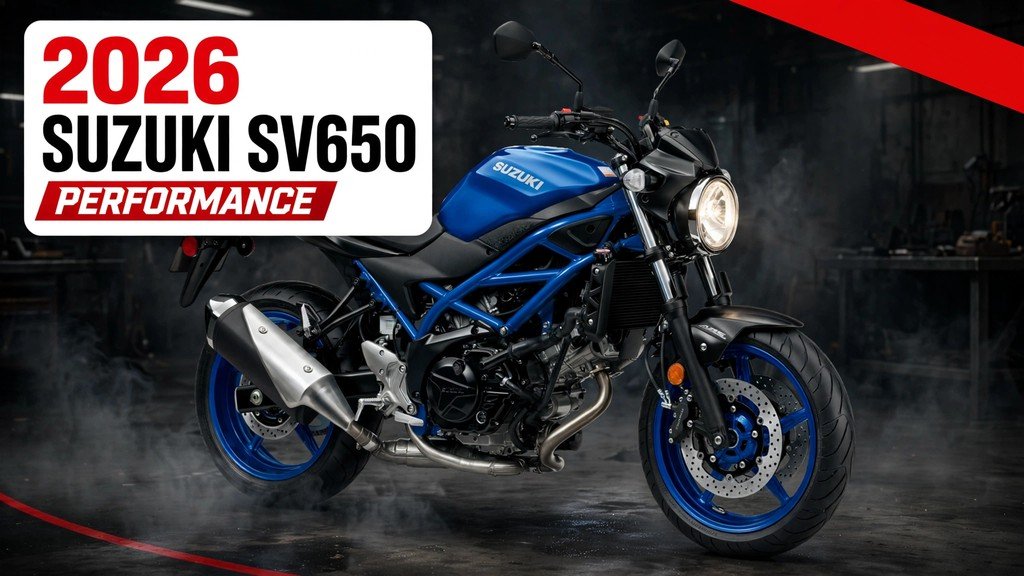
The 2026 Suzuki SV650 makes 68 to 71 hp at the rear wheel in three named-outlet dyno runs, runs the quarter-mile in 12.06 seconds at 108.91 mph, and returns 48 mpg in both US tests. No magazine has tested the Gen 3 bike’s top speed — the only measured figure is 134.2 mph from independent tester MotoStatz. That is the honest headline for this Suzuki SV650 performance guide.
Suzuki SV650 Engine Performance and Power Delivery
Suzuki USA publishes no horsepower or torque figure, so this Suzuki SV650 performance guide measures the engine the way riders can: on a dyno, at the rear wheel, in tests run by named magazines. The 645cc 90-degree V-twin has powered the SV650 since 1999.
Three Dynos Land Between 68 and 71 HP
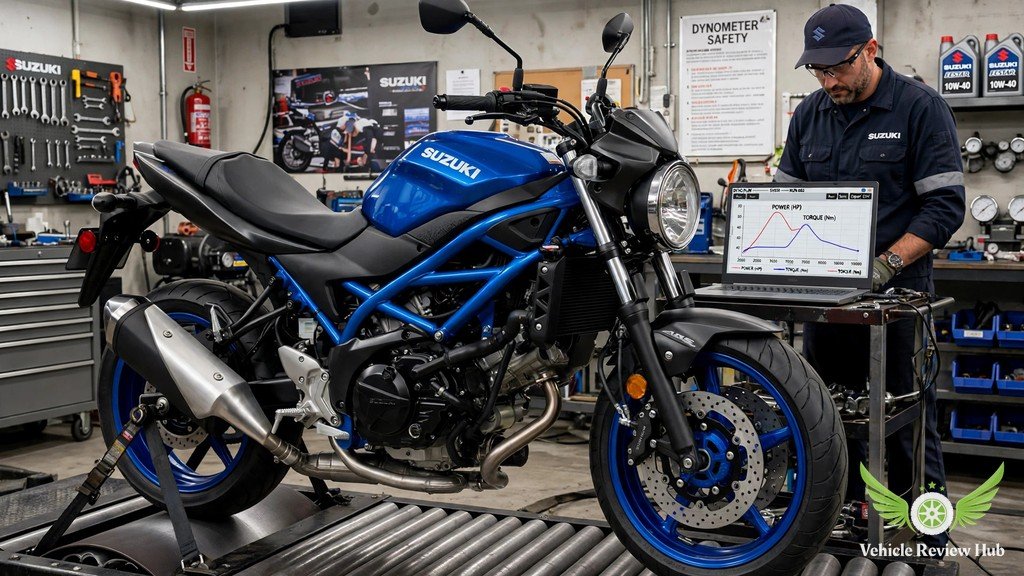
Three named-outlet dyno runs of the Gen 3 bike land between 68 and 71 hp at the rear wheel, and this Suzuki SV650 performance guide lists all three. Cycle World’s 2019 dyno of the SV650X — the cafe variant of the same 645cc engine — read 68.15 hp at 8,890 rpm. Cycle World’s 2017 comparison test of the standard SV650 read 69.3 hp at 8,530 rpm, Motorcycle.com’s 2017 shootout read 70.8 hp at 8,600 rpm, and its 2021 re-test read 70.7 hp. The spread across four runs is just 2.65 hp, and the same Motorcycle.com bike made 72.8 hp on an earlier run — so the honest range is 68.15 to 72.8 hp. For context, the launch claim is 75.1 hp at 8,500 rpm and 47.2 lb-ft (64 Nm) — a crank figure — and the 2021 Euro 5 revision cut the claim to 73 hp. Torque is quoted here as 64 Nm / 47.2 lb-ft with no peak rpm attached: launch material says 8,100 rpm, post-2021 sources quote 6,800 rpm.
The video below is Cycle World’s dyno run of the 2019 SV650X — the cafe variant of the same engine — which produced the 68.15 hp figure quoted above. It shows the SV650X, not the standard SV650.
| Test | Rear-wheel HP | Rear-wheel torque | Outlet |
|---|---|---|---|
| 2019 SV650X dyno | 68.15 hp @ 8,890 rpm | 42.90 lb-ft @ 8,170 rpm | Cycle World |
| 2017 SV650 comparison test | 69.3 hp @ 8,530 rpm | 44.2 lb-ft @ 8,000 rpm | Cycle World |
| 2017 SV650 shootout | 70.8 hp @ 8,600 rpm | 44.9 lb-ft @ 8,100 rpm | Motorcycle.com |
| 2021 SV650 spec-sheet shootout | 70.7 hp @ 8,600 rpm | 44.5 lb-ft @ 8,100 rpm | Motorcycle.com |
| 1999 SV650 road test | 64.2 hp @ 9,000 rpm | 42.3 lb-ft @ 7,200 rpm | Cycle World |
| Gen 2 SV650 / SV650S used-bike roundup | 71.7 hp @ 9,250 rpm | 46.2 lb-ft @ 7,250 rpm | Cycle World |
The 2017 comparison test also measured roll-ons for this Suzuki SV650 performance guide: top-gear 40 to 60 mph in 3.7 seconds and 60 to 80 mph in 4.3 seconds. The review covers the engine’s history and the SDTV throttle system in full.
1999 Original Dynoed 64.2 HP at Cycle World
The 1999 original dynoed 64.2 hp at 9,000 rpm and 42.3 lb-ft at 7,200 rpm in Cycle World’s May 1999 road test — only 4 to 6 hp behind the Gen 3 bike. The engine has not grown much in output, because it never needed to: the 1999 bike made its power higher up the rev range, at 9,000 rpm against the Gen 3’s 8,530 to 8,890. The Gen 2 bikes split the difference: Cycle World’s used-bike roundup measured a Gen 2-era SV650 at 71.7 hp at 9,250 rpm. What changed across the generations is refinement, not output: fuel injection in 2003, dual-spark heads and SDTV in 2017, and Euro 5 in 2021. A buyer comparing a clean used Gen 2 against a new Gen 3 should know the older bike is not slower on a dyno.
Suzuki SV650 Top Speed and Acceleration
Top speed is where this Suzuki SV650 performance guide has to be honest about what is not known. No magazine has published a tested top speed for the Gen 3 SV650. The only measured Gen 3 figure comes from independent tester MotoStatz: 134.2 mph genuine. What is tested is acceleration: the quarter-mile, the 0 to 60 sprint and the roll-ons.

Gen 3 Quarter-Mile Rests on One Source
The Gen 3 quarter-mile rests on one source, and this Suzuki SV650 performance guide names it: Cycle World’s 2017 comparison test, which measured 12.06 seconds at 108.91 mph. That is the only magazine quarter-mile for a Gen 3 SV650 that exists — no second magazine ran the test. The only other measured figure is MotoStatz’s own independent test at 11.82 seconds at 115 mph. One figure this Suzuki SV650 performance guide rejects outright: AccelerationTimes’ “14.4 seconds at 112 mph” for a 2016 SV650, which contradicts Cycle World by 2.3 seconds and is not credible.
1999 Bike Ran 11.85 at 110 MPH
The 1999 bike ran 11.85 seconds at 110 mph in Cycle World’s May 1999 road test — quicker than the Gen 3 bike’s 12.06 seconds, and two tenths faster than the Ducati Monster 900 it was tested against. The original bike was faster down the strip than its grandchild, for weight and gearing, not power — the first surprise in this Suzuki SV650 performance guide: the 1999 bike weighed 392 lb dry against the Gen 3’s 437 lb curb. The Gen 2 bikes sit between the two: Cycle World’s used-bike roundup lists 11.93 seconds at 111 mph for a Gen 2-era SV650. Top speed follows the same pattern: the 1999 bike was tested at 128 mph, the Gen 2 at 129 mph, and the Gen 3 at 134.2 mph by MotoStatz — the only Gen 3 figure. MCN’s “123 mph” top speed and “13.5 second” quarter-mile conflict with Cycle World’s tested figures and look like generic spec-table values, so this Suzuki SV650 performance guide does not use them. The 1999 bike’s 0 to 60 time of 3.2 seconds appears in secondary spec tables, not in Cycle World’s 1999 article text, so this Suzuki SV650 performance guide cites it as secondary data.
Suzuki SV650 Mileage and Fuel Economy
Fuel economy is the SV650’s quiet performance advantage, and this Suzuki SV650 performance guide measures it the same way it measures power: from named tests. The bike’s 3.8-gallon tank gives it real range, and the tested figures are consistent across two independent US tests.

Tested MPG: 48 in US Tests
Tested MPG is 48 in US tests — both of them, as this Suzuki SV650 performance guide records: Cycle World’s 2017 comparison test recorded 48 mpg for the SV650, and Motorcycle.com’s 2017 shootout independently observed the same 48 mpg. That agreement across two outlets, two test bikes and two test routes is why this Suzuki SV650 performance guide states 48 mpg as the tested figure, not a range. The 51 mpg figure in Cycle World’s comparison test belongs to the Yamaha FZ-07, not the SV650. No US test giving 51 mpg for the SV650 was found, so this Suzuki SV650 performance guide does not print a 48 to 51 range. At 48 mpg, the 3.8-gallon tank gives roughly 182 miles of range before reserve. Expect high-40s mpg in real US riding, and better on a steady highway run.
Suzuki Publishes No MPG Figure
Suzuki publishes no MPG figure for the SV650, and this Suzuki SV650 performance guide says so plainly. The Suzuki USA 2026 SV650 ABS spec page lists the full spec sheet and carries no fuel-economy, MPG or consumption field at all. The copy says only “outstanding fuel economy”, with no number attached. Motorcycle.com’s first-ride piece notes Suzuki itself has said the bike will return 61 mpg — a manufacturer claim, not a test. So the only numbers a US buyer can trust are the tested ones: 48 mpg from Cycle World and 48 mpg from Motorcycle.com. The FZ-07’s 51 mpg in Cycle World’s test is only 3 mpg better.
Suzuki SV650 Real-World Riding Experience
Numbers on a dyno sheet and a drag strip only tell half the story, and this Suzuki SV650 performance guide spends the second half on the road. The SV650’s real-world reputation rests on two things: a racing class it helped create, and a braking result that exposed its one genuine weakness.

The Bike That Helped Create Twins Cup
The SV650 helped create Twins Cup — MotoAmerica says so in its own words. The Twins Cup championship was launched in 2018, and Chris Parrish won the very first MotoAmerica Twins Cup race, on 14 April 2018, aboard a Suzuki SV650 — four of the six motorcycles in that inaugural race were SV650s. Parrish went on to win the 2018 championship with two wins and six podiums in nine races. The SV650 then won three straight titles, 2018 to 2020: Parrish, Alex Dumas and Rocco Landers. The class is a tuner and builders’ class for 600 to 800 cc twins. What Twins Cup proves for this Suzuki SV650 performance guide is that the SV650 is a road bike racers chose: stable chassis, tough engine, cheap parts. The MotoAmerica Twins Cup story is the source for the class history.
Braking: 139 Feet on the Early Gen 3
Braking measured 139 feet from 60 mph on the early Gen 3 bike in Cycle World’s 2017 comparison test — the longest stop of the three, with the FZ-07 stopping in 136 feet and the Z650 in 132 feet. Cycle World’s verdict was blunt: the front brakes “lack good power”, with numb feedback. That 139-foot figure is the only measured braking distance for any Gen 3 SV650. No 60 to 0 test exists for a later model — not for the 2019 bike with its four-piston Tokico calipers, not for an ABS bike, not for the SV650X. The early Gen 3 bike launched with two-piston front calipers on twin 290 mm discs; the four-piston Tokico calipers arrived only in 2019. Cycle World’s 2017 test bike was non-ABS — ABS was optional at launch in the USA. The rear brake is a single-piston caliper, and ABS has been standard on every US SV650 since 2024. The 1999 bike’s braking distance in spec tables is 118 feet, but that figure comes from secondary tables, not a named magazine test. The early Gen 3 brakes were the bike’s weakest point in magazine testing, the 2019 calipers fixed the hardware, and no outlet has ever measured the fixed bike — the honest gap this Suzuki SV650 performance guide leaves open.
Suzuki SV650 Handling, Braking and Stability
Handling is where Suzuki SV650 performance is strongest. The bike’s longest wheelbase, its relaxed rake and its low weight add up to a chassis that is stable, planted and predictable — and the budget suspension is the honest limit on that praise.

Handling, Braking and Stability on Budget Suspension
Handling on the SV650 is brisk without being nervous, and the magazines agree on why. Cycle World’s 2017 comparison test called it “the most stable, predictable, and planted on a twisting canyon road” of the three bikes and “the only bike that won’t tickle your extremities with vibrations at 5,000 rpm and beyond” — and it named the SV650 the most comfortable bike of the group. Motorcycle.com’s shootout found the same: the SV felt “most planted when leaned over”. The chassis numbers explain it: the longest wheelbase of the trio at 57.2 inches, the most relaxed rake, 4.1 inches of trail, and at 437 lb curb the lightest of the three. The suspension itself is deliberately budget: a 41 mm fork with 125 mm of travel and no adjustment at all, and a single rear shock with 63 mm of stroke and seven-step spring preload only. Rider magazine’s first ride noted the suspension is “set up for a 165-to-175-pound rider”. The geometry is excellent and the suspension is basic, and the bike is at its best on the road at a sane pace. The GSX-8S performance guide covers the in-house heir’s more modern chassis for comparison.
Tire, Brake and Suspension Checks That Matter
Tire, brake and suspension checks matter more on a used SV650 than on most middleweights. The tyres are Dunlop RoadSmart III, front 120/70ZR17 and rear 160/60ZR17 — check the date codes, because a 2017 bike on original tyres is riding on rubber that has aged out even if the tread looks fine. The brakes need the closest look: on a 2017 or 2018 bike, the two-piston front calipers are the ones the magazines criticised, and the only fix is the 2019 four-piston Tokico upgrade. On any Gen 3 bike, check the front discs, the pads, and the brake fluid, which Suzuki says to replace every two years. The suspension checks are simple: fork seals for leaks, the rear shock for a working preload adjuster, and the chain — a DID 520V0 with 112 links — for stretch and lubrication. The reliability guide covers the full service schedule. No outlet publishes a timed SV650 track test or lap time, so this Suzuki SV650 performance guide makes no track claim.
Suzuki SV650 Performance Compared With Other Nakeds
This Suzuki SV650 performance guide compares the SV650 against the bike every buyer cross-shops it with: the Yamaha MT-07. The figures below come from the same Cycle World 2017 comparison test.
Suzuki SV650 vs Yamaha MT-07
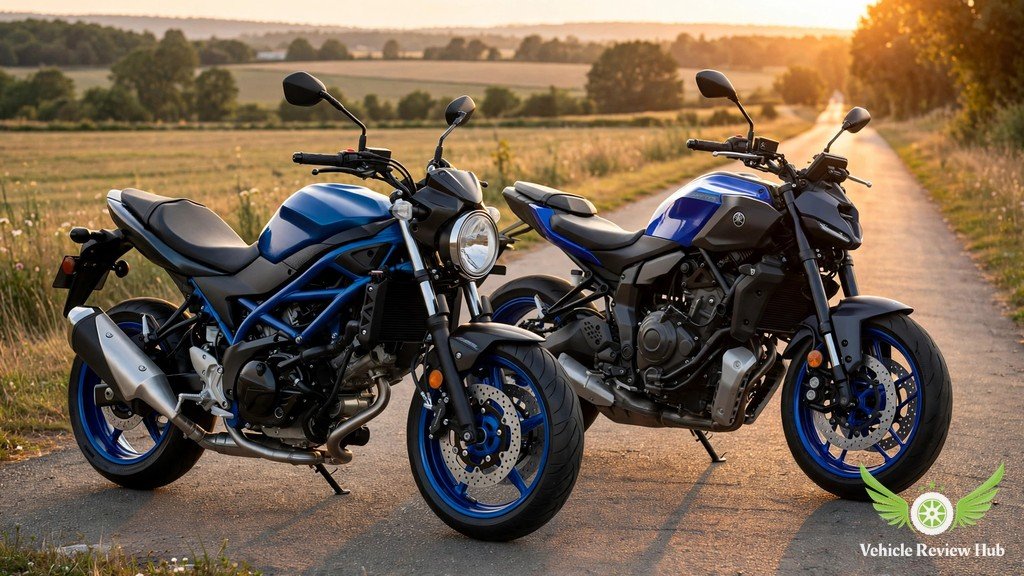
The MT-07 is the SV650’s closest rival on performance, and the same-test numbers in this Suzuki SV650 performance guide show a near-tie with a clear character split. In Cycle World’s 2017 comparison test, the SV650 dynoed 69.3 hp at 8,530 rpm against the FZ-07’s 66.7 hp at 8,820 rpm, but the Yamaha made more torque, 46.3 lb-ft at 6,290 rpm against the SV650’s 44.2 lb-ft at 8,000 rpm. Motorcycle.com’s shootout tells the same story: SV650 70.8 hp at 8,600 rpm and 44.9 lb-ft at 8,100 rpm, FZ-07 69.8 hp at 9,000 rpm and 48.0 lb-ft at 6,500 rpm. Down the quarter-mile, the FZ-07 edged it, 12.02 seconds at 107.93 mph against the SV650’s 12.06 at 108.91 mph, and both hit 0 to 60 mph in 3.3 seconds. The Yamaha stopped shorter — 136 feet against 139 — and drank less, 51 mpg against 48 mpg. What the numbers mean for a rider is simple: the MT-07 feels quicker because its torque arrives lower and harder, while the SV650 feels smoother and more settled, with its power spread evenly and its chassis more planted. The Motorcycle.com 2017 shootout is the source for the shootout figures, and the comparison guide puts the two bikes side by side on price, weight and equipment.
| Figure (same test) | 2026 Suzuki SV650 | Yamaha MT-07 / FZ-07 | Outlet |
|---|---|---|---|
| Dyno power (rear wheel) | 69.3 hp @ 8,530 rpm | 66.7 hp @ 8,820 rpm | Cycle World 2017 |
| Dyno torque (rear wheel) | 44.2 lb-ft @ 8,000 rpm | 46.3 lb-ft @ 6,290 rpm | Cycle World 2017 |
| Quarter-mile | 12.06 sec @ 108.91 mph | 12.02 sec @ 107.93 mph | Cycle World 2017 |
| 0–60 mph | 3.3 sec | 3.3 sec | Cycle World 2017 |
| Braking 60–0 | 139 ft | 136 ft | Cycle World 2017 |
| Tested fuel economy | 48 mpg | 51 mpg | Cycle World 2017 |
The rival table above is the fairest comparison this Suzuki SV650 performance guide can make: same test, same day, same instruments. Bennetts’ 2017 group test reached a similar verdict and called the SV650 the “biggest bargain” — the full test is at Bennetts. The GSX-8R review covers Suzuki’s parallel-twin sportbike for riders who want the same engine family in a faired package.
Is the Suzuki SV650 Suitable for Beginner Riders?
Yes — and Suzuki SV650 performance figures are the reason why. A beginner does not need the most power in the class; they need power that arrives predictably, brakes that forgive, and a bike that does not punish a mistake. The SV650’s 69.3 hp at the rear wheel is enough to keep up with traffic, but it arrives smoothly through a cable throttle with no sudden step. The 3.3-second 0 to 60 time is quick without being violent, and the 139-foot braking distance is still a safe, controllable stop with ABS standard since 2024. Low RPM Assist raises the idle slightly as the clutch is released, so the bike is harder to stall, and Easy Start fires the engine with one press of the starter button. At 437 lb with a 30.9-inch seat, the bike is light and low enough for shorter riders to flat-foot at a stop. The honest caveat is the same one every review gives: it is still a 645cc motorcycle with around 70 hp at the rear wheel, so a training course comes first, and a 2017 or 2018 used bike’s weaker two-piston brakes are worth knowing about before buying. But as a first big bike, Suzuki SV650 performance is a strength, not a warning — quick enough to grow into, gentle enough to learn on.
Suzuki SV650 Performance: Frequently Asked Questions
Direct answers to the questions riders ask about this Suzuki SV650 performance guide.
How much horsepower does the SV650 make?
Three named-outlet dyno runs land between 68 and 71 hp at the rear wheel: Cycle World measured 68.15 hp on the SV650X and 69.3 hp on the standard SV650, and Motorcycle.com measured 70.8 hp. Suzuki USA publishes no horsepower figure; the launch claim is 75.1 hp at 8,500 rpm at the crank.
What is the SV650’s top speed?
No magazine has tested the Gen 3 SV650’s top speed. The only measured figure is 134.2 mph from independent tester MotoStatz. The 1999 original was tested at 128 mph by Cycle World. This Suzuki SV650 performance guide does not print an estimated top speed as a tested figure.
What is the SV650’s quarter-mile time?
12.06 seconds at 108.91 mph in Cycle World’s 2017 comparison test — the only magazine quarter-mile for a Gen 3 SV650, and the headline figure of this Suzuki SV650 performance guide. The 1999 original ran 11.85 seconds at 110 mph.
What is the SV650’s 0–60 time?
3.3 seconds in Cycle World’s 2017 comparison test, the same as the Yamaha FZ-07 in the same test. The 1999 bike’s 3.2-second figure appears in secondary spec tables, not in Cycle World’s 1999 article text.
What MPG does the SV650 get?
48 mpg in both US comparison tests — Cycle World and Motorcycle.com independently recorded the same figure, and it is the tested figure this Suzuki SV650 performance guide uses. Suzuki publishes no MPG figure for the US bike, and its own 61 mpg claim is a manufacturer claim, not a test.
How far does the SV650 stop from 60 mph?
139 feet in Cycle World’s 2017 comparison test, on the early Gen 3 bike with two-piston front calipers — the braking figure this Suzuki SV650 performance guide records. The FZ-07 stopped in 136 feet and the Z650 in 132 feet in the same test. No braking test exists for the 2019 bike with four-piston Tokico calipers.
Does the SV650 have ride-by-wire or a TFT dash?
No. This Suzuki SV650 performance guide is explicit: the SV650 has a cable throttle with Suzuki Dual Throttle Valve and a full LCD instrument panel, not a TFT screen. There are no ride modes, no traction control and no quickshifter. The SV-7S successor gets ride-by-wire and a TFT, but its US sale is unconfirmed.
Is the SV650 faster than the MT-07?
On peak power, yes — 69.3 hp against 66.7 hp in Cycle World’s same-test dyno runs — but the MT-07 makes more torque lower down, stops shorter and uses less fuel, and the quarter-mile is effectively tied. The MT-07 feels quicker; the SV650 feels smoother — the verdict of this Suzuki SV650 performance guide.
What torque does the SV650 make?
64 Nm / 47.2 lb-ft as a claimed figure, quoted in this Suzuki SV650 performance guide with no peak rpm attached, because the torque-peak rpm is disputed: launch material says 8,100 rpm and post-2021 sources quote 6,800 rpm. On the dyno, the Gen 3 bike makes 42.90 to 44.9 lb-ft at the rear wheel.
Was the 1999 SV650 faster than the Gen 3 bike?
Down the quarter-mile, yes: 11.85 seconds at 110 mph against the Gen 3’s 12.06 at 108.91 mph, because the 1999 bike was lighter at 392 lb dry. The Gen 3 bike is stronger on the dyno and faster at the top end, as this Suzuki SV650 performance guide shows.
Did the SV650 really create Twins Cup?
Effectively, yes. As this Suzuki SV650 performance guide notes, MotoAmerica says “The Suzuki SV650 essentially created the REV’IT! Twins Cup class.” Chris Parrish won the first Twins Cup race on 14 April 2018 aboard an SV650, and SV650s won the first three championships, 2018 to 2020.
Is the SV650 good for beginners?
Yes — one of the best first big bikes you can buy. This Suzuki SV650 performance guide rates it so highly because its 69 hp arrives smoothly, its 437 lb weight and 30.9-inch seat are easy to manage, and Low RPM Assist makes stalling harder. Take a training course first.