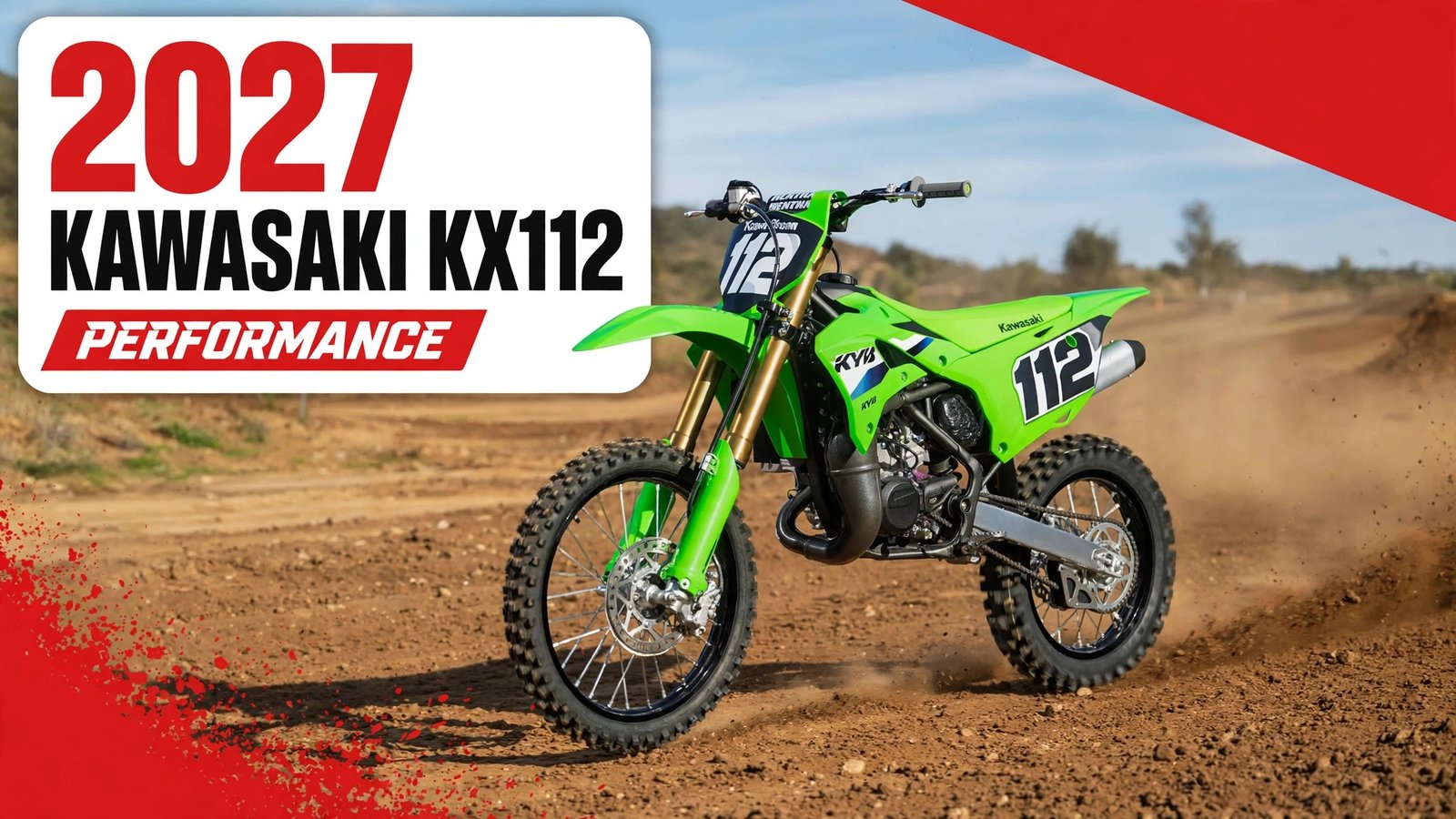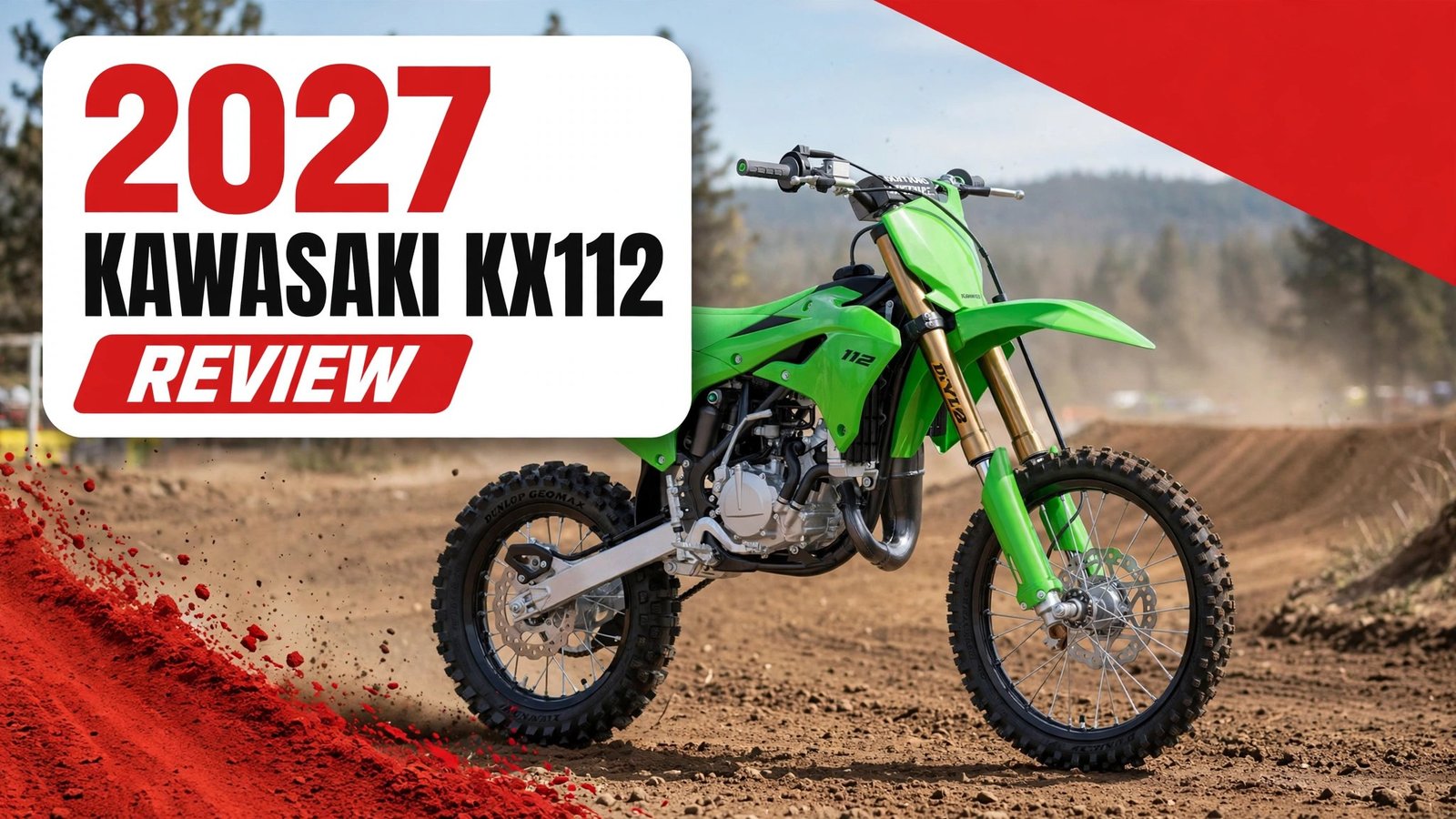
The 2027 Kawasaki KX112 costs $5,799 in the USA, and it is the only factory-built supermini on a showroom floor. Every other 79–112cc race bike in the class is either a standard 85 with a big-bore kit or a European bike with a factory top-end kit you fit yourself. This Kawasaki KX112 review starts from that fact: a 112cc two-stroke single, stroked from the KX100, on the same chassis as the KX85 L, revamped for 2026 and carried into 2027 with new graphics and a $50 price rise.
The 112 is not a new model — it arrived for 2022, replacing the KX100 — but the 2026 revamp changed almost everything around the engine: a 43 mm KYB fork, 12.0 inches of rear travel, 240/220 mm brakes, a new perimeter frame and Dunlop MX34 tyres.
Kawasaki KX112 Overview and Model-Year Updates
A buyer reading this Kawasaki KX112 review needs two facts first: the engine has not changed since 2022, and the chassis was revamped for 2026. The 2027 bike is identical to the 2026 bike except graphics and a $50 MSRP rise, from $5,749 to $5,799. That split — old engine, new chassis — is the thread through every section below.
MotoRevs27’s 2026 KX112 review below is a narrated photo slideshow, not a ride test — still photos of a Lime Green KX with an English voiceover, no riding footage and no on-camera presenter. It is a 2026 bike, mechanically identical to the 2027 except graphics and a $50 price rise, and it walks through the 112cc engine, the 43 mm KYB fork and the 19/16-inch wheels this Kawasaki KX112 review covers.
Stroked From the KX100
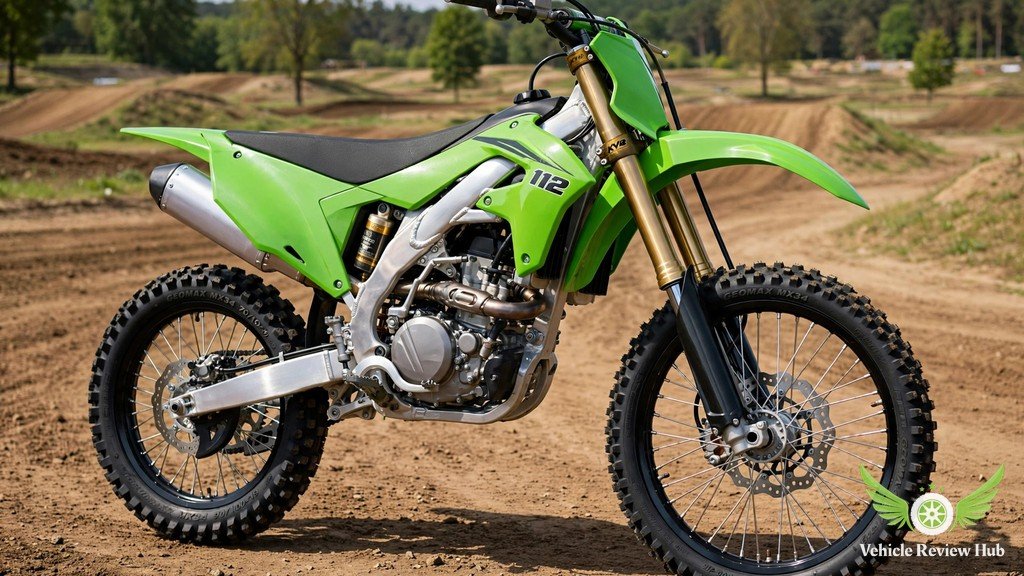
The KX112 is the KX100 stroked 5.8 mm. The bore is untouched at 52.5 mm; the stroke grew from 45.8 mm to 51.6 mm, taking displacement from 99cc to 112cc, a 13 percent rise. Kawasaki’s 2022 launch material says the extra displacement comes by way of a 5.8 mm longer stroke, with a larger crankshaft, a longer 99 mm connecting rod and a stronger transmission. The KX100’s last US model year was 2021, at $4,649; the 2022 KX112 arrived at $4,999, a $350 step. That lineage is the first thing this Kawasaki KX112 review checks, because it explains why the bike feels settled rather than new.
For a buyer, the stroke matters more than the badge. The extra 28cc over the KX85 L puts the 112 at the top of the AMA Supermini 12-16 band — 79 to 112cc — and it is why this Kawasaki KX112 review keeps coming back to the engine whenever the price gap is discussed.
Revamped With the 85s in 2026
The 2026 revamp touched the chassis only; the engine was carried over unchanged. Kawasaki’s January 2026 press release says the two models retain their proven engines while receiving significant chassis updates: displacement, bore and stroke, carburettor, KIPS and transmission are identical from 2022 to 2027. What changed is everything around that engine. The fork grew from 36 mm to a 43 mm KYB inverted unit with Kashima-coated outer tubes and a rebound adjuster, while front travel stayed at 10.8 inches. Rear travel grew from 10.8 to 12.0 inches through a revised Uni-Trak linkage rod — linkage, not a longer swingarm, a point this Kawasaki KX112 review stresses because no source mentions one at all.
The brakes grew too — front 220 to 240 mm, rear 184 to 220 mm — with a KX250-style Nissin master cylinder, and the rear shock gained a 14 mm rod, a 390 mm cylinder and a high-speed compression adjuster. The frame is a new rigid perimeter design; the handlebar is a Renthal Fatbar, the grips moved 50 mm forward and 35 mm wider, the footpegs grew from 40 to 48 mm and sit 10 mm lower, and the tyres changed from Dunlop Geomax MX33 to MX34. One figure this Kawasaki KX112 review will not print flat is “4.8 lb lighter”: like for like on the fueled basis, the 2026 bike is 3.1 lb heavier, at 172.8 lb against 169.7 lb.
Kawasaki KX112 Engine and Specifications
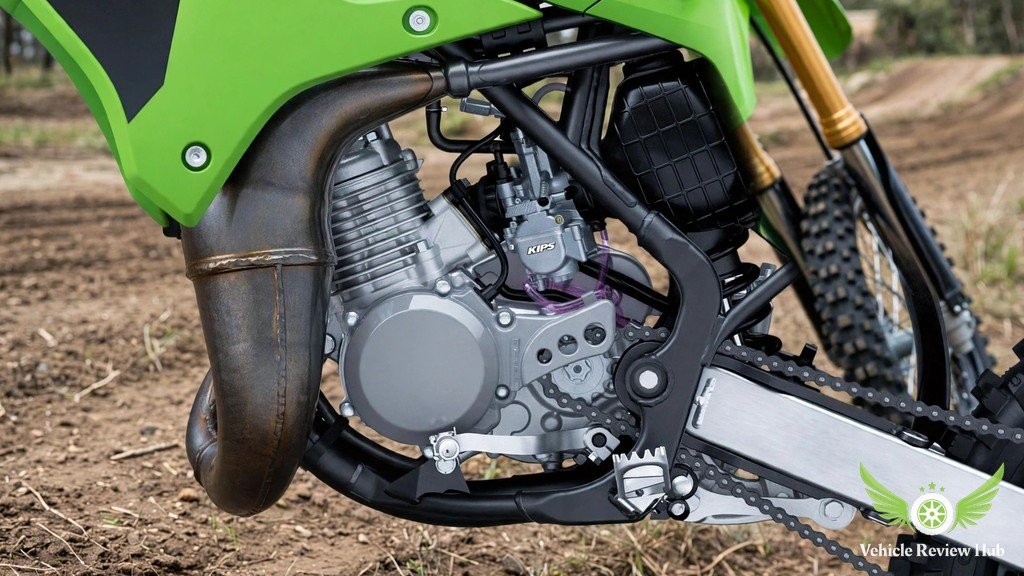
The engine is the whole point of this Kawasaki KX112 review. It is a 112cc liquid-cooled two-stroke single with KIPS, a 28 mm Keihin PWK28 carburettor and a six-speed gearbox — the same engine since 2022. The table below is the 2027 spec sheet, in substance, from Kawasaki’s own PDF.
112cc, Stroke-Driven Growth
Every number in the engine follows from the stroke. The 52.5 x 51.6 mm bore and stroke give 112cc; compression is 9.9:1 at low speed and 8.6:1 at high speed; the fuel system is a 28 mm Keihin PWK28 carburettor; ignition is CDI with digital advance; and the gearbox is a six-speed return shift with a wet multi-disc manual clutch driving a chain. One figure worth stating plainly in this Kawasaki KX112 review is the dyno figure: Motocross Action Magazine dyno’d the 2022 KX112 at 24.96 hp and 11.6 lb-ft stock, 25.9 hp and 11.9 lb-ft piped, peaking at 11,600 rpm. The engine is unchanged since 2022, so that is the best available datapoint — a 2022-bike dyno, never a 2026 or 2027 dyno. Kawasaki itself publishes no power figure.
Against the KX85 L, the engine is the only sheet difference that matters. The L runs the same Keihin carburettor, the same six-speed, the same KIPS system and the same chassis, but its 84cc engine uses a 48.5 x 45.8 mm bore and stroke and a 10.9:1/9.0:1 compression ratio. The 112’s 28cc advantage is a 33 percent displacement gain, and it buys Supermini eligibility at the top of the 79–112cc band, while the L is an 85cc-class bike. The fuel capacity is 1.32 gallons on both bikes, and the premix ratio is 32:1 — 5.28 oz of two-stroke oil per full tank, a figure this Kawasaki KX112 review prints because buyers ask it constantly.
Warranty: Not Available
Kawasaki’s own Latin America sheet prints “Warranty — Not Available”; the US sheets carry no warranty line at all. The KX line is sold as-is in the USA: the owner’s manual disclaimer states the bike is sold “AS IS, with all faults” and there are “NO WARRANTIES expressed or implied”. That is the whole warranty position in this Kawasaki KX112 review: no warranty to budget for, only owner-paid repairs. The contrast is stark: the Yamaha YZ85LW carries a 30-day limited factory warranty, and the KTM 85 SX a one-year premium manufacturer’s warranty from model year 2027. Neither of those warranties applies to the Kawasaki, and no Kawasaki source supports the six-month limited competition warranty one aggregator claims for the 112 — this Kawasaki KX112 review does not print it.
| Spec (2027) | Kawasaki KX112 |
|---|---|
| Engine | 2-stroke single with KIPS, liquid-cooled |
| Displacement | 112cc |
| Bore x stroke | 52.5 x 51.6 mm |
| Compression ratio | 9.9:1 (low speed) / 8.6:1 (high speed) |
| Fuel system | 28 mm Keihin PWK28 carburettor |
| Ignition | CDI with digital advance |
| Transmission | 6-speed, wet multi-disc manual clutch |
| Front suspension / travel | 43 mm KYB inverted fork / 10.8 in |
| Rear suspension / travel | Uni-Trak single shock / 12.0 in |
| Front tyre | 70/100-19 Dunlop Geomax MX34 |
| Rear tyre | 90/100-16 Dunlop Geomax MX34 |
| Front brake | 240 mm petal disc, dual-piston caliper |
| Rear brake | 220 mm petal disc, single-piston caliper |
| Frame | Perimeter, high-tensile steel |
| Rake / trail | 29.2 degrees / 4.6 in |
| Overall L / W / H | 76.2 / 31.5 / 45.9 in |
| Ground clearance | 13.0 in |
| Seat height | 34.1 in |
| Curb weight | 164.9 lb without fuel / 172.8 lb fueled |
| Fuel capacity | 1.32 gal |
| Wheelbase | 51.6 in |
| Colour | Lime Green (only) |
| MSRP | $5,799 |
Note: Spec-sheet figures from Kawasaki’s own 2027 KX112 spec sheet PDF. The tyre model is not on the sheet — Dunlop Geomax MX34 per the 2026 press release. This Kawasaki KX112 review prints the 164.9 lb figure on its without-fuel basis; the fueled figure is 172.8 lb.
Kawasaki KX112 Price and Market Availability
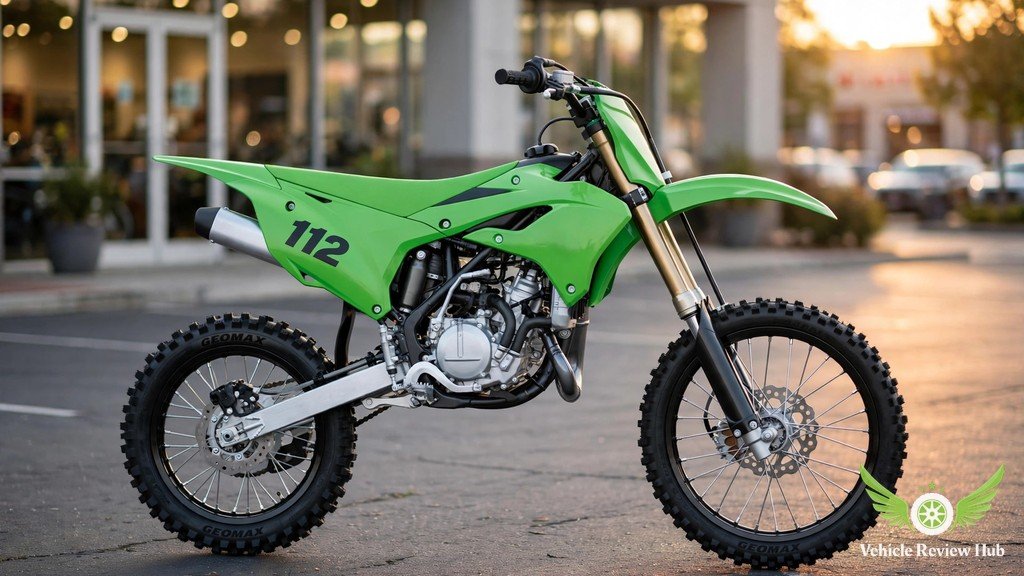
Price is where this Kawasaki KX112 review turns to the buyer’s wallet. The 2027 MSRP is $5,799, verified on Kawasaki’s own spec sheet, press release and model page, and the delivered total is $6,114 — computed on the $315 destination charge, which Kawasaki does not publish and which must be labelled single-source every time.
Kawasaki KX112 Price in the USA: $5,799 (2027)
The 2027 price is $5,799, after an $800 climb since launch. The 2022 KX112 was $4,999 on Kawasaki’s June 2021 press release; 2023 was $5,399, corroborated three ways (both the 2022 and 2023 sheets print “BASE MSRP: TBA”); 2024 was $5,649 on Kawasaki’s own sheet; 2025 was $5,649 again, corroborated by the Latin America sheet and dealer brochures (the 2025 US sheet is a soft 404); 2026 was $5,749 on the sheet and press release; and 2027 is $5,799, a $50 rise over 2026. The year steps are +$400, +$250, $0, +$100 and +$50. One caution in this Kawasaki KX112 review: discounted dealer listings are not MSRP. Live 2026 listings show $4,749 all-in after discounts and rebates, $4,874 and $4,899 — promo prices, never the bike’s price.
The destination ladder is single-source throughout, from motorcycle.com, and it climbs with the years: $240 in 2022, $245 in 2023, $255 in 2024, $305 in 2025, $315 in 2026 and $315 in 2027. The 2027 figure is corroborated by a Cycle Motion dealer listing; the 2025 figure sits $5 from a Hollister brochure showing “+$300.00”. The 2027 delivered total of $6,114 is computed, and this Kawasaki KX112 review labels it computed wherever it appears.
Incentives Reach $700 More
The heading’s figure is verified; its wording is the risk. Kawasaki’s homepage, read live in November 2026, offers “UP TO $200* HOLIDAY CASH + UP TO $700* IN FACTORY SAVINGS”, with the fine print naming the 2025–2027 KX65, KX85, KX112 and KLX140R as eligible, through December 31, 2026, at participating dealers, on new unregistered bikes only, with a holiday-cash form required. The honest sentence is “up to $700 FDI plus up to $200 holiday cash, up to $900 combined” — “up to” on both, dealer-dependent. The “$700 more” phrasing implies a comparison the offer never states, and dealer listings vary: one shows $500 savings under the “up to $700” banner, another the full $700 rebate. A buyer reading this Kawasaki KX112 review should treat $700 as the ceiling, not the guaranteed figure on a 2027 bike.
| Year | MSRP | Destination | Delivered (computed) |
|---|---|---|---|
| 2022 | $4,999 | $240 | $5,239 |
| 2023 | $5,399 | $245 | $5,644 |
| 2024 | $5,649 | $255 | $5,904 |
| 2025 | $5,649 | $305 | $5,954 |
| 2026 | $5,749 | $315 | $6,064 |
| 2027 | $5,799 | $315 | $6,114 |
Note: MSRPs from Kawasaki’s own sheets and press releases where stated; 2023 rests on three corroborations, 2025 on the Latin America sheet plus dealer brochures (the 2025 US sheet is a soft 404). Destinations are single-source from motorcycle.com; the 2027 $315 is corroborated by a Cycle Motion listing. This Kawasaki KX112 review labels every delivered total computed.
Kawasaki KX112 Design, Features and Technology
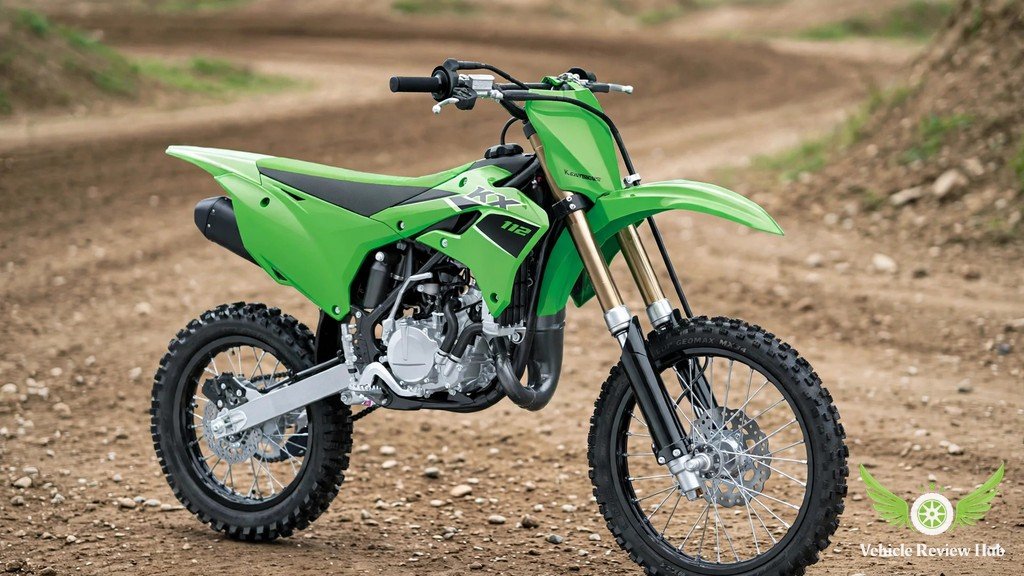
The design story of this Kawasaki KX112 review is the 2026 chassis: the engine did not change, the bodywork did. The new perimeter frame, the 43 mm fork, the bigger brakes, the Renthal Fatbar and the MX34 tyres are the bike — the 2027 bike is a 2026 bike with new graphics, and this Kawasaki KX112 review judges the bike on the 2026 chassis, not the 2022 one.
Chassis Identical to KX85 L
A line-by-line diff of Kawasaki’s own 2027 spec sheets finds exactly six differing lines: the model name, the MSRP ($5,799 against $5,199), the displacement (112cc against 84cc), the bore and stroke (52.5 x 51.6 mm against 48.5 x 45.8 mm), the compression ratio (9.9:1/8.6:1 against 10.9:1/9.0:1) and the curb weight (164.9 lb against 164.5 lb without fuel — 0.4 lb). Everything else is identical: the 28 mm Keihin carburettor, the six-speed gearbox, the chain, the 43 mm KYB fork with 10.8 inches of travel, the Uni-Trak rear shock with 12.0 inches, the Dunlop MX34 tyres, the 240/220 mm petal brakes, the 13.0-inch ground clearance, the 34.1-inch seat, the 51.6-inch wheelbase, ERGO-FIT and Lime Green. The engine internals differ beyond the sheet, but the sheet-level identity is what makes the $600 question in this Kawasaki KX112 review so sharp: the money buys the stroke, and nothing else.
No Spark Arrestor Statement
Kawasaki has published no statement for or against a stock spark arrestor on the KX112 — the search covered both press releases, all six US spec sheets, the Latin America sheet, the model page and a web search, and found nothing. The 2026 press release’s muffler paragraph mentions a steel-wool layer and an enclosed end, but nothing about a spark arrestor. The only related evidence is aftermarket: FMF sells a Turbinecore 2 spark arrestor for the 2022–2026 KX112, which shows owners buy one — it does not prove the stock muffler lacks one. The defensible sentence, and the one this Kawasaki KX112 review prints, is the closed-course status instead: the KX112 is a competition model for sanctioned closed-course events only, for experienced young riders under adult supervision.
Kawasaki KX112 Riding Experience and Comfort
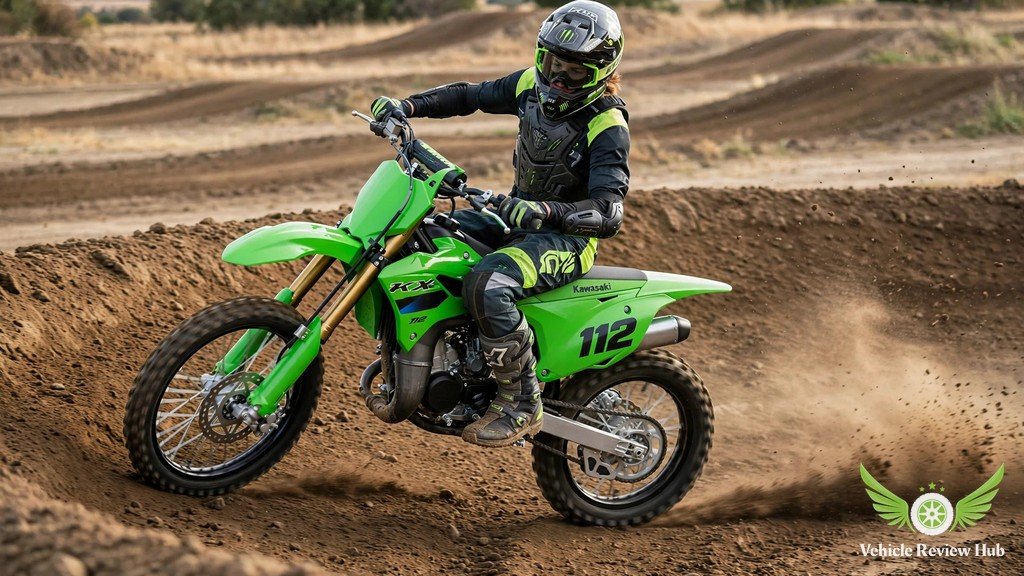
There is no long-distance comfort story to tell about a closed-course supermini, and this Kawasaki KX112 review will not invent one. What exists is geometry, ergonomics and one real ride test: Cycle News’s July 2026 review, with a 15-year-old tester, 118 lb and 5 feet 5 inches, who picked the 112 as the test’s clear favourite.
Riding Position and Comfort Over Longer Distances
The riding position is the 2026 ergonomics package: a Renthal Fatbar in an 8-position ERGO-FIT mount, grips 50 mm forward and 35 mm wider, footpegs widened from 40 to 48 mm and dropped 10 mm, and a slim flat seat. The 34.1-inch seat and 51.6-inch wheelbase read as a big-wheel 85 with a longer, roomier cockpit, not as a small 125. Cycle News’s tester, at 5 feet 5 inches, found the 112 the favourite for its smoothness and ease of riding, especially for taller riders. Two feel notes from that test belong in any honest Kawasaki KX112 review: the cable clutch engages more immediately, somewhat on/off against the European bikes’ wider range, and both Kawasakis vibrated more than the tester’s own bikes as engine speed climbed. Neither is a failure; both are the price of the $1,450 saving over the KTM.
Seat Dropped to 34.1 in 2026
The seat height dropped 0.2 inches in 2026, from 34.3 inches to 34.1 inches. The drop is a spec-sheet diff only — the press release never states a seat-height figure. For fit, 34.1 inches sits between the KTM at 34.3 inches and the Yamaha at 34.8 inches, and it is identical to the KX85 L’s seat. The practical point for a buyer in this Kawasaki KX112 review is the class: the 112’s 19/16-inch wheels and 112cc engine put it in Supermini 12-16, and a rider who has outgrown the 85cc classes will find the 34.1-inch seat the natural next step.
Kawasaki KX112 Review: Pros, Cons and Verdict
The verdict on this Kawasaki KX112 review is a class decision, not a ranking. The 112 is the only factory supermini, $600 more than its own sibling and $1,450 less than the KTM, and it carries the only dyno figure in the class. The question is whether the rider needs Supermini eligibility — the one thing the extra 28cc buys that nothing else in the price band can.
Main Advantages and Limitations of the Kawasaki KX112
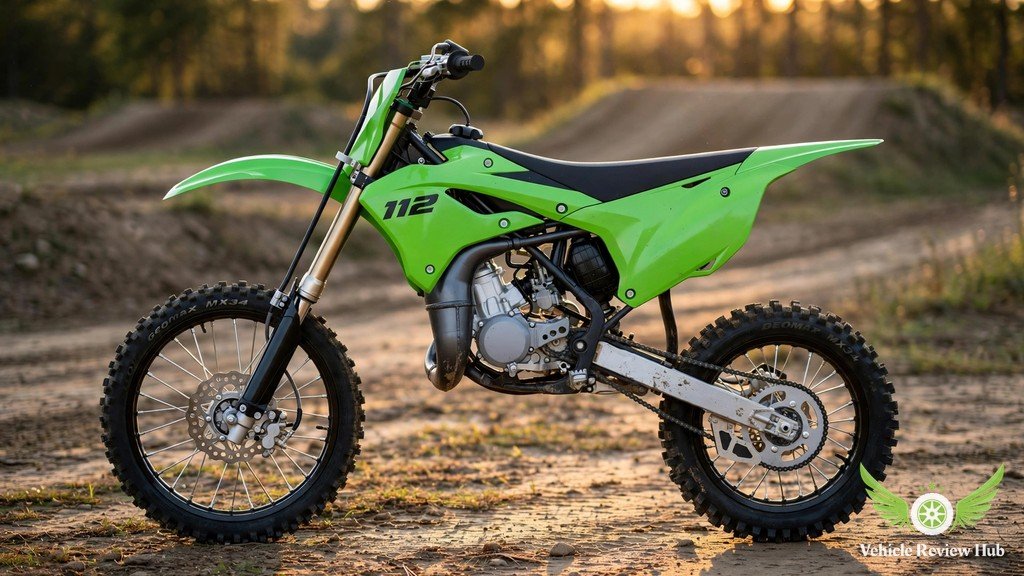
The advantages start with the class: Kawasaki is the only manufacturer producing a showroom-stock Supermini, per MXA’s 2025 85cc shootout, and the KX112 fits the AMA Supermini 12-16 class exactly, at the top of its 79–112cc band. Then the hardware: a 112cc engine with a verified 24.96 hp dyno figure, a 43 mm KYB fork, 12.0 inches of linkage rear travel, 240/220 mm petal brakes, Dunlop MX34 tyres and ERGO-FIT bars — all for $5,799, $400 more than the Yamaha YZ85LW and $1,450 less than the KTM 85 SX 19/16. Cycle News’s tester called the 112 the clear favourite over the 85, and the price ladder has risen only $800 in six years. That is the value case this Kawasaki KX112 review keeps returning to.
The limitations are the warranty, the weight and the maintenance. There is no warranty at all — every repair is owner-paid, while the Yamaha carries 30 days and the KTM a full year. The 112 is 12.8 lb heavier than the KTM without fuel and 7.8 lb heavier than the Yamaha fueled. The piston is a wear item: the family chart says check it every 3 races (7.5 hours) and replace it every 5 races (12.5 hours), and the 112’s own piston, part 13001-0833, was last seen at $194.62 on Partzilla — roughly double the KX85’s — with the ring price unverified. The KIPS valves need cleaning after every race. No mechanical failures were reported in any of the five ride tests, but the 2026 Dirt Bike Magazine test noted a lean bog off the bottom, and the 2022 bike’s stock suspension was judged too soft for serious Supermini racing — a verdict the 2026 fork and shock answer, though Cycle News still stiffened the suspension for its 118-lb tester.
The verdict, in one line, is that this Kawasaki KX112 review recommends the 112 to the rider who must race Supermini and to the taller 85 graduate who wants broader power without a 125. The $600 over the KX85 L review buys the stroke and the class; the $1,450 saving against the KTM buys the displacement advantage with a linkage rear and 0.6 inches more travel, at the cost of 12.8 lb and a cable clutch. A rider who must still race 85cc classes should buy the L instead — the 112’s engine is not legal there. Everyone else in the class should look at the 112 first.
Early Destinations Unverified
The heading is true in the strict sense and misleading in the loose one, and this Kawasaki KX112 review prints the distinction. Kawasaki publishes no destination figure for any year from 2022 to 2027 — every spec sheet says the MSRP excludes destination and the dealer sets the price. But motorcycle.com publishes one for every year: $240, $245, $255, $305, $315 and $315, with 2027 corroborated by a Cycle Motion listing. The honest heading would read “no Kawasaki-published destination”, and the delivered total — $6,114 for 2027 — is computed, not Kawasaki-published. One warning: motorcycle.com’s MSRP column is wrong in three of the six years ($5,099 for 2022, $5,599 for 2024, the stale $5,749 for 2027), so its destination column is the only part of that site this Kawasaki KX112 review uses, labelled single-source wherever it appears.
Kawasaki KX112 Review FAQs
The questions US buyers ask about the 2027 Kawasaki KX112, answered from the verified figures in this Kawasaki KX112 review.
How much does the 2027 Kawasaki KX112 cost in the USA?
$5,799 MSRP, plus a $315 destination charge, for $6,114 delivered. The $315 destination figure is dealer- and motorcycle.com-sourced — Kawasaki publishes none — so the $6,114 total is computed and labelled as such. This Kawasaki KX112 review uses the computed figure everywhere.
Is the KX112 a new model?
No — it was first introduced for model year 2022, replacing the KX100 (last year 2021, $4,649), which is why this Kawasaki KX112 review calls the 2026 revamp a mid-life chassis update rather than a new-model launch. The 2026 bike got a chassis revamp (43 mm KYB fork, 12.0-inch rear travel, 240/220 mm brakes); the 2027 bike is identical except graphics and a $50 price rise.
What is the difference between the KX112 and the KX100 it replaced?
The KX112 is the KX100 stroked 5.8 mm — same 52.5 mm bore, stroke 45.8 to 51.6 mm, 99 to 112cc — with a new 6-speed and a stronger transmission. It cost $350 more at launch ($4,999 against $4,649) and inherited the KX100’s chassis numbers. This Kawasaki KX112 review treats the stroke, not the badge, as the difference that matters.
What changed on the KX112 for 2026?
The chassis only — the engine is unchanged. New 43 mm KYB fork (was 36 mm), rear travel 10.8 to 12.0 inches via a revised Uni-Trak linkage rod, brakes 220/184 to 240/220 mm, a new perimeter frame, Renthal Fatbar, wider flat pegs, and Dunlop MX34 tyres (was MX33). Seat height dropped 0.2 inches, to 34.1 inches.
What is the difference between the KX112 and the KX85 L?
Almost nothing — a diff of Kawasaki’s own 2027 spec sheets shows exactly six differences: name, MSRP ($5,799 against $5,199), displacement (112 against 84cc), bore/stroke, compression, and 0.4 lb of weight. Everything else — fork, brakes, wheels, seat, tank, colour — is identical, which is the $600 question this Kawasaki KX112 review closes on.
Does the KX112 come with a warranty?
No. Kawasaki’s own spec sheet prints “Warranty: Not Available”, and the KX line is sold as-is with no warranty in the USA. This Kawasaki KX112 review budgets no warranty cost.