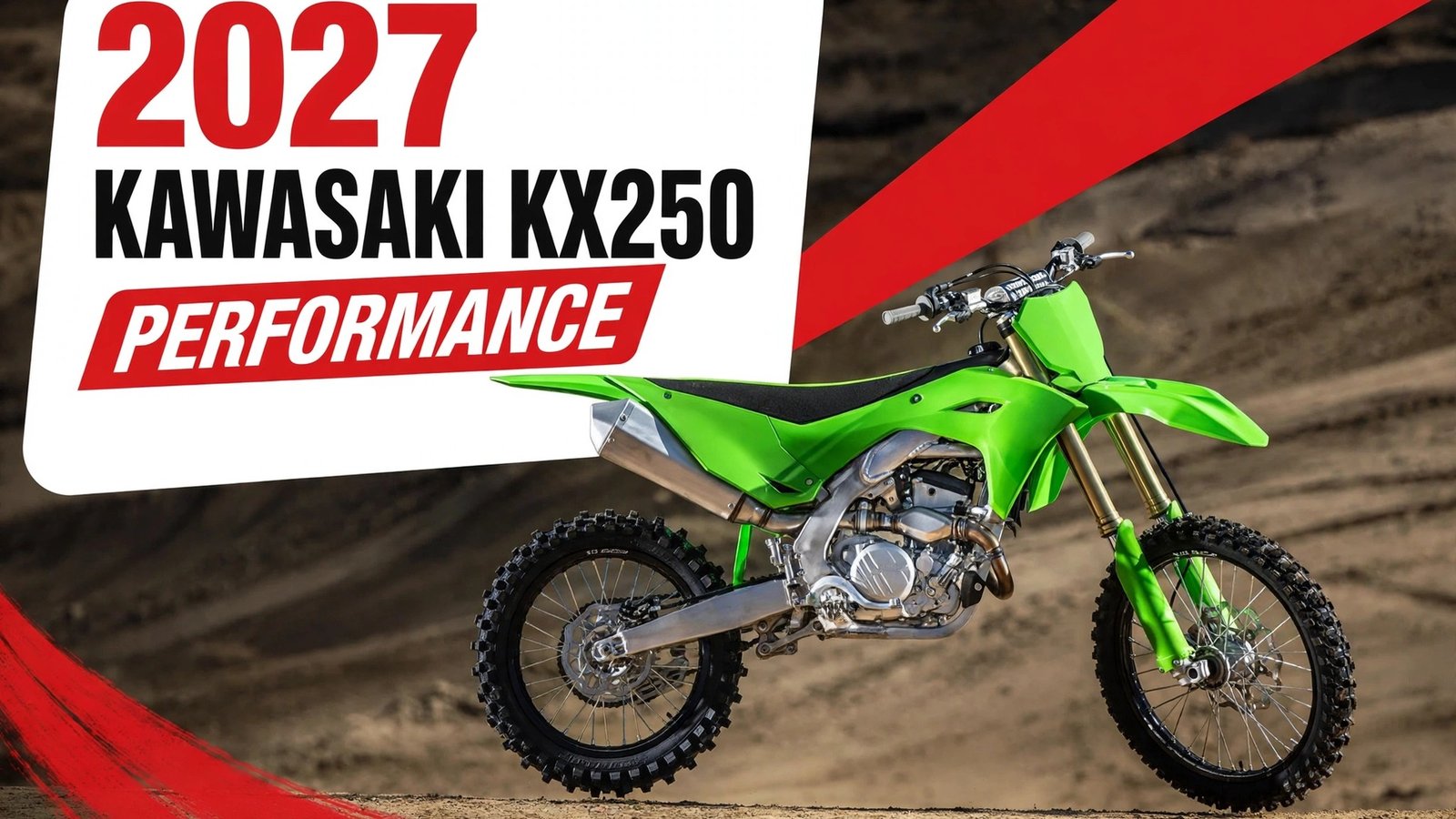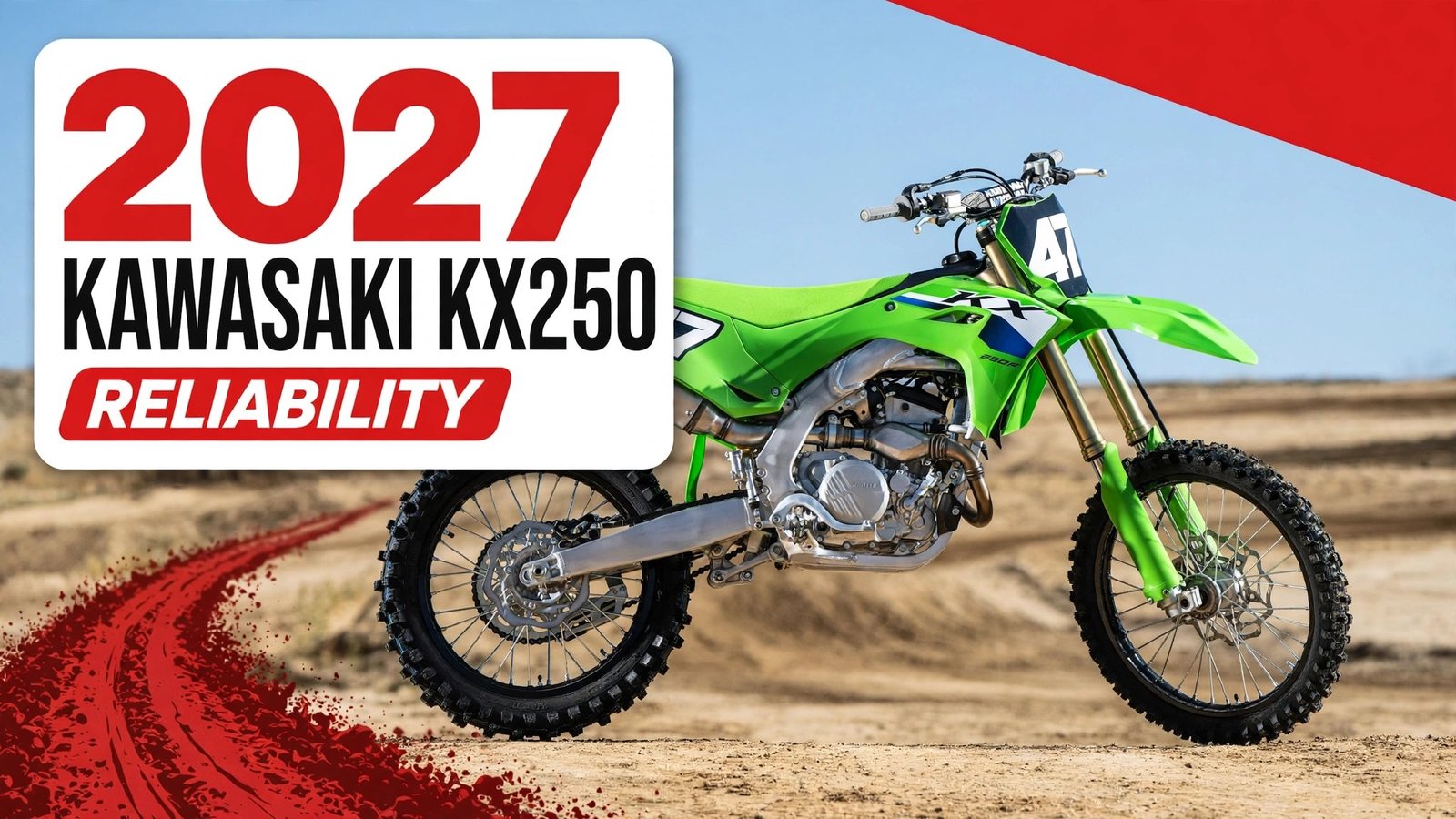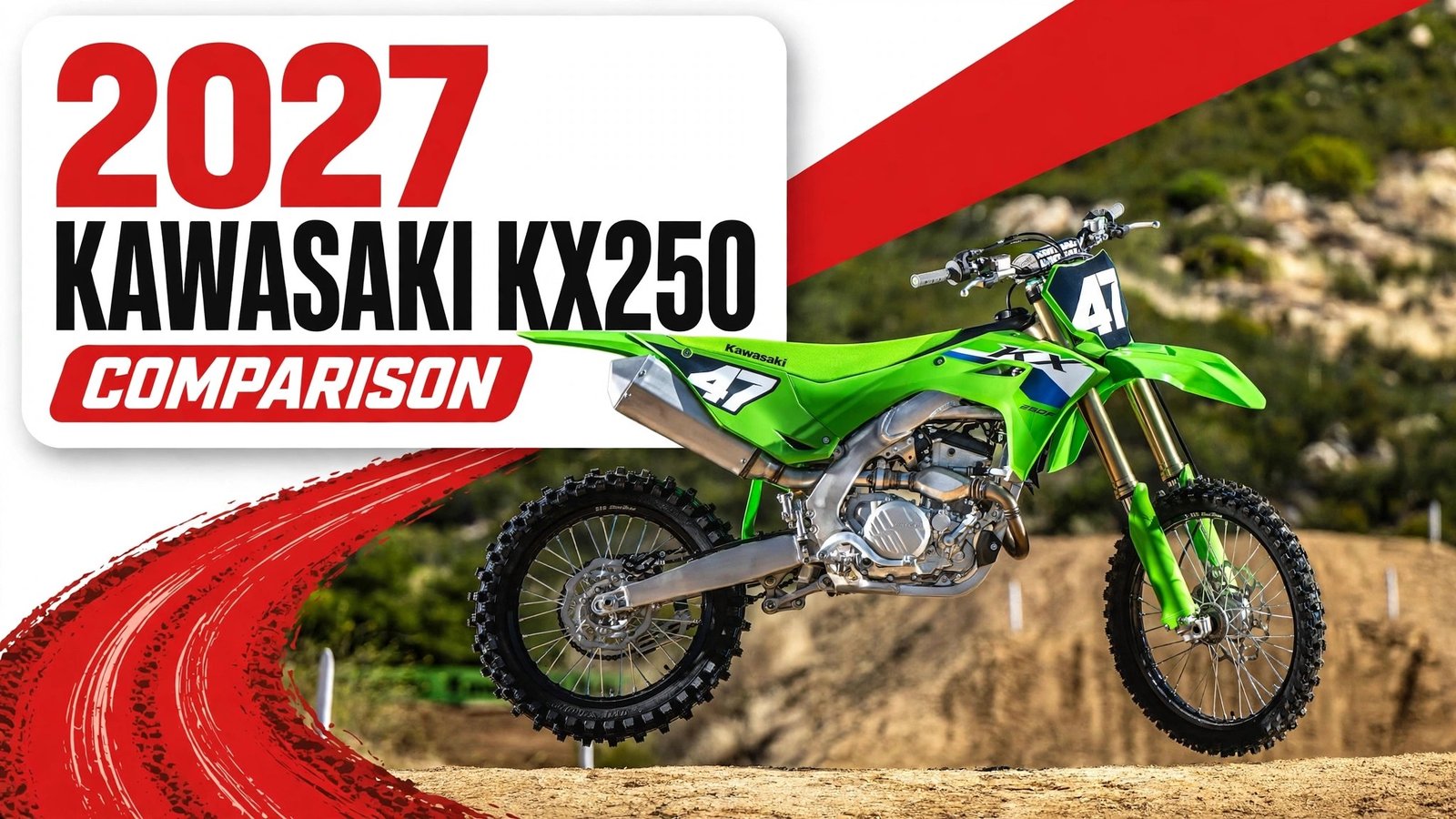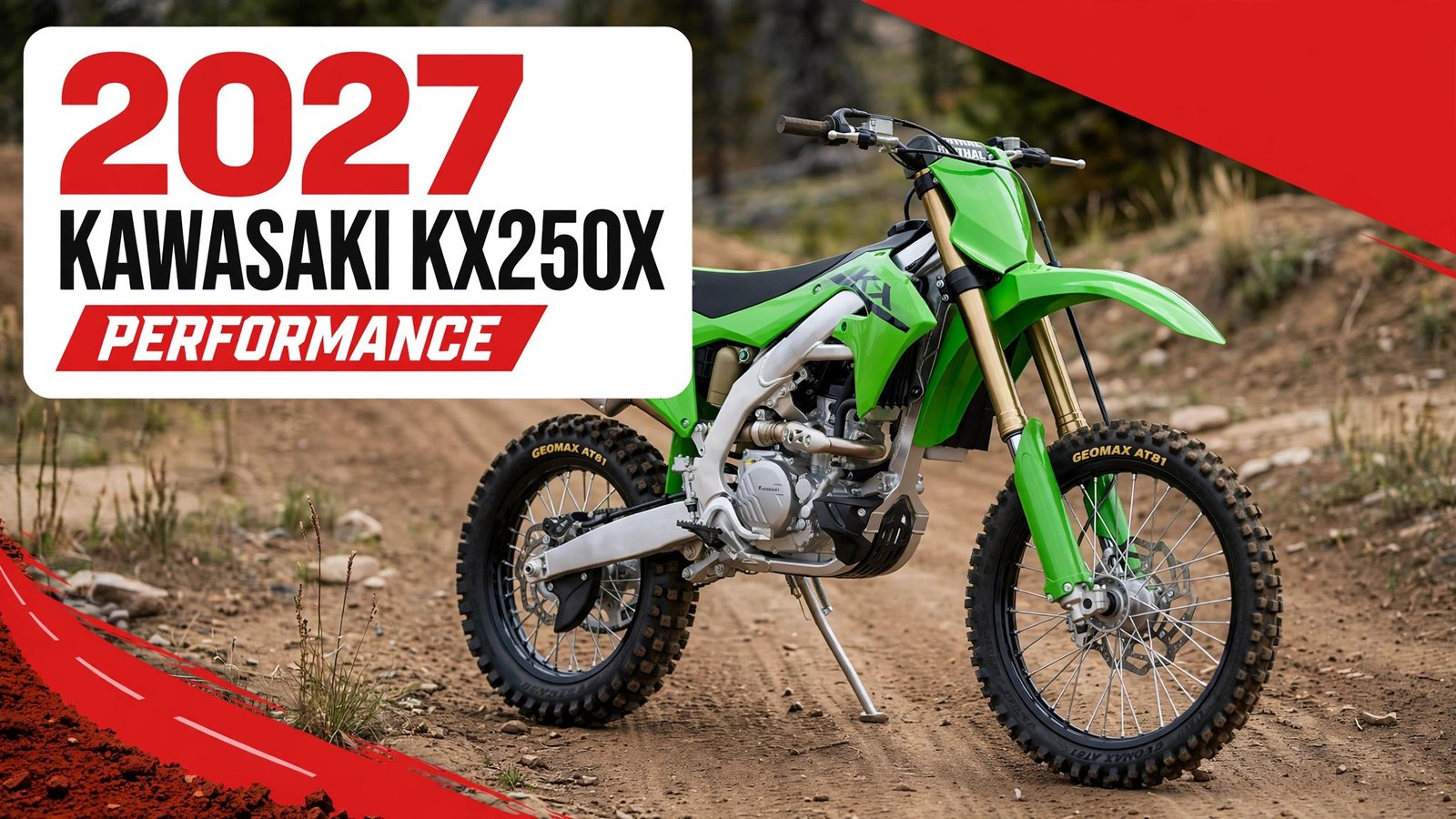
The Kawasaki KX250X performance story starts with an honest admission: Kawasaki publishes no power figure for this bike, and no citable peak horsepower exists for it in print. That does not mean the X is slow — testers call its top-end power competitive and its 2025 redesign added the low-end the first bike lacked — but it does mean this Kawasaki KX250X performance guide measures the bike the way the tests did: on the dyno it ran, on the gear ratios it carries, on the fuel it burns, and on what riders actually said about it on the trail.
The X is the KX250 motocrosser turned into a cross-country racer: an 18-inch rear wheel, a kickstand, softer suspension and shorter gearing. The 2027 bike carries the KX250FX name on Kawasaki USA’s 2027 KX250FX model page, and this Kawasaki KX250X performance guide uses the FX name for all 2027 figures. The companion Kawasaki KX250X review covers the bike’s price, spec sheet and model-year changes in full. What follows is every verified number about how the X goes, stops and handles — and the numbers that do not exist.
Kawasaki KX250X Engine Performance and Power Delivery
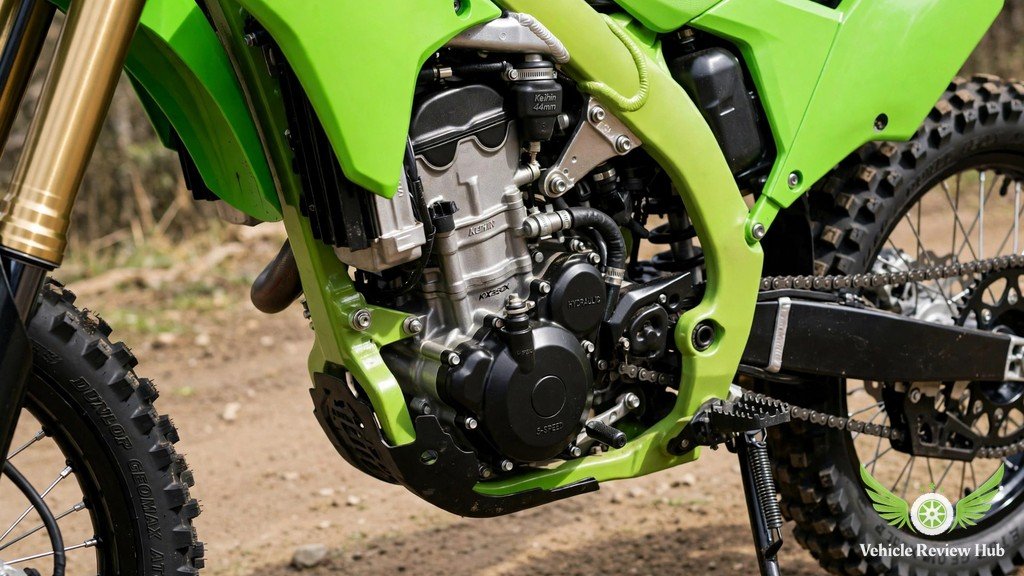
The engine is the KX250’s 249cc four-stroke single, and Kawasaki KX250X performance begins with that shared motor: a dual-overhead-cam single with a 44 mm Keihin throttle body and dual injectors, a five-speed gearbox and a hydraulic clutch. The differences are in the mapping, gearing and exhaust, not the bore, stroke or compression.
Ran on Pro Circuit’s Dyno
The X has been on a dyno, and that matters, because it is the only dyno run of the X that exists in print. Dirt Bike Magazine’s 2026 off-road wrap put all five 2026 250 cross-country racers — the Honda CRF250RX, the Kawasaki KX250X, the KTM 250 XC-F, the Triumph TF250-C and the Yamaha YZ250FX — on Pro Circuit’s dyno. The results were published as charts, each bike broken out with peak numbers listed. The problem for this Kawasaki KX250X performance guide is that those peak numbers exist only as chart images, not as extractable text, so no peak horsepower or torque figure for the X can be quoted from them. The only peak number from that shootout available as text belongs to the Triumph, which measured 44.3 hp at 13,600 rpm. Dirt Bike Magazine’s social summary of the same chart called the Honda near 45 hp with the Kawasaki close behind — a paraphrase, not a citable figure. What can be said, and what this Kawasaki KX250X performance guide does say, is that the X ran on Pro Circuit’s dyno in Dirt Bike Magazine’s 2026 off-road wrap, and that no citable peak figure for the X exists in text anywhere.
39.2 hp Is the MX Bike’s
The number most often misprinted as the X’s power figure is 39.2 hp at 12,700 rpm, with 18.7 lb-ft of torque at 9,100 rpm. That is Dirt Rider’s dyno figure for the 2027 KX250 motocrosser, and this Kawasaki KX250X performance guide is explicit about it: 39.2 hp is the MX bike’s, not the X’s. The X shares the MX bike’s engine family, but sharing an engine family is not the same as sharing a dyno result — the X runs different mapping, different gearing and a different exhaust, and no dyno has published the X’s own peak. Kawasaki publishes no power figure for the X or for the motocrosser, so the only numbers in circulation come from independent dynos, and every one of them must carry its bike’s name. The companion Kawasaki KX250 performance guide covers the motocrosser’s dyno numbers in full, and they must never be quoted as the X’s figures.
| Item | KX250X | Source / Note |
|---|---|---|
| Engine | 249cc DOHC four-stroke single | Kawasaki spec sheets |
| Bore x stroke | 78.0 x 52.2 mm | Kawasaki spec sheets |
| Compression | 14.1:1 (2021–2024); 14.0:1 (2025–2027 FX) | Kawasaki spec sheets |
| Fuel system | DFI, 44 mm Keihin, dual injectors | Kawasaki spec sheets |
| Transmission | 5-speed, hydraulic clutch | Kawasaki spec sheets |
| Dyno run | Pro Circuit dyno, Dirt Bike Magazine 2026 off-road wrap | Peak numbers chart images only |
| Peak horsepower (X) | No citable figure in text | See note below |
| Peak horsepower (MX) | 39.2 hp @ 12,700 rpm (Dirt Rider) | The MX bike’s figure, not the X’s |
Note: Kawasaki KX250X performance figures in this table come from Kawasaki USA’s own spec sheets for 2021–2026 and the 2027 KX250FX model page. The X ran on Pro Circuit’s dyno, but its peak numbers exist only as chart images, so this Kawasaki KX250X performance guide prints no peak horsepower for the X. Dirt Rider’s 39.2 hp is the KX250 motocrosser’s figure.
Kawasaki KX250X Top Speed and Acceleration
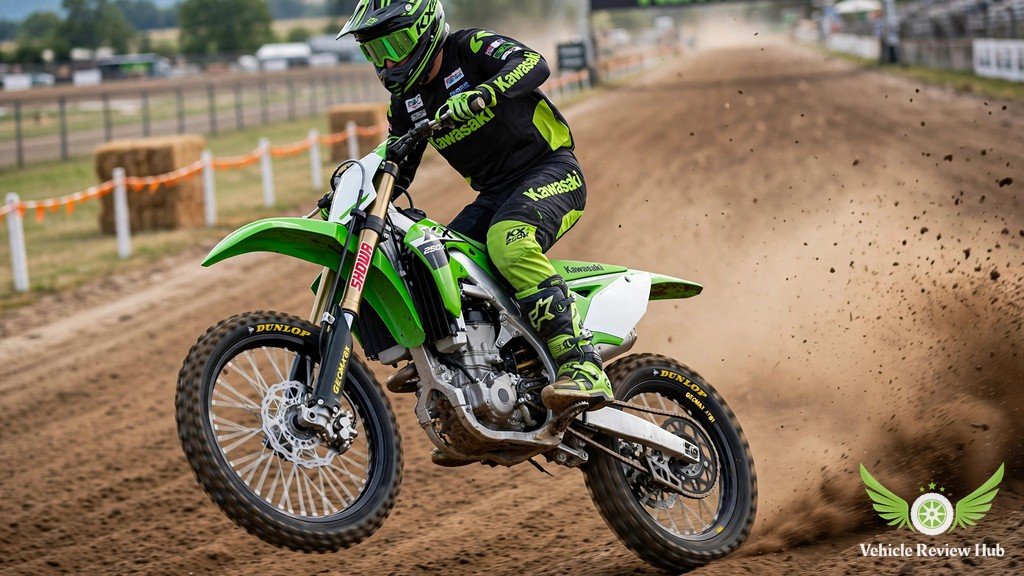
Top speed is the thinnest section of this Kawasaki KX250X performance guide, and that is by design: no tested top speed exists for the X, and Kawasaki publishes none. What exists is a calculated speed from the gear ratios and a handful of anecdotal speeds from test loops.
No Tested Top Speed Exists
No magazine, no test outlet and no owner has published a tested top speed for any year of the KX250X, and this Kawasaki KX250X performance guide prints none. There is no GPS run, no timed run and no radar figure in any source searched. The bike has no speedometer, no odometer and no road use — it is a closed-course race bike, and top speed is not a number its testers chased. What the tests do give is context: Cycle News saw over 50 mph on its 2021 test loop, and Dirt Bike Test’s long-term report saw 70 mph-plus on straightaways at the 6 Hours of Glen Helen. Neither is a measured top speed. The only speed figure with a real source behind it is the calculated one, and this Kawasaki KX250X performance guide prints it in the next section with its label attached.
No Official Top Speed
Kawasaki publishes no top speed for the X, and no official figure exists to print. The closest thing to a speed table is Dirt Bike Magazine’s comparative gear-ratio table from the 2026 off-road dyno wrap, which lists a calculated speed at 12,500 rpm for each gear. The magazine states plainly: “This isn’t observed speed (it’s unlikely that any of them can reach redline in top gear), but it does illustrate the gaps between gear ratios.” The X’s calculated fifth-gear speed is 73.0 mph, and this Kawasaki KX250X performance guide prints it only with that label — calculated, not observed. The X’s fifth-gear figure is the second-lowest of the five — the five-speed’s short legs made visible.
| Gear | KX250X calculated speed at 12,500 rpm |
|---|---|
| 1st | 36.7 mph |
| 2nd | 45.2 mph |
| 3rd | 53.0 mph |
| 4th | 61.7 mph |
| 5th | 73.0 mph |
Note: Calculated speeds from Dirt Bike Magazine’s 2026 off-road dyno wrap, gear-ratio table. Dirt Bike Magazine’s table also lists the rivals’ top-gear calculated speeds: CRF250RX 72.7 mph in fifth, TF250-C 73.6 mph in fifth, YZ250FX 91.6 mph in sixth and KTM 250 XC-F 94.0 mph in sixth. All figures are calculated at 12,500 rpm, not observed speeds, and this Kawasaki KX250X performance guide prints them only with that label.
Kawasaki KX250X Mileage and Fuel Economy
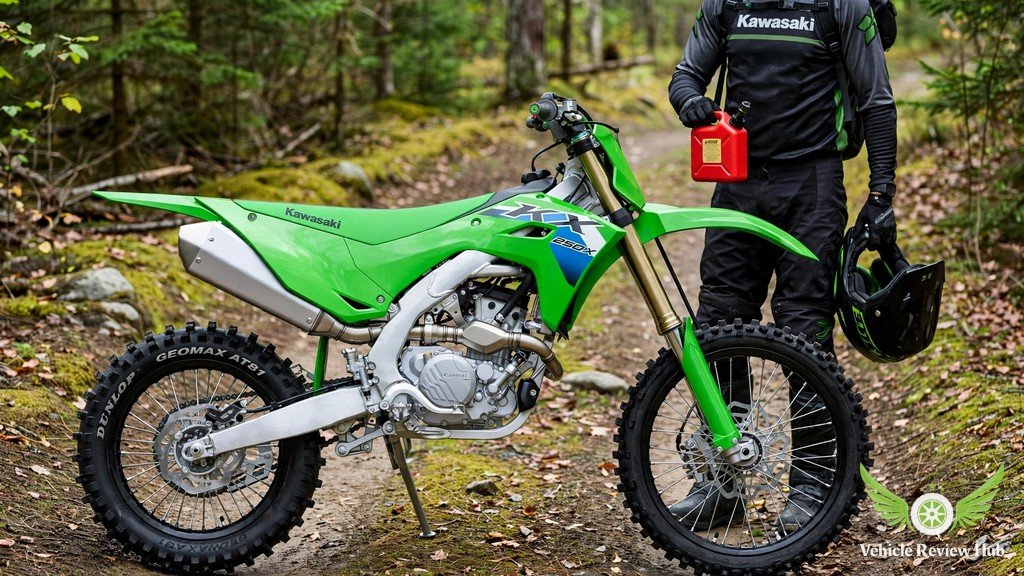
Fuel economy is where Kawasaki KX250X performance meets its hardest limit: the 1.64-gallon tank. There is no published MPG figure for the X, so this section measures fuel the way the tests did, in minutes of racing.
50 Minutes Is Cutting It Close
Dirt Bike Test’s first impression of the 2025 bike put the fuel problem in one sentence: “In the past, racing for ~50 minutes is cutting it really close on gas, and going on longer trail rides is difficult without an aftermarket tank.” That is the source for the 50-minute figure, and this Kawasaki KX250X performance guide prints it with the attribution attached. Cycle News said the same thing in 2021, warning that the 1.64-gallon tank “could be an issue in a typical 40-plus-minute grand prix, or multi-hour-long races (aka GNCC and WORCS), or for extended trail rides.” Converting minutes at race pace into miles per gallon would require a distance, a speed and a fuel burn the tests never published, so this Kawasaki KX250X performance guide does not attempt it.
Tank Is Class-Smallest 1.64
The 1.64-gallon tank is the smallest in the class by a clear margin, and Dirt Bike Magazine’s 2026 off-road wrap puts the numbers side by side: the Honda CRF250RX carries 2.1 gallons, the Yamaha YZ250FX 2.0 gallons in the wrap’s table (2.1 gallons on Yamaha’s own page), the KTM 250 XC-F 2.2 gallons and the Triumph TF250-C 2.2 gallons, against the X’s 1.6 gallons as the wrap rounds it. The tank never changed — 1.64 gallons on every spec sheet from 2021 through 2026, and 1.64 gallons on the 2027 FX page. That constancy is the one unchanging fact of Kawasaki KX250X performance: the fuel system never grew. The 2025 redesign changed the engine, the frame and the fork, but it did not touch the tank, and Kawasaki KX250X performance on a long race is still limited by fuel before it is limited by anything else.
| Model (2026 off-road wrap) | Fuel capacity (gal) |
|---|---|
| Kawasaki KX250X | 1.64 |
| Honda CRF250RX | 2.1 |
| Yamaha YZ250FX | 2.0 (wrap table; 2.1 on Yamaha’s page) |
| KTM 250 XC-F | 2.2 |
| Triumph TF250-C | 2.2 |
Note: Fuel capacities from Dirt Bike Magazine’s 2026 off-road dyno wrap, which rounds the X’s 1.64 gallons to 1.6. Yamaha’s own page lists the YZ250FX at 2.1 gallons. No MPG figure exists for the X, so this Kawasaki KX250X performance guide measures fuel in minutes at race pace, not miles per gallon.
Kawasaki KX250X Real-World Riding Experience
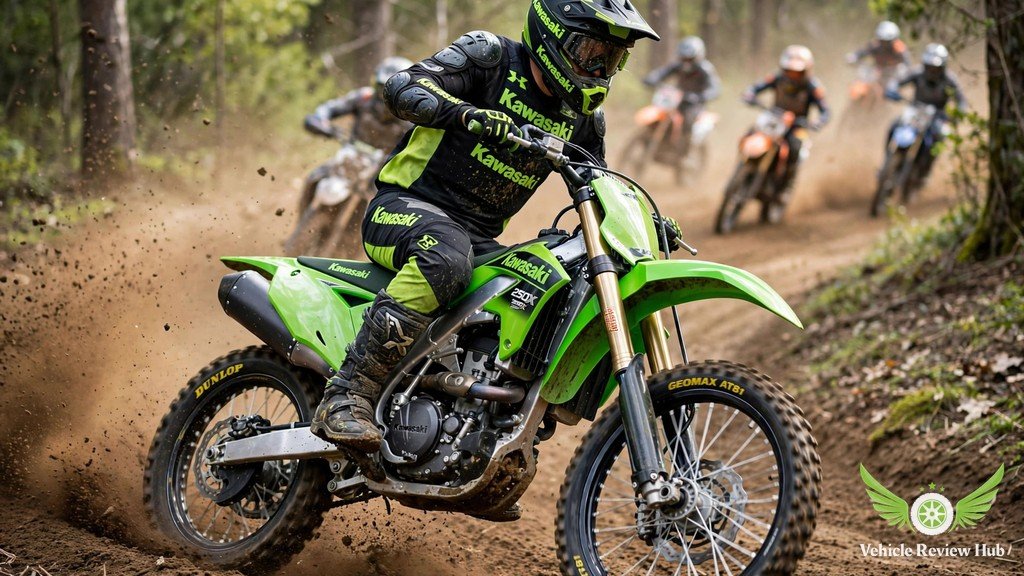
The riding reports say the same thing in testers’ words, and this Kawasaki KX250X performance guide leans on them: the engine is the least off-road oriented of its class, and testers liked it anyway.
The Riding Experience Buyers Actually Talk About
Launch reviews of the 2021 bike agreed on the shape of the X, and on what Kawasaki KX250X performance feels like from the saddle. Ultimate Motorcycling called it “an instant winner” with KYB suspension that was “outstanding, as is”, and Cycle News found the suspension “noticeably softer and much better suited for the trail … not too soft, not too stiff, but just right”. Dirt Bike Test’s first impression at Cahuilla Creek found the bike “performs very well as a GP race bike” with “a lot of power, especially as you climb the RPMs”. The long-term racing report — four events from the Glen Helen SRA Grand Prix to the 6 Hours of Glen Helen — found a “high fun factor” across testers from Pro to Vet, and 70 mph-plus on the straightaways at the 6 Hour. None of this is a laboratory result — it is what riders actually said, and this Kawasaki KX250X performance guide treats it as the real-world record.
Least Off-Road Engine, 2022
Dirt Bike Test’s 2022 woods comparison — Honda CRF250RX, GasGas EX250F, Kawasaki KX250X and Yamaha YZ250FX — gave the X the bluntest verdict in the test: “The KX motor is the least off-road oriented of the bunch, though don’t let that scare you away from it. For pure racing, the aggressive power was favored by quite a few of our testers, from Pro to Novice/Intermediate, as it has competitive top-end power and is easily ridden there.” The same article added the other half: “The KX has the least amount of torque down low, but its quick-revving powerband gets it into the meat of the power quick to stay competitive.” The reason is in the mapping: the X runs MX mapping while the Honda and Yamaha run off-road mapping, so the X feels like a motocrosser on a trail — quick-revving, top-end biased, and short on low-end torque. Yamaha’s motor was judged “one of, if not the best in its class” with low-end torque “unmatched”, and Honda’s the “second-best all-around motor”. The KX’s competitive top-end is the counterweight, and this Kawasaki KX250X performance guide prints both halves.
One correction belongs here, because the sheet description for this blog repeats a claim this guide cannot support. There was no ranked 2022 woods shootout, and the X was never ranked “second-equal” in one. Dirt Bike Test’s 2022 comparison explicitly declines to pick a winner, saying it compares bikes “to accurately describe a bike’s characteristics and performance above trying to pick a winner” and that “declaring a true winner isn’t as applicable as some might think.” The 2022 shootouts that do rank bikes are motocross shootouts of motocross bikes, not the X — and in Cycle News’s 2022 motocross shootout the KX250 motocrosser finished sixth of six, the opposite of second-equal. This Kawasaki KX250X performance guide therefore prints no 2022 placement for the X, and no ranking from that year should be quoted for it.
Kawasaki KX250X Handling, Braking and Stability
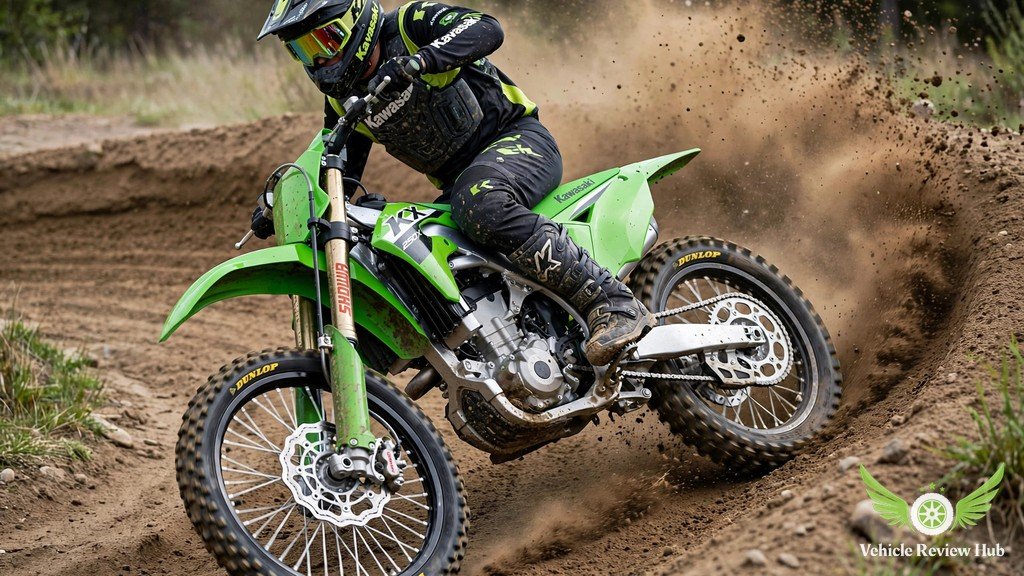
Kawasaki KX250X performance on a trail is the KX250’s handling with softer springs and an 18-inch rear wheel, and the 2025 redesign changed the chassis underneath it.
Better Low-End From 2025
Kawasaki redesigned the engine for 2025 to fix the exact weakness the 2022 comparison named: low-end torque. The June 2024 press release says the redesigned engine was “aimed at enhancing its performance across various sectors … to boost low to midrange power delivery”, with a new cylinder head, a flatter piston, compression slightly reduced from 14.1:1 to 14.0:1, the cylinder tilted 5 degrees forward, the intake cam raised 10 mm, and a single-shaft primary balancer. Dirt Bike Test’s first impression of the 2025 bike says the result is “much appreciated” in rocks, trees and low-traction conditions: “This new power delivery with more emphasis on low-mid range power and torque is much appreciated in these conditions.” The 2025 bike also brought a new lightweight aluminium perimeter frame, a centre-port exhaust, KTRC traction control, RIDEOLOGY THE APP KX connectivity, and a 49 mm Showa fork in place of the gen-1 KYB 48 mm fork, with softer settings two spring rates lighter front and rear. The chassis and the engine changed together, and this Kawasaki KX250X performance guide treats the low-end gain as the gen-2 bike’s biggest improvement.
Watch the first impression: Dirt Bike Test’s “2025 Kawasaki KX250X First Impression” video rides the redesigned gen-2 bike on an off-road loop — the new low-to-midrange engine and the Showa chassis doing the work. It is a first impression of the 2025 bike, not a comparison, and it does not rank the X against its rivals.
Handling, Braking and Stability on Real Roads
A note on “real roads” first: the X is a closed-course race bike with no lights, no mirrors and no spark arrestor, so “real roads” here means off-road trails and race loops, never public roads. On those loops the X handles like the motocrosser it is, and braking is one area where Kawasaki KX250X performance never changed across the generations. The 2025 redesign’s new aluminium perimeter frame and centre-port exhaust sit under Showa suspension that Dirt Bike Test found soaked up rocks and roots with more comfort and compliance than the gen-1 KYB setup, and Cycle News noted the X’s softer settings — two spring rates lighter front and rear — against the motocrosser. Braking is the same every year: a 270 mm petal disc up front and a 240 mm petal disc at the rear, and no test named the brakes a weakness. Stability comes from the same place as the speed: the wheelbase grew from 58.3 inches on the gen-1 bike to 58.5 inches on the 2025 redesign, with rake printed at 27.5 degrees on the 2025 sheet and 27.8 degrees on the 2026 sheet — both as printed. The 18-inch rear wheel with its 110/100-18 Dunlop Geomax AT81 tyre is the X’s real handling difference against the motocrosser: a taller sidewall that absorbs square edges and finds grip where the MX bike’s 19-inch rear skips. This Kawasaki KX250X performance guide rates the handling as the bike’s strongest suit after its price — the engine is the question mark, the chassis is not.
Kawasaki KX250X Performance Compared With Other Sport Bikes
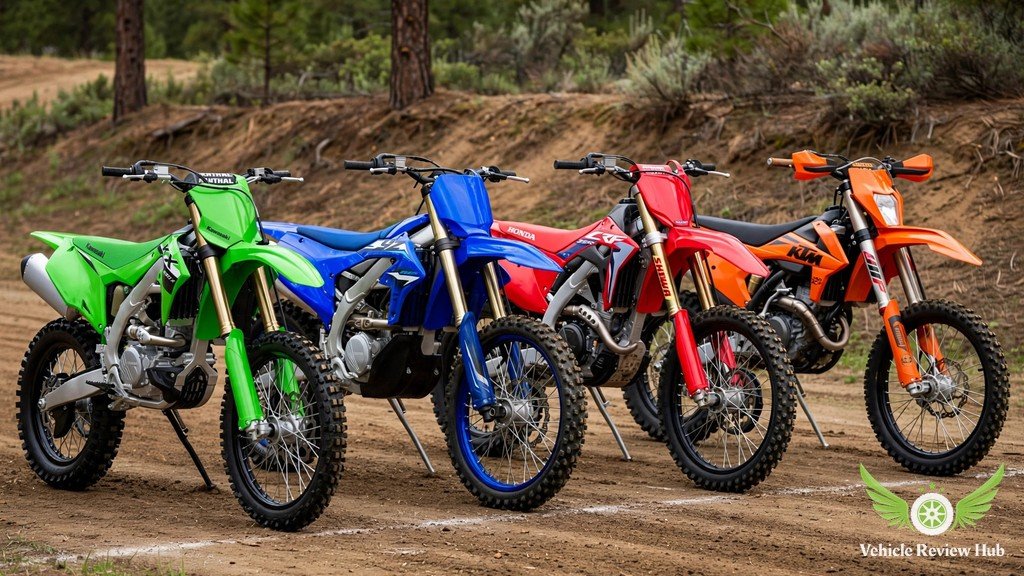
The heading says “sport bikes”, and this Kawasaki KX250X performance guide keeps the heading verbatim while saying plainly that none of these bikes is a sport bike — they are 250 cross-country racers, and the comparison below is between woods bikes.
Kawasaki KX250X vs Yamaha YZ250FX
The Yamaha is the X’s hardest rival on performance, and Dirt Bike Test’s 2022 comparison said so directly: the YZ250FX’s motor was “one of, if not the best in its class” with low-end torque “unmatched”, against the X’s least off-road oriented engine with the least torque down low. The Yamaha carries a wide-ratio six-speed gearbox against the X’s close-ratio five-speed, a 2.1-gallon tank against the X’s 1.64, and off-road mapping against the X’s MX mapping. The Dirt Bike Channel podcast scored it YZ250FX 4 – KX250X 2. The X’s answers are price and top-end: the 2027 KX250FX lists at $8,699 against the Yamaha’s $9,099 on Yamaha’s YZ250FX page, $400 less, and its quick-revving top-end was favoured by testers from Pro to Novice. Neither bike has a published power figure from its maker, so this Kawasaki KX250X performance guide compares them on test verdicts, not dyno sheets.
| Model (2027) | MSRP | Gearbox | Fuel tank | Mapping |
|---|---|---|---|---|
| Kawasaki KX250FX | $8,699 | 5-speed, close-ratio | 1.64 gal | MX |
| Yamaha YZ250FX | $9,099 | 6-speed, wide-ratio | 2.1 gal | Off-road |
| Honda CRF250RX | $8,899 | 5-speed | 2.1 gal | Off-road |
| KTM 250 XC-F | $11,149 | 6-speed, wide-ratio | 2.2 gal | MX |
Note: 2027 prices from maker and dealer sources verified in the research brief; the Yamaha destination charge was not verified, so no delivered total is printed for it. The Honda CRF250RX’s 37.7 hp dyno figure (2025) comes from our CRF250RX performance guide. On Dirt Bike Magazine’s tight off-road loop, both six-speeds were effectively four-speeds. This Kawasaki KX250X performance guide prints no peak horsepower for the X itself, because none exists in citable text.
Is the Kawasaki KX250X Suitable for Beginner Riders?
No — and this Kawasaki KX250X performance guide says so directly, because the reasons are the bike’s own spec sheet. The X is a 249cc closed-course race bike with a 37.2-inch seat, an aggressive top-end powerband, no lights, no mirrors and no spark arrestor, and a race-bike service rhythm with valve checks and piston replacement measured in hours, not miles. A beginner needs the opposite: a low seat, forgiving low-end power, lights and a spark arrestor, and service intervals measured in months. Kawasaki’s own answer is the KLX300R: $5,799 plus a $650 destination charge, $6,449 delivered for 2027, a 292cc six-speed trail bike with a 35.4-inch seat, built for trails rather than racing and $2,900 cheaper than the FX.
Kawasaki KX250X Performance: Frequently Asked Questions
The questions below are the ones buyers ask about this Kawasaki KX250X performance guide.
How much horsepower does the Kawasaki KX250X make?
Kawasaki publishes no power figure for the X. The X ran on Pro Circuit’s dyno in Dirt Bike Magazine’s 2026 off-road wrap, but the peak numbers exist only as chart images — no citable peak horsepower exists in text. That is the honest answer this Kawasaki KX250X performance guide gives: do not trust any site that prints a peak figure for the X without a dyno source.
Is the 39.2 hp figure the KX250X’s?
No. Dirt Rider’s 39.2 hp at 12,700 rpm is the KX250 motocrosser’s dyno figure, not the X’s, and this Kawasaki KX250X performance guide never prints it as the X’s figure.
What is the Kawasaki KX250X top speed?
There is no tested or official top speed. Dirt Bike Magazine calculated 73.0 mph in 5th gear at 12,500 rpm from the gear ratios — a calculated figure, explicitly not an observed speed.
How long does a tank of fuel last on the KX250X?
About 50 minutes at race pace, per Dirt Bike Test’s 2025 first impression: “racing for ~50 minutes is cutting it really close on gas.” There is no published MPG figure for the X, and this Kawasaki KX250X performance guide measures fuel in minutes, not miles per gallon.
Did the 2025 KX250X get more low-end power?
Yes. Kawasaki redesigned the engine for 2025 to boost low-to-midrange power (new cylinder head, flatter piston, 14.0:1 compression), and Dirt Bike Test’s first impression says the new low-mid delivery is “much appreciated” in rocks, trees and low-traction conditions.
Is the Kawasaki KX250X good for beginners?
No. It is a 249cc closed-course race bike with a 37.2-inch seat, aggressive power, no lights or spark arrestor, and a race-bike service schedule. Beginners should look at the KLX300R instead.