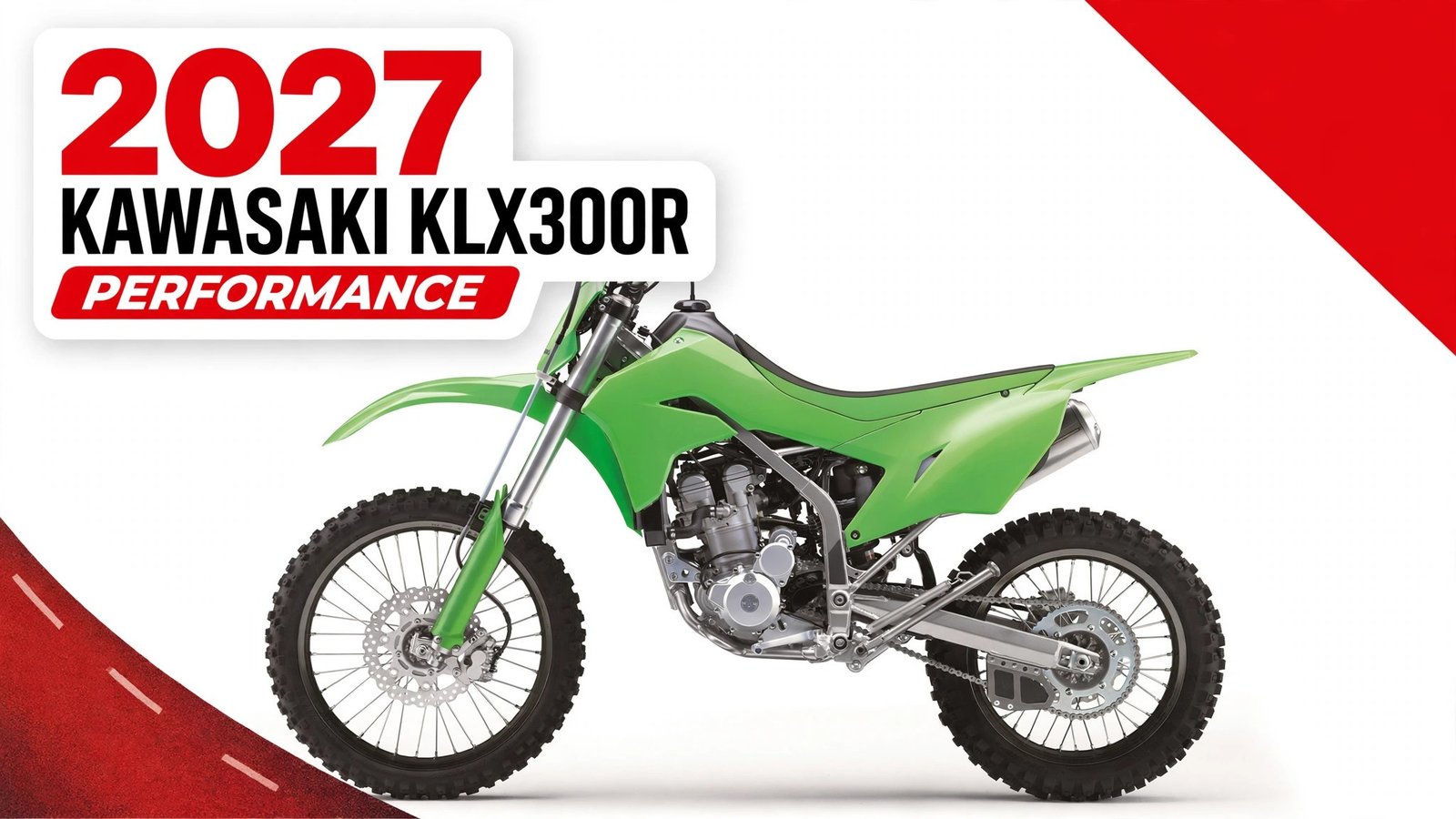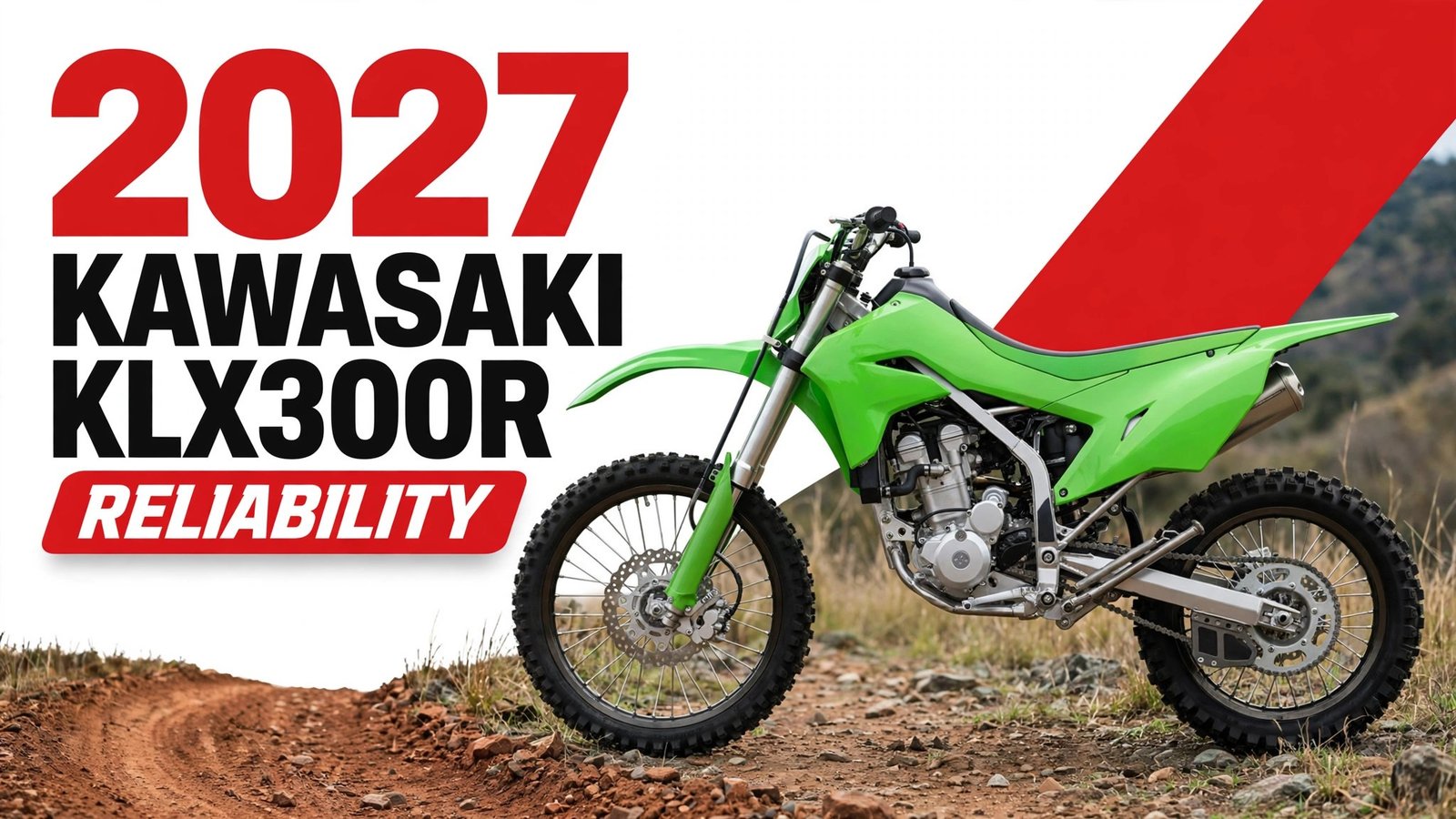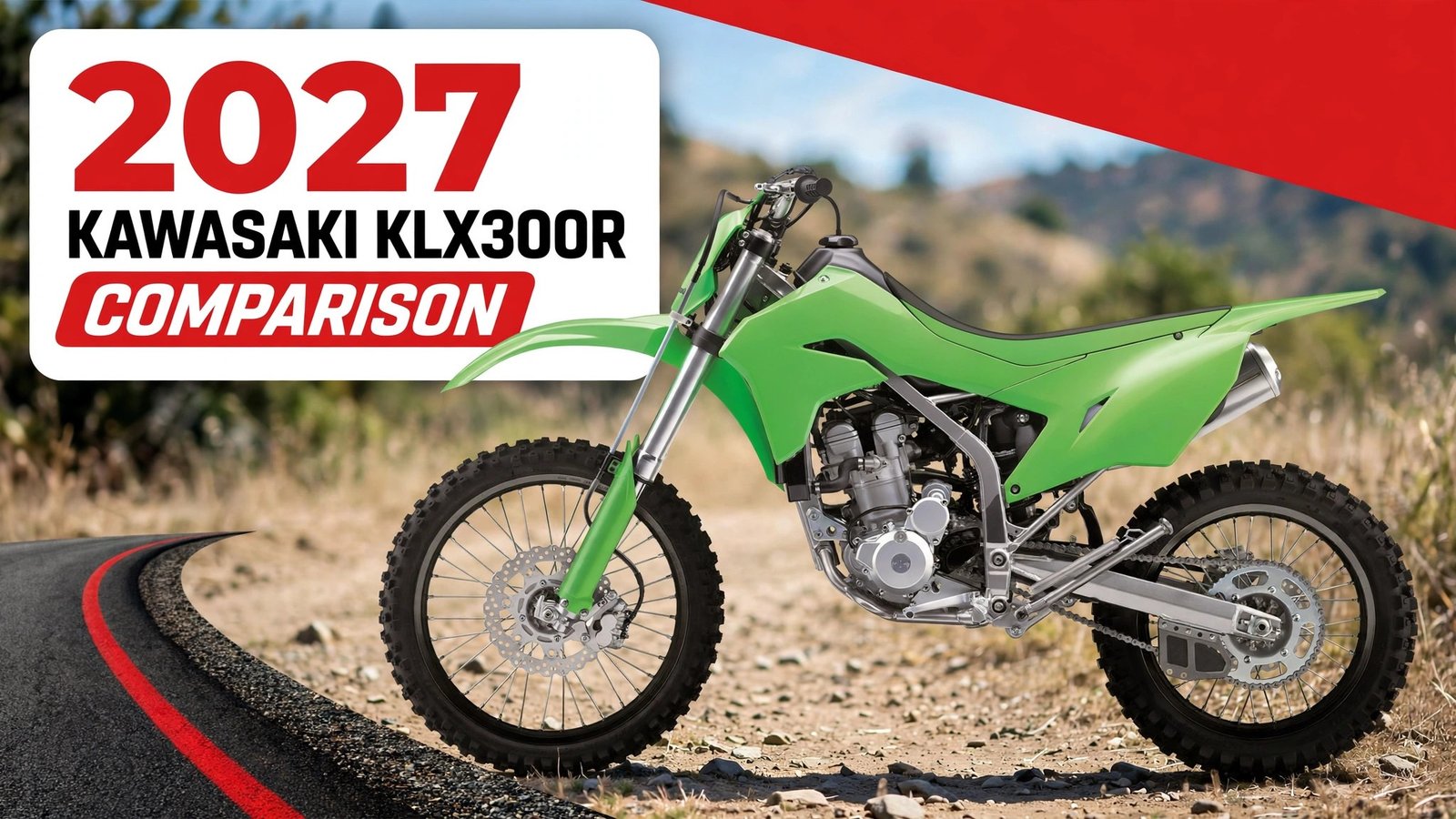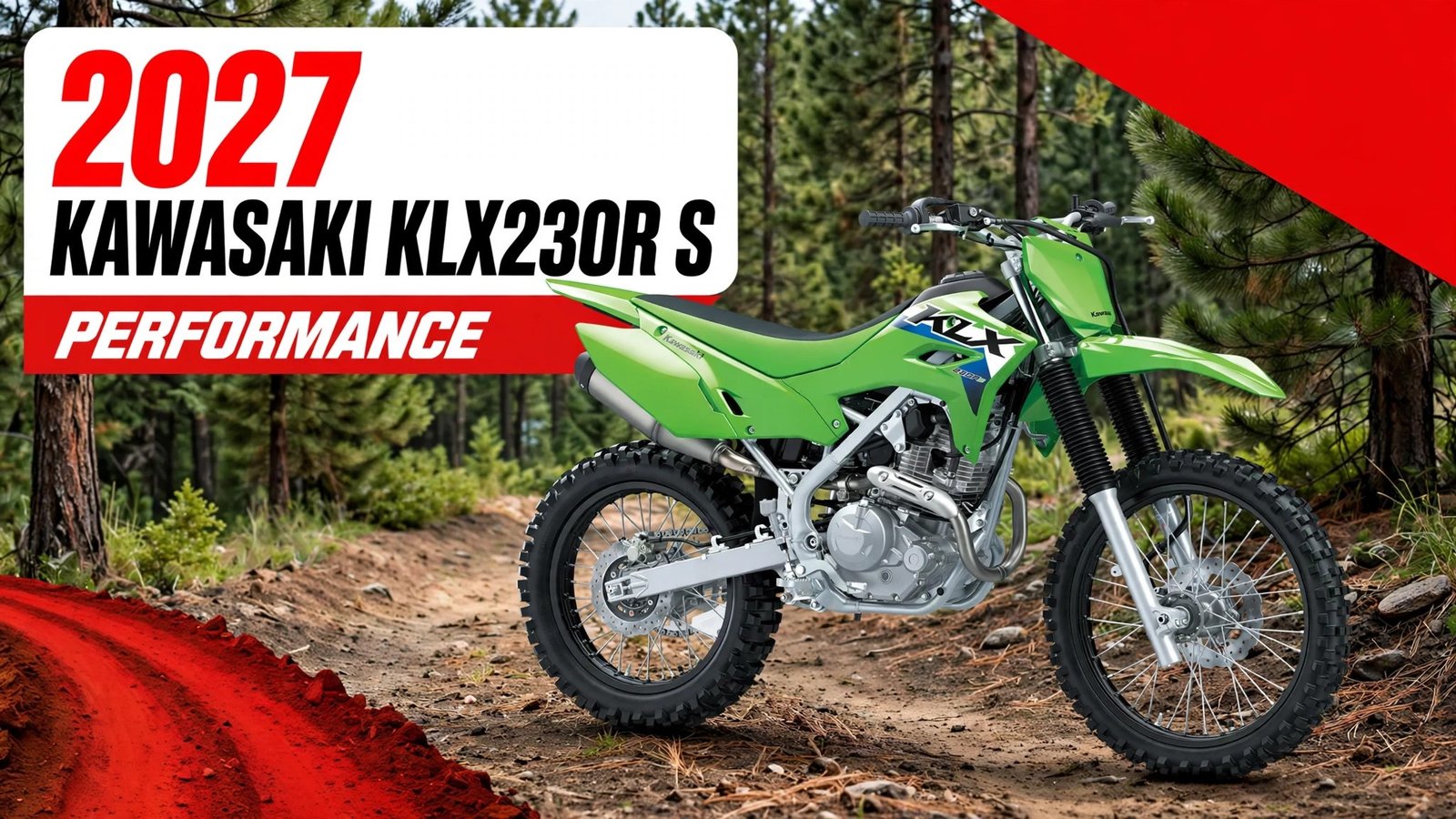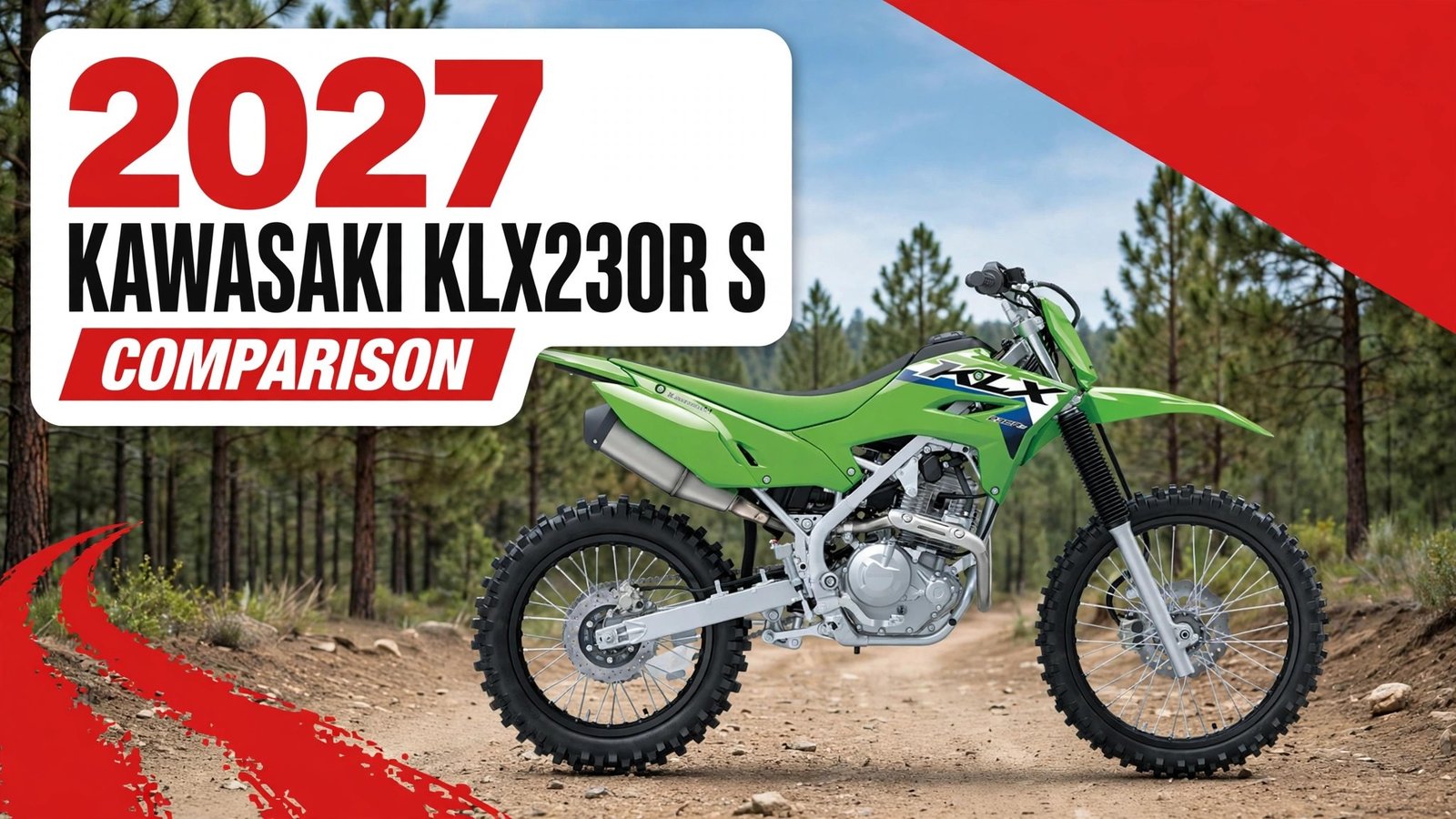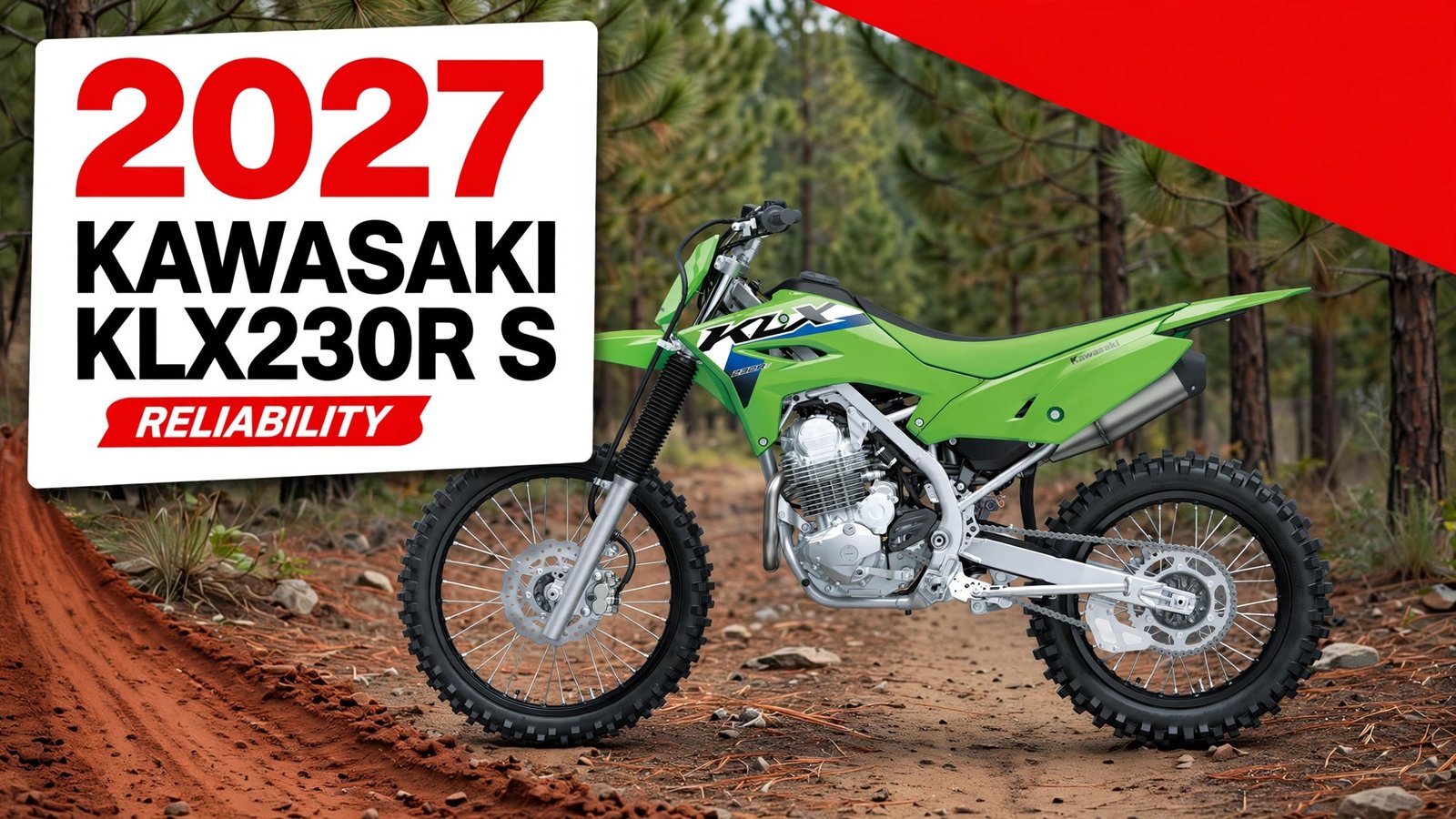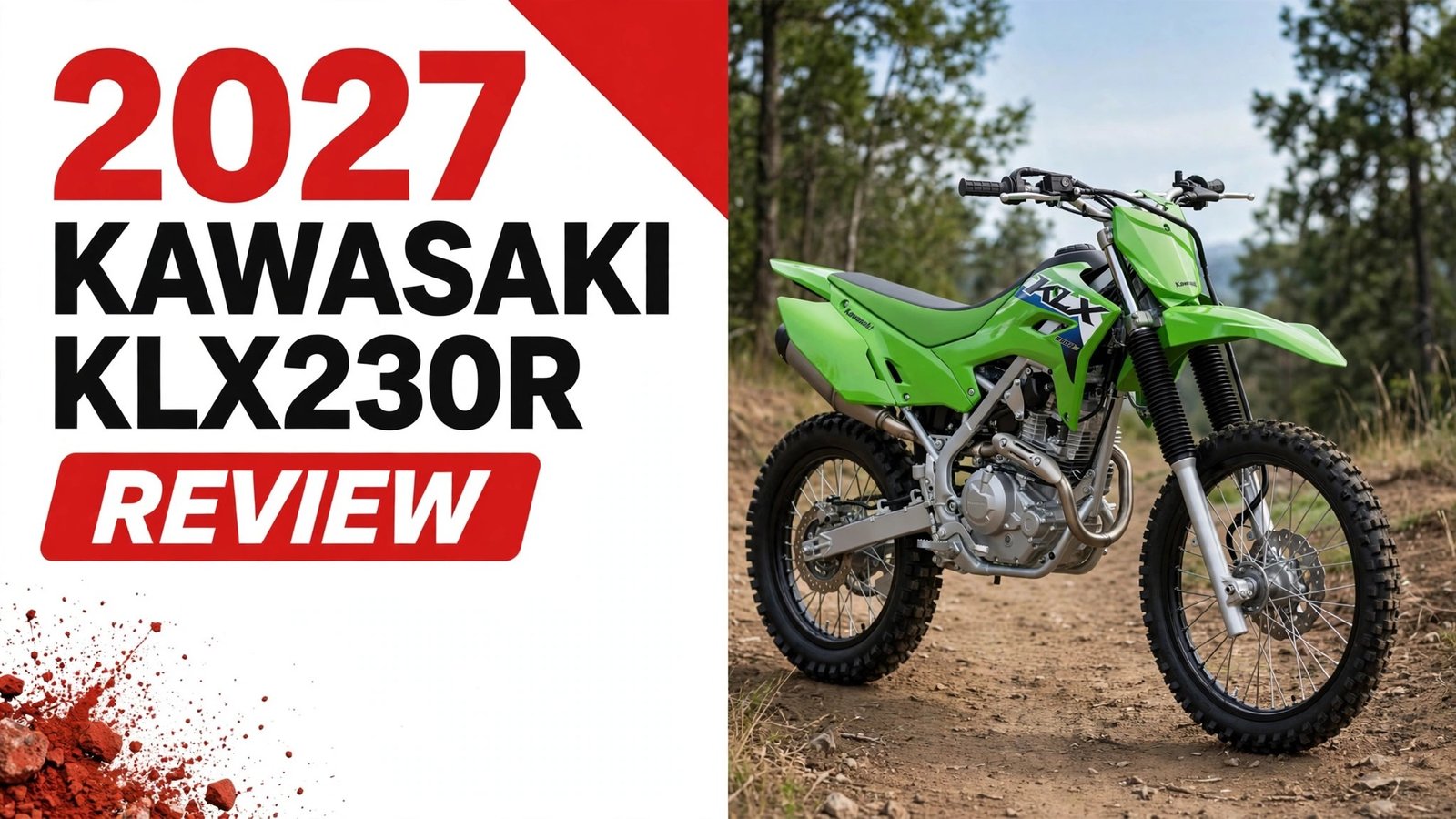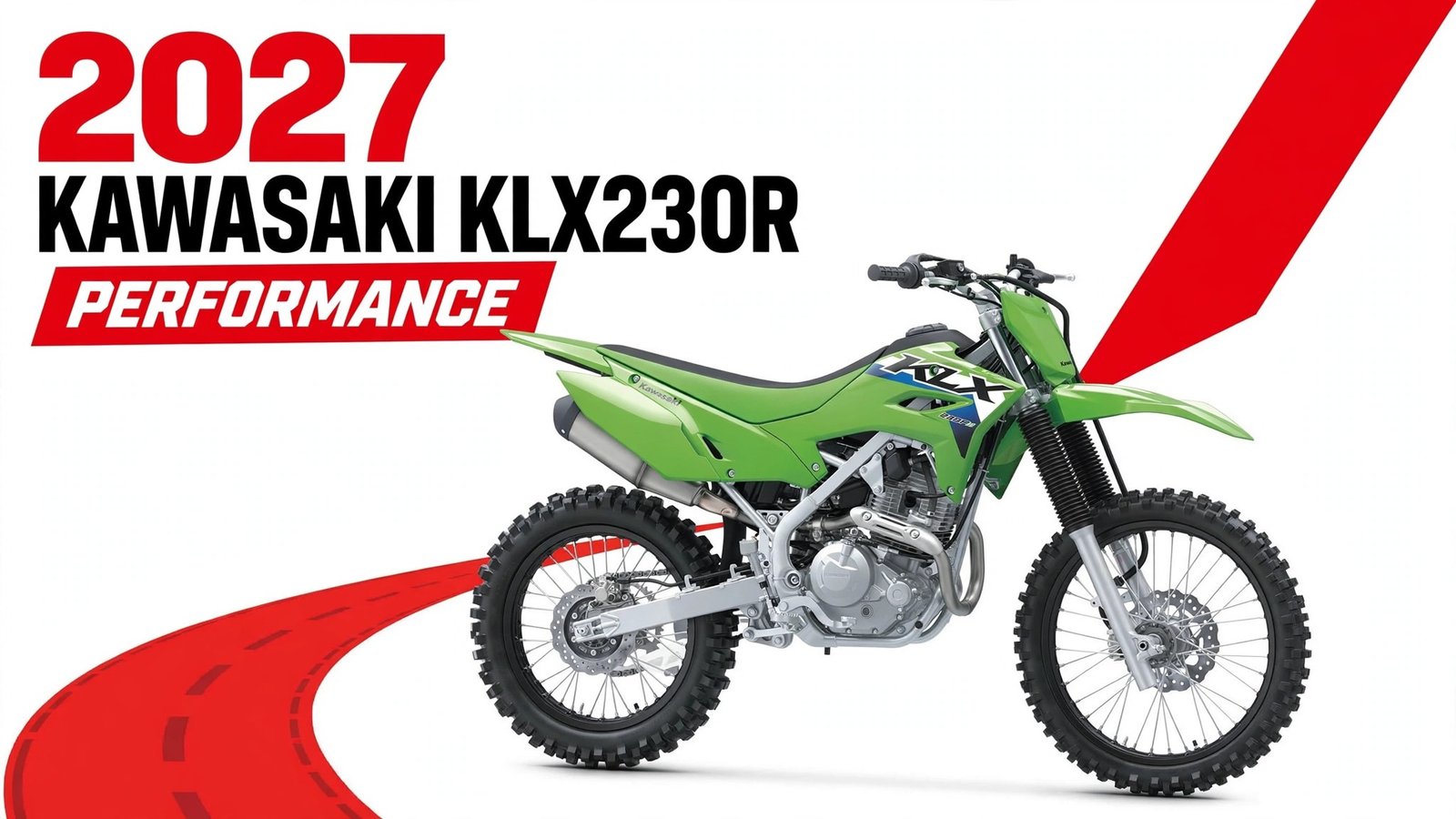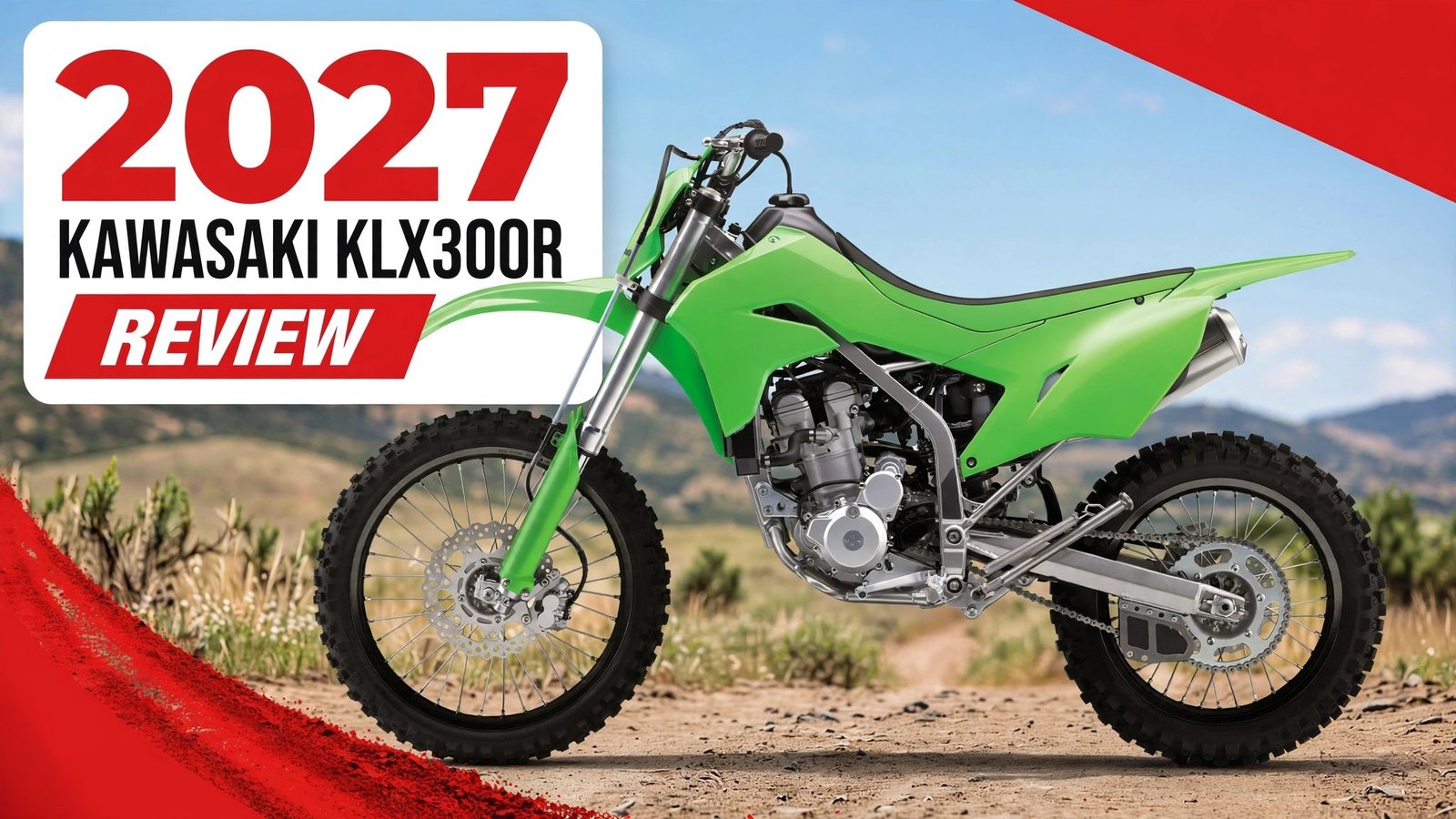
The 2027 Kawasaki KLX300R costs $5,799 plus a $650 destination charge, $6,449 delivered, and it is the only full-size trail bike in its price class with a fully adjustable fork and shock. This Kawasaki KLX300R review covers the 2027 bike: a 292cc liquid-cooled single with fuel injection, a six-speed gearbox, electric start only, no dash, no headlight, and no mirrors, built for trails and closed courses only, not for the street.
There is no instrument cluster, no ABS, and no rider mode to explain. What you get instead is a 43 mm inverted fork with compression adjustment, a piggyback-reservoir rear shock with compression, rebound and preload adjustment, 11.2 inches of travel at both ends, and a 35.4-inch seat on 2023 and later bikes. Kawasaki USA publishes no horsepower figure for the R, and no independent dyno of the R itself exists, so this Kawasaki KLX300R review labels every power claim by its source and prints no top speed, no tested fuel figure, and no resale percentage.
Kawasaki KLX300R Overview and Model-Year Updates
This Kawasaki KLX300R review starts with the bike’s place in the line. The KLX300R returned for 2020 after a 12-year break, announced on June 18, 2019, at $5,499, and it relaunched a nameplate that last ran from 1996 to 2008. The new bike is a clean-sheet fuel-injected machine, not a rehash of the old carburetted 292cc bike, and the old bike’s 32.32 hp claim belongs to that old bike only. Its biggest change came for 2023, when the seat dropped from 36.4 inches to 35.4 inches, and this Kawasaki KLX300R review treats that drop as the most important model-year change.
No Dash and No Headlight
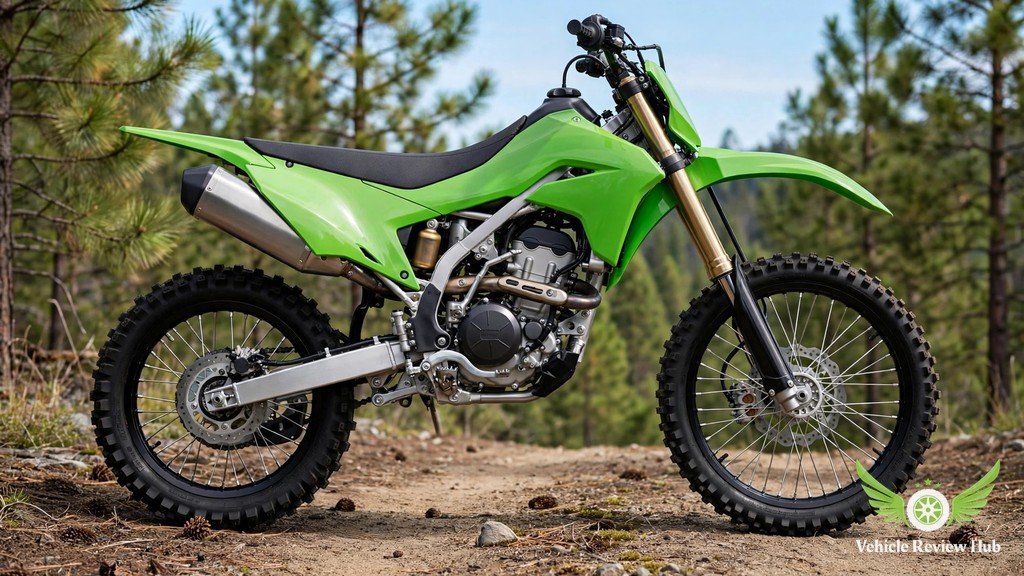
The KLX300R has no dash and no headlight, and that is the first thing a rider coming from a dual-sport notices. There is no instrument cluster of any kind, only indicator lamps, including a low-fuel lamp, and there are no mirrors, no turn signals, and no licence plate holder. This Kawasaki KLX300R review stresses the point because the missing equipment is the whole identity of the bike: it is an off-road-only trail bike, and it cannot be ridden on public roads. A USFS-approved spark arrester is fitted, and it is California Green Sticker legal. There is also no odometer, trip meter or hour meter, so this Kawasaki KLX300R review recommends fitting an hour meter or keeping a written log from day one.
Announced June 2019 at $5,499
Kawasaki announced the KLX300R on June 18, 2019, priced at $5,499 for the 2020 model year, and the first-look coverage from Cycle News and Motorcycle.com both carried that figure. With the 2020 destination charge of $410, the bike cost $5,909 delivered. The price has moved in both directions since, falling to $5,549 for 2024 and 2025 before rising to $5,749 for 2026 and $5,799 for 2027, and this Kawasaki KLX300R review gives the full year-by-year path in the price section below. The first three model years were essentially unchanged, the 2023 bike brought the lower 35.4-inch seat, and colours moved from Lime Green only through 2023 to Lime Green and Battle Gray for 2024 and 2025 and Lime Green and Bright White for 2026 and 2027. Nothing about the engine changed, so this Kawasaki KLX300R review treats a used 2020 bike and a new 2027 bike as the same machine with a different seat height.
Kawasaki KLX300R Engine and Specifications
The engine in this Kawasaki KLX300R review is a 292cc liquid-cooled single with double overhead cams and four valves, fed by a 34 mm Keihin throttle body and a six-speed gearbox. Kawasaki USA publishes no horsepower figure for the R on any spec sheet from 2020 to 2027, and this Kawasaki KLX300R review will not invent one. The closest official figure comes from the Australian Kawasaki spec sheet for the same 292cc engine: 21.4 kW, or 29 PS, at 8,000 rpm and 26.3 Nm at 7,000 rpm. That 29 PS converts to 28.6 hp, so it must never be written as 29 hp.
| Specification | Kawasaki KLX300R (2027) |
|---|---|
| Engine | 292cc liquid-cooled DOHC 4-valve single |
| Bore x stroke | 78.0 x 61.2 mm |
| Compression ratio | 11.0:1 (US sheets; Australian sheet says 11.1:1) |
| Fuelling | DFI, 34 mm Keihin throttle body, TCBI with electronic advance |
| Power (labelled) | No US figure published; Australian sheet 21.4 kW (29 PS) at 8,000 rpm |
| Torque (labelled) | 26.3 Nm at 7,000 rpm (Australian sheet) |
| Transmission | 6-speed return shift, wet multi-disc manual clutch |
| Final drive | Chain, stock gearing 14/50 |
| Starting | Electric start only, no kick starter |
| Front suspension | 43 mm inverted fork, compression adjustable, 11.2 in travel |
| Rear suspension | Uni-Trak piggyback shock, compression + rebound + preload, 11.2 in travel |
| Front brake | 270 mm petal disc, dual-piston caliper |
| Rear brake | 240 mm petal disc, single-piston caliper |
| ABS | None — every US sheet marks the bike NON-ABS |
| Wheels / tyres | 21/18 in spoke; 80/100-21 front, 100/100-18 rear |
| Wheelbase | 56.5 in |
| Rake / trail | 26.9 degrees / 4.3 in |
| Seat height | 35.4 in (2023+; 36.4 in for 2020–2022) |
| Ground clearance | 11.8 in (2024+; 12.0 in / 11.8 in CA for 2020–2023) |
| Curb weight | 282.2 lb / 286.7 lb 50-state (2024+) |
| Fuel capacity | 2.1 gal |
| Warranty | 6 Month Limited |
Notes: the power and torque figures in this Kawasaki KLX300R review are the Australian-sheet figures for the same 292cc engine, labelled as such, because Kawasaki USA publishes no horsepower figure for the R. The 2027 street KLX300’s revised engine claims 26.8 hp at 8,000 rpm, but the R did not receive that update. The Cycle World dyno figure of 23.4 hp at 8,100 rpm belongs to the street KLX300, not the R, and no dyno of the R itself exists.
43 mm Inverted Fork, Not Conventional
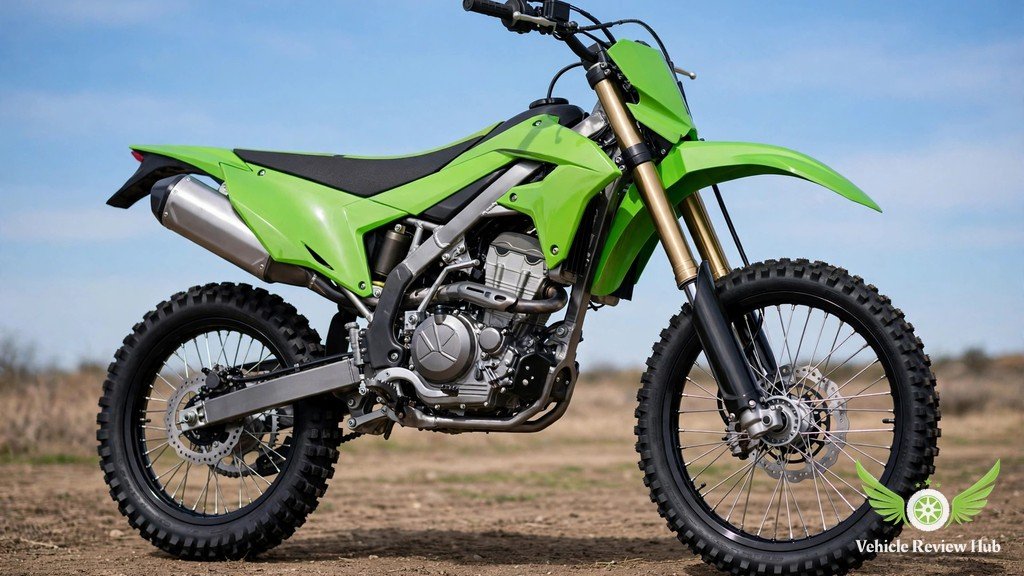
The front end is the single most important specification in this Kawasaki KLX300R review, because it is what separates the R from every cheaper trail bike in the class. The 43 mm inverted fork is compression-adjustable and offers 11.2 inches of travel, and the rear Uni-Trak shock carries a piggyback reservoir with compression, rebound and preload adjustment and the same 11.2 inches of travel. The Ultimate Motorcycling 2020 review lists the adjustable suspension among its nine fast facts, and no rival at this price gives the rider that much adjustment: the KLX230R runs a 37 mm conventional fork with no adjustment, and the Honda CRF300F runs a 41 mm Showa fork with no adjustment. Brakes are 270 mm petal front and 240 mm petal rear discs, with no ABS to interfere on loose dirt.
Seat Is 35.4 Inches, Not 35.2
The seat on a 2023 or later KLX300R is 35.4 inches, and this Kawasaki KLX300R review is careful with that number because a very similar number belongs to a different bike. The street-legal dual-sport KLX300 has a 35.2-inch seat, and the two figures are easy to mix up. The R’s own seat was 36.4 inches for 2020 to 2022, then dropped to 35.4 inches for 2023, a full inch lower, so a rider who sat on a 2020 bike and found it too tall should try a current one before deciding. Ground clearance moved the same way, from 12.0 inches to a single 11.8-inch figure on the 2024 and later sheets. This Kawasaki KLX300R review prints the year splits wherever they exist.
Kawasaki KLX300R Price and Market Availability
The 2027 KLX300R lists at $5,799 with a $650 destination charge, $6,449 delivered, and that is the price this Kawasaki KLX300R review uses as its anchor. The bike is sold in the USA as a current model, and this Kawasaki KLX300R review uses the 2027 sheet as its price source. The price path since launch has not been a straight climb: the bike started at $5,499 in 2020, rose to $5,699 in 2022, then fell to $5,549 for 2024 and 2025 before rising again to $5,749 for 2026 and $5,799 for 2027. The destination charge has climbed from $410 to $650 through the same years, which is why this Kawasaki KLX300R review labels every delivered price with its year.
| Model year | MSRP | Destination | Delivered |
|---|---|---|---|
| 2020 | $5,499 | $410 | $5,909 |
| 2021 | Not verified | Not verified | Not printed |
| 2022 | $5,699 | $430 | $6,129 |
| 2023 | $5,899 (conflicted) | $435 | $6,334 if $5,899 |
| 2024 | $5,549 | $450 | $5,999 |
| 2025 | $5,549 | $600 | $6,149 |
| 2026 | $5,749 | $650 | $6,399 |
| 2027 | $5,799 | $650 | $6,449 |
Notes: MSRP figures in this Kawasaki KLX300R review come from Kawasaki USA’s official spec-sheet PDFs, and destination charges come from Motorcycle.com spec pages for 2020 to 2025 and dealer listings for 2026 and 2027. The 2021 MSRP was not verified in this pass, so no 2021 dollar figure is printed as fact. The 2023 MSRP is conflicted: Kawasaki’s own 2023 sheet prints “TBA” while Motorcycle.com lists $5,899, so the $6,334 delivered figure is shown only as the arithmetic if $5,899 is correct.
Kawasaki KLX300R Price in the USA: $5,799
The 2027 KLX300R costs $5,799 in the USA, and the figure comes from Kawasaki’s own 2027 spec sheet, not from a dealer listing. With the $650 destination charge, the delivered price is $6,449. That puts the R exactly $1,000 above the 2027 KLX230R on MSRP, $5,799 against $4,999, and $1,015 above it delivered, $6,449 against $5,434. Against the street-legal dual-sport KLX300 ABS, the R is $200 cheaper on MSRP and $200 cheaper delivered, $6,449 against $6,649. This Kawasaki KLX300R review keeps those comparisons like-for-like. The 2027 bike comes in Lime Green or Bright White, and a leftover 2026 bike at $5,749 differs only by $50, colour and dealer stock.
2023 Price Remains in Conflict
The 2023 price is the one figure in this Kawasaki KLX300R review that cannot be settled, and the conflict is worth explaining in full. Kawasaki’s own 2023 spec sheet prints the base MSRP as “TBA”, which means Kawasaki itself did not publish a 2023 price on that sheet. Motorcycle.com’s database, meanwhile, lists the 2023 KLX300R at $5,899 with a $435 destination charge, $6,334 delivered. Both figures are printed here, labelled by source, and neither is the settled 2023 price. The shape of the price path is the reason for caution: a $5,899 price for 2023 followed by a $5,549 price for 2024 would be a $350 cut in a single year, and the same Motorcycle.com page lists the 2023 street KLX300 at exactly the same $5,899. The 2024 price of $5,549 is settled, because it comes from Kawasaki’s own 2024 spec sheet, and only 2023 stays open in this Kawasaki KLX300R review.
Kawasaki KLX300R Design, Features and Technology
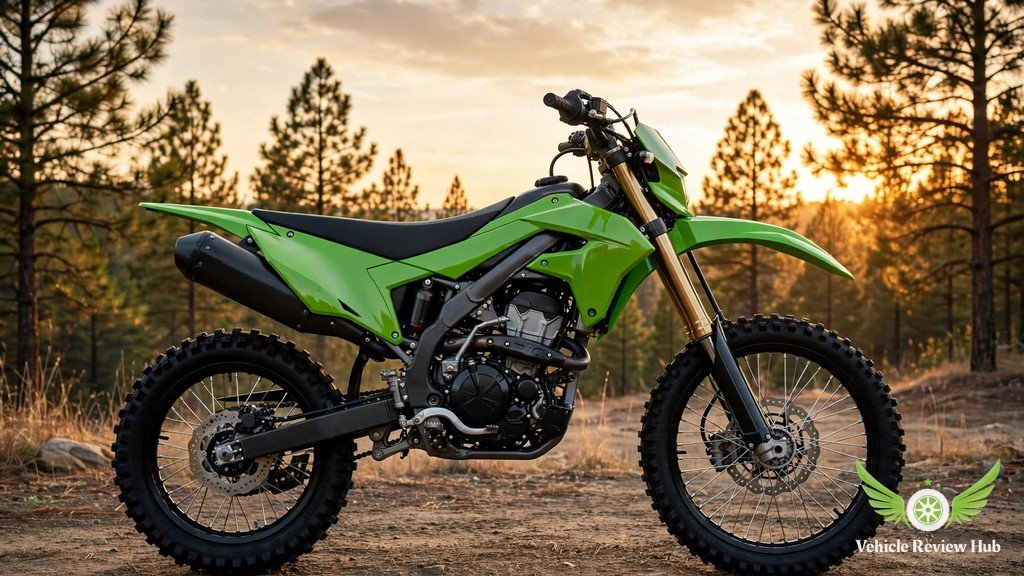
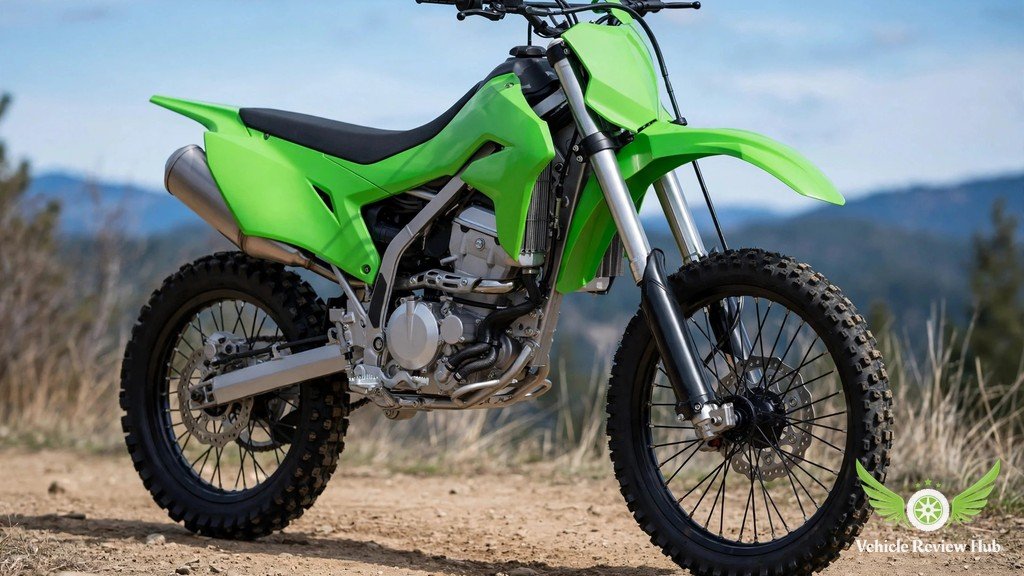
The KLX300R looks like a modern KX motocross bike with the lights taken off, and that is essentially what it is. The angular shrouds, the high front fender, the high-mounted muffler on the right, and the slim seat all come from Kawasaki’s off-road family. This Kawasaki KLX300R review notes the design because it explains the bike’s character: everything on it is there to work on a trail, and nothing on it is there for the street. There is no headlight to break in a fall, no mirrors to fold, and no turn signals to snap off, which matters when the bike falls over.
| Bike | Curb weight | Gap vs KLX300R |
|---|---|---|
| Kawasaki KLX300R | 282.2 lb | — |
| Kawasaki KLX300 dual-sport | 302.1 lb (2021–2023 sheets) | 19.9 lb heavier |
| Kawasaki KLX300 dual-sport ABS (2027) | 304.3 lb | 22.1 lb heavier |
| Kawasaki KLX300SM supermoto | 304.3 lb (2023 sheet) | 22.1 lb heavier |
Notes: the 22.1-lb gap in this Kawasaki KLX300R review is against the 304.3-lb KLX300SM and the 2027 KLX300 ABS, both 304.3 lb on their official sheets. Against the 302.1-lb dual-sport KLX300 on the 2021 and 2023 sheets, the gap is 19.9 lb. The two figures must not be mixed.
Liquid-Cooled: Radiators to Protect
The R is liquid-cooled, and that is a genuine advantage over the air-cooled KLX230R, because the 292cc engine holds its temperature on a slow, technical climb where an air-cooled motor would heat-soak. The trade-off is that the radiators sit exposed at the front of the bike, and this Kawasaki KLX300R review flags them as the first thing to protect. A radiator guard is the standard owner add-on for the R, worth fitting before the first ride, because a bent radiator on a trail bike is a ride-ending failure. The guard is owner practice, not a factory fitment, and the liquid cooling also means the bike has coolant to service, which the air-cooled 230R does not.
22.1 Pounds Lighter Than Street
The KLX300R is 22.1 pounds lighter than the street KLX300SM, and this Kawasaki KLX300R review is precise about which street bike that figure is against. The arithmetic is exact: the KLX300SM’s curb weight is 304.3 lb on its official 2023 sheet, and the R’s curb weight is 282.2 lb, so 304.3 minus 282.2 is 22.1 lb. The same 22.1-lb gap holds against the 2027 KLX300 ABS dual-sport, which also lists 304.3 lb. Against the dual-sport KLX300 on the 2021 and 2023 sheets, which lists 302.1 lb, the gap is 19.9 lb. The saving comes from what the R does not carry: no lights, mirrors, dash, or ABS hardware.
Kawasaki KLX300R Riding Experience and Comfort
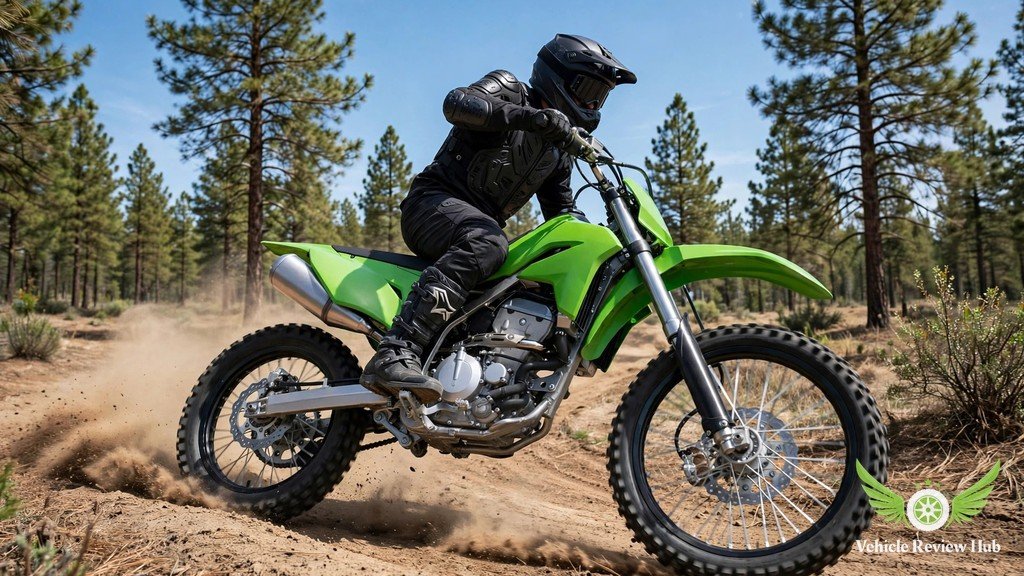
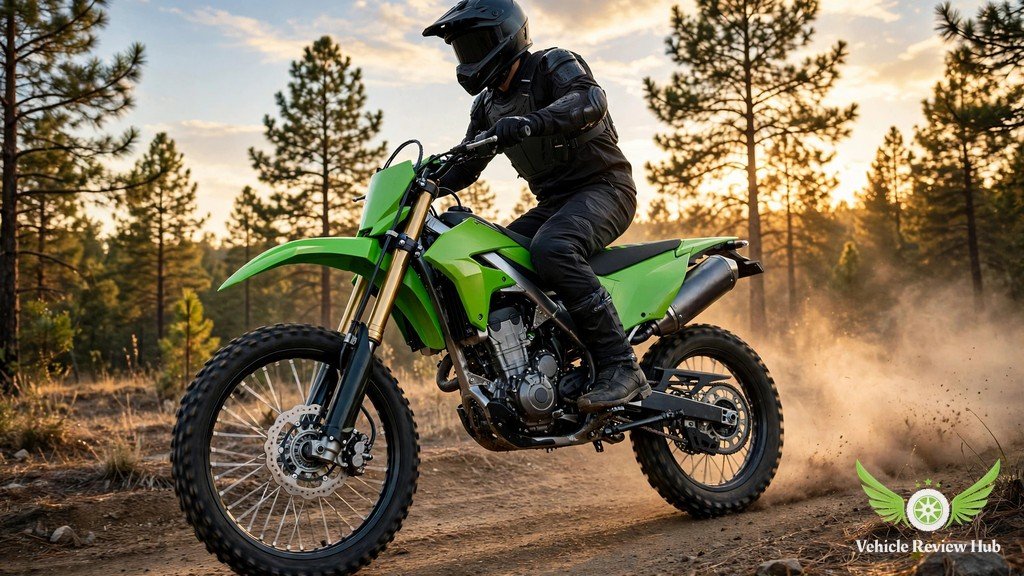
On the trail, the KLX300R feels like a full-size bike that is easy to ride rather than a small bike that is easy to outgrow, and that is the balance testers keep coming back to. The Motorcycle.com 2020 review, which scored the bike 85.75 out of 100, found that it never feels overly fast or intimidating but can handle technical trails, two-trackers and single track all day, and praised its predictable mid-range power. This Kawasaki KLX300R review agrees with that framing: the R is not a fast bike, and it is not trying to be one, but it is a capable one. The short 14/50 gearing keeps the engine in its useful range, and the electric start means a stall costs seconds, not a kick-start wrestling match. Comfort is a matter of fit, and the 2020 review’s tester, 5 feet 8 inches tall with a 30-inch inseam, got both boots on level ground on the original 36.4-inch bike once the shock settled, so this Kawasaki KLX300R review recommends sitting on the bike before buying.
Full-Size Chassis, Trail Manners
The full-size chassis is what makes the R feel planted where the smaller KLX230R feels light, and this Kawasaki KLX300R review treats that as the R’s defining ride quality. The 11.2 inches of travel at both ends soak up rocks and roots that would deflect a shorter-travel bike. The RevZilla 2020 first ride of the KLX230R and KLX300R together found the R the more planted of the two. The KLX230R is the step down from this bike, and the KLX230R review covers that smaller, air-cooled trail bike in full. The weight is the one thing every tester mentions against the R: at 282.2 lb curb, it is roughly 30 to 50 lb heavier than a 250 or 350 race enduro, and that weight is felt when the bike is picked up after a fall. This Kawasaki KLX300R review prints no specific enduro weight, because none was verified against a source in this pass.
6 Month Limited Warranty
The KLX300R carries a 6 Month Limited warranty, and that figure appears on every official spec sheet from 2020 to 2027. This Kawasaki KLX300R review states it plainly because the warranty is short, and a buyer should know it before signing. Six months is the standard warranty for an off-road-only bike in this class, and it reflects the way these bikes are used: hard, off road, and often modified. The warranty covers manufacturing defects, not wear items, crash damage, or the consequences of racing. A used KLX300R will almost always be out of warranty, so judge it on condition, hours, and maintenance history.
Kawasaki KLX300R Review: Pros, Cons and Verdict
The verdict in this Kawasaki KLX300R review is that the R is the best trail bike Kawasaki sells for a rider who wants a full-size machine with real suspension and no street pretence, at a price that stays under $6,500 delivered. It costs $1,015 more delivered than the KLX230R, and for that money it gives a liquid-cooled 292cc engine, a 43 mm inverted fork, a fully adjustable shock, and 11.2 inches of travel at both ends. Motorcycle.com scored the 2020 bike 85.75 out of 100, with its highest mark for value at 10 out of 10 and its lowest for instruments and controls at 3 out of 5. This Kawasaki KLX300R review agrees with that balance: the bike’s weaknesses are all things it chose not to have, and its strengths are all things it chose to have.
| Advantages | Limitations |
|---|---|
| Fully adjustable 43 mm inverted fork and piggyback shock, 11.2 in travel both ends | No dash, no headlight, no mirrors — off-road only, never street legal |
| Liquid-cooled 292cc single with fuel injection, 6-speed, electric start | No horsepower figure published by Kawasaki USA; no dyno of the R exists |
| 35.4 in seat (2023+) fits more riders than the 36.4 in original | 282.2 lb curb is heavy next to a race enduro |
| $6,449 delivered for 2027 — $1,015 more than the KLX230R | 2.1 gal tank with a low-fuel lamp only, no gauge and no reserve tap |
| No recall names the R in any source consulted | 6 Month Limited warranty only; no hour meter fitted |
Notes: the advantages and limitations in this Kawasaki KLX300R review are drawn from the tested record, not from a spec-sheet comparison alone. The “no recall names the R” line rests on the NHTSA API search, which returned Count:0 for the 2026 KLX300R with the Ninja 500 2024 control returning Count:1, campaign 25V146000, so the zero is a search result with a working control, not a guarantee. The CPSC search was inconclusive, so no claim about CPSC records is made here. No resale percentage or running-cost dollar figure is printed, because none was verified.
Main Advantages and Limitations of the Kawasaki KLX300R
The main advantage of the R is its suspension, and this Kawasaki KLX300R review puts that first because it is the reason the bike exists at its price. A fully adjustable fork and shock with 11.2 inches of travel is not available on the KLX230R, the Honda CRF300F, or the Yamaha TT-R230. The liquid-cooled engine is the second advantage, and the fuel injection is the third, because it starts cleanly and runs the same at altitude. Testers also agree the R suits beginners stepping up from a 230-class bike, with the caveats of its full-size seat height and its 282 lb weight, and the KLX140R review covers the smaller, carburetted step-down bike for riders who want to start lower still. The limitations are the mirror image: no dash, no headlight and no mirrors, so it can never be ridden on the road; no published horsepower figure and no dyno of the R; a 2.1-gallon tank with a low-fuel lamp only and no reserve tap; a 6 Month Limited warranty and no hour meter.
Thailand-Built Platform
The KLX300R is built in Thailand, and the evidence is a 2023 bike’s VIN decode, which lists the plant as Kawasaki Motors Enterprise Co., LTD in Pluak Daeng, Rayong, Thailand. This Kawasaki KLX300R review states the build origin because the doc heading names it, and the VIN evidence confirms it. The Honda CRF300F is the R’s closest rival on price and purpose, and the Honda CRF300F review covers that air-cooled 2026 trail bike for buyers comparing the two.
The final word in this Kawasaki KLX300R review is simple. Buy the R if you want a full-size trail bike with real suspension, a liquid-cooled fuel-injected engine, and no street compromise, and if $6,449 delivered fits your budget. Buy the KLX230R instead if you want a lighter, cheaper bike, or the street KLX300 if you need a plate. The R sits in the gap between the 230-class trail bikes and the race enduros, and it fills that gap better than anything else at its price.
Kawasaki KLX300R Review Frequently Asked Questions
These answers cover the questions buyers ask first about the R — what it costs, whether it can be ridden on the road, and what its numbers actually are — all from the verified record in this Kawasaki KLX300R review.
How much does the KLX300R cost?
The 2027 KLX300R lists at $5,799 plus a $650 destination charge, $6,449 delivered. The price path has not been a straight climb: $5,499 in 2020, $5,699 in 2022, $5,549 in 2024 and 2025, $5,749 in 2026, and $5,799 in 2027. The 2023 price is still in conflict — Kawasaki’s own 2023 sheet prints “TBA” while Motorcycle.com lists $5,899 — so neither figure is settled. The 2021 MSRP was not verified, so no 2021 dollar figure is printed as fact.
Is the KLX300R street legal?
No. The R has no headlight, no mirrors, no turn signals, no licence plate holder and no dash — only indicator lamps, including a low-fuel lamp — so it can never be ridden on public roads. It is an off-road-only trail bike for trails and closed courses. A USFS-approved spark arrester is fitted, and it is California Green Sticker legal.
What engine does the KLX300R have?
A 292cc liquid-cooled DOHC four-valve single with fuel injection through a 34 mm Keihin throttle body, a six-speed gearbox and electric start only — there is no kick starter. Kawasaki USA publishes no horsepower figure for the R, and no dyno of the R itself exists. The only factory power number this Kawasaki KLX300R review attaches to the R’s engine comes from the Australian Kawasaki spec sheet: 21.4 kW, or 29 PS, at 8,000 rpm and 26.3 Nm at 7,000 rpm. That 29 PS converts to 28.6 hp, so it must never be written as 29 hp.
What is the seat height?
35.4 inches on 2023 and later bikes, and that is the figure this Kawasaki KLX300R review prints for the current bike. The original 2020 to 2022 bikes had a 36.4-inch seat, and the one-inch drop came for 2023. Do not mix it up with the street-legal dual-sport KLX300, whose seat is 35.2 inches — that is a different bike’s number.
How much does the KLX300R weigh?
282.2 lb curb on the 2024 and later sheets, or 286.7 lb in 50-state trim. Dirt Bikes weighed a 2020 California-trim bike and recorded a measured 288 pounds full of liquids. Against the street bikes the R is lighter: 22.1 lb lighter than the 304.3-lb KLX300SM and the 2027 KLX300 ABS, and 19.9 lb lighter than the 302.1-lb dual-sport KLX300 on the 2021 to 2023 sheets. The two gaps must not be mixed.
Is the KLX300R still made, and what is the warranty?
Yes — the 2027 bike is a current model, and this Kawasaki KLX300R review uses the 2027 sheet as its price source. It comes in Lime Green or Bright White. Colours moved from Lime Green only through 2023 to Lime Green and Battle Gray for 2024 and 2025. The bike is built in Thailand, at Kawasaki Motors Enterprise in Pluak Daeng, Rayong. It carries a 6 Month Limited warranty, the figure on every official spec sheet from 2020 to 2027.