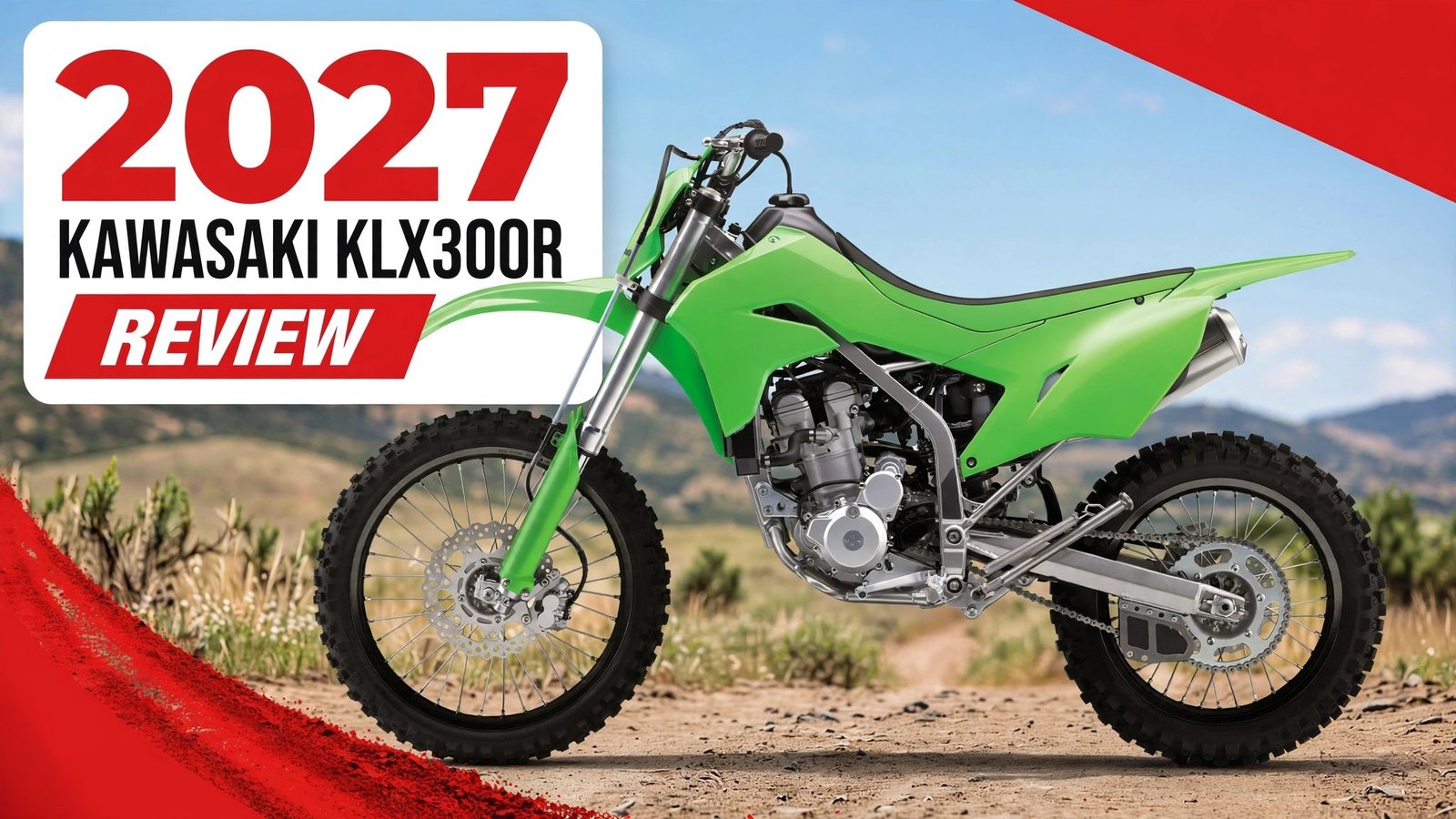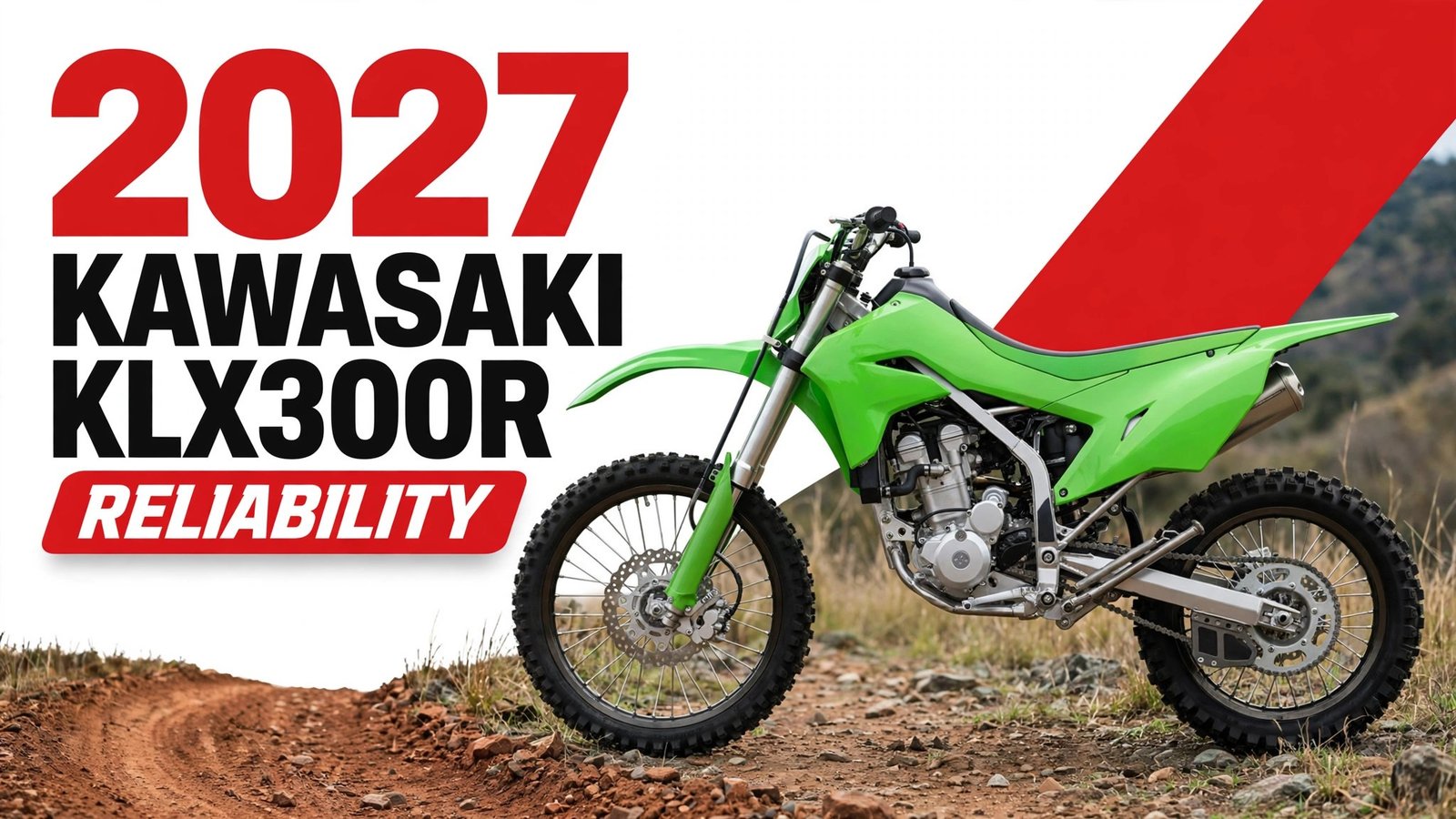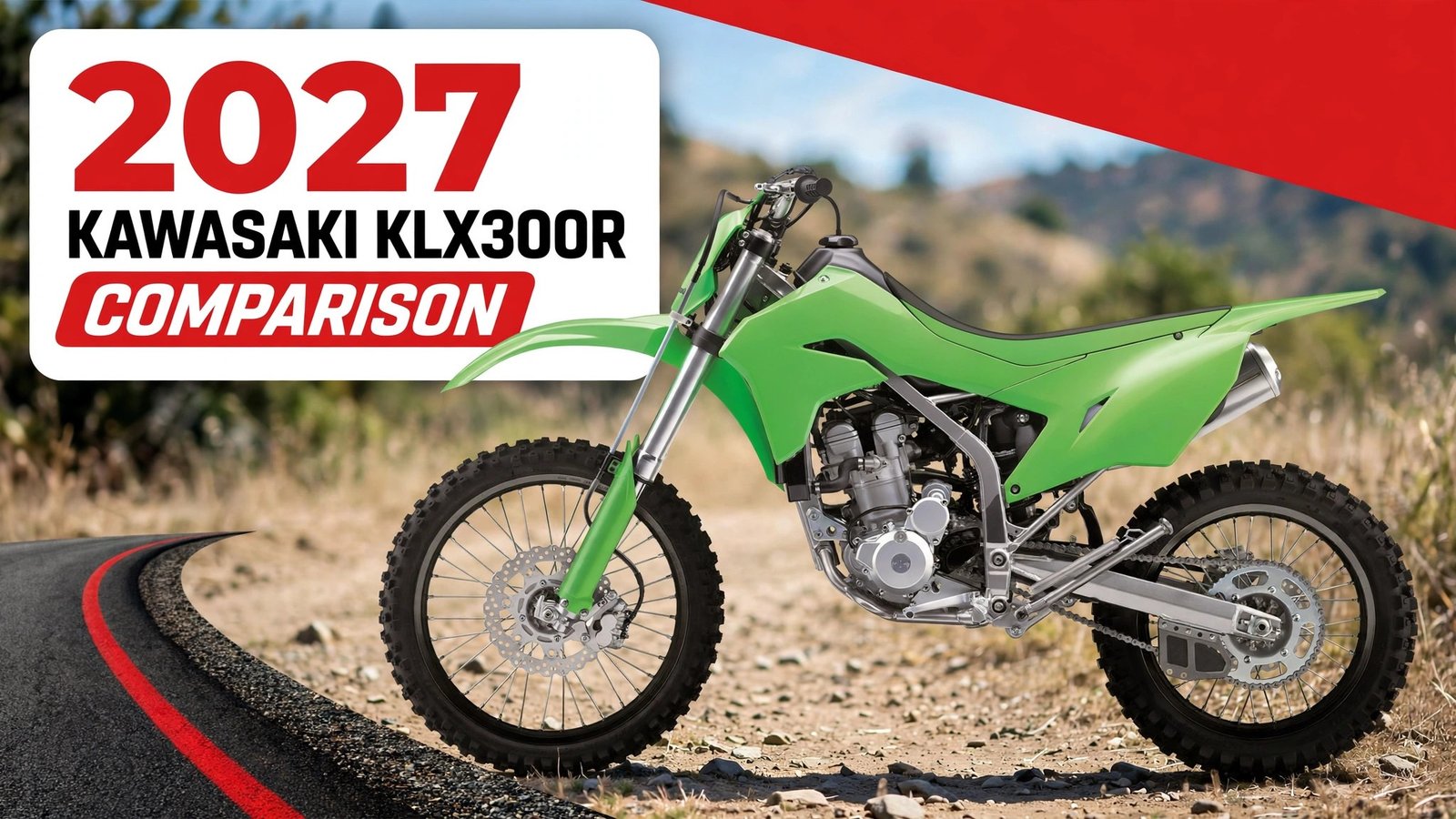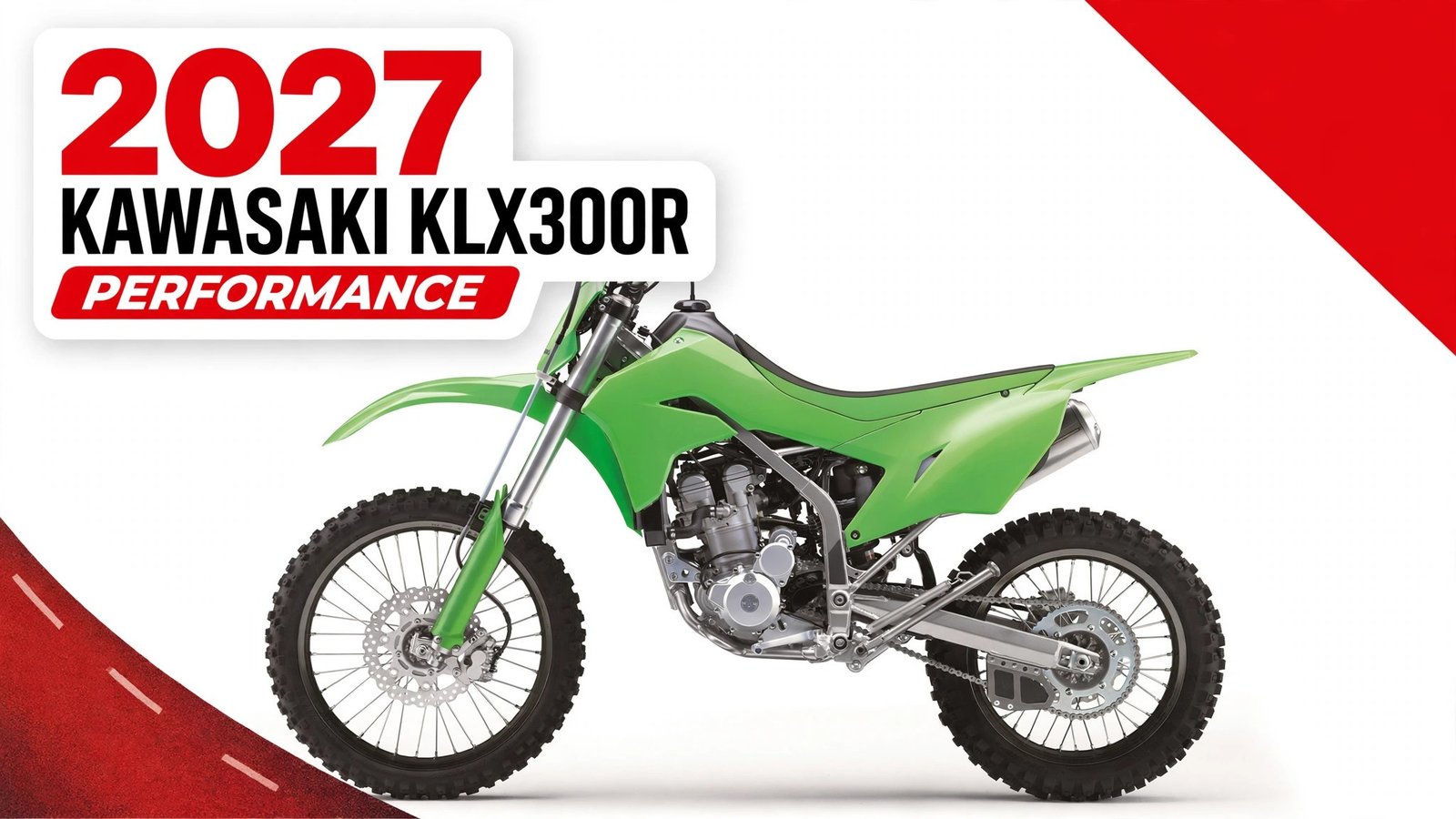
The 2027 Kawasaki KLX300R is a trail bike defined by what it does not try to be. Kawasaki has never published a horsepower figure for it. The numbers most often quoted for the R, a 23.4-horsepower dyno run, a 56-mpg fuel figure, and a 70-mph top speed, come from the street-legal KLX300 or owner websites, not a test of the R itself. This Kawasaki KLX300R performance guide covers the engine, the missing top-speed and mileage figures, the real-world ride, and the handling.
Kawasaki KLX300R Engine Performance and Power Delivery
This Kawasaki KLX300R performance story starts with the engine. The 292cc liquid-cooled DOHC four-valve single makes its power in the mid-range, and the six-speed gearbox with its short 14/50 gearing keeps it there. Kawasaki USA has never published a horsepower figure for the R, so any number quoted needs a source label. The Australian Kawasaki spec sheet for the same 292cc engine lists 21.4 kW, or 29 PS, at 8,000 rpm and 26.3 Nm at 7,000 rpm. That 29 PS converts to 28.6 horsepower. For Kawasaki KLX300R performance, the mid-range is the whole point: the engine tractors up obstacles at low revs, and that character is what testers praise.
The video below, chosen for this Kawasaki KLX300R performance guide, shows three KLX300Rs riding together on the tame trails of McLean Creek in Alberta, Canada, recorded in August 2026: a real-world group trail ride, not a performance test.
Dyno Figure Belongs to the Street Bike
The most quoted dyno figure for the KLX300R does not belong to the R at all. In September 2021, Cycle World put the street-legal KLX300 on its in-house dyno and recorded 23.4 horsepower at 8,100 rpm and 15.4 lb-ft of torque at 8,000 rpm. Those are rear-wheel figures for the plated dual-sport, repeated so often that listings now attach them to the R. This Kawasaki KLX300R performance guide is clear: no dyno test of the R itself exists, so the 23.4-horsepower figure must never be printed as the R’s power. The two bikes share the same 292cc engine, but the R runs a different tune and gearing, and its output was never measured on a dyno. The Australian-sheet figure of 21.4 kW, or 29 PS, is the only factory power number attached to the R’s own engine. The 2027 street KLX300’s revised engine, claimed at 26.8 horsepower, is another figure that does not belong to the R, because the R did not receive that engine update. The old KLX300 from 1996 to 2008 claimed 32.32 horsepower, a figure that belongs to a carburetted bike from another era, not to the current R. For Kawasaki KLX300R performance, the honest baseline is the Australian-sheet 29 PS, labelled by source.
85.75 Out of 100 (Motorcycle.com 2020)
Motorcycle.com’s 2020 review gave the KLX300R an editor score of 85.75 out of 100, and the sub-scores explain where the R earns its marks. The engine scored 17.0 out of 20, suspension and handling 13.0 out of 15, transmission and clutch 9.0 out of 10, brakes 9.0 out of 10, instruments and controls 3.0 out of 5, ergonomics and comfort 8.75 out of 10, appearance and quality 8.0 out of 10, desirability 8.0 out of 10, and value 10.0 out of 10. The lowest mark is the price of having no dash at all, and the highest, value, is the point of the bike. The review found the R never feels overly fast or intimidating, but it can handle technical trails, two-trackers, and single track all day, with predictable mid-range power. That mid-range character is the heart of Kawasaki KLX300R performance, and it is why the engine scored 17.0 out of 20. The R does not win drag races, and it was never built to. It wins by putting usable power where a trail rider needs it, at low and middle revs, with fuel injection that starts cleanly and runs the same at altitude. The electric start means a stall costs seconds rather than a kick-start wrestling match on a hillside.
| Power figure | Value | Source | Applies to |
|---|---|---|---|
| Horsepower published by Kawasaki USA | No figure published | Kawasaki USA spec sheets 2020–2027 | KLX300R |
| Factory power, Australian sheet | 21.4 kW (29 PS) at 8,000 rpm | Kawasaki Australia spec sheet | KLX300R engine |
| Factory torque, Australian sheet | 26.3 Nm at 7,000 rpm | Kawasaki Australia spec sheet | KLX300R engine |
| Cycle World dyno | 23.4 hp at 8,100 rpm, 15.4 lb-ft at 8,000 rpm | Cycle World, Sept 2021 | Street KLX300 only |
| Cycle World dyno, rival | 22.7 hp at 8,400 rpm, 16.7 lb-ft at 6,400 rpm | Cycle World, same dyno session | Honda CRF300L |
| 2027 street engine claim | 26.8 hp at 8,000 rpm, 18.4 lb-ft at 6,800 rpm | Kawasaki 2027 street announcement | Street KLX300 only |
| Old-generation claim | 32.32 hp at 8,500 rpm, 28.0 Nm at 7,500 rpm | CycleChaos, KLX300A 1996–2008 | Old carburetted bike only |
Notes: only the Australian-sheet figure attaches to the R’s own engine, and 29 PS converts to 28.6 horsepower, never 29 hp. The Cycle World dyno figure, the 26.8-horsepower claim, and the 32.32-horsepower figure belong to the street KLX300 and the old carburetted bike. No dyno test of the R itself exists, so this Kawasaki KLX300R performance guide prints no rear-wheel figure for the R.
Kawasaki KLX300R Top Speed and Acceleration
Top speed is the weakest part of this Kawasaki KLX300R performance guide: Kawasaki has never published a figure for the R, and no tester has ever run an instrumented top-speed test on one. The bike has no speedometer, so a rider aboard one cannot read an accurate speed without a GPS unit. What exists instead is a handful of owner-site estimates, printed in this Kawasaki KLX300R performance guide as labelled estimates, because printing one as fact would invent a test that never happened.
No Official Figure Is Published
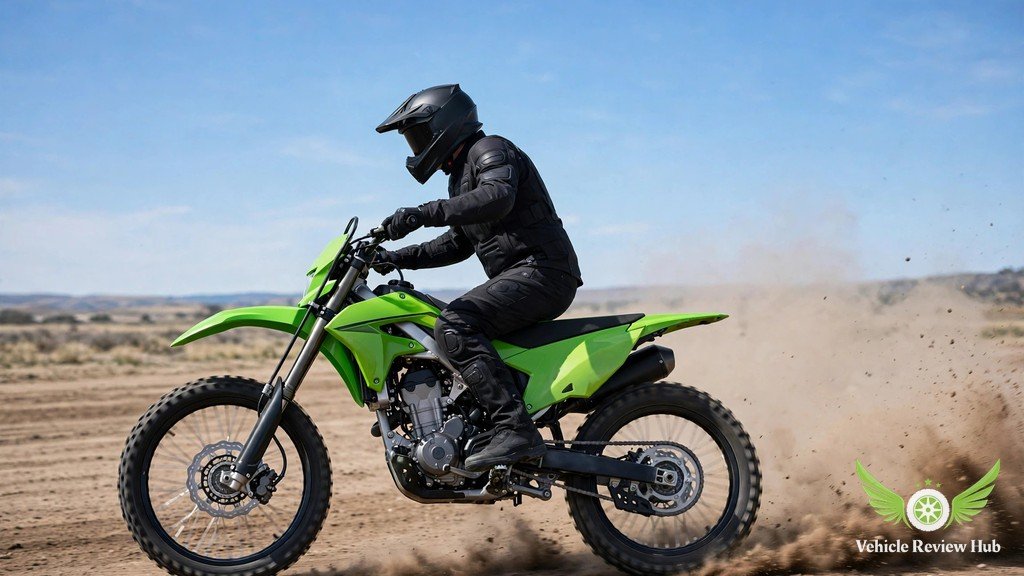
No official top-speed, 0–60, or quarter-mile figure for the KLX300R exists on any Kawasaki USA spec sheet from 2020 to 2027. The short 14/50 gearing means the engine reaches its useful revs quickly, but the bike runs out of gearing early at the top end. For Kawasaki KLX300R performance, the gearing trade favours drive over top speed. In Motorcycle.com’s 2021 shootout, the street KLX300 felt best at about 55 or 60 mph and would make it all the way to 85 mph, and other street-bike reports cite 90 mph. Those are the numbers of a bike with lights, mirrors, a plate, and a digital dash. The R has none of those. For Kawasaki KLX300R performance, the honest statement is that the bike is quick enough for trail work and that no verified top speed exists.
No Credible Tested Figure Either
With no official figure and no instrumented test, the only top-speed numbers attached to the R are owner-site estimates. Motocross Hideout puts the figure at 70 mph, and Braap Academy says about 70 mph, generally 65 to 75 mph stock, citing a rider video claiming around 75 mph. None of those is a GPS-verified run or a magazine test, and this Kawasaki KLX300R performance guide prints them only as estimates. For Kawasaki KLX300R performance, acceleration is in the same position: no 0–60 or quarter-mile time has ever been published for the R, and the short gearing that makes it feel brisk off the line also means it is not built for straight-line speed. The acceleration that matters is the low-speed drive that tractors up an obstacle from a standstill, a riding quality, not a stopwatch figure. Any listing that prints a top speed for the R as fact is repeating an estimate without saying so.
| Claim | Figure | Source | Status |
|---|---|---|---|
| R top speed | 70 mph | Motocross Hideout | Owner-site estimate |
| R top speed | 65–75 mph stock | Braap Academy | Owner-site estimate |
| R top speed | About 75 mph | Rider video claim | Unverified claim |
| Street KLX300 top speed | 85 mph | Motorcycle.com 2021 shootout | Street bike |
| Street KLX300 freeway speed | 90 mph | Street-bike freeway reports | Street bike |
| R 0–60 / quarter-mile | No figure | No source | No test exists |
Notes: every top-speed number attached to the R is an estimate or an unverified claim, and the 85-mph and 90-mph figures belong to the plated street KLX300. No instrumented test of the R exists, so this Kawasaki KLX300R performance guide prints no top speed as fact.
Kawasaki KLX300R Mileage and Fuel Economy
Fuel economy is the second gap in this Kawasaki KLX300R performance guide: no tester has ever measured the R’s fuel consumption, so there is no honest tank-range figure either. Riders plan fuel stops by hours and by habit.
No Tester Fuel Figure Exists
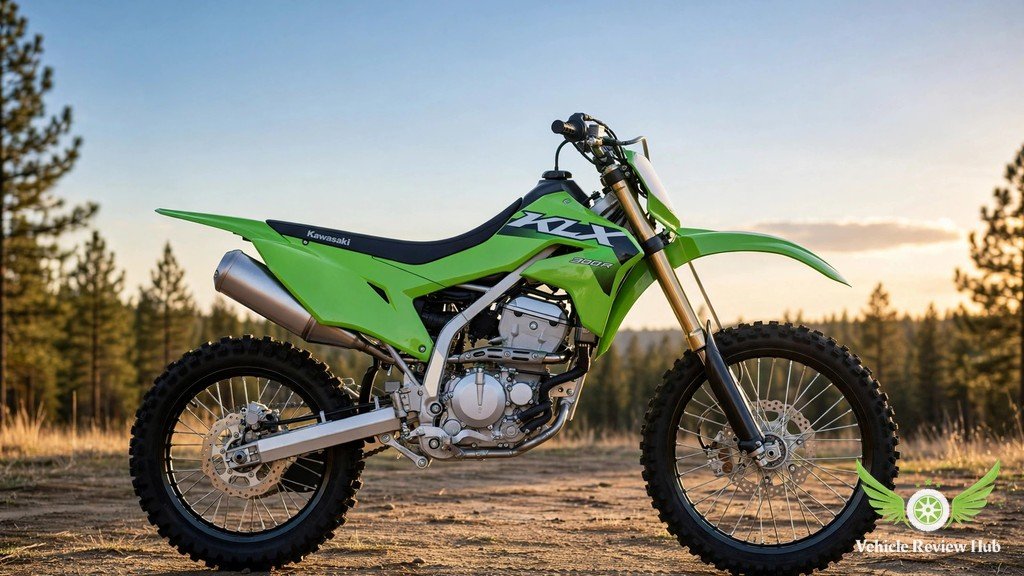
No tester-measured fuel figure for the KLX300R exists. The 56-mpg figure that sometimes appears next to the KLX300 name comes from Motorcycle.com’s 2021 shootout, where the plated KLX300 returned 56 mpg and the CRF300L returned 60 mpg. Those are street-bike figures, and they must never be printed as the R’s mileage. The R spends its life at low speed and high revs on trails, so its real consumption would look nothing like a street bike’s shootout number. Owner reports of fuel use vary widely with terrain and throttle use, and none of them is a controlled test. For Kawasaki KLX300R performance, the honest position is that fuel economy is unmeasured, and any MPG printed for the R without a source is invented.
2.1 Gallon Tank, Low-Fuel Lamp Only
The R carries 2.1 gallons of fuel, or 7.9 litres, on every official spec sheet from 2020 to 2027. There is no fuel gauge, no trip meter, no reserve tap, and only a low-fuel lamp. That is why experienced owners top up before a long loop rather than trusting the lamp. A 2.1-gallon tank is small by dual-sport standards, but the R is a trail bike that returns to a truck or a fuel can at the end of a loop, not a bike that crosses a state on one tank. Without a tested MPG, no tank-range figure can be calculated honestly, because range is mileage multiplied by capacity, and the mileage half does not exist. This Kawasaki KLX300R performance guide prints no range figure for that reason.
| Fuel item | Figure | Note |
|---|---|---|
| Tank capacity | 2.1 gal (7.9 L) | Every official spec sheet 2020–2027 |
| Fuel gauge | None fitted | Low-fuel lamp only |
| Reserve tap | None fitted | No petcock reserve |
| Tested MPG, KLX300R | No figure exists | No tester has measured it |
| Shootout MPG, street KLX300 | 56 mpg | Motorcycle.com 2021 shootout |
| Shootout MPG, CRF300L | 60 mpg | Motorcycle.com 2021 shootout |
| Tank range, KLX300R | Cannot be calculated | No tested MPG exists |
Notes: the 56-mpg and 60-mpg figures are street-bike shootout results, never the R’s mileage. With no tested MPG for the R, this Kawasaki KLX300R performance guide prints no tank-range figure.
Kawasaki KLX300R Real-World Riding Experience
On the trail, the KLX300R feels like a full-size bike that is easy to ride, not a small bike that is easy to outgrow, and that balance is the heart of Kawasaki KLX300R performance. Testers keep coming back to the same balance: enough power to tractor up obstacles, suspension that soaks up rocks and roots, and a chassis that stays planted. This Kawasaki KLX300R performance guide treats the ride, not the spec sheet, as the real test.
Praise for the Adjustable Suspension
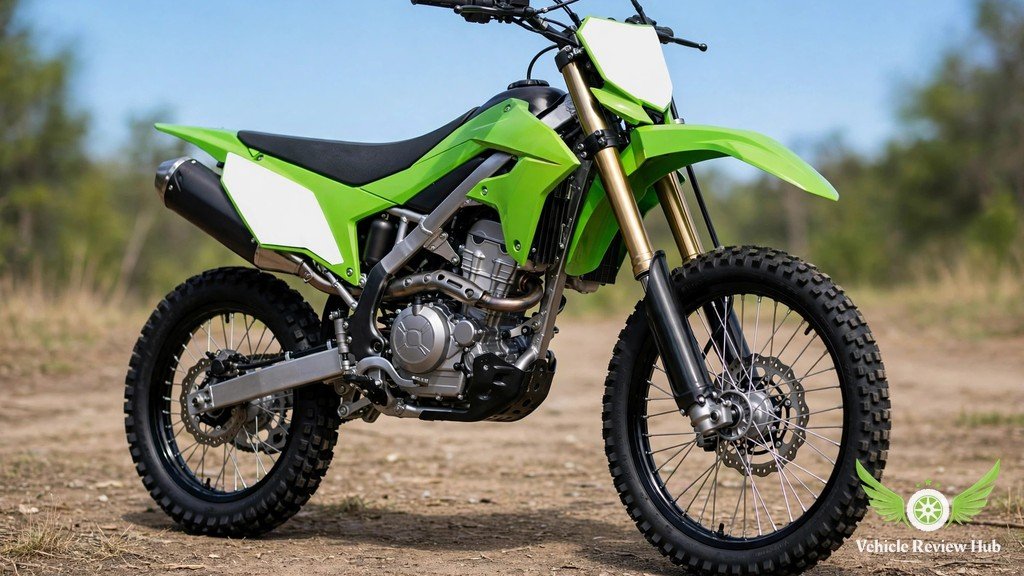
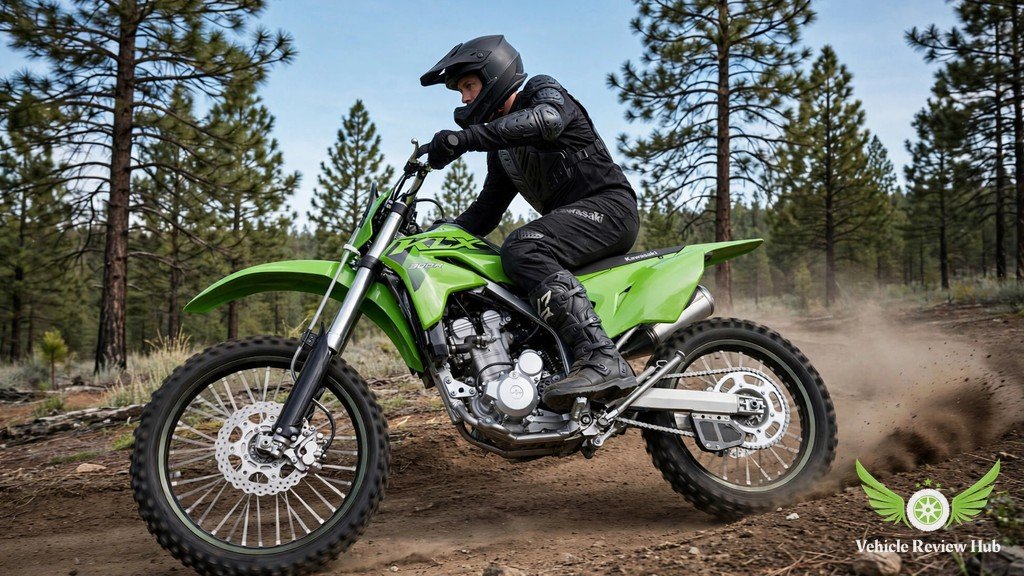
Suspension praise for the R is universal across every tester. The 43 mm inverted fork adjusts for compression, and the Uni-Trak piggyback shock adjusts for compression, rebound, and preload, with 11.2 inches of travel at both ends. No rival in the trail class at this price offers that much adjustment, and that adjustability is the core of Kawasaki KLX300R performance. RevZilla’s 2020 first ride found the R the more planted of the two, and Motorcycle.com scored suspension and handling 13.0 out of 15, one of the bike’s strongest marks. The adjustability matters because riders differ in weight and terrain: a heavier rider can add preload and compression, and a lighter rider can soften it. The KLX230R is the step down from this bike, and the KLX230R review covers that smaller, air-cooled trail bike with its non-adjustable fork in full. For Kawasaki KLX300R performance, the suspension is the headline feature, and it is why the R costs $1,000 more than the 230R and still reads as good value.
Weight Felt Against Race Enduros
The weight is the one thing every tester mentions against the R. At 282.2 lb curb, it is roughly 30 to 50 lb heavier than a 250 or 350 race enduro, and that weight is felt when the bike is picked up after a fall. The R is not a race bike: its steel semi-double-cradle frame, full-size chassis, electric starter, and liquid-cooling system all add pounds a stripped race enduro does not carry. What the weight buys is stability on fast two-track, where a lighter bike gets deflected by rocks. The trade is clear: the R gives up lightness to race enduros and gains planted, forgiving manners that suit a trail rider better than a race bike’s nervous edge. For Kawasaki KLX300R performance, the weight is a penalty on paper and a virtue on the trail.
Kawasaki KLX300R Handling, Braking and Stability
Handling is where the R’s full-size chassis earns its keep. The 56.5-inch wheelbase, 26.9-degree rake, and 11.2 inches of travel give the bike a planted feel on fast two-track and composure on technical single track. The brakes are simple: a 270 mm petal disc up front, a 240 mm petal disc at the rear, and no ABS to intervene. This Kawasaki KLX300R performance section looks at how the chassis, the brakes, and the measured weight work together.
Handling, Braking and Stability on the Trail
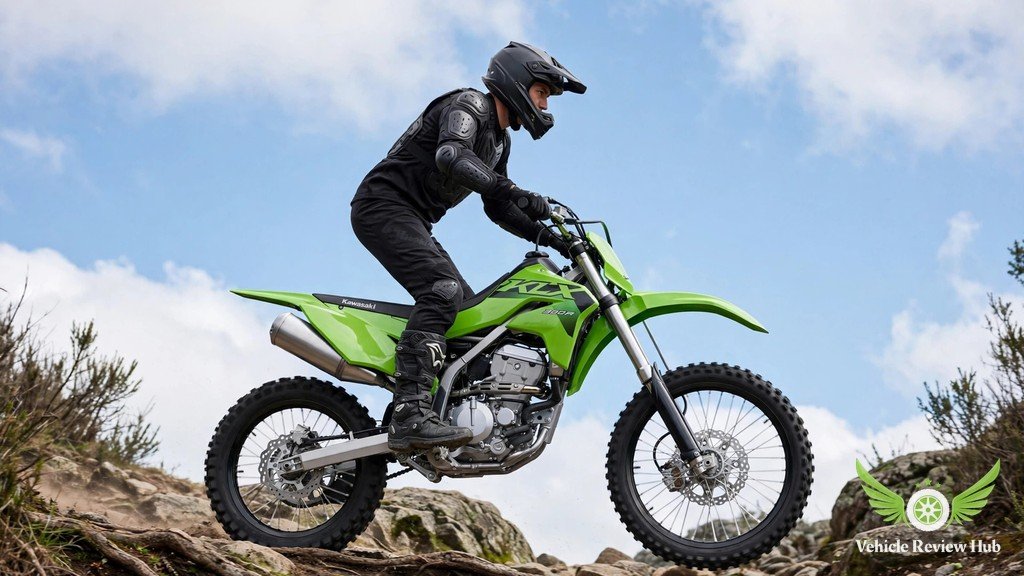
The R handles like a bike built for trails first. The 21-inch front wheel rolls over rocks and roots that would deflect a smaller wheel, the 18-inch rear wheel keeps the back end hooked up, and the long-travel suspension absorbs hits that would kick a shorter-travel bike sideways. The brakes are strong enough for trail speeds without being grabby: the front petal disc gives real stopping power, the rear disc is easy to modulate for steering with the back brake, and the absence of ABS means the rider controls lock-up, not a computer. The Kawasaki KLX300R review covers the full spec sheet and price history. For Kawasaki KLX300R performance, the handling is the part that needs no apology: planted, predictable, and adjustable to the rider.
Measured 288 lb in California Trim
Dirt Bikes weighed the 2020 KLX300R and recorded a measured 288 pounds full of liquids, on the California-trim bike. The California bike’s charcoal canister is part of why the measured figure sits above the claimed curb weight of 282.2 lb. The 2020 to 2023 sheets list 282.2 lb, or 286.6 lb for the California model, and the 2024 and later sheets list 282.2 lb, or 286.7 lb for the 50-state figure. The measured 288 lb is a real scale figure with fluids aboard, not a factory claim, and it is the number that matters to a rider who has to pick the bike up. This Kawasaki KLX300R performance guide uses the measured figure because it is the only scale weight ever published for the R.
| Weight figure | Value | Source |
|---|---|---|
| Curb weight | 282.2 lb | Kawasaki USA spec sheets |
| California curb weight | 286.6 lb | Kawasaki USA sheets 2020–2023 |
| 50-state curb weight | 286.7 lb | Kawasaki USA sheets 2024+ |
| Measured full | 288 lb | Dirt Bikes 2020 review, California trim |
| Estimated dry | 264.6 lb / 269.0 lb 50-state | Kawasaki USA sheets 2024+ |
| Street KLX300 curb | 302.1 lb (2021–2023 sheets) | Kawasaki USA spec sheets |
| Street KLX300 ABS curb | 304.3 lb (2027) | Kawasaki USA 2027 sheet |
| KLX300SM curb | 304.3 lb (2023 sheet) | Kawasaki USA 2023 SM sheet |
Notes: the measured 288 lb is a scale figure with fluids on the California bike, not a factory claim. Against the 302.1-lb dual-sport KLX300 the R is 19.9 lb lighter, and against the 304.3-lb KLX300SM and the 2027 KLX300 ABS it is 22.1 lb lighter. The two gaps must not be mixed, and this Kawasaki KLX300R performance guide keeps them labelled.
Kawasaki KLX300R Performance Compared With Other Trail Bikes
The R’s performance only makes sense against the bikes buyers cross-shop. Against the street KLX300 it is lighter and better suspended but gives up the plate, the dash, and the lights. Against the KLX230R it is faster, liquid-cooled, and far better suspended for $1,000 more on MSRP, and against the Honda CRF300F it is the more capable trail bike on suspension, with the Honda answering on price. This Kawasaki KLX300R performance comparison keeps every figure labelled, because the family shares one engine name across four different bikes.
Kawasaki KLX300R vs Kawasaki KLX300
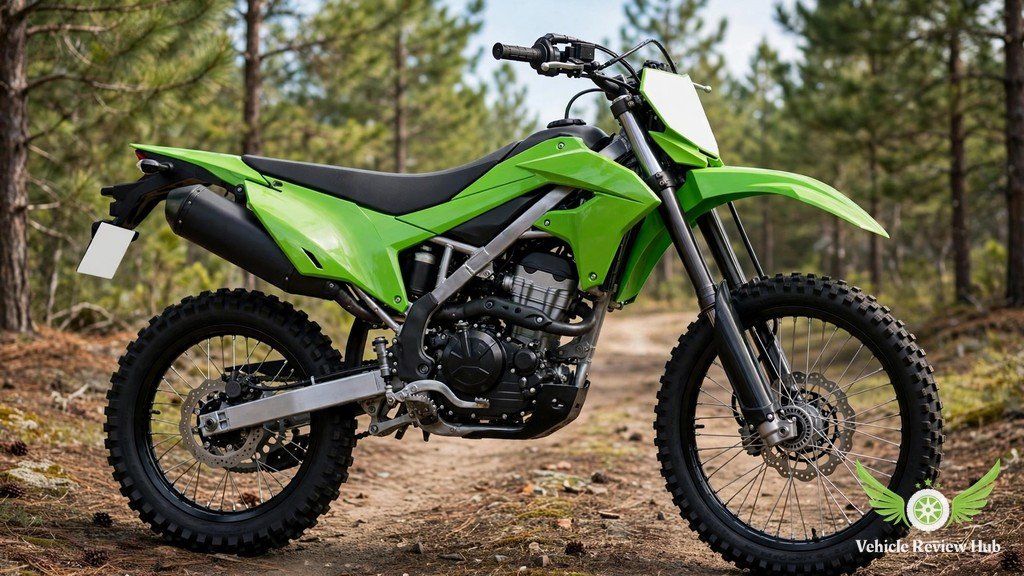
The street KLX300 is the R’s closest relative and its most confusing rival, because the two share the same 292cc engine and name. The street bike holds the dyno figure: Cycle World’s 23.4 horsepower belongs to it, and its 2027 engine claims 26.8 horsepower. The R has no dyno figure and did not get the 2027 engine update, so the street bike wins the paper power contest, but Kawasaki KLX300R performance is measured on the trail, not on paper. What the R wins is everything else on a trail: its 43 mm inverted fork and fully adjustable shock give 11.2 inches of travel at both ends, against the street bike’s 10.0 and 9.1 inches. Its curb weight is 282.2 lb, against the street dual-sport’s 302.1 lb on the 2021 to 2023 sheets and 304.3 lb for the 2027 ABS model, so the R is 19.9 lb lighter than the dual-sport and 22.1 lb lighter than the 2027 ABS and the SM. The street bike answers with a digital dash, lights, mirrors, a plate, and ABS, and the 2027 ABS model costs $6,649 delivered, against the R’s $6,449. For Kawasaki KLX300R performance, the R is the better trail machine, and the street bike is the better road machine, and neither pretends to be the other.
Is the Kawasaki KLX300R Suitable for Beginner Riders?
Testers agree the R suits beginners stepping up from a 230-class bike, with two caveats every new rider should hear. Motorcycle.com called it a fantastic option for dirt newcomers, and Motocross Hideout calls it a great trail bike for beginners and intermediate riders. The reasons are the same ones behind Kawasaki KLX300R performance: predictable mid-range power that tractors rather than snaps, fuel injection that starts cleanly, electric start with no kick lever to fight, and suspension that forgives mistakes. The caveats are the full-size 35.4-inch seat and the 282.2-lb curb weight. A shorter rider should sit on the bike before buying, and a lighter rider should know the weight will be felt when the bike goes over. The step-down option is the smaller carburetted trail bike, and the KLX140R review covers that 144cc machine for riders who want to start lower. The Honda CRF300F review covers that air-cooled 2026 trail bike for buyers comparing the two. For Kawasaki KLX300R performance, the beginner verdict is yes, with the seat height and the weight as the honest conditions.
| Bike | Engine | Suspension travel | Curb weight | 2027 delivered |
|---|---|---|---|---|
| Kawasaki KLX300R | 292cc liquid-cooled single | 11.2 in / 11.2 in, adjustable | 282.2 lb | $6,449 |
| Kawasaki KLX300 ABS | 292cc liquid-cooled single | 10.0 in / 9.1 in | 304.3 lb | $6,649 |
| Kawasaki KLX230R | 233cc air-cooled single | 37 mm fork, non-adjustable | 262.4 lb | $5,434 |
| Honda CRF300F | 293cc air-cooled single | 41 mm Showa fork, non-adjustable | 271 lb | $5,399 |
Notes: the KLX230R dyno figures are 17.3 horsepower (Dirt Rider 2021) and 17.9 horsepower (Cycle World 2022), both gen-1 standard-R bikes. Honda publishes no horsepower figure for the CRF300F, and the street KLX300’s 23.4-horsepower dyno figure is its own. Prices are 2027 delivered figures, and this Kawasaki KLX300R performance comparison uses delivered prices so the gaps are like-for-like.
The final word on this Kawasaki KLX300R performance guide is that the R’s performance is honest, not headline-grabbing. It has no dyno figure of its own, no tested top speed, and no measured MPG, and this guide prints none as fact. What it does have is a liquid-cooled fuel-injected 292cc single with predictable mid-range power, the only fully adjustable suspension in its trail-bike class at $6,449 delivered, and a measured 288 pounds in California trim. Buy it for the suspension and the ride, not for a number on a chart.
Kawasaki KLX300R Performance Frequently Asked Questions
These answers give the R’s measured performance picture in this Kawasaki KLX300R performance guide — power, top speed and fuel economy — with every figure labelled by its source, because most of the numbers quoted for this bike belong to a different one.
How much horsepower does the KLX300R make?
Kawasaki USA has never published a horsepower figure for the R, on any spec sheet from 2020 to 2027. The only factory power number attached to the R’s own engine comes from the Australian Kawasaki spec sheet: 21.4 kW, or 29 PS, at 8,000 rpm and 26.3 Nm at 7,000 rpm. That 29 PS converts to 28.6 hp, so it must never be written as 29 hp. No dyno test of the R itself exists.
What is the KLX300R’s top speed?
No official figure exists, and no tester has ever run an instrumented top-speed test on the R — the bike has no speedometer at all. The only numbers attached to it are owner-site estimates: Motocross Hideout puts the figure at 70 mph, and Braap Academy says about 70 mph, generally 65 to 75 mph stock. None of those is a GPS-verified run or a magazine test, so this Kawasaki KLX300R performance guide prints them only as labelled estimates, never as fact.
What fuel economy does the KLX300R get?
No tester has ever measured the R’s fuel consumption, so there is no honest tank-range figure either. The 56-mpg figure that sometimes appears next to the KLX300 name comes from Motorcycle.com’s 2021 shootout, where the plated street KLX300 returned 56 mpg — a street-bike figure that must never be printed as the R’s mileage. The R carries 2.1 gallons, or 7.9 litres, with a low-fuel lamp only: no fuel gauge, no trip meter and no reserve tap.
What did Motorcycle.com score the KLX300R?
Motorcycle.com’s 2020 review gave the R 85.75 out of 100, and that score is the best single verdict in this Kawasaki KLX300R performance guide. Value scored a perfect 10 out of 10 and instruments and controls 3.0 out of 5 — the lowest mark is the price of having no dash at all. The engine scored 17.0 out of 20 and suspension and handling 13.0 out of 15. The review found the R never feels overly fast or intimidating, but it can handle technical trails, two-trackers and single track all day.
What makes the KLX300R’s suspension special?
The R is the only bike in its trail class at $6,449 delivered with fully adjustable suspension at both ends: a 43 mm inverted fork with adjustable compression damping and a Uni-Trak piggyback shock with adjustable compression, rebound and spring preload, giving 11.2 inches of travel at both ends. No rival at this price matches it — the KLX230R runs a 37 mm non-adjustable fork and the Honda CRF300F a 41 mm Showa fork with no adjustment. Testers praise the adjustability in every review, and this Kawasaki KLX300R performance guide treats it as the headline feature, because riders differ in weight and terrain.
Is the KLX300R good for beginner riders?
Yes, with two caveats, for beginners stepping up from a 230-class bike. Motorcycle.com called it a fantastic option for dirt newcomers, and Motocross Hideout calls it a great trail bike for beginners and intermediate riders. The reasons are predictable mid-range power that tractors rather than snaps, fuel injection that starts cleanly, and electric start with no kick lever to fight. The caveats are the full-size 35.4-inch seat and the 282.2-lb curb weight, and this Kawasaki KLX300R performance guide repeats them as the honest conditions: a shorter rider should sit on the bike before buying.