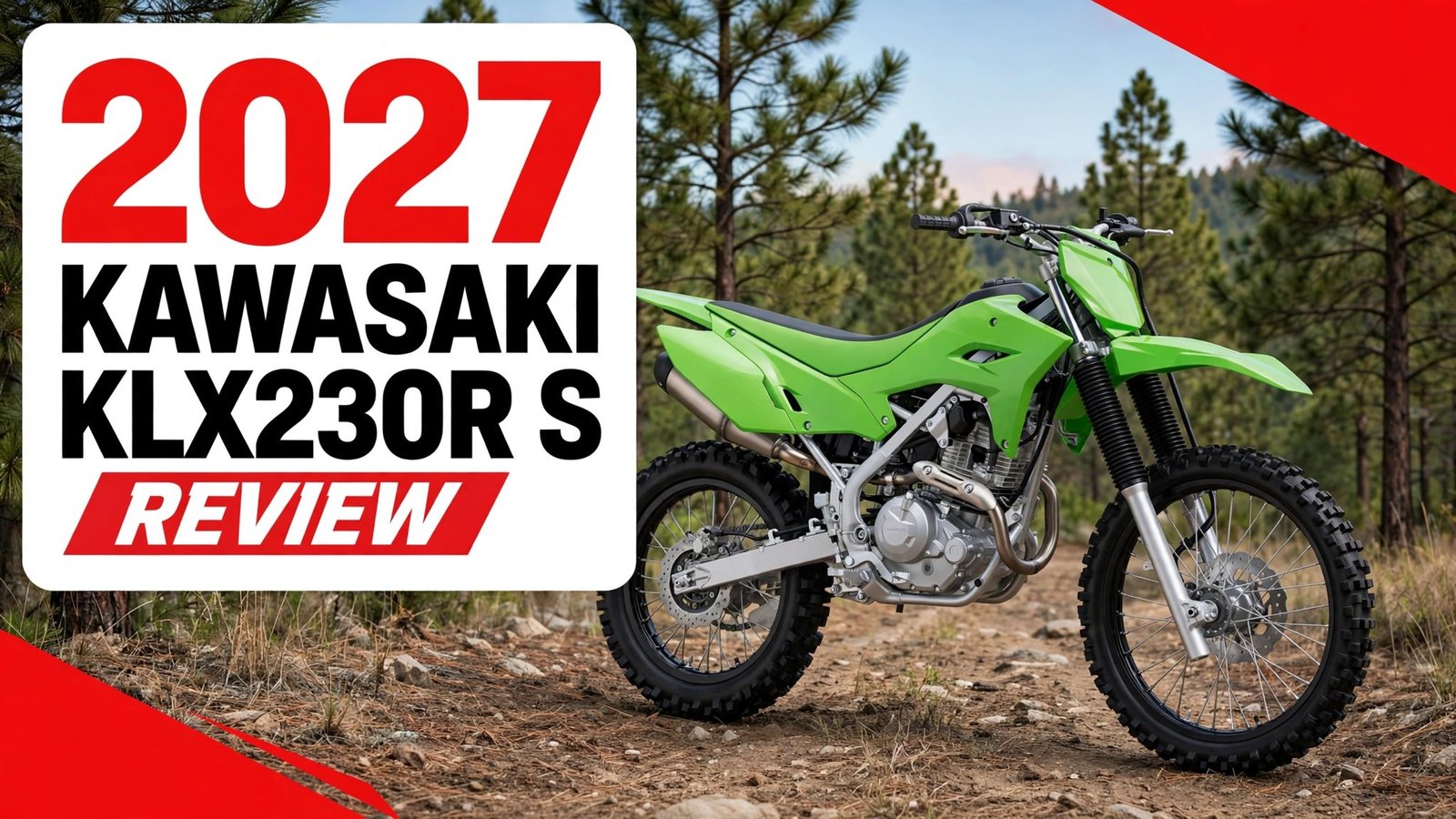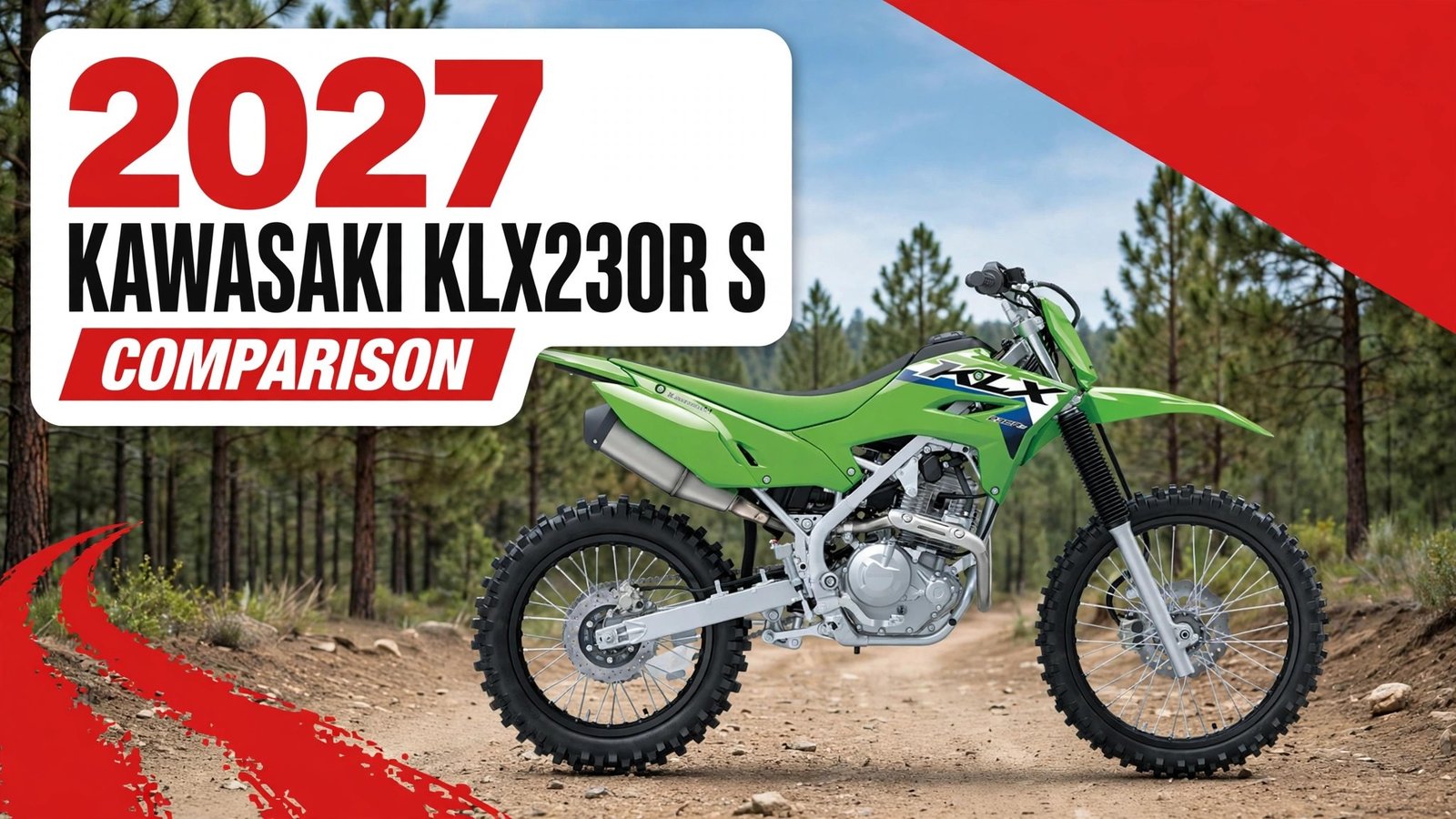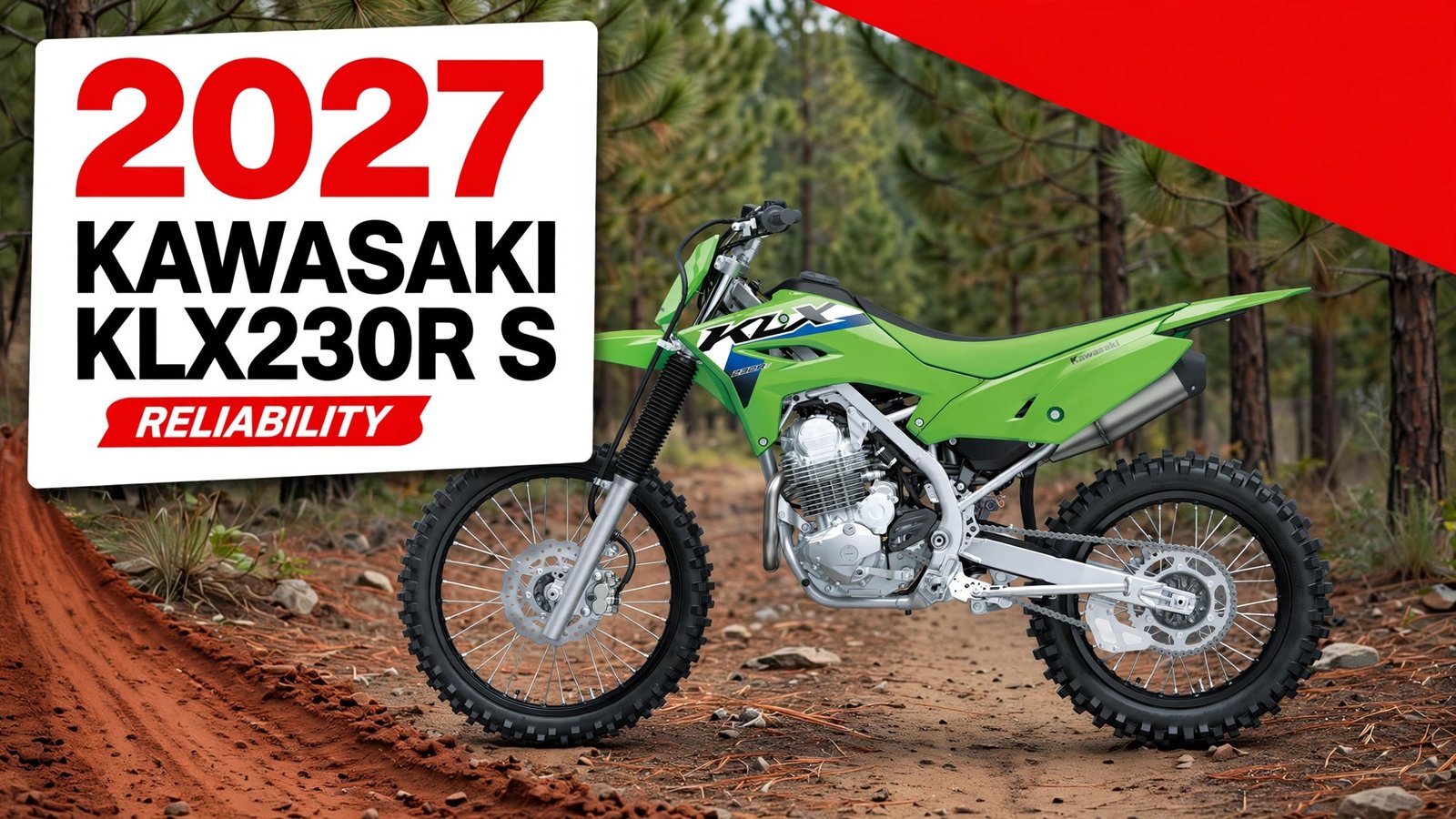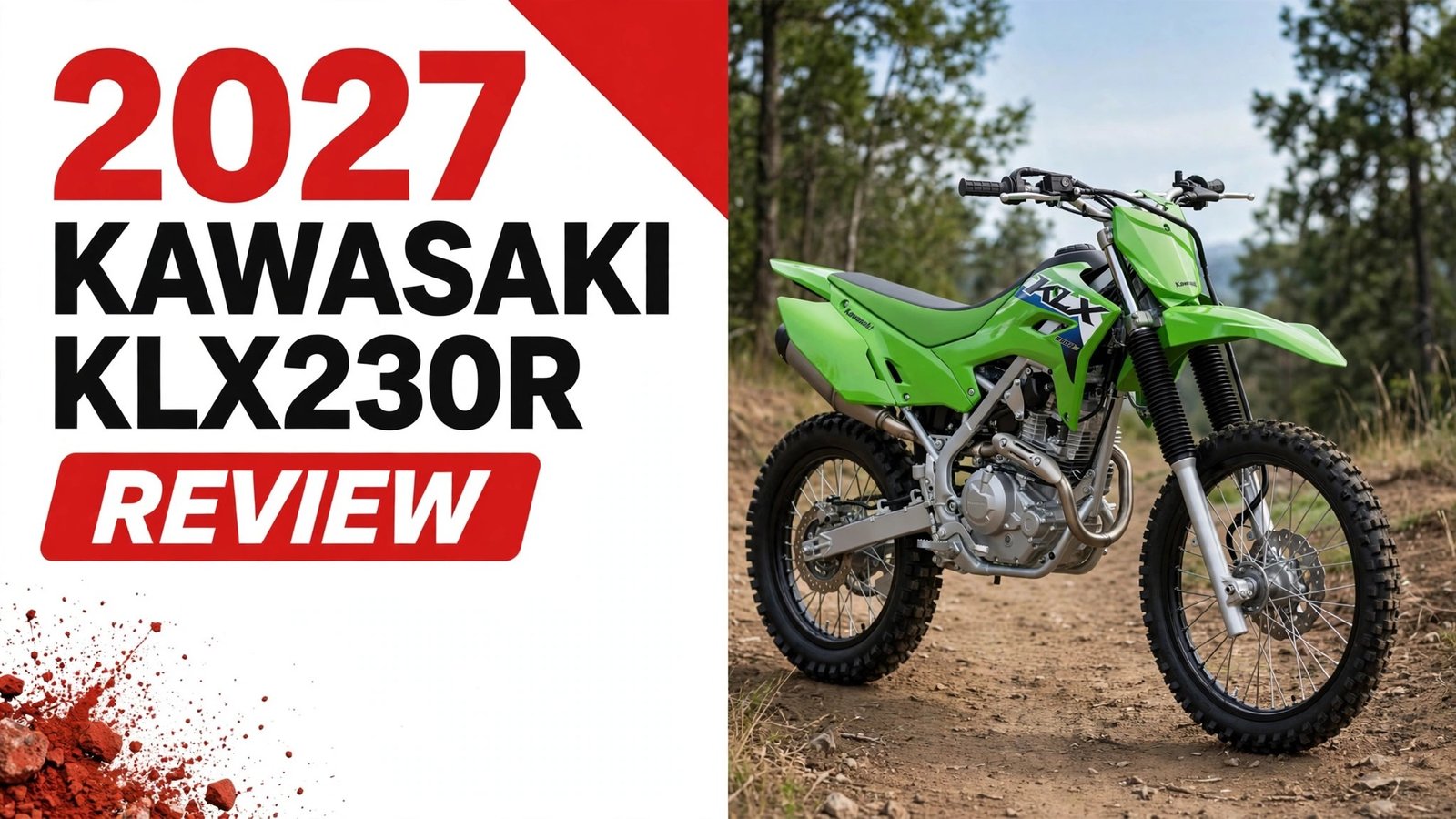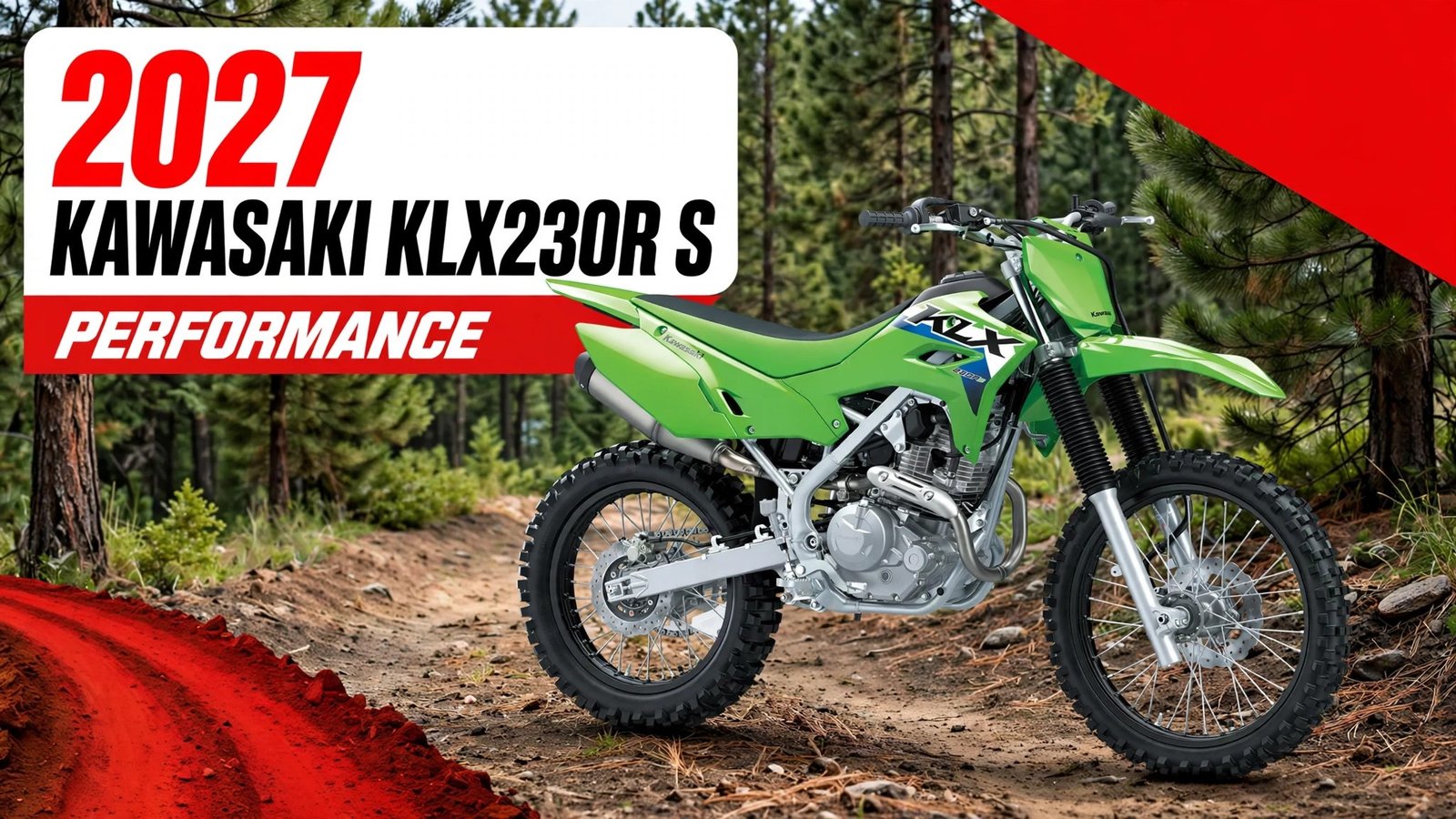
The Kawasaki KLX230R S is a strange bike to judge on performance, because almost none of it has been measured. There is no dyno figure for the S itself, no instrumented top speed, no tested fuel economy, no acceleration test. What exists instead is a single back-to-back test from 2021, a handful of standard-R dyno runs, and owner estimates repeated until they sound like facts. This Kawasaki KLX230R S performance guide sorts the measured from the guessed, so a buyer knows what the S can do.
Kawasaki KLX230R S Engine Performance and Power Delivery
The engine in the S is the same 233cc air-cooled single that powers the standard R, and this Kawasaki KLX230R S performance guide treats it as such — no separate S engine, no smaller bore, no detune. The 67.0 by 66.0 mm bore and stroke, 9.4:1 compression and 32 mm throttle body are identical, and the 2025 update gave both bikes a counterbalancer, a smaller 33 mm intake valve and a reworked ECU.
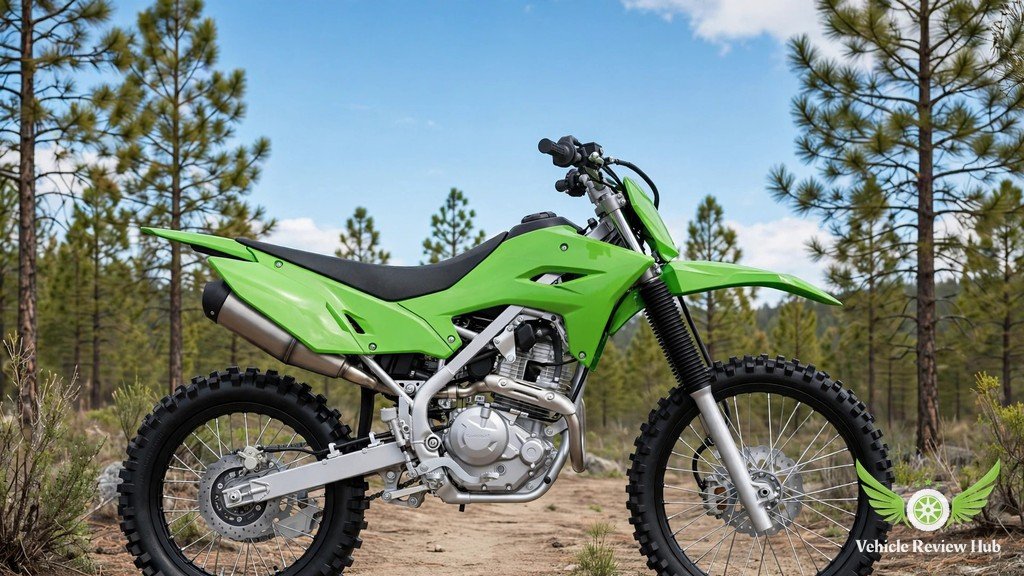
The video below is a motocross race, not a performance test. Hemby57’s “Battle of the Kawasaki’s” puts a KLX230R against KX250F and KX450F motocross bikes on an MX track — it shows the R’s limits against race bikes, not a measured run, and it is not the S and not a dyno session. It is useful in this Kawasaki KLX230R S performance guide because it shows how the shared 233cc engine behaves when ridden hard, which no instrumented S test has ever done.
No Dyno of the R S Exists
No publication has ever put a KLX230R S on a dynamometer. That is the first fact this Kawasaki KLX230R S performance guide has to state, because every horsepower number attached to the S in listings comes from somewhere else. Kawasaki USA publishes no horsepower figure for the R models. The only published power figure for the S itself comes from Kawasaki’s Canadian 2026 spec sheet: 13.8 kW, or 19 PS, at 8,000 rpm, with 19.6 Nm at 6,400 rpm. Nineteen PS converts to 18.7 horsepower, never 19 hp, and it is a crankshaft rating, not a rear-wheel measurement. The street KLX230 S publishes 17 hp at 8,000 rpm, but that is the plated street bike, not the R S. The S final-drive gearing was not separately verified, so this Kawasaki KLX230R S performance guide prints none.
Dyno Figures Are Standard-R Data
The rear-wheel figures that do exist all come from standard-R bikes of the first generation, and this Kawasaki KLX230R S performance guide keeps them labelled that way. Dirt Rider ran a 2021 R and measured 17.3 hp at 7,800 rpm and 13.3 lb-ft at 6,300 rpm. Cycle World ran a 2022 R on its Dynojet 250i and measured 17.9 hp at 7,700 rpm and 14.4 lb-ft at 6,100 rpm, with a midrange torque spike at 4,400 rpm. None of these figures is the S’s, and none applies directly to a 2025 or later bike, because the gen-2 engine changed. No gen-2 dyno exists for the R or the S.
| Source | Bike tested | Rear-wheel power | Rear-wheel torque |
|---|---|---|---|
| Dirt Rider 2021 | 2021 KLX230R (standard, gen-1) | 17.3 hp @ 7,800 rpm | 13.3 lb-ft @ 6,300 rpm |
| Cycle World 2022 (Dynojet 250i) | 2022 KLX230R (standard, gen-1) | 17.9 hp @ 7,700 rpm | 14.4 lb-ft @ 6,100 rpm |
| Dirt Rider 2023 | 2023 KLX230R California bike | 17.1 hp (doc-asserted) | Not published |
| Kawasaki Canada 2026 spec sheet | KLX230R S (crankshaft rating) | 13.8 kW (19 PS = 18.7 hp) @ 8,000 rpm | 19.6 Nm @ 6,400 rpm |
| Cycle World (same dyno) | Honda CRF250F (context only) | 20.1 hp @ 7,500 rpm | 15.5 lb-ft @ 6,000 rpm |
Notes: no dyno of the R S itself exists, so no rear-wheel figure in this Kawasaki KLX230R S performance guide belongs to the S. The 17.3 hp and 17.9 hp figures are standard-R gen-1 results from two different publications and must never be blended. The Canadian sheet’s 19 PS is a crankshaft rating for the S and converts to 18.7 hp, never 19 hp. No gen-2 dyno exists, so pre-2025 figures do not directly apply to 2025 and later bikes in this Kawasaki KLX230R S performance guide.
Kawasaki KLX230R S Top Speed and Acceleration
Top speed is the thinnest part of this Kawasaki KLX230R S performance guide, because there is nothing instrumented to report. Kawasaki publishes no top speed for the R or the S, no magazine has run a timed top-speed test, and the S has no speedometer — only indicator lamps. What exists is a pair of owner estimates, printed as estimates, not facts.
No Official Figure Exists
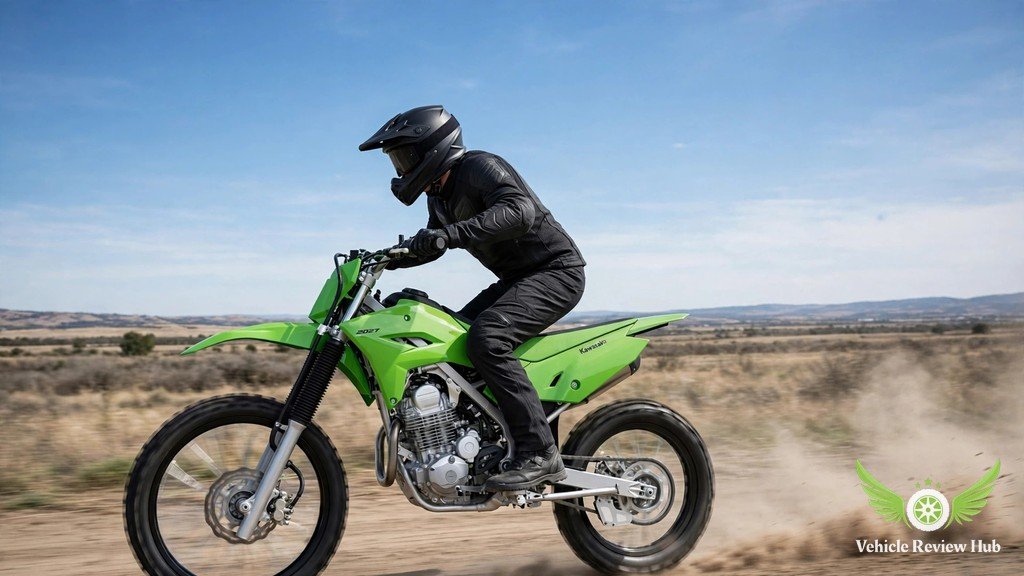
No official top speed exists for the KLX230R S, and this Kawasaki KLX230R S performance guide prints none. The bike is off-road-only with no dash and no speedometer, so the factory never published a number. The street KLX230’s 75 mph (77 mph per Motorcycle.com) does not fill the gap — a different, plated bike. No 0–60 or quarter-mile test exists either; the only figure — “slightly more than 10 seconds” to 60 mph — is a YouTube rider’s estimate. The Kawasaki KLX230R performance guide reaches the same conclusion for the standard R.
60 MPH Is an Owner Estimate
The figure most often quoted for the R family is about 60 mph, and this Kawasaki KLX230R S performance guide labels it as it is: an owner estimate. Motocross Hideout puts the top speed at about 60 mph, and one owner says a more experienced rider reached about 60 mph. None of these is a test. The 80 mph figure in some searches belongs to the Honda CRF300L and Rally, not any KLX230.
| Claim | Figure | What it actually is |
|---|---|---|
| Top speed, owner estimate | About 60 mph | Motocross Hideout estimate; owner report of “about 60 MPH” |
| Top speed, higher estimate | 65 mph, “give or take a few” | Braap Academy estimate, not a test |
| 0–60 mph | “Slightly more than 10 seconds” | YouTube rider’s estimate, not a timed run |
| Street KLX230 top speed | 75 mph redline-limited; 77 mph (Motorcycle.com) | Plated street bike — NOT the R S |
| Instrumented top speed, R S | None exists | No official figure, no timed test, no speedometer on the bike |
Notes: no instrumented top speed exists for the S, so this Kawasaki KLX230R S performance guide prints no top speed as fact. The 60 mph figure is an owner estimate and 65 mph a second, higher one — the honest range is about 60 mph, give or take. The 75 and 77 mph figures belong to the plated street KLX230. No 0–60 or quarter-mile test exists for the S.
Kawasaki KLX230R S Mileage and Fuel Economy
Fuel economy is the third blank in the S’s performance record, and this Kawasaki KLX230R S performance guide is honest about it: no tester has measured the fuel consumption of any KLX230R, standard or S. The bike has no odometer or fuel gauge — only a low-fuel lamp. The number that circulates online, 70 mpg, is real, but it belongs to a different bike.
No Tester MPG for Any R
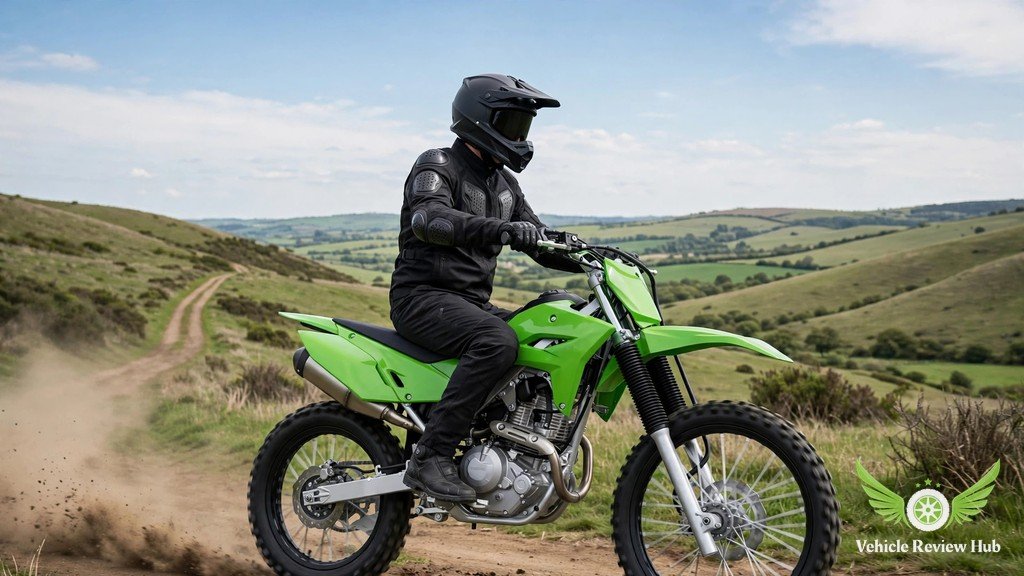
No tester MPG exists for any R, and this Kawasaki KLX230R S performance guide prints none. The “70 mpg” figure comes from Dirt Bike Test, which measured just over 70 mpg on the 2026 KLX230 Sherpa S ABS — the plated street bike, ridden 50/50 on and off road. Its fuel figure cannot be carried onto the off-road S. With no tested MPG, no tank range can be printed either. The Kawasaki KLX230R S reliability guide covers the fuel system from the ownership side.
High, Erratic Idle Noted by Testers
The one fuel-system behaviour testers did record is the high, erratic idle, and this Kawasaki KLX230R S performance guide reports it as a tester observation, not a defect with a fix on record. Ultimate Motorcycling’s 2021 comparison noted a tendency to idle high for stretches of time, which compromises engine braking on rough downhill trails. The same tester’s S review noted the bike would unpredictably idle high. Ultimate Motorcycling suggested a DynoJet Power Commander V would probably fix it, but the two UM articles disagree on its price — $430 in the comparison, $400 in the S review — so this Kawasaki KLX230R S performance guide prints no price for the fix.
| Item | Figure | Status |
|---|---|---|
| Fuel tank, gen-2 S (2025+) | 2.0 gal, steel | Official spec sheet |
| Fuel tank, gen-1 S (2021–2024) | 1.7 gal, plastic | Official spec sheet |
| Tested MPG, any R | None exists | No tester has measured it |
| “70 mpg” online figure | Just over 70 mpg | Dirt Bike Test, 2026 KLX230 Sherpa S ABS (street) — NOT the R S |
| Tank range | Not printed | Cannot be calculated without a tested MPG |
| Idle behaviour | High, erratic idle noted | UM 2021 comparison + S review; no TSB, no recall |
Notes: no tester MPG exists for any R, so this Kawasaki KLX230R S performance guide prints no MPG and no tank range for the S. The “just over 70 mpg” figure is Dirt Bike Test’s measurement on the 2026 KLX230 Sherpa S ABS street bike and must never be printed as an R S figure. The idle is a tester observation with no bulletin and no recall, and this Kawasaki KLX230R S performance guide prints no price for the fix because the two UM articles disagree.
Kawasaki KLX230R S Real-World Riding Experience
If the measured numbers are thin, the ridden evidence is not. One test — Ultimate Motorcycling’s December 2021 back-to-back comparison of the R and the S — is the only direct test of the two together, and this Kawasaki KLX230R S performance guide makes it the centrepiece. Two testers rode both bikes on the same trails and disagreed.
Back-to-Back Test Exists (2021)
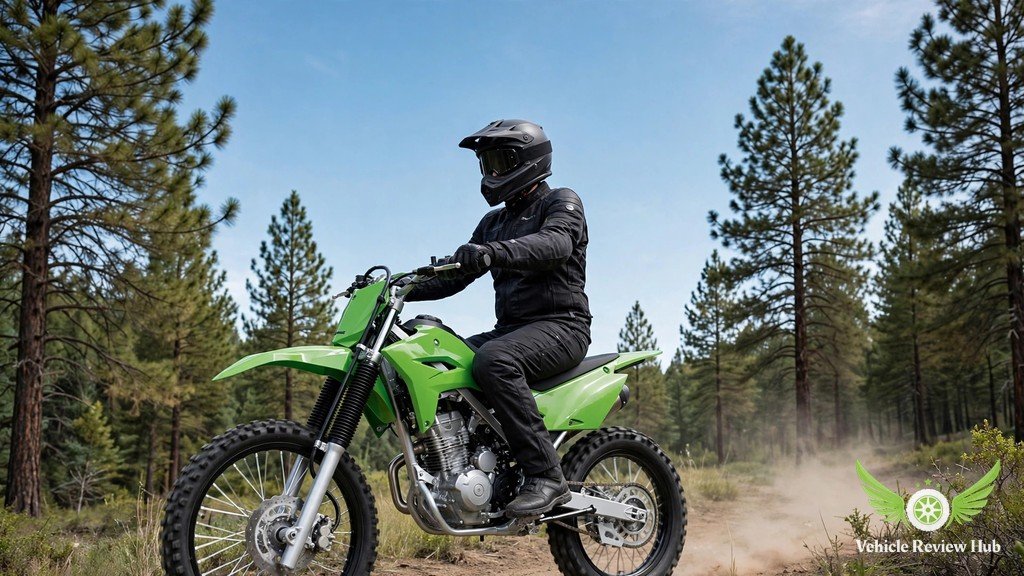
The back-to-back test exists, and it is the only one. Ultimate Motorcycling ran it on December 15, 2021, with Don Williams riding — a 115-pound tester with a 30.5-inch inseam — and a 170-pound second tester on the same trails, on the gen-1 R (36.4-in seat) and the gen-1 S (35.4-in seat). The 115-pound tester rode faster on the S — it fits her better, the rider triangle is identical, and she never bottomed its suspension. The 170-pound tester had the opposite day: constantly bottoming out the S, especially the rear on G-outs, and even first-gear whoops bottomed the suspension — for him, the R felt more like a real dirt bike. The lesson of this Kawasaki KLX230R S performance guide is weight-dependent: under about 130 pounds the S is the better bike, and over about 160 the R’s extra travel is the safer choice.
One Tester Felt the Drop Negligible
Not every tester agrees the drop matters, and this Kawasaki KLX230R S performance guide prints the dissent in full. Motorcycle.com’s 2025 tester — five feet seven inches, with a 30-inch inseam, and at home on the standard R at 35.6 inches — wrote that the R S model doesn’t offer a significant reduction in height. Cycle News’ 2025 review agrees the RS is quicker in the woods but bottoms sooner. The drop is enough for the rider it was built for — short, light, and nervous about footing — and negligible for the rider who never needed it. That is why the Kawasaki KLX230R S review tells buyers to test-sit the bike.
| Tester | Verdict on the S | Detail |
|---|---|---|
| 115 lb, 30.5-in inseam (UM 2021) | Faster on the S | “It fits me better”; never bottomed it; quicker steering, “like a skateboard on smoother single-track” |
| 170 lb tester (UM 2021) | Bottomed it constantly | Rear bottomed on G-outs and first-gear whoops; the R “felt more like a real dirt bike” |
| Same 115-lb tester, gen-2 (UM 2025) | More aggressive on the S | Quicker turning and nimbler on tight single-track; never blew through the travel on either bike |
| 5’7″, 30-in inseam (Motorcycle.com 2025) | Drop negligible | At home on the standard R at 35.6 in; the S “doesn’t offer a significant reduction in height” |
| Cycle News 2025 | Quicker, bottoms sooner | Even quicker handling in the woods than the R, but “you’ll feel the shorter travel quicker” |
Notes: the UM December 2021 back-to-back test is the only direct R-vs-S test, and this Kawasaki KLX230R S performance guide makes it the centrepiece for that reason. The 115-lb tester rode faster on the S and never bottomed it; the 170-lb tester bottomed it constantly. The Motorcycle.com dissent is printed in full: for a rider at home on the standard R, the drop is negligible. No other direct R-vs-S test exists in this Kawasaki KLX230R S performance guide’s research.
Kawasaki KLX230R S Handling, Braking and Stability
Handling is where the S’s lower seat actually changes the bike, and this Kawasaki KLX230R S performance guide gives it the space the dyno section could not. The S is the same bike as the R, lower, with shorter travel and a steeper head angle — and the testers who rode both agreed on what that does on the trail.
Handling, Braking and Stability on the Trail
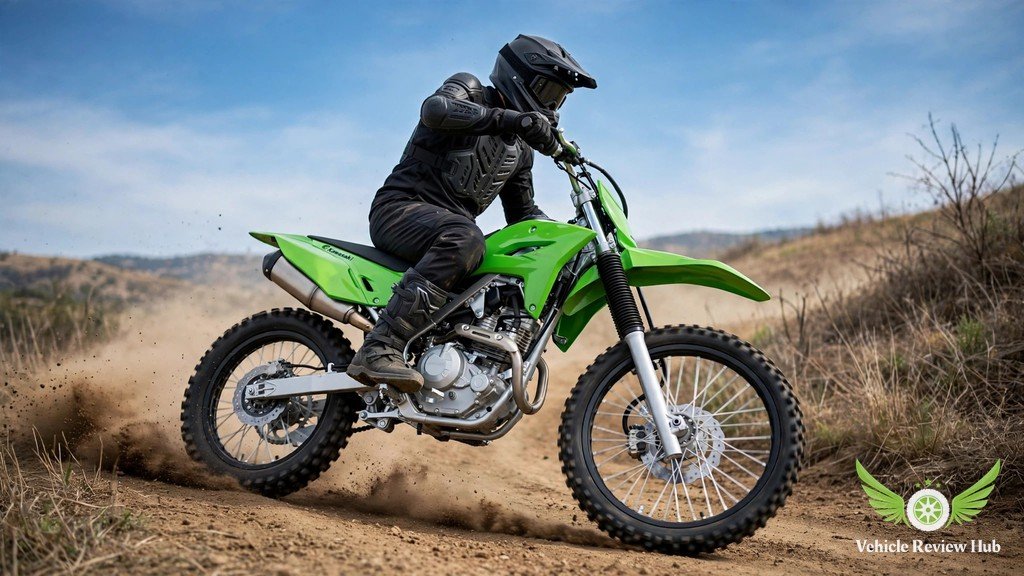
The S turns quicker than the R, and this Kawasaki KLX230R S performance guide starts with the geometry, because the numbers say why. The gen-2 S runs a 24.6-degree rake and 3.9 inches of trail on a 53.3-inch wheelbase, against the R’s 25.4 degrees, 4.2 inches and 54.1 inches — a shorter, steeper front end that testers felt immediately as quicker steering on tight single-track. The 21-inch front and 18-inch rear wheels wear Dunlop D952 tyres, and the front D952 is the weak point: Ultimate Motorcycling’s S review called it flimsy and not confidence-inspiring, and recommended Dunlop Geomax MX53s. Braking is compromised by rubber, not discs — the hardware is a 240 mm petal front disc with a dual-piston Nissin caliper and a 220 mm petal rear disc, with no ABS and no option to add it. The direct back-to-back test is the source for the handling claims here.
170 lb Tester Bottomed It Constantly
The bottoming report is the price of the drop, and this Kawasaki KLX230R S performance guide does not soften it. The 170-pound tester in the 2021 back-to-back test was constantly bottoming out the S, especially the rear end on G-outs, and even first-gear whoops bottomed the suspension. The numbers explain why: the S carries 8.7 inches of front travel and 8.5 at the rear, against the R’s 9.8 at both ends, and 10.6 inches of clearance against the R’s 11.4. The 115-pound tester never bottomed the S at all. For a buyer over about 160 pounds on rough ground, the R’s extra travel is the safer choice.
| Item | KLX230R S (2025+) | KLX230R (2025+) |
|---|---|---|
| Front travel | 8.7 in | 9.8 in |
| Rear travel | 8.5 in | 9.8 in |
| Ground clearance | 10.6 in | 11.4 in |
| Rake / trail | 24.6 deg / 3.9 in | 25.4 deg / 4.2 in |
| Wheelbase | 53.3 in | 54.1 in |
| Fork | 37 mm, non-adjustable, soft | 37 mm, non-adjustable, soft |
| Shock | Preload adjustable (new 2025), otherwise fixed | Preload adjustable (new 2025), otherwise fixed |
| Brakes | 240 mm / 220 mm petal discs, Nissin, no ABS | 240 mm / 220 mm petal discs, Nissin, no ABS |
| Tyres | Dunlop D952 80/100-21 / 100/100-18 | Dunlop D952 80/100-21 / 100/100-18 |
| Curb weight | 262.4 lb | 262.4 lb |
Notes: rear travel for the S is printed as 8.5 in from the official Canadian 2026 S spec sheet (217 mm), the same adoption as the KLX230R coverage in this Kawasaki KLX230R S performance guide; some US spec sheets print 8.8 in for the rear, and that figure is footnoted here rather than printed as the primary one. The gen-2 R clears 11.4 in, not 11.8 in, which was the gen-1 figure. The 170-lb tester bottomed the S constantly while the 115-lb tester never did in this Kawasaki KLX230R S performance guide’s reading of the test.
Kawasaki KLX230R S Performance Compared With Other Trail Bikes
Against its rivals, the S is the slowest on paper and one of the quickest on a tight trail, and this Kawasaki KLX230R S performance guide puts those two facts together. The rivals in this Kawasaki KLX230R S performance guide are the standard KLX230R, the Honda CRF300F and the Yamaha TT-R230.
Kawasaki KLX230R S vs Kawasaki KLX230R
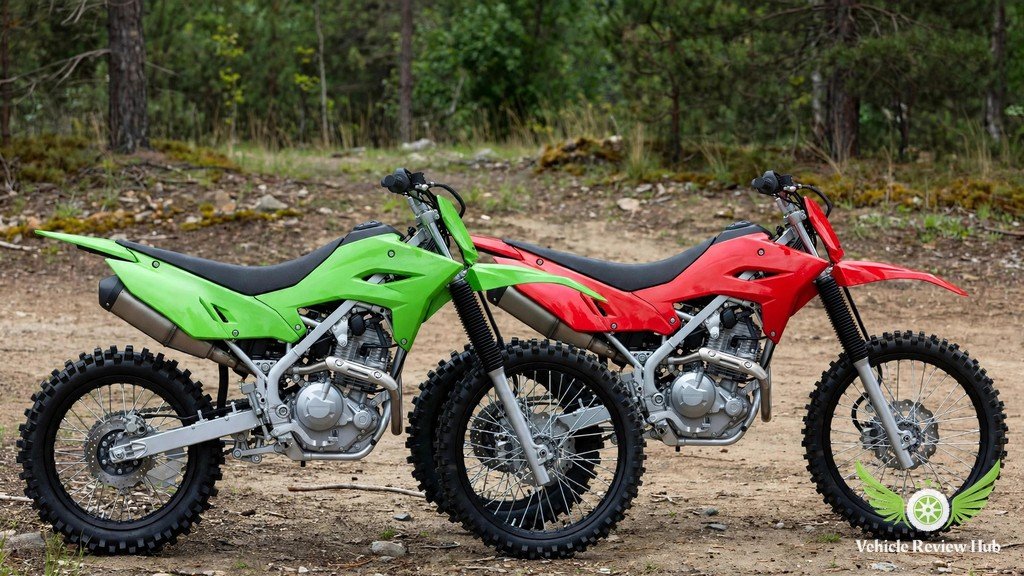
The S against the R is the comparison that matters most, because the two bikes are the same machine at two seat heights, and this Kawasaki KLX230R S performance guide has already made it in pieces. The differences are fit and geometry: the S sits 1.2 inches lower at 34.4 against the R’s 35.6, clears 0.8 inches less at 10.6 against 11.4, and carries 8.7 and 8.5 inches of travel against the R’s 9.8 and 9.8. On the dyno the two are the same bike, so there is no measured gap between them. On the trail the gap is real but small: the S turns quicker on tight single-track and the R holds up better on rough ground. The Kawasaki KLX230R S comparison covers the price and equipment side of the same choice in full. Against the Honda, the S gives up displacement: the CRF300F’s 286cc single is roughly 24 hp by Brazil-sourced figures, unmeasured, against the R family’s measured 17.3 to 17.9 hp — but the Honda’s seat is 35.0 inches on Honda’s own spec page, taller than the S’s 34.4, and its curb weight is 271 pounds against the S’s 262.4. The Yamaha TT-R230 is the cheapest rival at $5,039 delivered, with a 34.3-inch seat, but it is carburetted with a 223cc single and no published dyno.
Is the Kawasaki KLX230R S Suitable for Beginner Riders?
The S is the most beginner-friendly bike in this group, and this Kawasaki KLX230R S performance guide says so for reasons the spec sheet supports. The seat is 34.4 inches — the lowest fuel-injected trail bike in the group, below the CRF300F’s 35.0 and the R’s 35.6. The engine is a mild air-cooled single with a walking-speed first gear, fuel injection with no choke and electric start with no kick. Weight and price are identical to the R. The caveats are the soft fork, the flimsy front tyre, the erratic idle and the missing dash — the same ones this Kawasaki KLX230R S performance guide has carried throughout. The bike has no ABS and no mirrors, because it is off-road-only, and the 22V-397 recall names the street ABS bikes only — no recall names the S, and no NHTSA result is stated here because the recalls API could not be reached during research. The step down in the family is the Kawasaki KLX140R L review bike, and the Indonesian carburetted line is covered by the Kawasaki KLX150 review. Buy the S if the seat is the problem and the trail is the point. Buy the R if the ground is rough and the rider is heavy. Either way, this Kawasaki KLX230R S performance guide ends where it started: no dyno of its own, no tested top speed, no tested MPG — and one back-to-back test that says the lower seat is worth more than any of those numbers to the rider it was built for.
| Bike | Seat height | Curb weight | Gears | Fuel system | Measured power | Delivered |
|---|---|---|---|---|---|---|
| Kawasaki KLX230R S (2027) | 34.4 in | 262.4 lb | 6-speed | Fuel-injected | No dyno of the S exists | $5,434 ($4,999 + $435) |
| Kawasaki KLX230R (2027) | 35.6 in | 262.4 lb | 6-speed | Fuel-injected | 17.3 hp (Dirt Rider 2021) / 17.9 hp (Cycle World 2022), gen-1 | $5,434 ($4,999 + $435) |
| Honda CRF300F (2026) | 35.0 in | 271 lb | 6-speed | Fuel-injected | ~24 hp, Brazil-sourced, unmeasured | $5,299 |
| Yamaha TT-R230 | 34.3 in | 251 lb wet | 6-speed | Carburetted | No published dyno | $5,039 |
Notes: the Honda CRF300F seat height of 35.0 inches and curb weight of 271 pounds are from Honda’s own 2026 spec page, verified at writing — they were printed as “Not verified” in the KLX230R S review because they were unverified at that time, and they are verified now. At 34.4 inches the S is the lowest fuel-injected trail bike in this group; the TT-R230’s 34.3 inches do not count because it is carburetted. The CRF250F’s 20.1 hp Cycle World dyno figure must never be attributed to the CRF300F. No 2024 dollar figure is printed as fact anywhere in this Kawasaki KLX230R S performance guide, and no NHTSA result is stated because the recalls API could not be reached during research. The Ultimate Motorcycling 2025 review and Cycle News’ 2025 review agree the S is quicker in the woods but bottoms sooner, and Motorcycle.com’s 2025 review carries the dissenting view.
Kawasaki KLX230R S Performance Frequently Asked Questions
These answers give the S’s measured performance figures in this Kawasaki KLX230R S performance guide — and say plainly where no measurement exists.
How much power does the KLX230R S make?
No dyno of the S exists, so this Kawasaki KLX230R S performance guide prints no rear-wheel figure for it. The only published figure for the S itself comes from Kawasaki’s Canadian 2026 spec sheet: 13.8 kW, or 19 PS, at 8,000 rpm, with 19.6 Nm at 6,400 rpm. Nineteen PS converts to 18.7 horsepower — never 19 hp — and it is a crankshaft rating, not a rear-wheel figure. The rear-wheel numbers you will see quoted are standard-R gen-1 bikes: Dirt Rider measured 17.3 hp at 7,800 rpm in 2021, and Cycle World measured 17.9 hp at 7,700 rpm in 2022.
What is the KLX230R S top speed?
No official figure exists and no instrumented test has measured it. The figure most often quoted is about 60 mph, an owner estimate from Motocross Hideout and owner reports — not a test, as this Kawasaki KLX230R S performance guide stresses. Braap Academy gives a higher estimate, 65 mph, “give or take a few”. The 0 to 60 mph claim of “slightly more than 10 seconds” is a YouTube rider’s estimate, not a timed run, and the 80 mph figure in some searches belongs to the Honda CRF300L and Rally, not any KLX230.
What fuel economy does the KLX230R S get?
No tester has measured it, so this Kawasaki KLX230R S performance guide prints no MPG figure and no tank range for the S. The 70 mpg figure found online is street-bike data: Dirt Bike Test measured just over 70 mpg on the 2026 KLX230 Sherpa S ABS, a plated street bike ridden 50/50 on and off road. With a 2.0-gallon tank and no tested MPG, no range can be calculated honestly.
What did the back-to-back R vs S test find?
Ultimate Motorcycling ran the only direct test, on December 15, 2021, with a 115-pound tester on a 30.5-inch inseam and a 170-pound second tester. The 115-pound tester rode faster on the S — it fits her better, the rider triangle is identical, and she never bottomed its suspension — and called its steering “like a skateboard on smoother single-track”. The 170-pound tester had the opposite day, constantly bottoming out the S, especially the rear on G-outs. A Motorcycle.com tester in 2025 split the difference, saying the S “doesn’t offer a significant reduction in height” for a 5-foot-7 rider at home on the standard R. The test is the only direct R-vs-S evidence this Kawasaki KLX230R S performance guide could find.
What is the high, erratic idle testers noted?
Ultimate Motorcycling’s 2021 comparison records that the S has a tendency to idle high for stretches of time, which compromises engine braking on rough downhill trails. There is no TSB and no recall for it. Ultimate Motorcycling suggests a DynoJet Power Commander V will probably fix it — this Kawasaki KLX230R S performance guide prints no price for the fix, because the two Ultimate Motorcycling pieces quote different prices.
Is the KLX230R S good for beginner riders?
Yes — it is the most beginner-friendly bike in this group. The seat is 34.4 inches, the lowest fuel-injected trail bike in the group, below the CRF300F’s 35.0 and the R’s 35.6. The engine is a mild air-cooled single with a walking-speed first gear, fuel injection with no choke, and electric start with no kick. The caveats are the soft fork, the flimsy front tyre, the erratic idle and the missing dash. A heavier rider will bottom the suspension, so as a rough guide: under about 130 pounds, buy the S; over about 160, buy the R; between the two, sit on both.