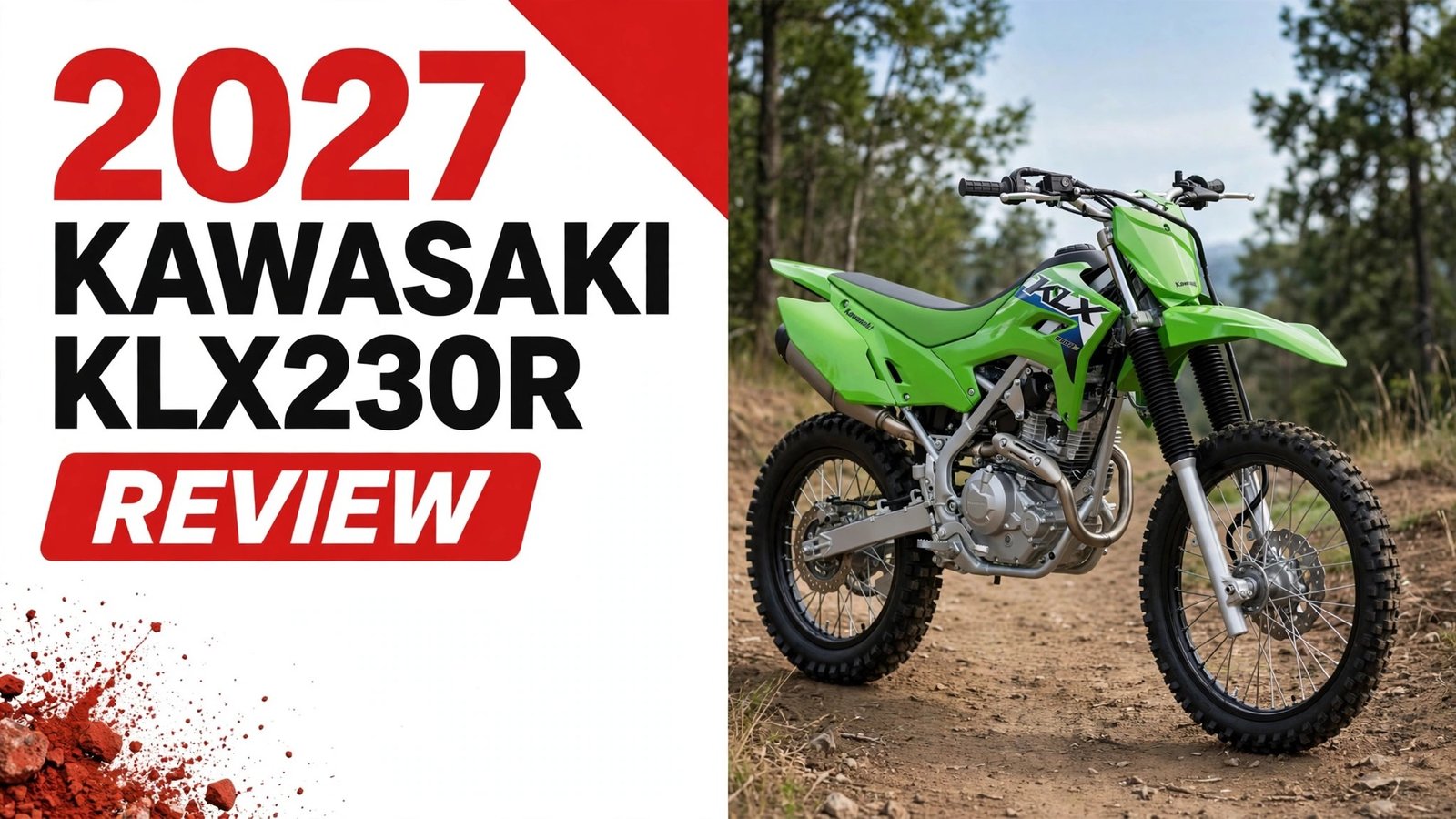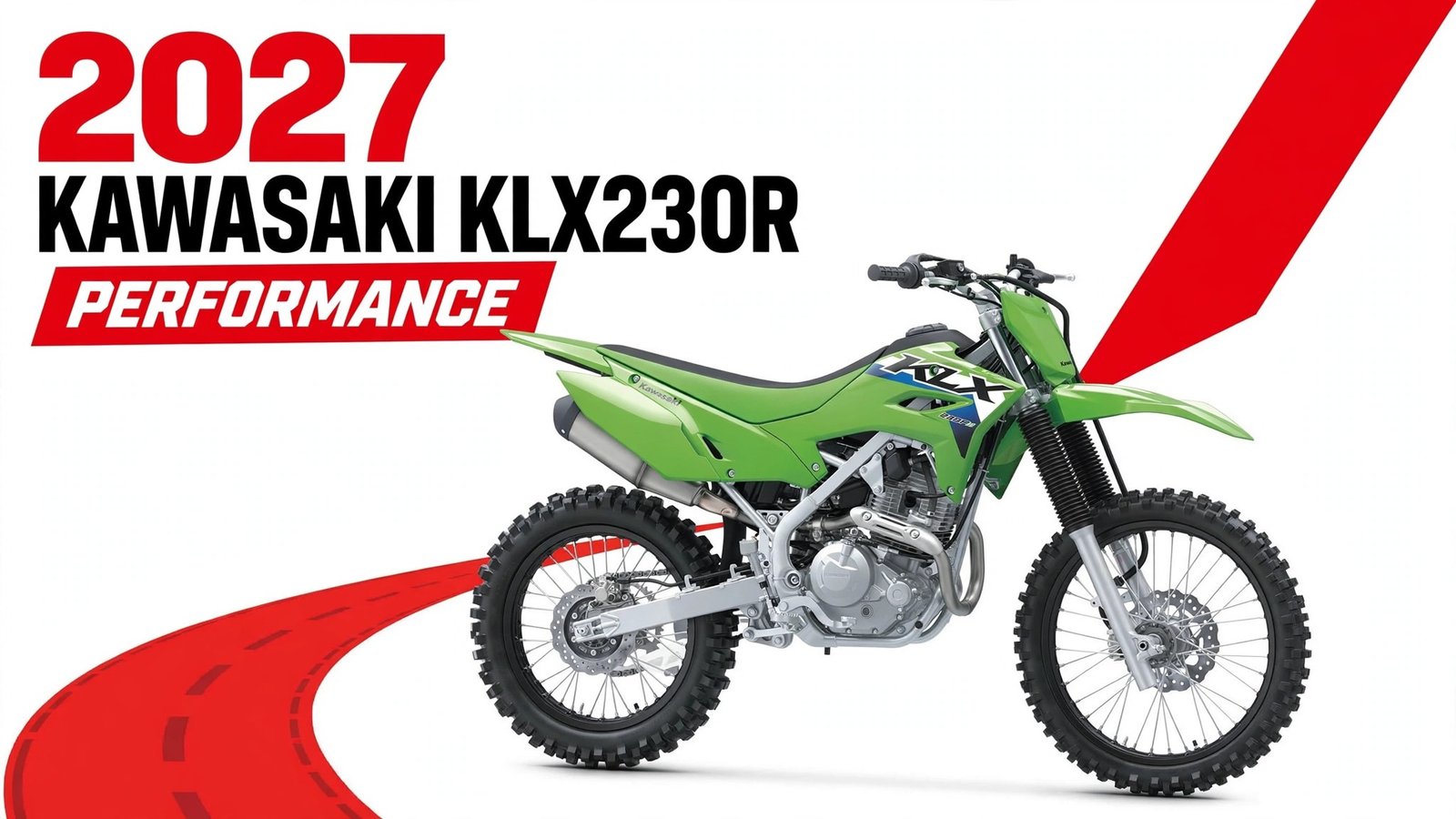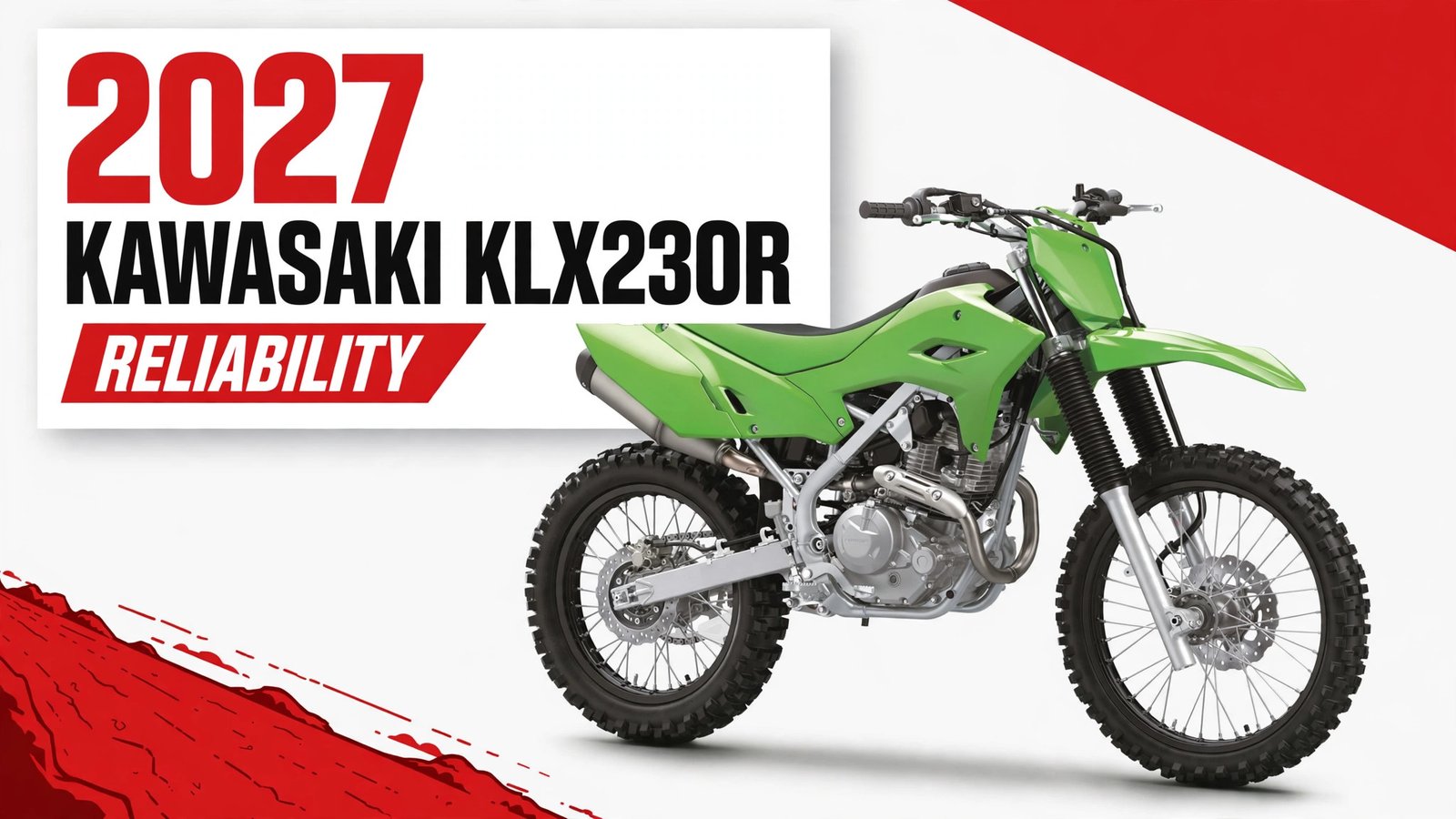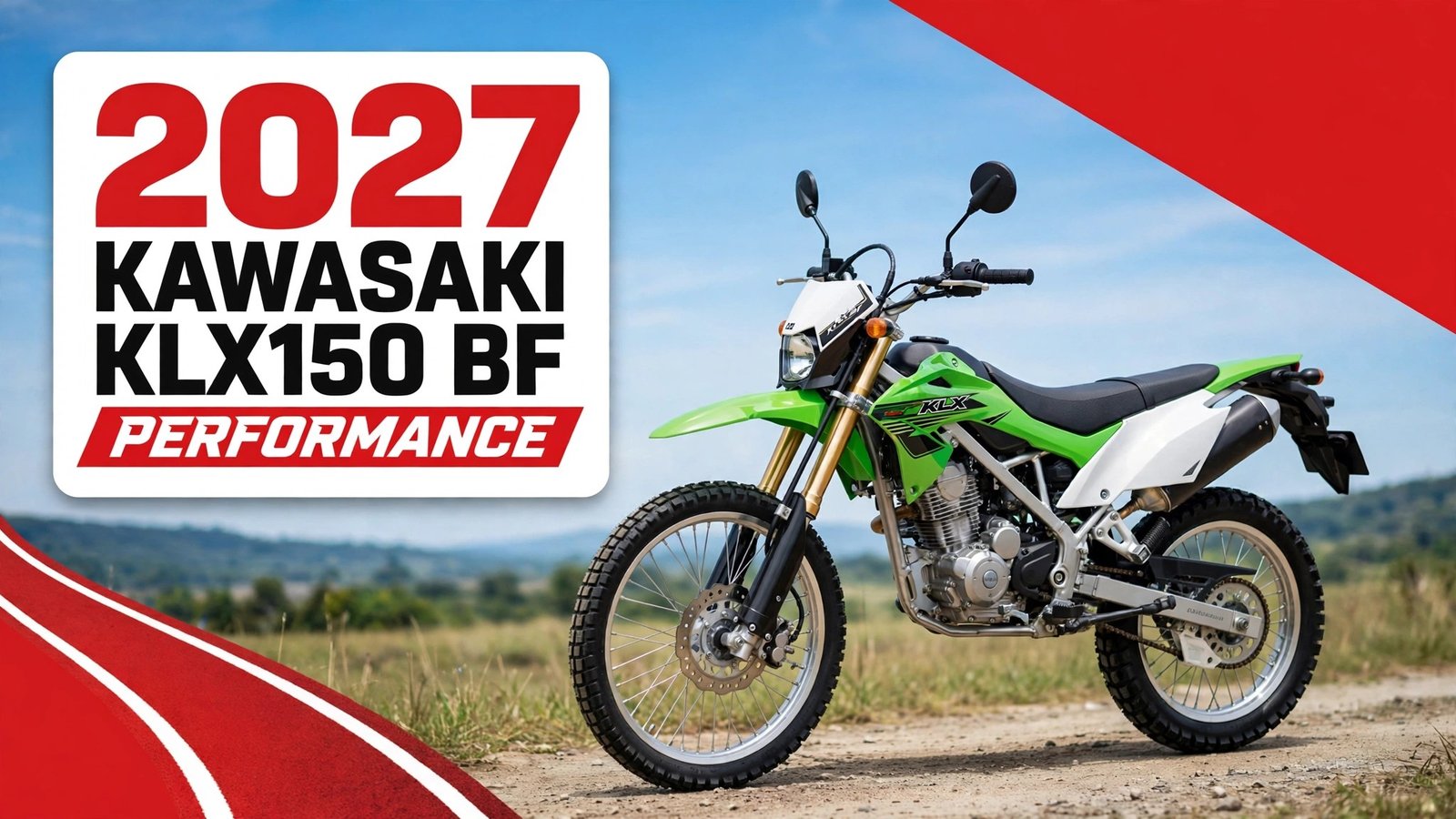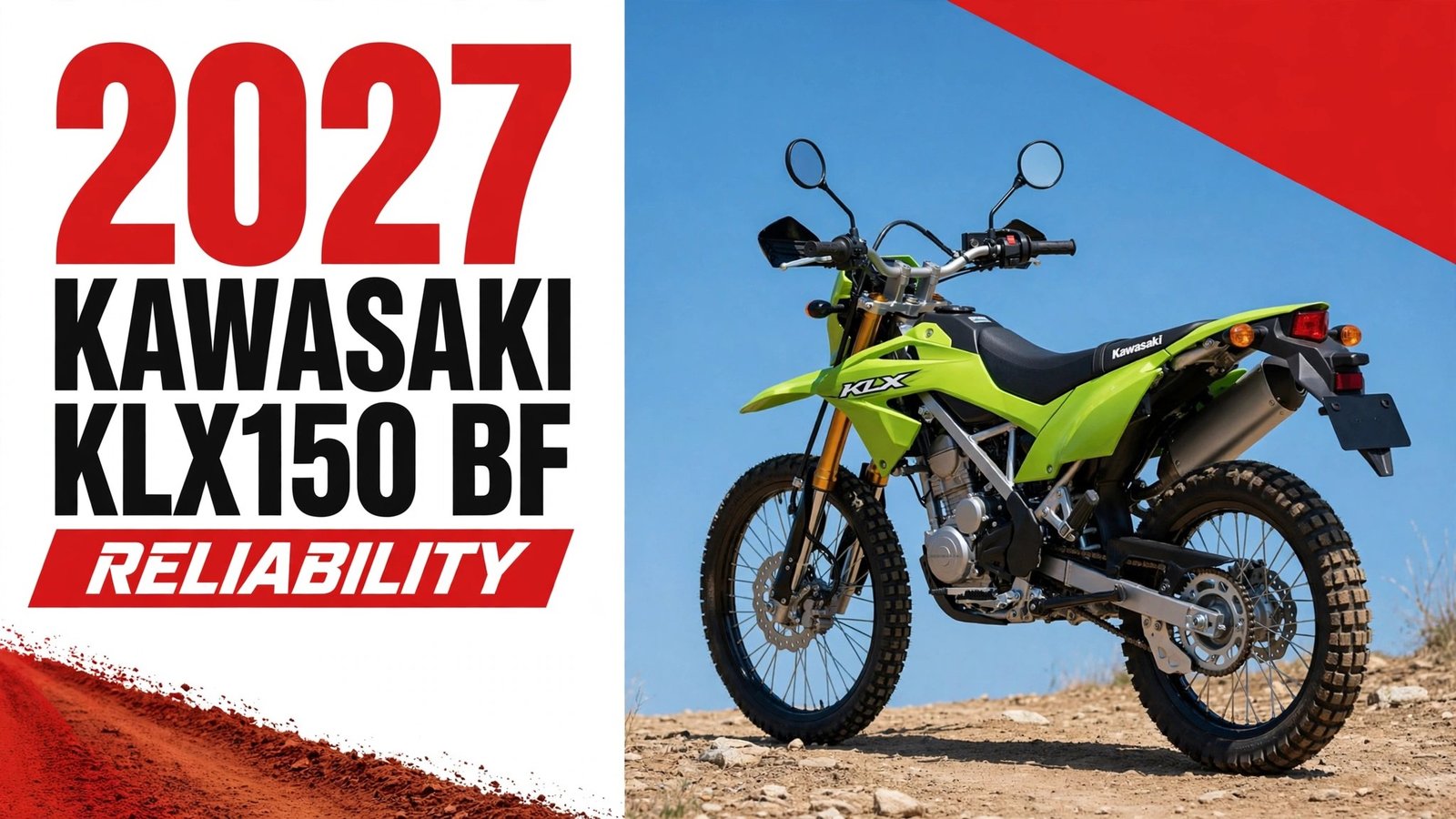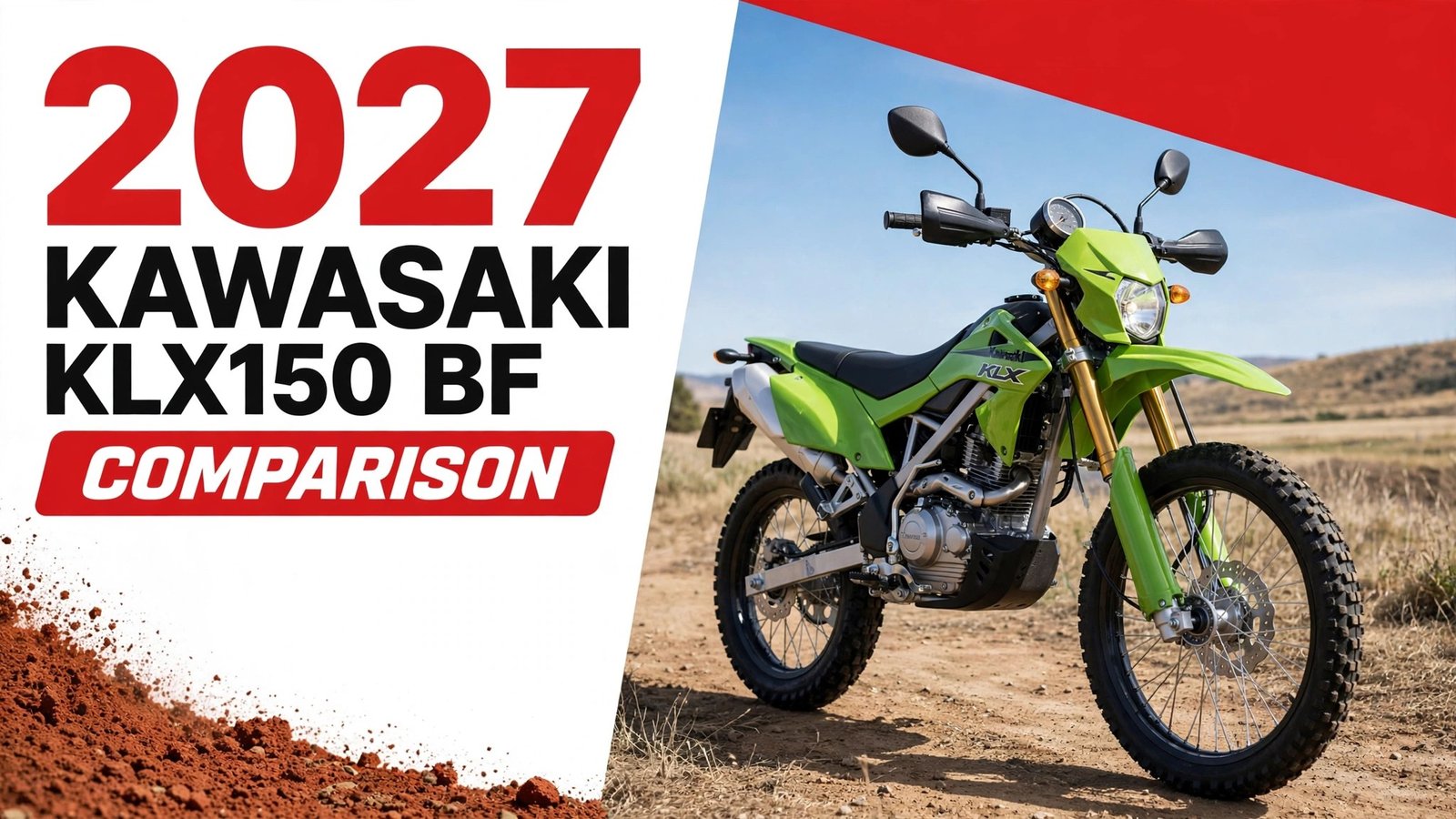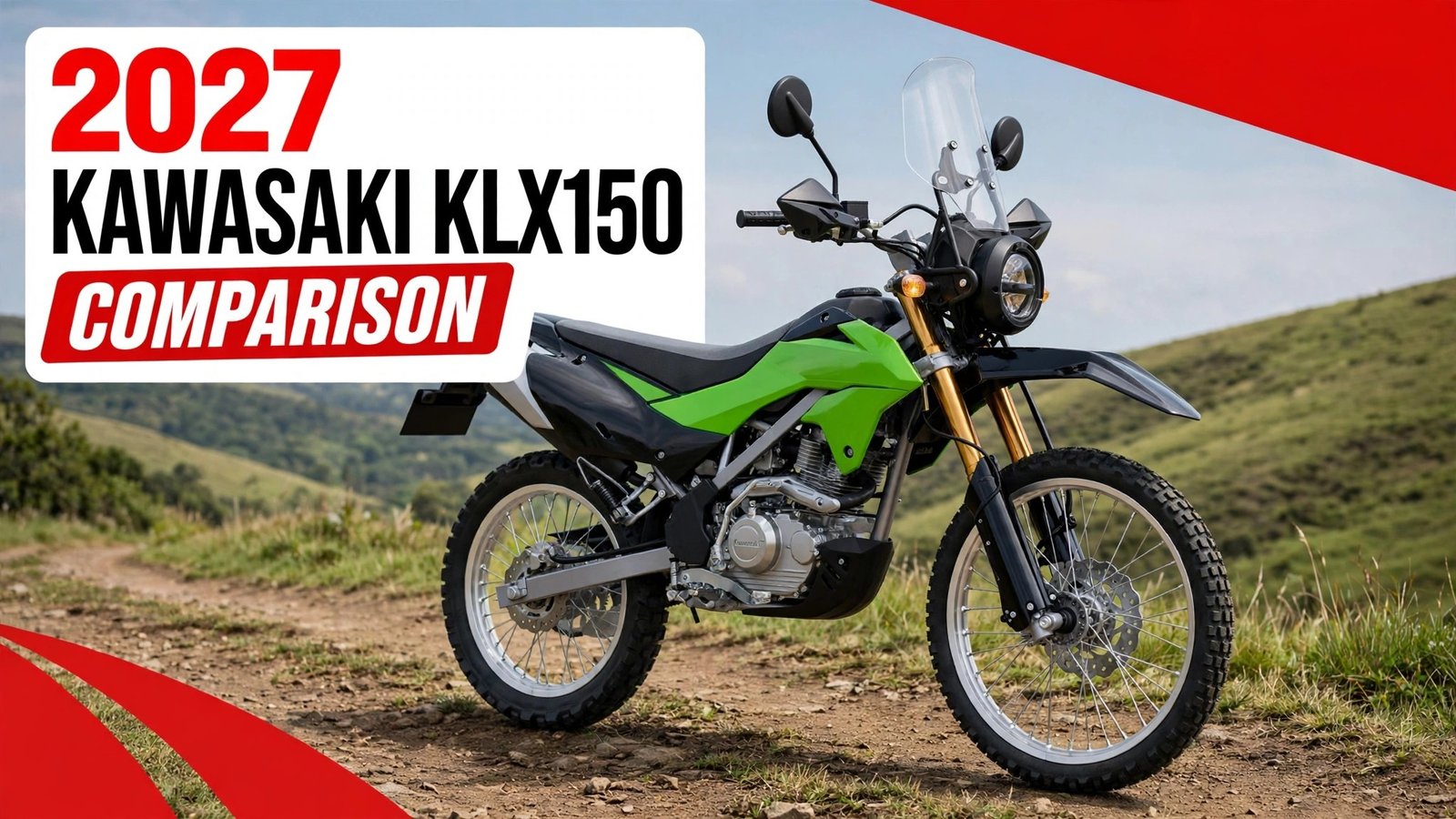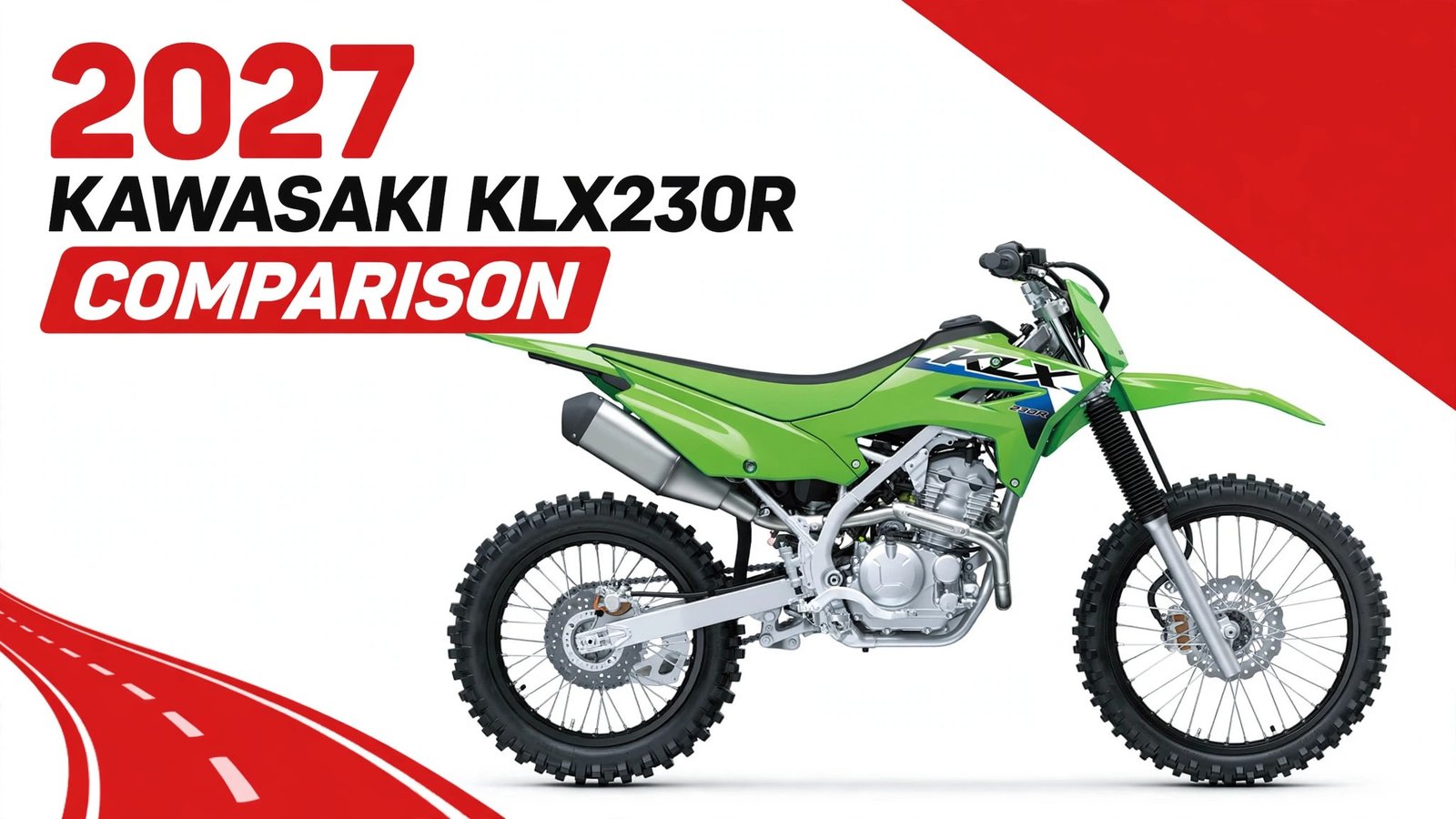
The short answer in this Kawasaki KLX230R comparison is that the R wins on weight, gears and simplicity, and loses on power and road legality. It is the lightest bike in its group and the only one that cannot be ridden to the trail. Against the Honda it is the older, smaller bike at the same money; against the Yamaha it is the more modern bike at $395 more. This Kawasaki KLX230R comparison puts all four bikes side by side on price, engine, gears, brakes and road legality.
Kawasaki KLX230R Overview and Its Closest Rivals
The KLX230R does not have one rival — it has three, and this Kawasaki KLX230R comparison takes them one at a time. Honda replaced the CRF250F with the bigger CRF300F and matched the Kawasaki’s $4,999 MSRP in 2026. Yamaha kept the TT-R230 cheap, simple and carburetted, undercutting the R by $300 before destination. And Kawasaki’s own street KLX230 S shares the R’s engine and name but adds a plate and ABS for $200 more. The off-road low-seat KLX230R S is a fourth name to keep straight — same $4,999 as the R — but it is a trim of the R, not a rival. This Kawasaki KLX230R comparison keeps the four names separate, because mixing them up gets prices, weights and legality wrong.
The video below is MXHideout’s practical comparison of the KLX230R against the OLD Honda CRF250F — the bike the CRF300F replaced — not the current CRF300F. It is a size and riding comparison on gen-1 bikes, not a dyno test, and it is useful in this Kawasaki KLX230R comparison for the riding feel, not for the CRF300F’s figures.
The Honda Changed the Argument
Before 2025, the argument for the KLX230R was simple: it was the modern bike against Honda’s old CRF250F. The Honda had more power — 20.1 horsepower on Cycle World’s Dynojet against the Kawasaki’s 17.9 — but only five gears and a $4,899 price that sat $150 above the 2023 Kawasaki. Then Honda changed the argument: the CRF300F arrived with a bigger 294cc engine, six speeds of its own, and a 2026 MSRP of $4,999 — exactly the same as the R. The Kawasaki is no longer the modern bike against an old rival; it is the smaller-engined bike against a bigger one at the same money.
How the Four Bikes Differ at a Glance
Four bikes, four different answers to the same question. The KLX230R is the fuel-injected, six-speed, off-road-only trail bike at $4,999.
| Bike | Engine | Gears | Seat | Weight | Road legal | Delivered |
|---|---|---|---|---|---|---|
| Kawasaki KLX230R (2027) | 233cc, fuel-injected | 6 | 35.6 in | 262 lb wet | No | $5,434 |
| Honda CRF300F (2026) | 294cc, fuel-injected | 6 | Not verified | Not verified | No | $5,299 |
| Yamaha TT-R230 (2026/2027) | 223cc, carburetted | 6 | 34.3 in | 251 lb wet | No | $5,039 |
| Kawasaki KLX230 S street (2026) | 233cc, fuel-injected | 6 | 33.3 in | 291.1 lb curb | Yes | $5,634 |
Notes: delivered prices in this Kawasaki KLX230R comparison are MSRP plus destination for the model year shown — the R is a 2027 price, the Honda and the street S are 2026 prices, the TT-R230 is the same price both years. The CRF300F’s seat height and weight are not verified from a retrievable Honda source, so no figures are printed for them in this Kawasaki KLX230R comparison. The street S curb weight is the non-ABS figure from Kawasaki’s own 2026 spec sheet; the ABS bike is 293.3 lb.
Kawasaki KLX230R vs Honda CRF300F
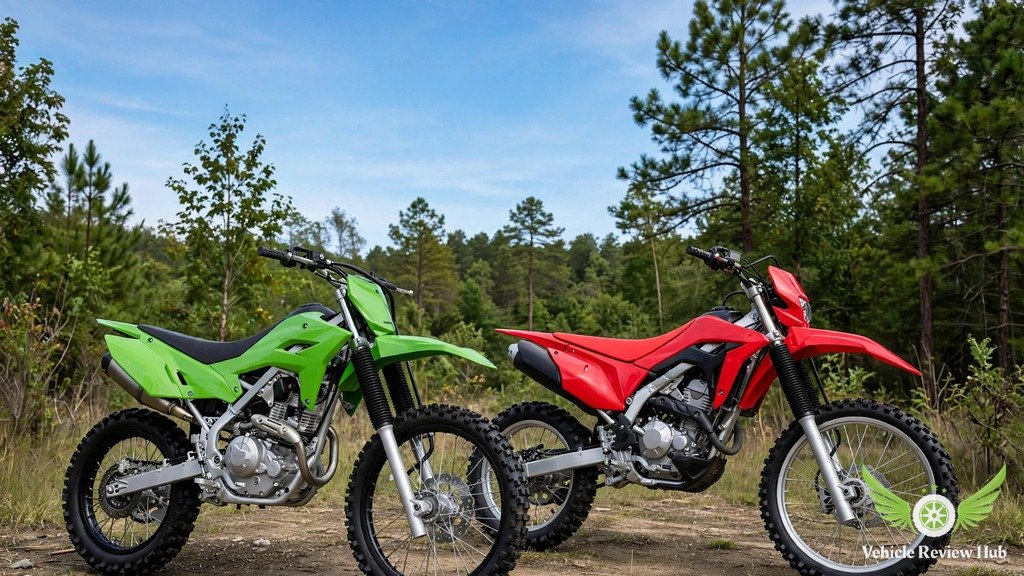
This is the Kawasaki KLX230R comparison that decides the R’s value in 2026 and 2027. The Honda is bigger, newer and the same price; the Kawasaki is lighter, lower and better proven. The differences that matter are engine size, tank size and weight — and this Kawasaki KLX230R comparison works through them.
Engine, Specs and Performance Side by Side
On paper the Honda has the engine advantage: 294cc against the Kawasaki’s 233cc. But Honda has published no verified power figure for the CRF300F in the USA, and the “~24 hp” number found online is Brazil-sourced and unmeasured — it is not printed here as a fact. What is verified is the old bike’s figure: the CRF250F made 20.1 horsepower at 7,500 rpm and 15.5 lb-ft at 6,000 rpm on Cycle World’s Dynojet, against the KLX230R’s 17.9 horsepower at 7,700 rpm and 14.4 lb-ft on the same dyno. That 2-horsepower gap belonged to the old Honda, not the new one. The Kawasaki’s figures are at least measured: Dirt Rider’s 2021 test recorded 17.3 horsepower at 7,800 rpm and 13.3 lb-ft, and no gen-2 dyno exists for either bike.
The R carries a 2.0-gallon steel tank from 2025; the Honda carries 1.6 gallons plus a 0.34-gallon reserve — a smaller tank on the bigger engine. The R’s six-speed gearbox has a walking-speed first gear and a midrange torque spike near 4,400 rpm. The Honda’s six speeds replace the old 250F’s five. Neither bike has a tested top speed, a tested 0–60 time or a tested MPG figure, so this Kawasaki KLX230R comparison prints none of those for either bike.
| Item | Kawasaki KLX230R | Honda CRF300F |
|---|---|---|
| Engine | 233cc air-cooled single, DFI, 32 mm throttle body | 294cc air-cooled single, fuel-injected |
| Measured power | 17.3 hp (Dirt Rider 2021) / 17.9 hp (Cycle World 2022) | No verified US dyno figure |
| Old rival’s power | — | CRF250F: 20.1 hp @ 7,500 rpm (Cycle World, same dyno) |
| Gears | 6-speed | 6-speed (old 250F had 5) |
| Fuel tank | 2.0 gal steel (2025+) | 1.6 gal + 0.34 gal reserve |
| Seat height | 35.6 in | Not verified |
| Wet weight | 262 lb | Not verified |
| Road legal | No — off-road only | No — off-road only |
Notes: the CRF250F’s 20.1 hp figure is from Cycle World’s comparison on the same Dynojet 250i and belongs to the discontinued CRF250F, never to the CRF300F that replaced it. The “~24 hp” figure found online for the CRF300F is Brazil-sourced and unmeasured, so it is not printed in this Kawasaki KLX230R comparison. No gen-2 dyno figure exists for the KLX230R, so none is printed for the 2025-and-later bike in this Kawasaki KLX230R comparison.
Price, Equipment and Which Suits Which Rider
On price the two bikes are tied in 2026 and split in 2027. Both wore a $4,999 MSRP in 2026 — the doc’s “same MSRP as the Honda now” is a 2026 claim. Delivered, the Honda was cheaper in 2026 at $5,299 against the R’s 2027 delivered figure of $5,434, because Honda’s destination is $300 against Kawasaki’s $435. For 2027 the Honda’s MSRP rises to $5,099 — $5,399 delivered, so the gap narrows to $35. The honest reading in this Kawasaki KLX230R comparison is that neither bike wins on price; the choice is about the bike, not the invoice. Motorcycle.com’s 2025 review of the updated Kawasaki praises the counterbalanced engine’s manners and the lower seat, and that is where the R’s case lives: a smoother, lower, more forgiving bike for a newer or shorter rider.
Kawasaki KLX230R vs Yamaha TT-R230
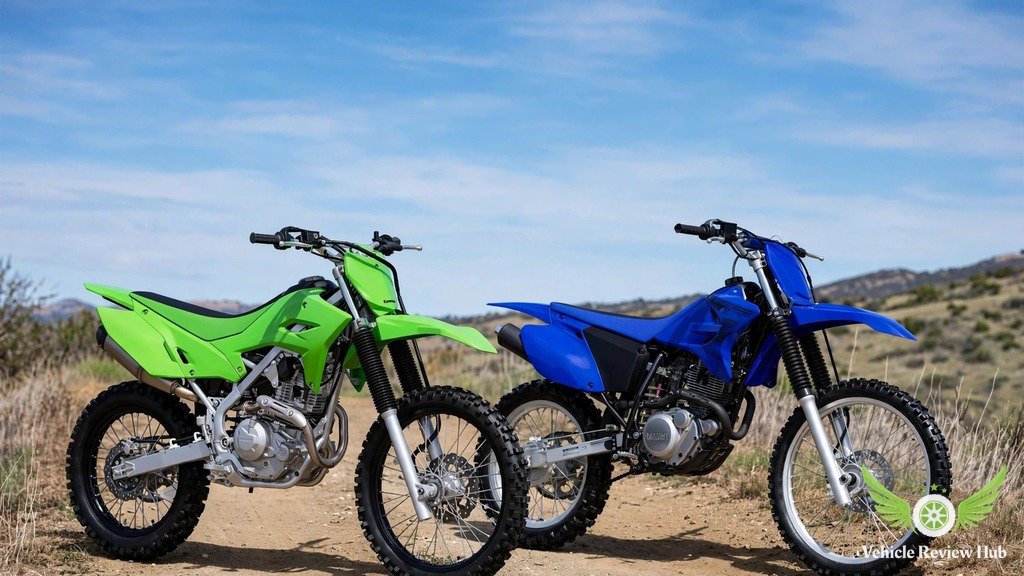
The Yamaha is the cheapest bike in this Kawasaki KLX230R comparison and the simplest. The TT-R230 is a carburetted 223cc Yamaha that has barely changed in years: $4,699 plus $340 destination is $5,039 delivered. The question in this Kawasaki KLX230R comparison is whether $395 buys enough modernity to matter, and the answer depends on who is riding.
Engine, Specs and Performance Side by Side
The engine comparison is the whole story: 233cc fuel-injected against 223cc carburetted. The Kawasaki’s digital fuel injection starts cleanly in the cold, needs no choke and no jetting changes for altitude. The Yamaha’s carburettor is the older technology — simple and cheap to fix — but it asks the rider to choke it, warm it and live with factory jetting chosen for sea level. Neither bike has a published dyno figure in the USA, so this Kawasaki KLX230R comparison prints no power figures for the Yamaha, and the Kawasaki’s 17.3 and 17.9 horsepower figures stand as the only measured numbers in the pair.
Weight and fit favour the Yamaha on paper and the Kawasaki in practice. The TT-R230 is 251 lb wet against the R’s 262 lb, and its 34.3-inch seat is lower than the R’s 35.6 inches — but the R’s seat is thicker and wider since 2025, and its 11.8 inches of ground clearance beat the Yamaha’s where the ground gets rough. The Kawasaki’s six-speed gearbox has a walking-speed first gear; the Yamaha’s six speeds are the same idea. Motocross Hideout’s KLX230 guide calls the R a practical, forgiving trail bike.
| Item | Kawasaki KLX230R | Yamaha TT-R230 |
|---|---|---|
| Engine | 233cc air-cooled single, DFI, 32 mm throttle body | 223cc air-cooled carburetted SOHC single |
| Measured power | 17.3 hp (Dirt Rider 2021) / 17.9 hp (Cycle World 2022) | No published dyno |
| Gears | 6-speed | 6-speed |
| Seat height | 35.6 in | 34.3 in |
| Weight | 262 lb wet | 251 lb wet |
| Fuel tank | 2.0 gal steel (2025+) | Not verified |
| Road legal | No — off-road only | No — off-road only |
| Delivered price | $5,434 (2027) | $5,039 (2026/2027) |
Notes: the TT-R230’s price is the same for 2026 and 2027 — the bike is unchanged except for cosmetics. The Yamaha’s fuel-tank capacity is not verified from a retrievable source, so no figure is printed in this Kawasaki KLX230R comparison. No dyno figure exists for the TT-R230, so none is printed for either bike in this Kawasaki KLX230R comparison beyond the Kawasaki’s two measured figures.
Price, Equipment and Which Suits Which Rider
On price the Yamaha wins by $395 delivered — $5,039 against the R’s $5,434 — and that is real money on a $5,000 bike. But the saving buys an older bike: a carburettor instead of fuel injection and no counterbalancer. The Kawasaki’s $395 buys cold starts without a choke, altitude without rejetting and a smoother engine. For a rider on a tight budget who does their own maintenance and rides near sea level, the Yamaha is the honest buy. For a rider who wants the bike to start first time on a cold morning, the Kawasaki is worth the $395, and this Kawasaki KLX230R comparison says so plainly.
Kawasaki KLX230R vs Kawasaki KLX230 S
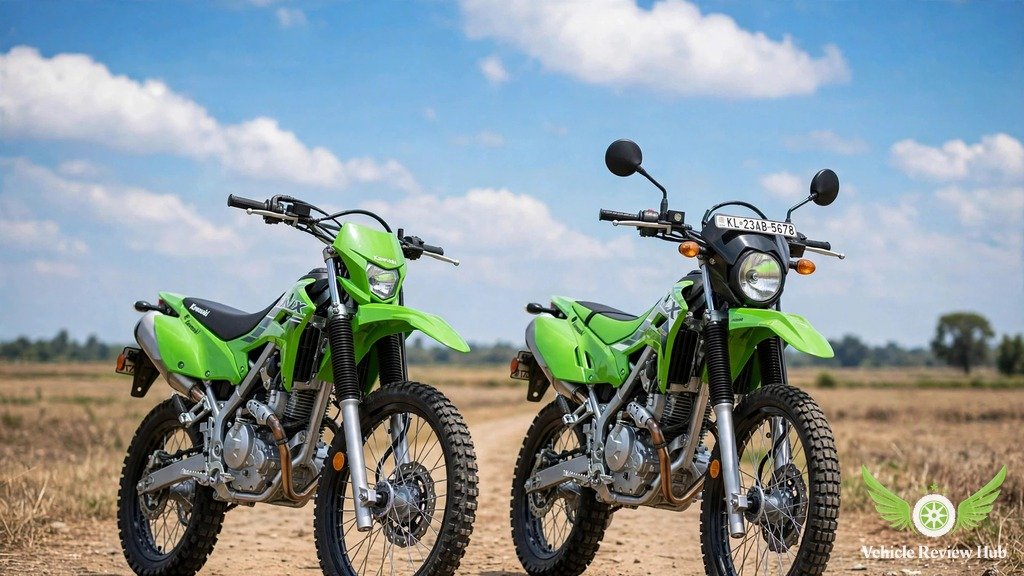
This is the comparison that confuses buyers most, because the two bikes share an engine, a name and a badge — and differ on the one thing that matters most: where they can legally go. The street KLX230 S is the plated dual-sport sibling, with lights, mirrors, turn signals, a plate and an ABS option, and it can be ridden to the trail. The R has none of those things and cannot. The street S costs $5,199 plus $435 destination — $5,634 delivered — and it is heavier, lower and slower-feeling for it. The name to keep separate is the off-road low-seat KLX230R S: same $4,999 as the R, seat at 34.4 inches. The street S and the off-road R S are different bikes, and this Kawasaki KLX230R comparison names them correctly in every table and paragraph.
Engine, Specs and Performance Side by Side
The two bikes share the same 233cc air-cooled single, the same 67.0 x 66.0 mm bore and stroke, the same 9.4:1 compression and the same 32 mm throttle body — but Kawasaki publishes power only for the street bike: 17 horsepower at 8,000 rpm and 13.0 lb-ft at 6,400 rpm, measured to the ISO 4106 standard. That is a factory figure for the street S, not a dyno result for the R. The R’s power was measured on a dyno: Dirt Rider recorded 17.3 horsepower at 7,800 rpm and 13.3 lb-ft at 6,300 rpm in 2021, and Cycle World recorded 17.9 horsepower at 7,700 rpm and 14.4 lb-ft at 6,100 rpm in 2022. The R’s numbers are measured and the street S’s number is published, and this Kawasaki KLX230R comparison keeps that distinction.
The street S is 291.1 lb at the curb without ABS and 293.3 lb with it, against the R’s 262 lb wet — about 29 lb of lights, mirrors, plate bracket, battery and road equipment that the R does not carry. The street S seat is 33.3 inches, verified from Kawasaki’s own 2026 spec sheet, against the R’s 35.6 inches — lower, but on a heavier bike with 9.4 inches of clearance against the R’s 11.8. The R’s travel is 9.8 inches at both ends; the street S runs shorter travel. On the trail the R is the better bike in this Kawasaki KLX230R comparison. On the road the street S is the only one of the two allowed to be there at all.
| Item | Kawasaki KLX230R | Kawasaki KLX230 S (street) |
|---|---|---|
| Engine | 233cc air-cooled single, DFI, 32 mm throttle body | 233cc air-cooled single, DFI, 32 mm throttle body |
| Power | 17.3 hp (Dirt Rider 2021) / 17.9 hp (Cycle World 2022), dyno-measured | 17 hp @ 8,000 rpm / 13.0 lb-ft @ 6,400 rpm, Kawasaki-published (ISO 4106) |
| Gears | 6-speed | 6-speed |
| Seat height | 35.6 in | 33.3 in (Kawasaki 2026 spec sheet) |
| Weight | 262 lb wet | 291.1 lb curb (non-ABS) / 293.3 lb (ABS) |
| Ground clearance | 11.8 in | 9.4 in |
| Brakes | 240 mm / 220 mm petal discs, no ABS | 240 mm (265 mm ABS) / 220 mm petal discs, ABS option |
| Road legal | No — off-road only | Yes — lights, mirrors, plate, ABS option |
| Delivered price | $5,434 (2027) | $5,634 (2026, non-ABS) / $5,934 (ABS) |
Notes: the street S seat height (33.3 in) and curb weights (291.1 lb non-ABS, 293.3 lb ABS) are verified from Kawasaki’s own 2026 KLX230 S spec sheet — not the “~32.9 in” estimate found in earlier research. The street S power figure is Kawasaki-published for the street bike only and must never be quoted as the R’s power in this Kawasaki KLX230R comparison. The off-road low-seat KLX230R S is a different bike from the street S: $4,999, seat 34.4 in, off-road only, no ABS.
Price, Equipment and Which Suits Which Rider
On price the street S costs $200 more than the R before destination and $200 more after it: $5,634 delivered against $5,434, or $5,934 with ABS. That $200 buys the plate, the lights, the mirrors and the right to ride to the trail — and it costs 29 lb, 2.3 inches of seat height the other way, and 2.4 inches of ground clearance. A rider who has a truck or trailer and rides only trails should buy the R. A rider who has no truck and wants to ride from home should buy the street S, because the R cannot legally leave the trailhead. Ultimate Motorcycling’s 2025 review of the updated R and S together makes the same point: only the street bike can be ridden home afterwards. The equipment gap is the whole decision in this Kawasaki KLX230R comparison, and no dyno figure changes it.
Kawasaki KLX230R Price and Value Compared
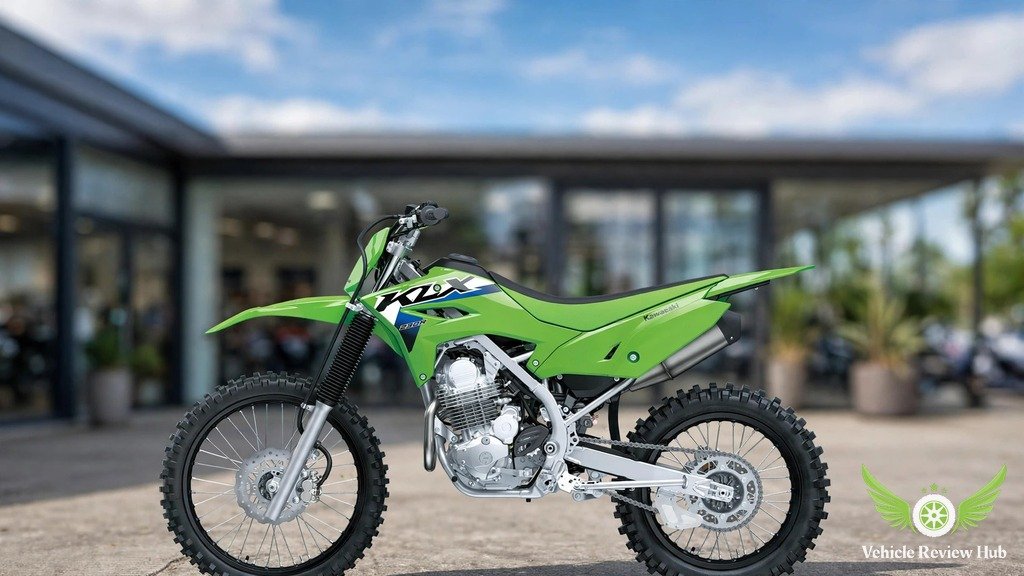
Price is where this Kawasaki KLX230R comparison stops being about spec sheets and starts being about money. The R sits in the middle of its group on delivered price. The ladder below is MSRP plus destination, year-labelled, with no dealer fees folded in. The R’s 2027 delivered price is $5,434.
Same MSRP as the Honda Now
The doc’s “same MSRP as the Honda now” is a 2026 claim, and it is true for 2026 only: both the KLX230R and the Honda CRF300F wore a $4,999 MSRP that year. It is not true for 2027, when the Honda rises to $5,099 — $100 more than the R. The delivered picture is closer, because Honda’s destination is $300 and Kawasaki’s is $435: in 2026 the Honda delivered at $5,299, and in 2027 it delivers at $5,399 — a $35 gap. The R has not had a price rise since the 2025 cut from $5,149 to $4,999, and that stability is part of its value case.
| Bike | MSRP | Destination | Delivered | Year |
|---|---|---|---|---|
| Yamaha TT-R230 | $4,699 | $340 | $5,039 | 2026/2027 |
| Honda CRF300F | $4,999 | $300 | $5,299 | 2026 |
| Honda CRF300F | $5,099 | $300 | $5,399 | 2027 |
| Kawasaki KLX230R | $4,999 | $435 | $5,434 | 2027 |
| Kawasaki KLX230 S (street, non-ABS) | $5,199 | $435 | $5,634 | 2026 |
| Kawasaki KLX230 S (street, ABS) | $5,499 | $435 | $5,934 | 2026 |
| Kawasaki KLX300R (step-up) | $5,799 | $650 | $6,449 | 2027 |
Notes: delivered prices are MSRP plus destination only — dealer setup and documentation fees are not included, because they are dealer charges and vary by dealer. The R’s 2026 destination is unverified, so no 2026 delivered price is printed for the R in this Kawasaki KLX230R comparison; the 2027 destination of $435 is confirmed by two dealers. The 2024 R price of $5,149 is derived from the 2025 price cut, never Kawasaki-published.
Running Costs and Resale Value Compared
No resale percentage and no running-cost dollar figure is printed anywhere in this Kawasaki KLX230R comparison, because none was verified for any of the four bikes. What can be said honestly is that the KLX230R is a small, simple, air-cooled single with ordinary consumables and no expensive systems to fail — the same story as the TT-R230, except the Yamaha’s carburettor is cheaper to fix and more fiddly to live with. The street S is the only one of the four whose plate adds used value. The R’s case on costs in this Kawasaki KLX230R comparison is simplicity: fewer systems, cheaper consumables, and a six-month warranty that covers the same short period on all four bikes.
Kawasaki KLX230R Comparison Verdict and US Alternatives
The verdict of this Kawasaki KLX230R comparison is that the R is the best trail bike in its group for a beginner or a shorter rider, and the second-best value in the group on price alone. It is not the most powerful — the old Honda was, and the new Honda probably is. It is not the cheapest — the Yamaha is, by $395. It is not the most useful — the street S is, because it has a plate. What it is, is the lightest-feeling, easiest-to-ride, most forgiving full-size trail bike of the four. The Kawasaki KLX230R review covers the price, the 2025 update and the riding position in full, and the Kawasaki KLX230R performance guide has the dyno figures and the top-speed evidence behind the numbers in this Kawasaki KLX230R comparison.
Verdict: Weight and the Low-Seat Option
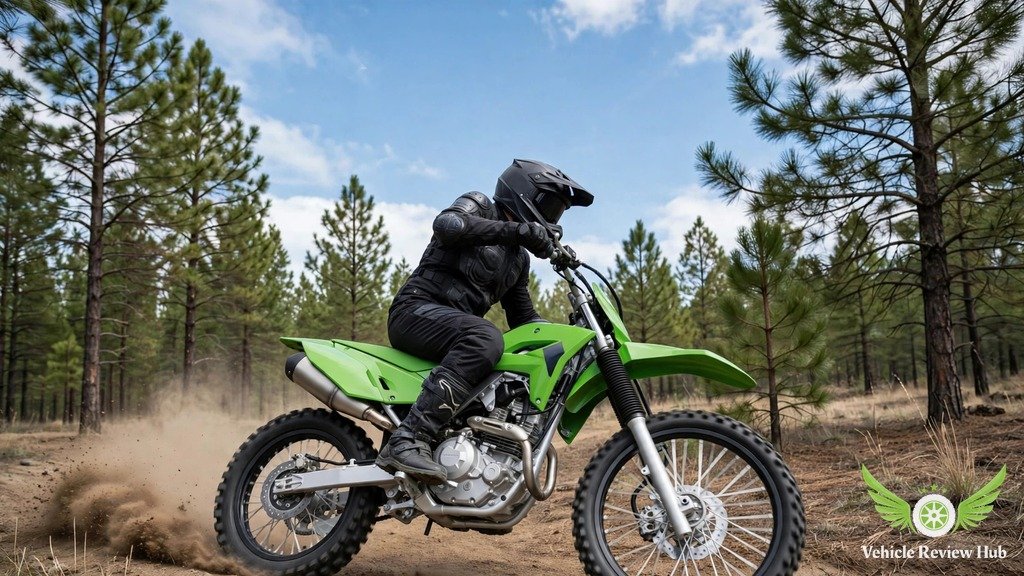
Weight is the R’s verdict in this Kawasaki KLX230R comparison, and the low-seat option is its answer to its own tallest problem. At 262 lb wet the R is 29 lb lighter than its street sibling and light enough to pick up after a fall. The reservation is height: at 35.6 inches the seat is still tall for a shorter beginner, and the answer is the low-seat KLX230R S, the off-road twin at the same $4,999, with the seat at 34.4 inches — not the street KLX230 S at $5,199. The step down in the family is the Kawasaki KLX140R L review, and the Indonesian carburetted line is covered by the Kawasaki KLX150 review. The Kawasaki KLX230R reliability guide covers what to check before paying, and it is the natural next read after this Kawasaki KLX230R comparison.
KLX300R: The Step-Up Alternative
The step up is the KLX300R, the 292cc liquid-cooled trail bike in the video at the top of the Kawasaki KLX230R performance guide. At $5,799 plus $650 destination — $6,449 delivered for 2027 — it costs $1,015 more than the R. The choice in this Kawasaki KLX230R comparison is one of size and confidence: the 300R is for a rider who has outgrown the 230R’s 17-horsepower class, and the 230R is for a rider who has not. RevZilla’s 2020 first ride tested both together and found the same split — the 300R for the bigger rider, the 230R for the newer one. Buy the R if the trail is the point. Buy the 300R if the R starts to feel small.
| Buyer | Best choice | Why |
|---|---|---|
| Beginner or shorter rider | KLX230R or low-seat KLX230R S ($5,434 delivered) | Lightest, friendliest, six speeds, fuel injection, 34.4 in low-seat option |
| Tightest budget | Yamaha TT-R230 ($5,039 delivered) | $395 cheaper, simple carburetted bike, same six speeds |
| Wants the biggest engine | Honda CRF300F ($5,299 delivered, 2026) | 294cc, six speeds, same $4,999 MSRP as the R in 2026 — but no verified dyno figure yet |
| No truck, rides from home | Kawasaki KLX230 S street ($5,634 delivered) | The only plated bike of the four — lights, mirrors, plate, ABS option |
| Outgrown the 230 class | Kawasaki KLX300R ($6,449 delivered) | 292cc liquid-cooled, $1,015 over the R delivered |
Notes: delivered prices are MSRP plus destination for the model year shown. The CRF300F’s power figure is unverified, so the “wants the biggest engine” row rests on displacement (294cc) alone. The low-seat KLX230R S is the off-road twin at the same $4,999 as the R in this Kawasaki KLX230R comparison — not the street KLX230 S at $5,199. No resale percentage or running-cost dollar figure is printed in this Kawasaki KLX230R comparison, because none was verified.
Kawasaki KLX230R Comparison Frequently Asked Questions
These answers settle the R’s closest contests — the Honda, the Yamaha and its own street sibling — on price, engine and road legality, as this Kawasaki KLX230R comparison does throughout.
Which is cheaper, the KLX230R or the Honda CRF300F?
On MSRP they were tied in 2026 at $4,999 each. Delivered, the Honda was cheaper in 2026 at $5,299, against the R’s 2027 delivered price of $5,434, because Honda’s destination is $300 and Kawasaki’s is $435. For 2027 the Honda rises to $5,099 MSRP, or $5,399 delivered — only $35 below the R. The honest reading in this Kawasaki KLX230R comparison is that neither bike wins on price; the choice is about the bike, not the invoice.
KLX230R or Yamaha TT-R230 — which should I buy?
The Yamaha is $395 cheaper delivered — $5,039 against the R’s $5,434 — and that is real money on a $5,000 bike. What the $395 buys is a modern bike: the R’s 233cc fuel-injected engine against the Yamaha’s 223cc carburettor, cold starts without a choke, and no rejetting for altitude. For a tight budget and home maintenance near sea level, the Yamaha is the honest buy; for first-time cold starts, the Kawasaki is worth the $395, and this Kawasaki KLX230R comparison says so plainly.
What is the difference between the KLX230R S and the KLX230 S?
They are different bikes with confusingly similar names. The KLX230R S is the off-road low-seat twin of the R: same $4,999, seat at 34.4 inches, off-road only, no ABS. The KLX230 S is the street-legal dual-sport: $5,199 for 2026 plus $435 destination, with lights, mirrors, turn signals, a plate and an ABS option. Mixing them up gets the price, the weight and the legality wrong.
Can I ride the KLX230R on the road?
No. It has no headlight, no mirrors, no turn signals and no plate, and it cannot legally leave the trailhead. The only bike in its group that can be ridden to the trail is the street KLX230 S, at $5,634 delivered for 2026 — or $5,934 with ABS. A rider with no truck who wants to ride from home should buy the street S, not the R.
Is the KLX300R worth the step up?
It costs $1,015 more delivered — $6,449 for 2027 against the R’s $5,434. For that you get a 292cc liquid-cooled engine in place of the R’s 233cc air-cooled single. The choice in this Kawasaki KLX230R comparison is one of size and confidence: the 300R is for a rider who has outgrown the 230R’s 17-horsepower class, and the 230R is for a rider who has not.
Which bike is best for a beginner?
The R, or its low-seat twin. At 262 lb wet the R is the lightest-feeling, easiest-to-ride, most forgiving full-size trail bike of the four, with a six-speed gearbox, fuel injection and the 34.4-inch low-seat option at the same $4,999. The TT-R230 is the cheapest buy at $5,039 delivered, and the street S is the only choice if there is no truck — but for a beginner on the trail, the R is the pick in this Kawasaki KLX230R comparison.