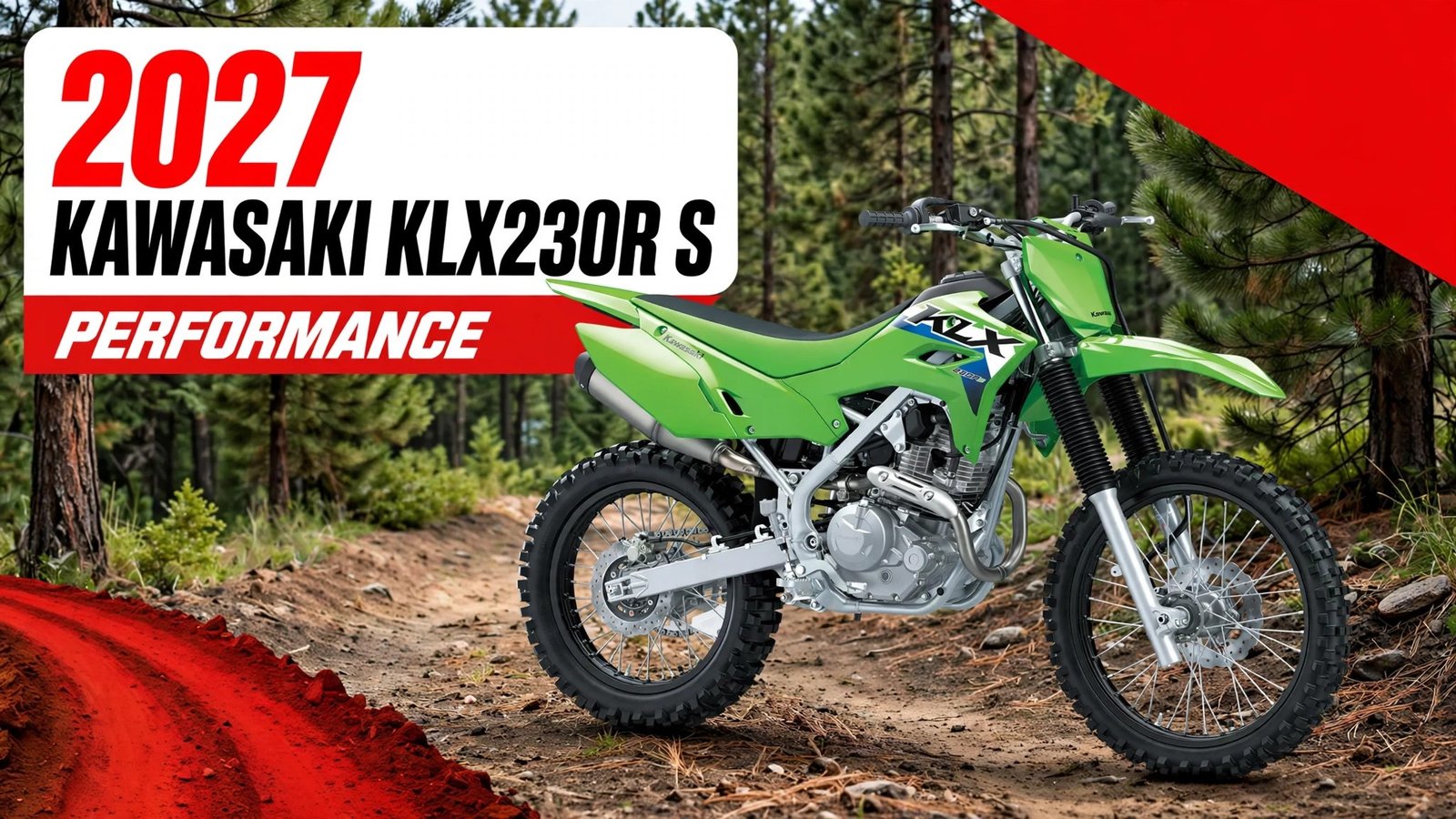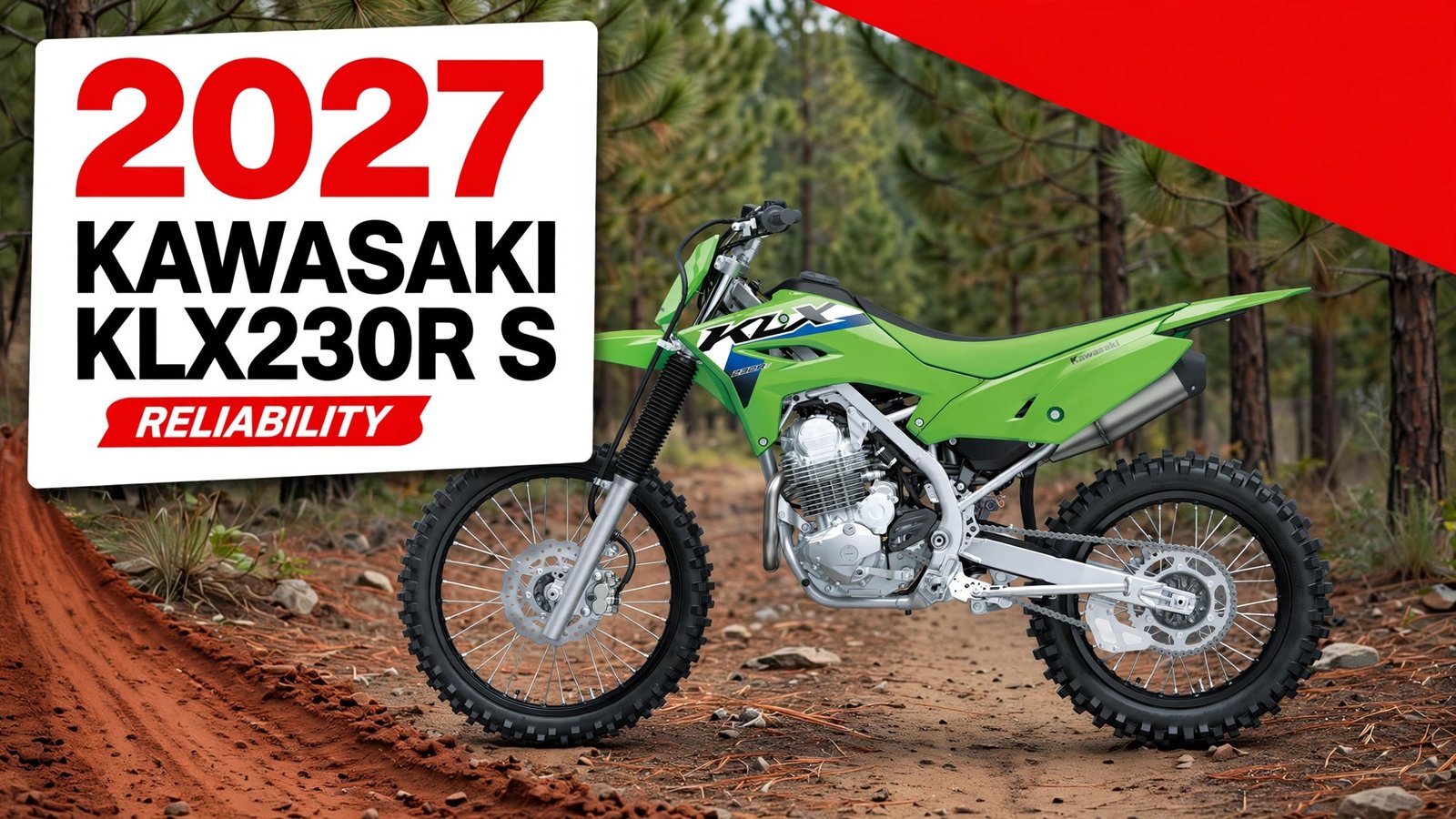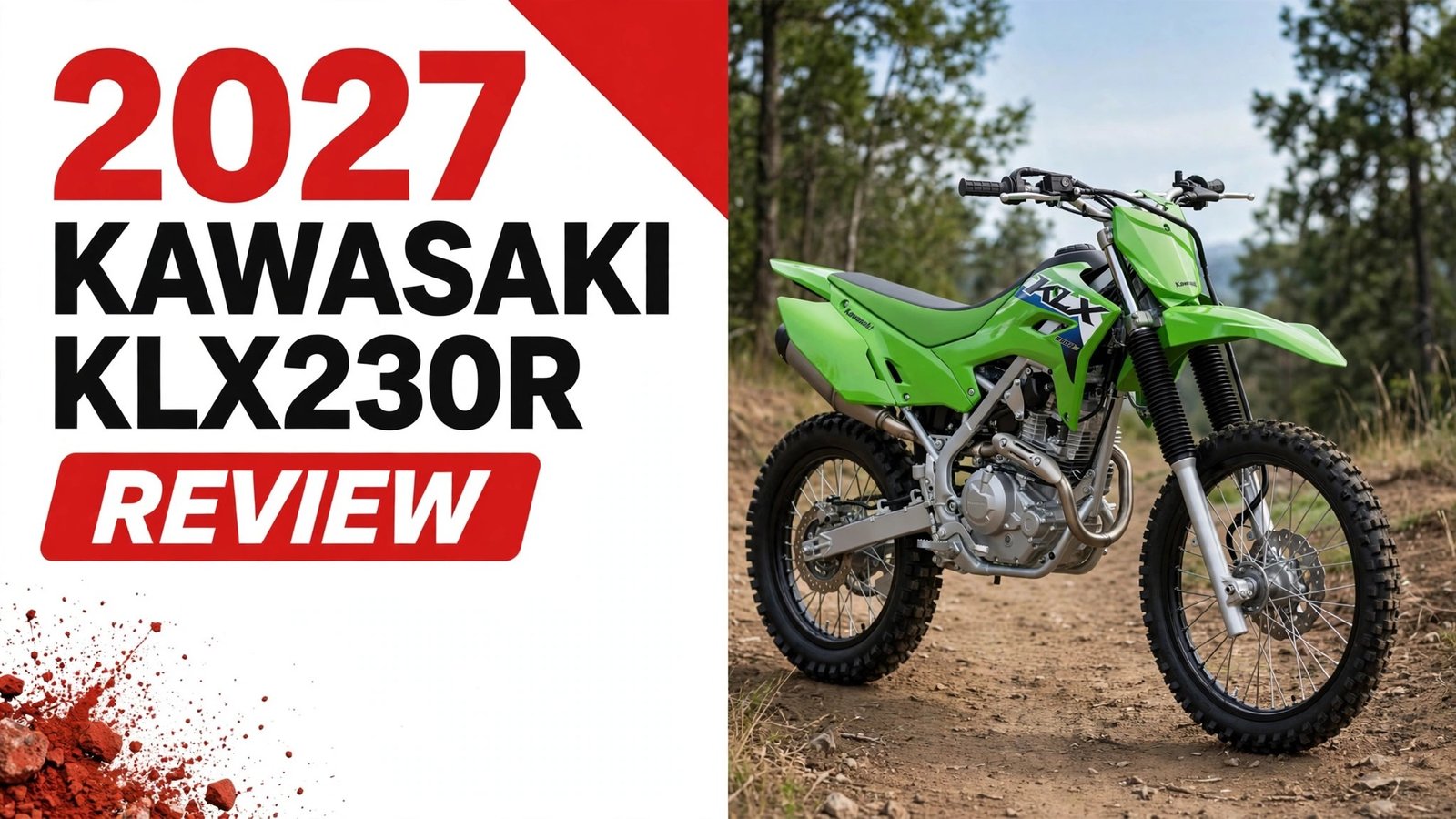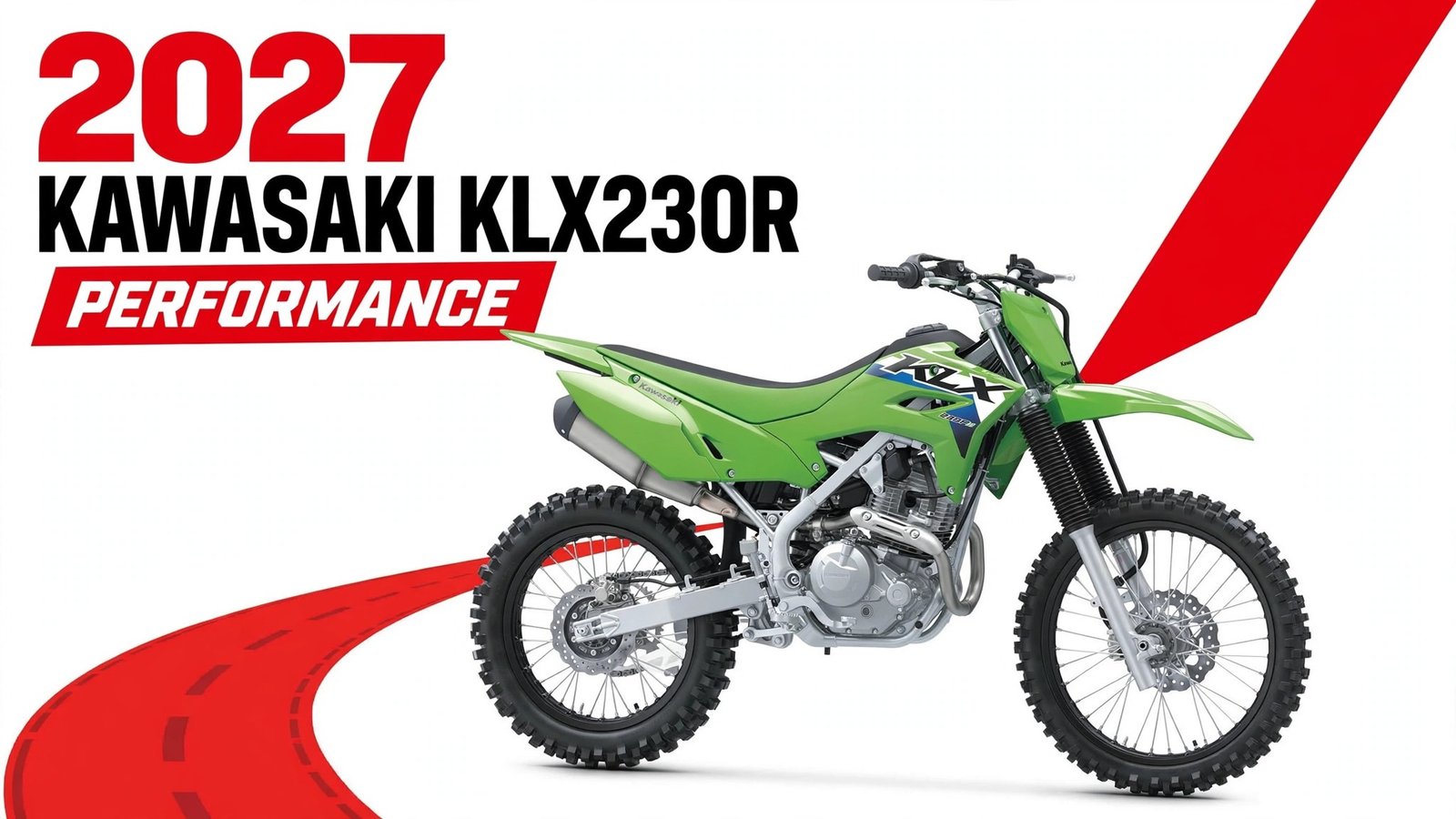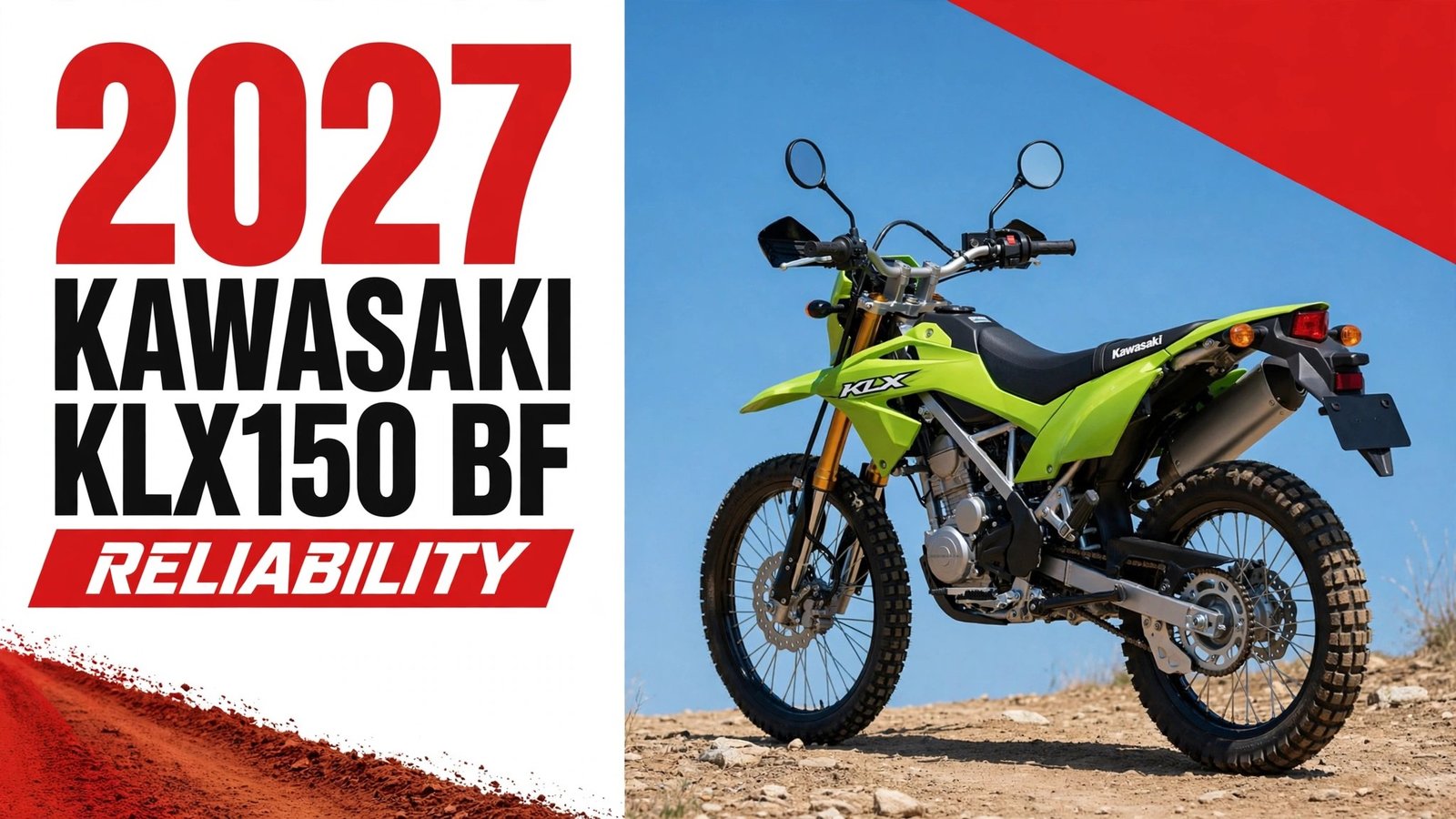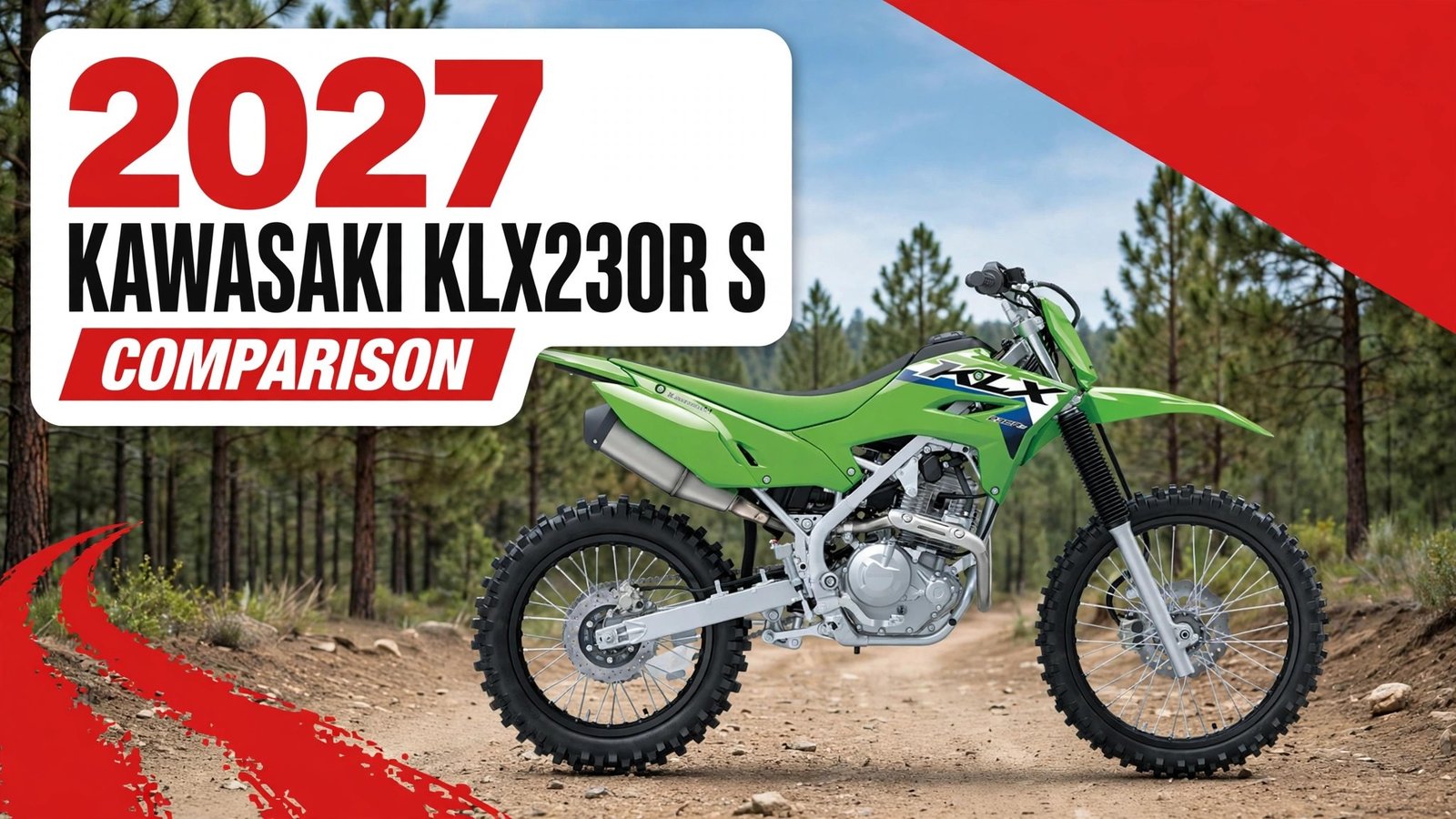
The Kawasaki KLX230R S costs exactly the same as the standard KLX230R, $4,999 before destination and $5,434 delivered for 2027, yet it is a different bike to ride. The S sits 1.2 inches lower than the gen-2 R, gives up travel and clearance, and charges nothing for it. This Kawasaki KLX230R S comparison puts that trade against the standard R, the Honda CRF300F and the Yamaha TT-R230, on seat height, price, brakes and fuelling, so a buyer can see what the lower seat really costs.
The short version is that the S is the lowest-seat fuel-injected trail bike in this group, and the only rival with a lower seat runs a carburettor. The Honda costs $135 less delivered in 2026 trim but stands 0.6 inches taller and carries 8.6 pounds more. The Yamaha undercuts the S by $395 and sits 0.1 inches lower, but it is carburetted. The standard R is the same bike, taller, for the same $5,434. One warning up front: the S has no street-legal twin with the same name. The KLX230 S dual-sport is a different, plated bike with lights, mirrors and ABS, a 33.3-inch seat, and a $5,634 delivered price, and this Kawasaki KLX230R S comparison keeps the two apart throughout.
Kawasaki KLX230R S Overview and Its Closest Rivals
The S is an off-road-only low-seat trim of the KLX230R, launched in 2021 and updated with the rest of the platform for 2025. It shares the R’s 233cc air-cooled single, six-speed gearbox and petal disc brakes, and the same $4,999 price in every year where a primary figure exists. The difference is fit: the S is lowered by suspension internals, not by a lowering link, so the fork and shock look identical to the R’s. This Kawasaki KLX230R S comparison starts with the seat-height claim, then measures the S against its three closest rivals.
The video below is a first-ride review of the Indian-market street KLX230 by BikeWale, not the US off-road KLX230R S. It is a beginner-bike review of the plated Indian bike, not a head-to-head comparison.
Lowest Seat in the Injected Class
The S has the lowest seat of any fuel-injected trail bike in this Kawasaki KLX230R S comparison. The gen-2 S seat is 34.4 inches, against 35.6 inches for the standard R and 35.0 inches for the Honda CRF300F, verified from Honda’s own 2026 spec page. That is the whole point of the S: a rider who cannot flat-foot the R can flat-foot the S, and the bike costs nothing extra for it.
Two bikes sit lower and do not count. The Yamaha TT-R230 seat is 34.3 inches, 0.1 inches lower than the S, but the Yamaha runs a carburettor, so it is outside the injected class. The street KLX230 S dual-sport seat is 33.3 inches, but that is a plated dual-sport with lights, mirrors and ABS, not a trail bike in this group, and this Kawasaki KLX230R S comparison says so explicitly wherever it is mentioned. Among fuel-injected trail bikes, the S has the lowest seat, and the only one under 35 inches.
How the Four Bikes Differ at a Glance
The four bikes in this Kawasaki KLX230R S comparison split into two pairs. The two Kawasakis share an engine, a chassis and a price, and differ only in fit. The Honda is the bigger, fuel-injected rival with more displacement, and the Yamaha is the cheapest, carburetted rival with the lowest seat of all. The table below sets the headline figures side by side.
| Bike | Seat height | Curb weight | Engine | Delivered price |
|---|---|---|---|---|
| Kawasaki KLX230R S | 34.4 in (gen-2) | 262.4 lb | 233cc DFI single, 6-speed | $5,434 (2027) |
| Kawasaki KLX230R | 35.6 in (gen-2) | 262.4 lb | 233cc DFI single, 6-speed | $5,434 (2027) |
| Honda CRF300F | 35.0 in | 271 lb | 286cc PGM-FI single, 6-speed | $5,299 (2026) |
| Yamaha TT-R230 | 34.3 in | 251 lb wet | 223cc carburetted single, 6-speed | $5,039 |
Notes: seat heights are gen-2 figures for the two Kawasakis (2025+). The S and the R share the same 262.4-pound curb weight and $5,434 delivered price for 2027. The CRF300F price is 2026 trim; the 2027 Honda is $5,399 delivered. The TT-R230 is the only carburetted bike in this Kawasaki KLX230R S comparison, and its 251-pound figure is a wet weight.
Kawasaki KLX230R S vs Kawasaki KLX230R
The standard KLX230R is the S’s closest rival and its identical twin. The two bikes share the same 233cc air-cooled single, six-speed gearbox, brakes and wheels, the same $4,999 price, and the same 262.4-pound curb weight. The only difference is fit: the R stands taller and travels further, and the S sits lower and travels less. This Kawasaki KLX230R S comparison treats the R as the default and the S as the fit option, because for most riders the question is which seat height fits.
Engine, Specs and Performance Side by Side
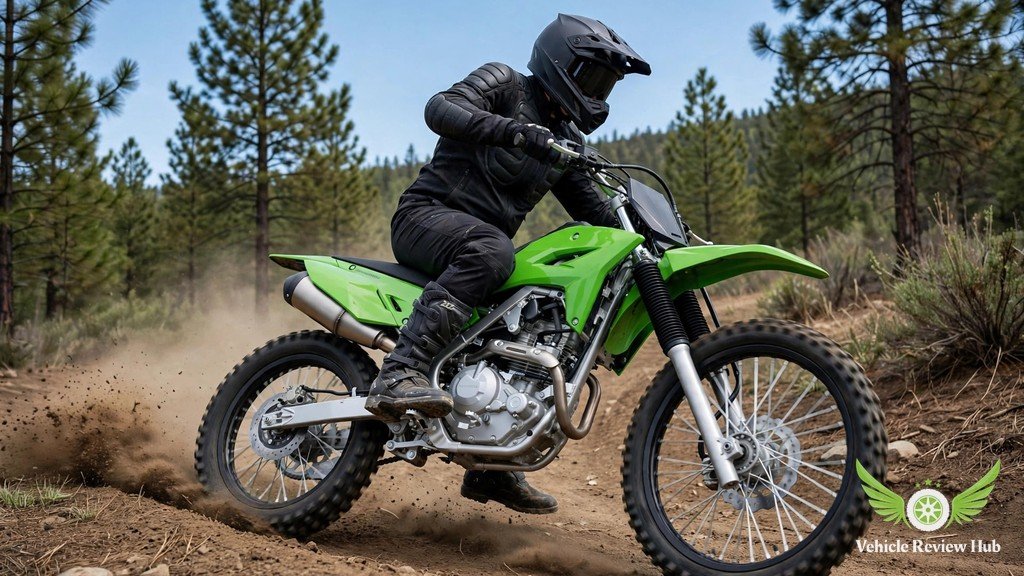
The engines are the same, so the performance figures are the same too. Both bikes run the 233cc air-cooled single with digital fuel injection through a 32 mm Keihin throttle body, a six-speed manual clutch and electric start only. Kawasaki USA publishes no horsepower figure for either bike in the US, and no dyno of the S exists at all. The only rear-wheel figures are standard-R, gen-1 bikes: Dirt Rider measured 17.3 hp at 7,800 rpm in 2021, and Cycle World measured 17.9 hp at 7,700 rpm on a 2022 bike. The two must never be blended, and neither is the S’s own number. The only published power figure for the S itself is the official Canadian 2026 sheet’s 13.8 kW (19 PS) at 8,000 rpm, which is 18.7 hp, never 19 hp.
Where the two bikes differ is the chassis. The gen-2 S seat is 34.4 inches against the R’s 35.6, a 1.2-inch drop, and the clearance is 10.6 inches against the R’s 11.4, a 0.8-inch drop. The S travel is 8.7 inches at the front and 8.5 at the rear from the official Canadian 2026 S spec sheet, against the R’s 9.8 at both ends, with the 8.8-inch US-sheet figure footnoted. The wheelbase is 53.3 inches against 54.1, and the rake is 24.6 degrees against 25.4. The Kawasaki KLX230R review covers the standard bike in full, and the Ultimate Motorcycling back-to-back test is the only direct R-versus-S test ever published, and this Kawasaki KLX230R S comparison leans on it heavily.
| Figure | KLX230R S (gen-2) | KLX230R (gen-2) | Difference |
|---|---|---|---|
| Seat height | 34.4 in | 35.6 in | S 1.2 in lower |
| Ground clearance | 10.6 in | 11.4 in | S 0.8 in lower |
| Front / rear travel | 8.7 / 8.5 in | 9.8 / 9.8 in | S 1.1 / 1.3 in less |
| 2027 delivered price | $5,434 | $5,434 | Identical |
Notes: all figures are gen-2 (2025+) from the official spec sheets. The S rear travel is printed as 8.5 inches from the official Canadian 2026 S spec sheet, with the 8.8-inch US-sheet figure footnoted. The gen-1 R seat was 36.4 inches and the gen-1 S seat 35.4 inches. No dyno figure in this Kawasaki KLX230R S comparison belongs to the S itself; the Dirt Rider and Cycle World figures are standard-R gen-1 bikes.
Price, Equipment and Which Suits Which Rider
Price cannot split the two bikes. The S and the R both cost $4,999 in every year where a primary figure exists, and both cost $5,434 delivered for 2027. Equipment cannot split them either: both run the same 240 mm petal front disc and 220 mm petal rear disc, the same Dunlop D952 tyres on 21/18 wheels, the same indicator lamps with no dash and no hour meter, and the same 6 Month Limited warranty. There is no “S” badging anywhere on the S. In this Kawasaki KLX230R S comparison, the choice is decided on the trail, not on the spec sheet.
The only direct test splits by rider weight. In the Ultimate Motorcycling 2021 back-to-back test, the 115-pound tester rode faster on the S, said it fit better, and never bottomed the suspension. The 170-pound tester bottomed the S constantly, especially the rear on G-outs, and said the R felt more like a real dirt bike. Motorcycle.com’s 2025 review dissents, with a 5-foot-7 tester at home on the standard R saying the S does not offer a significant reduction in height. This Kawasaki KLX230R S comparison reads those together as a weight rule: under about 130 pounds, buy the S; over about 160, buy the R; between the two, sit on both.
Kawasaki KLX230R S vs Honda CRF300F
The Honda CRF300F is the only fuel-injected rival in this Kawasaki KLX230R S comparison. The Honda brings a bigger engine, 286cc against the S’s 233cc, and a lower delivered price in 2026 trim, $5,299 against $5,434 for the 2027 S. But the Honda stands taller, 35.0 inches against 34.4, and heavier, 271 pounds against 262.4. The choice comes down to whether the rider values reach or displacement.
Engine, Specs and Performance Side by Side
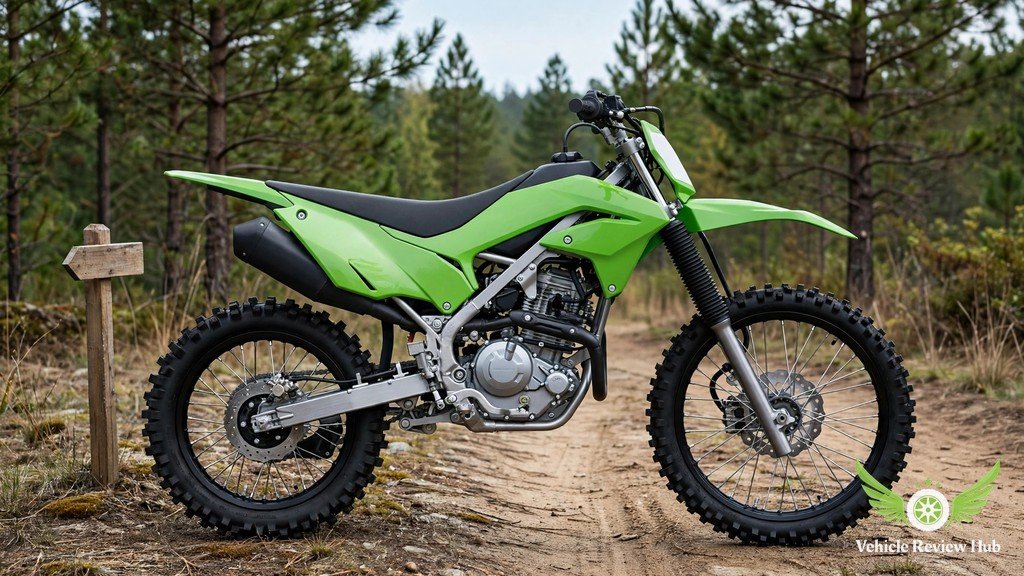
The Honda’s engine is the bigger one on paper: 286cc against 233cc, both air-cooled singles with fuel injection and six-speed gearboxes. Honda publishes no US horsepower figure for the CRF300F, so this Kawasaki KLX230R S comparison prints no horsepower number for the Honda at all. The only published S figure is the Canadian sheet’s 13.8 kW (19 PS) at 8,000 rpm, which is 18.7 hp. Neither bike has an instrumented top speed or a tested MPG figure, and the S’s top speed is an owner estimate of about 60 mph.
On the chassis the S wins the numbers that matter to a shorter rider. The S seat is 34.4 inches against the Honda’s 35.0, verified from Honda’s own 2026 spec page, and the S curb weight is 262.4 pounds against the Honda’s 271, a difference of 8.6 pounds a rider feels every time the bike is picked up. The S clearance is 10.6 inches, and its travel is 8.7 inches at the front and 8.5 at the rear from the official Canadian 2026 S spec sheet. The Ultimate Motorcycling 2025 review tested the gen-2 S alongside the R and found the S quicker turning on tight single-track in this Kawasaki KLX230R S comparison.
| Figure | KLX230R S | Honda CRF300F | Advantage |
|---|---|---|---|
| Engine | 233cc DFI single | 286cc PGM-FI single | Honda, 53cc more |
| Seat height | 34.4 in | 35.0 in | S, 0.6 in lower |
| Curb weight | 262.4 lb | 271 lb | S, 8.6 lb lighter |
| Delivered price | $5,434 (2027) | $5,299 (2026) | Honda, $135 less |
Notes: the CRF300F seat of 35.0 inches and curb weight of 271 pounds are verified from Honda’s own 2026 spec page, which settles the “Lowest Seat in the Injected Class” heading in the S’s favour. No horsepower figure is printed for either bike in this Kawasaki KLX230R S comparison, because Honda publishes no US figure for the CRF300F and the S has no dyno of its own. The Honda price is 2026 trim; the 2027 Honda is $5,099 plus $300 destination, $5,399 delivered.
Price, Equipment and Which Suits Which Rider
On price the Honda wins the 2026 match-up by $135 delivered, $5,299 against $5,434, but the year labels matter: the 2027 Honda is $5,399 delivered, narrowing the gap to $35, and the two bikes cost the same $4,999 before destination in 2026 trim. Neither bike carries a dash worth naming: the S has indicator lamps only, and the Honda is the same kind of simple trail bike. Both are off-road-only, with no lights, no mirrors and no plate. In this Kawasaki KLX230R S comparison, the rider split is simple: a shorter or lighter rider who needs the lowest seat in the injected class buys the S, because 0.6 inches at the seat and 8.6 pounds on the scales are worth more than 53cc on a tight trail, while a taller rider who wants the bigger engine buys the Honda.
The Cycle News 2025 review agrees the S is quicker in the woods but says the shorter travel is felt sooner, which is the same trade the Honda buyer avoids by taking the taller bike. This Kawasaki KLX230R S comparison calls the Honda the value pick for tall riders and the S the fit pick for short ones, and neither bike is the wrong answer.
Kawasaki KLX230R S vs Yamaha TT-R230
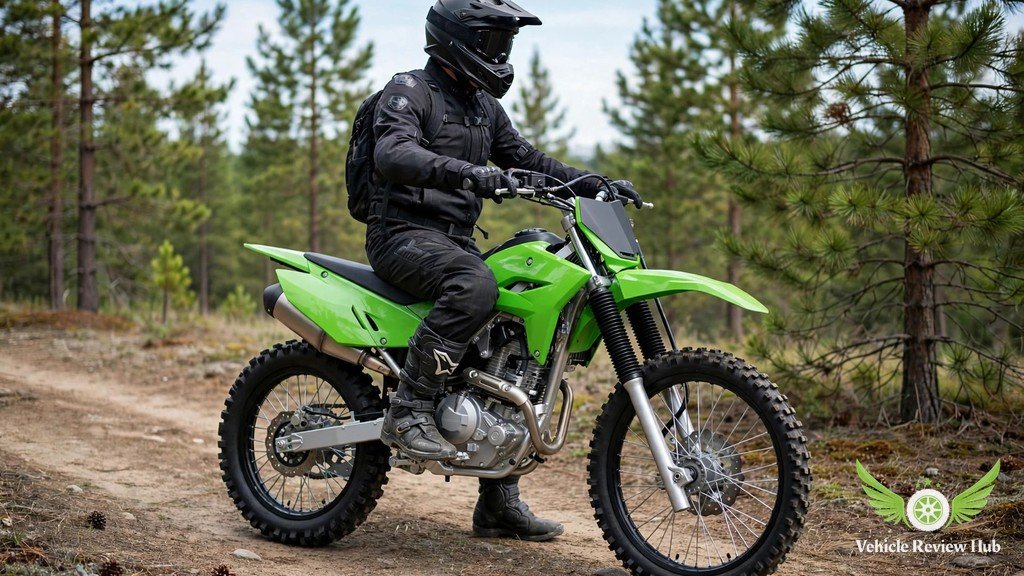
The Yamaha TT-R230 is the cheapest bike in this Kawasaki KLX230R S comparison and the only one with a lower seat than the S, at 34.3 inches against 34.4. It undercuts the S by $395 delivered, $5,039 against $5,434. But the Yamaha is carburetted, and that single fact decides the match-up for most buyers: the S is fuel-injected, the TT-R230 is not.
Engine, Specs and Performance Side by Side
The Yamaha’s engine is the smaller and older design: 223cc, air-cooled, carburetted, six-speed, with no published dyno figure. The S runs a 233cc air-cooled single with digital fuel injection through a 32 mm Keihin throttle body, also six-speed. Fuel injection starts cleanly in the cold and holds its tune at altitude, while a carburettor needs choke and jetting attention. No tested MPG figure exists for either bike, and no instrumented top speed exists for the S, so this Kawasaki KLX230R S comparison prints neither.
The Yamaha seat is 34.3 inches, 0.1 inches lower than the S, and the Yamaha is lighter at 251 pounds wet against the S’s 262.4-pound curb weight, though the two weight figures are measured differently and are not directly comparable. The S carries the better brakes on paper, a 240 mm petal front disc and a 220 mm petal rear disc, and its travel is 8.7 inches at the front and 8.5 at the rear from the official Canadian 2026 S spec sheet, with the 8.8-inch US-sheet figure footnoted. The step down is the Kawasaki KLX140R L review, and the Indonesian carburetted line is the Kawasaki KLX150 review.
| Figure | KLX230R S | Yamaha TT-R230 | Advantage |
|---|---|---|---|
| Engine | 233cc DFI single | 223cc carburetted single | S, injected |
| Seat height | 34.4 in | 34.3 in | Yamaha, 0.1 in lower |
| Delivered price | $5,434 (2027) | $5,039 | Yamaha, $395 less |
Notes: the TT-R230 seat of 34.3 inches is 0.1 inches lower than the S, but the Yamaha is carburetted and is therefore excluded from the “injected class” this Kawasaki KLX230R S comparison claims for the S. The weight figures are measured differently, 262.4 pounds curb against 251 pounds wet, and must not be read as a direct gap. No MPG or top-speed figure is printed for either bike, because no tested figure exists for the S.
Price, Equipment and Which Suits Which Rider
On price the Yamaha is the clear winner, $5,039 delivered against the S’s $5,434, a $395 gap. On equipment the S answers with fuel injection, a 240 mm petal front disc, and the same 6 Month Limited warranty as the rest of the family. The Yamaha is the simpler bike to work on, with a carburettor any owner can clean and jets any owner can change, while the S needs a dealer computer for fuel-system faults. Both bikes are off-road-only, with no lights, no mirrors and no plate. In this Kawasaki KLX230R S comparison, the rider split comes down to fuelling: a buyer who rides at changing altitudes or starts the bike in cold mornings buys the S, because fuel injection is worth $395 over the life of the bike, while a buyer on a strict budget buys the Yamaha and keeps the $395.
The 0.1-inch seat difference should decide nothing, since it is smaller than the difference between two pairs of boots. The Motorcycle.com 2025 review carries the dissenting view that the S’s seat drop barely matters for a rider at home on the standard R. This Kawasaki KLX230R S comparison calls the Yamaha the budget pick and the S the fuelling pick.
Kawasaki KLX230R S Price and Value Compared
The price ladder in this Kawasaki KLX230R S comparison runs from $5,039 to $6,449 delivered, and the S sits in the middle at $5,434. The Yamaha is cheapest, the Honda follows at $5,299 in 2026 trim, and the S ties the standard R. Above the S sit the street KLX230 S at $5,634 and the KLX300R at $6,449, so the S’s value rests on fit rather than price.
Yamaha Seat Is 0.1 Inch Lower
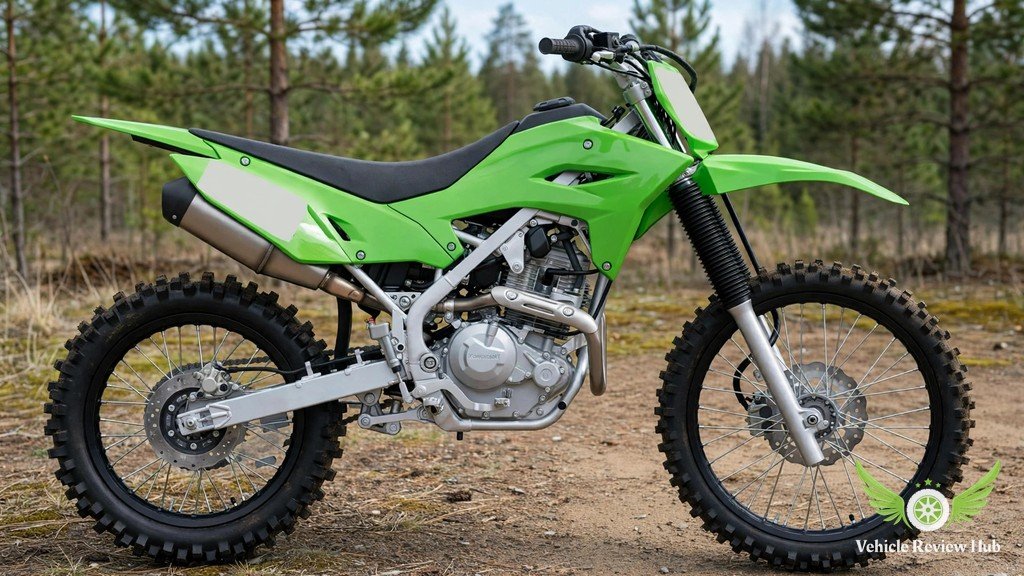
The Yamaha TT-R230 seat is 34.3 inches, 0.1 inches lower than the S at 34.4, and this Kawasaki KLX230R S comparison prints that figure plainly rather than hiding it. The reason the S still claims the lowest seat in the injected class is that the Yamaha runs a carburettor, and the class is fuel-injected trail bikes.
The street KLX230 S sits lower still at 33.3 inches, but it is a plated dual-sport with lights, mirrors and ABS, not a trail bike in this group, and it is excluded for the same reason as the Yamaha. A buyer who wants the lowest seat on a fuel-injected off-road trail bike buys the S, and this Kawasaki KLX230R S comparison is clear about which class each bike belongs to.
Running Costs and Resale Value Compared
Running costs are low on all four bikes, and no dollar figure is printed for any of them, because none was verified for this Kawasaki KLX230R S comparison. All four are simple air-cooled singles with hand-tool servicing: oil, air filter, chain and brake pads. Fuel is regular unleaded, and no tested MPG figure exists, so no tank range is printed. The one wear item with a tester verdict is the S’s stock Dunlop D952 front tyre, which Ultimate Motorcycling’s 2021 S review called flimsy, recommending Dunlop Geomax MX53s as the replacement.
Resale value is not printed for any bike in this group, because no resale percentage or used-price band was verified. The S has one resale advantage: as the only low-seat trim, a used S appeals to the same shorter riders. The 2024 price has no primary figure for the S, and this Kawasaki KLX230R S comparison prints no 2024 dollar figure as fact.
| Bike | MSRP | Destination | Delivered | Seat |
|---|---|---|---|---|
| Yamaha TT-R230 | $4,699 | $340 | $5,039 | 34.3 in |
| Honda CRF300F (2026) | $4,999 | $300 | $5,299 | 35.0 in |
| Kawasaki KLX230R S (2027) | $4,999 | $435 | $5,434 | 34.4 in |
| Kawasaki KLX230R (2027) | $4,999 | $435 | $5,434 | 35.6 in |
| Kawasaki KLX230 S street (2026) | $5,199 | $435 | $5,634 | 33.3 in |
| Kawasaki KLX300R (2027) | $5,799 | $650 | $6,449 | Not printed |
Notes: the 2027 destination charge of $435 is 2027-only. The CRF300F price is 2026 trim; the 2027 Honda is $5,099 plus $300 destination, $5,399 delivered. The street KLX230 S is a plated dual-sport, not a trail bike in this Kawasaki KLX230R S comparison, and is listed only as the road-legal alternative. No running-cost dollar figure or resale percentage is printed, because none was verified.
Kawasaki KLX230R S Comparison Verdict and US Alternatives
The verdict in this Kawasaki KLX230R S comparison is that the S is the right bike for the rider it was built for and the wrong bike for everyone else. It costs the same as the R, fits riders the R does not, and asks only for travel and clearance.
Verdict: Free Reach, Paid in Travel
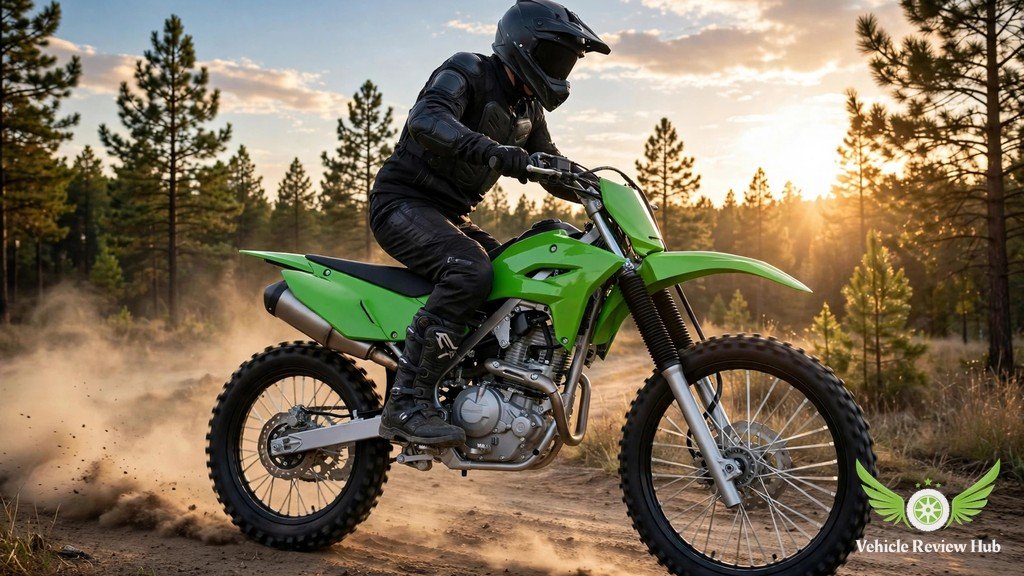
The reach is free and the travel is the payment in this Kawasaki KLX230R S comparison. The S costs $4,999, the same as the R, and $5,434 delivered for 2027. What it costs in this Kawasaki KLX230R S comparison is travel, 8.7 front and 8.5 rear against the R’s 9.8 at both ends, and clearance, 10.6 against 11.4.
The 115-pound tester in the only back-to-back test rode faster on the S, while the 170-pound tester bottomed it constantly. Against the Honda in this Kawasaki KLX230R S comparison, the S gives up 53cc and gains 0.6 inches of reach; against the Yamaha, it gives up $395 and gains fuel injection. This Kawasaki KLX230R S comparison recommends the S under about 130 pounds, the R over about 160, the Honda for tall riders, and the Yamaha for the tightest budgets. The Kawasaki KLX230R S review, performance guide and reliability guide cover the price, the dyno evidence and the owner quirks in full.
Street KLX230 S: A Different Bike
The street KLX230 S is a different bike from the off-road KLX230R S, and the similar names are a trap this Kawasaki KLX230R S comparison closes explicitly. The street S is a plated dual-sport with a headlight, mirrors, a plate and an ABS option, and a Kawasaki-published 17 hp at 8,000 rpm that belongs to the street bike only. It costs $5,634 delivered for 2026, with a 33.3-inch seat and a 291.1-pound curb weight.
The 22V-397 recall names the street ABS bikes only, 1,923 units, and the off-road R S is not named in it. The step-up in this Kawasaki KLX230R S comparison is the KLX300R at $6,449 delivered for 2027. The Motocross Hideout KLX230 guide covers the wider family, and this Kawasaki KLX230R S comparison ends with a simple rule: buy the S if the seat fits; buy the R if the weight does not; buy the Honda for the engine; buy the Yamaha for the budget.
Kawasaki KLX230R S Comparison Frequently Asked Questions
These answers settle the S’s closest contests — the standard R, the Honda and the Yamaha — and the price ladder American buyers actually face in this Kawasaki KLX230R S comparison.
KLX230R S or standard KLX230R — which should I buy?
The same bike, taller or shorter — so buy on fit, not on price. Both cost $4,999 before destination and $5,434 delivered for 2027, and both weigh 262.4 pounds. The S seat is 34.4 inches against 35.6, clearance is 10.6 inches against 11.4, and travel is 8.7 inches front and 8.5 rear against 9.8 front and rear. As a rough guide in this Kawasaki KLX230R S comparison: under about 130 pounds, buy the S; over about 160, buy the R; between the two, sit on both.
KLX230R S or Honda CRF300F — which is better value?
The Honda wins on engine and on 2026 price, the S wins on fit and weight. The CRF300F brings a 286cc engine against the S’s 233cc and a 2026 delivered price of $5,299, $135 less than the S — but the 2027 Honda is $5,399 delivered, narrowing the gap to $35, and the two cost the same $4,999 before destination in 2026 trim. The S seat is 34.4 inches against the Honda’s 35.0, verified from Honda’s own 2026 spec page, and the S is 8.6 pounds lighter at 262.4 against 271. Honda publishes no US horsepower figure for the CRF300F, so this Kawasaki KLX230R S comparison prints no horsepower number for either bike.
KLX230R S or Yamaha TT-R230 — which is cheaper to own?
The Yamaha is cheaper to buy: $5,039 delivered against $5,434, a $395 gap, and its seat is 34.3 inches, 0.1 inches lower than the S. The single fact that decides the match-up is fuelling: the S is fuel-injected and the Yamaha runs a carburettor on its older 223cc engine. No resale percentage and no used-price band was verified for either bike, so this Kawasaki KLX230R S comparison prices neither as a used buy.
Is the S the lowest-seat bike in its class?
The lowest-seat fuel-injected trail bike, yes. The gen-2 S seat is 34.4 inches, against 35.6 for the standard R and 35.0 for the Honda CRF300F, verified from Honda’s own 2026 spec page. Two bikes sit lower and do not count: the Yamaha TT-R230 at 34.3 inches runs a carburettor, so it is outside the injected class, and the street KLX230 S dual-sport at 33.3 inches is a different kind of bike, not a trail bike in this group.
What does the S cost against the whole class?
Delivered, the ladder runs: Yamaha TT-R230 $5,039, Honda CRF300F 2026 $5,299, KLX230R S and KLX230R 2027 $5,434, street KLX230 S 2026 $5,634, and KLX300R 2027 $6,449. The S costs exactly the same as the standard R in every year with a primary figure, so the lower seat is free — the verdict in this Kawasaki KLX230R S comparison is free reach, paid in travel.
Is the street KLX230 S the same bike as the KLX230R S?
No — different bikes that share a name and an engine. The street KLX230 S is a plated dual-sport with lights, mirrors, a plate and an ABS option, a Kawasaki-published 17 hp at 8,000 rpm, a 33.3-inch seat, about 291 pounds, and a 2026 price of $5,199 plus $435 destination, $5,634 delivered. The R S is off-road-only, with no lights, no ABS and no published horsepower figure. Never use the two names interchangeably.