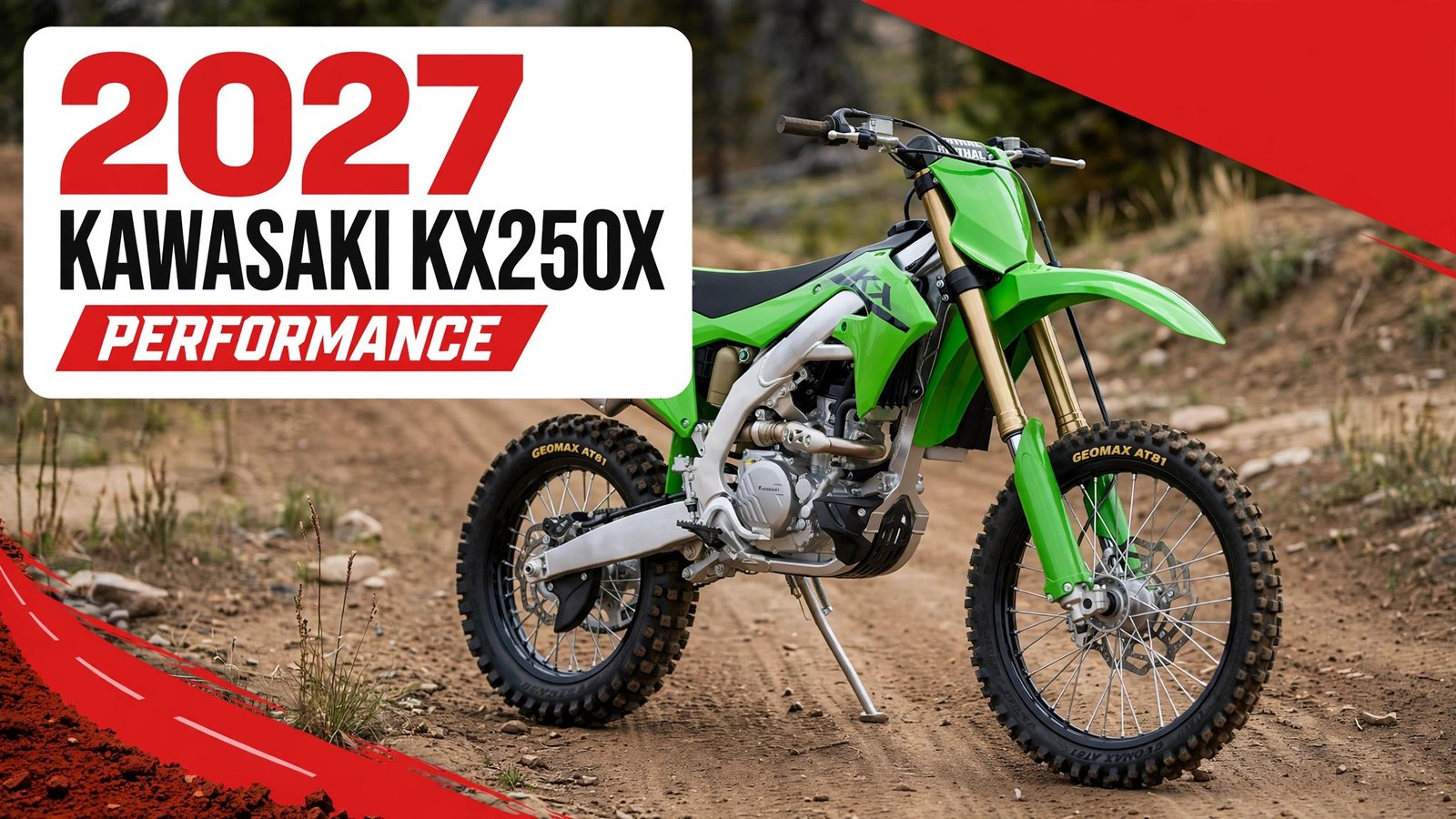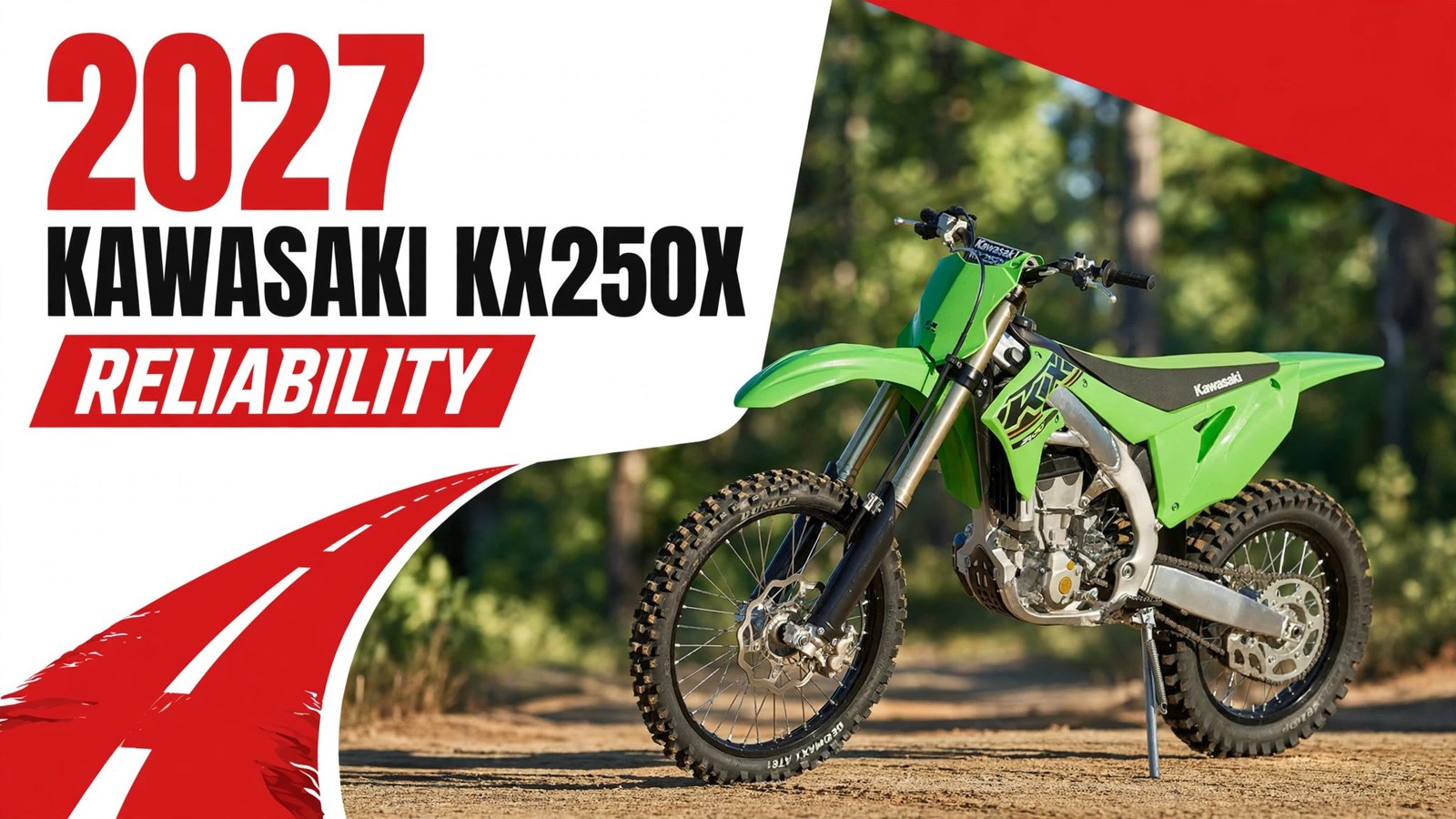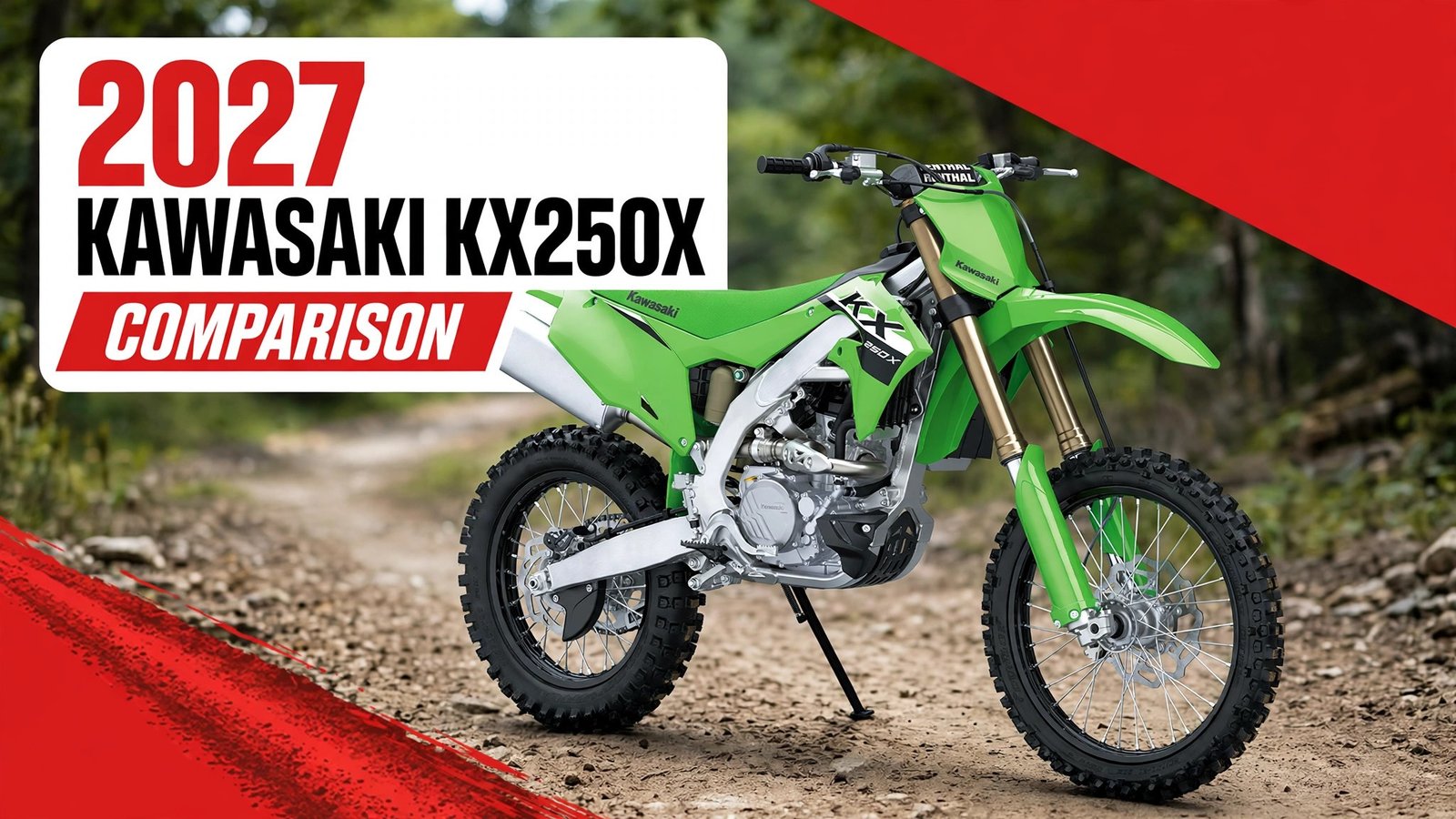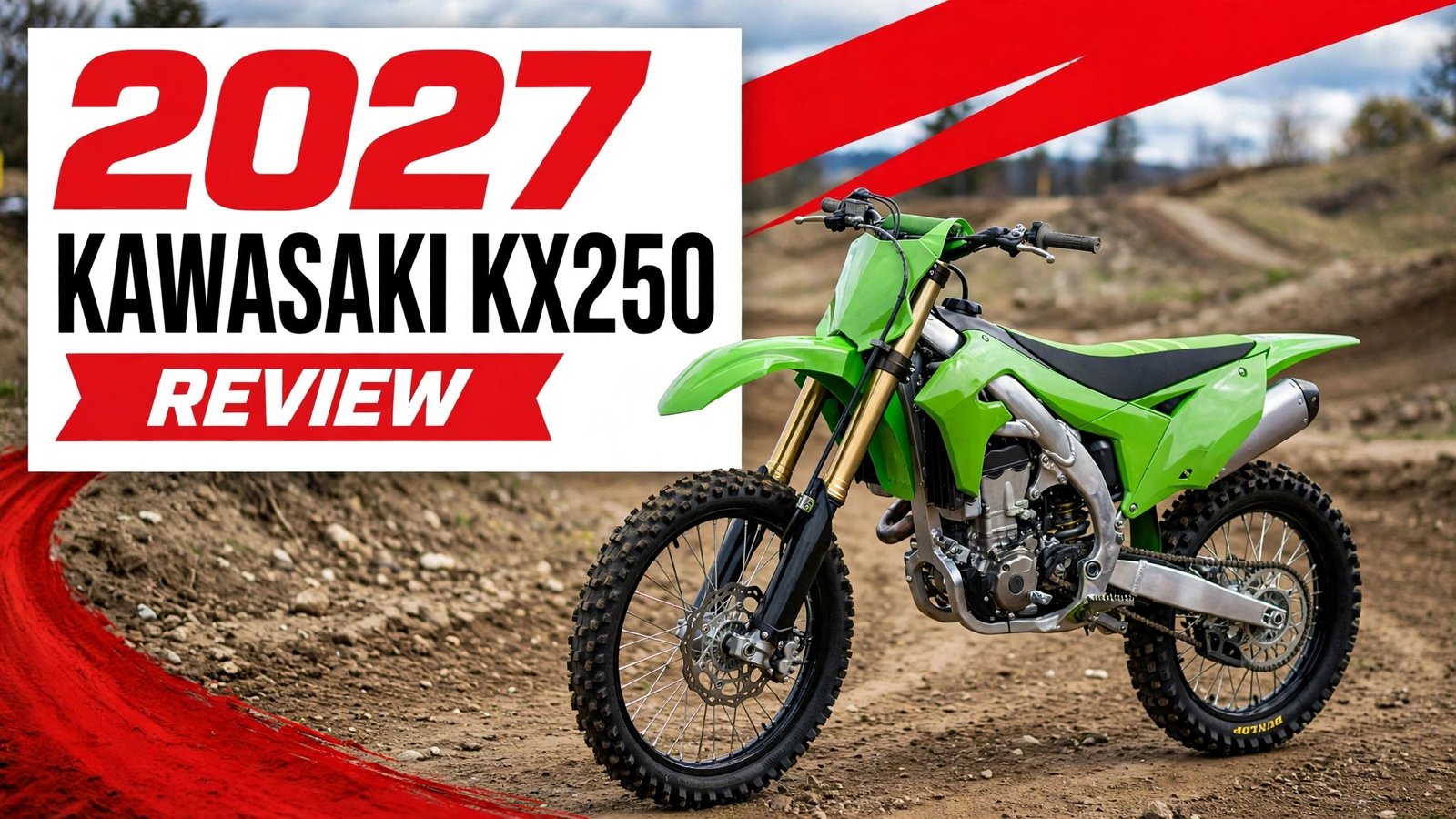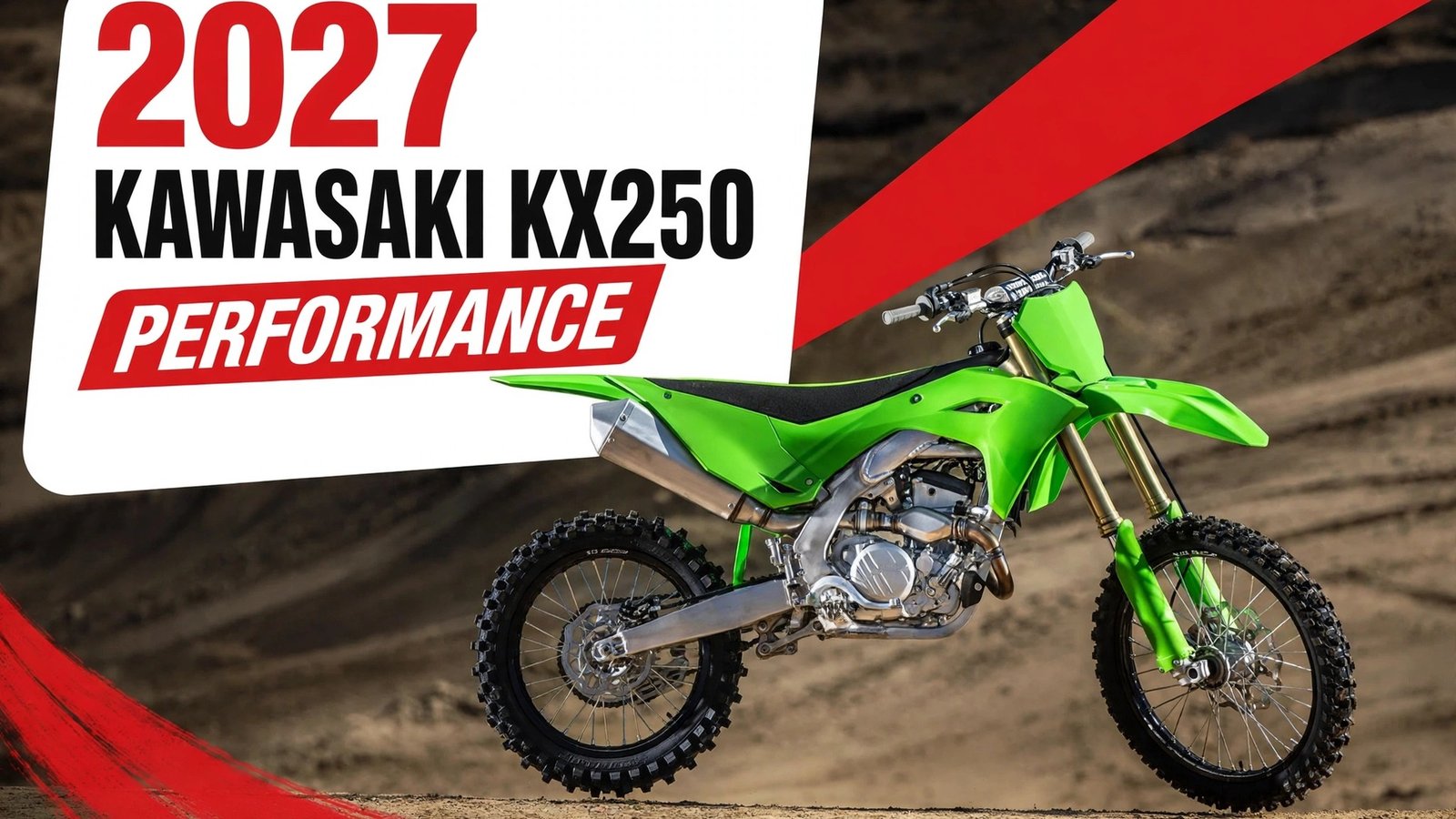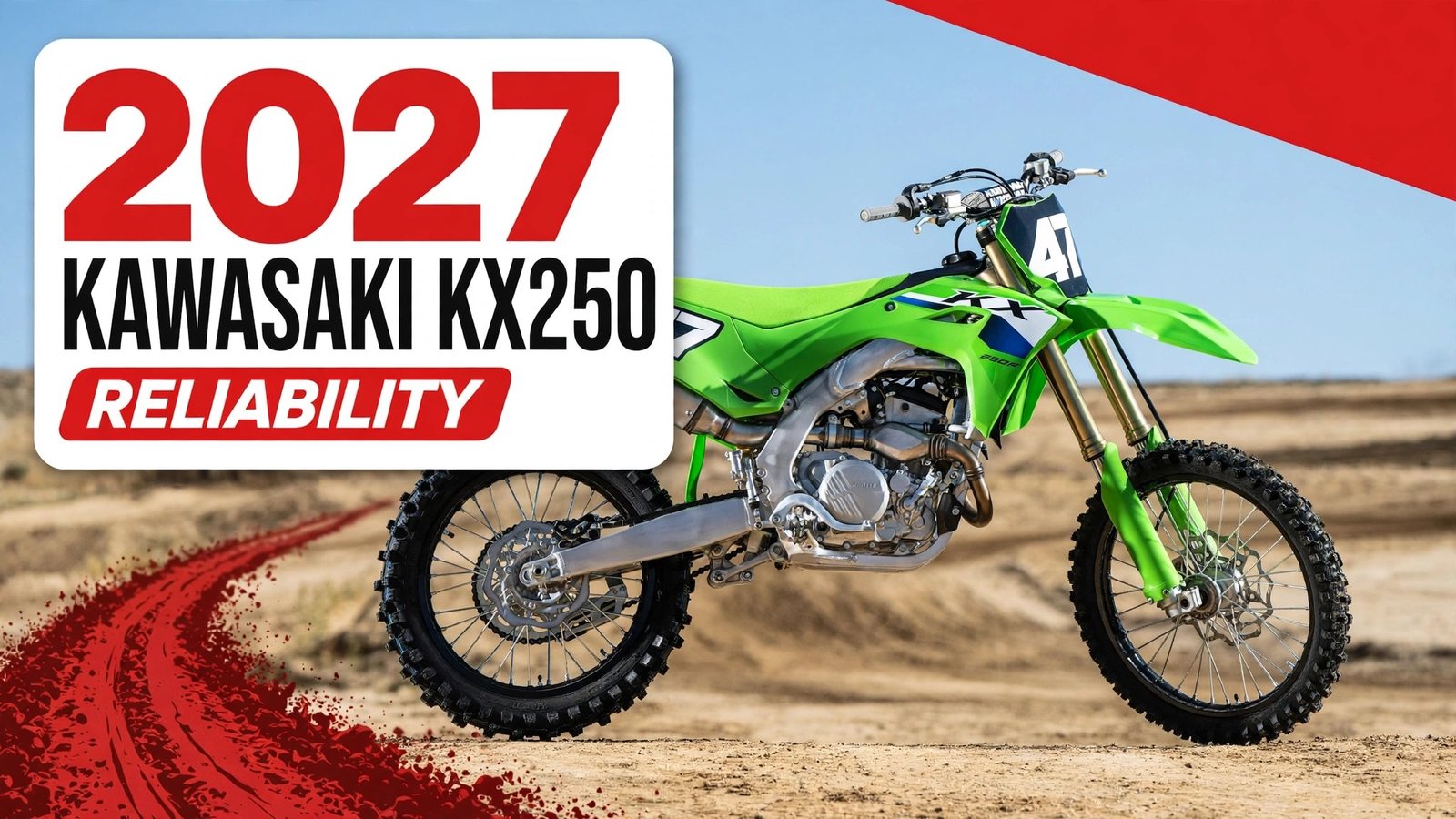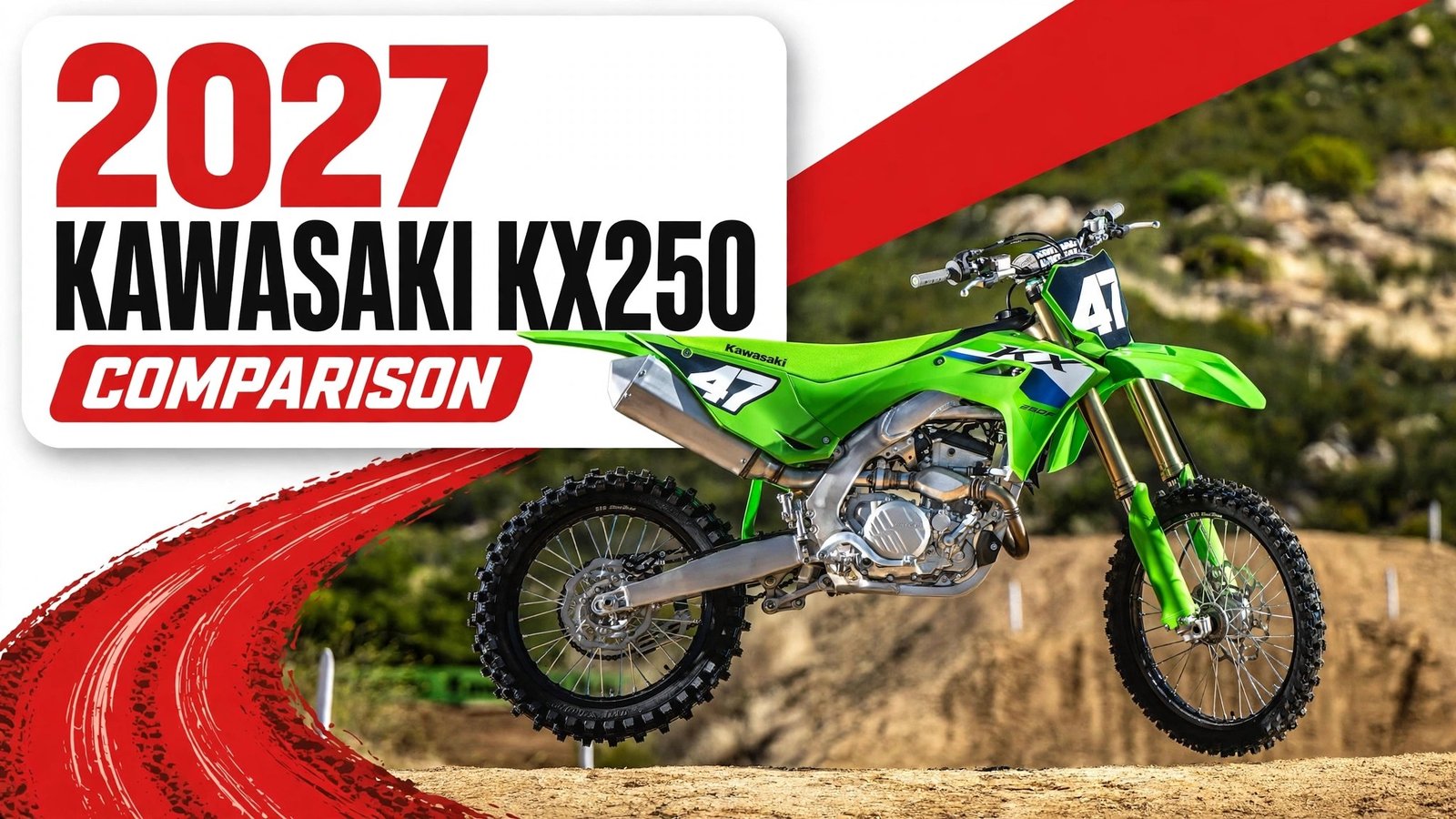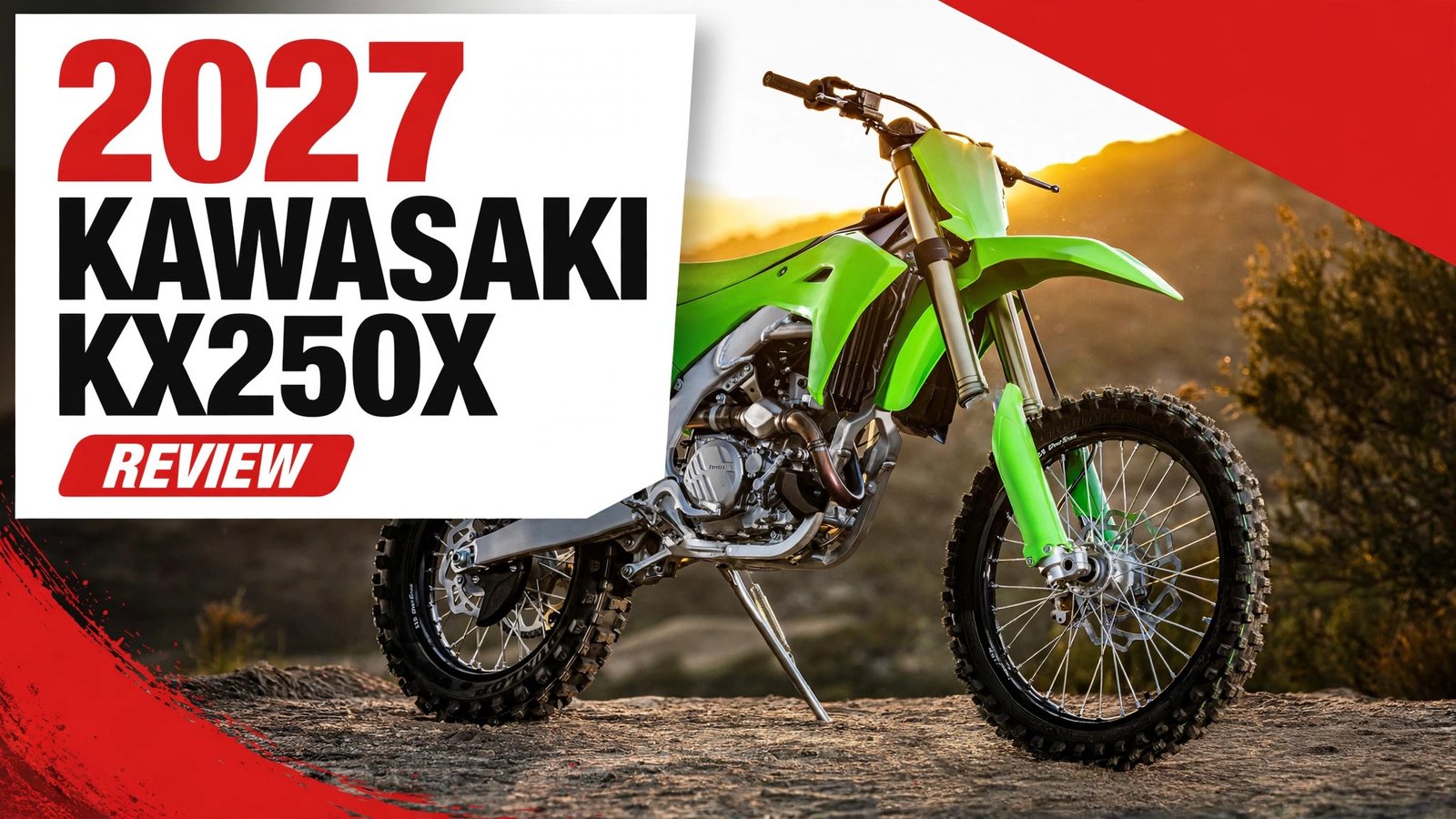
The Kawasaki KX250X became the KX250FX for 2027, and that rename is the first thing this Kawasaki KX250X review has to get right. There is no 2027 KX250X. The bike Kawasaki sells for 2027 is the KX250FX at $8,699 plus a $650 destination charge, $9,349 delivered — the headline price of this Kawasaki KX250X review. The X name covers model years 2021 through 2026 only, and everything in this Kawasaki KX250X review is priced and specced on that basis.
This Kawasaki KX250X review covers the cross-country version of Kawasaki’s 250 motocrosser: the same engine, frame and five-speed gearbox as the KX250, with woods equipment bolted on — an 18-inch rear wheel, a kickstand, softer suspension and shorter gearing. It costs $100 more than the motocrosser every year, it carries the smallest fuel tank in its class, and it has no spark arrestor, no lights and no warranty. For a rider who races grand prix, GNCC or enduro events, those trade-offs are the whole story of this Kawasaki KX250X review.
Kawasaki KX250X Overview and Model-Year Updates
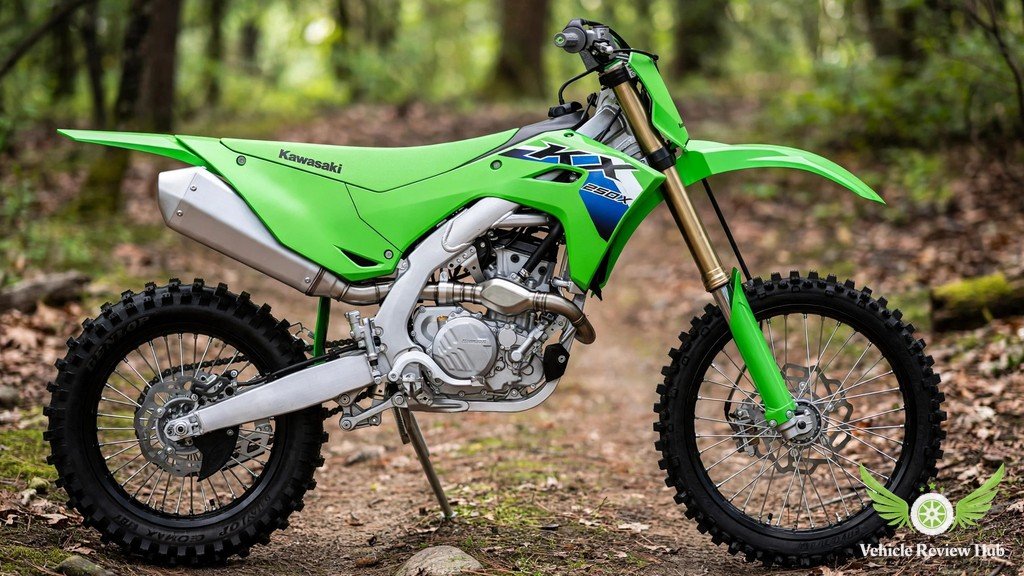
Kawasaki launched the KX250X for 2021 as its first 250cc cross-country racer, built from the KX250 motocrosser with the parts a woods racer needs, and this Kawasaki KX250X review follows it through both generations. The bike ran in two generations: the 2021–2024 bikes with a 48 mm KYB fork, and the redesigned 2025 bike with a 49 mm Showa fork and a new low-to-midrange engine. The 2027 rename to KX250FX changed the badge and cut the price by $500, not the bike.
Renamed KX250FX for 2027
Kawasaki USA’s 2027 model page lists the bike as the KX250FX, under the heading “Cross-Country Motorcycle | Full-Size XC”, and this Kawasaki KX250X review takes the FX as the 2027 bike. The rename follows the same pattern as the KX450X, which became the KX450FX for 2027. The bike itself is unchanged from the 2026 X: the same 249cc four-stroke single, the same 1.64-gallon tank, the same five-speed gearbox and the same 37.2-inch seat height. What changed, as this Kawasaki KX250X review shows, is the price. The 2027 FX lists at $8,699, $500 less than the 2026 X’s $9,199, and $9,349 delivered against the 2026 bike’s $9,849 computed delivered price. A buyer shopping a 2027 FX is buying the X with a new name and a lower sticker, not a new motorcycle. This Kawasaki KX250X review uses the FX name for 2027 figures and the X name for 2021–2026 figures.
Launched for XC Racing First
The doc heading for this section read “Launched as the XC First”, and that wording is corrected here: XC is the race class, not a Kawasaki model name. No motorcycle called the “KX250XC” ever existed. Kawasaki launched the KX250X and the KX450X as all-new cross-country models for 2021, aimed at GNCC XC2 Pro, NGPC Pro II and WORCS Pro 2 racing. The “XC” letters are the cross-country class designation. The bike itself was always the KX250X, and this Kawasaki KX250X review calls it that for 2021–2026. It arrived in 2021 alongside the bigger KX450X, and both bikes were built the same way: a motocross engine and chassis with the woods equipment a cross-country racer needs, sold as closed-course race bikes with no lights, no spark arrestor and no warranty.
Kawasaki KX250X Engine and Specifications
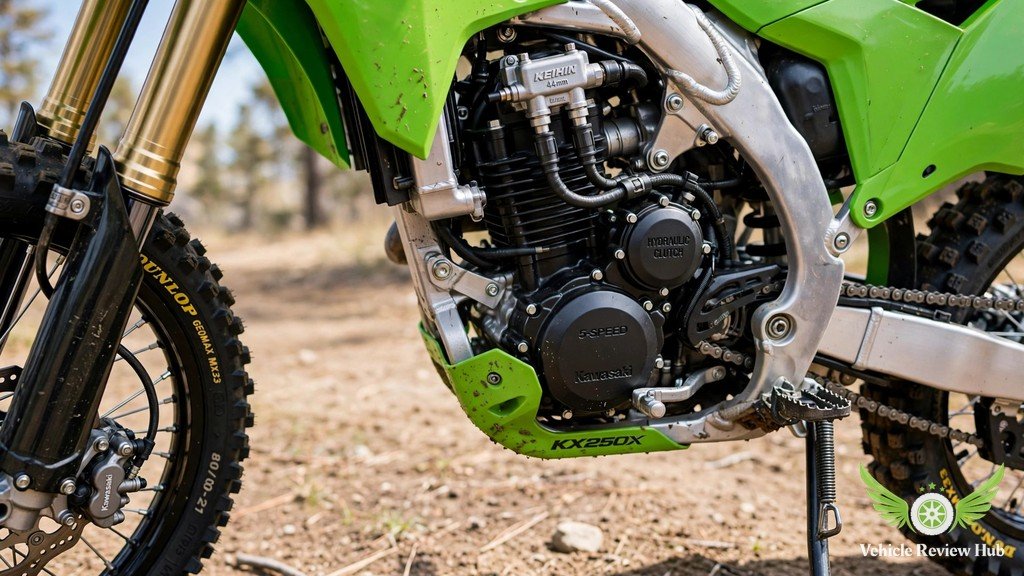
The KX250X runs the KX250 motocrosser’s engine without changes to its basic layout, as this Kawasaki KX250X review sets out in the table below: a 249cc liquid-cooled DOHC four-stroke single, 78.0 x 52.2 mm bore and stroke, fed by a 44 mm Keihin throttle body with dual injectors. The 2025 redesign changed the engine’s character rather than its size, with a new cylinder head, a flatter piston and a single-shaft primary balancer, all aimed at stronger low-to-midrange power. Compression fell slightly, from 14.1:1 on the 2021–2024 bikes to 14.0:1 on the 2025 and later bikes.
| Spec | 2021–2024 KX250X | 2025–2026 KX250X | 2027 KX250FX |
|---|---|---|---|
| Engine | 249cc DOHC four-stroke single | 249cc DOHC four-stroke single | 249cc DOHC four-stroke single |
| Bore x stroke | 78.0 x 52.2 mm | 78.0 x 52.2 mm | 78.0 x 52.2 mm |
| Compression | 14.1:1 | 14.0:1 | 14.0:1 |
| Fuel system | DFI, 44 mm Keihin, dual injectors | DFI, 44 mm Keihin, dual injectors | DFI, 44 mm Keihin, dual injectors |
| Transmission | 5-speed, hydraulic clutch | 5-speed, hydraulic clutch | 5-speed, hydraulic clutch |
| Front fork | 48 mm KYB, 12.4 in travel | 49 mm Showa, 12.0 in travel | 49 mm Showa, 12.0 in travel |
| Rear suspension | Uni-Trak, 12.4 in travel | Uni-Trak, 12.1 in travel | Uni-Trak, 12.1 in travel |
| Brakes | 270 mm front / 240 mm rear petal discs | 270 mm front / 240 mm rear petal discs | 270 mm front / 240 mm rear petal discs |
| Tyres | 80/100-21 front, 110/100-18 rear, Dunlop Geomax AT81 | 80/100-21 front, 110/100-18 rear, Dunlop Geomax AT81 | 80/100-21 front, 110/100-18 rear, Dunlop Geomax AT81 |
| Seat height | 37.2 in | 37.2 in | 37.2 in |
| Fuel capacity | 1.64 gal | 1.64 gal | 1.64 gal |
| Curb weight | 240.2 lb | 243.2 lb | 243.2 lb |
| Warranty | Not Available | Not Available | Not Available |
Note: All figures in this Kawasaki KX250X review come from Kawasaki USA’s own spec-sheet PDFs for 2021–2026 and the 2027 KX250FX model page. Curb weight is Kawasaki’s figure with all fluids and a full tank of fuel. One printed discrepancy: the 2025 sheet prints 27.5 degrees of rake while the 2026 sheet prints 27.8 degrees, and this Kawasaki KX250X review prints both as printed.
Five-Speed in Every Year
Every KX250X ever built, from the 2021 launch bike to the 2027 KX250FX, uses the same five-speed gearbox with a wet multi-disc manual clutch and hydraulic actuation. Kawasaki never fitted a sixth gear, even though two of the X’s three 2027 rivals — the Yamaha YZ250FX and the KTM 250 XC-F — run wide-ratio six-speed gearboxes. The five-speed is a close-ratio motocross box, and its short legs show in the numbers: Dirt Bike Magazine’s calculated gear-ratio table puts the X at 73.0 mph in fifth gear at 12,500 rpm, a calculated figure, not an observed speed. On a tight off-road loop that short gearing is less of a handicap than it looks: Dirt Bike Magazine found the two six-speeds in its 2026 off-road test were effectively four-speeds. The five-speed is part of the X’s character in this Kawasaki KX250X review: an MX bike with woods equipment, not a dedicated trail bike with a wide-ratio box.
No Bigger Tank, Ever
The KX250X carried the same 1.64-gallon fuel tank in every model year, from 2021 through the 2027 FX, and Kawasaki never fitted a bigger one. That makes it the smallest tank in its class by a clear margin: the 2027 Honda CRF250RX and Yamaha YZ250FX both carry 2.1 gallons, and the KTM 250 XC-F carries 2.2 gallons. The small tank is the X’s most practical limitation, and the tests say so plainly. Cycle News warned in its 2021 review that the tank “could be an issue in a typical 40-plus-minute grand prix, or multi-hour-long races (aka GNCC and WORCS), or for extended trail rides”. Dirt Bike Test’s 2025 first impression put a number on it: racing for about 50 minutes is cutting it really close on gas. The only fix is aftermarket: IMS makes a replacement tank more than a gallon bigger. The factory tank never grew, and that is the lasting weakness this Kawasaki KX250X review keeps coming back to.
Kawasaki KX250X Price and Market Availability
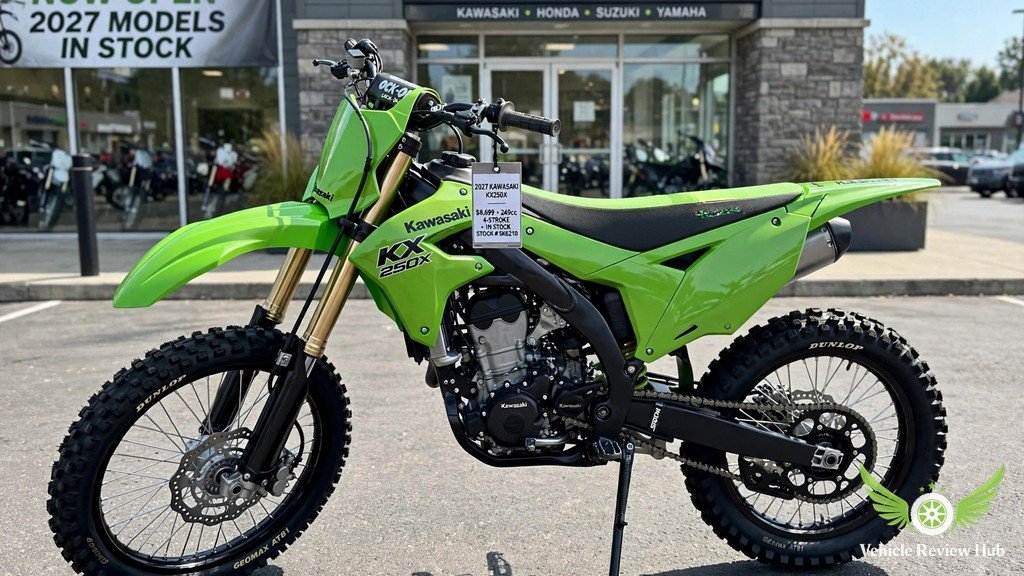
The KX250X was never a cheap bike, and its price climbed $800 across its six model years before the 2027 rename cut it back. The 2027 FX is the cheapest 250 cross-country racer in its class, and this Kawasaki KX250X review prices every rival against it. Destination charges are verified per model year, never carried across years.
| Model year | MSRP | Destination | Delivered |
|---|---|---|---|
| 2021 KX250X | $8,399 | Not verified | — |
| 2022 KX250X | $8,499 | Not verified | — |
| 2023 KX250X | $8,599 | $425 + $300 freight surcharge | $9,324 as seen |
| 2024 KX250X | $8,999 | Not verified | — |
| 2025 KX250X | $9,099 | Not verified | — |
| 2026 KX250X | $9,199 | $650 (single-source) | $9,849 computed |
| 2027 KX250FX | $8,699 | $650 | $9,349 |
Note: MSRP figures in this Kawasaki KX250X review come from Kawasaki USA spec sheets and press releases, except the 2023 figure, which is dealer-corroborated only and is labelled as such. Destination charges are shown only where verified for that year. The 2026 delivered total is computed; the 2027 total of $9,349 is Kawasaki’s own figure.
Kawasaki KX250X Price in the USA: $8,699 (2027)
The 2027 KX250FX lists at $8,699 in the USA, with a $650 destination charge, for $9,349 delivered — all three figures from Kawasaki USA’s own 2027 KX250FX model page. That is the FX’s price, not a 2027 KX250X price, because no 2027 KX250X exists. The $500 cut from the 2026 X’s $9,199 is the biggest price move in the bike’s run, and it lands the FX $200 above the 2023 price and $300 above the 2022 price. Against its 2027 rivals the FX is the cheapest bike in the class on MSRP: the Honda CRF250RX lists at $8,899, the Yamaha YZ250FX at $9,099, and the KTM 250 XC-F at $11,149. Leftover 2026 X bikes were advertised as low as $7,149 to $7,424, but those are dealer discounts, not MSRP.
Premium Over MX Is $100
The KX250X cost exactly $100 more than the KX250 motocrosser in every single year of its run, and the renamed 2027 FX keeps the same $100 gap over the 2027 KX250F. The ladder is consistent: $8,399 against $8,299 in 2021, rising to $9,199 against $9,099 in 2026, and $8,699 against $8,599 in 2027. That $100 buys the woods equipment: the 18-inch rear wheel with a 110/100-18 Dunlop Geomax AT81 tyre, the kickstand, softer suspension settings, shorter gearing with a 51-tooth rear sprocket, a skid plate on the 2021–2024 bikes, an engine guard, a rear disc guard, a sealed O-ring chain on the 2025 and later bikes, and the mildest black mapping coupler fitted from the factory. The engine, frame and five-speed gearbox are the motocrosser’s. A buyer choosing between the two Kawasaki 250s is paying $100 for the right to race cross-country without buying those parts separately. The companion Kawasaki KX250 review covers the motocrosser’s price and spec sheet in full.
Kawasaki KX250X Design, Features and Technology
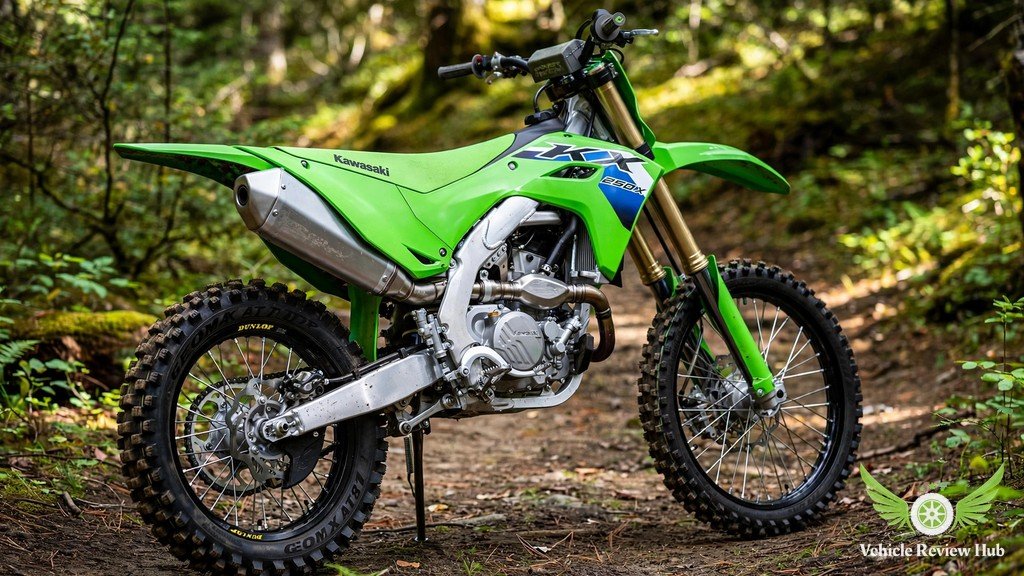
The X’s design, as this Kawasaki KX250X review lays out, is the motocrosser’s design with the parts a cross-country racer needs and nothing it does not. There is no headlight, no tail light, no mirrors and no dashboard. What the bike does carry is an 18-inch rear wheel, a kickstand, a sealed O-ring chain on the 2025 and later bikes, and Kawasaki’s electronic rider aids on the redesigned bike: KTRC traction control, a handlebar-mounted traction-control switch and RIDEOLOGY THE APP KX connectivity for map changes. The 2025 redesign also brought a new lightweight aluminium perimeter frame and a centre-port exhaust. Everything else about the bike this Kawasaki KX250X review covers — the engine, the frame, the five-speed gearbox — is the KX250’s.
Skid Plate: Standard, Then Accessory
The skid plate is the clearest example of how the X changed between its two generations. On the 2021–2024 bikes, the skid plate was standard equipment. Kawasaki’s 2021 launch material listed it among the X’s equipment, and Cycle News’ 2021 review noted that “for protection, you’ll find a skid plate, an engine guard and a rear disc brake guard on the KX-Xs”. From the 2025 redesign, the skid plate became an accessory. Dirt Bike Test’s first impression of the 2025 bike states plainly that the bike has no skid plate, and the 2025 press release does not list one. Kawasaki sells the plate as an accessory for the gen-2 bike, though no accessory price was verified for this Kawasaki KX250X review, so none is printed. A buyer of a 2025 or later bike should budget for the plate, and this Kawasaki KX250X review flags it as a real cost of the gen-2 bike.
No Spark Arrestor Fitted
The KX250X has no spark arrestor in any model year, and that is a fact a buyer needs before the bike leaves the dealer. Cycle News’ 2021 review states that the X bikes “are not fitted with handguards, nor are they equipped with spark arrestors, and they are sold as closed-course race bikes”, and that for Californians this means the bikes are considered red-sticker machines. Ultimate Motorcycling’s 2021 review says the same thing: “There is no spark arrestor and, in California, the KX250X gets the dreaded Red Sticker limitation.” The practical result is that the stock X cannot legally ride public trail systems that require a USFS-approved spark arrestor. The fix is an insert or an aftermarket muffler, which Ultimate Motorcycling’s long-term 2023 X needed to ride trails legally. The X is a closed-course race bike, and its exhaust is built for the race course, not the trail system.
Kawasaki KX250X Riding Experience and Comfort
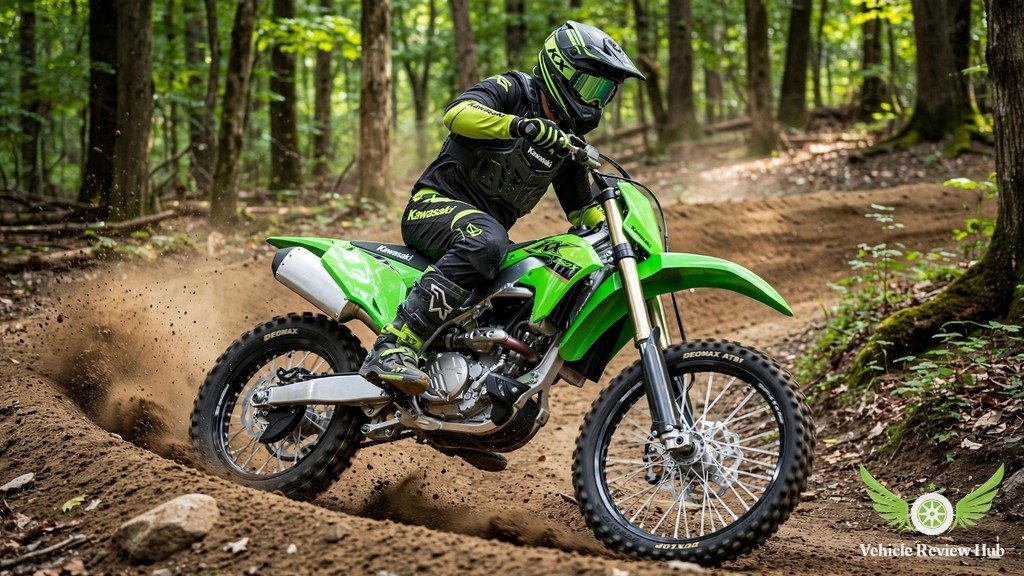
The X rides like a motocrosser that has been softened for the woods, and the testers who rode it back to back with the KX250 said so in almost the same words. Ultimate Motorcycling called the launch bike “an instant winner” with KYB suspension that was “outstanding, as is”. Cycle News found the suspension “noticeably softer and much better suited for the trail … not too soft, not too stiff, but just right”. Dirt Bike Test’s first impression at Cahuilla Creek found the bike performs very well as a grand prix race bike, with “a lot of power, especially as you climb the RPMs”. The 2025 bike kept that character and added the low-end power the gen-1 bike lacked, which Dirt Bike Test said was “much appreciated” in rocks, trees and low-traction conditions — the change this Kawasaki KX250X review rates as the gen-2 bike’s biggest improvement.
Seat Height Is 37.2 Inches
The KX250X seat sits at 37.2 inches on every model year, from the 2021 launch bike to the 2027 FX, and that figure never changed in this Kawasaki KX250X review’s research. It is 0.4 inches lower than the KX250 motocrosser’s 37.6-inch seat, every year, and that small difference is real: the X’s softer suspension settings and 18-inch rear wheel drop the bike slightly, and the lower seat helps a rider touch down in ruts and on off-camber trail sections. At 37.2 inches it is still a tall race bike, and shorter riders will be on tiptoes at a standstill. The footpegs mount in two positions, with the lower position preferred off-road, which helps taller riders stretch out and shorter riders reach the ground. This Kawasaki KX250X review treats the 37.2-inch seat as a race-bike figure, not a trail-bike figure.
Riding Position and Comfort Over Longer Distances
Comfort on the X is race-bike comfort, as this Kawasaki KX250X review found: good for a grand prix or an enduro loop, limited by the fuel tank rather than the seat. Dirt Bike Test’s 2022 comparison praised the ergonomics while disliking the levers and grips, and noted the air-filter service is “a pain”, which matters on a bike that needs its filter cleaned after every race. The same outlet’s long-term racing report found a “high fun factor” across testers from Pro to Vet. The limiting factor on longer rides is the 1.64-gallon tank, not the riding position: about 50 minutes of fuel at race pace means a rider plans fuel stops, not comfort breaks. No long-distance comfort figure exists for this bike, and this Kawasaki KX250X review prints none — the bike is built for races measured in minutes and hours, not for touring.
Kawasaki KX250X Review: Pros, Cons and Verdict
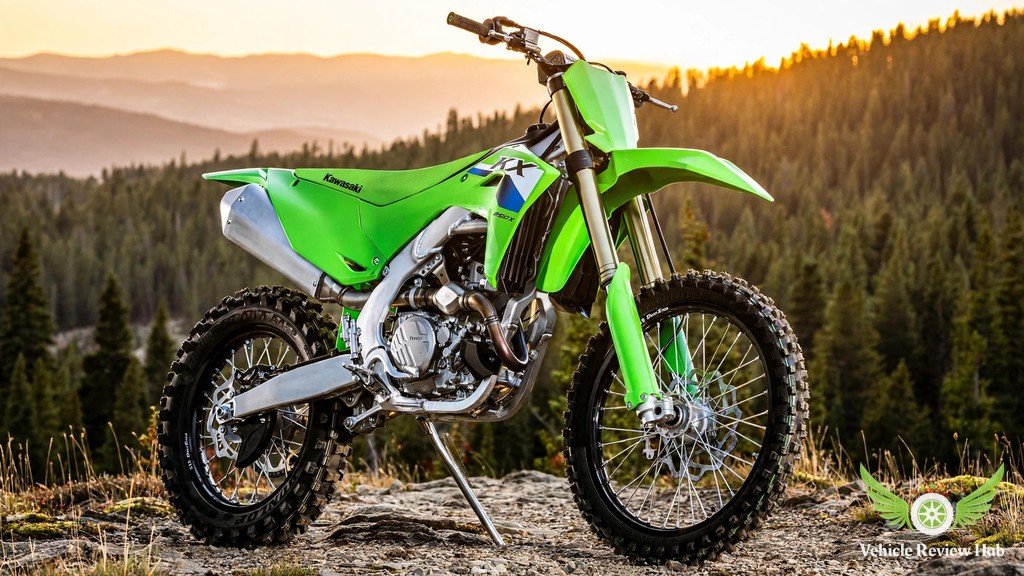
The verdict of this Kawasaki KX250X review is that the X is the cheapest way into 250 cross-country racing on a bike that is, at heart, a motocrosser with woods equipment. The 2027 FX costs $8,699, less than every rival, and it carries the KX250’s engine, frame and handling into races the motocrosser was never built for. The price is the advantage; the compromises are the 1.64-gallon tank, the missing spark arrestor and skid plate, and a five-speed gearbox where two rivals run six. A rider who races grand prix, GNCC or enduro events gets a proven race bike for the lowest price in the class. A rider who wants a trail bike should buy something else.
Main Advantages and Limitations of the Kawasaki KX250X
The advantages this Kawasaki KX250X review found start with the price and the engine. The FX is the cheapest 250 cross-country racer for 2027 at $8,699, and the X held a $100 premium over the motocrosser in every year, so the woods equipment effectively costs $100. The engine is the KX250’s proven 249cc four-stroke, the handling is the motocrosser’s, and the 2025 redesign added the low-to-midrange power the gen-1 bike lacked. The limitations this Kawasaki KX250X review found are just as clear. The 1.64-gallon tank is the smallest in the class and gives about 50 minutes of fuel at race pace. There is no spark arrestor, no lights and no handguards, so the bike is closed-course only and red-sticker in California. The skid plate became an accessory from 2025, the air filter is a pain to service, and the five-speed gearbox is the shortest-legged in the class. Kawasaki publishes no power figure for the X, and no citable peak horsepower exists for the bike, so a buyer cannot compare it on power alone. The companion Kawasaki KX250 performance guide covers the motocrosser’s dyno numbers, which must never be quoted as the X’s figures.
Watch the launch test: Swapmoto Live’s “Ripping on the new 2021 Kawasaki KX450X & KX250X Off-Road Machines” video is the first test of the launch-year X bikes, ridden alongside the bigger KX450X. The video shows both cross-country models on the 2021 models’ debut ride, and the lead-in names it as a launch test, not a comparison — it does not rank the bikes against rivals.
2026 Price Prints Conflict
The 2026 KX250X price prints conflict, and the conflict is real, sourced and now resolved. Kawasaki’s own 2026 spec sheet says the 2026 X lists at $9,199, the figure this Kawasaki KX250X review prints. A Cycle Trader listing for a new 2026 KX250X at Delmarva Power Sports in Salisbury, Maryland, prints $9,099 instead. That $9,099 figure is the 2026 KX250 motocrosser’s MSRP, printed against the X — a dealer and aggregator error that copies the MX price onto the cross-country bike. The correct 2026 X MSRP is $9,199, and this Kawasaki KX250X review prints it as such, naming the $9,099 print as the MX price misapplied to the X. Leftover 2026 X bikes advertised at $7,149 to $7,424 are discounts, not MSRP, and they do not change the $9,199 figure.
Kawasaki KX250X Review: Frequently Asked Questions
The questions below are the ones buyers ask about this Kawasaki KX250X review.
What is the 2027 Kawasaki KX250X called?
There is no 2027 KX250X. Kawasaki renamed the bike the KX250FX for 2027, the same cross-country model at $8,699 plus a $650 destination charge, $9,349 delivered. The X name covers 2021 through 2026, and this Kawasaki KX250X review uses the FX name for all 2027 figures.
How much does a 2027 Kawasaki KX250FX cost?
The 2027 KX250FX costs $8,699 MSRP plus a $650 destination charge, $9,349 delivered, from Kawasaki USA’s own 2027 model page. It is $500 less than the 2026 KX250X’s $9,199 MSRP, and the cheapest 250 cross-country racer in its class for 2027.
What is the difference between the KX250X and the KX250 motocrosser?
The X is the MX bike with woods equipment, as this Kawasaki KX250X review sets out: an 18-inch rear wheel, a kickstand, softer suspension, shorter gearing with a 51-tooth rear sprocket, a skid plate on the 2021–2024 bikes, and the mildest mapping coupler fitted from the factory. The engine, frame and five-speed gearbox are the motocrosser’s, and the X costs $100 more than the MX bike in every year.
Does the Kawasaki KX250X have a spark arrestor?
No. The X is sold as a closed-course race bike with no spark arrestor, no lights and no handguards. In California it is a red-sticker bike, and a spark-arrestor insert or an aftermarket muffler is needed for public trails. This applies to every model year in this Kawasaki KX250X review, including the 2027 FX.
How big is the KX250X fuel tank?
The KX250X fuel tank is 1.64 gallons in every model year, 2021 through the 2027 FX, and this Kawasaki KX250X review found no bigger factory tank in any year. It is the smallest tank in its class. At race pace it gives about 50 minutes of fuel.
How tall is the Kawasaki KX250X seat?
The KX250X seat is 37.2 inches on every model year, 0.4 inches lower than the KX250 motocrosser’s 37.6-inch seat, and this Kawasaki KX250X review treats that as a race-bike figure. The footpegs mount in two positions, with the lower position preferred off-road. It is still a tall race bike, and shorter riders will be on tiptoes at a standstill.