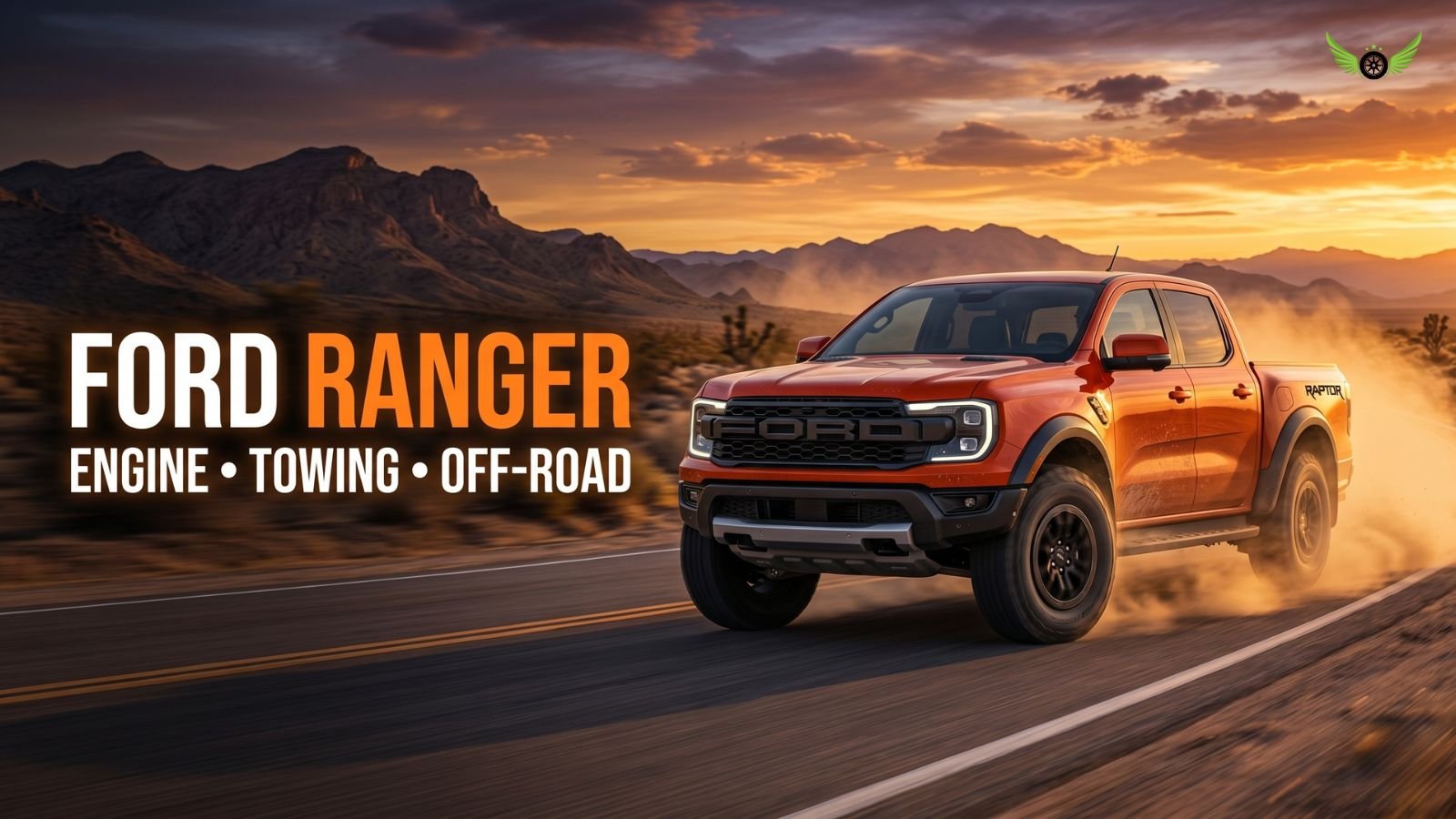
The 2026 Ford Ranger is designed for buyers who need strong towing capability, practical work utility, turbocharged engine performance, and real off-road capability in a mid-size truck. Ford currently offers three EcoBoost engine options across the lineup, including a high-output twin-turbo V6 in the Ranger Raptor.
The standard 2.3L EcoBoost engine produces 270 horsepower and 310 lb-ft of torque. Buyers wanting stronger towing performance and highway acceleration can choose the available 2.7L EcoBoost V6 producing 315 horsepower and 400 lb-ft of torque. The Ranger Raptor uses a 3.0L twin-turbo EcoBoost V6 generating 405 horsepower and 430 lb-ft of torque. Every engine is paired with a 10-speed automatic transmission.
Properly equipped XL, XLT, and Lariat models can tow up to 7,500 pounds depending on drivetrain configuration. Maximum payload capacity reaches approximately 1,805 pounds on certain rear-wheel-drive setups. The Ranger Raptor focuses more on suspension performance and off-road control, so its towing capacity is lower at around 5,510 pounds.
The latest Ford Ranger also improved highway stability, low-speed response, towing confidence, and terrain-management technology compared to previous generations. FX4-equipped models add off-road drive modes, upgraded suspension tuning, skid plates, and electronic locking rear differentials for improved trail capability.
Ranger Raptor models include FOX Live Valve suspension, 33-inch all-terrain tires, locking front and rear differentials, wider suspension geometry, and Baja drive modes developed for high-speed off-road driving.
This guide covers real Ford Ranger Engine performance, towing capability, payload strength, work utility, acceleration performance, and off-road driving behavior using verified 2026 USA-market specifications and testing data.
Ford Ranger Engine Options Explained
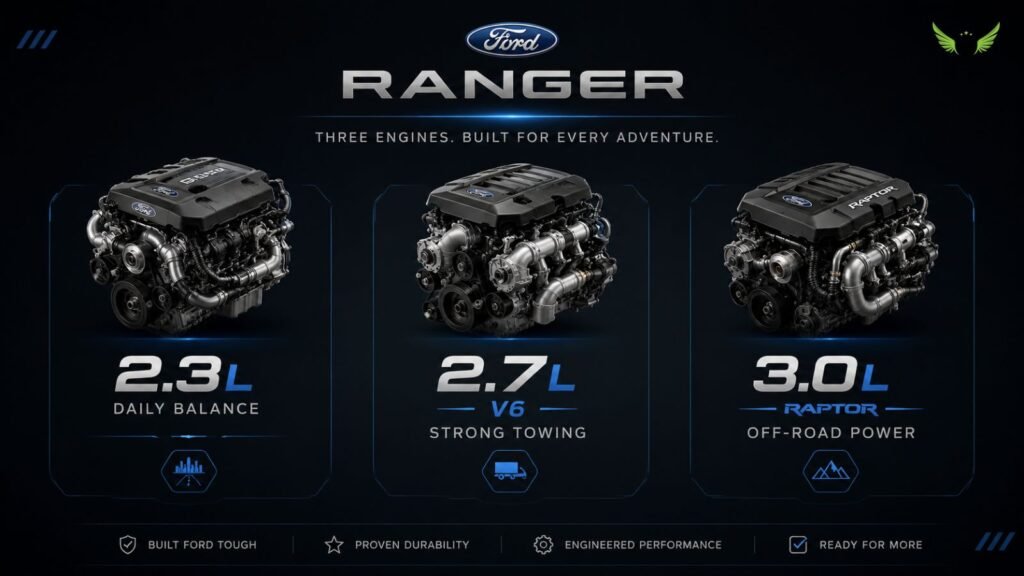
The 2026 Ford Ranger lineup offers three EcoBoost engine options designed for different driving needs. The standard 2.3L EcoBoost focuses on balanced daily performance and towing capability, the available 2.7L EcoBoost V6 delivers stronger highway power and towing response, and the Ranger Raptor’s twin-turbo V6 is tuned mainly for high-speed off-road performance.
All engines use a 10-speed automatic transmission. Standard Ranger models focus more on towing capability and daily usability, while the Ranger Raptor prioritizes suspension travel, terrain control, and off-road stability.
Engine | Horsepower | Torque |
2.3L EcoBoost I-4 | 270 HP | 310 lb-ft |
2.7L EcoBoost V6 | 315 HP | 400 lb-ft |
3.0L Twin-Turbo V6 (Raptor) | 405 HP | 430 lb-ft |
2.3L EcoBoost Engine Real Performance
The standard 2.3L EcoBoost engine produces 270 horsepower and 310 lb-ft of torque. This engine is available with rear-wheel drive and four-wheel drive configurations and supports the full 7,500-pound towing capacity when properly equipped.
In real driving, the 2.3L EcoBoost provides strong low-speed torque and quick throttle response, which helps during city driving, merging, and light trailer towing. Independent testing recorded a 0–60 mph time of around 6.2 seconds for a four-wheel-drive Lariat model equipped with this engine.
Many buyers choose this setup because it balances fuel economy, towing strength, and daily usability well for a mid-size truck. EPA estimates reach around 21 mpg city and 26 mpg highway on rear-wheel-drive configurations.
2.7L EcoBoost V6 Driving Feel
The available 2.7L EcoBoost V6 produces 315 horsepower and 400 lb-ft of torque. This engine is mainly offered on higher trims and comes standard with four-wheel drive.
Compared to the 2.3L engine, the V6 delivers noticeably stronger highway acceleration and better loaded towing performance. It provides smoother uphill towing behavior and stronger passing power at highway speed. Independent testing recorded a 0–60 mph time of approximately 5.6 seconds.
Many buyers who tow campers, enclosed trailers, or boats regularly prefer the V6 because it maintains stronger power delivery under load. Fuel economy drops slightly compared to the standard engine, with EPA estimates around 19 mpg city and 23 mpg highway.
Raptor Twin-Turbo V6 Off-Road Power
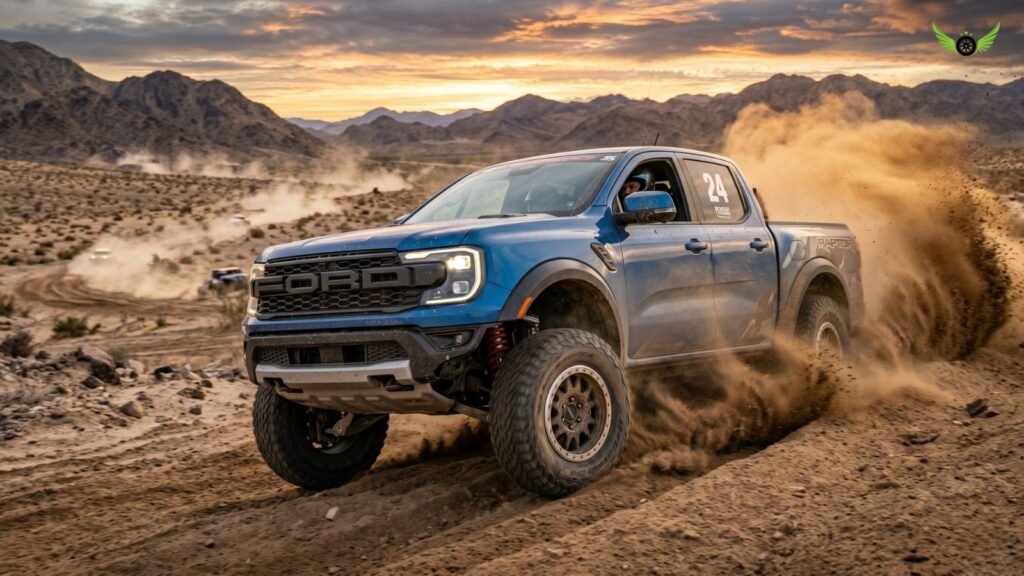
The Ranger Raptor uses a 3.0L twin-turbo EcoBoost V6 producing 405 horsepower and 430 lb-ft of torque. This engine is paired exclusively with four-wheel drive and a performance-focused off-road suspension system.
Unlike standard Ford Ranger models, the Raptor prioritizes suspension performance and terrain control over maximum towing numbers. Towing capacity is rated around 5,510 pounds, while payload capacity is lower because of the heavier off-road hardware and long-travel suspension setup.
The Ranger Raptor includes FOX 2.5-inch Live Valve shocks, locking front and rear differentials, 33-inch all-terrain tires, wider suspension geometry, and Baja drive modes developed for high-speed desert-style off-road driving.
Independent testing recorded 0–60 mph acceleration in roughly 5.3 seconds, making the Ranger Raptor one of the quickest factory off-road trucks in the mid-size segment.
Ford Ranger Real Driving Performance
The 2026 Ford Ranger delivers stronger real-world driving performance than many mid-size trucks because of its turbocharged engine lineup, responsive 10-speed automatic transmission, and improved chassis stability. Compared to previous Ranger generations, the latest model feels more stable at highway speed, more responsive during acceleration, and smoother during daily driving.
0–60 MPH Acceleration Performance
The standard 2.3L EcoBoost Ford Ranger produces 270 horsepower and 310 lb-ft of torque. Independent testing recorded 0–60 mph acceleration in approximately 6.2 seconds for a four-wheel-drive Lariat model equipped with this engine.
The available 2.7L EcoBoost V6 improves acceleration significantly. With 315 horsepower and 400 lb-ft of torque, independent testing recorded around 5.6 seconds from 0–60 mph, making it one of the quickest trucks in the mid-size segment.
The Ranger Raptor delivers the strongest Ford Ranger Performance in the lineup. Its 3.0L twin-turbo EcoBoost V6 generates 405 horsepower and 430 lb-ft of torque. Independent testing recorded 0–60 mph acceleration in approximately 5.2–5.3 seconds depending on testing conditions.
Highway Stability and Overtaking Power
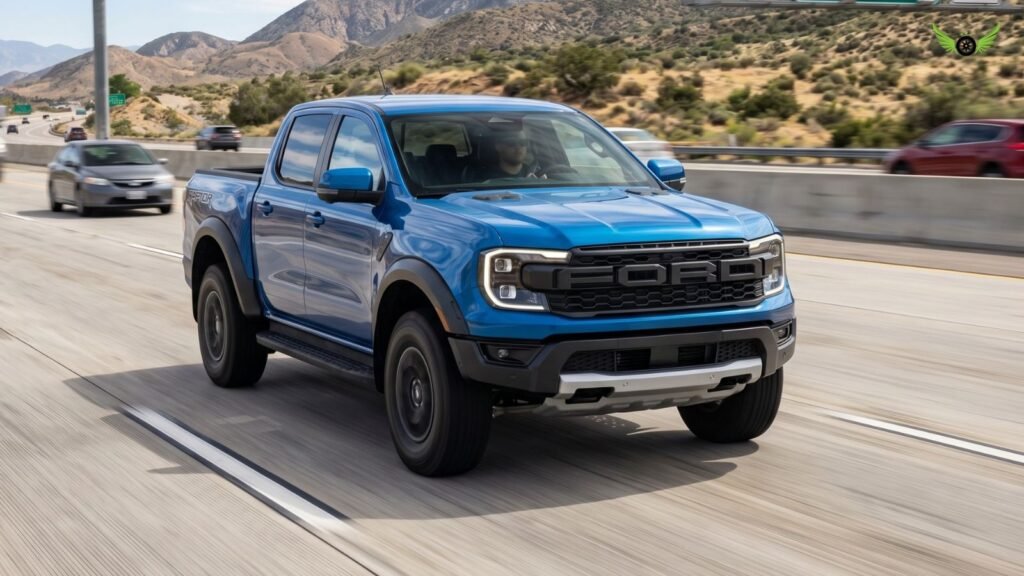
The latest Ford Ranger feels more stable at highway speed because of its wider track, updated suspension tuning, and improved steering calibration. Even standard trims remain composed during long-distance highway driving and towing situations.
The 2.3L EcoBoost engine provides enough power for normal highway overtaking and merging, but the 2.7L EcoBoost V6 feels noticeably stronger during uphill acceleration and loaded towing situations. Many owners who tow campers or trailers regularly prefer the V6 because it delivers smoother power under load and requires fewer aggressive downshifts during highway driving.
The Ranger Raptor uses FOX Live Valve suspension and a wider suspension setup that improves high-speed stability on rough pavement and uneven terrain while still maintaining controlled highway driving behavior.
City Driving and Low-Speed Response
In city driving, the standard 2.3L EcoBoost engine provides quick throttle response and strong low-speed torque, which helps during stop-and-go traffic, parking-lot maneuvering, and low-speed acceleration.
The Ford Ranger also remains easier to maneuver in urban areas than most full-size trucks because of its smaller size and tighter overall driving feel. Visibility is improved by the upright seating position and available camera systems.
The 2.7L EcoBoost V6 feels smoother and more effortless during low-speed driving because of the added torque output. Ranger Raptor models remain comfortable in city traffic, although the larger off-road tires and firmer suspension setup create more road feel and tire noise compared to standard trims.
Ford Ranger Towing Capability
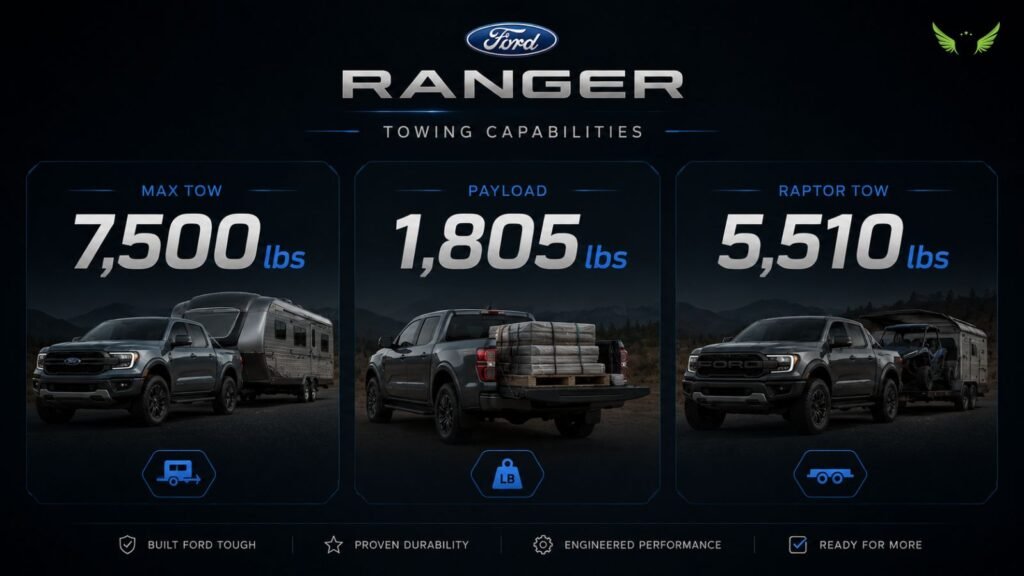
The 2026 Ford Ranger delivers one of the strongest towing ratings in the mid-size truck segment. Properly equipped XL, XLT, and Lariat models can tow up to 7,500 pounds with the available Trailer Tow Package. The Ranger Raptor is rated at approximately 5,510 pounds because its suspension is tuned mainly for off-road driving rather than maximum towing load.
Ford also improved towing technology on the latest Ranger with Trailer Sway Control, Tow/Haul mode, integrated trailer brake support, and available Pro Trailer Backup Assist designed to improve trailer stability and reversing control.
Maximum Towing Capacity by Configuration
Configuration | Maximum Towing Capacity |
XL 2.3L EcoBoost | Up to 7,500 lbs |
XLT 2.3L EcoBoost | Up to 7,500 lbs |
Lariat 2.3L / 2.7L EcoBoost | Up to 7,500 lbs |
Ranger Raptor 3.0L Twin-Turbo V6 | Around 5,510 lbs |
The full 7,500-pound towing rating requires the available Trailer Tow Package, which includes a Class IV hitch receiver and 4-pin/7-pin trailer wiring connections.
Real Trailer and Camper Towing Experience
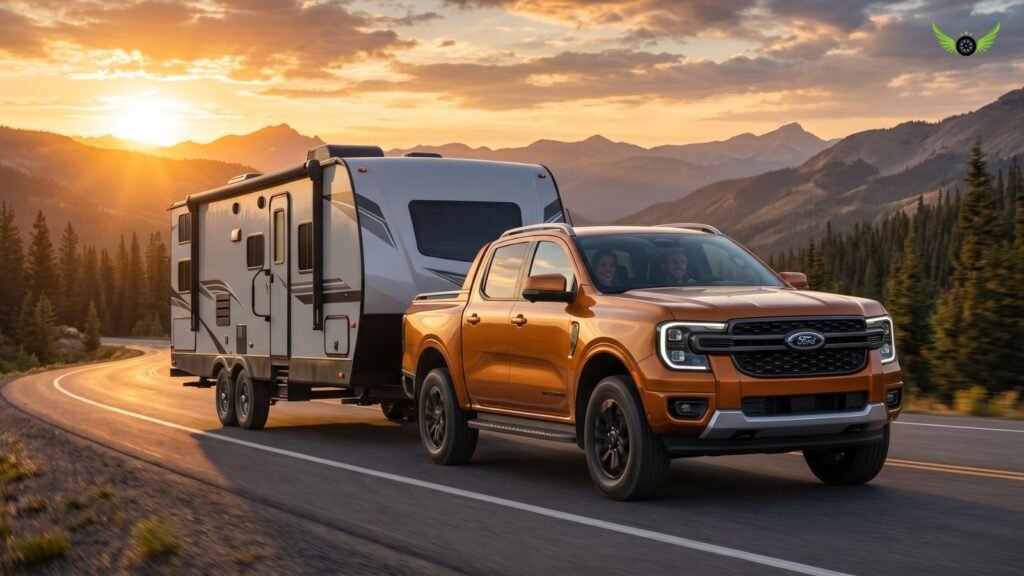
The standard 2.3L EcoBoost engine provides enough torque for utility trailers, smaller campers, fishing boats, and light equipment hauling. The turbocharged low-end torque helps the truck feel responsive during uphill towing and highway merging.
Buyers who tow larger campers, enclosed trailers, or heavier boats regularly usually prefer the available 2.7L EcoBoost V6 because it delivers stronger highway pulling power and smoother acceleration under load. The added 400 lb-ft of torque also reduces aggressive downshifting during towing situations.
The Ranger Raptor can still tow recreational trailers and smaller campers, but its softer long-travel suspension is designed mainly for off-road terrain control rather than maximum trailer stability under heavy load.
Trailer Sway Control and Tow Features
Trailer Sway Control is standard across the Ford Ranger lineup. The system automatically applies braking and engine-management adjustments if trailer movement becomes unstable during towing.
Higher trims and towing packages also add:
- Integrated Trailer Brake Controller
- Tow/Haul drive mode
- Pro Trailer Backup Assist
- Trailer Reverse Guidance
- Blind Spot Information System with Trailer Coverage
- 360-degree camera system
Pro Trailer Backup Assist is one of the most useful towing technologies in the Ranger lineup because it helps drivers reverse trailers more accurately during camper parking, boat launching, and tight trailer maneuvering.
Ford Ranger Payload and Work Utility
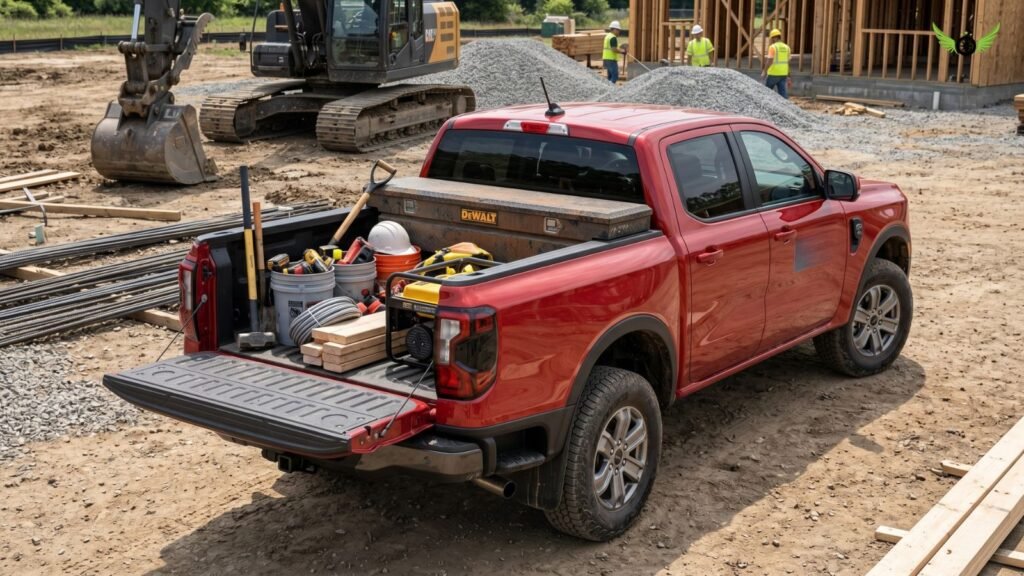
The 2026 Ford Ranger combines strong payload capability with practical cargo utility designed for hauling tools, equipment, outdoor gear, and work supplies. Depending on trim and drivetrain configuration, payload capacity reaches up to 1,805 pounds on certain rear-wheel-drive models. Four-wheel-drive setups carry slightly lower payload ratings because of the additional drivetrain weight.
Ford also improved work usability with upgraded tie-down systems, available in-bed power outlets, integrated bed lighting, and practical tailgate features designed for daily hauling and job-site use.
Payload Capacity by Trim Level
Configuration | Maximum Payload Capacity |
Ranger XL RWD | Up to 1,805 lbs |
Ranger XL 4WD | Around 1,711 lbs |
Ranger XLT | Around 1,711–1,788 lbs |
Ranger Lariat V6 | Around 1,542 lbs |
Ranger Raptor | Around 1,373 lbs |
The highest payload ratings are available on standard 2.3L EcoBoost rear-wheel-drive models. V6-equipped trims and the Ranger Raptor carry lower payload ratings because of additional drivetrain and suspension hardware.
Truck Bed Size and Cargo Features
The Ford Ranger uses a 5-foot SuperCrew cargo bed measuring approximately 59.6 inches in length. Bed width measures around 62.4 inches at the floor and 48.2 inches between the wheel housings.
Cargo Bed Measurement | Size |
Bed Length | 59.6 inches |
Bed Width at Floor | 62.4 inches |
Width Between Wheel Housings | 48.2 inches |
Cargo Bed Height | 20.8 inches |
Cargo Volume | 48.5 cubic feet |
The bed design allows standard plywood sheets to fit diagonally with the tailgate down. Available cargo-focused features include spray-in bedliners, LED bed lighting, multiple tie-down points, a tailgate work surface, and an available 400W in-bed power outlet.
The available in-bed power outlet is especially useful for powering small tools, portable electronics, and camping equipment during outdoor work or travel.
Best Setup for Work and Hauling
For buyers focused mainly on hauling equipment, contractor work, and payload strength, the XL or XLT trims with the 2.3L EcoBoost engine provide the best balance of hauling capability, towing strength, fuel economy, and ownership cost.
The standard 2.3L EcoBoost engine produces 270 horsepower and 310 lb-ft of torque, which is enough for utility trailers, landscaping equipment, contractor supplies, and general work hauling without the higher fuel consumption of larger engines.
Buyers regularly towing enclosed trailers or carrying heavier cargo may benefit more from the available 2.7L EcoBoost V6 because of its stronger torque delivery during loaded highway driving and uphill hauling.
The Ranger Raptor is less focused on maximum work utility because its suspension, tires, and chassis setup are designed mainly for off-road terrain performance rather than payload efficiency.
Ford Ranger Off-Road Capability
The 2026 Ford Ranger delivers stronger off-road capability than previous Ranger generations because of its updated suspension design, improved terrain-management systems, locking differential options, and wider chassis setup. FX4-equipped models are designed for trails, mud, sand, and uneven terrain, while the Ranger Raptor is engineered mainly for higher-speed off-road driving and rough desert conditions.
Ford also improved underbody protection, suspension travel, traction-management systems, and trail visibility to make the latest Ford Ranger more capable during real off-road driving situations.
Terrain Management System Explained
The Ford Ranger uses selectable drive modes that adjust throttle response, transmission behavior, traction control, steering calibration, and differential settings based on terrain conditions.
Standard Ranger drive modes include:
- Normal
- Eco
- Sport
- Tow/Haul
- Slippery
FX4-equipped models add:
- Mud/Ruts
- Sand
The Ranger Raptor includes additional off-road-focused modes:
- Baja
- Rock Crawl
Baja mode is designed mainly for higher-speed desert driving by allowing more aggressive throttle response and revised suspension behavior. Rock Crawl mode improves low-speed wheel control and traction during rocky terrain driving.
FX4-equipped models also include Trail Control, which works like low-speed off-road cruise control by automatically managing braking and throttle input during trail driving.
Ground Clearance and Suspension Setup
Ground clearance changes depending on trim and suspension configuration.
Configuration | Ground Clearance |
Standard Ford Ranger | Around 8.8 inches |
FX4 Package Models | Around 9.3 inches |
Ranger Raptor | Around 10.7 inches |
FX4-equipped Ford Ranger models include off-road-tuned suspension systems, skid plates, all-terrain tires, Trail Control, and an electronic-locking rear differential designed for improved traction on loose surfaces.
The Ranger Raptor uses FOX 2.5-inch Live Valve internal bypass shocks, reinforced frame components, locking front and rear differentials, long-travel suspension geometry, and 33-inch all-terrain tires developed for aggressive off-road driving.
The wider suspension setup also improves high-speed stability on rough terrain compared to standard Ranger models.
Real Off-Road Driving Experience
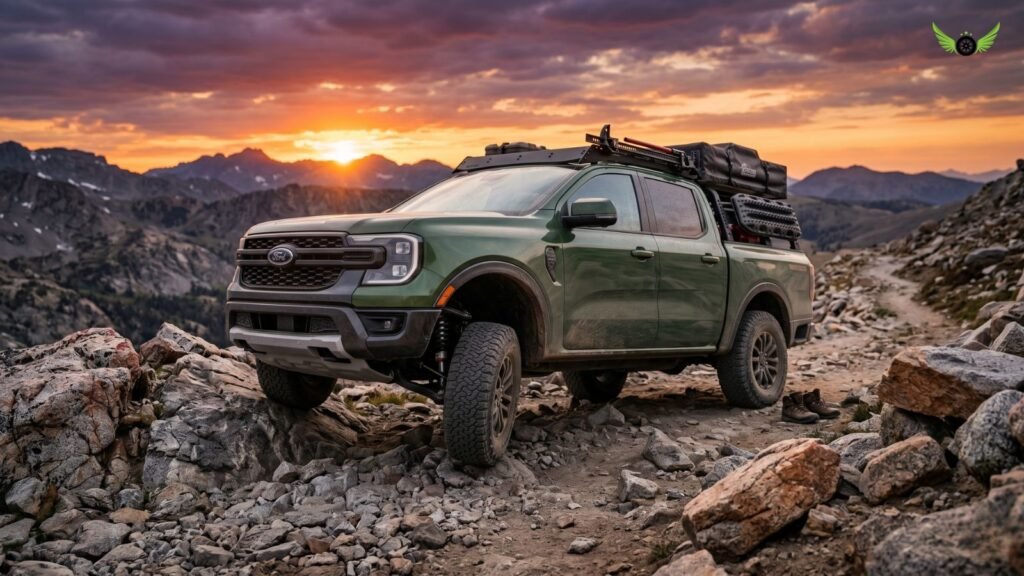
In real off-road driving, FX4-equipped Ford Ranger models handle dirt roads, loose gravel, muddy trails, and uneven terrain confidently without requiring major aftermarket modifications.
The turbocharged engines provide strong low-speed torque, which helps during hill climbs, trail driving, and loose-surface acceleration. The 10-speed automatic transmission also responds smoothly during low-speed off-road situations.
The Ranger Raptor delivers the strongest Ford Ranger Capability for serious off-road driving. Its FOX Live Valve suspension absorbs rough terrain significantly better than standard Ranger models, especially during higher-speed trail driving and uneven desert surfaces.
Many drivers also praise the available off-road camera system and 360-degree camera visibility because they improve obstacle positioning and trail visibility during narrow or rocky trail driving.
Ford Ranger Engine, Towing & Off-Road FAQs
Many buyers compare the Ford Ranger with other mid-size trucks before making a final decision. Most questions focus on towing capability, engine performance, payload strength, fuel economy, and real off-road usability. The answers below cover the most important Ford Ranger Performance and capability questions using verified 2026 USA-market data.
How much can the 2026 Ford Ranger tow?
Properly equipped XL, XLT, and Lariat models can tow up to 7,500 pounds. The Ranger Raptor is rated at approximately 5,510 pounds.
Which Ford Ranger engine is best for towing?
The 2.7L EcoBoost V6 is the best overall choice for regular towing because it produces 315 horsepower and 400 lb-ft of torque while still maintaining the full 7,500-pound towing rating.
How fast is the Ford Ranger from 0–60 mph?
The 2.3L EcoBoost reaches 0–60 mph in around 6.2 seconds, the 2.7L EcoBoost V6 takes approximately 5.6 seconds, and the Ranger Raptor can reach 0–60 mph in about 5.2–5.3 seconds.
Does the Ford Ranger have good off-road capability?
Yes. FX4-equipped models include off-road suspension tuning, Trail Control, skid plates, and locking rear differentials. The Ranger Raptor adds FOX Live Valve suspension, locking front and rear differentials, and Baja drive modes for more aggressive off-road drivin
What is the payload capacity of the Ford Ranger?
Payload capacity reaches up to approximately 1,805 pounds on certain rear-wheel-drive configurations. Payload ratings vary depending on trim and drivetrain setup.
Does the Ford Ranger come with four-wheel drive?
Yes. Four-wheel drive is available on most trims and standard on the Ranger Raptor.
Which Ford Ranger trim is best for off-road driving?
The Ranger Raptor is the most capable off-road trim because it includes long-travel FOX suspension, 33-inch all-terrain tires, locking differentials, and upgraded terrain-management systems.
Is the 2.3L EcoBoost engine powerful enough?
Yes. The standard 2.3L EcoBoost produces 270 horsepower and 310 lb-ft of torque, which is enough for daily driving, towing, highway merging, and moderate hauling.
Does the Ranger Raptor sacrifice towing capability?
Yes. The Ranger Raptor focuses more on suspension performance and off-road control, so its towing capacity is lower than standard Ranger models.
What is the ground clearance of the Ford Ranger?
Ground clearance measures around 8.8 inches on standard models, approximately 9.3 inches on FX4-equipped trims, and around 10.7 inches on the Ranger Raptor.