
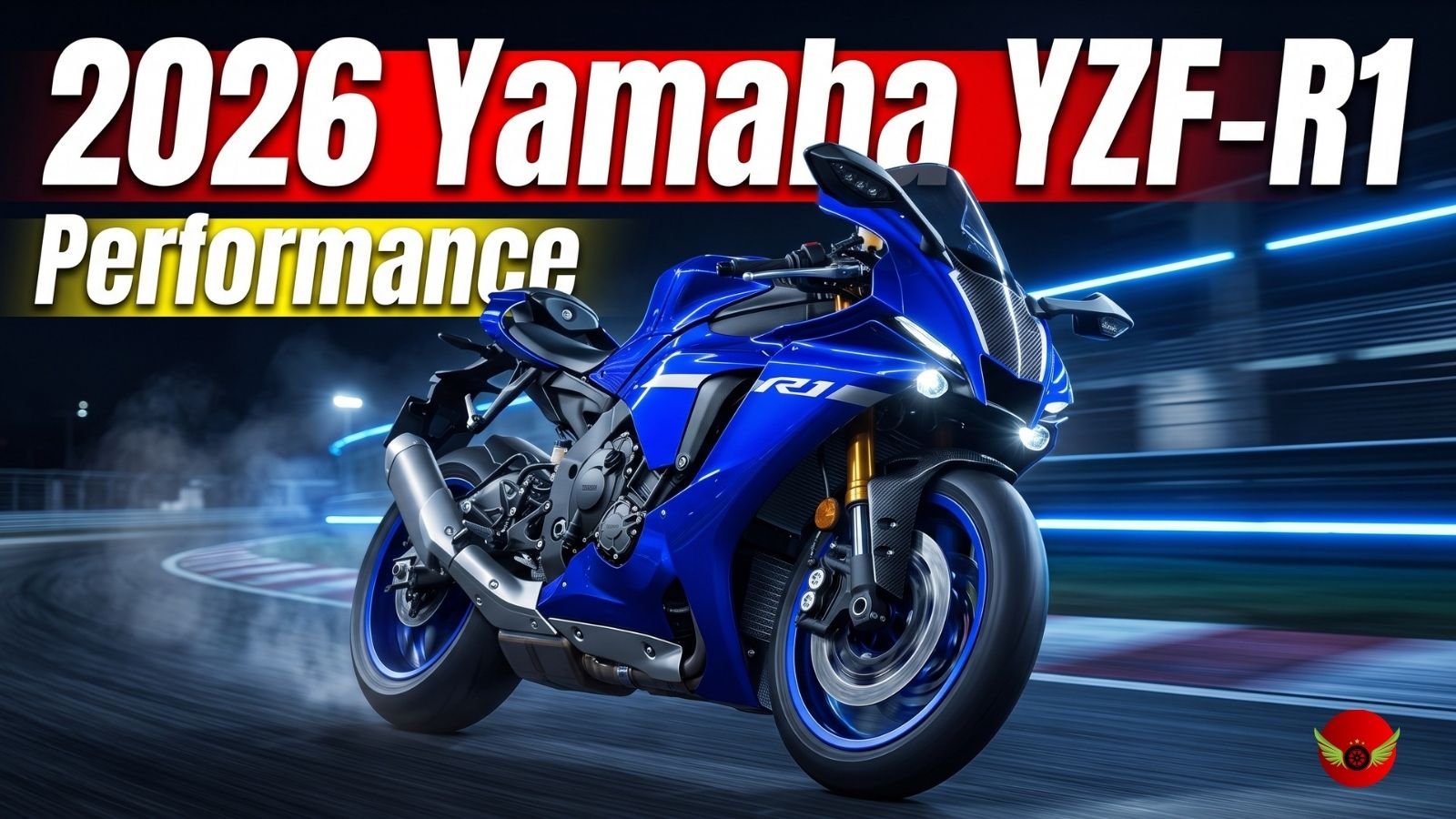
The Yamaha YZF-R1 is designed to deliver high-performance riding through a combination of race-developed engineering, advanced electronics, and a lightweight chassis. Its 998cc CP4 crossplane inline-four engine, aluminum Deltabox frame, fully adjustable KYB suspension, Brembo Stylema braking system, and six-axis Inertial Measurement Unit (IMU) work together to provide strong acceleration, precise handling, and consistent control. These components make the Yamaha YZF-R1 one of the most technically advanced production superbikes available in the U.S. market.
This Yamaha YZF-R1 Performance guide focuses on the motorcycle’s real-world capabilities rather than repeating technical specifications alone. The following sections examine how the CP4 engine delivers power across the rev range, how the motorcycle performs during highway riding and acceleration testing, and how its chassis, braking system, and electronic rider aids influence overall riding dynamics. Independent testing has shown the Yamaha YZF-R1 is capable of 0–60 mph in approximately 3.0 seconds, completing the quarter mile in under 10 seconds, and reaching a top speed of around 186 mph (299 km/h) under controlled test conditions. Actual performance varies depending on rider weight, weather, gearing, road surface, and motorcycle setup.
This Yamaha YZF-R1 Top Speed and Yamaha YZF-R1 Riding Experience guide also evaluates braking performance, cornering confidence, suspension behavior, and high-speed stability. Instead of focusing on a single performance figure, the article explains how each system contributes to the motorcycle’s overall riding experience, helping prospective buyers understand what to expect from the Yamaha YZF-R1 on both public roads and closed-course tracks.
Yamaha YZF-R1 Performance
The Yamaha YZF-R1 Performance is defined by the way its engine, chassis, electronics, and suspension work together rather than by peak power alone. The motorcycle combines a 998cc CP4 crossplane inline-four engine, lightweight aluminum Deltabox frame, fully adjustable KYB suspension, Brembo Stylema front brakes, and a six-axis IMU to deliver strong acceleration, precise cornering, and stable high-speed handling. This integrated design gives the Yamaha YZF-R1 predictable throttle response and consistent performance on both public roads and closed circuits.
Yamaha YZF-R1 Crossplane Engine Performance
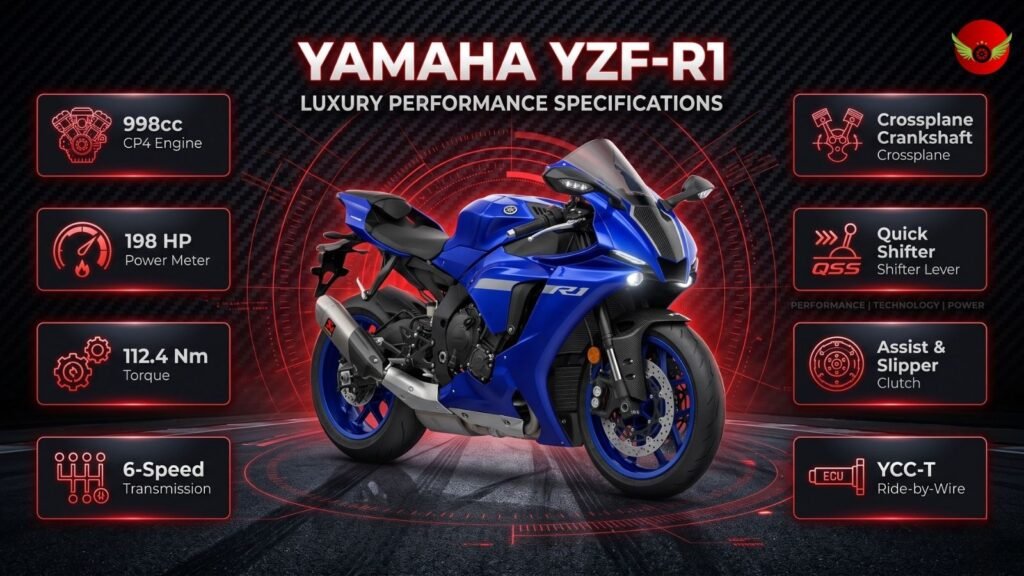
The Yamaha YZF-R1 is powered by a 998cc liquid-cooled DOHC CP4 inline-four engine that uses Yamaha’s crossplane crankshaft technology. Unlike a conventional inline-four engine, the crossplane crankshaft uses an uneven firing sequence to reduce inertial torque, allowing smoother torque delivery and improved rear-wheel traction during acceleration. This design helps riders apply throttle more confidently when exiting corners and improves overall control during aggressive riding.
For the current U.S. specification, the engine produces approximately 198 horsepower (200 PS) at 13,500 rpm and 112.4 Nm (82.9 lb-ft) of torque at 11,500 rpm. Yamaha pairs the engine with Yamaha Chip Controlled Throttle (YCC-T), Yamaha Chip Controlled Intake (YCC-I), and a 6-speed transmission featuring an assist-and-slipper clutch. These systems contribute to the responsive and linear power delivery that defines the Yamaha YZF-R1 Riding Experience.
Engine Specification | Value |
Engine | 998cc liquid-cooled CP4 inline-four |
Maximum Power | 200 PS (198 hp) @ 13,500 rpm |
Maximum Torque | 112.4 Nm (82.9 lb-ft) @ 11,500 rpm |
Compression Ratio | 13.0:1 |
Transmission | 6-speed with assist & slipper clutch |
Yamaha YZF-R1 Mid-Range and Top-End Power
A key strength of Yamaha YZF-R1 Performance is its broad and controllable power delivery. In the mid-range, the CP4 engine provides smooth acceleration that allows riders to increase speed without abrupt power spikes. This characteristic improves throttle control during corner exits and makes the motorcycle easier to manage under hard acceleration.
As engine speed increases beyond 10,000 rpm, the Yamaha YZF-R1 delivers a stronger top-end surge, reaching peak power at 13,500 rpm. The standard Quick Shift System (QSS) supports seamless clutchless gear changes, helping maintain continuous acceleration while reducing interruption in power delivery. This combination gives the motorcycle competitive straight-line performance without sacrificing throttle precision.
Yamaha YZF-R1 Highway Performance
The Yamaha YZF-R1 remains composed at highway speeds thanks to its aerodynamic bodywork, rigid aluminum chassis, and advanced electronic rider aids. Roll-on acceleration is immediate, allowing confident overtaking with minimal delay, while the aerodynamic fairing helps reduce wind pressure when riding at sustained speeds.
The motorcycle’s Traction Control System (TCS), Slide Control System (SCS), Lift Control System (LIF), and Brake Control (BC) continuously adjust to changing riding conditions using data from the six-axis IMU. These systems improve stability without interfering with normal riding. Although the Yamaha YZF-R1 is capable of comfortable highway cruising, its riding position and suspension tuning are optimized primarily for sport riding and track performance rather than long-distance touring.
Yamaha YZF-R1 Top Speed
The Yamaha YZF-R1 Top Speed reflects the motorcycle’s balanced combination of engine performance, aerodynamics, gearing, and electronic control systems. Rather than publishing an official maximum speed, Yamaha focuses on the motorcycle’s overall performance package. Independent instrumented testing consistently shows the Yamaha YZF-R1 reaching approximately 186 mph (299 km/h) in standard factory specification, with some GPS-based tests recording 190–191 mph (306–307 km/h) under ideal conditions. These results place the motorcycle among the fastest production litre-class superbikes while maintaining stability and predictable handling at very high speeds.
Yamaha YZF-R1 Real-World Top Speed
The real-world Yamaha YZF-R1 Top Speed depends on several factors, including rider weight, riding position, weather, elevation, tire condition, and available road or track length. In controlled testing, the motorcycle continues to accelerate strongly beyond 150 mph (241 km/h) before aerodynamic drag becomes the primary limiting factor. Its 998cc CP4 crossplane engine, close-ratio six-speed gearbox, ram-air intake, and aerodynamic fairing allow the motorcycle to build speed progressively while maintaining chassis stability.
Top Speed Test | Performance |
Typical Verified Top Speed | 186 mph (299 km/h) |
Highest Recorded GPS Speed | 190–191 mph (306–307 km/h) |
These figures represent performance recorded during professional testing on closed courses. Riders should never attempt to reach maximum speed on public roads.
Yamaha YZF-R1 0–60 MPH and Quarter-Mile Performance
The Yamaha YZF-R1 Performance is defined as much by its acceleration as its maximum speed. Independent testing records 0–60 mph in approximately 3.1 seconds, while the motorcycle reaches 100 mph in about 5.7 seconds. The quarter mile is typically completed in around 10.1 seconds, with trap speeds ranging from 146 to 154 mph (235–248 km/h) depending on rider technique and test conditions.
Acceleration Test | Typical Result |
0–60 mph | 3.1 seconds |
0–100 mph | 5.7 seconds |
Quarter Mile | 10.1 seconds |
Trap Speed | 146–154 mph (235–248 km/h) |
These acceleration results highlight the strength of the CP4 engine throughout the rev range. Combined with the standard Quick Shift System (QSS), six-axis IMU, and advanced traction management, the motorcycle delivers rapid yet controlled acceleration. This balance of power, stability, and rider confidence is a defining part of the Yamaha YZF-R1 Riding Experience, making the Yamaha YZF-R1 one of the benchmark superbikes for riders seeking both straight-line performance and real-world usability.
Yamaha YZF-R1 Track Performance
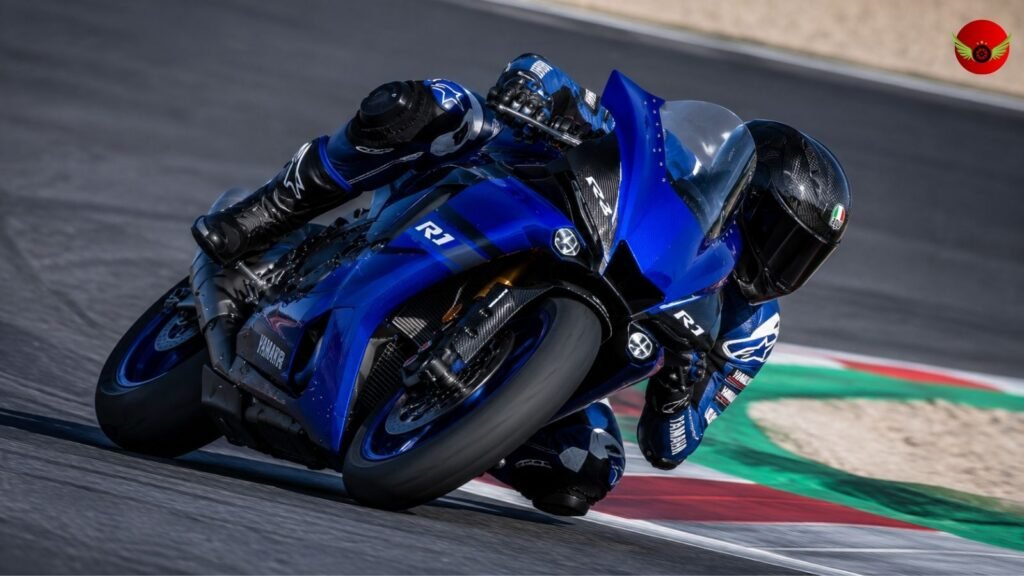
The Yamaha YZF-R1 is designed to perform at a high level on closed circuits. Its 998cc CP4 crossplane engine, lightweight aluminum Deltabox frame, fully adjustable KYB suspension, Brembo Stylema braking system, and six-axis IMU work together to deliver predictable handling, strong braking, and consistent lap performance. Rather than relying only on engine power, the Yamaha YZF-R1 Performance comes from the balance between its chassis, electronics, and rider-focused engineering.
Yamaha YZF-R1 Braking Performance
The Yamaha YZF-R1 features dual 320 mm floating front discs, Brembo Stylema radial-mount calipers, and a 220 mm rear disc. An IMU-based Brake Control (BC) system and ABS continuously adjust braking performance according to lean angle and wheel speed. This setup provides strong stopping power, precise lever feel, and consistent performance during repeated hard braking, making the motorcycle well suited for track riding.
Braking Component | Specification |
Front Brakes | Dual 320 mm floating discs |
Front Calipers | Brembo Stylema radial-mount |
Rear Brake | 220 mm hydraulic disc |
Electronic Support | IMU-based Brake Control (BC) with ABS |
Yamaha YZF-R1 Cornering Performance
The Yamaha YZF-R1 Riding Experience stands out for its confidence through corners. The aluminum Deltabox frame, 43 mm KYB inverted fork, fully adjustable rear shock, and compact wheelbase allow quick direction changes while maintaining stability. Electronic systems, including Traction Control (TCS), Slide Control (SCS), and Lift Control (LIF), help maximize grip during corner entry and exit. The carbon-fiber winglets also improve front-end stability at higher speeds, giving riders more confidence on technical circuits.
Yamaha YZF-R1 Track Riding Experience
The Yamaha YZF-R1 delivers a focused riding experience for track enthusiasts. Its aggressive ergonomics, Quick Shift System (QSS), and customizable Yamaha Ride Control (YRC) settings allow riders to optimize the motorcycle for different track conditions. The smooth torque delivery of the CP4 engine, combined with precise steering and advanced electronics, creates a predictable and rewarding ride. For experienced riders, the Yamaha YZF-R1 Performance offers the balance of speed, control, and feedback expected from a modern flagship superbike.
Yamaha YZF-R1 Handling and Ride Quality
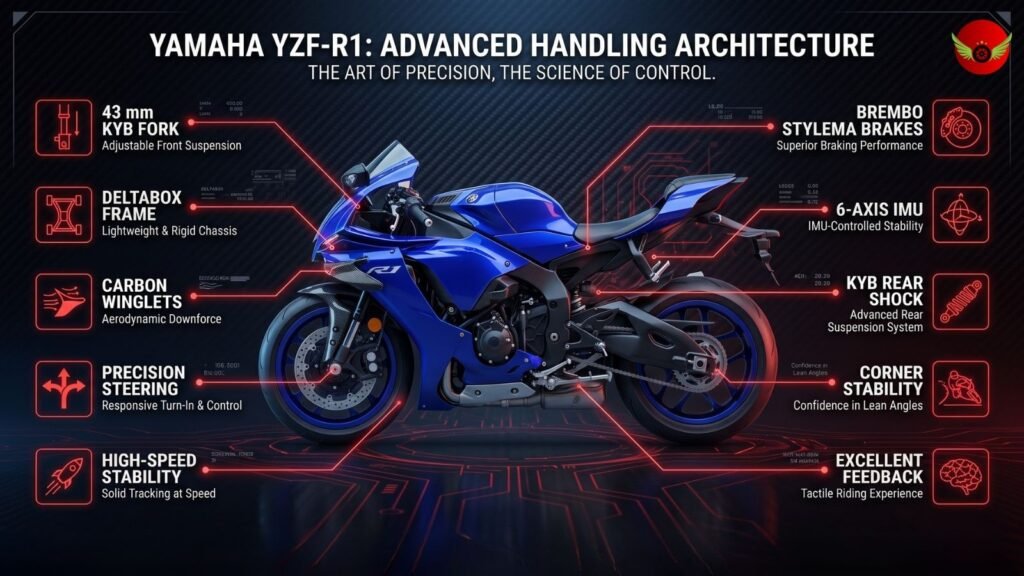
The Yamaha YZF-R1 delivers a handling package designed for precision rather than comfort alone. Its lightweight aluminum Deltabox frame, fully adjustable KYB suspension, long swingarm, and six-axis IMU provide quick steering, accurate front-end feedback, and excellent chassis balance. Together, these components create a Yamaha YZF-R1 Riding Experience that remains stable during aggressive cornering, hard braking, and high-speed acceleration.
Yamaha YZF-R1 Suspension Performance
The Yamaha YZF-R1 features a 43 mm fully adjustable KYB inverted front fork and a fully adjustable KYB link-type rear shock. Riders can adjust preload, compression damping, and rebound damping to suit different road conditions or track setups.
The KYB suspension is tuned to maintain front-end stability under heavy braking while keeping the rear tire planted during acceleration. Independent track evaluations consistently praise its predictable damping, responsive steering, and ability to maintain grip through fast direction changes. These characteristics make the suspension a key part of Yamaha YZF-R1 Performance.
Suspension Component | Specification |
Front Suspension | 43 mm fully adjustable KYB inverted fork |
Rear Suspension | Fully adjustable KYB link-type shock |
Adjustments | Preload, compression, and rebound damping |
Yamaha YZF-R1 High-Speed Stability
The Yamaha YZF-R1 remains remarkably stable at high speed due to its rigid Deltabox chassis, extended swingarm, aerodynamic fairing, and MotoGP-inspired carbon-fiber winglets. The winglets generate additional front-end downforce, helping improve stability during rapid acceleration and high-speed corner entry.
The motorcycle’s six-axis IMU continuously manages Traction Control (TCS), Slide Control (SCS), Lift Control (LIF), and Brake Control (BC) to maintain chassis balance as speed increases. This combination of mechanical design and electronic control gives the Yamaha YZF-R1 Riding Experience a confident, planted feel, making the Yamaha YZF-R1 one of the most stable production superbikes for experienced riders.
Yamaha YZF-R1 Top Speed, Performance & Riding Experience FAQs
The questions below answer the most common performance-related topics that riders search before choosing the Yamaha YZF-R1. These FAQs focus on acceleration, top speed, handling, track capability, and real-world riding experience to provide quick, practical answers.
What is the top speed of the Yamaha YZF-R1?
The Yamaha YZF-R1 has a verified top speed of approximately 186 mph (299 km/h) in standard factory specification. Under ideal closed-course testing, some GPS-based runs have recorded speeds close to 190–191 mph (306–307 km/h).
How fast does the Yamaha YZF-R1 accelerate from 0–60 mph?
Independent performance testing shows the Yamaha YZF-R1 accelerates from 0–60 mph in about 3.1 seconds. Rider skill, launch technique, and track conditions can slightly affect the result.
Is the Yamaha YZF-R1 good for track riding?
Yes. The Yamaha YZF-R1 is designed with track riding in mind. Its CP4 crossplane engine, fully adjustable KYB suspension, Brembo Stylema brakes, six-axis IMU, and Yamaha Ride Control (YRC) provide the performance and control expected from a modern superbike.
How does the Yamaha YZF-R1 perform at highway speeds?
The Yamaha YZF-R1 remains stable at highway speeds thanks to its aerodynamic fairing, rigid Deltabox frame, and electronic rider aids. The engine delivers strong roll-on acceleration, making overtaking quick and predictable.
Does the Yamaha YZF-R1 handle corners well?
Yes. The Yamaha YZF-R1 is known for its precise cornering. Its lightweight chassis, fully adjustable suspension, and IMU-controlled traction and slide control systems provide excellent stability and front-end feedback during corner entry and exit.
What makes the Yamaha YZF-R1 Performance different from other superbikes?
The Yamaha YZF-R1 Performance is defined by its CP4 crossplane engine, which delivers smooth, linear torque rather than an abrupt power surge. Combined with advanced electronics and a balanced chassis, it provides excellent throttle control and predictable handling.
Is the Yamaha YZF-R1 comfortable for long rides?
The Yamaha YZF-R1 can handle highway journeys, but its aggressive riding position is designed primarily for sport riding and track use. Riders planning frequent long-distance touring may prefer a sport-touring motorcycle.
Is the Yamaha YZF-R1 stable at high speed?
Yes. The Yamaha YZF-R1 remains highly stable at high speeds due to its aluminum Deltabox frame, long swingarm, carbon-fiber winglets, KYB suspension, and six-axis IMU, which continuously manages the electronic rider aids.
Does the Yamaha YZF-R1 have enough power for experienced riders?
Yes. With approximately 198 horsepower, responsive throttle control, and strong top-end performance, the Yamaha YZF-R1 is designed to meet the expectations of experienced riders seeking a litre-class supersport motorcycle.