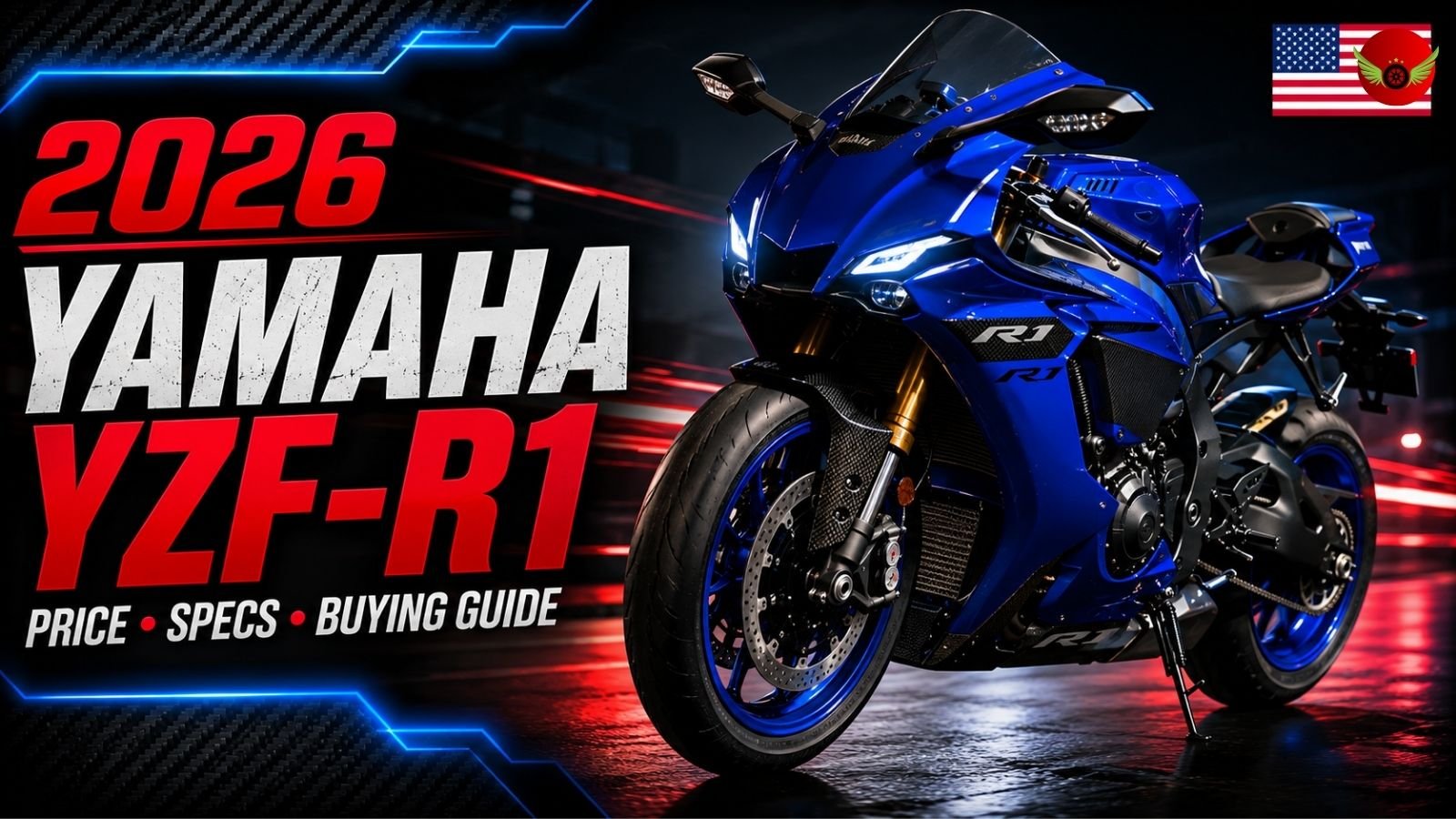
The Yamaha YZF-R1 is Yamaha’s flagship supersport motorcycle, built with race-derived engineering and advanced electronic technology. In the United States, the 2026 model carries an official MSRP starting at $19,199 for the Team Yamaha Blue edition, while the 70th Anniversary Edition starts at $19,699, excluding destination and dealer fees. It is powered by a 998cc liquid-cooled CP4 crossplane engine, paired with a six-speed transmission, a lightweight aluminum Deltabox frame, fully adjustable KYB suspension, Brembo front brakes, and a six-axis IMU that supports multiple rider-assistance systems.
This Yamaha YZF-R1 Review focuses on the information that matters before purchasing this superbike in the U.S. market. Instead of repeating manufacturer claims, this guide explains the latest Yamaha YZF-R1 Price, verified specifications, standard features, and buying considerations using accurate, up-to-date information. The goal is to help you understand what the motorcycle offers, how it compares within the litre-class sportbike segment, and whether it is the right choice for your riding needs.
This Yamaha YZF-R1 Buying Guide is structured to answer the most common questions buyers have before making a purchase. The following sections cover current pricing, technical specifications, electronic features, and the key factors to evaluate before choosing the Yamaha YZF-R1 in the USA.
Yamaha YZF-R1 Price in the USA
The Yamaha YZF-R1 Price in the United States depends on whether you purchase a new or used motorcycle. For the 2026 model year, Yamaha offers two factory versions: the standard Team Yamaha Blue model and the 70th Anniversary Edition. Besides the official MSRP, buyers should also consider destination charges, dealer fees, registration, taxes, and insurance to estimate the total ownership cost. If you’re shopping for a used Yamaha YZF-R1, market value is influenced by mileage, maintenance history, title status, accident records, and factory-original condition.
2026 Yamaha YZF-R1 Price and Availability
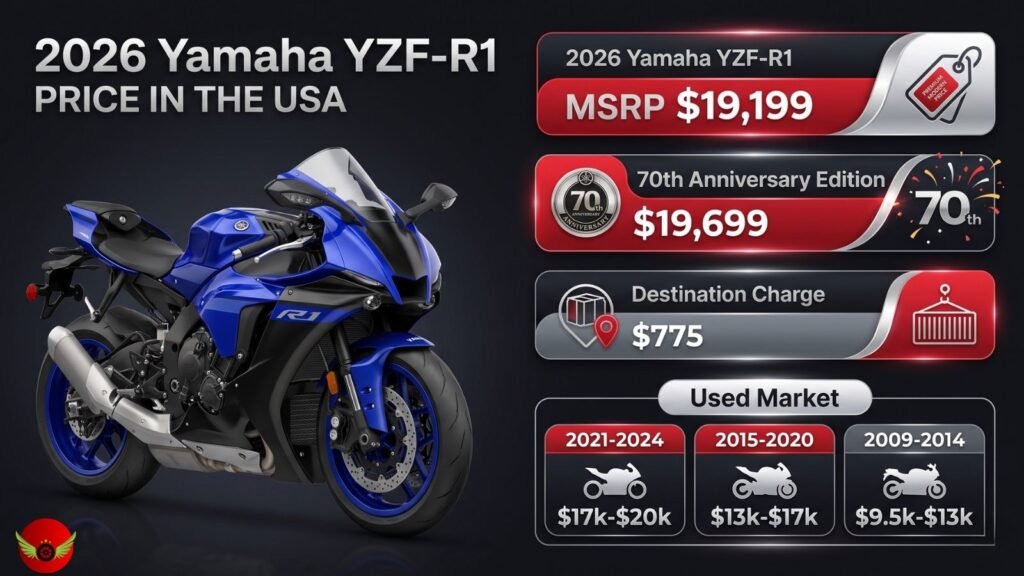
According to Yamaha Motor USA, the 2026 Yamaha YZF-R1 has an official MSRP of $19,199, while the 70th Anniversary Edition is priced at $19,699. Both models include a $775 destination charge, which is added before taxes and dealer fees. Availability varies by dealership because the Yamaha YZF-R1 is produced in relatively limited numbers for the U.S. market. Checking inventory through an authorized Yamaha dealer is the most reliable way to confirm current availability.
Model | MSRP (USD) | Destination Charge |
2026 Yamaha YZF-R1 | $19,199 | $775 |
2026 Yamaha YZF-R1 70th Anniversary Edition | $19,699 | $775 |
Used Yamaha YZF-R1 Prices in 2026
The used Yamaha YZF-R1 Price remains strong because of the motorcycle’s reputation for performance and reliability. Based on current U.S. marketplace listings, clean-title motorcycles with documented service history generally fall within the following ranges.
Model Year | Typical Market Price (USD)* |
2021–2024 | $17,000–$20,000 |
2015–2020 | $13,000–$17,000 |
2009–2014 | $9,500–$13,000 |
Actual selling prices vary by mileage, condition, maintenance records, location, ownership history, and aftermarket modifications.
Before purchasing a used Yamaha YZF-R1, inspect the service records, verify the VIN history, check for crash damage, and confirm that scheduled maintenance has been completed. These factors have a greater impact on long-term value than mileage alone.
Is the Yamaha YZF-R1 Worth the Price
The Yamaha YZF-R1 justifies its premium price by combining race-derived engineering with high-end components that come standard from the factory. Buyers receive a 998cc CP4 crossplane engine, lightweight aluminum Deltabox frame, fully adjustable KYB suspension, Brembo front brakes, six-axis IMU, lean-sensitive electronic rider aids, quick shifter, slide control, launch control, and MotoGP-inspired aerodynamic winglets without requiring major performance upgrades after purchase.
If your priority is track performance, advanced electronics, and precise handling, the Yamaha YZF-R1 delivers strong value within the litre-class superbike segment. Riders who mainly commute or ride casually may find a middleweight sportbike more practical, but for experienced enthusiasts seeking a flagship supersport, the Yamaha YZF-R1 remains one of the strongest choices in its price range.
Yamaha YZF-R1 Specs
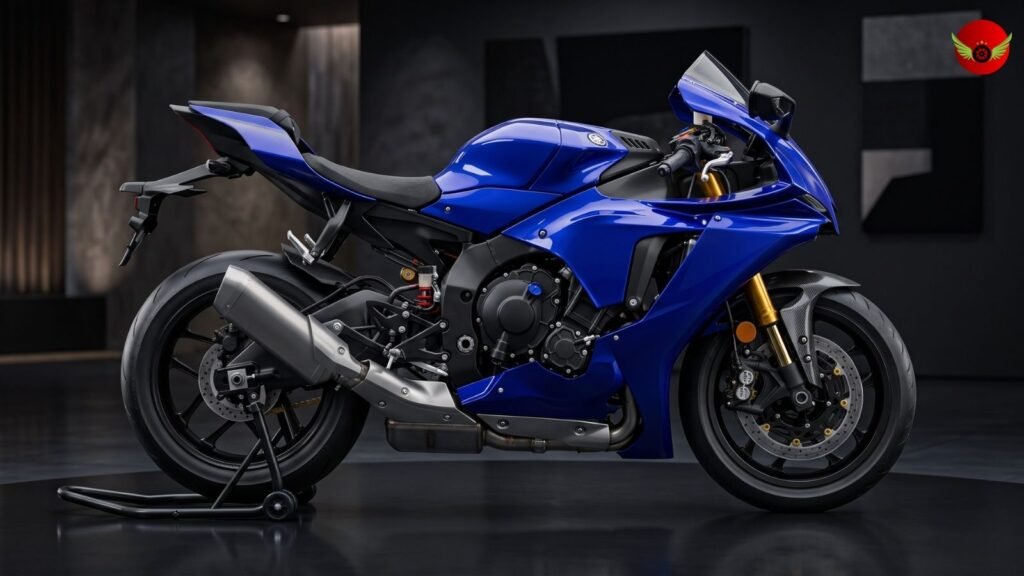
The Yamaha YZF-R1 combines a race-developed engine, lightweight aluminum chassis, and premium suspension with advanced electronic systems. Its official specifications reflect a motorcycle designed for high-performance riding, offering precise handling, responsive power delivery, and braking performance suitable for both road and closed-course use. The following specifications are based on the current U.S. model.
Yamaha YZF-R1 Engine and Transmission
The Yamaha YZF-R1 uses a 998cc liquid-cooled, DOHC inline-four CP4 engine with Yamaha’s crossplane crankshaft technology. The engine features a 79.0 mm × 50.9 mm bore and stroke, 13.0:1 compression ratio, and electronic fuel injection with Yamaha Chip Controlled Throttle (YCC-T) and Yamaha Chip Controlled Intake (YCC-I). Power is delivered through a 6-speed constant-mesh transmission with a wet multiplate assist and slipper clutch, while a chain final drive transfers power to the rear wheel. This engine configuration is engineered to deliver smooth torque, predictable throttle response, and strong acceleration throughout the rev range.
Engine Specification | Details |
Engine Type | 998cc liquid-cooled DOHC inline-four (CP4) |
Bore × Stroke | 79.0 mm × 50.9 mm |
Compression Ratio | 13.0:1 |
Fuel System | Fuel Injection with YCC-T & YCC-I |
Transmission | 6-speed constant mesh |
Clutch | Wet multiplate assist & slipper clutch |
Final Drive | Chain |
Yamaha YZF-R1 Weight, Dimensions and Fuel Capacity
The Yamaha YZF-R1 features compact dimensions that contribute to its agile handling and aerodynamic profile. The motorcycle has a wet weight of 448 lb (203 kg) and a 4.5-gallon (17 L) fuel tank. It measures 80.9 inches (2,055 mm) in overall length, 27.2 inches (690 mm) in width, and 45.9 inches (1,165 mm) in height. Additional key measurements include a 55.3-inch (1,405 mm) wheelbase, 33.7-inch (855 mm) seat height, and 5.1-inch (130 mm) ground clearance.
Dimension | Measurement |
Wet Weight | 448 lb (203 kg) |
Fuel Capacity | 4.5 gal (17 L) |
Seat Height | 33.7 in (855 mm) |
Wheelbase | 55.3 in (1,405 mm) |
Overall Length | 80.9 in (2,055 mm) |
Overall Width | 27.2 in (690 mm) |
Overall Height | 45.9 in (1,165 mm) |
Ground Clearance | 5.1 in (130 mm) |
Yamaha YZF-R1 Suspension and Brakes
The Yamaha YZF-R1 is equipped with fully adjustable 43 mm KYB inverted front forks and a fully adjustable KYB link-type rear shock, allowing riders to fine-tune preload, compression, and rebound damping. The braking system consists of dual 320 mm hydraulic front discs with Brembo four-piston radial-mount calipers and a 220 mm hydraulic rear disc. Standard ABS, working with the motorcycle’s six-axis IMU, helps optimize braking stability during hard braking and corner entry.
Component | Specification |
Front Suspension | 43 mm fully adjustable KYB inverted fork |
Rear Suspension | Fully adjustable KYB link-type shock |
Front Brakes | Dual 320 mm hydraulic discs with Brembo radial-mount calipers |
Rear Brake | 220 mm hydraulic disc |
ABS | Standard |
Yamaha YZF-R1 Electronics and Features
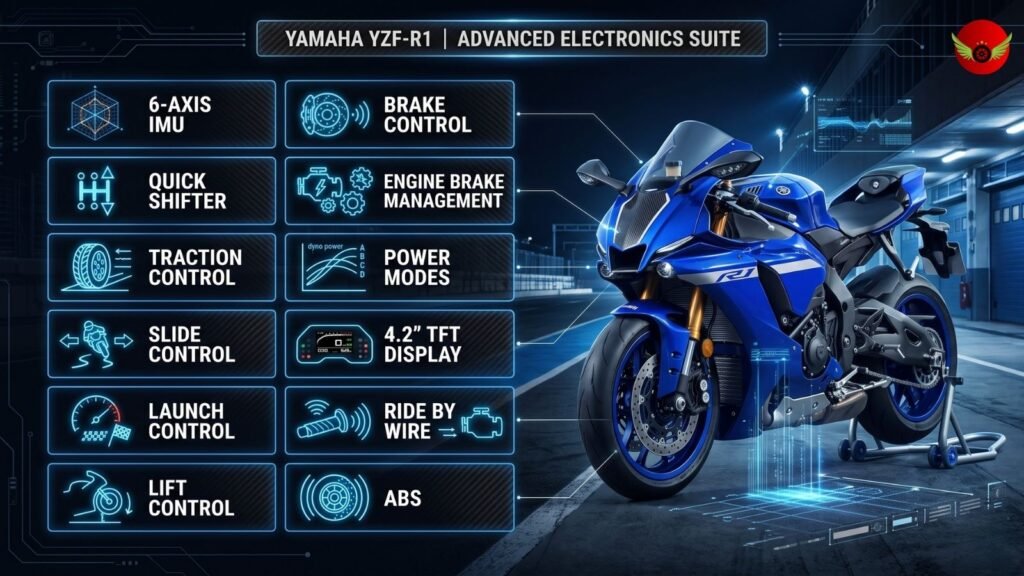
The Yamaha YZF-R1 combines race-developed electronics with advanced rider technology to improve control, precision, and stability. Its electronic package is built around a six-axis Inertial Measurement Unit (IMU) that continuously monitors the motorcycle’s movement and adjusts multiple rider-assistance systems in real time. Combined with a full-color TFT display, ride-by-wire throttle, and aerodynamic bodywork, these features help the Yamaha YZF-R1 deliver predictable performance on both public roads and closed circuits.
Yamaha YZF-R1 Rider Aids
The Yamaha YZF-R1 uses a six-axis IMU to support a comprehensive suite of electronic rider aids. These systems work together with Yamaha Chip Controlled Throttle (YCC-T) to improve traction, braking, acceleration, and cornering stability while allowing riders to customize settings through Yamaha Ride Control (YRC).
Rider Aid | Function |
Traction Control System (TCS) | Reduces rear-wheel slip during acceleration. |
Slide Control System (SCS) | Helps manage rear-wheel slide while cornering. |
Lift Control System (LIF) | Reduces front-wheel lift under hard acceleration. |
Launch Control System (LCS) | Optimizes power delivery during standing starts. |
Brake Control (BC) | Adjusts ABS response using IMU data. |
Engine Brake Management (EBM) | Lets riders select different engine braking characteristics. |
Power Delivery Modes (PWR) | Adjusts throttle response and power delivery. |
Quick Shift System (QSS) | Enables clutchless upshifts and downshifts. |
These systems are standard on the current U.S. model and are designed to give experienced riders greater confidence without reducing the motorcycle’s performance potential.

Yamaha YZF-R1 TFT Display and Controls
The Yamaha YZF-R1 features a 4.2-inch full-color TFT instrument display that provides clear access to essential riding information. The screen displays speed, engine rpm, gear position, fuel level, coolant temperature, ride mode, lap timer, and electronic system status. Riders can adjust Yamaha Ride Control settings directly from the left handlebar switchgear, allowing quick access to electronic functions without leaving the riding position.
The motorcycle also uses YCC-T ride-by-wire throttle technology, which delivers precise throttle control while supporting all electronic rider-assistance systems. This integrated control system helps maintain smooth power delivery and consistent rider input across different riding conditions.
Yamaha YZF-R1 Aerodynamics
The Yamaha YZF-R1 incorporates aerodynamic technology developed from Yamaha’s MotoGP racing program. The front fairing features integrated carbon-fiber winglets that generate additional downforce to improve front-end stability during high-speed acceleration, braking, and corner entry. A centrally positioned ram-air intake directs airflow efficiently into the engine, while the compact fairing design helps reduce aerodynamic drag without compromising rider protection.
Rather than focusing only on top speed, the aerodynamic package improves chassis stability and complements the motorcycle’s lightweight frame and electronic control systems, giving riders more confidence during aggressive riding on both the street and the track.
Is the Yamaha YZF-R1 Worth Buying in 2026
The Yamaha YZF-R1 continues to be one of the most capable litre-class superbikes available in the U.S. market. For 2026, it retains its proven 998cc CP4 crossplane engine, lightweight aluminum Deltabox frame, fully adjustable KYB suspension, Brembo Stylema front brake calipers, six-axis IMU, and Yamaha Ride Control (YRC) electronics package. With an official U.S. MSRP starting at $19,199, the motorcycle offers premium components as standard, reducing the need for aftermarket performance upgrades. For riders seeking a track-focused supersport with advanced technology and proven engineering, the Yamaha YZF-R1 remains a competitive option.
Yamaha YZF-R1 Pros and Cons
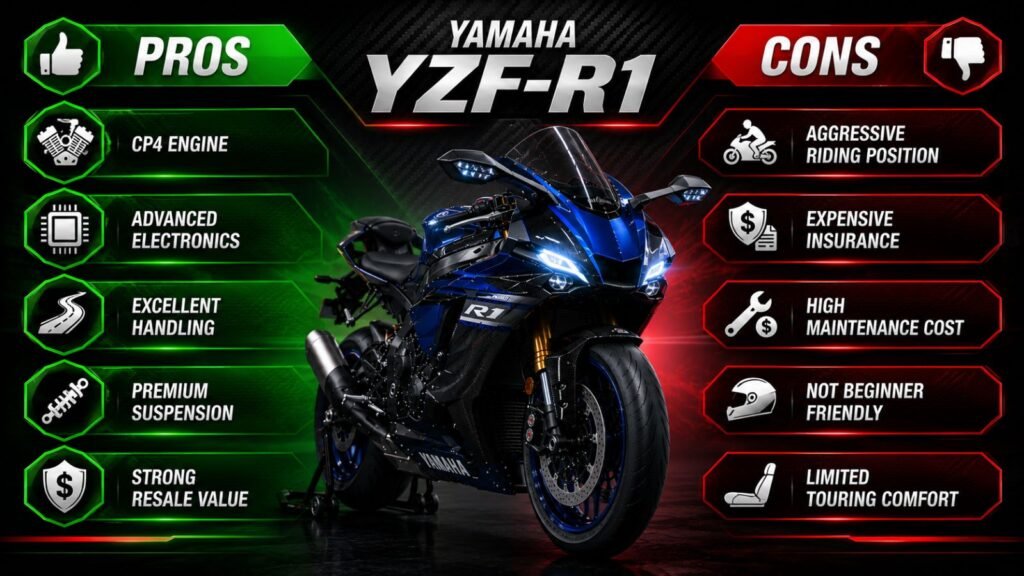
The Yamaha YZF-R1 is designed for performance-oriented riders. Its strengths are most noticeable during spirited riding and track use, while its compromises are typical of high-performance supersport motorcycles.
Pros | Cons |
Proven 998cc CP4 crossplane engine with strong mid-range torque | Aggressive riding position may be uncomfortable on long-distance rides |
Six-axis IMU with advanced electronic rider aids | Higher purchase price than middleweight sportbikes |
Fully adjustable KYB suspension | Insurance premiums are generally higher due to the motorcycle’s performance class |
Brembo Stylema front braking system | Operating and maintenance costs are typically higher than smaller-displacement motorcycles |
Carbon-fiber winglets improve high-speed stability | Limited passenger comfort and minimal luggage capacity |
Strong resale value in the U.S. used market | Not recommended for inexperienced riders |
Who Should Buy the Yamaha YZF-R1
The Yamaha YZF-R1 is best suited for experienced riders who want a motorcycle capable of both track days and high-performance road riding. Its advanced electronics, premium suspension, and powerful CP4 engine make it an excellent choice for riders who value precise handling, braking performance, and race-derived technology.
It is less suitable for beginners, daily commuters, or riders who prioritize long-distance comfort. The committed riding position, higher ownership costs, and performance-focused setup are designed for enthusiasts who can fully utilize the motorcycle’s capabilities. If your priority is maximum performance in a production superbike with factory-installed premium components, the Yamaha YZF-R1 remains one of the strongest choices in its class for 2026.
Yamaha YZF-R1 Review, Price, Specs & Buying Guide FAQs
If you still have questions about the Yamaha YZF-R1, the answers below cover the topics buyers search most often before making a purchase. These FAQs summarize key information about pricing, specifications, features, ownership, and buying considerations to help you make an informed decision.
What is the price of the 2026 Yamaha YZF-R1 in the USA?
The 2026 Yamaha YZF-R1 has an official U.S. MSRP of $19,199, while the 70th Anniversary Edition starts at $19,699. Taxes, destination charges, dealer fees, and registration costs are additional.
What engine does the Yamaha YZF-R1 have?
The Yamaha YZF-R1 is powered by a 998cc liquid-cooled DOHC inline-four CP4 engine with a crossplane crankshaft, electronic fuel injection, and a six-speed transmission with an assist-and-slipper clutch.
What are the key specifications of the Yamaha YZF-R1?
Key specifications include a 998cc CP4 engine, 448 lb (203 kg) wet weight, 4.5-gallon (17 L) fuel tank, 43 mm KYB inverted forks, Brembo Stylema front brakes, and a six-axis IMU with advanced electronic rider aids.
What electronic rider aids are available on the Yamaha YZF-R1?
The Yamaha YZF-R1 includes Traction Control System (TCS), Slide Control System (SCS), Lift Control System (LIF), Launch Control System (LCS), Brake Control (BC), Engine Brake Management (EBM), Power Delivery Modes (PWR), and a Quick Shift System (QSS).
Is the Yamaha YZF-R1 good for street riding?
Yes, the Yamaha YZF-R1 is street legal in the United States. However, its aggressive ergonomics and performance-focused setup make it better suited to experienced riders than everyday commuters.
Is the Yamaha YZF-R1 reliable?
Yes. The Yamaha YZF-R1 has a strong reputation for reliability when maintained according to Yamaha’s recommended service schedule. Regular oil changes, valve inspections, brake maintenance, and proper chain care are essential for long-term durability.
How much does a used Yamaha YZF-R1 cost?
In 2026, well-maintained used Yamaha YZF-R1 models typically range from $9,500 to $20,000, depending on the model year, mileage, service history, condition, and location.
Is the Yamaha YZF-R1 worth buying in 2026?
For experienced riders looking for a litre-class supersport motorcycle, the Yamaha YZF-R1 remains one of the strongest options in 2026. It combines a proven CP4 engine, premium chassis components, advanced electronics, and track-ready performance in a factory-equipped package.
Who should buy the Yamaha YZF-R1?
The Yamaha YZF-R1 is best suited to experienced riders who want a high-performance motorcycle for spirited road riding or track days. It is not recommended for beginners because of its powerful engine and aggressive riding position.