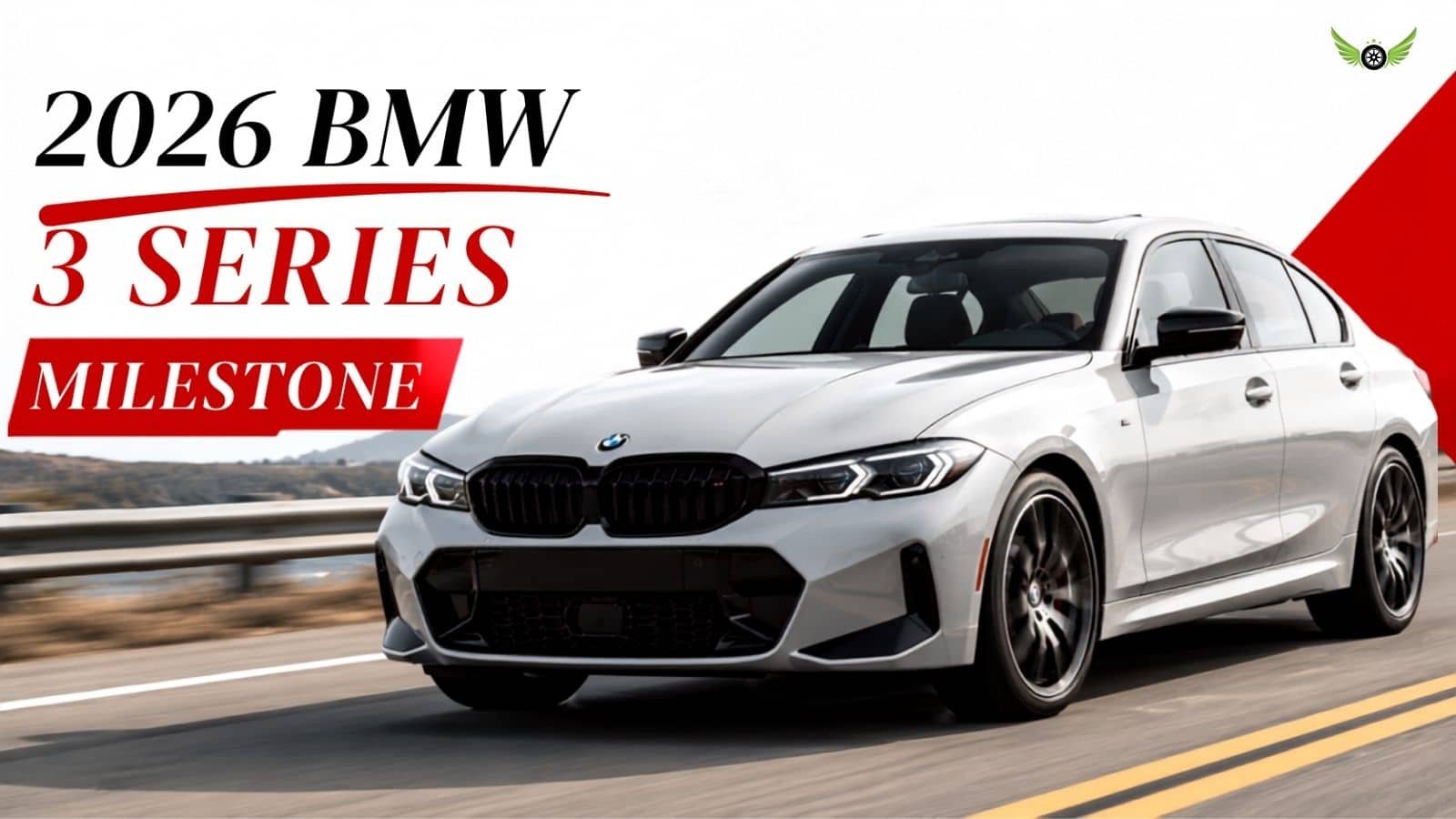
The 2026 BMW 3 Series is a strong option for U.S. drivers who want a luxury sedan that combines good fuel economy with engaging performance. The lineup ranges from the efficient 330i to the significantly quicker M340i, giving buyers a clear choice based on whether daily efficiency or stronger performance matters more.
The 330i is rated at 28 mpg city and 35 mpg highway in rear-wheel-drive form, while the M340i delivers up to 27 mpg city and 33 mpg highway despite its more powerful six-cylinder engine. BMW also offers xDrive all-wheel drive for drivers who want additional traction, with a small fuel-economy trade-off. Independent highway testing has shown that real-world results can vary significantly depending on driving conditions and speed.
Performance is another major reason to consider the BMW 3 Series. The 330i produces 255 horsepower, while the M340i makes 386 horsepower and uses a 48-volt mild-hybrid system. According to BMW’s published figures, the 330i reaches 60 mph in 5.6 seconds, while the M340i does it in 4.4 seconds; real-world instrumented tests can produce different results.
According to our experience and analysis of independent road tests, the BMW 3 Series continues to stand out because it does not force drivers to choose completely between comfort and handling. Independent testers consistently highlight its responsive powertrains, balanced chassis, and everyday usability, although ride quality can feel firmer depending on the suspension and wheel setup.
This guide examines BMW 3 Series Mileage, EPA fuel economy, real-world MPG, acceleration, ride and handling, daily comfort, and how the car compares with competing luxury sedans. The goal is simple: to help you understand what the 2026 BMW 3 Series is actually like to own and drive before deciding which version best suits your needs.
BMW 3 Series Mileage, MPG & Fuel Economy
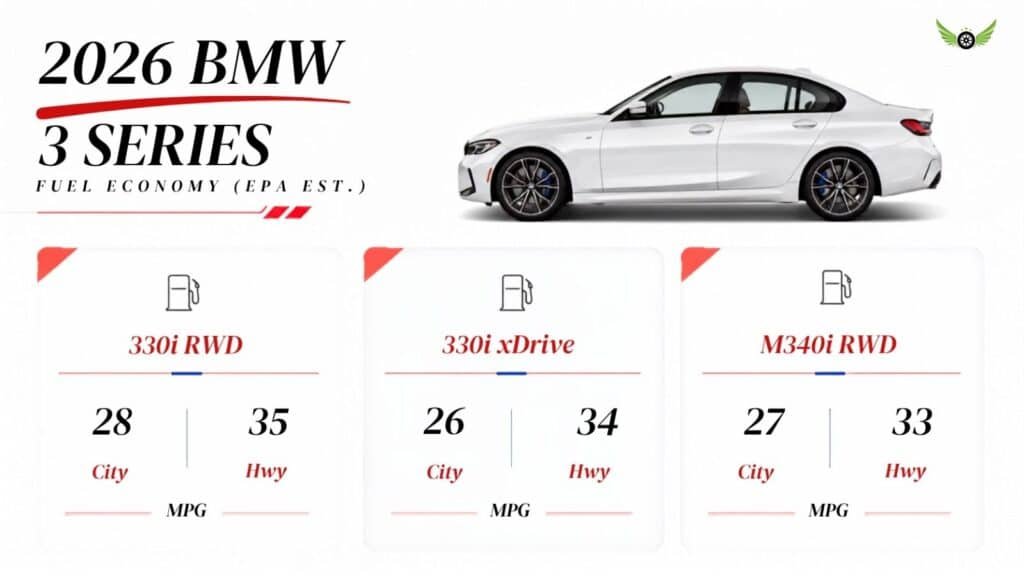
The 2026 BMW 3 Series delivers competitive fuel economy for a luxury sports sedan. The 330i is the most efficient option, while the M340i adds significantly more performance with a relatively small reduction in combined MPG. For most buyers, the key difference is not just fuel economy—it is how much premium gasoline will cost over time.
EPA City, Highway & Combined MPG by Trim
The 330i RWD leads the lineup with an EPA combined rating of 31 mpg. Adding xDrive reduces efficiency slightly, while both M340i versions are rated at 29 mpg combined.
Trim | City MPG | Highway MPG | Combined MPG |
330i | 28 | 35 | 31 |
330i xDrive | 26 | 34 | 29 |
M340i | 27 | 33 | 29 |
M340i xDrive | 26 | 33 | 29 |
According to our experience, the 330i is the better fit for drivers who prioritize lower fuel use, especially with frequent commuting or high annual mileage. The M340i’s efficiency remains respectable, but its stronger performance comes with higher fuel consumption in everyday driving.
Real-World BMW 3 Series Fuel Economy & Premium Fuel Costs
EPA ratings provide a useful benchmark, but real-world fuel economy can vary with traffic, speed, weather, and driving style. In Car and Driver’s 75-mph highway testing, a rear-wheel-drive 330i achieved 42 mpg, while an M340i xDrive returned 33 mpg. These results come from controlled highway testing, so individual owners may see different numbers in everyday driving.
Premium fuel also has a direct impact on running costs. BMW recommends 91 AKI gasoline for standard models and 93 AKI for M Performance models. According to AAA, the U.S. national average price for premium gasoline was $4.9638 per gallon on August 30, 2026.
Using that national average as an example, driving 12,000 miles per year at the highway-test fuel economy figures would cost approximately:
Model/Test MPG | Estimated Annual Fuel Cost |
330i at 42 mpg | $1,418 |
M340i xDrive at 33 mpg | $1,805 |
According to our experience, these figures show why fuel costs should be considered alongside performance when choosing between trims. The 330i can offer meaningful savings for high-mileage drivers, while the M340i’s higher fuel use may be a reasonable trade-off for buyers who prioritize stronger performance. Actual costs will depend on local premium fuel prices and your driving conditions.
BMW 3 Series Performance & Acceleration
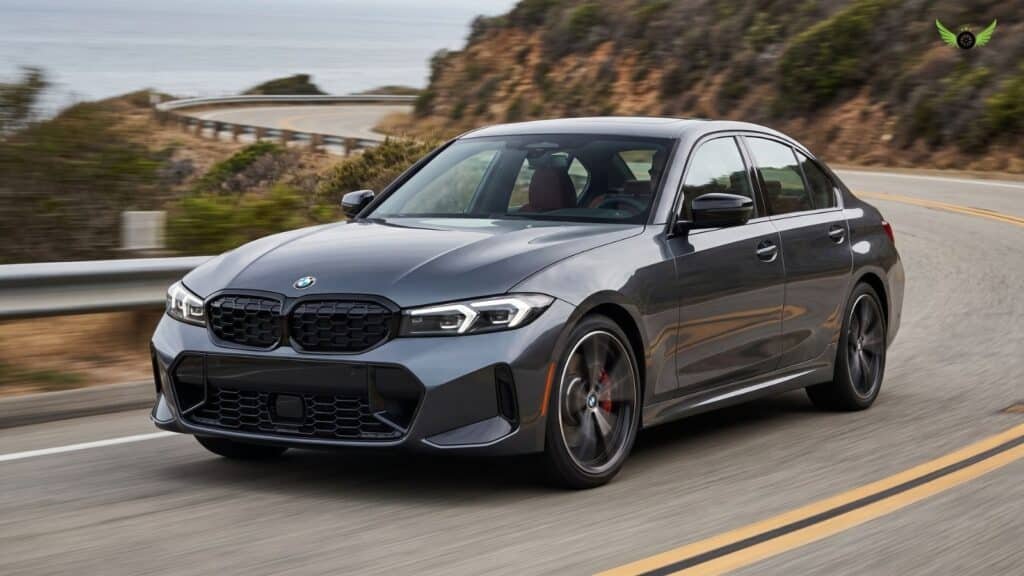
The 2026 BMW 3 Series offers two distinct performance levels. The 330i provides quick, responsive acceleration for everyday driving, while the M340i delivers substantially stronger straight-line performance and a more powerful six-cylinder character. Both use an eight-speed automatic transmission and 48-volt mild-hybrid technology.
330i vs M340i Power and 0–60 MPH Performance
The difference between the two models is significant. The 330i uses a turbocharged 2.0-liter four-cylinder engine producing 255 horsepower and 295 lb-ft of torque, while the M340i has a turbocharged 3.0-liter inline-six with 386 horsepower and 398 lb-ft of torque. BMW estimates 0–60 mph in 5.6 seconds for the 330i and 4.4 seconds for the M340i; xDrive versions are quicker at 5.4 and 4.1 seconds, respectively.
Model | Horsepower | Torque | 0–60 MPH |
330i | 255 hp | 295 lb-ft | 5.6 sec |
M340i | 386 hp | 398 lb-ft | 4.4 sec |
Independent testing supports the clear performance gap. MotorTrend recorded 5.3 seconds for a rear-wheel-drive 330i and 4.4 seconds for an M340i, while Edmunds tested a rear-wheel-drive M340i at 4.8 seconds. Results vary with drivetrain, tires, weather, and test conditions.
According to our experience, the 330i has enough power for most daily driving, including highway merging and passing. The M340i is the better choice for drivers who specifically want stronger acceleration and the smoother character of a turbocharged inline-six.
Engine Response, 8-Speed Automatic & Mild-Hybrid System
Both engines are paired with an eight-speed automatic transmission, and the 2026 lineup uses a 48-volt mild-hybrid system. The system supports the gasoline engine rather than turning the sedan into a full hybrid. BMW says the electric assist can contribute up to 11 horsepower on the M340i, helping sharpen power delivery and improve efficiency.
In everyday driving, the four-cylinder feels responsive thanks to its strong low-end torque, while the M340i’s inline-six delivers smoother and more effortless acceleration. Independent testing from Car and Driver also describes the eight-speed automatic as exceptionally smooth, which is important because transmission response has a major effect on how quick a car feels in normal driving—not just its 0–60 time.
According to our experience, this combination is one of the sedan’s biggest strengths: it remains easy and refined in normal traffic while responding quickly when more power is needed.
BMW 3 Series Real-World Driving Experience
The 2026 BMW 3 Series remains one of the most balanced luxury sports sedans for everyday driving. It combines responsive handling with a refined cabin, although ride comfort can feel firmer than some rivals on rough roads. According to our experience, this balance is what makes it appealing to drivers who want one car for both commuting and enjoyable weekend driving.
Ride Comfort, Handling & Steering Feel
The 3 Series feels controlled and agile through corners without losing its everyday usability. Edmunds found the optional M Sport suspension balanced in corners without making its test car excessively harsh over bumps, while MotorTrend praised the car’s neutral chassis and direct steering. Consumer Reports also found it lively and composed when driven hard.
The main compromise is ride firmness. Both Edmunds and Consumer Reports note that the suspension can feel firm or tense on some road surfaces, even though it absorbs bumps effectively. According to our experience, buyers who prioritize comfort should pay attention to wheel and suspension options, while drivers who value handling will appreciate the car’s controlled and engaging character.
City Driving, Highway Comfort & Cabin Noise
In daily traffic, the sedan is easy to drive thanks to its smooth eight-speed automatic, responsive power delivery, and good outward visibility. On the highway, it feels stable and relaxed, making it well suited to longer trips.
Cabin refinement is another strength. Edmunds and Consumer Reports both describe the cabin as quiet, particularly during highway cruising, while the engine becomes more noticeable under hard acceleration. According to our experience, this gives the car a good balance between everyday comfort and the sporty character many buyers expect from a BMW.
BMW 3 Series Daily Driving & Practicality
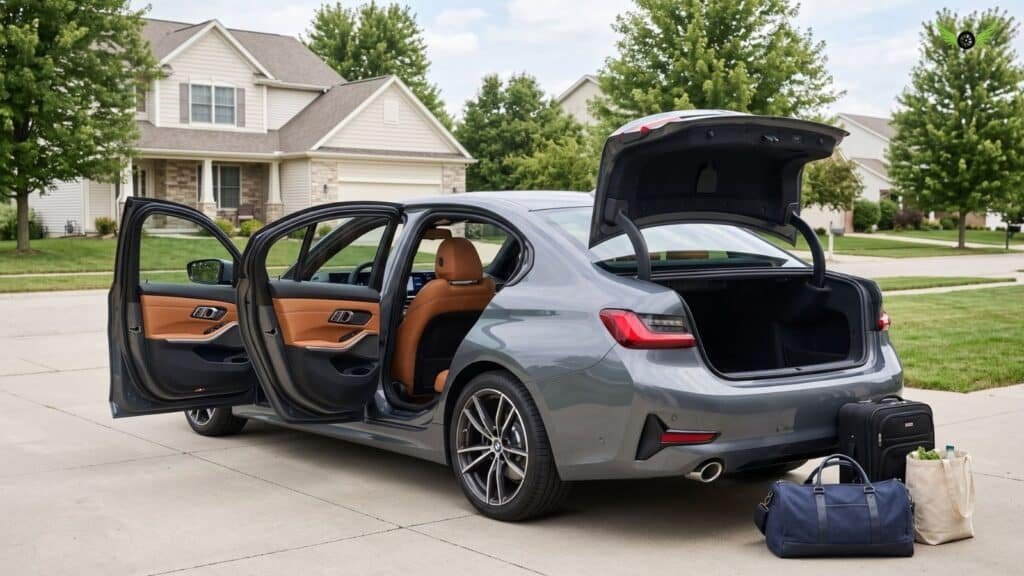
The 2026 BMW 3 Series is practical for daily commuting, errands, and regular road trips while maintaining its compact luxury-sedan character. It offers comfortable seating, useful cargo flexibility, and available xDrive for drivers who need extra traction in changing weather conditions.
Passenger Comfort, Trunk Space & Everyday Usability
The cabin provides good space for a compact luxury sedan. In Edmunds’ testing, the car was easy to get in and out of thanks to its large door openings and wide range of seat and steering-wheel adjustments, with sufficient elbow room for front and rear passengers. The main limitation is the compact rear seating area when a rear-facing child seat is installed, as the front passenger may need to move forward.
BMW lists 16.9 cubic feet of trunk space, and the 40/20/40-split folding rear seat adds flexibility for longer items. According to our experience, the available space is suitable for everyday shopping and typical travel luggage, while the folding rear seat makes the sedan more versatile when carrying larger items.
Practical Feature | Data |
Seating Capacity | 5 passengers |
BMW-listed Trunk Space | 16.9 cu. ft. |
Rear Seat | 40/20/40 split-folding |
xDrive AWD Performance & All-Weather Driving
BMW’s xDrive all-wheel-drive system is most useful when roads are wet, snowy, or slippery, providing additional traction compared with rear-wheel drive. The system is designed to work alongside BMW’s stability and traction-control systems to help maintain control in challenging conditions.
For winter driving, however, all-wheel drive is not a substitute for proper tires. BMW recommends combining xDrive with winter-specific tires for optimal winter performance. According to our experience, xDrive is a worthwhile option for drivers who regularly face snow or poor weather, while rear-wheel drive remains practical for buyers in milder climates.
BMW 3 Series vs Competitors for Mileage & Driving Performance
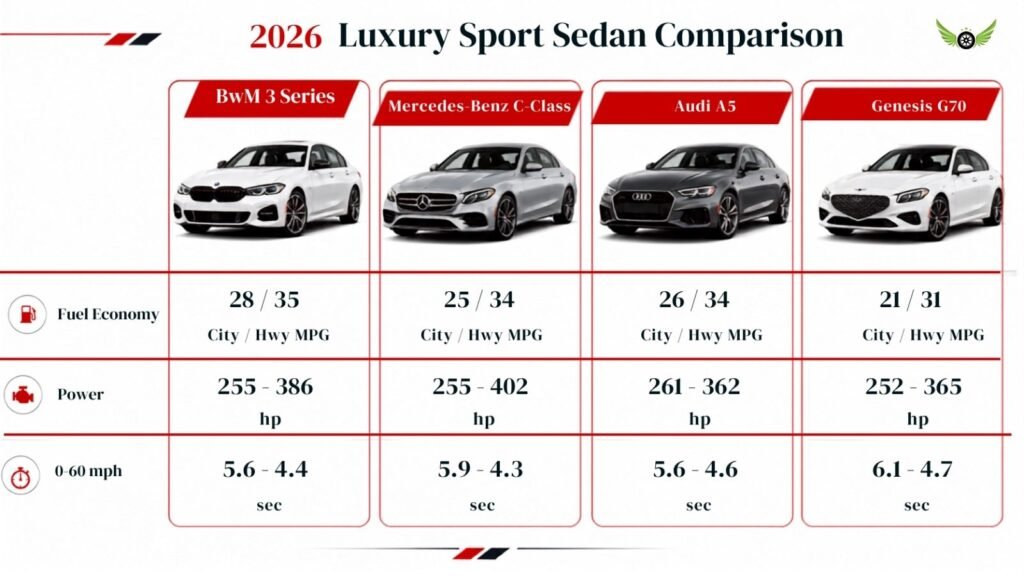
The 2026 BMW 3 Series remains one of the strongest all-round choices in the luxury sports sedan segment. Its advantage is not class-leading performance or fuel economy in every category, but a strong balance of both. The 330i delivers 255 horsepower and competitive EPA fuel economy, while rivals such as the Mercedes-Benz C-Class, Audi A5, and Genesis G70 each take a different approach to performance and efficiency.
Fuel Economy and Performance Compared with Luxury Rivals
Among comparable entry-level models, the 330i offers the strongest fuel economy in this group while still providing competitive acceleration. The Genesis G70 produces more power, but its fuel consumption is noticeably higher. The Audi A5 offers slightly more horsepower and standard all-wheel drive, although its EPA combined rating is lower. The Mercedes-Benz C 300 matches the BMW’s horsepower but is slower according to the manufacturer’s published 0–60 mph figure.
Model | Horsepower | City MPG | Highway MPG | Combined MPG | 0–60 MPH |
BMW 330i RWD | 255 hp | 28 | 35 | 31 | 5.6 sec |
Mercedes-Benz C 300 4MATIC | 255 hp | 24 | 33 | 27 | 6.0 sec |
Audi A5 quattro | 268 hp | 22 | 32 | 26 | 5.6 sec |
Genesis G70 2.5T RWD | 300 hp | 21 | 29 | 24* | — |
*Combined MPG is calculated from the published city/highway figures using the standard EPA formula and rounded. Genesis does not publish a manufacturer 0–60 mph figure for this trim in the source reviewed, so it is not presented as an estimated number.
The numbers show the trade-offs clearly. The Genesis offers the most power among these entry-level models, while the 330i has the strongest published fuel economy. According to our experience, the BMW makes the most sense for drivers who want responsive performance without paying a large penalty at the fuel pump.
Which Luxury Sports Sedan Offers the Best Balance?
The best choice depends on your priorities. The Genesis G70 is appealing for buyers who want more standard power, while the Audi A5 offers standard quattro all-wheel drive and a different approach to interior technology. The Mercedes-Benz C-Class is a strong alternative for drivers who place greater emphasis on comfort and luxury features.
According to our experience, the BMW 3 Series offers one of the best overall balances for buyers who want good fuel economy, quick acceleration, engaging handling, and everyday usability in one sedan. The 330i is the better fit for most drivers, while buyers who want substantially stronger performance can step up to the M340i. Independent specifications and current EPA-based listings support the 330i’s position as one of the more efficient choices among its direct luxury rivals.
BMW 3 Series Mileage, MPG, Performance & Real-World Driving Experience FAQs
The 2026 BMW 3 Series offers a different balance depending on whether you choose the efficient 330i or the more powerful M340i. Here are quick answers to the most important questions about fuel economy, performance, comfort, and everyday driving.
Is the 2026 BMW 3 Series fuel efficient?
Yes. The 330i is rated at up to 28 mpg city and 35 mpg highway, making it one of the more efficient luxury sports sedans. The M340i uses more fuel but delivers significantly stronger performance.
What is the real-world MPG of the BMW 3 Series?
It depends on driving conditions. Consumer Reports recorded 29 mpg overall with a 330i xDrive, while Car and Driver achieved 42 mpg in a 75-mph highway test with a rear-wheel-drive 330i. Your results will vary with traffic and driving style.
Does the BMW 3 Series require premium gas?
Yes, premium fuel is recommended. Using the recommended fuel helps the engine deliver its intended performance, but premium fuel also increases everyday running costs.
Is the BMW 330i fast enough for daily driving?
Yes. Its 255-hp turbocharged engine provides strong everyday acceleration, and BMW lists a 5.6-second 0–60 mph time for the rear-wheel-drive model.
Is the M340i much faster than the 330i?
Yes. The M340i produces 386 hp and BMW lists a 4.4-second 0–60 mph time for the rear-wheel-drive version, making it a significant step up in performance.
Is the BMW 3 Series comfortable for long drives?
Yes, for most drivers. Independent testing highlights its supportive seats, quiet highway cabin, and stable road manners, although some configurations can feel firm on rough pavement.
Is the BMW 3 Series good for daily driving?
Yes. It combines manageable size, smooth transmission performance, comfortable seating, and enough practicality for commuting and regular travel. According to our experience, its ability to balance everyday comfort with responsive handling is one of its biggest strengths.
Is xDrive worth it for the BMW 3 Series?
Yes, if you regularly drive in poor weather. xDrive adds all-wheel-drive traction, but it slightly reduces fuel economy and does not replace proper winter tires in severe conditions.
Which BMW 3 Series offers the best balance of MPG and performance?
For most buyers, the 330i. It offers stronger fuel economy while still delivering quick acceleration and engaging handling. Choose the M340i if stronger performance is your main priority.
Is the 2026 BMW 3 Series a good choice compared with its luxury rivals?
Yes. According to our experience, it remains one of the best-balanced choices for drivers who want fuel efficiency, performance, handling, and everyday refinement in one luxury sedan. Independent 2026 testing also continues to rate it highly for its sporty driving character and overall versatility.