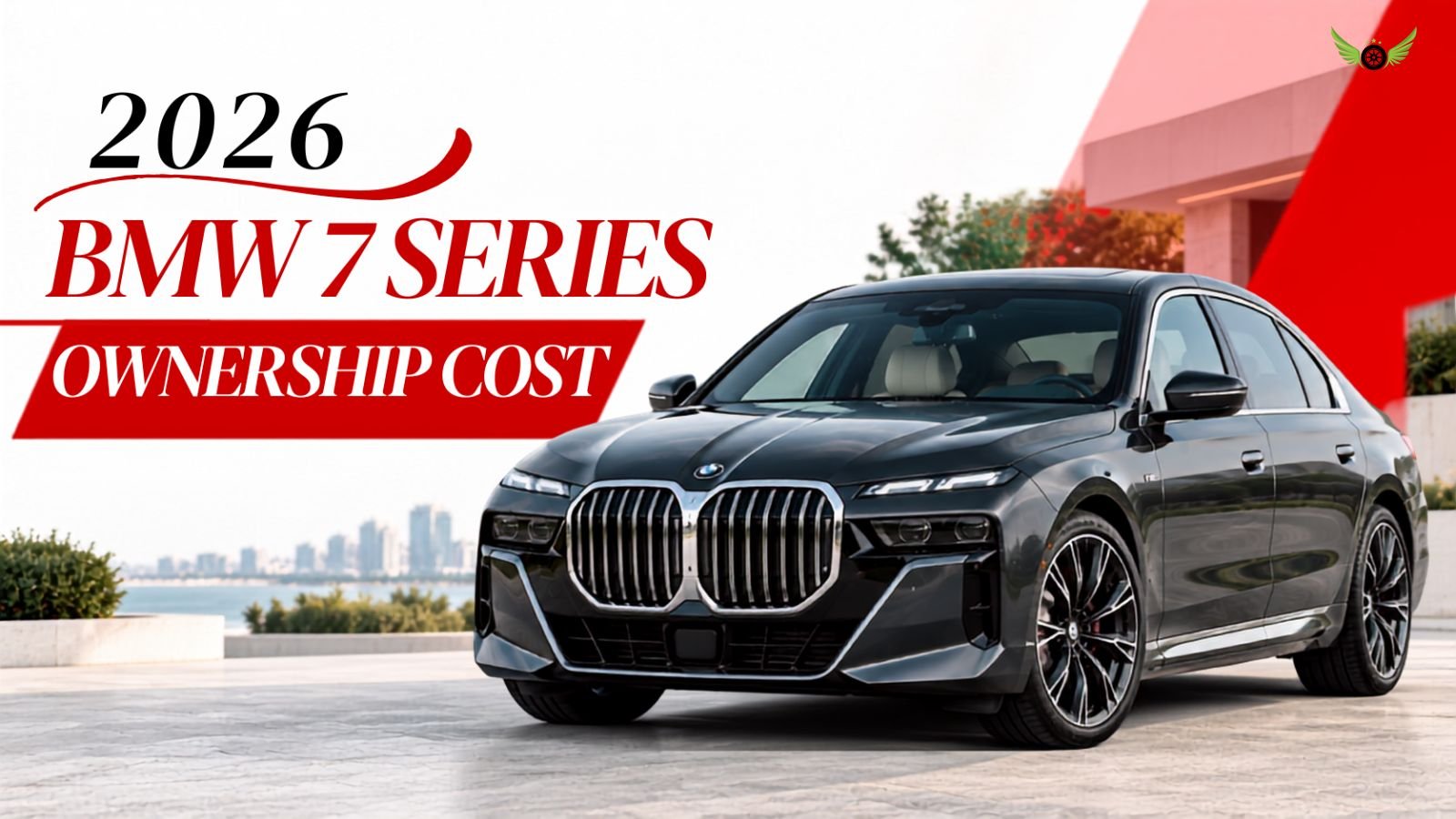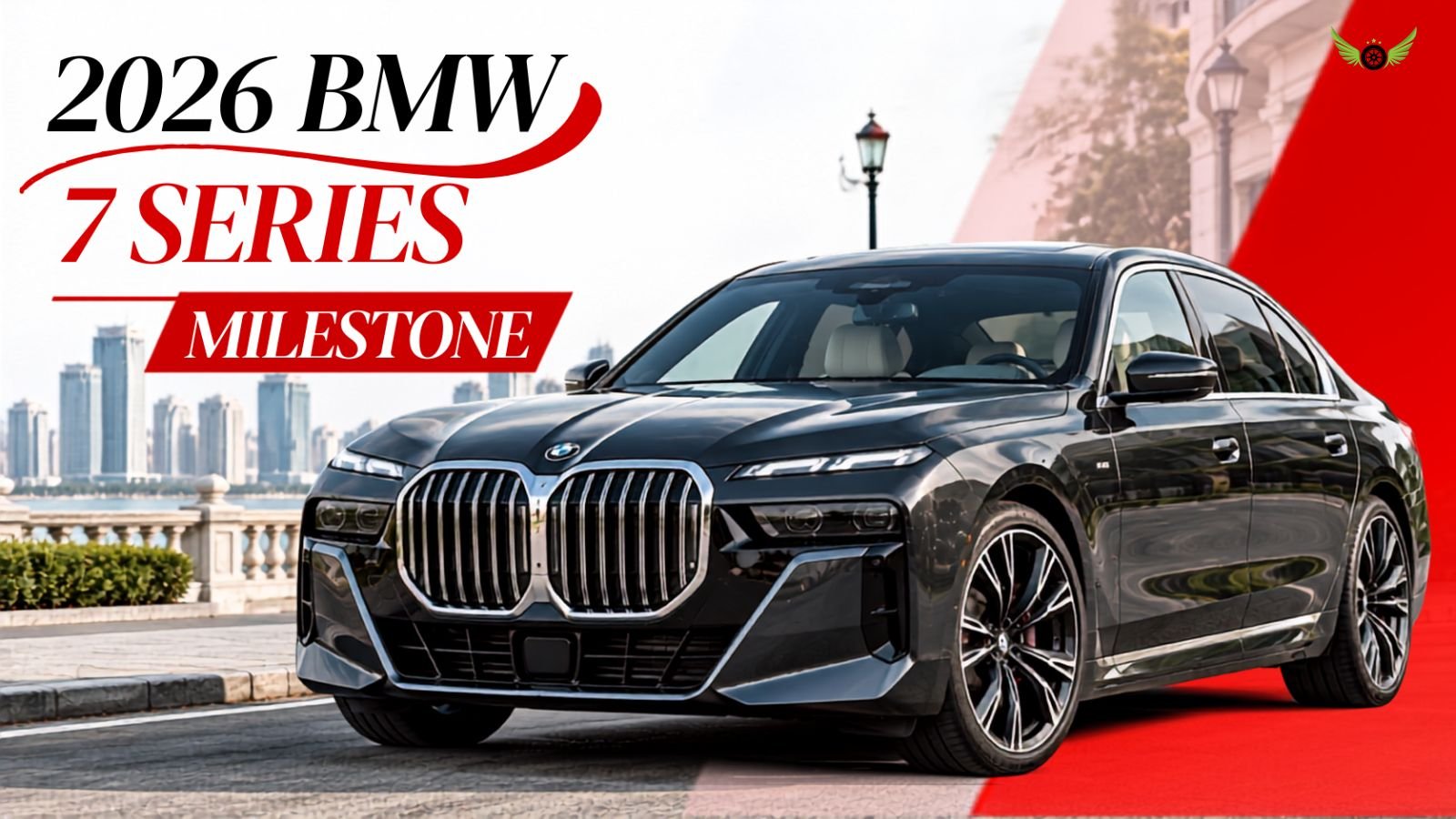
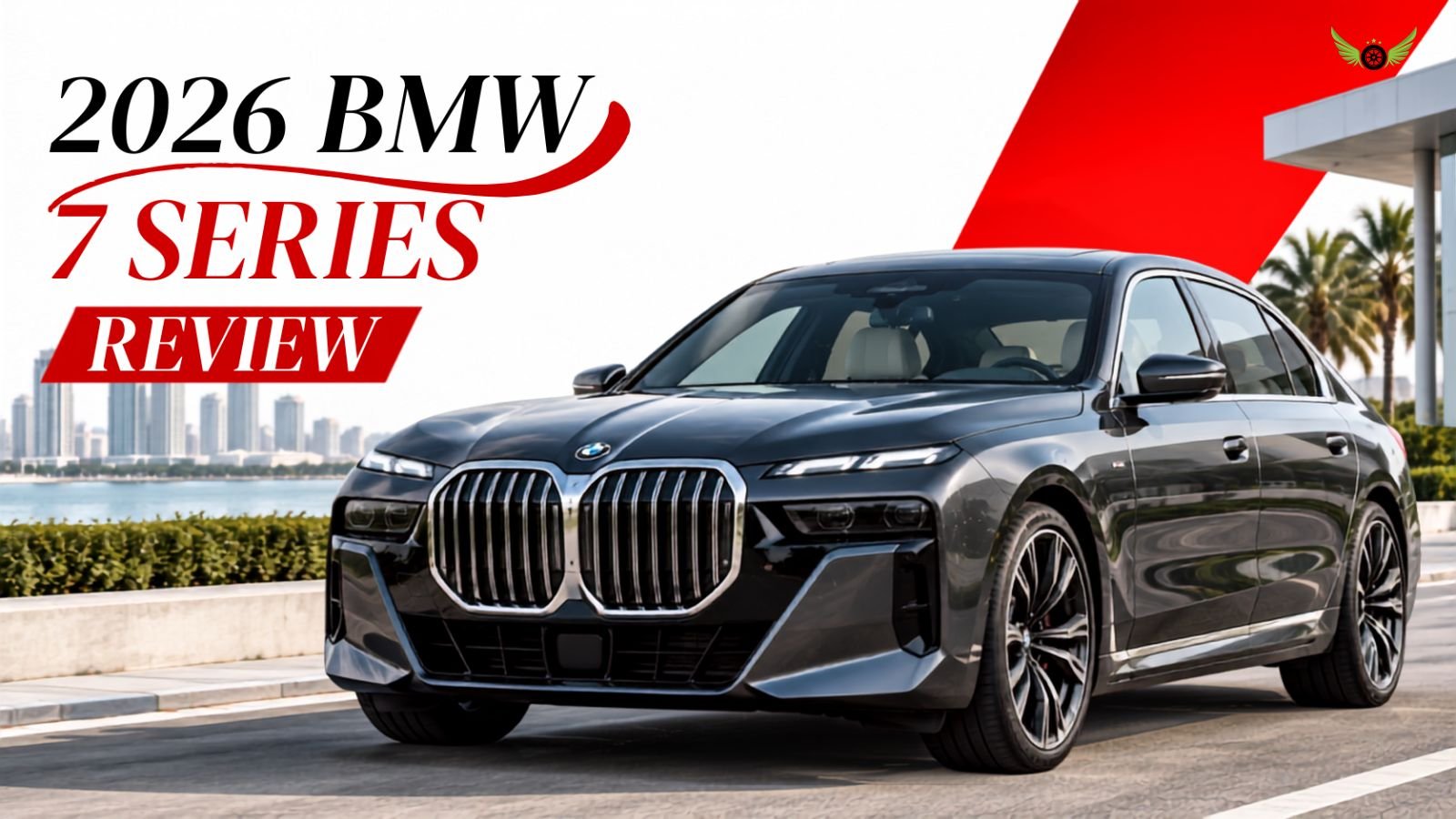
The 2026 BMW 7 Series is BMW’s flagship luxury sedan, offering a choice of a turbocharged inline-six, a plug-in hybrid powertrain, or a twin-turbo V8. In the U.S., the lineup starts with the 740i at $100,850, followed by the 740i xDrive at $103,850, 750e xDrive at $111,550, and 760i xDrive at $126,250, before destination and options.
The 740i produces 375 hp, the 750e xDrive delivers 483 hp, and the 760i xDrive makes 536 hp. All versions use an eight-speed automatic transmission, while xDrive all-wheel drive is standard on the 750e and 760i and available on the 740i.
In this BMW 7 Series Review, we look at the key differences between the models, including pricing, performance, fuel economy, interior comfort, technology, and everyday usability. The BMW 7 Series Price also varies significantly with the powertrain and available options, so choosing the right version matters as much as choosing the car itself.
According to our experience, the 740i is the most balanced starting point for buyers who want flagship-level comfort and strong performance without stepping up to the V8. The 750e xDrive is more appealing for drivers who can regularly charge at home, while the 760i xDrive is designed for buyers who want maximum power. This BMW 7 Series Buying Guide focuses on those practical differences to help U.S. shoppers decide which version fits their needs best.
BMW 7 Series Trims, Pricing & Model Comparison
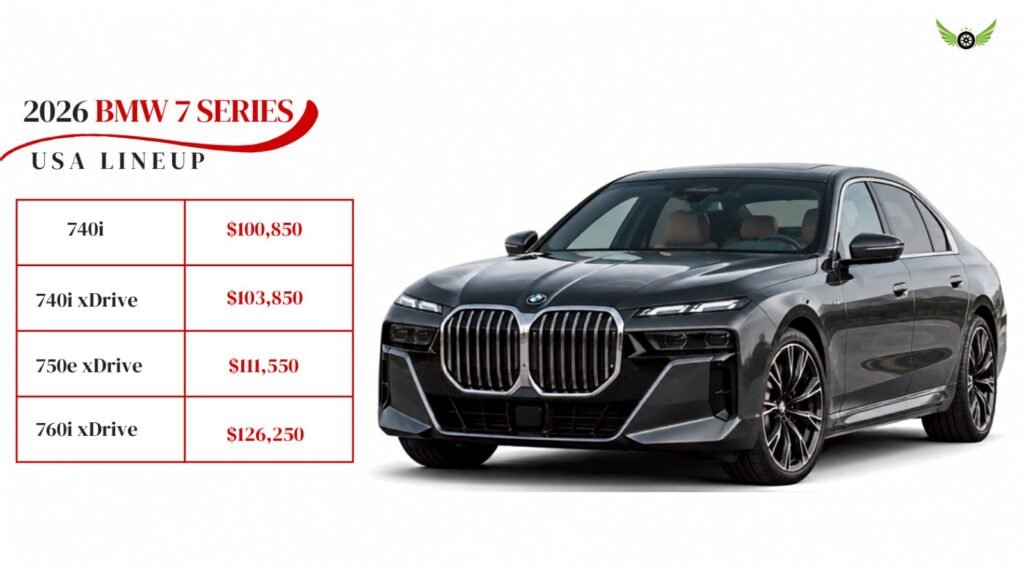
The 2026 BMW 7 Series lineup in the U.S. is divided by powertrain rather than conventional trim levels. Buyers can choose the 740i, 740i xDrive, 750e xDrive, or 760i xDrive. Starting MSRP is $100,850 for the 740i, rising to $126,250 for the 760i xDrive, before destination charges and options.
The main decision comes down to power, drivetrain, and electrification. The 740i uses a turbocharged inline-six with mild-hybrid assistance, the 750e xDrive combines that six-cylinder engine with a plug-in hybrid system, and the 760i xDrive uses a twin-turbo V8. Standard and available luxury equipment is broadly shared across the lineup, so the powertrain is the biggest reason to move between models.
BMW 740i vs 750e xDrive vs 760i xDrive
The 740i is the value-oriented choice. Its 3.0-liter turbocharged inline-six produces 375 hp and 398 lb-ft of torque, with rear-wheel drive standard and xDrive available. BMW lists a 0–60 mph time of 4.9 seconds for the 740i xDrive.
The 750e xDrive adds a plug-in hybrid system and raises total output to 483 hp and 516 lb-ft. It comes with all-wheel drive and can travel about 34 miles on electric power according to EPA data cited by Car and Driver. This makes it the most practical option for buyers who can regularly charge at home but still need gasoline-powered long-distance driving.
The 760i xDrive is the performance flagship. Its 4.4-liter twin-turbo V8 produces 536 hp and 553 lb-ft, with standard all-wheel drive. BMW lists a 0–60 mph time of 4.1 seconds, while Car and Driver independently recorded 3.5 seconds in its instrumented test of a 760i xDrive. The latter is an independent test result from an earlier model year, not a 2026 factory figure.
Model | Starting MSRP | Power | Drivetrain | Best suited for |
740i | $100,850 | 375 hp | RWD | Value and everyday luxury |
740i xDrive | $103,850 | 375 hp | AWD | Luxury with all-weather traction |
750e xDrive | $111,550 | 483 hp | AWD | Plug-in efficiency and extra power |
760i xDrive | $126,250 | 536 hp | AWD | Maximum performance |
MSRP excludes destination, taxes, and options. Performance and electric-range figures can vary by equipment and conditions.
Best BMW 7 Series Trim for Luxury, Performance & Value
For most buyers, the 740i is the strongest value. Edmunds specifically recommends it because it is the least expensive version while still offering the same basic flagship-sedan formula and access to a wide range of options.
The 740i xDrive is the better choice when all-wheel drive is important. The 750e xDrive deserves consideration if home charging is convenient and daily driving can take advantage of its electric range. The 760i xDrive is the clear performance choice, but its roughly $25,000 higher starting price than the 740i needs to be justified by the V8 and stronger acceleration.
According to our experience evaluating the specifications and independent testing, the 740i offers the best balance for a typical luxury-sedan buyer. The 750e makes more sense for drivers who will actually use its plug-in capability, while the 760i is best for buyers who specifically want V8 performance rather than simply the most expensive version.
BMW 7 Series Engine, Performance & Specifications
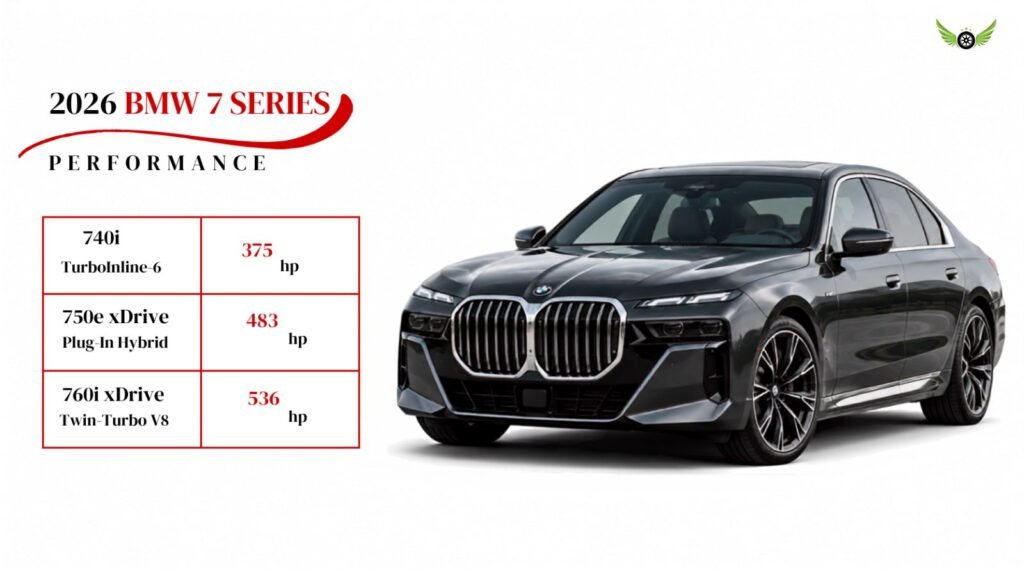
The 2026 BMW 7 Series gives U.S. buyers three powertrain choices: a 375-hp turbocharged inline-six, a 483-hp plug-in hybrid, and a 536-hp twin-turbo V8. All use an eight-speed automatic transmission. Rear-wheel drive is available only with the 740i, while xDrive all-wheel drive is standard on the 750e and 760i.
The important difference is how each powertrain balances performance and efficiency. The six-cylinder models are the sensible everyday choices, the 750e adds meaningful electric-only driving, and the V8-powered 760i delivers the strongest acceleration. The sedan also uses adaptive air suspension and rear-wheel steering, helping manage its large dimensions without making the ride unnecessarily firm.
Inline-Six, Plug-In Hybrid & Twin-Turbo V8 Powertrains
The 740i and 740i xDrive use BMW’s 2,998cc turbocharged inline-six with 48-volt mild-hybrid technology. It produces 375 hp and 398 lb-ft of torque. The rear-wheel-drive 740i is rated at 28 mpg combined, while the 740i xDrive returns 27 mpg combined.
The 750e xDrive pairs the same basic six-cylinder engine with an electric motor for 483 hp and 516 lb-ft. It has an EPA-rated electric range of about 35 miles, with a 17.2-gallon fuel tank and an estimated two-hour charging time at 240 volts.
The 760i xDrive moves to a 4.4-liter twin-turbo V8 producing 536 hp and 553 lb-ft. BMW pairs it with mild-hybrid technology and standard xDrive. This is the powertrain to choose when outright performance matters more than fuel economy.
Horsepower, Acceleration, Drivetrain & Key Specifications
The factory figures show a clear progression through the range. BMW rates the 740i at 5.2 seconds from 0–60 mph, the 740i xDrive at 4.9 seconds, the 750e xDrive at 4.6 seconds, and the 760i xDrive at 4.1 seconds. These are BMW preliminary test figures, so real-world results can vary with equipment, conditions, tires, and driving style.
Model | Power | Torque | Drivetrain | 0–60 mph | Combined MPG |
740i | 375 hp | 398 lb-ft | RWD | 5.2 sec | 28 |
740i xDrive | 375 hp | 398 lb-ft | AWD | 4.9 sec | 27 |
750e xDrive | 483 hp | 516 lb-ft | AWD | 4.6 sec | 24* |
760i xDrive | 536 hp | 553 lb-ft | AWD | 4.1 sec | 20 |
*750e gasoline combined rating when the battery is depleted; EPA also rates it at 70 MPGe combined and about 35 miles of electric range.
A personal test drive is still the best way to judge throttle response, ride comfort, steering feel, and how quickly the large sedan settles after acceleration. Based on BMW’s specifications and available independent testing, the 760i xDrive is clearly the performance leader, while the 740i offers the strongest balance of power and fuel economy for everyday use.
BMW 7 Series Interior, Technology & Comfort
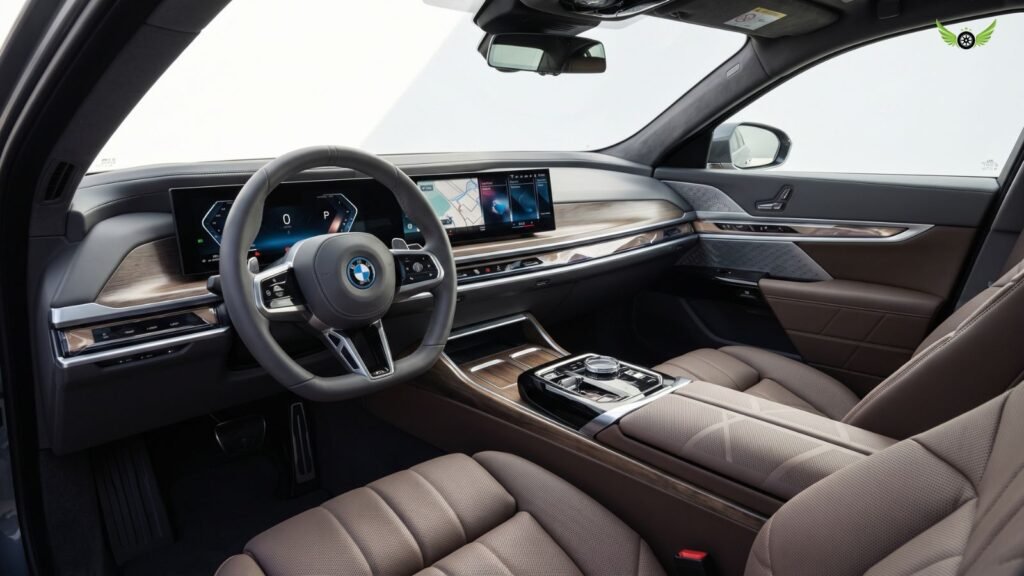
The 2026 BMW 7 Series puts most of its luxury emphasis on cabin comfort, rear-seat space, and high-end technology. The interior is well insulated from road noise, while standard air suspension helps keep the ride smooth. The cabin also combines leather, available cashmere upholstery, glass and wood trim, and extensive digital controls.
For buyers, the biggest distinction is between the already well-equipped standard cabin and the optional rear-seat upgrades. The latter can turn the second row into a much more executive-focused space, while the optional Theatre Screen adds a dedicated entertainment system for rear passengers.
Front and Rear Seat Comfort, Space & Luxury Features
The front seats provide extensive power adjustment, heating, and available ventilation and massage. Rear passengers get generous legroom, heated seats, rear climate controls, and power sunshades. The Luxury Rear Seating Package adds reclining rear seats with massage, adjustable neck cushions, and a rear wireless charging pad.
Interior measurement | 2026 BMW 7 Series 740i |
Front legroom | 41.2 in. |
Rear legroom | 43.3 in. |
Front headroom | 39.8 in. |
Rear headroom | 38.6 in. |
Cargo volume | 19.0 cu. ft. |
The 750e xDrive has slightly different packaging, including 42.8 inches of rear legroom, according to Edmunds.
The trunk is practical for a full-size luxury sedan. Car and Driver reported fitting six carry-on suitcases into the trunk of a 760i xDrive during its testing.
According to our experience, the rear seating is one of the strongest reasons to consider the 7 Series. The standard space is already generous, but the optional rear-seat packages are most valuable for owners who regularly carry passengers rather than drive alone.
Infotainment, Rear Entertainment & Driver Assistance Technology
The dashboard uses a 14.9-inch infotainment touchscreen with BMW’s iDrive 8.5 system, while wireless Apple CarPlay and Android Auto are standard. A rotary controller provides another way to operate the system, which is useful because the large touchscreen contains many functions.
Rear passengers have touchscreen controls integrated into the rear doors for functions such as seating and climate settings. The optional 31.3-inch BMW Theatre Screen drops from the roof and uses a 5G connection for streaming, with HDMI connectivity for external devices.
Driver-assistance equipment includes automated emergency braking with pedestrian detection and lane-departure warning with lane-keeping assistance as standard. Available systems add adaptive cruise control with hands-free highway assistance and advanced parking functions.
A personal test drive is still useful for judging seat support, screen usability, visibility, and ride comfort because those aspects are subjective. Based on current specifications and independent testing, the 2026 model’s strongest interior qualities are its quiet ride, spacious rear compartment, and extensive technology.
BMW 7 Series vs Mercedes-Benz S-Class, Audi A8 & Genesis G90
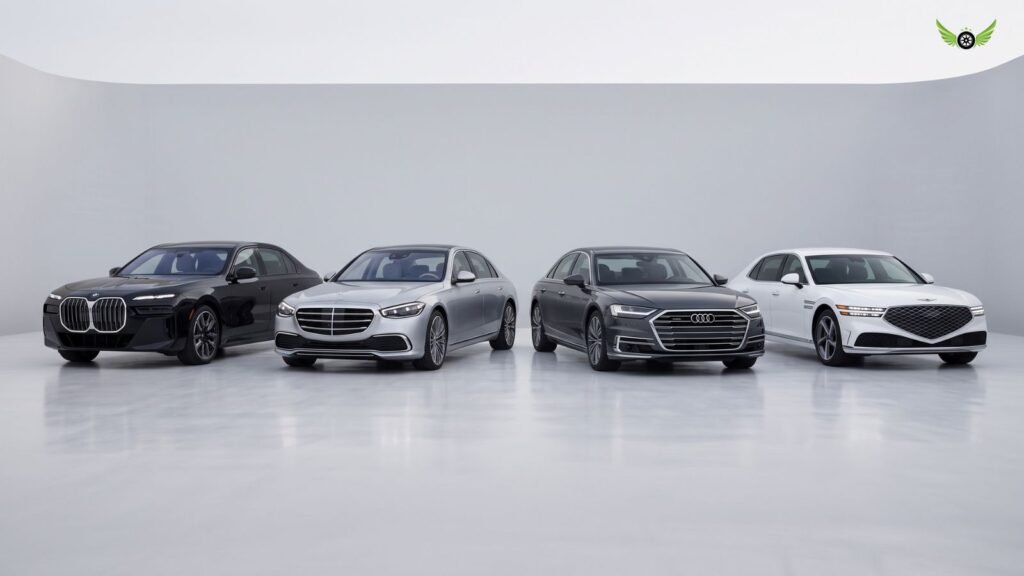
The 2026 BMW 7 Series competes with the Mercedes-Benz S-Class, Audi A8, and Genesis G90, but each takes a different approach to full-size luxury. The BMW stands out for its combination of powertrain choices, driving performance, rear-seat comfort, and technology. The S-Class leans more heavily toward traditional executive luxury and ride comfort, the A8 offers a quieter and more understated experience, while the G90 provides a strong luxury feature set at a lower price.
Luxury, Performance, Technology & Value Comparison
The price gap is significant. The 2026 BMW 7 Series starts at $100,850, compared with $120,900 for the Mercedes-Benz S-Class, $96,495 for the Audi A8, and $92,700 for the Genesis G90 before destination charges and options.
Model | Starting MSRP | Base Powertrain | Horsepower | Drivetrain |
BMW 7 Series | $100,850 | 3.0L turbo I-6 mild hybrid | 375 hp | RWD/AWD |
Mercedes-Benz S-Class | $120,900 | 3.0L turbo I-6 mild hybrid | 442 hp | AWD |
Audi A8 | $96,495 | 3.0L turbo V6 | 335 hp | AWD |
Genesis G90 | $92,700 | 3.5L twin-turbo V6 | 375 hp | AWD |
The BMW also offers a 483-hp 750e xDrive plug-in hybrid and a 536-hp 760i xDrive V8, giving it a wider performance range than the standard A8 or G90. The S-Class counters with a 442-hp S500 and a 530-hp S580, while the G90’s available e-SC version produces 409 hp.
For luxury, the S-Class remains particularly strong because of its rear-seat-focused options and plush ride. The BMW counters with features such as its available Executive Lounge seating and 31.3-inch Theatre Screen. The G90 is particularly compelling on equipment-per-dollar, with Nappa leather and massaging front seats included on its $92,700 base model.
Which Full-Size Luxury Sedan Is the Better Buy?
There is no universal winner because the priorities are different. The BMW 7 Series is the better choice for buyers who want a balance of performance, advanced technology, and traditional luxury. The Mercedes-Benz S-Class is more convincing for buyers who prioritize maximum ride comfort and executive-style rear-seat amenities.
The Genesis G90 offers the strongest price-to-equipment proposition, while the Audi A8 is a sensible choice for someone who prefers understated styling, a quiet cabin, and a lower entry price.
According to our experience evaluating these specifications and independent road-test results, the 7 Series sits in a strong middle position: it costs less to enter than the S-Class while offering more powertrain variety than the A8 and a stronger performance focus than the G90. A personal test drive is still important before choosing among them because ride quality, seating comfort, steering feel, and infotainment usability are subjective.
BMW 7 Series Buying Guide
The 2026 BMW 7 Series is easiest to choose by powertrain rather than equipment level. The 740i is the value-focused model, the 740i xDrive adds all-wheel drive, the 750e xDrive is the plug-in hybrid choice, and the 760i xDrive is the V8 performance model. Starting MSRP ranges from $100,850 to $126,250 before destination, taxes, and options. Edmunds currently recommends the 740i as the best value in the lineup.
Who Should Buy Each BMW 7 Series Model?
The 740i is the best fit for buyers who want flagship-level comfort and technology without paying for a larger engine. Its 375-hp inline-six provides strong performance, while rear-wheel drive keeps the starting price lower. The 740i xDrive is the better choice when all-wheel-drive traction is more important than keeping the price as low as possible.
The 750e xDrive is aimed at buyers who can regularly charge at home and want a plug-in hybrid without giving up gasoline-powered long-distance driving. Its combined output is 483 hp, and its EPA electric range is 34 miles.
The 760i xDrive is for buyers who specifically want V8 performance. Its 4.4-liter twin-turbo V8 produces 536 hp and 553 lb-ft of torque, and BMW rates 0–60 mph at 4.1 seconds. Car and Driver recorded 3.5 seconds in its independent testing.
Pros, Cons & Final Buying Verdict
Pros
- Strong six-cylinder, plug-in hybrid, and V8 powertrains
- Spacious and well-equipped cabin
- Standard adaptive air suspension
- Strong rear-seat comfort
- Extensive technology and customization options
Cons
- Six-figure starting price
- Options can substantially increase the final cost
- Infotainment system can feel complicated
- 760i xDrive sacrifices fuel economy for V8 performance
Overall, the 740i is the most sensible choice for most buyers. It delivers the main strengths of the flagship sedan without requiring the higher purchase price or fuel consumption of the V8. The 750e xDrive becomes more attractive when its electric range fits your daily driving, while the 760i xDrive is best justified by its performance.
According to our experience, buyers should choose the powertrain first and then spend carefully on options that genuinely improve how they use the car. A personal test drive is still worthwhile before buying because ride comfort, steering response, seat support, and the usability of BMW’s technology cannot be judged from specifications alone. Car and Driver similarly notes that the sedan remains more comfort-oriented than athletic despite feeling relatively agile for its size.
2026 BMW 7 Series FAQs: Price, Specs, Performance & Buying Guide
The 2026 BMW 7 Series covers the main questions a luxury-sedan buyer is likely to have, from U.S. pricing and engine choices to fuel economy, passenger space, technology, and model selection. These answers focus on the 2026 model year and published U.S. specifications rather than mixing information from older or newer versions.
Is the 2026 BMW 7 Series expensive?
Yes. The 2026 740i starts at $100,850, before destination charges, taxes, and options. The higher-output versions cost substantially more, with the 760i xDrive reaching a $126,250 starting MSRP.
Does the 2026 BMW 7 Series have a six-cylinder engine?
Yes. The 740i and 740i xDrive use a 3.0-liter turbocharged inline-six with 48-volt mild-hybrid assistance and produce 375 hp. The 750e xDrive also uses a six-cylinder engine but adds an electric motor.
Is the BMW 7 Series 750e a plug-in hybrid?
Yes. The 750e xDrive combines its turbocharged inline-six with an electric motor for 483 hp and 516 lb-ft of torque. Its EPA-rated electric range is about 35 miles, making it the electrified alternative to the gasoline-powered models.
Does the BMW 7 Series offer a V8?
Yes. The 760i xDrive uses a 4.4-liter twin-turbocharged V8 producing 536 hp and 553 lb-ft of torque. It also includes 48-volt mild-hybrid technology and standard all-wheel drive.
Is the 2026 BMW 7 Series fast?
Yes. BMW lists 0–60 mph in 5.2 seconds for the 740i, 4.9 seconds for the 740i xDrive, 4.6 seconds for the 750e xDrive, and 4.1 seconds for the 760i xDrive. Car and Driver independently recorded 3.5 seconds for a 760i xDrive in its instrumented testing.
Does every BMW 7 Series have all-wheel drive?
No. The standard 740i uses rear-wheel drive, although xDrive is available. The 740i xDrive, 750e xDrive, and 760i xDrive use all-wheel drive.
Does the 740i get good fuel economy?
Yes, for a full-size luxury sedan. The rear-wheel-drive 740i is EPA-rated at 25 mpg city, 31 mpg highway, and 28 mpg combined. The 740i xDrive is rated at 24/31/27 mpg.
Is the BMW 7 Series comfortable for rear passengers?
Yes. The 740i provides 43.3 inches of rear legroom, and available rear-seat packages add reclining seats, massage, and other executive-oriented comfort features.
Does the 2026 BMW 7 Series have a large trunk?
Yes. The sedan offers approximately 19 cubic feet of cargo space, and Car and Driver was able to fit six carry-on suitcases into the trunk of a tested 760i xDrive.
Does the BMW 7 Series have a rear entertainment screen?
Yes, but it is optional. The available 31.3-inch BMW Theatre Screen provides rear-seat entertainment and is one of the more distinctive technology options in the segment.
Is the BMW 7 Series good for long-distance driving?
Yes. Its spacious cabin, standard air suspension, comfortable seating, quiet interior, and available rear-seat amenities make it well-suited to highway travel. The 750e can also cover shorter trips using electric power when sufficiently charged.
Is the BMW 7 Series better than the Mercedes-Benz S-Class?
Not for every buyer. The 7 Series offers strong performance, multiple powertrain choices, and extensive technology, while the S-Class places greater emphasis on traditional flagship luxury and ride comfort. Car and Driver currently ranks the S-Class above the 7 Series among full-size luxury cars.
Is the BMW 7 Series better value than the Genesis G90?
Not necessarily. The G90 starts below the BMW and offers extensive standard luxury equipment, making it a strong value alternative. The BMW has an advantage in powertrain variety and performance, particularly with the 760i xDrive.
Is the 740i the best 2026 BMW 7 Series to buy?
For most buyers, yes. It provides 375 hp, strong fuel economy, rear-wheel drive, and the core luxury features of the range at the lowest starting price. Buyers who can regularly charge at home may find the 750e xDrive more suitable, while the 760i xDrive is the choice for V8 performance.
Is the 2026 BMW 7 Series worth buying?
Yes, if its priorities match yours. It combines strong performance, a quiet and spacious cabin, advanced technology, and several powertrain choices. Its main drawback is cost: the purchase price can rise quickly once expensive options are added.