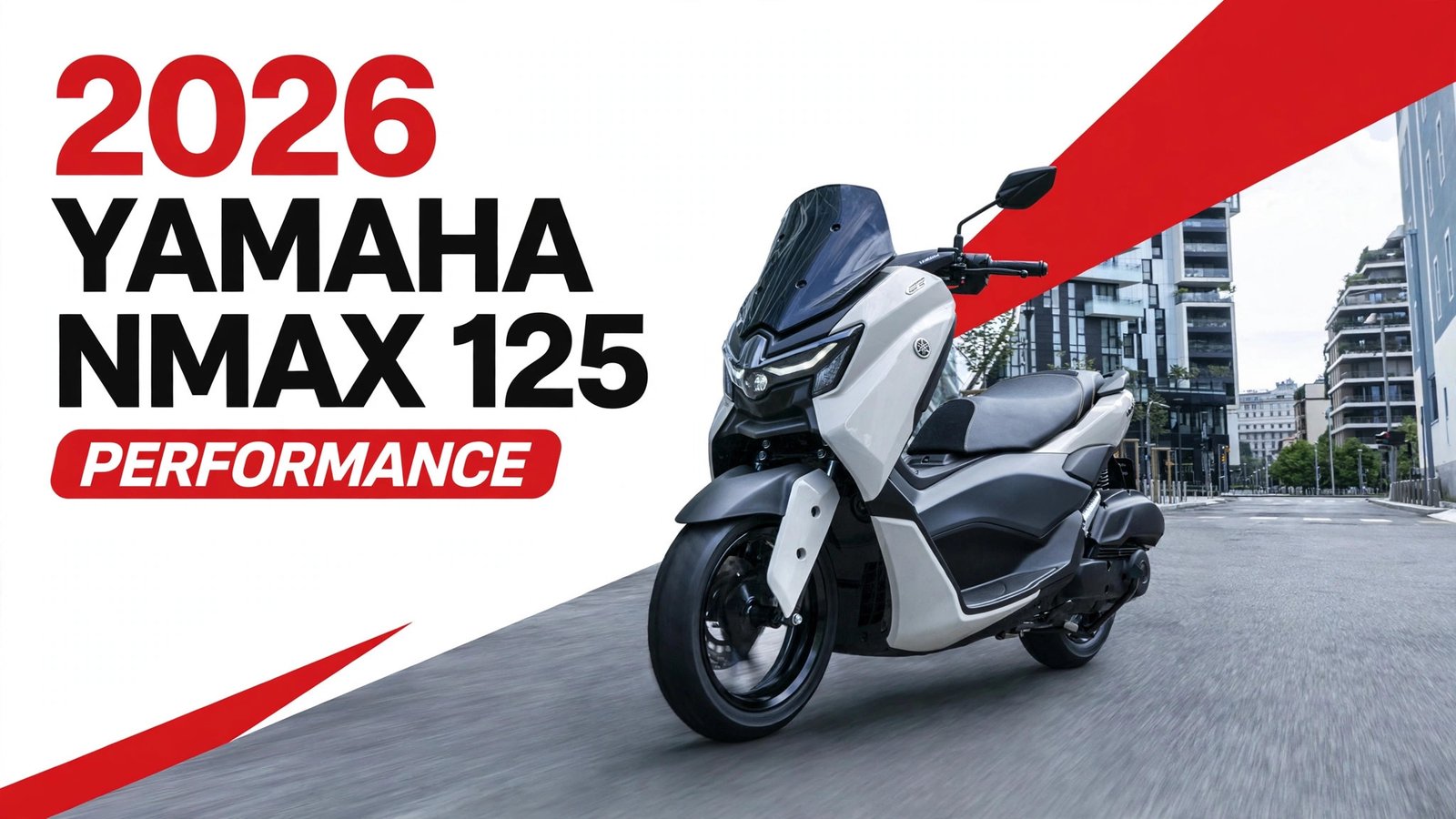
Yamaha NMAX 125 performance is honest 125cc maxi-scooter performance: quick off the lights, happiest between 30 and 60 mph, and upfront about its ceiling. The 125cc liquid-cooled Blue Core single makes 12.2 PS, sips fuel at an official 2.2 litres per 100 km, and tops out around 67 to 70 mph on the speedometer in independent tests — so Yamaha NMAX 125 performance suits city commuting, suburban dual carriageways and learner riders, not motorway touring. This guide separates Yamaha’s figures from independent tests and compares speed, mileage and braking with the Honda PCX 125 and the Zuma 125.
The short version of Yamaha NMAX 125 performance: expect 60 mph without fuss, 67 to 70 mph flat-out on the clock, roughly 80 mpg US in real riding against Yamaha’s 106.9 mpg US official figure, and around 150 miles from the 7.1-litre tank. One framing note matters first: the NMAX 125 is not sold in the United States, so every price here is a UK price, every test is a European test, and Yamaha NMAX 125 performance is judged on European evidence throughout.
Yamaha NMAX 125 Engine Performance and Power Delivery
Yamaha NMAX 125 performance starts with an engine that has barely changed in a decade — because it never needed to. The same basic Blue Core single has powered every generation, with Euro 5 and Euro 5+ updates adding emissions hardware rather than power.
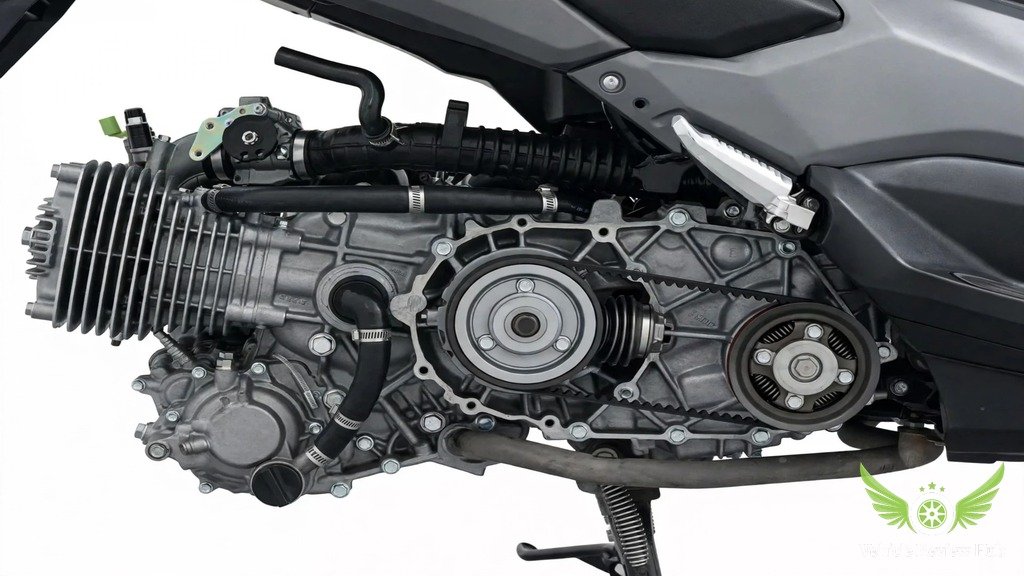
12.2 PS at 8,000 RPM and 11.2 Nm Torque From EU Fact Sheets
Yamaha’s European factsheets list the NMAX 125 at 12.2 PS (9.0 kW) at 8,000 rpm and 11.2 Nm of torque at 6,000 rpm, from a 125cc liquid-cooled, four-stroke, single-overhead-cam single with four valves and variable valve actuation (VVA). Bore and stroke are 52.0 by 58.7 mm and compression is 11.2:1. Those are EU figures — Yamaha USA publishes nothing for a bike it does not sell there.
Twelve horsepower sounds small, but the A1 licence class caps learner bikes at 15 PS, so the NMAX sits sensibly inside the limit. VVA is the clever part of Yamaha NMAX 125 performance: the engine switches intake cam profiles as revs rise, giving stronger low-end pull for traffic and freer breathing at higher revs. Reviewers describe Yamaha NMAX 125 performance as adequate rather than exciting — brisk to 30 mph, willing to 50, and patient beyond that.
CVT Tuning and Why YECVT and Ride Modes Belong to the 155 Model
Drive is a fully automatic V-belt CVT with a centrifugal clutch: twist the throttle and go, with no gears and no clutch lever to learn. The CVT holds the engine near its strongest revs during acceleration, which is why Yamaha NMAX 125 performance feels quicker in traffic than 12.2 PS suggests. The trade-off is familiar scooter behaviour — a steady drone at sustained high speed and a rubber-band feel when asking for a burst at 60 mph.
One spec-sheet trap for Yamaha NMAX 125 performance needs calling out plainly. Some comparison pages list YECVT electronic CVT and ride modes against the 2025 NMAX 125. Those features belong to the NMAX 155, not the 125. The 125 keeps a conventional mechanical CVT and has no ride modes in any year. What the 125 did gain for 2025 is a Tech MAX trim with a 4.2-inch colour TFT dash and Garmin navigation, while the standard bike uses a 4.2-inch monochrome LCD with Yamaha’s MyRide phone link — displays, not drivetrain tech.
| Yamaha NMAX 125 performance snapshot | Figure | Source and status |
|---|---|---|
| Engine | 125cc liquid-cooled SOHC single, 4 valves, VVA | Yamaha EU factsheets |
| Power / torque | 12.2 PS @ 8,000 rpm / 11.2 Nm @ 6,000 rpm | Yamaha EU factsheets |
| Transmission | V-belt automatic (CVT), centrifugal clutch | Yamaha EU factsheets |
| Top speed | 67–70 mph indicated; Yamaha claim 62 mph | MCN / Bennetts / Yamaha launch claim |
| Fuel economy | 2.2 L/100 km official; ~80 mpg US tested | Yamaha + Bennetts tested |
Yamaha NMAX 125 Top Speed and Acceleration
Top speed is the number every prospective buyer asks about, and Yamaha NMAX 125 performance answers it consistently across independent sources — once speedometer readings are separated from GPS truth and Yamaha’s own modest claim is kept in view.
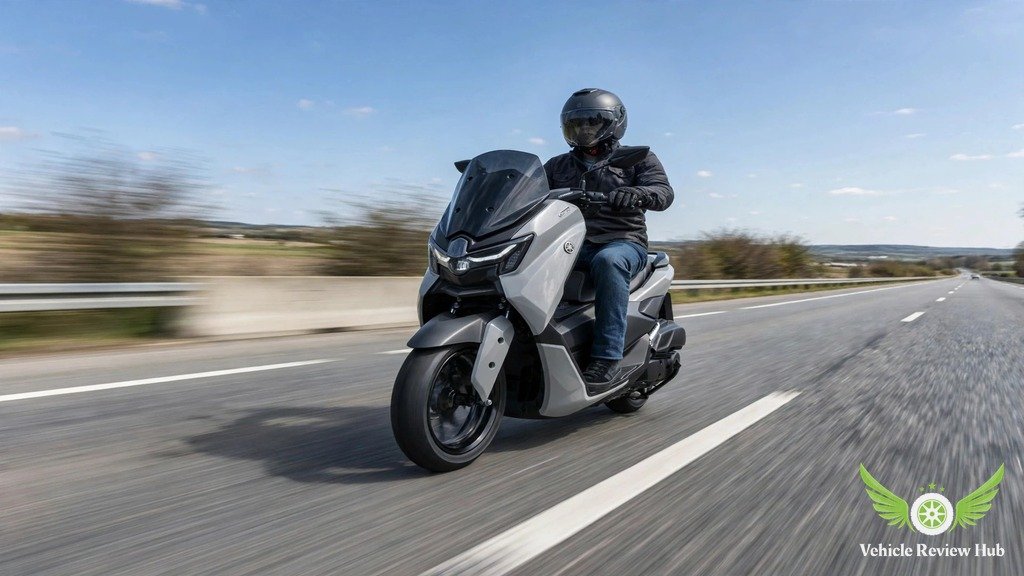
MCN Saw 67 MPH Indicated and Bennetts Around 70 MPH Explained
At the original 2015 launch, Yamaha claimed a 62 mph top speed — a modest figure that testers promptly beat. Visordown’s launch ride saw 108 km/h (67 mph) on the digital clock before having to shut off for a turn, and MCN’s test of the first-generation bike recorded 67 mph on the speedometer sat bolt upright, against Yamaha’s 62 mph claim, with a spec-table top speed of 68 mph. Bennetts’ 2021 review lists top speed as 70 mph (ish) — the “(ish)” doing honest work, since none of these figures is a GPS-verified measurement.
The honest summary for Yamaha NMAX 125 performance is therefore a band, not a number: 67 to 70 mph indicated, with Yamaha’s own 62 mph claim sitting below it. Speedometers typically read a few percent optimistic, so true GPS speed is likely a couple of mph lower. The 2025 bike changes nothing here — the engine is unchanged at 12.2 PS.
The video below is a GPS top-speed run of a 2021 NMAX 125: real Yamaha NMAX 125 performance at full throttle, with indicated and GPS speeds shown side by side.
Why No Instrumented 0-60 Test Exists From MCN or Bennetts
Neither MCN nor Bennetts has published an instrumented 0–60 mph test for Yamaha NMAX 125 performance, and that absence is itself informative. Big outlets instrument-test larger machines, where acceleration figures differentiate models; for a 125cc city scooter, reviewers describe acceleration qualitatively, and this guide follows them. What can be said with confidence about Yamaha NMAX 125 performance is comparative: brisk to 30 mph, willing from 30 to 50 mph thanks to the CVT holding the engine in its strong zone, then fading to a crawl beyond 50 mph.
Any website quoting a precise NMAX 125 0–60 figure without naming its timing method is dressing up an estimate. For Yamaha NMAX 125 performance, the credible acceleration story is the one reviewers agree on: the bike launches smartly, keeps up with town traffic without effort, and runs out of urgency exactly where a 12 PS scooter should.
Yamaha NMAX 125 Mileage and Fuel Economy
If top speed is the NMAX’s limitation, fuel economy is the strong point of Yamaha NMAX 125 performance — though its mileage figures need the same careful reading as its speed figures, because two different gallons are involved.
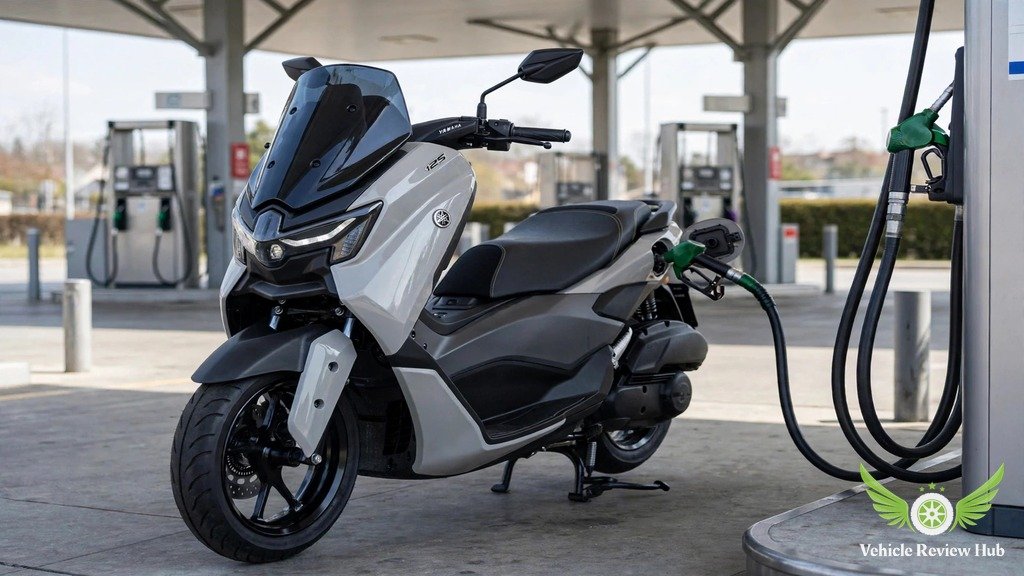
Official 2.2 Litres per 100 km Equals 106.9 MPG US, Not 128
Yamaha quotes official consumption of 2.2 litres per 100 km for the NMAX 125, the headline number for Yamaha NMAX 125 performance. Converted honestly, that is 128.4 mpg on the imperial gallon — the figure splashed across UK reviews — but only 106.9 mpg on the smaller US gallon. The difference is pure arithmetic: an imperial gallon holds 4.546 litres, a US gallon 3.785 litres, so the same fuel burn reads about 20 percent higher in imperial mpg. Any source quoting “128 mpg” to an American audience without saying “imperial” is overstating Yamaha NMAX 125 performance by a fifth, and this guide will not do that.
The same conversion discipline applies to range. The 2021-on tank holds 7.1 litres (1.88 US gallons; the 2015–2021 bike’s tank was 6.6 litres). At the official 2.2 L/100 km, the theoretical range is 322 km, or 200 miles.
Bennetts Tested Around 80 MPG US and 7.1-Litre Tank Range
Bennetts’ 2021 test is the most useful real-world anchor for Yamaha NMAX 125 performance. After a few hours of riding — admittedly not ridden conservatively, since the test fleet was press bikes — the tester saw an average closer to 98 mpg imperial, against the 128.4 mpg imperial official figure, and expected it to climb with gentler riding. Converted, that is about 80 mpg US.
At 80 mpg US, a full 7.1-litre (1.88 US gallon) tank gives about 150 miles — comfortably short of the 200-mile theoretical figure, and the honest planning number for Yamaha NMAX 125 performance.
| Riding condition | Economy | Range on 7.1 litres |
|---|---|---|
| Yamaha official (2.2 L/100 km) | 128.4 mpg imperial / 106.9 mpg US | ~200 miles (theoretical) |
| Bennetts tested (2021) | 96–98 mpg imperial / ~80 mpg US | ~150 miles |
Yamaha NMAX 125 Real-World Riding Performance
Numbers aside, Yamaha NMAX 125 performance in daily use is defined by where the scooter feels effortless and where it feels out of its depth — and the two zones are separated by a fairly sharp line around 60 mph.
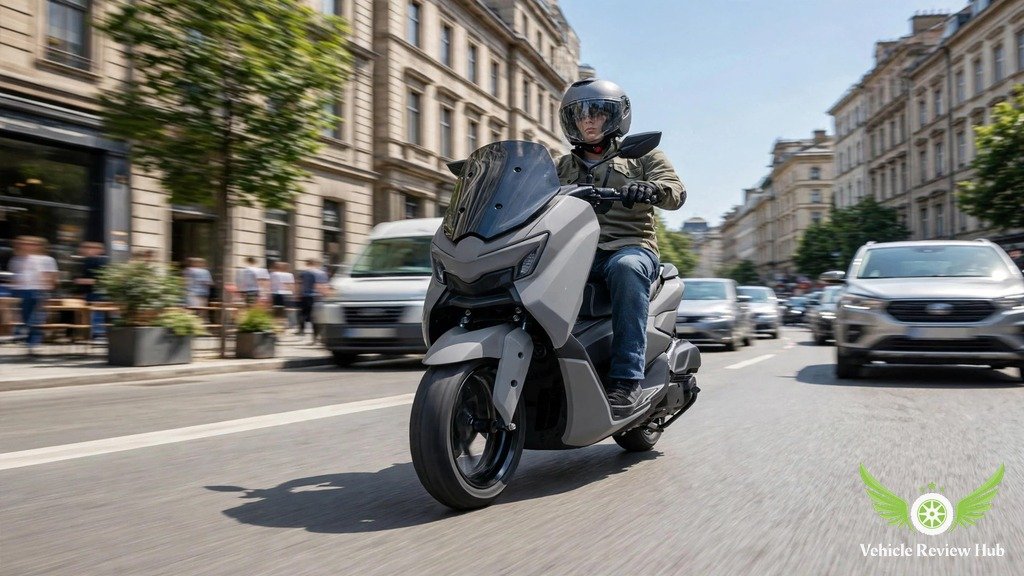
City Riding, Traffic Performance and Everyday Acceleration
In city traffic, Yamaha NMAX 125 performance is in its element. The twist-and-go CVT launches the scooter ahead of cars from green lights, the 132 kg weight and 770 mm seat (765 mm on 2021–2024 bikes) make filtering and parking easy Acceleration to 30 mph is genuinely brisk, and 45 mph cruising feels relaxed.
Dual-Carriageway Riding, Hills and Long-Distance Limitations
Leave the city and Yamaha NMAX 125 performance shows its limits honestly. Devitt’s 2025 ride review found the speedometer slow to get much past 60 mph on a faster dual carriageway without serious tucking-in, and the motor labouring on steeper hills, with overtaking at 50–60 mph needing effort and careful planning. Visordown’s 2025 verdict agrees: enough go to just about keep up with dual-carriageway traffic, labouring a little uphill or above 60 mph.
Wind protection is improved on the 2025 bike, but sustained 70 mph motorway work is still beyond its brief. For Yamaha NMAX 125 performance, the rule is simple: if your fastest regular road is a 60 mph dual carriageway, the NMAX copes; if it is a 70 mph motorway, buy a bigger scooter.
Yamaha NMAX 125 Handling, Braking and Stability
Speed is only half of Yamaha NMAX 125 performance. The chassis and brakes shape how confidently the scooter uses its speed, and here the bike punches above its price — with one honest caveat about brake feel.
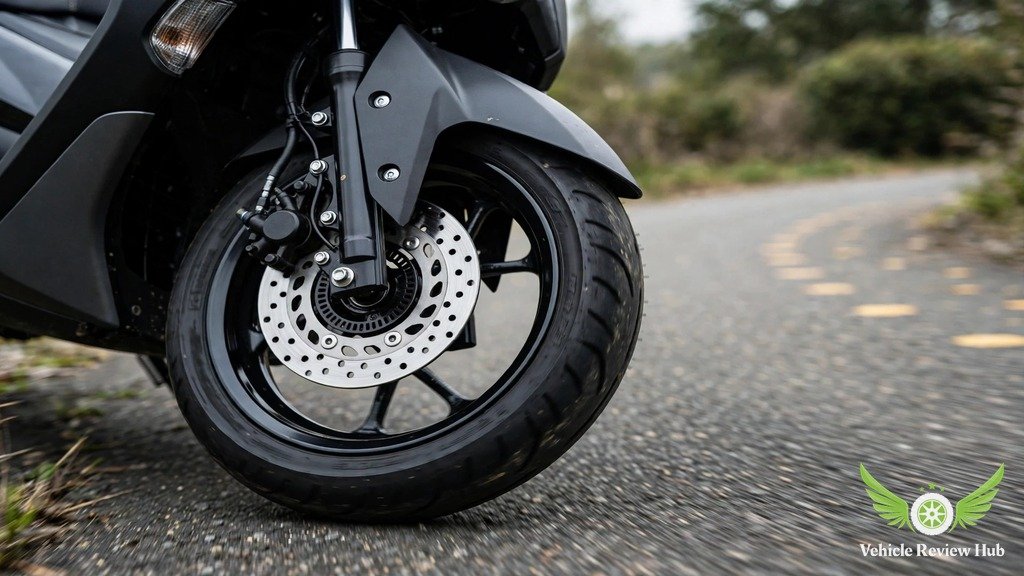
13-Inch Wheels, Chassis, Tires, Cornering and Traction Control
The NMAX rides on 13-inch wheels front and rear — 110/70-13 front, 130/70-13 rear, the handling core of Yamaha NMAX 125 performance — on a tubular steel underbone frame with a telescopic fork (100 mm travel) and a unit-swing monoshock (85–91 mm rear travel by year). The 13-inch wheels are the handling story: bigger than the 12-inch wheels on most city scooters, they roll over potholes with less drama and hold a line better at speed.
Traction control is standard on the 2021-on bike, a small but real part of Yamaha NMAX 125 performance, though Visordown calls it rudimentary — a simple system that trims power on slippery surfaces, and the NMAX has no IMU, no cornering ABS and no ride modes.
230mm Discs Front and Rear With Standard ABS Features
Braking in Yamaha NMAX 125 performance is a 230 mm disc front and rear, each with a single-piston caliper, backed by standard ABS on every year — which already separates the NMAX from its American cousin. Visordown’s 2025 verdict calls braking “adequate rather than inspiring”: each disc independently seems a little weak, but used together they are more than adequate.
For Yamaha NMAX 125 performance, the hardware is well matched to the speed the bike can actually reach. ABS matters most exactly where this bike lives — wet city streets and sudden stops in traffic.
Yamaha NMAX 125 Performance Compared With Other 125 Scooters
Yamaha NMAX 125 performance only makes sense against its rivals: its strengths — economy, refinement, ABS braking — trade directly against tank size, top speed and price, and the trade differs on each side of the Atlantic.
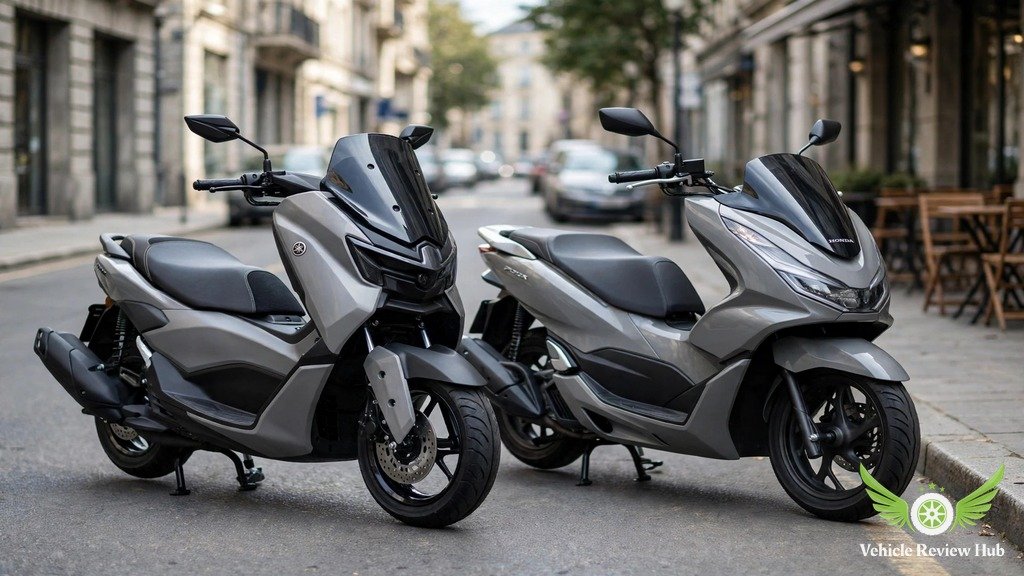
Yamaha NMAX 125 vs Honda PCX 125 in Europe and Zuma 125 in USA
The 2025 PCX125 DX makes 13 hp at 8,750 rpm and 11.7 Nm at 6,500 rpm from its 125cc single — a whisker more power than the NMAX’s 12.2 PS — with 2.1 L/100 km economy, an 8.1-litre tank, 134 kg kerb weight, a 763 mm seat and 220 mm discs front and rear with ABS and Honda’s selectable torque control. AutoTrader’s 2025 PCX review credits up to 130 mpg imperial and 240 miles between fill-ups, both imperial-arithmetic figures that still beat the NMAX’s real-world range thanks to the bigger tank. Against the PCX, Yamaha NMAX 125 performance wins on refinement and the 4-valve engine’s mid-range pull, loses on tank range and underseat space, and roughly ties on top speed — both sit in the same 67–70 mph indicated band.
The American comparison is stranger, because the NMAX’s closest US-market Yamaha is not a maxi-scooter at all. The Zuma 125 performance figures show a 125cc single making roughly 8 hp by third-party estimate, topping out at 61 mph GPS best, with 101 mpg Yamaha-estimated economy from a 1.6-gallon tank — and, crucially, no ABS at all, just linked UBS braking. Against that yardstick, Yamaha NMAX 125 performance looks like a different class of machine: more power, more speed, real ABS and traction control, at a similar UK price. The NMAX 125 review covers price and specs for the full ownership picture.
| Scooter | Engine | Top speed | Economy | Brakes | Tank / weight |
|---|---|---|---|---|---|
| Yamaha NMAX 125 (2025) | 125cc single, VVA, CVT | 67–70 mph indicated | 2.2 L/100 km; ~80 mpg US tested | 230/230 mm discs, ABS + TC | 7.1 L / 132 kg |
| Honda PCX 125 DX (2025) | 125cc single, CVT | ~67–70 mph class | 2.1 L/100 km; up to 130 mpg imperial claimed | 220/220 mm discs, ABS + HSTC | 8.1 L / 134 kg |
| Yamaha Zuma 125 (USA, 2026) | 125cc single, VVA, CVT | 61 mph GPS best | 101 mpg Yamaha est. | 245/230 mm discs, UBS linked, no ABS | 1.6 gal / 282 lb |
Is the Yamaha NMAX 125 Suitable for Learner Riders and Daily Riding?
For learner riders, Yamaha NMAX 125 performance is close to ideal, licensing caveat aside. In the UK it is A1-licence friendly, so a rider with a CBT certificate can ride it on L-plates; the twist-and-go CVT removes the hardest skill a new motorcyclist must learn, the 132 kg weight is easy at parking speeds, the 770 mm seat suits shorter riders, and forgiving power delivery turns a ham-fisted throttle hand into a surge, not a scare. A safety course is strongly recommended.
For daily riding, the Yamaha NMAX 125 performance verdict depends entirely on the route. A commute of city streets, suburban roads and dual carriageways posted at 60 mph or below is exactly what the NMAX was built for, at roughly four cents a mile in fuel on US-gallon maths. A commute with motorway stretches or sustained 70 mph traffic is not — the scooter will do it at its absolute limit, unhappily, with nothing left for overtaking. Match the machine to the fastest road on your route, not the average one.
Yamaha NMAX 125 Performance FAQs
Direct answers on Yamaha NMAX 125 performance, from verified figures and labelled estimates.
What is the top speed of the Yamaha NMAX 125?
About 67 to 70 mph indicated for Yamaha NMAX 125 performance, from MCN’s 67 mph speedometer reading and Bennetts’ 70 mph (ish) figure, against Yamaha’s own 62 mph claim at launch. True GPS speed is likely a couple of mph lower.
How much horsepower does the Yamaha NMAX 125 have?
For Yamaha NMAX 125 performance, Yamaha’s European factsheets list 12.2 PS (9.0 kW) at 8,000 rpm, with 11.2 Nm of torque at 6,000 rpm. Those are EU figures; Yamaha USA publishes nothing for a bike it does not sell.
What is the 0–60 time of the Yamaha NMAX 125?
No major outlet has published an instrumented 0–60 test for Yamaha NMAX 125 performance, so no verified figure exists; owner GPS runs and press-launch boasts should not be quoted as one.
What gas mileage does the Yamaha NMAX 125 get?
Yamaha quotes 2.2 litres per 100 km, which is 128.4 mpg imperial but only 106.9 mpg US. Bennetts’ real-world test returned 96–98 mpg imperial, about 80 mpg US, for Yamaha NMAX 125 performance.
How far can a Yamaha NMAX 125 go on a tank?
For Yamaha NMAX 125 performance, about 150 miles at Bennetts’ tested ~80 mpg US from the 7.1-litre tank. The often-quoted 200 miles is the theoretical range at Yamaha’s official figure, and Yamaha’s 2025 press claim of up to 185 miles uses imperial-gallon arithmetic.
Does the Yamaha NMAX 125 have ABS?
Yes. Yamaha NMAX 125 performance includes standard ABS on every year, with 230 mm discs front and rear — unlike the American Zuma 125, which has linked braking but no ABS.
Does the Yamaha NMAX 125 have ride modes or YECVT?
No. Yamaha NMAX 125 performance uses a conventional mechanical CVT with no ride modes. YECVT electronic CVT and ride modes belong to the NMAX 155, and comparison pages that list them against the 125 are wrong.
Is the Yamaha NMAX 125 good for beginners?
Yes. For Yamaha NMAX 125 performance, the automatic CVT, 132 kg weight, low 770 mm seat and forgiving delivery make it one of the easiest powered two-wheelers to learn on, and in the UK it is A1-licence friendly on a CBT certificate.
How does the NMAX 125 compare with the Honda PCX 125?
Against Yamaha NMAX 125 performance, the 2025 PCX125 DX makes slightly more power (13 hp), drinks slightly less (2.1 L/100 km) and carries a bigger 8.1-litre tank for longer range, but the NMAX answers with sharper mid-range pull and comparable top speed.
Can I buy a Yamaha NMAX 125 in the USA?
No, not new through Yamaha dealers. Yamaha NMAX 125 performance is a European story: the bike was never officially sold in the USA, so American riders must weigh import rules and the lack of local dealer support.