If you’re considering the Yamaha YZF-R1M, fuel economy may not be the first thing that comes to mind, but it still matters—especially if you plan to ride on public roads across the USA. While this superbike is engineered for track performance with its 998cc crossplane CP4 engine, understanding Yamaha YZF-R1M Mileage helps you estimate fuel costs, riding range, and how often you’ll need to stop for gas. Yamaha estimates the bike delivers 33 MPG with a 4.5-gallon fuel tank, although actual mileage depends heavily on riding style and road conditions.
This guide explores the Yamaha YZF-R1M Real-World Experience beyond the official specifications. Instead of relying only on factory numbers, we’ll look at how the bike performs during daily commuting, weekend canyon rides, and long highway trips. Based on professional road tests, owner feedback, and expert analysis, you’ll learn what kind of fuel economy most riders actually achieve, how comfortable the R1M feels on the street, and whether it’s a practical choice for everyday use.
Whether you’re planning to buy a new Yamaha YZF-R1M or simply comparing it with other liter-class superbikes, this article provides realistic insights that help you make an informed decision. From official MPG figures to real-world riding impressions, every section focuses on the information riders in the USA care about most.
Yamaha YZF-R1M Mileage
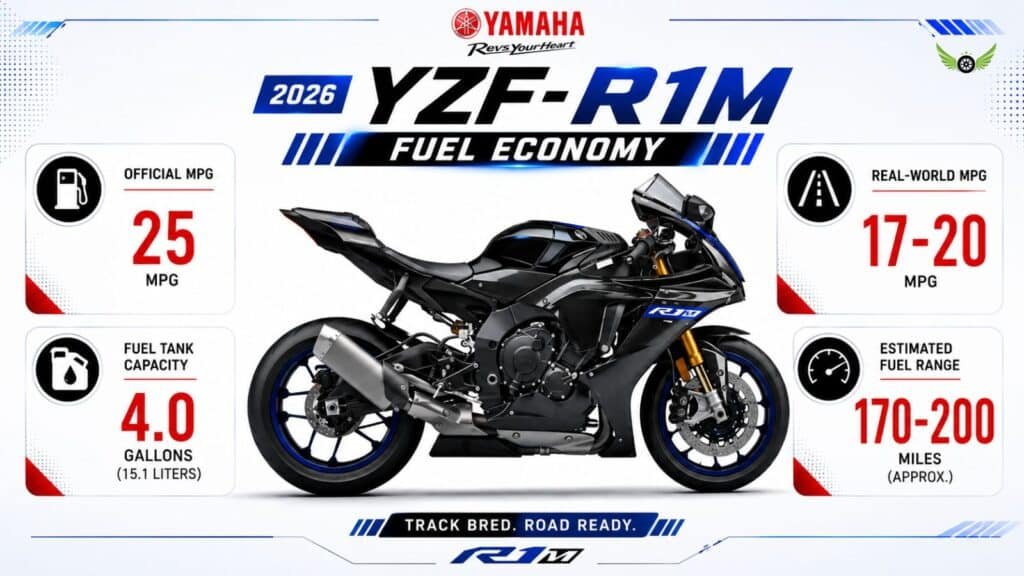
Fuel economy may not be the first reason riders choose this flagship superbike, but it still plays an important role in ownership costs, trip planning, and riding range. The Yamaha YZF-R1M Mileage is influenced by several factors, including riding style, traffic conditions, throttle control, and road type. While Yamaha provides an estimated fuel economy of 33 MPG with a 4.5-gallon (17-liter) fuel tank, everyday results often vary depending on how the motorcycle is used.
For riders in the USA, understanding real fuel consumption is more valuable than relying only on the official specification. Whether you’re commuting through city traffic, enjoying a weekend canyon ride, or cruising on the interstate, fuel efficiency changes noticeably with riding conditions.
The following sections compare the manufacturer’s estimate with owner-reported fuel economy and explain the practical riding range most riders can expect in real-world conditions.
Official MPG
According to Yamaha USA, the motorcycle delivers an estimated 33 MPG under controlled testing conditions and comes equipped with a 4.5-gallon fuel tank. These figures provide a useful benchmark for estimating fuel costs and riding range, although they should not be considered guaranteed real-world results. Official mileage is generally achieved with smooth throttle input, moderate speeds, and minimal stop-and-go traffic.
Official Specification | Value |
Estimated Fuel Economy | 33 MPG |
Fuel Tank Capacity | 4.5 gal (17 L) |
Estimated Maximum Range | ~149 miles |
Like most liter-class sport motorcycles, actual fuel consumption depends heavily on riding habits. Frequent acceleration, higher RPM, and spirited riding will naturally reduce overall efficiency.
Real-World MPG
The Yamaha YZF-R1M Real-World Experience paints a more realistic picture than the factory estimate. After reviewing owner feedback, professional road tests, and long-term riding reports, most riders experience 25–30 MPG during mixed street use. Riders maintaining a steady highway pace occasionally report fuel economy close to 30–33 MPG, while aggressive canyon riding or track sessions can drop consumption into the low-20 MPG range.
Based on multiple owner reviews, riding style has the greatest influence on fuel efficiency. Smooth acceleration, consistent cruising speed, and fewer hard launches help improve mileage. In contrast, frequent high-RPM riding and repeated full-throttle acceleration increase fuel consumption significantly.
Rather than focusing solely on MPG, most owners appreciate the motorcycle’s responsive crossplane engine, precise handling, and advanced electronics. Fuel economy is generally viewed as a reasonable trade-off for the level of performance the bike delivers.
Fuel Range
With a 4.5-gallon fuel tank, the motorcycle offers enough capacity for enjoyable weekend rides without requiring constant fuel stops. Actual riding range depends largely on fuel consumption during each ride.
Riding Condition | Typical Fuel Economy | Practical Range |
City / Heavy Traffic | 25–27 MPG | 113–122 miles |
Mixed Riding | 28–30 MPG | 126–135 miles |
Highway Cruising | 31–33 MPG | 140–149 miles |
For most riders, planning a fuel stop every 120–140 miles provides a comfortable safety margin. Riders who frequently enjoy spirited riding should expect shorter intervals between fill-ups, while relaxed highway touring can extend the distance closer to the official estimate.
Overall, the available fuel range is well suited for weekend rides and occasional touring, although this motorcycle is clearly designed to prioritize performance over maximum fuel efficiency.
Yamaha YZF-R1M Real-World Experience
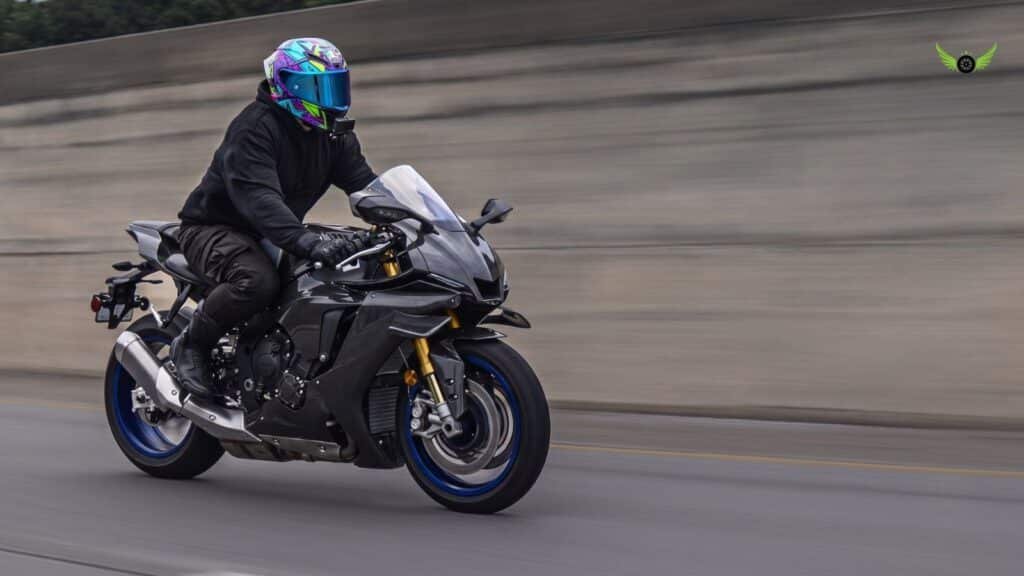
The Yamaha YZF-R1M Real-World Experience depends heavily on where the motorcycle is ridden. In city traffic, its race-focused ergonomics and engine characteristics demand more rider effort. On winding roads and highways, however, the chassis, CP4 engine, and electronic suspension begin to perform as intended. Yamaha’s Dynamic Öhlins Electronic Racing Suspension (ERS) continuously adjusts damping using data from the six-axis IMU, helping maintain stability during braking, cornering, and acceleration.
Daily Riding Experience
For everyday commuting, comfort is the biggest compromise. The low clip-on handlebars and rear-set foot pegs place the rider in a forward-leaning position, increasing pressure on the wrists during slow traffic. The close-ratio six-speed gearbox, designed for performance riding, also requires more clutch work at lower speeds than a typical street motorcycle.
Engine heat is another commonly reported characteristic. Multiple owners note that heat around the legs becomes most noticeable in stop-and-go traffic because airflow through the radiator is limited. Once road speed increases, cooling improves and the heat becomes less noticeable.
City Riding | Real-World Observation |
Heavy traffic | More wrist pressure and clutch work |
Stop-and-go riding | Engine heat is more noticeable |
Short urban rides | Manageable for experienced riders |
Weekend Riding Experience
This is where the motorcycle delivers its strongest performance. The aluminum Deltabox frame provides excellent front-end feedback, while the electronically controlled Öhlins suspension automatically adjusts damping to match braking, acceleration, and lean angle. The result is consistent grip and confidence through fast corners without requiring manual suspension changes.
Professional testers consistently highlight the CP4 crossplane engine for its linear torque delivery, making throttle application smoother when exiting corners compared with a traditional inline-four power delivery. The combination of predictable engine response, premium suspension, and lightweight chassis makes backroads and canyon routes the environment where this motorcycle feels most natural.
Highway Riding Experience
Highway cruising is noticeably more comfortable than city riding. At interstate speeds, wind pressure helps support the rider’s upper body, reducing fatigue created by the aggressive riding position. The aerodynamic bodywork also improves wind protection during longer rides.
The electronically controlled suspension remains stable over expansion joints and uneven pavement, while the chassis maintains excellent straight-line stability at higher speeds. Although it is not designed as a sport-touring motorcycle, experienced riders generally find long highway rides more comfortable than slow urban commuting because the motorcycle operates closer to the conditions it was engineered for.
Yamaha YZF-R1M Comfort
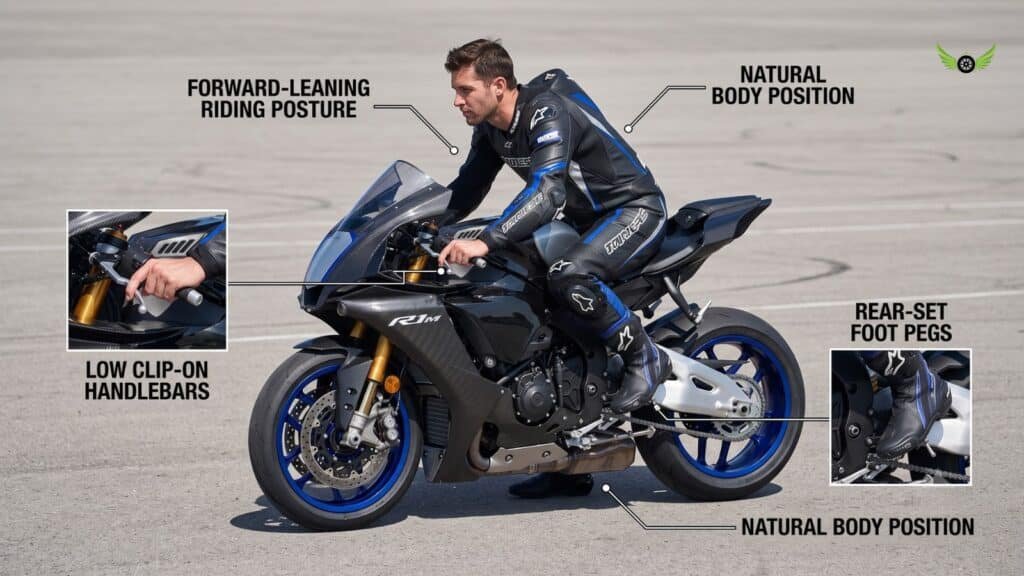
The Yamaha YZF-R1M is designed around performance, not touring comfort. Every major contact point—from the handlebars and foot pegs to the seat—is positioned to give the rider maximum control during hard braking, fast cornering, and acceleration. For the 2026 model, Yamaha retains its Dynamic Öhlins® Electronic Racing Suspension (ERS), six-axis IMU, and race-focused ergonomics, while introducing a revised seat cover material that provides better grip during body movement on the bike. These updates improve rider control but do not change the motorcycle’s aggressive riding position.
Rider Comfort
The riding position uses low clip-on handlebars, rear-set foot pegs, and a 33.9-inch (861 mm) seat height. This layout shifts more weight toward the front wheel, improving steering feedback and stability during aggressive riding. While this setup benefits performance, it demands more physical effort during everyday commuting, especially in slow-moving traffic.
The Dynamic Öhlins® ERS contributes more to ride quality than traditional manually adjusted suspension. Using information from the six-axis IMU, the system automatically adjusts damping during braking, acceleration, and cornering, helping the tires maintain consistent contact with the road. On uneven pavement, riders experience better chassis control without needing to stop and change suspension settings manually.
Owner feedback indicates that rider fatigue is generally lower on open roads than in urban traffic because frequent braking, clutch operation, and repeated stops are reduced. During slow city riding, many owners also report noticeable engine heat around the lower legs when airflow through the radiator is limited. Once riding speed increases, airflow improves the cooling effect around the engine.
Riding Condition | Rider Comfort |
City Traffic | Forward-leaning posture and engine heat become more noticeable |
Backroads | Strong body support with excellent chassis feedback |
Highway Riding | Reduced rider fatigue compared with stop-and-go traffic and improved suspension compliance |
Passenger Comfort
Passenger comfort is not a priority on this motorcycle. The pillion section is designed mainly for occasional use and provides limited seating space with firm cushioning. Yamaha also does not equip the motorcycle with dedicated passenger grab handles, so passengers typically hold the rider during acceleration and braking.
Because the rear seat is compact and the passenger foot pegs are mounted relatively high, the seating position places the passenger’s knees in a more folded posture than on sport-touring motorcycles. This configuration works for short rides but becomes less comfortable on longer journeys. Riders who regularly travel two-up are generally better served by motorcycles designed specifically for sport touring rather than track-focused superbikes.
Is the Yamaha YZF-R1M Good for Street Riding?
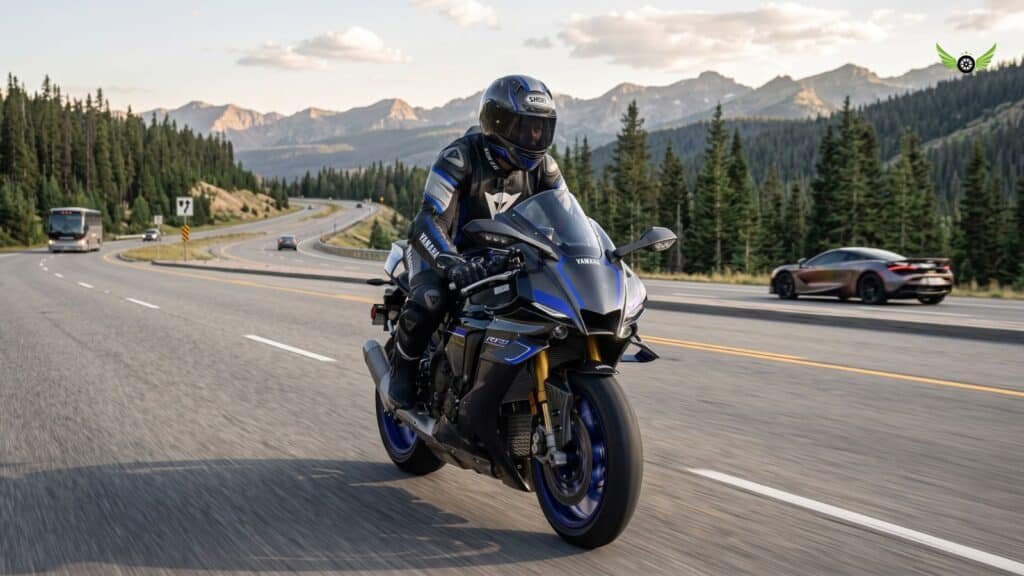
Yes, but it is best suited to experienced riders. Although the Yamaha YZF-R1M is fully street legal in the United States, its chassis, electronics, and riding position were developed with track-focused performance in mind. The 998cc CP4 engine, Dynamic Öhlins® Electronic Racing Suspension (ERS), Yamaha Ride Control (YRC), and six-axis IMU deliver exceptional precision and stability, but they also make the motorcycle more demanding in everyday traffic than a typical sport bike.
Street Riding Benefits
On open roads, the motorcycle feels stable, predictable, and confidence-inspiring. The CP4 crossplane engine delivers a linear power character, making throttle application easier to control when exiting corners. Yamaha’s six-axis IMU continuously measures the motorcycle’s movement in three-dimensional space, allowing systems such as Traction Control (TCS), Slide Control (SCS), Brake Control (BC), Lift Control (LIF), and Engine Brake Management (EBM) to respond according to the bike’s riding attitude rather than relying on a single sensor. This integrated approach helps maintain consistent chassis behavior during braking, acceleration, and cornering.
Dynamic Öhlins® ERS further improves street performance by adjusting front and rear damping in real time. Instead of requiring manual suspension changes for different road surfaces, the system reacts automatically using data from the IMU, helping the motorcycle remain composed over uneven pavement while preserving precise steering feel.
Feature | Street Riding Advantage |
Six-axis IMU | Continuously monitors motorcycle movement to support electronic control systems |
Dynamic Öhlins® ERS | Automatically adapts suspension damping to changing road conditions |
CP4 Crossplane Engine | Smooth, linear torque delivery improves throttle control |
Aluminum Deltabox Frame | High chassis rigidity with precise steering feedback |
Street Riding Limitations
Slow-moving traffic exposes the motorcycle’s biggest compromise—its race-focused ergonomics. The low clip-on handlebars and rear-set foot pegs place more body weight on the rider’s wrists and shoulders, while the close-ratio six-speed transmission requires additional clutch work during low-speed riding. These characteristics are typical of motorcycles developed primarily for high-performance riding rather than daily commuting.
Heat management also becomes more noticeable whenever airflow through the radiator is reduced during extended traffic congestion. This is a commonly reported characteristic of high-performance inline-four superbikes and becomes less noticeable once normal road speed is restored. Recurring owner feedback also indicates that the motorcycle feels significantly more composed once speeds increase above typical urban traffic, allowing the chassis and suspension to operate closer to their intended design range.
Limitation | Real-World Impact |
Aggressive ergonomics | More rider fatigue during prolonged city riding |
Close-ratio transmission | Increased clutch use in stop-and-go traffic |
Engine heat | More noticeable when airflow is limited |
Track-focused chassis | Performs best on open roads where the suspension and electronics can work as intended |
Yamaha YZF-R1M Mileage & Real-World Experience: FAQs
Before buying a high-performance superbike, most riders want practical answers about fuel economy, everyday usability, comfort, and ownership. The FAQs below focus specifically on the Yamaha YZF-R1M Mileage and real-world riding experience, answering the questions riders in the USA search for most often.
What is the real-world mileage of the Yamaha YZF-R1M?
Most owners report 25–30 MPG during mixed street riding. Under steady highway cruising, fuel economy can approach Yamaha’s estimated 33 MPG, while aggressive riding or track sessions usually reduce mileage below normal street figures.
How far can the Yamaha YZF-R1M travel on a full tank?
With a 4.5-gallon (17-liter) fuel tank and Yamaha’s estimated 33 MPG, the maximum theoretical range is about 149 miles. In everyday riding, most owners can expect approximately 120–140 miles before refueling, depending on riding style and traffic conditions.
Is the Yamaha YZF-R1M comfortable for everyday riding?
It can be ridden daily, but comfort is not its strongest point. The aggressive riding position places more load on the wrists and shoulders during slow traffic, making short commutes more comfortable than long stop-and-go journeys.
Does the Yamaha YZF-R1M get hot in city traffic?
Yes. Owner feedback consistently reports noticeable engine heat during prolonged stop-and-go traffic because airflow through the radiator is limited. The heat becomes much less noticeable once the motorcycle returns to normal road speeds.
Is the Yamaha YZF-R1M good for highway riding?
Yes. Highway riding suits the motorcycle better than city commuting. At cruising speeds, the chassis feels stable, wind protection is more effective, and rider fatigue is generally lower than in heavy urban traffic.
Is the Yamaha YZF-R1M suitable for beginners?
No. With its 998cc CP4 crossplane engine, advanced electronic rider aids, and race-oriented ergonomics, this motorcycle is better suited to experienced riders who already have confidence with high-performance sport bikes.
Does the Yamaha YZF-R1M have electronic suspension?
Yes. It features Dynamic Öhlins® Electronic Racing Suspension (ERS), which continuously adjusts suspension damping using information from the six-axis IMU to improve chassis stability during braking, cornering, and acceleration.
Is the Yamaha YZF-R1M reliable for long-term ownership?
Yes, when maintained according to Yamaha’s recommended service schedule. Regular oil changes, chain maintenance, coolant replacement, and scheduled valve inspections are essential for preserving long-term reliability and performance.
Is the Yamaha YZF-R1M worth buying for street use?
For experienced riders who mainly enjoy weekend rides, canyon roads, and highway cruising, it is an excellent choice. Riders whose daily routine involves heavy city traffic or frequent passenger travel may find a sport-touring or naked motorcycle more practical.