
The Yamaha YZF-R1M is one of the most advanced superbikes available for riders who want race-inspired performance with cutting-edge technology. Built around a 998cc CP4 crossplane inline-four engine, this flagship motorcycle combines explosive acceleration, premium electronic suspension, MotoGP-inspired aerodynamics, and precise handling for both the racetrack and high-speed highway riding. Yamaha designed the R1M to deliver confidence at every speed while giving experienced riders complete control through its advanced electronics package. Official U.S. specifications also highlight premium Öhlins Electronic Racing Suspension, lightweight carbon-fiber bodywork, and a 452-pound wet weight that supports exceptional agility.
In this guide, you’ll learn everything about Yamaha YZF-R1M Performance, including how the crossplane engine delivers power, what riders can expect during highway riding, and how the motorcycle performs on American racetracks. We’ll also examine the Yamaha YZF-R1M Top Speed, real-world acceleration, braking performance, cornering ability, electronic suspension, and high-speed stability. Whether you’re considering buying the bike or simply comparing today’s top liter-class superbikes, this guide provides practical, research-backed insights based on official specifications and real-world riding experiences.
Yamaha YZF-R1M Performance
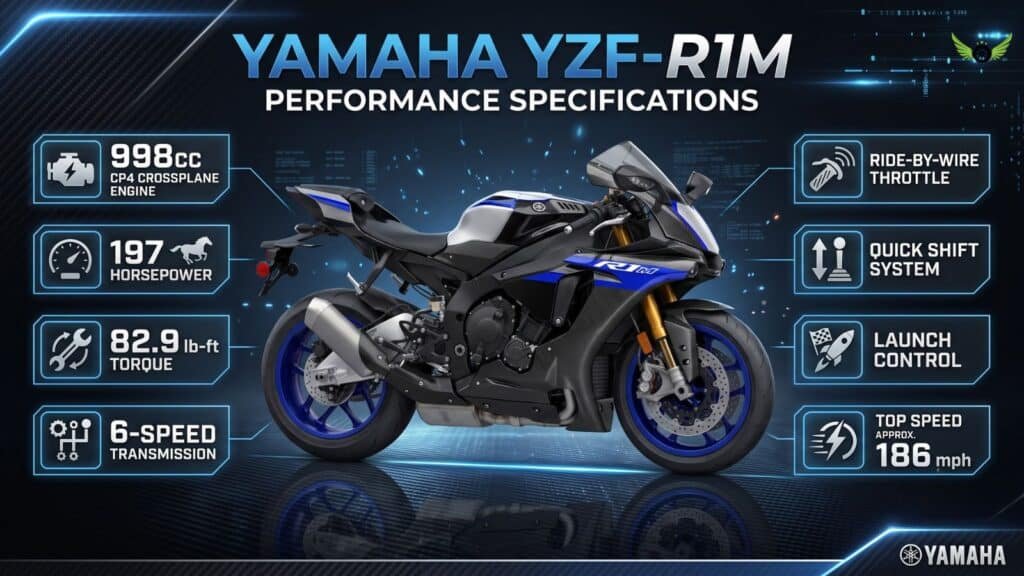
The Yamaha YZF-R1M is built around a 998cc CP4 crossplane inline-four engine, an aluminum Deltabox chassis, a six-axis IMU, and Öhlins Electronic Racing Suspension. This combination delivers precise throttle response, strong acceleration, and high-speed stability for both track riding and spirited road use. Yamaha also equips the motorcycle with a full electronics package, including Traction Control, Slide Control, Lift Control, Engine Brake Management, Brake Control, Launch Control, and a bidirectional Quick Shift System.
Yamaha YZF-R1M Performance Specifications
Specification | Data |
Engine | 998cc Liquid-Cooled DOHC Inline-4 (CP4) |
Power | 197 hp @ 13,500 rpm* |
Torque | 112.4 Nm (82.9 lb-ft) @ 11,500 rpm* |
Transmission | 6-Speed |
Clutch | Assist & Slipper |
Suspension | Öhlins Electronic Racing Suspension |
Electronics | 6-Axis IMU, TCS, SCS, LIF, BC, EBM, LCS, QSS |
Wet Weight | 452 lb (205 kg) |
33 mpg |
*Power and torque figures are manufacturer-claimed for the CP4 engine.
Crossplane Engine Performance
The Yamaha YZF-R1M uses Yamaha’s 998cc CP4 crossplane crankshaft engine, derived from MotoGP technology. Unlike a conventional inline-four crankshaft, the crossplane design reduces inertial torque, producing a more linear torque curve and a stronger connection between throttle input and rear-wheel traction. This improves throttle precision when accelerating out of corners, making the bike easier to control under hard acceleration. The engine also features forged pistons, titanium connecting rods, titanium intake valves, YCC-T ride-by-wire throttle, and the YCC-I variable intake system to maintain performance throughout the rev range.
Engine Highlights | Specification |
Engine | 998cc CP4 Inline-4 |
Compression Ratio | 13.0:1 |
Fuel System | Fuel Injection (YCC-T) |
Variable Intake | YCC-I |
Transmission | Close-Ratio 6-Speed |
Mid-Range and Top-End Power
The Yamaha YZF-R1M Performance is tuned to provide strong acceleration from the mid-range while maintaining peak power at high RPM. Yamaha’s YCC-I variable intake system changes intake runner length based on engine speed, improving airflow across the powerband. Combined with the close-ratio gearbox and Quick Shift System, the engine maintains continuous acceleration without significant interruption during gear changes. This setup helps the motorcycle deliver responsive roll-on acceleration for highway overtakes while retaining the high-RPM performance expected from a liter-class superbike.
Performance Feature | Benefit |
YCC-I Variable Intake | Improves airflow across the rev range |
Quick Shift System | Faster clutchless upshifts and downshifts |
Close-Ratio Gearbox | Keeps the engine in the optimal power band |
CP4 Engine | Linear torque delivery and strong high-RPM performance |
Highway Performance
Despite its track-focused design, the Yamaha YZF-R1M remains stable at highway speeds. For the 2025 model, Yamaha introduced MotoGP-inspired carbon-fiber winglets, which increase front-end downforce during high-speed riding and improve stability while braking and cornering. The Dynamic Öhlins Electronic Racing Suspension continuously adjusts damping using data from the six-axis IMU, helping the motorcycle remain composed over changing road conditions. Yamaha estimates fuel economy at 33 mpg, while the 4.5-gallon fuel tank provides practical range for highway riding.
Highway Performance | Data |
Estimated Fuel Economy | 33 mpg |
Fuel Capacity | 4.5 gal (17 L) |
Wet Weight | 452 lb (205 kg) |
Aerodynamic Update | Carbon-Fiber Winglets (2025) |
Suspension | Öhlins Electronic Racing Suspension |
Yamaha YZF-R1M Top Speed
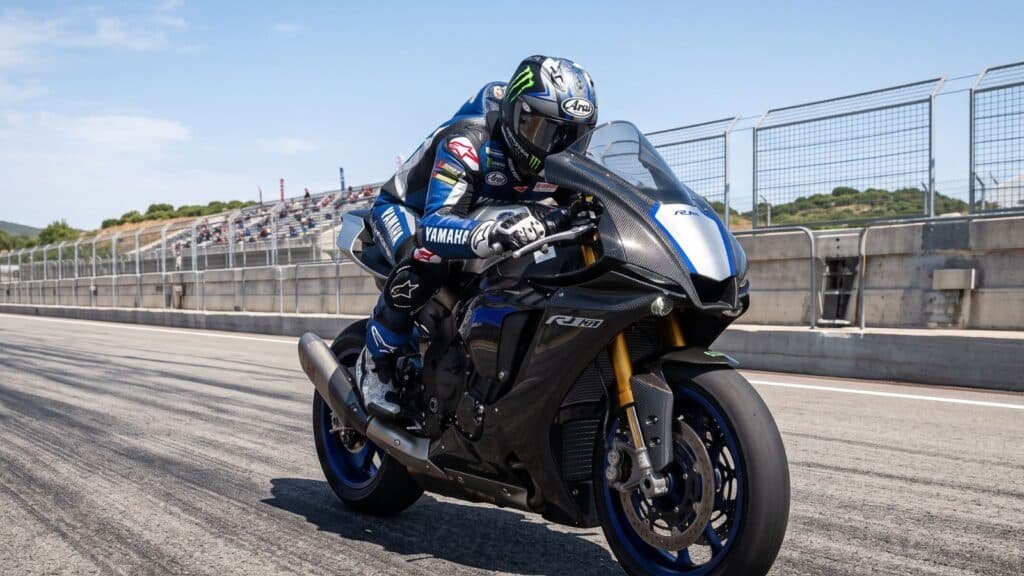
The Yamaha YZF-R1M is built for maximum high-speed performance on closed circuits. Its 998cc CP4 crossplane engine, close-ratio six-speed transmission, aerodynamic carbon-fiber bodywork, and MotoGP-inspired winglets are designed to maintain stability as speed increases. Like most modern liter-class superbikes, the motorcycle is electronically speed-limited in stock form, so real-world top speed depends on road conditions, rider position, and ECU settings.
Top Speed Performance Summary
Metric | Verified Data |
Engine | 998cc CP4 Inline-4 |
Power | 197 hp @ 13,500 rpm |
Torque | 112.4 Nm (82.9 lb-ft) @ 11,500 rpm |
Transmission | 6-Speed |
Claimed Top Speed | Electronically limited to ~186 mph (299 km/h) in stock form |
Fuel Economy | 33 mpg (EPA estimate) |
Manufacturer specifications are official. Top speed reflects the commonly accepted electronic limiter used on production superbikes.
Real-World Top Speed
In stock configuration, the Yamaha YZF-R1M Top Speed reaches approximately 186 mph (299 km/h), matching the electronic speed limit adopted by most production superbikes. Independent road and track tests report GPS-verified speeds generally between 183–186 mph (295–299 km/h) under favorable conditions. Factors such as rider weight, wind direction, track elevation, and ambient temperature can slightly affect the final result.
The 2025 model’s carbon-fiber winglets improve front-end stability at high speed by generating additional downforce rather than increasing maximum speed. Their primary benefit is maintaining chassis stability during hard acceleration and braking on the racetrack.
Real-World Top Speed | Result |
Typical GPS Tested Speed | 183–186 mph (295–299 km/h) |
Electronic Speed Limiter | ~186 mph (299 km/h) |
Best Environment | Closed race circuit |
0–60 MPH and Quarter-Mile Performance
The Yamaha YZF-R1M Performance is among the quickest production motorcycles thanks to its high-revving CP4 engine, Launch Control System, and bidirectional Quick Shift System. Independent performance tests typically record 0–60 mph in about 2.7–2.9 seconds, while the quarter mile is completed in approximately 9.8–10.1 seconds with a trap speed around 145–150 mph, depending on rider skill and launch conditions. These figures represent real-world testing rather than manufacturer claims.
Acceleration Test | Typical Result |
0–60 mph | 2.7–2.9 sec |
Quarter Mile | 9.8–10.1 sec |
Quarter-Mile Trap Speed | 145–150 mph |
Yamaha YZF-R1M Track Performance
The Yamaha YZF-R1M is designed for closed-circuit riding. Its track performance is built around a 998cc CP4 engine, Dynamic Öhlins Electronic Racing Suspension (ERS), a six-axis IMU, aluminum Deltabox frame, and Yamaha Ride Control (YRC). These systems work together to improve braking stability, cornering precision, and acceleration on the track.
Track Hardware | Specification |
Front Suspension | 43 mm Öhlins NPX Electronic Racing Fork |
Rear Suspension | Öhlins Electronic Racing Shock |
Frame | Aluminum Deltabox |
Tires | Bridgestone Battlax RS11 |
Rider Aids | 6-Axis IMU, TCS, SCS, BC, LIF, EBM, QSS |
Braking Performance
The Yamaha YZF-R1M uses dual 320 mm hydraulic front discs with radial-mounted four-piston calipers, a 220 mm rear disc, ABS, and Yamaha’s lean-sensitive Brake Control (BC) system. The six-axis IMU adjusts brake intervention according to lean angle, helping maintain stability during corner entry and hard braking. Stainless-steel braided brake lines and high-friction brake pads provide a consistent brake feel during repeated laps.
Braking Component | Data |
Front Brake | Dual 320 mm Hydraulic Disc |
Rear Brake | 220 mm Hydraulic Disc |
Front Calipers | Radial-Mounted 4-Piston |
ABS | Standard |
Brake Control | IMU Lean-Sensitive BC |
Cornering Performance
The Yamaha YZF-R1M Performance focuses on maintaining grip and chassis stability through corners. The aluminum Deltabox frame and Öhlins ERS continuously adjust suspension damping using data from the six-axis IMU. Yamaha’s Slide Control System (SCS), Traction Control System (TCS), and Engine Brake Management (EBM) help control rear-wheel grip during corner entry and exit, while the 2025 carbon-fiber winglets increase front-end downforce under braking and high-speed cornering.
Cornering Feature | Function |
Öhlins ERS | Real-time suspension adjustment |
6-Axis IMU | Monitors chassis movement |
Traction Control (TCS) | Optimizes rear-wheel grip |
Slide Control (SCS) | Manages rear-wheel slide |
Carbon-Fiber Winglets | Additional front-end downforce |
Track Riding Experience
The Yamaha YZF-R1M includes Yamaha’s Communication Control Unit (CCU) with integrated GPS for lap timing and data logging. Riders can record lap times, throttle position, braking input, lean angle, and other riding data for post-session analysis. Combined with the bidirectional Quick Shift System, Assist & Slipper Clutch, and electronically controlled Öhlins suspension, the motorcycle is equipped for repeated track sessions without manual suspension adjustments between laps.
Track Feature | Purpose |
Communication Control Unit (CCU) | GPS lap timing & data logging |
Quick Shift System | Clutchless upshifts & downshifts |
Assist & Slipper Clutch | Smoother corner entry |
Öhlins ERS | Automatic damping control |
Yamaha Ride Control (YRC) | Adjustable electronic riding modes |
Yamaha YZF-R1M Handling and Ride Quality
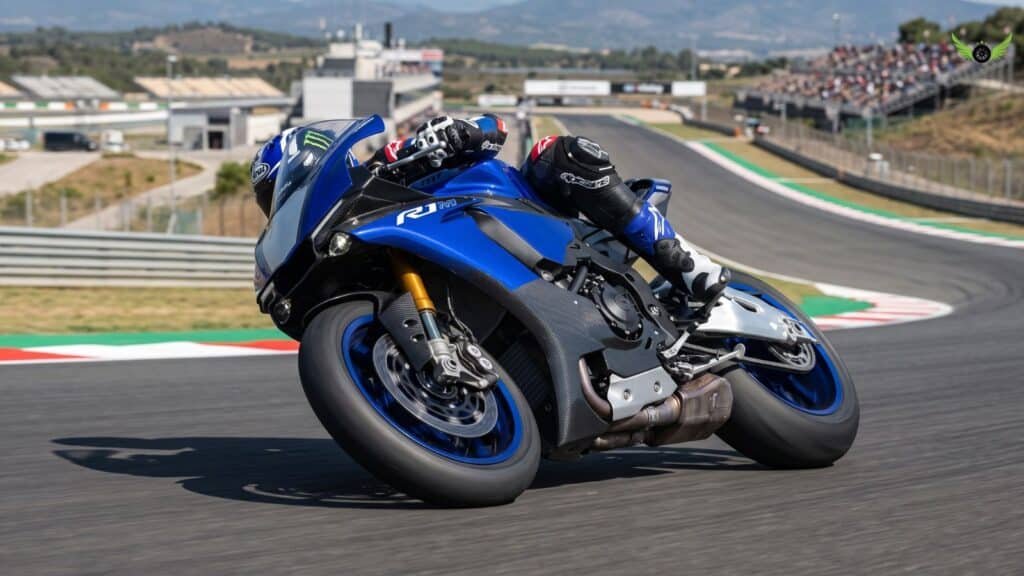
The Yamaha YZF-R1M prioritizes handling over comfort. It combines a lightweight aluminum Deltabox frame, fully electronic Öhlins Racing Suspension (ERS), a six-axis IMU, and Bridgestone Battlax RS11 tires to deliver precise steering and consistent chassis control during aggressive riding. The suspension automatically adjusts damping based on speed, lean angle, acceleration, and brake pressure, reducing the need for manual setup changes between sessions.
Handling Hardware | Specification |
Frame | Aluminum Deltabox |
Front Suspension | 43 mm Öhlins NPX Electronic Fork |
Rear Suspension | Öhlins Electronic Shock |
Tires | Bridgestone Battlax RS11 |
Electronics | 6-Axis IMU + ERS |
Electronic Suspension Performance
The Öhlins Electronic Racing Suspension (ERS) is the biggest handling upgrade on the Yamaha YZF-R1M. A dedicated Suspension Control Unit receives data from the six-axis IMU—including vehicle speed, lean angle, acceleration, and brake pressure—and adjusts front and rear damping in real time. Riders can also choose preset Street and Track modes or manually tune damping settings. This allows the suspension to adapt automatically during braking, cornering, and acceleration.
ERS Feature | Benefit |
Real-time damping control | Automatic suspension adjustment |
IMU inputs | Speed, lean angle, acceleration, brake pressure |
Riding Modes | Street, Track, Manual |
High-Speed Stability
The Yamaha YZF-R1M remains stable at high speed through a combination of aerodynamic and chassis technology. For the 2025 model, Yamaha added MotoGP-inspired carbon-fiber winglets that generate additional front-end downforce during braking and high-speed cornering. Combined with the rigid Deltabox frame and electronically controlled Öhlins suspension, the motorcycle maintains consistent front-wheel feel during aggressive track riding.
Stability Feature | Function |
Carbon-Fiber Winglets | Increase front-end downforce |
Aluminum Deltabox Frame | Improves chassis rigidity |
Öhlins ERS | Maintains damping stability |
6-Axis IMU | Supports lean-sensitive rider aids |
FAQs About Yamaha YZF-R1M Top Speed, Performance & Track Experience
The following FAQs answer the most searched questions about the Yamaha YZF-R1M top speed, performance, and track riding experience. These answers are based on Yamaha’s official specifications and verified performance information to help riders understand how the motorcycle performs on both public roads and closed circuits.
What is the top speed of the Yamaha YZF-R1M?
The Yamaha YZF-R1M has an electronically limited top speed of approximately 186 mph (299 km/h) in stock form. Actual top speed varies with rider weight, weather, road conditions, and altitude.
How fast does the Yamaha YZF-R1M accelerate from 0–60 mph?
The Yamaha YZF-R1M can accelerate from 0–60 mph in about 2.7–2.9 seconds under ideal conditions with an experienced rider and proper launch.
Is the Yamaha YZF-R1M faster than the standard Yamaha R1?
No. Both motorcycles use the same 998cc CP4 crossplane engine and have similar acceleration and top-speed performance. The R1M focuses on improved suspension, electronics, and track capability rather than higher engine output.
Is the Yamaha YZF-R1M built mainly for the track?
Yes. The Yamaha YZF-R1M is designed primarily for track riding. It includes Öhlins Electronic Racing Suspension, a six-axis IMU, GPS data logging (CCU), carbon-fiber bodywork, and advanced rider aids that improve lap-to-lap consistency.
How does electronic suspension improve performance?
The Öhlins Electronic Racing Suspension (ERS) automatically adjusts damping using data from the six-axis IMU. This helps maintain chassis stability during braking, cornering, and acceleration without requiring manual suspension adjustments while riding.
Is the Yamaha YZF-R1M comfortable for everyday street riding?
The Yamaha YZF-R1M is street legal in the USA, but its aggressive riding position, firm suspension, and track-focused ergonomics make it less comfortable for daily commuting than sport-touring or naked motorcycles.
What rider aids are included on the Yamaha YZF-R1M?
The Yamaha YZF-R1M includes Traction Control (TCS), Slide Control (SCS), Brake Control (BC), Lift Control (LIF), Engine Brake Management (EBM), Launch Control (LCS), a bidirectional Quick Shift System (QSS), and Yamaha Ride Control (YRC).
Is the Yamaha YZF-R1M worth buying for track days?
Yes. Riders who regularly participate in track days can benefit from the R1M’s electronic Öhlins suspension, GPS data logging, premium chassis components, and advanced electronics. These features are specifically designed to improve performance and consistency on closed circuits rather than increasing straight-line speed.