The 2026 BMW 2 Series offers one of the better combinations of fuel efficiency and driving performance in the compact luxury car segment. For U.S. buyers, the 230i Coupe delivers up to 26 MPG city and 35 MPG highway, while the more powerful M240i is rated at 23 MPG city and 32 MPG highway. The 230i produces 255 horsepower, while the M240i delivers 382 horsepower, giving buyers two distinctly different performance options.
The biggest advantage of the BMW 2 Series is that fuel economy does not come at the expense of an engaging drive. The rear-wheel-drive layout, responsive engines, and eight-speed automatic transmission give the car a sporty character, while the 230i remains practical for regular commuting and highway trips. BMW lists 0–60 mph times of 5.5 seconds for the 230i and 4.5 seconds for the rear-wheel-drive M240i, with the M240i xDrive reaching 60 mph in 4.1 seconds according to BMW’s published figures.
According to our experience and analysis of real-world testing, the 230i is the stronger choice for drivers who want a balance of BMW 2 Series Mileage and everyday performance, while the M240i is better suited to buyers who prioritize acceleration and stronger engine response. Independent highway testing has also shown that the 230i can exceed its official highway estimate under favorable conditions, although actual BMW 2 Series MPG will always depend on driving style, traffic, weather, and road conditions.
In this guide, we look at the official fuel economy ratings, real-world mileage expectations, BMW 2 Series Performance, driving comfort, daily usability, and how the 2 Series compares with other compact luxury cars. The goal is to help U.S. buyers understand what the car is actually like to own and drive—not just what the specifications say on paper.
BMW 2 Series Mileage, MPG & Fuel Economy
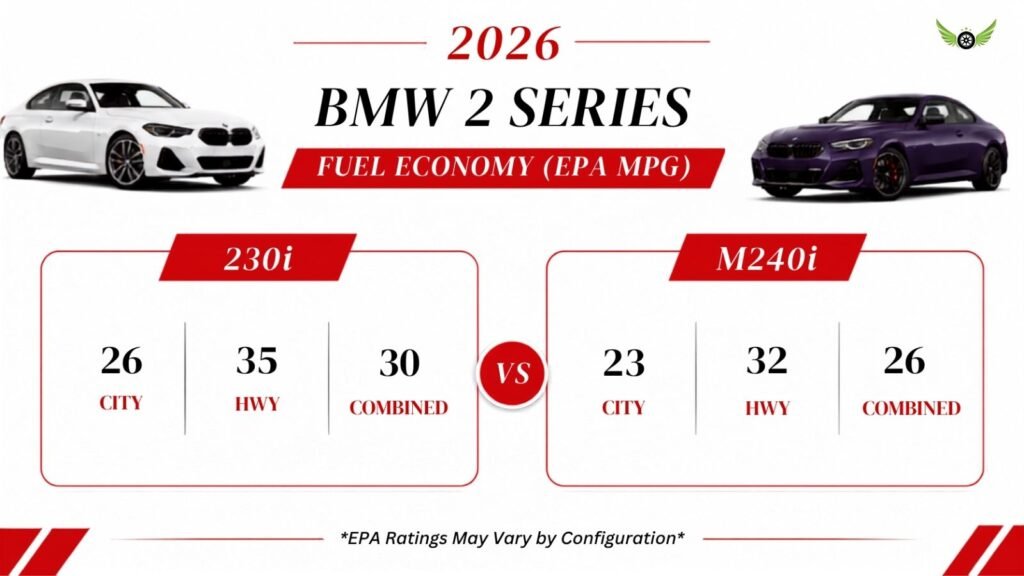
The 2026 BMW 2 Series offers two different approaches to fuel economy: the 230i focuses on efficiency for everyday driving, while the M240i delivers much stronger performance with higher fuel consumption. EPA ratings, independent testing, and premium fuel costs give a clearer picture of what U.S. buyers can expect.
Official EPA City, Highway & Combined MPG Ratings
The rear-wheel-drive 230i is the most efficient model, rated at 26 MPG city, 35 MPG highway, and 30 MPG combined. The M240i is rated at 23 MPG city, 32 MPG highway, and 26 MPG combined, reflecting the additional fuel required by its turbocharged six-cylinder engine.
2026 Model | City | Highway | Combined |
230i RWD | 26 MPG | 35 MPG | 30 MPG |
230i xDrive | 25 MPG | 33 MPG | 28 MPG |
M240i RWD | 23 MPG | 32 MPG | 26 MPG |
M240i xDrive | 23 MPG | 32 MPG | 26 MPG |
For buyers who drive frequently or want lower running costs, the 230i provides the stronger fuel-efficiency balance. The M240i sacrifices some economy but remains relatively efficient for its level of power.
Real-World BMW 2 Series Mileage and Fuel Economy
Real-world fuel economy can be close to—or sometimes better than—official EPA estimates under favorable conditions. Edmunds recorded 31 MPG on its 115-mile mixed-driving test of the 2026 230i, compared with its 30-MPG combined EPA rating. Car and Driver recorded 38 MPG in a 75-mph highway test of a rear-wheel-drive 230i. These tests are useful benchmarks, but individual results will vary with traffic, speed, weather, and driving style.
According to our experience and analysis of independent testing, the 230i is the better fit for drivers who want an engaging luxury coupe without high fuel consumption. Highway driving is where its efficiency is most impressive, while frequent hard acceleration and heavy city traffic will naturally reduce mileage.
Premium Fuel Costs and Everyday Running Efficiency
Fuel costs are an important part of everyday ownership because BMW recommends 91 AKI gasoline for standard models and 93 AKI for M Performance models. BMW also notes that fuel requirements can vary by model, so owners should check their vehicle’s specific manual.
As of August 28, 2026, AAA listed the U.S. national average for premium gasoline at $4.984 per gallon. With a 13.7-gallon fuel tank, a complete fill-up would cost approximately $68.28 at that average price. This is an estimate, not a fixed ownership cost, because fuel prices vary considerably by location and change frequently.
Everyday Fuel Cost Estimate | Approximate Amount |
U.S. average premium gasoline | $4.98 per gallon |
Full 13.7-gallon tank | $68.28 |
The 230i’s higher EPA rating helps offset the cost of premium fuel, making it the more economical choice for daily commuting and long-distance driving. The M240i will generally cost more to fuel, but buyers choosing it are getting substantially stronger acceleration and engine performance in return.
BMW 2 Series Performance & Acceleration
The 2026 BMW 2 Series offers two distinct performance levels. The 230i delivers quick acceleration and responsive power for daily driving, while the M240i provides a major step up in straight-line speed and high-performance capability. Both models use turbocharged engines and an eight-speed automatic transmission, but the six-cylinder M240i is the clear choice for buyers who prioritize maximum acceleration.
230i vs M240i Engine Performance and 0–60 MPH
The 230i uses a 2.0-liter turbocharged four-cylinder producing 255 horsepower and 295 lb-ft of torque. BMW estimates 0–60 mph in 5.5 seconds for the rear-wheel-drive model and 5.3 seconds with xDrive. This level of performance is more than sufficient for confident highway merging and everyday driving.
The M240i gets a 3.0-liter turbocharged inline-six with 382 horsepower and 369 lb-ft of torque for the 2026 model. BMW lists 0–60 mph times of 4.5 seconds for the M240i and 4.1 seconds for the M240i xDrive. Independent testing can produce different results; for example, Car and Driver tested an M240i to 60 mph in 3.6 seconds, highlighting how test conditions and methodology affect acceleration figures.
Model | Engine | Horsepower | Torque | BMW 0–60 MPH |
230i | 2.0L Turbo I4 | 255 hp | 295 lb-ft | 5.5 sec |
M240i | 3.0L Turbo I6 | 382 hp | 369 lb-ft | 4.5 sec |
M240i xDrive | 3.0L Turbo I6 | 382 hp | 369 lb-ft | 4.1 sec |
According to our experience and analysis of independent testing, the 230i provides the better balance for drivers who want a sporty daily car, while the M240i feels like a substantially more serious performance machine. The difference is not just the 0–60 time—the inline-six delivers much stronger acceleration across the rev range.
Turbo Response, Transmission and Power Delivery
Both models use an eight-speed automatic transmission, but their power delivery feels noticeably different. The 230i’s turbocharged four-cylinder produces its peak torque from 1,550 rpm, helping it respond quickly in normal city and highway driving. The M240i develops 369 lb-ft from 1,800 rpm, giving it stronger mid-range acceleration and effortless passing power.
The automatic transmission is a key part of the driving experience, providing quick shifts and keeping the engine in its useful power range. Independent testing by MotorTrend describes the transmission as responsive, particularly when paired with the M240i’s turbocharged inline-six.
For most drivers, the 230i offers smooth and accessible performance without requiring aggressive driving. The M240i, however, delivers the stronger engine response and acceleration expected from an M Performance model. The right choice depends on whether everyday efficiency or outright speed is the higher priority.
BMW 2 Series Real-World Driving Experience
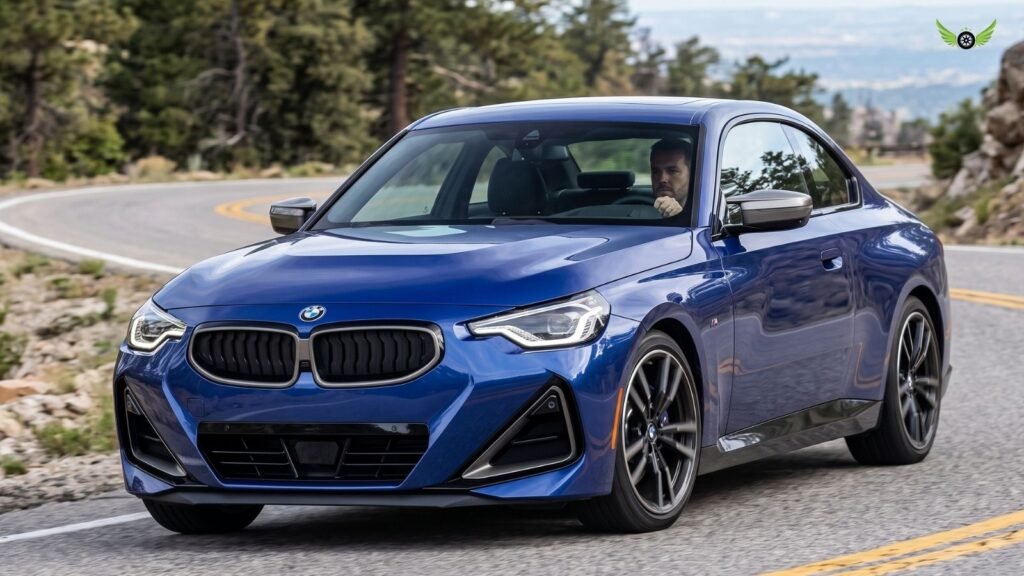
The 2026 BMW 2 Series delivers the kind of driving experience many buyers expect from a compact BMW: agile handling, strong body control, and responsive engines. Independent testing consistently identifies driving enjoyment as one of its biggest strengths. The trade-off is a firmer ride than some luxury-focused rivals, particularly on rough roads or with sport-oriented suspension setups.
Ride Comfort, Handling and Steering Feel
The coupe feels nimble and composed through corners, helped by its compact size and rear-wheel-drive-based platform. Edmunds’ testing of the 230i found minimal body roll with the M Sport suspension and strong braking performance, while Car and Driver also highlights the car’s athletic handling as a major strength.
Ride quality is firm but generally controlled. The M Sport suspension improves body control but can make uneven pavement more noticeable. Reviews also point to one consistent weakness: the steering is accurately weighted but provides limited feedback from the road.
According to our experience and analysis of independent road tests, this balance makes the 2 Series especially appealing to drivers who value handling over a soft, isolated ride. It feels more like a driver’s car than a comfort-first luxury coupe, which is an important distinction for potential buyers.
City Driving, Highway Comfort and Cabin Noise
In city driving, the compact dimensions and good outward visibility help make the coupe easier to manage than larger luxury cars. Edmunds also notes that the upright windows and relatively unobtrusive roof pillars help keep blind spots manageable. The turbocharged engines provide strong low- and mid-range power, so normal traffic and highway merging do not require aggressive driving.
On longer highway trips, the car is generally refined for a sporty coupe. What Car?’s testing found the engines subdued at steady cruising speeds and described the car as relatively peaceful for long journeys, although mild wind and road noise can be heard at higher speeds. Rough pavement remains the main comfort limitation rather than excessive engine noise.
According to our experience, the real-world strength of the 2 Series is its ability to remain enjoyable during everyday driving while still feeling comfortable enough for regular highway travel. Buyers should simply understand that its sporty setup prioritizes control and engagement over the softest possible ride.
BMW 2 Series Daily Driving & Practicality
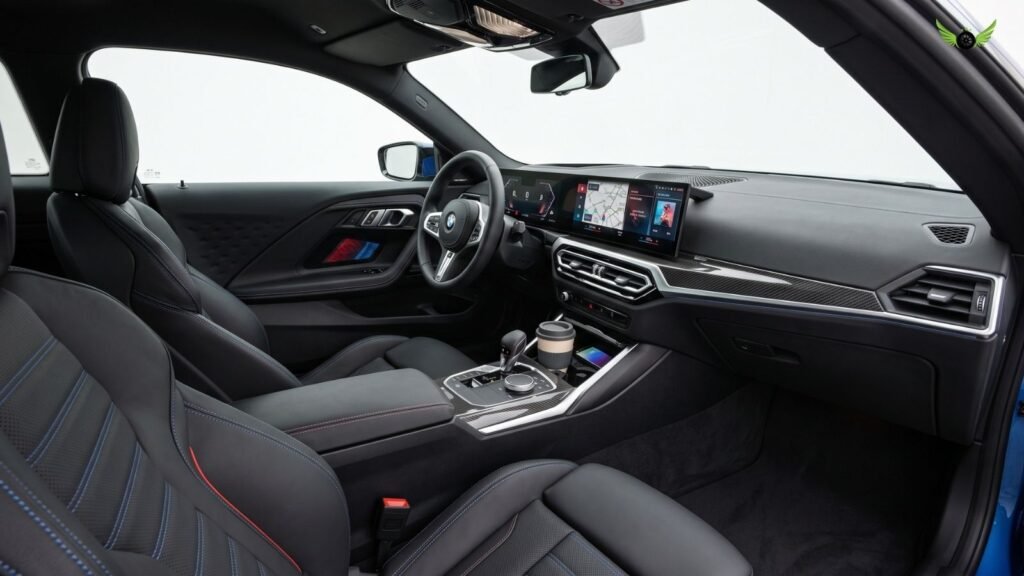
The 2026 BMW 2 Series Coupe is practical for daily driving when the front seats are the primary seating area. It offers a comfortable driving position, supportive front seats, and a 13.8-cubic-foot trunk, which is useful for groceries and weekend trips. However, the rear seat is a clear limitation for adults and frequent family use.
Passenger Comfort and Everyday Usability
Front-seat occupants get the best experience. Independent testing by Edmunds found good headroom, legroom, and shoulder room, along with a supportive seating position and easy-to-reach controls. The compact dimensions also make the Coupe easy to handle in daily traffic and parking situations.
The rear seats are best treated as occasional seating. Edmunds describes the rear area as uncomfortable for adults and notes that getting into the back can be awkward, while Car and Driver also finds the rear seat snug for adult passengers. The trunk is a stronger point: Car and Driver fit five carry-on suitcases in its testing, making the car more useful for luggage than its sporty shape might suggest.
According to our experience and analysis of independent testing, the Coupe works best for singles or couples who prioritize driving enjoyment and rarely carry rear passengers. For this type of ownership, its everyday limitations are manageable.
Coupe vs Gran Coupe Practicality
The two models serve different purposes. The Coupe is a traditional two-door vehicle with seating for four, while the Gran Coupe has four doors and seats five, making entry and exit more convenient for passengers. However, the Gran Coupe’s rear seat is still relatively tight for taller adults, so the extra doors improve access more than they transform it into a spacious family car.
Practicality Feature | 2 Series Coupe | 2 Series Gran Coupe |
Doors | 2 | 4 |
Seating capacity | 4 | 5 |
Rear-seat access | Less convenient | Easier |
Cargo capacity | 13.8 cu. ft. | 12.0 cu. ft. |
Best for | Driving-focused buyers | Buyers needing easier passenger access |
Cargo figures can vary depending on the source, measurement method, and configuration; the figures shown are the current 2026 values listed by Edmunds.
According to our experience, the better choice depends on how the car will actually be used. Choose the Coupe if front-seat comfort and a more driver-focused experience matter most. The Gran Coupe is the more convenient option for regular passenger access, but buyers who frequently carry adults in the back should still check the available space in person.
BMW 2 Series vs Competitors for Mileage & Driving Performance
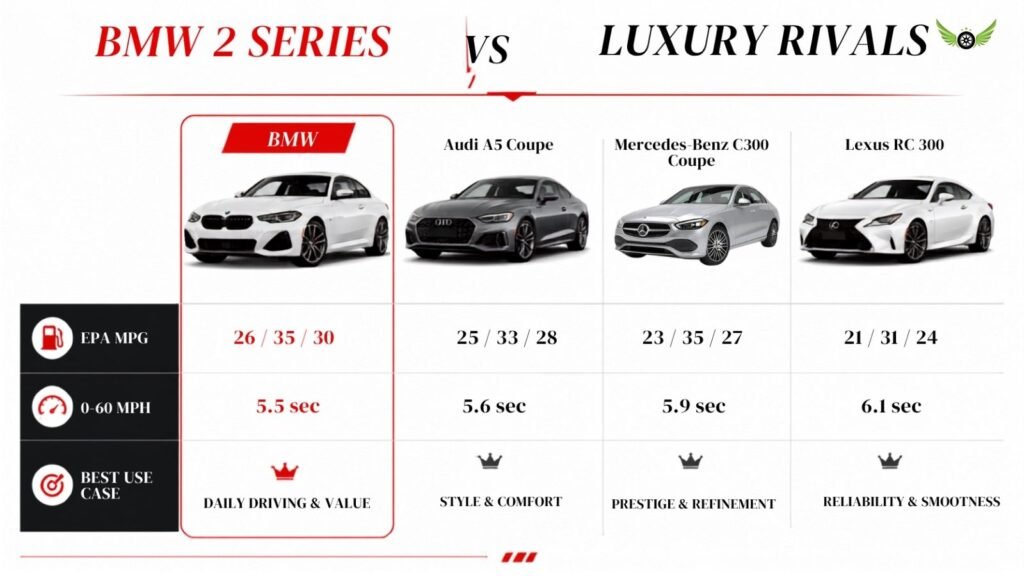
The 2026 BMW 2 Series offers a combination that is increasingly rare in the compact luxury market: a traditional two-door coupe layout, rear-wheel-drive dynamics, and a choice between an efficient turbocharged four-cylinder and a powerful inline-six. The 230i is rated at 26 city/35 highway MPG, while the M240i delivers substantially stronger acceleration with a 23/32 MPG rating.
Its main alternatives offer different strengths. The Acura Integra focuses on efficiency and practicality, the Audi A3 combines all-wheel drive with refinement, and the Mercedes-Benz CLA emphasizes comfort and style. The right choice depends on whether driving engagement, fuel economy, or everyday usability matters most.
Fuel Economy and Performance Compared with Luxury Rivals
The 230i provides the strongest balance of performance and efficiency among the cars compared here. Car and Driver tested the 230i from 0–60 mph in 5.1 seconds and recorded 38 MPG in its 75-mph highway test. The M240i is in another performance category, reaching 60 mph in 3.6 seconds in Car and Driver testing.
The 2026 Acura Integra is the efficiency and practicality leader. Its most efficient CVT models are EPA-rated at 29 city/37 highway MPG, and its hatchback design provides significantly greater everyday versatility. However, its 200-hp engine is noticeably less powerful than the BMW 230i.
The Audi A3 offers standard all-wheel drive, a 201-hp turbocharged engine, and a more comfort-oriented driving experience. It is EPA-rated at 24 city/34 highway MPG, although Car and Driver recorded 40 MPG in its 75-mph highway test. Its acceleration is also more relaxed, with a previously tested A3 reaching 60 mph in 6.0 seconds.
Model | EPA Fuel Economy | Independent 0–60 MPH Test* | Main Strength |
BMW 230i Coupe | 26 city / 35 highway MPG | 5.1 sec | Best mix of handling and performance |
BMW M240i Coupe | 23 city / 32 highway MPG | 3.6 sec | Strongest acceleration |
Acura Integra | Up to 29 city / 37 highway MPG | 6.8 sec (manual A-Spec) | Efficiency and practicality |
Audi A3 | 24 city / 34 highway MPG | 6.0 sec | Refinement and AWD |
Independent test figures can differ based on test conditions and vehicle configuration.
The cited Car and Driver acceleration test was for an earlier A3 configuration; the publication notes the current model is similar but not identical.
Which Compact Luxury Car Offers the Better Balance?
For buyers who prioritize driving enjoyment without sacrificing reasonable fuel economy, the 230i is arguably the strongest overall choice. It is quicker than the mainstream Integra and A3 while maintaining competitive highway efficiency. The M240i is the better option for outright performance, but its higher price and fuel consumption make it less balanced for buyers focused primarily on everyday efficiency.
According to our experience and analysis of independent testing, the best choice depends on how the car will be used. The Acura Integra is more practical for passengers and cargo, while the Audi A3 is a sensible option for buyers who prefer all-wheel drive and a smoother everyday character. However, the 2 Series Coupe remains particularly appealing because its compact size and driver-focused design deliver an experience that many four-door luxury rivals do not replicate.
BMW 2 Series Mileage, Performance & Real-World Driving Experience FAQs
Before choosing the 2026 BMW 2 Series, most buyers want clear answers about its fuel economy, acceleration, ride comfort, and everyday practicality. The FAQs below cover the key ownership and driving questions using official specifications and independent road-test findings. The 2 Series Coupe offers 26–30 MPG combined depending on configuration, along with either a 255-hp four-cylinder or a 382-hp inline-six engine.
What MPG does the 2026 BMW 2 Series get?
The 230i is the most fuel-efficient version, with the rear-wheel-drive model rated at 26 MPG city, 35 MPG highway, and 30 MPG combined. The more powerful M240i is rated lower because of its turbocharged inline-six, but it still delivers reasonable highway efficiency for a performance-focused coupe.
Is the BMW 2 Series fuel-efficient for a luxury performance car?
Yes, especially the 230i. It offers a strong combination of highway fuel economy and quick acceleration, making it suitable for buyers who want a sporty luxury car without excessive fuel consumption. Real-world results will depend on driving style, traffic, and road conditions.
Which is faster: the BMW 230i or M240i?
The M240i is significantly faster. The 230i produces 255 horsepower and the M240i produces 382 horsepower, giving the six-cylinder model much stronger acceleration. Independent testing also confirms that the M240i belongs in a noticeably higher performance category.
Is the BMW 2 Series fun to drive?
Yes. Independent reviews consistently identify its compact size, strong engines, and agile handling as major strengths. According to our experience and analysis of independent road tests, the Coupe delivers the driver-focused character that many buyers expect from a rear-wheel-drive-based BMW.
Is the BMW 2 Series comfortable for daily driving?
It is comfortable enough for daily use, particularly for front-seat occupants. The driving position and front seats are well regarded, but the ride can feel firm on rough roads, especially with sport-oriented suspension and larger wheels.
Is the BMW 2 Series quiet and comfortable on the highway?
The Coupe is generally refined at highway speeds, with engines remaining relatively subdued during steady cruising. Some wind and road noise can still be noticeable, and rough pavement can make the firm suspension more apparent.
Is the BMW 2 Series practical enough for everyday use?
Yes, for one or two people. The front cabin is comfortable and the approximately 14-cubic-foot trunk is useful for groceries and weekend luggage. However, the rear seat is tight for adults and is better suited to occasional use.
Should I choose the BMW 2 Series Coupe or Gran Coupe?
Choose the Coupe if driving enjoyment and rear-wheel-drive dynamics are your priorities. The Gran Coupe offers four doors and easier rear-seat access, but it is a separate, front-wheel-drive-based model rather than simply a four-door version of the Coupe.
Is the BMW 2 Series better than its compact luxury rivals?
It depends on your priorities. The 2 Series is one of the stronger choices for buyers who value driving engagement and performance, while alternatives may offer better rear-seat space or everyday practicality. According to our experience and research, the 230i provides one of the best overall balances for drivers who want both reasonable efficiency and a genuinely sporty driving experience.
Which BMW 2 Series model offers the best overall balance?
For most buyers, the 230i is the better all-around choice. It provides strong fuel economy, responsive performance, and lower running costs than the M240i. The M240i is the better choice for buyers who place maximum acceleration and six-cylinder performance above efficiency.