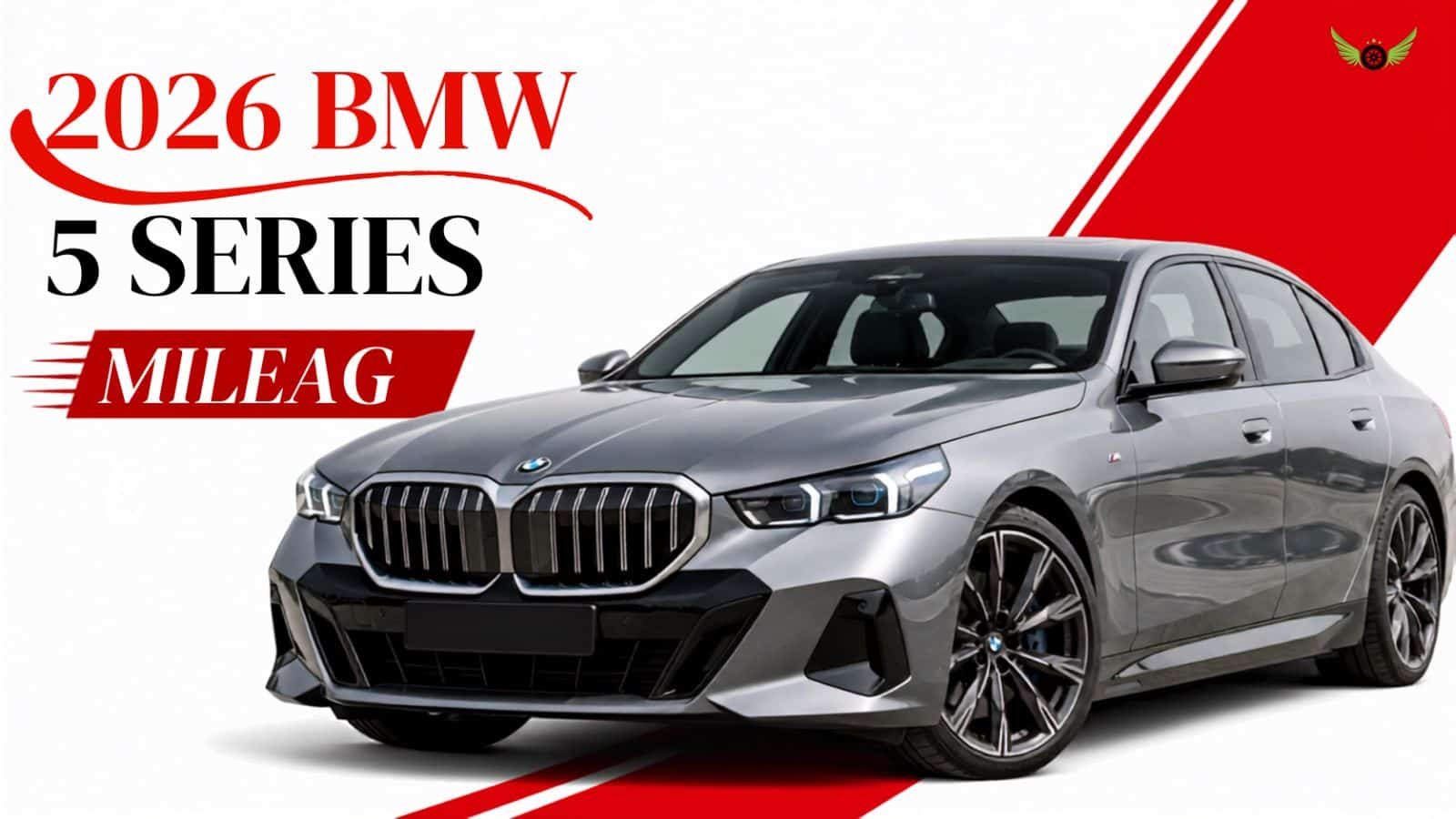
The 2026 BMW 5 Series is a luxury sedan where the real experience depends heavily on the powertrain you choose. In this review, we look beyond the basic specifications to understand how the car performs in everyday U.S. driving, from fuel efficiency and acceleration to ride comfort, handling, and highway refinement.
We will examine BMW 5 Series Mileage and BMW 5 Series MPG across the available gasoline and plug-in hybrid models, with a focus on what the EPA ratings mean for everyday use. The review also covers BMW 5 Series Performance, including power delivery, acceleration, and how the different engines and hybrid systems change the character of the sedan.
The driving experience is another major focus. We look at how the BMW 5 Series feels in city traffic, how comfortable and quiet it is on the highway, and how the steering and handling respond during normal and more spirited driving. The 550e xDrive is also examined for its electric driving and charging experience.
According to our experience, a good luxury-sedan review should explain not only what the numbers say, but how those numbers translate into real driving. That is why this guide combines current U.S. specifications with real-world road-test findings to give a practical view of the 2026 BMW 5 Series and help buyers understand which version best matches their driving needs.
BMW 5 Series Mileage, MPG & Fuel Economy
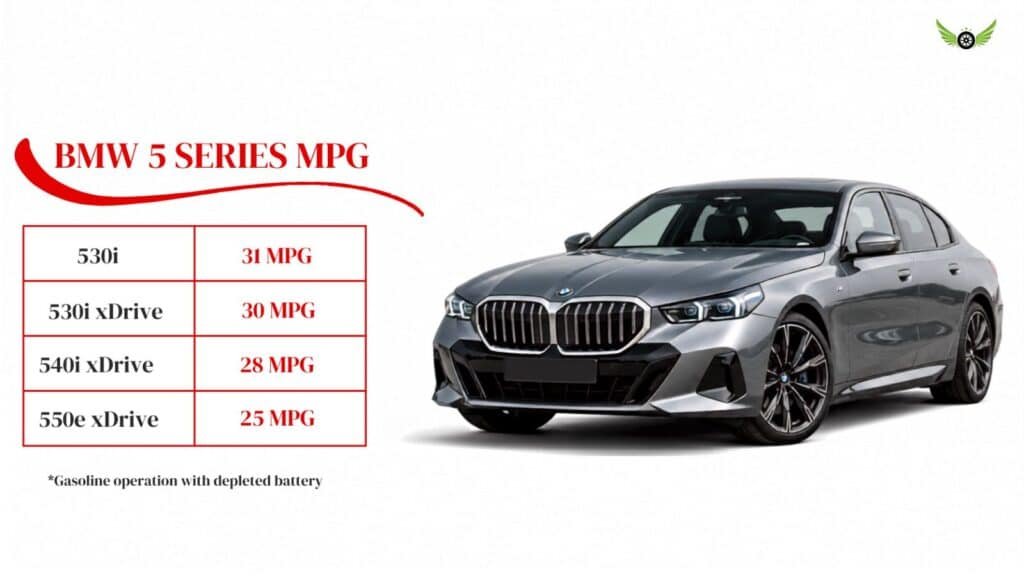
The BMW 5 Series offers different fuel-economy results depending on the engine and drivetrain. For U.S. buyers, the 530i is the most efficient gasoline model, while the 540i xDrive gives up some mileage for its stronger six-cylinder performance. The 550e xDrive takes a different approach by combining gasoline and electric power. In real-world use, driving style, traffic, weather, speed, and how often the 550e is charged can make a noticeable difference to overall fuel consumption.
EPA City, Highway & Combined MPG by Powertrain
For 2026, the BMW 5 Series MPG ratings show a clear difference between the powertrains. The rear-wheel-drive 530i is rated at 29 mpg city, 35 mpg highway, and 31 mpg combined. Choosing the 530i xDrive lowers those figures to 26/34/30 mpg. The 540i xDrive is rated at 26 mpg city, 32 mpg highway, and 28 mpg combined.
The 550e xDrive plug-in hybrid is rated at 25 mpg combined when operating on gasoline, while its combined electric/gasoline efficiency is rated at 68 MPGe. Car and Driver lists the 550e at 22 mpg city and 28 mpg highway on gasoline.
2026 BMW 5 Series | City | Highway | Combined |
530i | 29 mpg | 35 mpg | 31 mpg |
530i xDrive | 26 mpg | 34 mpg | 30 mpg |
540i xDrive | 26 mpg | 32 mpg | 28 mpg |
550e xDrive | 22 mpg* | 28 mpg* | 25 mpg* |
Gasoline operation; the 550e also has a 68 MPGe combined rating when electric operation is included.
Real-World BMW 5 Series Mileage & Premium Fuel Costs
The BMW 5 Series Mileage looks particularly strong on the highway when compared with the power available. In independent 75-mph highway testing, the 530i xDrive returned 35 mpg, while the 540i xDrive delivered 37 mpg. The 540i result is especially impressive because it comes from the 375-hp inline-six rather than the four-cylinder 530i.
For fuel cost, the important point is that BMW recommends 91 AKI gasoline for these models. The U.S. average premium gasoline price was $5.070 per gallon on August 31, 2026, according to the U.S. Energy Information Administration. With the 5 Series’ 15.9-gallon fuel tank, filling an empty tank at that national average would cost approximately $80.61. Your local price can be higher or lower depending on the state and station.
2026 BMW 5 Series | Mileage Used | Fuel for 15,000 Miles | Premium Fuel Cost/Year* | Cost per 1,000 Miles |
530i EPA combined | 31 mpg | 483.9 gal | $2,452.95 | $163.55 |
530i xDrive real-world highway | 35 mpg | 428.6 gal | $2,171.43 | $144.76 |
540i xDrive EPA combined | 28 mpg | 535.7 gal | $2,714.29 | $180.95 |
540i xDrive real-world highway | 37 mpg | 405.4 gal | $2,055.41 | $137.03 |
550e xDrive gasoline rating | 25 mpg | 600.0 gal | $3,042.00 | $202.80 |
Calculated at the current U.S. average premium price of $5.070/gal and assumes 15,000 miles driven entirely on gasoline. Actual annual cost will vary with fuel prices and driving conditions. The 530i xDrive and 540i xDrive highway figures are independent 75-mph test results, not EPA combined ratings.
According to our experience, the BMW 5 Series MPG story is more favorable on longer highway trips than the EPA combined figure alone suggests. The 540i xDrive is a good example: its EPA combined rating is 28 mpg, yet it returned 37 mpg in a controlled 75-mph highway test. For buyers who drive many highway miles, that difference can have a meaningful effect on fuel spending.
BMW 5 Series Performance & Acceleration
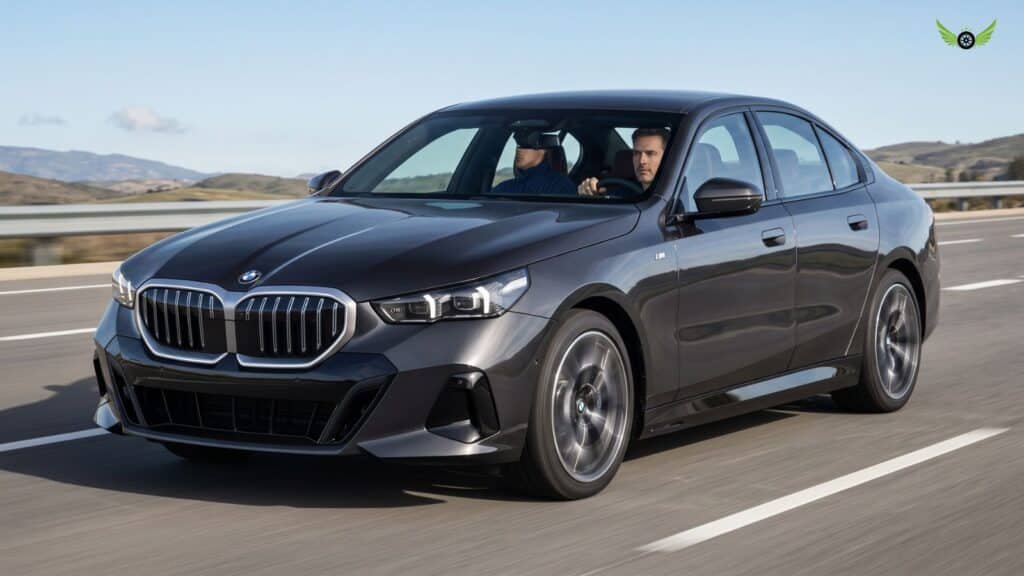
The 2026 BMW 5 Series offers a clear step-up in performance from the 530i to the 540i xDrive and 550e xDrive. The 530i uses a 255-hp turbocharged four-cylinder, the 540i xDrive has a 375-hp turbocharged inline-six, and the 550e xDrive combines a turbocharged inline-six with an electric motor for 483 hp. BMW rates the 530i, 540i xDrive, and 550e xDrive at 5.9, 4.4, and 4.1 seconds from 0–60 mph, respectively.
530i vs 540i vs 550e Power and 0–60 MPH Performance
The 530i produces 255 hp and 295 lb-ft of torque. Its 2.0-liter turbocharged four-cylinder provides adequate acceleration for everyday driving. In independent testing, Edmunds recorded 5.7 seconds from 0–60 mph, slightly quicker than BMW’s 5.9-second estimate.
The 540i xDrive uses a 3.0-liter turbocharged inline-six with 375 hp and 398 lb-ft of torque. Its additional power makes it considerably quicker than the 530i. Edmunds recorded 4.3 seconds to 60 mph, while a recent Car and Driver comparison recorded 4.1 seconds.
The 550e xDrive is the most powerful non-M version, producing 483 hp and 516 lb-ft of torque. BMW lists 4.1 seconds to 60 mph, while MotorTrend achieved 3.8 seconds in testing. Edmunds recorded 4.1 seconds.
Model | Power | Torque | BMW 0–60 mph |
530i | 255 hp | 295 lb-ft | 5.9 sec |
540i xDrive | 375 hp | 398 lb-ft | 4.4 sec |
550e xDrive | 483 hp | 516 lb-ft | 4.1 sec |
For most drivers, the 530i has sufficient performance for daily use. The 540i xDrive is the stronger choice for faster acceleration and more effortless passing, while the 550e xDrive provides the quickest straight-line performance of the three.
Mild-Hybrid and Plug-In Hybrid Driving Performance
The 530i and 540i xDrive use 48-volt mild-hybrid systems. The electric motor-generator supports the gasoline engine and helps smooth power delivery, but these models remain gasoline-powered vehicles. The 540i benefits more noticeably from its inline-six, delivering stronger low- and mid-range acceleration than the 530i.
The 550e xDrive uses a plug-in hybrid system with a 3.0-liter turbocharged inline-six and electric motor. Its electric motor adds immediate torque at low speeds, while the gasoline engine provides continued power as speed increases. The combined output is 483 hp and 516 lb-ft of torque.
This combination also shows up in independent testing. MotorTrend recorded 3.8 seconds to 60 mph and described the transition between electric and gasoline power as smooth. Edmunds recorded 4.1 seconds to 60 mph and a 12.2-second quarter mile at 113.4 mph.
The main difference is therefore simple: the mild-hybrid 530i and 540i retain a conventional gasoline driving character, while the plug-in hybrid 550e uses electric torque to provide faster initial response and stronger overall acceleration.
BMW 5 Series Real-World Driving Experience
The 2026 BMW 5 Series focuses on comfort, stability, and refinement rather than sharp sports-sedan behavior. Independent road tests consistently find a comfortable ride, strong high-speed stability, and a quiet cabin. The main compromise is steering feel, which several reviewers describe as light or lacking road feedback.
Ride Comfort, Handling & Steering Feel
Ride comfort is one of the strongest aspects of the 5 Series. Consumer Reports found the 530i xDrive’s ride comfortable while maintaining controlled handling, and Edmunds also rated the car highly for comfort. The chassis remains stable when driven harder, with limited body movement and good control at higher speeds.
The suspension setup makes a noticeable difference. Cars equipped with sport suspension and larger wheels can feel firmer over broken pavement. Capital One’s 2026 540i test found that its 21-inch wheels and sport suspension transmitted more bumps and tire noise into the cabin.
Steering feedback is less impressive. Consumer Reports found the 530i’s steering too light and lacking information about road texture and tire grip. Edmunds reported a similar issue with the 550e, noting its quick steering response but limited surface feedback.
According to our experience, the 5 Series is better suited to drivers who want a controlled and comfortable luxury sedan than those looking for highly communicative steering. The chassis provides confidence, but the steering does not deliver the road feel traditionally associated with BMW sedans.
City Driving, Highway Comfort & Cabin Quietness
In city driving, the 5 Series is easy to manage despite its size. Edmunds describes it as comfortable and pleasant to drive, with sufficient power for traffic and quick enough responses for normal urban driving.
Highway driving is where the car’s refinement becomes most noticeable. The suspension keeps the sedan composed at speed, while the seats provide good support for longer journeys. Cabin noise is also low; Edmunds reports that the six-cylinder engine is largely inaudible during normal driving, while Consumer Reports describes the cabin as very quiet.
The 550e xDrive adds another layer of refinement because its plug-in hybrid powertrain can operate on electric power when battery charge is available. Edmunds describes the 550e’s cabin as near-silent and its ride as particularly compliant.
For everyday use, the 5 Series is strongest as a quiet, comfortable, and stable luxury sedan. Buyers who prioritize steering feedback and maximum driving involvement may find its tuning less engaging than earlier BMW 5 Series generations.
BMW 5 Series Plug-In Hybrid Driving & Charging Experience
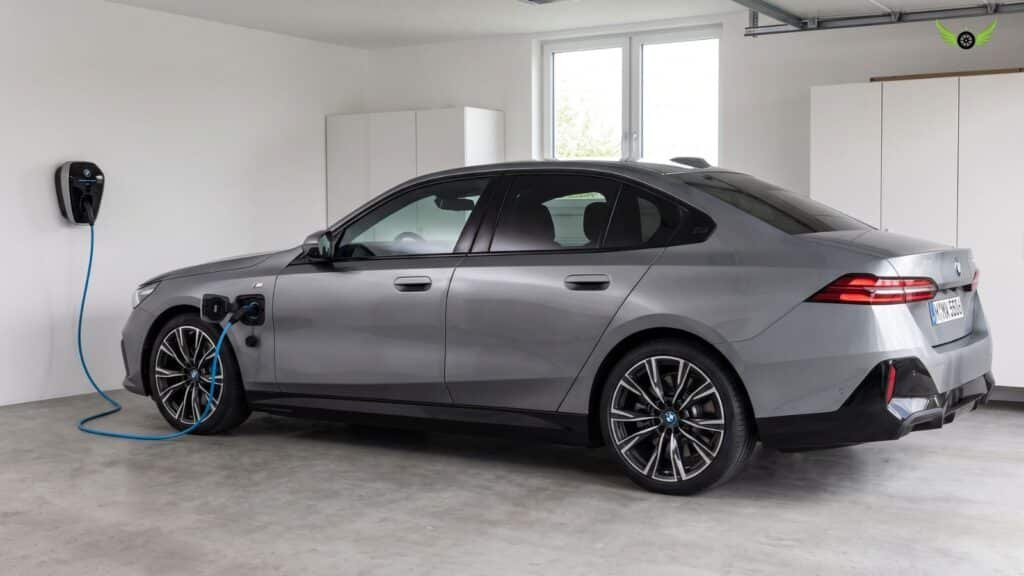
The 2026 BMW 550e xDrive combines a 3.0-liter turbocharged inline-six with an electric motor and a high-voltage battery. It has an EPA-rated 34-mile electric range, while BMW lists up to 33 miles depending on configuration. When the battery is depleted, the gasoline engine continues to power the car, making the 550e practical for both short electric trips and longer journeys.
Electric Driving Range and Everyday PHEV Use
The 550e xDrive can travel 34 miles on electricity according to the EPA. BMW notes that actual electric range varies with wheel and tire selection, driving style, traffic, temperature, and other conditions.
For everyday driving, that range can cover many short commutes without starting the gasoline engine. BMW recommends charging the vehicle regularly so owners can make greater use of its electric drive system. When the available battery charge becomes low, the vehicle automatically uses its TwinPower Turbo engine.
Independent testing shows that actual electric range can vary from the EPA figure. Tom’s Guide recorded 36.2 electric miles during a week-long test, while other road tests have reported results around 40 miles under favorable conditions. These results are useful real-world references, but they should not be treated as a guaranteed range for every driver.
2026 BMW 550e xDrive | Official / EPA figure |
EPA electric range | 34 miles |
EPA combined MPGe | 68 MPGe |
EPA gasoline economy with depleted battery | 25 mpg |
Fuel tank | 15.9 gallons |
Charging connector | SAE J1772 |
Home Charging, Charging Time & Long-Distance Travel
The 2026 550e xDrive supports 11 kW AC charging, an increase from the previous 7.4-kW charging rate. BMW says the change applies to 550e xDrive models produced from March 2025 onward. BMW USA lists approximately 1 hour 45 minutes for a 0–100% AC charge when charging at the vehicle’s maximum rate.
A 240-volt Level 2 home charger is therefore the most practical setup for regular use. BMW states that Level 1 charging from a standard 120-volt outlet can take 15–20 hours or more for a full PHEV charge, depending on the model and battery size.
The 550e is not dependent on public DC fast charging for long-distance travel. BMW’s charging information states that DC charging is intended for its battery-electric vehicles, not its plug-in hybrids. Once the 550e’s electric range is used, the gasoline engine continues operating, with an EPA-rated 25 mpg combined when the battery is depleted.
This makes the 550e most useful for drivers who can charge at home and use electric power for daily trips, while still having the flexibility of a gasoline engine for longer highway journeys.
BMW 5 Series vs Competitors for Mileage & Driving Performance
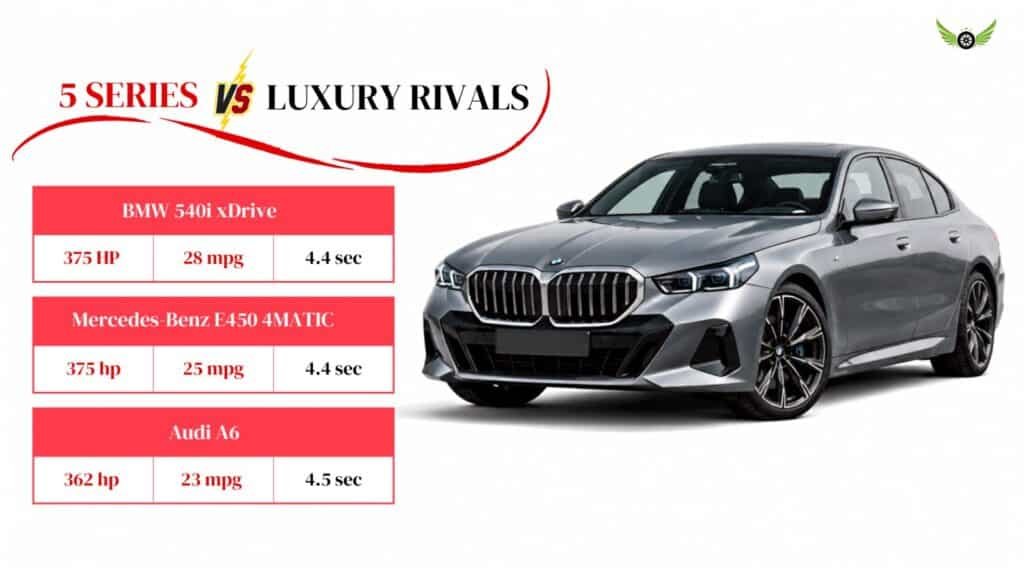
The 2026 BMW 5 Series has one of the broadest powertrain choices in the midsize luxury sedan class. The 530i focuses on fuel economy, the 540i xDrive adds six-cylinder performance, and the 550e xDrive combines six-cylinder power with plug-in hybrid technology. Its closest rivals include the Mercedes-Benz E-Class, Audi A6, and Genesis G80.
Fuel Economy and Performance Compared with Luxury Rivals
The 530i has the strongest EPA combined fuel economy among the gasoline models compared here, at 31 mpg, while the 540i xDrive is rated at 28 mpg. The Mercedes-Benz E350 4MATIC returns 27 mpg combined, while the 2026 Audi A6 is rated at 23 mpg. The Genesis G80 2.5T AWD is rated at 20/29 mpg city/highway.
Performance is similarly competitive. BMW rates the 540i xDrive at 4.4 seconds from 0–60 mph, matching the Mercedes-Benz E450 4MATIC’s 4.4-second claim. The Audi A6 is rated at 4.5 seconds, while the Genesis G80 3.5T is less quick in independent testing.
Model | Power | EPA Combined MPG | 0–60 mph |
BMW 530i | 255 hp | 31 mpg | 5.9 sec |
BMW 540i xDrive | 375 hp | 28 mpg | 4.4 sec |
Mercedes-Benz E350 4MATIC | 255 hp | 27 mpg | 6.1 sec |
Mercedes-Benz E450 4MATIC | 375 hp | 25 mpg | 4.4 sec |
Audi A6 | 362 hp | 23 mpg | 4.5 sec |
Genesis G80 2.5T AWD | 300 hp | 23 mpg combined | N/A |
Genesis publishes 20/29 mpg city/highway for the 2.5T AWD; a combined figure is not shown on its current U.S. build page.
Independent testing adds useful context. Car and Driver recorded 4.1 seconds to 60 mph for the 540i xDrive and 4.3 seconds for the Audi A6. It also recorded 37 mpg for the 540i and 38 mpg for the A6 on its 75-mph highway test. These are test results, not EPA ratings, and were achieved under controlled test conditions.
The 550e xDrive changes the comparison because it adds a plug-in hybrid powertrain. It produces 483 hp, reaches 60 mph in a BMW-rated 4.1 seconds, and has an EPA-rated 34 miles of electric range. None of the standard E-Class, A6, or G80 versions listed above combines this level of output with a comparable plug-in hybrid setup.
Which Luxury Sedan Offers the Best Balance?
For overall balance, the BMW 540i xDrive is one of the strongest choices if performance and fuel economy are equally important. Its 375-hp inline-six delivers 4.4-second claimed acceleration while still returning 28 mpg combined. That is better fuel economy than the 375-hp Mercedes-Benz E450 4MATIC, which is rated at 25 mpg combined.
The Audi A6 is also highly competitive. It produces 362 hp, reaches 60 mph in 4.5 seconds, and returns 23 mpg combined. Its advantage is not fuel economy but its balance of performance and refinement; in a recent direct comparison, Car and Driver favored the A6 overall, while the BMW was quicker and more engaging to drive.
The Mercedes-Benz E-Class is a strong choice for buyers prioritizing smooth performance and luxury, but its comparable E350 and E450 versions do not match the BMW’s fuel-economy figures. The Genesis G80 offers strong value and a 300-hp base engine, but its 20/29 mpg rating is lower than the 530i’s and its performance is less focused on outright acceleration.
For buyers who want the broadest combination of fuel efficiency, six-cylinder performance, and plug-in hybrid capability, the 5 Series has the most flexible lineup. The 540i xDrive provides the best balance for a conventional gasoline luxury sedan, while the 550e xDrive is the better fit for buyers who can regularly charge at home and want stronger performance with electric driving capability.
2026 BMW 5 Series Mileage, MPG, Performance & Driving Experience FAQs
The 2026 BMW 5 Series combines fuel economy, acceleration, ride comfort, highway refinement, and different powertrain options. These FAQs cover the main questions buyers may have about BMW 5 Series mileage, MPG, performance, real-world driving, the 550e plug-in hybrid, electric range, charging, and choosing the right model.
How many MPG does the 2026 BMW 5 Series get?
The 2026 BMW 5 Series 530i is rated at 31 mpg combined, the 530i xDrive at 30 mpg, and the 540i xDrive at 28 mpg. The 550e xDrive is rated at 25 mpg combined when its battery is depleted.
Which 2026 BMW 5 Series has the best MPG?
The 530i has the best EPA-rated fuel economy, at 31 mpg combined. It is rated at 28 mpg city and 35 mpg highway.
How fast is the 2026 BMW 5 Series?
BMW rates the 530i at 5.9 seconds, the 540i xDrive at 4.4 seconds, and the 550e xDrive at 4.1 seconds from 0–60 mph. Independent testing has recorded quicker results for some versions.
Which BMW 5 Series has the best performance?
The 550e xDrive has the highest output and quickest BMW-rated acceleration among the non-M models. It produces 483 hp and 516 lb-ft of torque and is rated at 4.1 seconds to 60 mph.
Is the BMW 5 Series comfortable for daily driving?
Yes. The 5 Series provides a comfortable ride, controlled body movement, and easy around-town driving. Independent testing also finds strong highway stability, although sport suspension and larger wheels can make the ride firmer over rough roads.
Is the BMW 5 Series good for highway driving?
Yes. Highway driving is one of its strongest areas because of its stable chassis, controlled ride, supportive seats, and quiet cabin. Edmunds found the 5 Series stable at highway speeds and easy to drive around town.
Does the BMW 5 Series have a good steering feel?
The steering is responsive but relatively light and provides limited road feedback compared with older, more driver-focused BMW sedans. The chassis itself offers good grip and stability, but steering feel is not a major strength.
How far can the BMW 550e xDrive drive on electric power?
The 2026 BMW 550e xDrive has an EPA-rated 34-mile electric range. Actual electric range varies with temperature, driving conditions, speed, tires, and climate-control use.
How long does the BMW 550e take to charge?
The 550e takes approximately 2 hours to charge at 240 volts according to current EPA/Edmunds specifications. BMW’s charging information can vary by charging equipment and conditions.
Is the BMW 550e good for everyday driving?
Yes, particularly for drivers who can charge at home. Its 34-mile EPA electric range can cover many short trips, while the gasoline engine provides additional range for longer journeys.
What happens when the BMW 550e battery runs out?
When the available electric charge becomes low, the 550e automatically switches to gasoline operation. Its EPA rating is 25 mpg combined when the battery is depleted.
Is the BMW 5 Series quiet inside?
Yes. Independent testing describes the 5 Series cabin as very quiet, and the 550e can be particularly quiet when operating on electric power.
Which BMW 5 Series is best for fuel economy?
The 530i is the best choice for buyers focused primarily on fuel economy, with its 31-mpg combined EPA rating. It also avoids the additional weight and complexity of the 550e plug-in hybrid system.
Which BMW 5 Series is best for performance and fuel economy?
The 540i xDrive offers the strongest balance for conventional gasoline driving, with 375 hp, 398 lb-ft of torque, a 4.4-second BMW-rated 0–60 mph time, and 28 mpg combined. Edmunds also recommends the 540i xDrive as its preferred blend of power and efficiency.
Is the 2026 BMW 5 Series good for long-distance driving?
Yes. Its comfortable ride, highway stability, quiet cabin, and efficient powertrains make it well suited to longer trips. The 550e adds electric driving for shorter journeys while retaining gasoline power for extended travel.
What is the best BMW 5 Series for everyday use?
The 540i xDrive is the best all-around choice for buyers who want stronger performance without giving up reasonable fuel economy. The 530i is better for maximum efficiency, while the 550e makes more sense for buyers who can regularly charge and want plug-in hybrid capability.