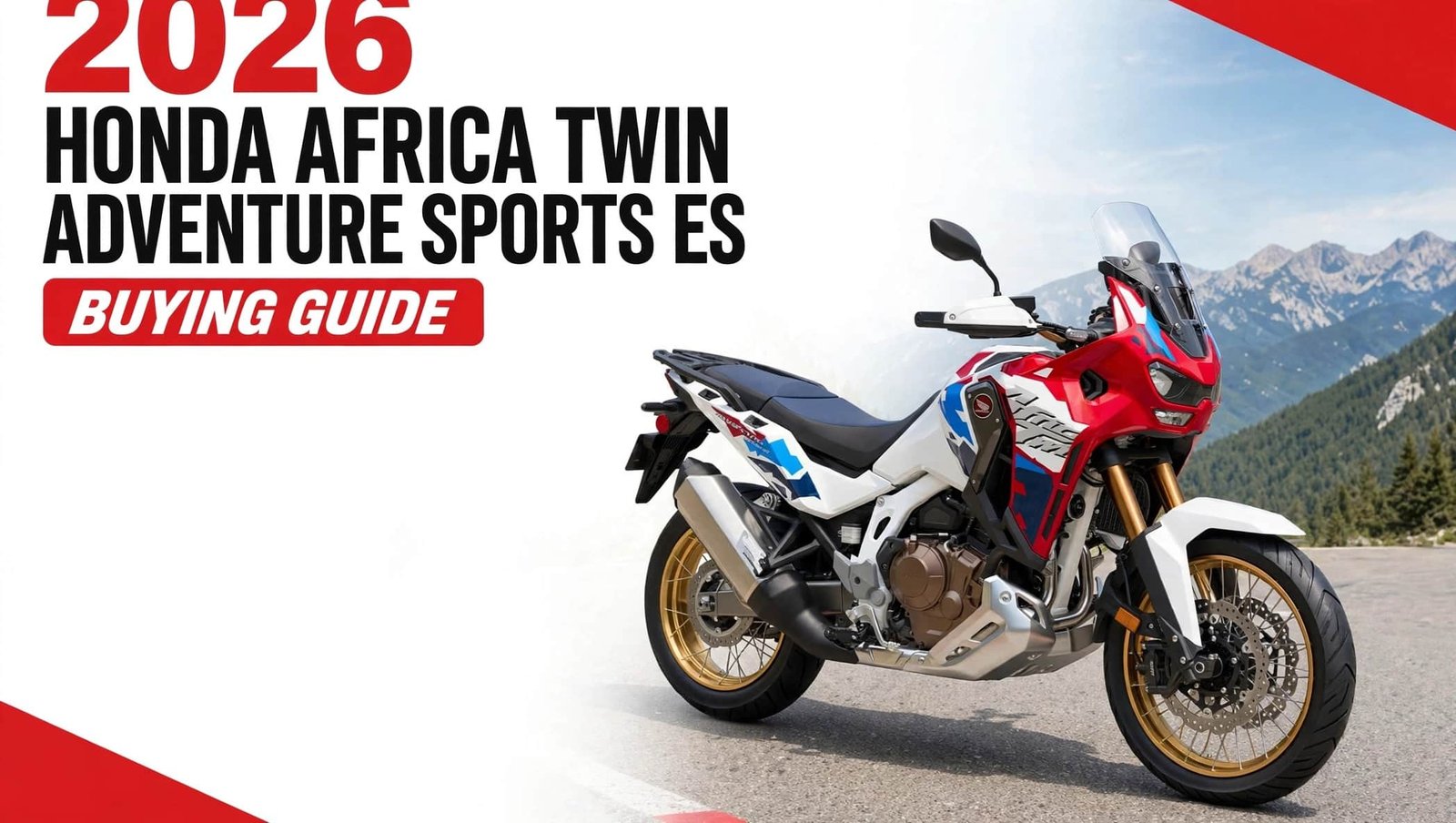
If you want the touring version of Honda’s big adventure bike, a used Adventure Sports ES is one of the smartest buys — but only if you buy the right year and check the electronics properly. This Honda Africa Twin Adventure Sports ES buying guide gives you the direct answers first: clean used ES examples run roughly $10,000 to $16,500 by year and mileage, a new 2026 ES lists at $17,799 manual or $18,599 DCT before a $775 destination charge, and the checks that catch buyers out most are the EERA suspension, the cold touchscreen, and open recalls.
The short version of this Honda Africa Twin Adventure Sports ES buying guide is simple. Buy a 2024-or-newer ES if your budget reaches it, for the 19-inch wheel, lower seat, and newest electronics. Buy a 2020–2022 ES for electronic suspension for less, accepting the taller 21-inch-wheel bike. Either way, check the VIN, test the touchscreen cold, and cycle the EERA suspension before you pay.
Honda Africa Twin Adventure Sports ES Price and Market Availability
Used ES prices are set by year first and mileage second: 2024-on bikes cost most, 2020–2022 models sit in the middle, and high-mileage 2021 examples are cheapest. This Honda Africa Twin Adventure Sports ES buying guide uses real dealer listings observed on November 2–3, 2026; every price in this Honda Africa Twin Adventure Sports ES buying guide is an asking price.
What Does a Used Africa Twin Adventure Sports ES Cost in the USA by Year?
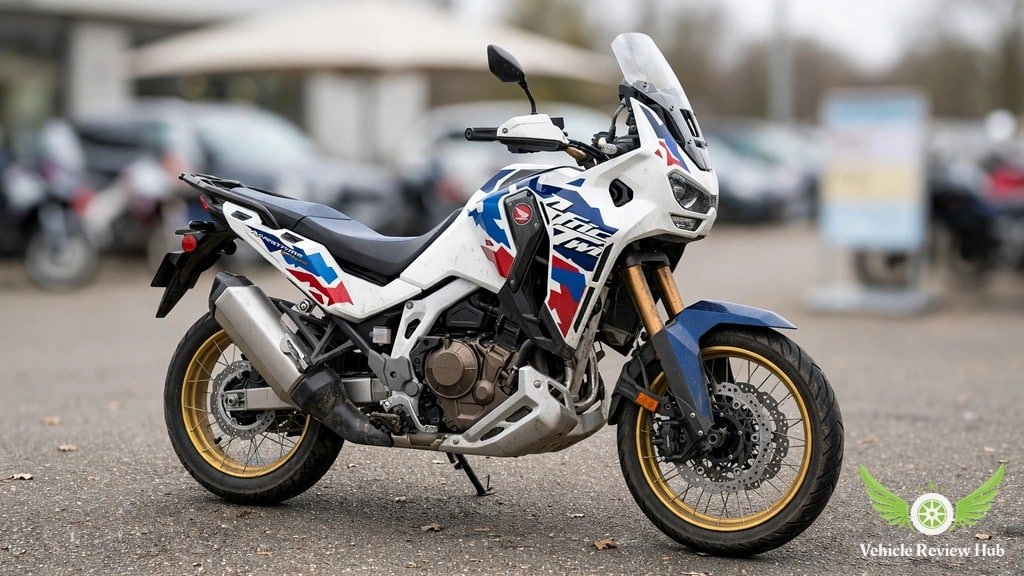
For the newest generation, this Honda Africa Twin Adventure Sports ES buying guide found a 2025 ES with 214 miles at $16,500 from New York Honda, Long Island City, a 2025 ES DCT with 4,017 miles at $14,999 from Lafayette Powersports II, Louisiana, and a 2024 ES DCT with 2,142 miles at $14,495 from Team R&S Powersports, Albuquerque. For the earlier generation, a 2021 ES manual with 1,725 miles was listed at $11,999 by Crossbay Motorsports, Bay Shore, NY, while a 2021 ES manual with 40,370 miles was listed at $9,995 by Specialty Motorsports, Sacramento. This Honda Africa Twin Adventure Sports ES buying guide notes mileage moves price by hundreds on low-mileage bikes but by thousands past 40,000.
| Listing observed Nov 2–3, 2026 | Price | Mileage | Seller |
|---|---|---|---|
| 2025 Adventure Sports ES | $16,500 | 214 miles | New York Honda, Long Island City, NY |
| 2025 Adventure Sports ES DCT | $14,999 | 4,017 miles | Lafayette Powersports II, Lafayette, LA |
| 2024 Adventure Sports ES DCT | $14,495 | 2,142 miles | Team R&S Powersports, Albuquerque, NM |
| 2021 Adventure Sports ES manual | $11,999 | 1,725 miles | Crossbay Motorsports, Bay Shore, NY |
| 2021 Adventure Sports ES manual | $9,995 | 40,370 miles | Specialty Motorsports, Sacramento, CA |
Is the Africa Twin Adventure Sports ES Available Through US Dealers?
Yes, through any authorized Honda dealer. For 2026, this Honda Africa Twin Adventure Sports ES buying guide notes Honda lists the ES at $17,799 manual and $18,599 DCT, plus $775 destination, in Pearl White. The 2024 and 2025 ES models were listed at $17,599 manual and $18,399 DCT, also in Pearl White — $200 less. Honda sold no 2023 US model; the lineup returned for 2024, as this Honda Africa Twin Adventure Sports ES buying guide notes. The official Honda USA Adventure Sports ES page confirms the 2026 specifications, and Motorcycle.com’s 2024 US announcement confirms the 2024 prices. This Honda Africa Twin Adventure Sports ES buying guide recommends comparing every used ES price against the 2026 ceiling.
Honda Africa Twin Adventure Sports ES Insurance and Ownership Costs
The purchase price is only the first ES cost. Insurance, fuel, tires, chain, and service add up to a real annual figure, and this Honda Africa Twin Adventure Sports ES buying guide separates predictable costs from surprises.
Why No ES-Specific US Insurance Average Exists and Quotes Vary Widely
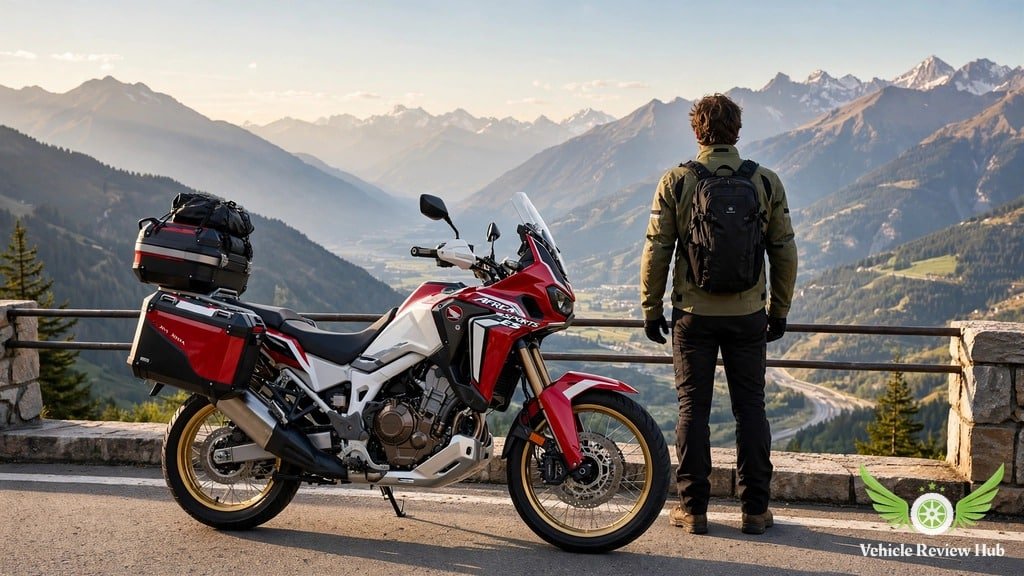
There is no published ES-specific US insurance average, and this Honda Africa Twin Adventure Sports ES buying guide will not invent one. Insurers rate the Africa Twin line as a whole, and no survey breaks the ES trim out separately, so any “ES average premium” is a guess. The closest labelled data is BikeBound’s owner-reported Africa Twin survey: full coverage roughly $300–$800 a year for experienced riders ($297–$751 examples), but $2,600 for a 25-year-old in Alaska and above $3,000 in California. This Honda Africa Twin Adventure Sports ES buying guide treats that range as a family reference, not an ES quote. This Honda Africa Twin Adventure Sports ES buying guide recommends three quotes with the exact VIN, and checking EERA coverage, since one actuator or dash replacement can exceed a year of premiums.
How to Estimate Fuel, Maintenance, Parts and Other Ownership Expenses
Honda USA publishes no official MPG figure, so owner-logged data tells the story: Fuelly’s owner average for the 2017 CRF1000L ABS is 47.8 mpg, or roughly 315 miles from the 6.6-gallon tank. That 47.8 figure is owner-logged data from the older 998cc generation, not a magazine test, so treat 310–315 miles as a planning range. Maintenance is the next fixed cost: oil every 8,000 miles, valves every 16,000 miles, air cleaner every 24,000 miles, plugs every 32,000 miles, brake fluid every two years, and coolant every three years, per the service chart. This Honda Africa Twin Adventure Sports ES buying guide notes tires last 5,000 to 8,000 miles; the wider 110/80-19 front costs more. This Honda Africa Twin Adventure Sports ES buying guide puts a budget around $1,500 to $2,500 before fuel, before fuel. The Adventure Sports ES reliability and maintenance guide explains which wear items turn expensive; the ES-specific warning is the suspension, since EERA work is dealer-level diagnosis and repair.
How to Inspect a Used Honda Africa Twin Adventure Sports ES
A used ES hides its problems where a walk-around misses them: suspension electronics, touchscreen, service book, and recall record — four checks this Honda Africa Twin Adventure Sports ES buying guide covers. This section of the Honda Africa Twin Adventure Sports ES buying guide is a checklist — VIN first, cold electronics second, chassis third.
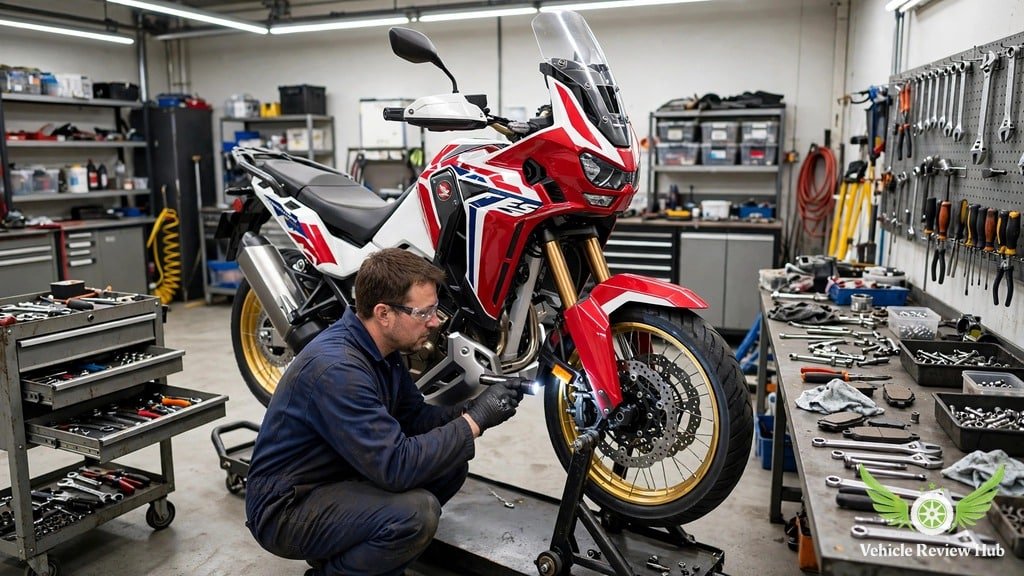
Checking Recall Completion by VIN, Cold TFT Test and Service Records
This Honda Africa Twin Adventure Sports ES buying guide says start with the VIN: run it through Honda’s recall lookup and NHTSA, and ask for paperwork, not just an assurance. The fuel-filter recall, NHTSA 20V797000 and Honda KL4, covers certain Adventure Sports models, 2,690 units, for tank-welding contaminants clogging the filter; dealers drain and clean the tank and replace the filter free of charge. This is Adventure Sports history, not standard-model history. The ECU recall, NHTSA 24V882000 and Honda KR1, covers certain 2022 and 2024–2025 CRF1100 models, 4,205 units, for a software error that can stall the engine when Wheelie Control is activated; dealers reprogram it free. The switch harness recall, NHTSA 25V583000 and Honda KS8, covers certain 2020–2022 and 2024–2025 CRF1100 models, 7,492 units, for corrosion at the left switch terminals; dealers fit a redesigned assembly free. Next, test the touchscreen cold: arrive before the seller warms the bike, and check every zone of the 6.5-inch TFT for dead areas, plus Bluetooth pairing. Cold-weather touchscreen trouble is a documented ES niggle, so a warm-bike-only test can hide it. Finally, check receipts against the oil, valve, and air cleaner schedule. This Honda Africa Twin Adventure Sports ES buying guide treats an unchecked VIN or an untested cold screen as an unfinished inspection.
Inspecting the EERA Suspension, Frame, Tires, Brakes and Chain
The EERA suspension is the ES’s headline feature and its most expensive inspection item, so this Honda Africa Twin Adventure Sports ES buying guide says test it properly. With the bike running, cycle the damper through hard, medium, soft, off-road, and user, and the preload through solo, solo with luggage, two-up, and two-up with luggage, feeling for a real change at each step. A dead setting, grinding actuator, warning light, or stored error code is a walk-away or renegotiate fault, because EERA repair is dealer work. Then check for fork and shock leaks. Next, check the chassis for crash scrapes, cracked or repainted frame welds, and rusty spokes and rims. Confirm tire sizes match the year: 2024-on ES models use a 110/80-19 front and 150/70-18 rear, while 2020–2022 ES models use a 90/90-21 front, so a wrong-size front tire means a swap or a misidentified bike. Check discs for scoring and pad thickness, and the chain for stretch and hooked teeth. The Adventure Sports ES performance figures show what the engine delivers, but no figure compensates for dead suspension electronics. This Honda Africa Twin Adventure Sports ES buying guide recommends pricing every failed EERA setting, every worn item, and every missing service receipt into your offer.
Honda Africa Twin Adventure Sports ES Model Years and Features to Compare
Three eras, one badge, and one wheel change make the ES lineup confusing, so this Honda Africa Twin Adventure Sports ES buying guide compares them side by side. The full Adventure Sports ES review covers how each generation rides.
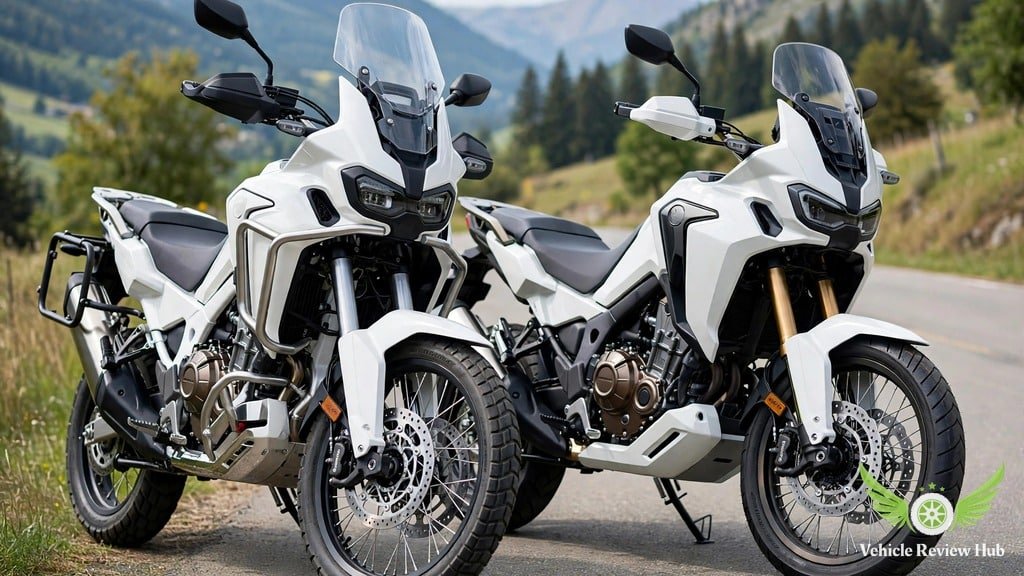
Comparing Tall 2018-2019 and 21-Inch 2020-2022 Models With 2024-On Versions
This Honda Africa Twin Adventure Sports ES buying guide traces the story to 2018 and the CRF1000L Adventure Sports: tall, 21-inch front wheel, larger tank, bigger fairing, no electronic suspension — the ES badge did not exist yet. The ES arrived in 2020 with the CRF1100L: the same 21-inch wheel, plus Showa EERA suspension, heated grips, and the 1084cc engine, keeping that tall layout through 2022. Honda sold no 2023 US model, and the 2024 repositioning changed the bike’s character: a 19-inch front wheel, shorter-travel EERA suspension at 7.3 inches front and 7.9 inches rear against 9.1 and 8.7 inches before, a lower 33.7-inch seat (32.9 inches low) and revised touring bodywork. The 2024-on bike is calmer on pavement and easier at stops, but gives up some off-road ability. Rider’s 2024 first look confirms the changes and prices, and Ultimate Motorcycling’s 2024 ES buyer’s guide confirms the shorter travel figures. This Honda Africa Twin Adventure Sports ES buying guide recommends the 2024-or-newer ES for pavement riding and shorter riders, and the 2020–2022 ES for riders wanting the taller, longer-travel bike. Never accept a pre-2024 ES advertised with a 19-inch wheel: on a 2020–2022 bike it has been swapped.
Which Features Matter Most: EERA, Tank Size and Heated Grips?
Three features matter most, and this Honda Africa Twin Adventure Sports ES buying guide ranks them above all other options. EERA matters most, changing damping and preload at the touch of a button for solo, loaded, and two-up riding — but only if every setting works. Tank size matters second: the 6.6-gallon ES tank stretches range to roughly 310–315 miles on owner-logged economy, against roughly 240 miles for the standard 5.0-gallon tank. Heated grips matter third, standard on the ES, extending the riding season, while the larger windscreen and fairing cut fatigue on long highway days. The standard Africa Twin review shows the base bike without these extras. This Honda Africa Twin Adventure Sports ES buying guide recommends working EERA, the big tank, and heated grips over cosmetics.
Honda Africa Twin Adventure Sports ES vs Standard Africa Twin in the USA
This Honda Africa Twin Adventure Sports ES buying guide answers this split decision without favoring either bike: the standard is the off-road tool, the ES the touring machine, both sharing the 1084cc engine.
Watch the years to avoid, the recalls to check, and the prices to expect:
ES at $17,799 Against the Standard Model at $15,199: What the Extra Buys
For 2026, this Honda Africa Twin Adventure Sports ES buying guide notes the ES manual lists at $17,799 against the standard model’s $15,199 manual, a difference of $2,600 before the same $775 destination on both. That extra money buys Showa EERA suspension, the 6.6-gallon tank against 5.0 gallons, the larger adjustable windscreen and touring fairing, heated grips as standard, and the 19-inch front wheel with its wider tubeless tire. The standard bike keeps the 21-inch front wheel, longer travel, and 510-pound manual curb weight against the ES’s 535 pounds, so it is better for genuinely off-road riding; the ES is better for pavement touring and two-up riding. This Honda Africa Twin Adventure Sports ES buying guide recommends the ES for pavement touring with range, wind protection, and electronic suspension, and the standard bike for genuinely off-road riders.
Manual or DCT? The $800 Premium and 24 lb Weight Difference Explained
The ES DCT lists at $18,599 against $17,799 for the ES manual, an $800 premium, and weighs 559 pounds against 535 pounds for the manual, a 24-pound difference. This Honda Africa Twin Adventure Sports ES buying guide notes the manual is lighter and simpler to service, with a clutch you control, while the DCT removes clutch fatigue in traffic and on tours and holds its value well, since most choose it. Test ride both before you decide. The standard Africa Twin performance figures show how the same engine behaves in the lighter bike. This Honda Africa Twin Adventure Sports ES buying guide recommends the manual for off-road control and the lightest ES, and the DCT for commuting and touring; DCT examples dominate, so manual ES bikes can take longer to find.
Is Buying a Used Honda Africa Twin Adventure Sports ES Worth It?
For most touring riders, yes — with two conditions: fully working electronics and a fair price, as this Honda Africa Twin Adventure Sports ES buying guide weighs below.
Benefits and Risks of Buying a Used Adventure Sports ES in the USA
Benefits: a proven Honda parallel-twin, the most comfortable Africa Twin chassis, a large owner community, and strong dealer parts support. Depreciation favors buyers, as this Honda Africa Twin Adventure Sports ES buying guide notes: a clean 2021 ES at around $10,000 to $12,000 delivers electronic suspension, heated grips, and the big tank for two thirds of a new ES price, and a new 2025 ES at $14,999 to $16,500 saves thousands against the 2026 ceiling. The risks are specific and avoidable: dead EERA settings, a cold-sensitive touchscreen, the 16,000-mile valve service, and tires, chain, and suspension refresh on high-mileage bikes. Owner satisfaction scores are not quoted here: the ES sample is too small to carry a number. This Honda Africa Twin Adventure Sports ES buying guide recommends a $500 to $1,000 first-service reserve, plus an allowance for dealer electronics.
US-Market Alternatives: R 1300 GS, V-Strom 1050DE and Tiger 900
If the ES does not fit you, this Honda Africa Twin Adventure Sports ES buying guide compares three alternatives on price and purpose. The BMW R 1300 GS Adventure, starting at $23,645 plus destination for 2026 with a 1,300cc boxer twin making 145 horsepower and 110 lb-ft and a 7.9-gallon tank, is the premium alternative: more power and range, but far higher purchase and service costs. The Suzuki V-Strom 1050DE, listed at $16,449 for 2026, is the value alternative: a 1037cc V-twin with a 21-inch front wheel, priced below the ES, without electronic suspension. The Triumph Tiger 900 is the middleweight-flavored alternative, with the Rally Pro listed at $17,595 for 2026 and the GT Pro at $17,295 — an 888cc triple, but higher service costs. The ES stays the default in this Honda Africa Twin Adventure Sports ES buying guide for touring.
Honda Africa Twin Adventure Sports ES Buying Guide: Frequently Asked Questions
These direct answers cover the questions buyers ask most after reading the Honda Africa Twin Adventure Sports ES buying guide above. Check the year, VIN, and electronics cold before you decide.
How much does a used Honda Africa Twin Adventure Sports ES cost?
Recent US listings in this Honda Africa Twin Adventure Sports ES buying guide show 2021 ES examples between $10,000 and $12,000, 2024 ES DCT examples near $14,500, and new 2025 ES examples between $15,000 and $16,500.
What model year Adventure Sports ES should I buy?
This Honda Africa Twin Adventure Sports ES buying guide says buy a 2024-or-newer ES if your budget allows, for the 19-inch wheel, lower seat, and newest electronics. The 2020–2022 ES is the value pick in this Honda Africa Twin Adventure Sports ES buying guide.
How do I check the EERA suspension before buying?
This Honda Africa Twin Adventure Sports ES buying guide says cycle the damper through hard, medium, soft, off-road, and user, and the preload through solo, solo with luggage, two-up, and two-up with luggage, feeling for a change each step. Any dead setting, grinding actuator, or warning light is a renegotiate-or-walk-away fault.
What recalls should I check before buying a used Adventure Sports ES?
This Honda Africa Twin Adventure Sports ES buying guide says run the VIN through Honda’s recall lookup and NHTSA and confirm three campaigns: fuel-filter 20V-797, ECU 24V-882, and switch harness 25V-583. All three repairs are free when open, but trim coverage must be confirmed by VIN.
Is the TFT touchscreen a problem on the Adventure Sports ES?
Cold-weather touchscreen trouble is a documented ES niggle, with the strongest complaints from Adventure Sports and ES listings. Test every touch zone on a cold bike.
How much does it cost to insure an Adventure Sports ES?
No ES-specific US average exists, so this Honda Africa Twin Adventure Sports ES buying guide gives no invented number. Owner-reported Africa Twin family premiums for experienced riders cluster around $300 to $800 a year for full coverage; younger riders pay far more, so get three quotes with the exact VIN.
Can I buy a new Adventure Sports ES from a US dealer in 2026?
Yes. This Honda Africa Twin Adventure Sports ES buying guide confirms the 2026 ES is available through authorized Honda dealers at $17,799 manual and $18,599 DCT, plus a $775 destination charge, in Pearl White only.
What is the real-world fuel range of an Adventure Sports ES?
Honda USA publishes no official MPG figure, but this Honda Africa Twin Adventure Sports ES buying guide notes owner-logged data (Fuelly, 2017 CRF1000L ABS) averages 47.8 mpg, or 315 miles from the 6.6-gallon tank. Treat 310–315 miles as a planning range.