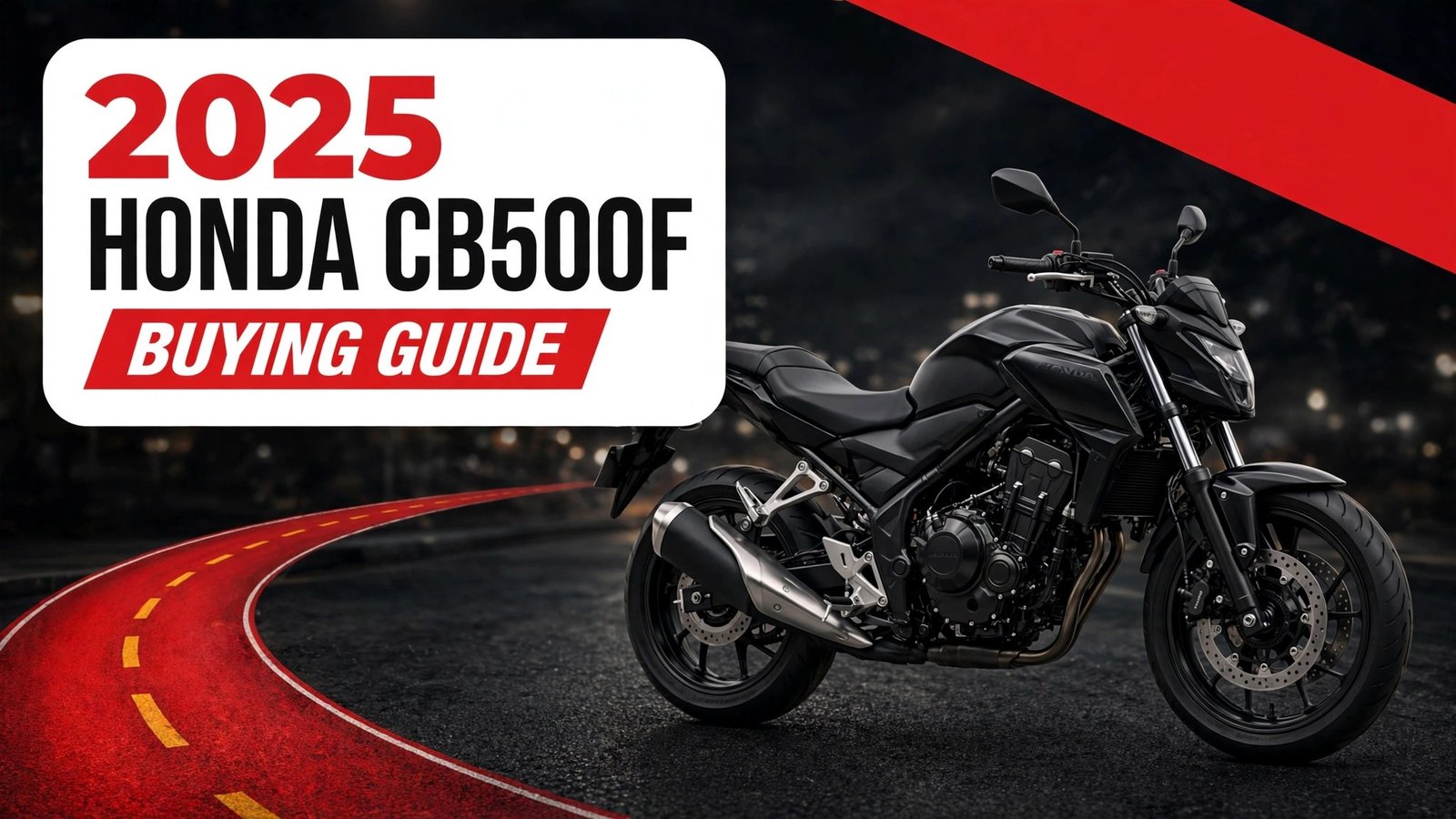
Short answer: this Honda CB500F buying guide starts with the one fact that shapes every used purchase — the CB500F and the CB500 Hornet are the same motorcycle. The naked 471cc twin launched in 2013 as the CB500F, Europe renamed it CB500 Hornet for 2024, and the United States followed for 2026, keeping the same CB500FA model code throughout. So a used CB500F is not a discontinued oddity; it is the earlier badge of a bike Honda still sells — the premise of this Honda CB500F buying guide. The final F year is 2025 at $6,899 plus $600 destination, and the new 2026 Hornet at $5,899 plus $600 sets a hard ceiling on what any used F is worth.
That identity rule runs through this whole Honda CB500F buying guide. Used buyers should search both names plus the CB500FA code, because the same bike hides under two badges, and sellers list it under either. Every price, recall, and service figure below belongs to the F by model year, never to the faired CBR500R or the adventure NX500, and this Honda CB500F buying guide labels UK figures as UK figures wherever they appear.
Honda CB500F Price and Market Availability
Prices are the first thing to get right in this Honda CB500F buying guide, because the rename creates a trap: a used F priced above a brand-new Hornet is a bad deal wearing a familiar badge. The F ran in the United States from 2013 to 2025 with no 2020 model year, and its prices climbed from $5,499 at launch to $6,899 by 2024, before Honda cut the renamed Hornet back to $5,899 for 2026.
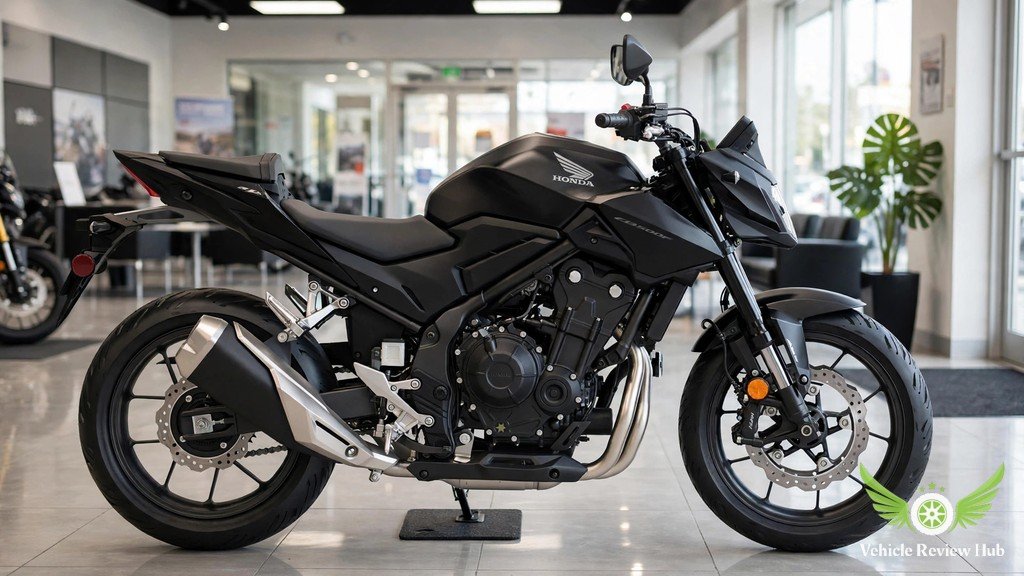
What Does a Used Honda CB500F Cost in the USA by Generation?
Used prices in this Honda CB500F buying guide split by generation, not by badge. Early bikes from 2013 to 2018, the pre-slipper-clutch generation, are the cheapest used buys: expect roughly $3,500 to $4,800 for honest examples, with the lowest prices on higher-mileage bikes and the highest on clean, low-mileage ones. The 2019 to 2021 generation, with the slipper clutch and redrawn styling, typically asks $4,500 to $5,800, and the 2022-on bikes with the SFF-BP fork and dual front discs command the most, often $5,000 to $6,000 for late, low-mileage examples. Those bands are dealer-ask ranges from late 2026 listings, not sale prices, so check any asking price against two comparable listings first. For the full model story, see our Honda CB500F review.
Used 2024 Example at $5,525 and the New Hornet Price Cap
The doc’s own example anchors this Honda CB500F buying guide: a used 2024 CB500F ABS asked $5,525 with 2,093 miles at Ecofun Motorsports in Forest Lake, Minnesota, in November 2026, and a used 2025 CB500F ABS asked $5,491 with 3,015 miles in Jacksonville, Florida, while a leftover new 2023 CB500F asked $5,999 in Litchfield, Illinois. All three are dealer asks, not sales, and all three sit below the price cap this Honda CB500F buying guide insists on: a new 2026 CB500 Hornet costs $5,899 plus $600 destination, or $6,499 before tax and fees. Any used F asking at or above $6,499 makes no sense, because the buyer could walk out with a new Hornet, a full warranty, and zero miles for the same money.
Honda CB500F Insurance and Ownership Costs
Insurance and running costs decide whether a cheap used F stays cheap, and this Honda CB500F buying guide is blunt about what is known and what is not. No published United States model-specific insurance figure exists for the F, so no number below is dressed up as a quote.
No US Model-Specific Insurance Data Was Found for the F
No US model-specific insurance data was found for the F, and this Honda CB500F buying guide says so rather than inventing a premium. The F is a 471cc naked middleweight, so insurers price it in the middleweight naked class, and the only honest way to get a number is to quote the exact VIN with three insurers and compare like for like. Age, riding record, garaging, and state matter more than the badge, and a 2024 F and a 2026 Hornet with the same rider will usually quote within a few dollars of each other, because they are the same motorcycle. Be wary of any website printing a single “CB500F insurance cost” figure without a rider profile attached; that figure describes somebody else, not you. For the servicing costs behind the ownership maths, see our Honda CB500F reliability guide.
How to Estimate Fuel, Maintenance, Parts and Other Ownership Expenses
Ownership expenses in this Honda CB500F buying guide are easy to estimate from tested figures. Fuel is the smallest bill: Cycle World’s F test averaged 59.0 mpg, and a Rider test recorded 62.4 mpg over 274 miles, so on the current 4.5-gallon tank a planning range of roughly 250 to 265 miles is realistic. Maintenance follows a simple schedule in this Honda CB500F buying guide: first service at 600 miles, oil and filter every 8,000 miles or 12 months, valve-clearance inspection every 16,000 miles, chain care every 600 miles, brake fluid every two years, and coolant every three years. UK guidance puts routine servicing around £160 to £180 a year and a professional valve service near £500, but those are UK benchmarks, never United States quotes. Parts are plentiful after a decade of 500 twins, tyres are sensibly sized at 120/70R-17 front and 160/60-17 rear, and the one-year transferable United States warranty on a late bike is worth checking before it expires.
How to Inspect a Used Honda CB500F
Inspection is where this Honda CB500F buying guide earns its keep. The F is a reliable motorcycle, so a bad used example is usually a neglected or crashed one, not a bike with a hidden design flaw. Check the motorcycle, not the listing title, says this Honda CB500F buying guide, and check the paperwork against the VIN.
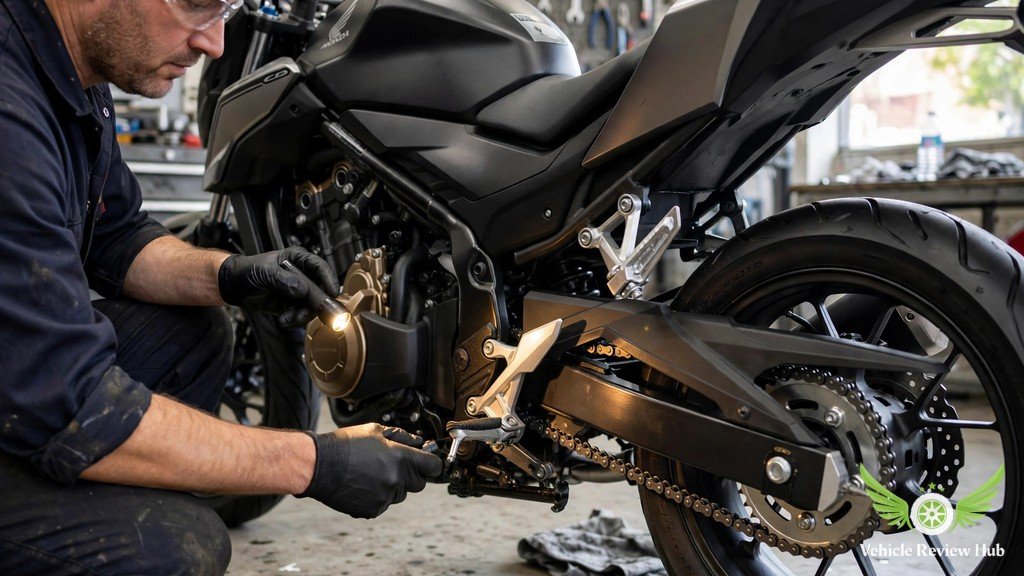
Checking the 16,000-Mile Valve Service and Recall Completion
The 16,000-mile valve service is the most expensive checkpoint in this Honda CB500F buying guide, so it deserves the most attention. Ask for the service book and receipts proving the valve-clearance inspection at 16,000 miles, and note that the F’s spark plugs are replaced at 16,000 miles in the United States manual, which is different from the faired R’s inspect-at-16,000 and replace-at-32,000 schedule. A bike near 16,000 miles without that service is a bike with a bill coming, and the price should reflect it. Recalls need the same documentary care: exactly four campaigns name the F. They are 14V056 for 2013 rocker-arm bolts, 15V475 for 2013 to 2015 fuel sensors, 15V439 for 2014 to 2015 starter relays, and 21V-382 for 2021 only, covering 256 F units for a rear reflector. Note that 21V-690 does not name the F at all, and any seller citing it for an F has the wrong bike’s paperwork. Get the recall answer in writing before paying.
Identifying ABS Bikes Before 2021 When ABS Was Optional
Identifying ABS bikes before 2021 matters in this Honda CB500F buying guide because ABS was optional until 2019 and standard only from 2021, with the gap year of 2020 having no United States F at all. Do not trust the listing: look for the ABS ring on the wheels, the ABS warning light that self-tests at switch-on, and the model code on the paperwork, where ABS bikes carry the A suffix family. A pre-2021 non-ABS bike is not a bad buy, but it should cost less than an equivalent ABS bike, and a seller claiming ABS on a bike without the hardware is either mistaken or dishonest. The video below is a used-buyer-friendly review of the 2016 to 2018 F, covering its history, specs, a real ride, and its positives and gripes, and this Honda CB500F buying guide recommends it as a pre-inspection watch.
Honda CB500F Model Years and Features to Compare
Model years are the real buying decision in this Honda CB500F buying guide, because the badge never changed the bike but the years changed plenty. Buy the year, not the name, says this Honda CB500F buying guide, and pay for the updates that matter to how you ride.
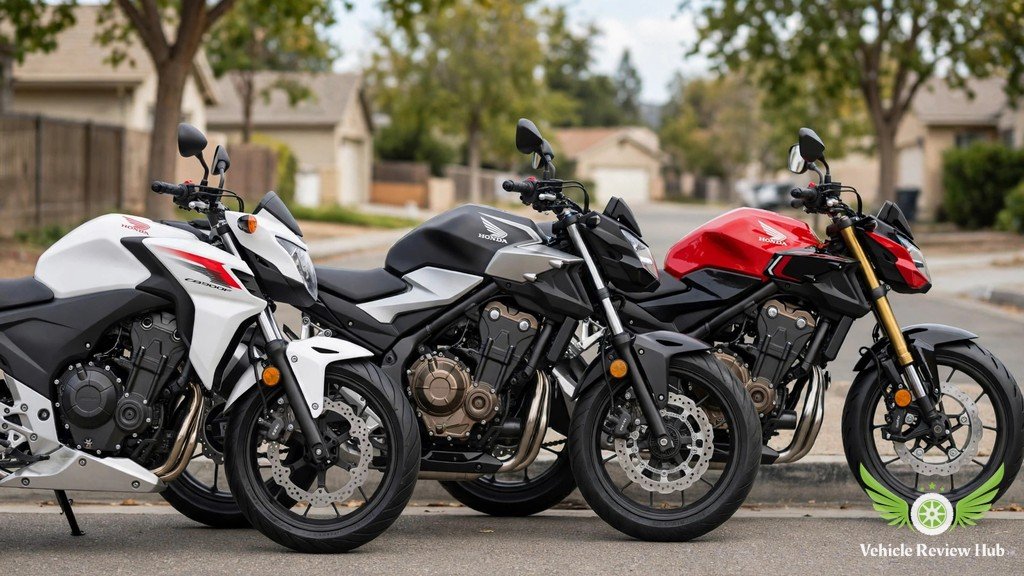
Comparing 2013-18 Bikes With the 2019 Slipper-Clutch Update
Comparing 2013-18 bikes with the 2019 update is the first fork in this Honda CB500F buying guide. The early bikes are honest, simple machines with a single 320mm front disc, an LCD dash, and no slipper clutch, and they remain the value pick for a buyer who wants the cheapest way into the 471cc twin. The 2019 update redrew the styling, added the assist and slipper clutch that lightens the lever and calms downshifts, and revised the engine and chassis details, making it the sweet spot for most used buyers: modern enough to feel current, old enough to be affordable. Either generation shares the same 471cc twin, the same 31.1-inch seat, and the same easy character, so the choice is about condition and price rather than performance.
2022-On Bikes Add the SFF-BP Fork and Dual Front Discs
The 2022-on bikes are the ones to buy if the budget stretches, says this Honda CB500F buying guide, because the chassis update is the biggest single improvement in the F’s life. The 41mm Showa SFF-BP inverted fork replaced the older conventional fork, and dual 296mm front discs with radial-mounted Nissin calipers replaced the single 320mm disc, sharpening feel and stopping power together. The 2024 update then added the 5-inch TFT dash and Honda Selectable Torque Control in the United States, still under the F name, plus aggressive new styling, and Matte Black Metallic became the only United States colour for 2024 and 2025. A 2022-on bike with full history is the closest thing to a new Hornet a used buyer can get.
Honda CB500F vs Kawasaki Z500: Which One to Buy in the USA
The Z500 is the rival every used-F buyer should cross-shop, and this Honda CB500F buying guide compares them on sticker prices, not on brand loyalty. The answer in this Honda CB500F buying guide depends on whether the buyer wants the cheapest new naked or the cheapest good used one.
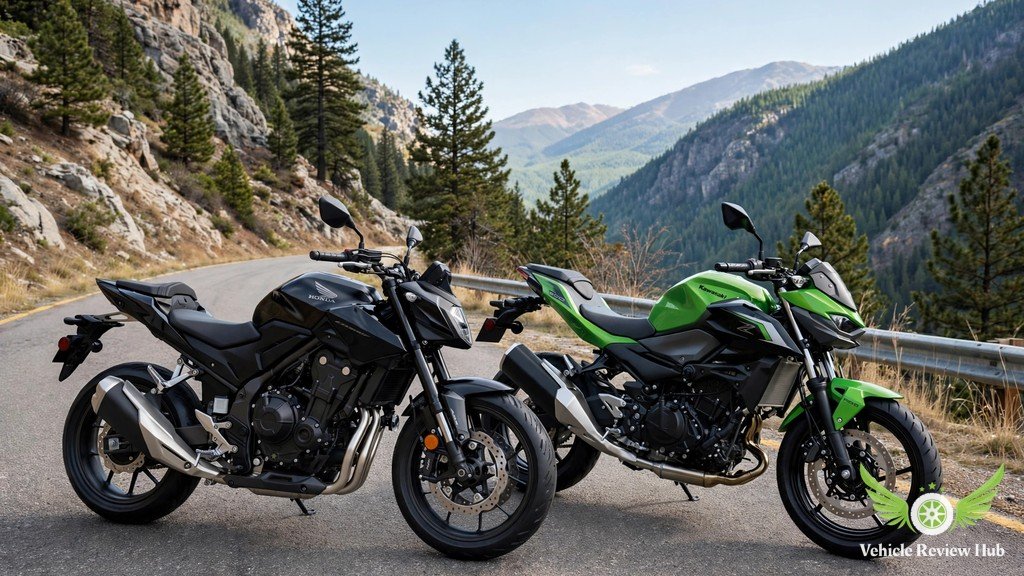
Used F Against a New Z500 ABS at $5,699 for 2026
A used F against a new Z500 ABS at $5,699 for 2026 is a closer fight than Honda fans admit, and this Honda CB500F buying guide lays it out plainly. The Z500 ABS costs $5,699 plus $650 destination, or $6,349 before tax and fees, for a 451cc twin making a claimed 51 horsepower, with ABS standard and a lighter feel than the Honda. A used 2024 F at $5,525 is cheaper on the sticker but older, out of warranty sooner, and carries used-bike risk, while the new Z500 carries a full warranty and zero miles. The Honda counters with a bigger engine, a roomier feel, and a deeper used-parts supply, and its Z500 ABS specification shows the Kawasaki’s weight and price advantage clearly. Buy the used F only when it is clean, documented, and at least $500 under the new Z500’s out-the-door price; otherwise the new Kawasaki wins on value.
| 2026 comparison | Used 2024 Honda CB500F ABS | New 2026 Kawasaki Z500 ABS |
|---|---|---|
| Price (dealer ask / MSRP + destination) | $5,525 ask (2,093 miles) | $5,699 + $650 |
| Engine | 471cc twin | 451cc twin, 51 hp claimed |
| Warranty | Remainder of 1-year transferable, if any | Full new-bike warranty |
| Summary | Buy only if clean, documented, $500 under Z500 out-the-door | Wins on value unless the F is a bargain |
When a New CB500 Hornet at $5,899 Makes More Sense
A new CB500 Hornet at $5,899 makes more sense whenever the used F is not a genuine bargain, and this Honda CB500F buying guide treats that as a rule, not a preference. The Hornet is the same CB500FA motorcycle with a new badge, a $1,000 price cut from the 2025 F, a full one-year transferable warranty, and the 2024-on TFT dash and HSTC as standard, and its own page still lives under the old CB500F web address, which is the rename caught mid-transition. Any used F asking $6,000 or more should lose to the Hornet on the spot, and even a $5,525 used F only wins if its condition and history are excellent. For the renamed bike’s own story, see our Honda CB500 Hornet review and our Honda CB500 Hornet buying guide. The Hornet is not a rival to the F; it is the F’s future, and this Honda CB500F buying guide prices every used F against it.
Is Buying a Used Honda CB500F Worth It?
Yes, with conditions, and this Honda CB500F buying guide ends with the verdict buyers actually need: the F is one of the safest used purchases in motorcycling, provided the price respects the Hornet cap and the paperwork checks out. The risks are ordinary used-bike risks, plus one paperwork trap worth a section of its own.
Benefits and Risks: Honda’s Own Caliper Description Conflicts
The benefits in this Honda CB500F buying guide are real: a proven 471cc twin, cheap consumables, a simple service schedule, deep parts availability, and a bike that holds its value well for a middleweight. The risks are a neglected chain, crash damage hidden by the naked bike’s minimal bodywork, and one genuine documentation conflict buyers should know about. Honda’s own caliper descriptions conflict: American Honda’s 2022 press release says only “dual front-brake rotors with radial-mounted Nissin calipers” with no piston count, while Honda News’ own 2022 CB500F ABS features page says “dual Nissin radial-mount four-piston calipers biting 296 mm rotors”, and Bennetts’ 2022 range news says “radial-mount two-piston Nissin calipers”, matching the 1000PS spec tables that list “Double piston”. So Honda’s own pages disagree with each other, and this Honda CB500F buying guide does not pick a winner: on a 2022-on bike, check the caliper fitted to the actual motorcycle and order pads by model year and VIN from the parts fiche, never by a spec table alone. The pre-2022 setup is undisputed: a single 320mm disc with a two-piston caliper.
US-Market Alternatives: MT-03, 390 Duke and the NX500
The alternatives in this Honda CB500F buying guide cover every reason to walk away from an overpriced F. The Yamaha MT-03 is the budget door at $4,999 plus $650 destination for 2026, a 321cc twin that is $900 cheaper than the Hornet on sticker but smaller and less highway-capable, right for a newer rider on a strict budget. The KTM 390 Duke is the sharp-handling alternative, but its 2026 United States pricing is messy, with dealer listings near $5,899 against older $6,499 tariff-era figures and a TopSpeed report of $5,499, so this Honda CB500F buying guide tells readers to verify the current price rather than printing one figure as settled. The Honda NX500 is the family alternative at $6,899 plus $600 for 2026, the same 471cc twin in adventure dress with a taller seat and a 4.7-gallon tank, and for that bike see our Honda NX500 review. The India-market 2026 Honda CB500, a 501cc single, is a different motorcycle entirely and should never be confused with either American twin. The verdict of this Honda CB500F buying guide stands: buy a clean, documented F under the Hornet cap, or buy the Hornet itself.
Honda CB500F Buying Guide FAQs
Direct answers to the Honda CB500F buying guide questions used buyers ask most in this Honda CB500F buying guide, covering prices, insurance, inspection, and the Hornet connection.
Is the Honda CB500F the same bike as the CB500 Hornet?
Yes. This Honda CB500F buying guide confirms the CB500F and CB500 Hornet are the same CB500FA motorcycle; Europe renamed it for 2024 and the United States for 2026, changing the badge, not the bike.
How much does a used Honda CB500F cost?
By generation, says this Honda CB500F buying guide: roughly $3,500 to $4,800 for 2013 to 2018 bikes, $4,500 to $5,800 for 2019 to 2021 bikes, and $5,000 to $6,000 for late 2022-on examples, all as dealer asks, never above the $6,499 new-Hornet cap.
What is the new CB500 Hornet price cap?
$5,899 plus $600 destination, or $6,499 before tax and fees, says this Honda CB500F buying guide. Any used F asking at or above that figure makes no sense against a brand-new Hornet.
How much does insurance cost for a CB500F?
No United States model-specific figure exists, says this Honda CB500F buying guide. Quote the exact VIN with three insurers; age, record, garaging, and state matter more than the badge.
What should I check first on a used CB500F?
The VIN, the 16,000-mile valve service record, and recall completion, says this Honda CB500F buying guide, then chain, tyres, brakes, fork seals, and crash damage on bar ends, levers, and engine cases.
Which recalls affect the CB500F?
Exactly four, says this Honda CB500F buying guide: 14V056, 15V475, 15V439, and 21V-382 for 2021 only with 256 F units. 21V-690 does not name the F.
Does the CB500F have ABS?
Optional until 2019 and standard from 2021, says this Honda CB500F buying guide, with no 2020 United States model year in between. Verify ABS by the wheel rings and the self-test light, not the listing.
What is the Honda caliper description conflict?
Honda News’ 2022 features page says four-piston calipers while Bennetts and 1000PS say two-piston, says this Honda CB500F buying guide. Check the caliper on the actual bike and order pads by model year and VIN.
Should I buy a used F or a new Z500?
Buy the used F only if it is clean, documented, and at least $500 under the new Z500’s out-the-door price, says this Honda CB500F buying guide; otherwise the new Z500 ABS at $5,699 plus $650 wins on value.
Is buying a used Honda CB500F worth it?
Yes, says this Honda CB500F buying guide, when the bike is clean, documented, and priced under the new-Hornet cap. Otherwise buy the Hornet itself, the same motorcycle with a full warranty.