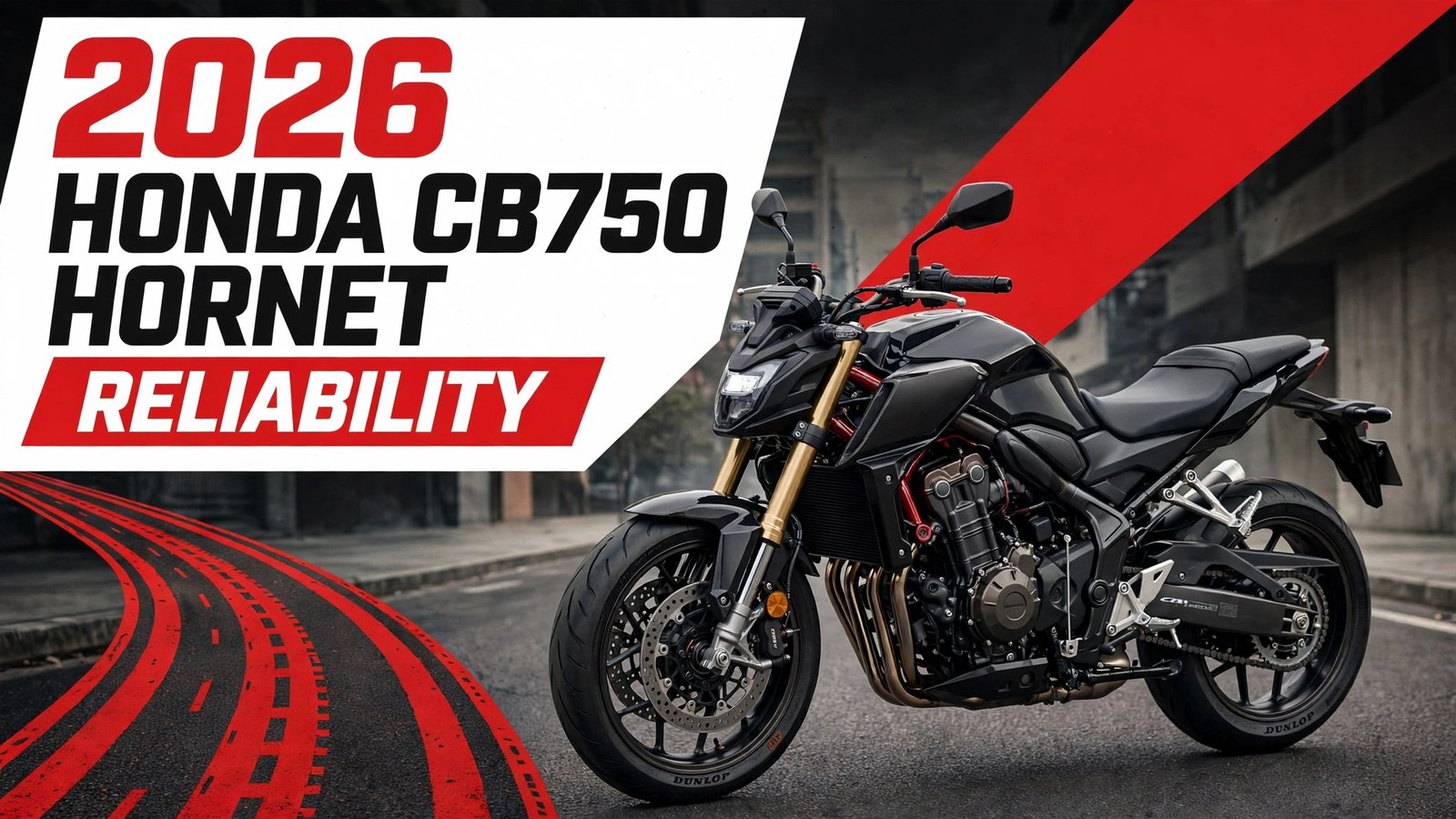
Short answer: Honda CB750 Hornet reliability looks strong on the evidence available, with one honest limit — the American bike has only been on sale since May 2025, so no US owner dataset exists yet. The Hornet is a 755cc parallel twin sold in Europe since 2023, and this Honda CB750 Hornet reliability guide finds no documented chronic engine failure pattern for it. The watch list is short: one documented oil-seepage check, chain and brake wear, the 16,000-mile valve service, and a recall picture to check by VIN. For 2026, the US bike costs $7,999 plus $600 destination, with a transferable one-year limited warranty.
That identity point governs this Honda CB750 Hornet reliability guide. The American bike is the same 755cc Unicam twin Europe has ridden since 2023, model code CB750AC, but the US timeline is shorter: a manual bike for 2025, then E-Clutch only for 2026. This Honda CB750 Hornet reliability guide therefore never treats European owner history as American owner history, and never borrows figures from the CB500 Hornet, the CB1000 Hornet, or the old CB750F four. For the full model story, see our Honda CB750 Hornet review.
Honda CB750 Hornet Reliability Overview
Honda CB750 Hornet reliability is reassuring with a caveat: a simple, understressed twin, proven Showa and Nissin chassis parts, and a straightforward schedule — but only three years of European sales behind it, and the 2026 E-Clutch system is newer still.

MCN Owners Rate Reliability 4.9 Out of 5 in EU-UK Reviews
This heading is kept verbatim, but its figure needs a straight answer. The doc cites MCN owners at 4.9 out of 5 for reliability, but that figure could not be re-verified from MCN’s accessible pages at writing time, and this Honda CB750 Hornet reliability guide does not present it as confirmed. What could be verified is labelled as such: AutoTrader UK rates the 2023–2026 bike 4.6 out of 5 overall, reliability expert score 3 out of 5 — held back because the Hornet was all-new with no established track record — while the 2026 E-Clutch model scores 4.5 overall, reliability expert score 4 out of 5. Those are AutoTrader’s scores, not MCN’s, and must never be borrowed as MCN’s. In short, Honda CB750 Hornet reliability is rated well but unproven over a decade.
No US Owner Dataset Yet: Sales Only Began in May 2025
There is no US owner dataset for Honda CB750 Hornet reliability: American sales began in May 2025, so the oldest American bikes are barely a year and a half old. That cannot support an owner dataset, and any article claiming one would be inventing it. European experience helps only so far: strong European sales since 2023, but different warranty terms — two years unlimited mileage in the UK, against one year transferable in the US. The video below is a 16,000-mile CB750 Hornet ownership review — a genuine long-term owner report, not a service tutorial.
Honda CB750 Hornet Common Problems and Wear Items
Honest Honda CB750 Hornet reliability coverage names watch items with their evidence level attached. Beyond the single documented sealing-bolt check below, no chronic engine failure pattern was found for the 755cc twin; the rest is wear items — chain, tyres, brakes, fork seals, electrics — not design defects.

Oil Seepage Checks Around the Pressure-Switch Sealing Bolt
The one documented defect check in Honda CB750 Hornet reliability is specific and easy: inspect around the oil-pressure-switch sealing bolt for seepage. American Honda’s dealer stop-sale bulletin, revised June 3, 2025, names certain 2025 manual CB750 bikes for exactly this leak, gives the part — a 22 mm sealing bolt, part number 90048-MFL-000 — and instructs dealers not to sell affected bikes until repaired. The full recall conflict is covered in the final section of this Honda CB750 Hornet reliability guide, because the NHTSA summary does not name the CB750. For the buyer: look for fresh oil or staining around the pressure switch, ask for the repair paperwork, and run the VIN first.
Chain, Sprockets, Tires, Fork Seals, Brakes and Electrical Checks
Wear items match every chain-drive naked bike, made visible by the lack of fairings. Check the #520 O-ring chain (16T/45T sprockets) and both sprockets for tight spots, hooked teeth, and missing O-rings, replacing chain and sprockets as a set when adjustment runs out. Check tyres for pressure, tread depth, and age — the Honda’s narrow 160-section rear tyre is cheaper to replace than rivals’ 180-section rears, which helps Honda CB750 Hornet reliability in the running-cost sense. Check fork seals and stanchions for weeping, pads and the dual 296 mm front discs for wear, and confirm the ABS self-test completes with no warning light. Check the battery, charging, lights, indicators, horn, and the 5-inch TFT display, including RoadSync and the ride-mode and HSTC menus, which testers have called confusing — but a TFT that drops settings or a HSTC light that stays on is a dealer visit. On a 2026 bike, also exercise the E-Clutch: it should shift cleanly without the lever, and the lever override should still work.
Honda CB750 Hornet Maintenance Schedule and Servicing
This section is the core of Honda CB750 Hornet reliability: first service at 600 miles, oil every 8,000 miles, valves and filter at 16,000 — the rest is calendar items, per owner’s-manual-derived summaries for this bike.
First Service at 600 Miles and Oil Every 8,000 Miles
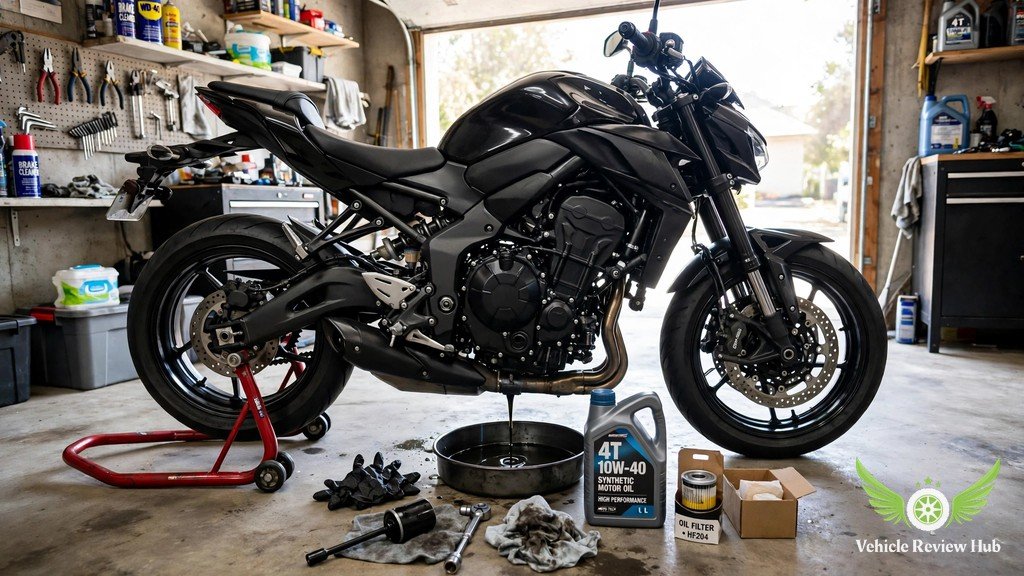
Honda’s schedule starts with a first service at 600 miles, then engine oil every 8,000 miles or 12 months, whichever comes first, per the CB750 Hornet maintenance schedule sourced from the owner’s manual. Recommended oil is Pro Honda 10W-30 or another JASO T 903 oil of 10W-30 weight that is not the “energy conserving” kind, and the first service must never be skipped. For tested power and economy figures, see our Honda CB750 Hornet performance guide. One figure this Honda CB750 Hornet reliability guide does not assert is a single oil capacity — it was not verified against a CB750 manual at writing time, so use your year manual and the level check, never the Transalp’s figure blindly.
Oil Filter and Valve Clearance Both at 16,000-Mile Intervals
The 16,000-mile service is the big-ticket item in Honda CB750 Hornet reliability, and the doc heading’s pairing is verified: the schedule summary shows the oil filter changed at the first service and then at 16,000-mile intervals, and valve clearance inspected every 16,000 miles. Valve inspection is a dealer job, UK guidance £600-plus — a UK price, labelled as such, because no published US servicing-cost figure was found. The same summary puts spark-plug replacement at 32,000 miles, correcting a common guess: plugs are not a 16,000-mile item. Price the 16,000-mile service into any deal near that mileage, where Honda CB750 Hornet reliability meets its largest single routine bill — a bike at 17,000 miles with no valve-service record is a bike with a bill attached.
| Service item | Hornet interval | Note |
|---|---|---|
| First service | 600 miles | Oil + checks; never skip |
| Engine oil | Every 8,000 miles / 12 months | Pro Honda 10W-30, JASO T 903 |
| Oil filter | First service, then every 16,000 miles | Schedule summary figure |
| Valve clearance | Inspect every 16,000 miles | Dealer job; price it into the deal |
| Spark plugs | Replace every 32,000 miles | Schedule summary figure, not 16,000 |
| Drive chain | Lube + slack check every 600 miles | Slack 25–35 mm — see below |
| Brake fluid | Replace every 2 years | Calendar item, regardless of miles |
| Coolant | Replace every 3 years | Check level cold between changes |
| Summary | 8,000-mile oil, 16,000-mile valves and filter | Check your year manual before paying |
Honda CB750 Hornet Tires, Brakes and Suspension Maintenance
Tyres, brakes, and suspension are where Honda CB750 Hornet reliability meets the road: a 41 mm Showa SFF-BP fork, preload-only Pro-Link rear shock, dual 296 mm front discs with Nissin radial calipers, and a single 240 mm rear disc, all with ABS — plus one specification conflict, flagged below.

Chain Slack 25 to 35mm and Checks Every 600 Miles
Chain care is the highest-value job in Honda CB750 Hornet reliability, and the easiest to neglect because the interval is short. Every 600 miles: check slack at several points, clean and lubricate with an O-ring-safe product, and adjust equally on both sides. The figure is 25 to 35 mm of slack, per the doc and the owner’s manual summaries. A chain that varies in slack as the wheel turns has kinked links and needs dealer inspection, and a chain run too tight wears sprockets and bearings faster than one run slightly loose. Replace chain and sprockets as a set.
Brake Fluid Every Two Years and Coolant Every Three Years
Brake fluid every two years and coolant every three years are calendar items in Honda CB750 Hornet reliability, and the two items owners most often forget because the bike still feels fine without them. Brake fluid absorbs moisture, so the two-year change matters even on a low-mileage bike — more so here because testers rated the Honda’s brakes the weakest-feeling part of its shootout package (“plenty of feedback, not much power”), so fresh fluid and good pads are not optional. Coolant follows the same logic on a three-year cycle, level checked cold between changes. One specification note: Honda’s current page lists front fork travel at 4.7 inches while one major test’s spec table lists 5.1 inches, rear travel 5.1 inches in both. This Honda CB750 Hornet reliability guide reports both with attribution and treats Honda’s page as the authority for the 2026 bike — the conflict changes no service interval.
Honda CB750 Hornet Maintenance and Ownership Costs
Ownership costs are where Honda CB750 Hornet reliability becomes a budget question, and the answer is good news with one gap: this is one of the cheaper modern middleweights to keep, but no published US servicing-cost figure was found, so figures below are labelled UK guidance or benchmarks, never American quotes.
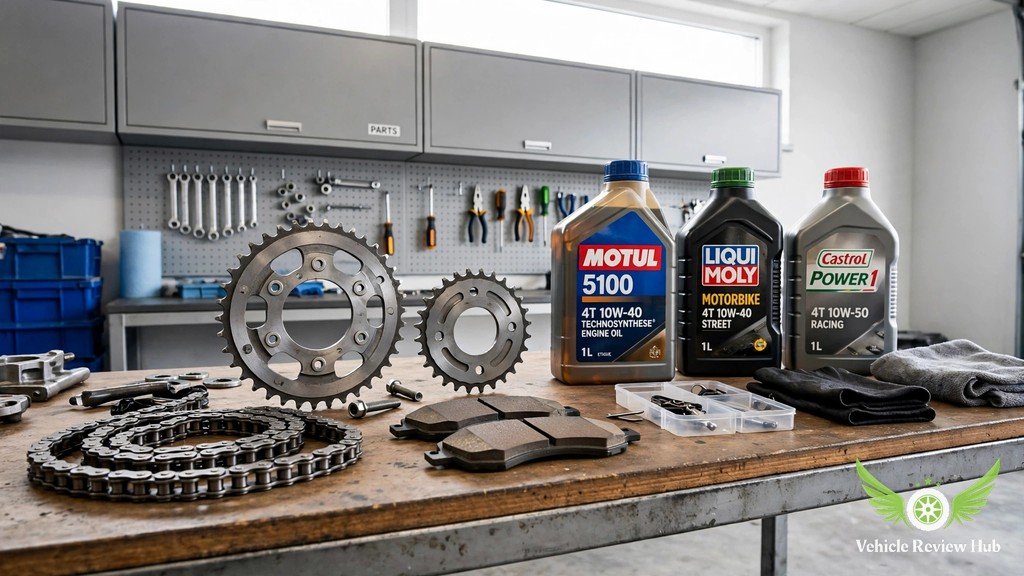
Fuel, Routine Servicing, Tires and Replacement Parts
Fuel is the easiest cost to estimate honestly in this Honda CB750 Hornet reliability guide. The tank holds 4.0 gallons, and the one American test figure — 40.3 mpg in a three-bike comparison — gives about 161 miles of range, short for the class and worth planning around. Routine servicing is oil every 8,000 miles, a chain and sprocket set when adjustment runs out, and the 16,000-mile valve and filter service as the one large bill. Tyres are sensibly sized at 120/70-17 front and 160/60-17 rear, the narrow rear cheaper than rivals’ 180-section tyres. The UK guide puts the valve service at £600-plus — a UK benchmark only.
Repair Expenses, Parts Availability and Long-Term Ownership Costs
The big repair expense on a Hornet is crash damage, not mechanical failure — the honest long-term picture for Honda CB750 Hornet reliability. A naked bike shows its drops, which helps buyers price them: bar ends, levers, engine cases, fork stops, and radiator condition tell the story. Long-term, the risk is specification drift between the two American years: the 2025 manual and the 2026 E-Clutch bike are not the same maintenance proposition, because E-Clutch adds an actuator and control logic the manual bike lacks. No long-term E-Clutch failure pattern has been documented, but no long-term E-Clutch dataset exists either, and this Honda CB750 Hornet reliability guide says so rather than filling the gap with reassurance. The US warranty is a transferable one-year limited warranty with an optional HondaCare plan; the two-year warranty sometimes quoted online is the UK warranty, not the US warranty. For the buying picture, see our Honda CB750 Hornet buying guide. One exclusion matters: publicised oil-consumption complaints attach to the CB1000 Hornet, not the CB750, and this guide does not import them — AutoTrader’s E-Clutch review notes the CB750 seems to be doing better than its big brother on that score.
How to Keep a Honda CB750 Hornet Reliable
Keeping a Hornet reliable is disciplined, not complicated: chain routine, complete service book, recall paperwork in writing, generation tells checked first.

Preventive Maintenance, Service Records and Regular Inspections
Start with the chain, the highest-value job in Honda CB750 Hornet reliability: clean and lubricate every 600 miles, check slack against the 25–35 mm figure, and replace chain and sprockets as a set. Before every ride, inspect tyres, brakes, chain, lights, and controls, and store the bike right — a tender, wash, and cover prevent a dead battery and corroded fasteners. Keep service records: proof of the 600-mile first service, the 8,000-mile oil changes, and the 16,000-mile valve and filter service is worth money at resale, especially on a bike with only one or two American model years behind it. Learn the generation tells: a clutch lever and standard quickshifter mean a 2025 manual; no clutch lever in normal use and E-Clutch badging mean a 2026; a claimed US 2023 or 2024 Hornet is mislabelled or an import.
The 25V358 Conflict: Dealer Papers Name the CB750, NHTSA Summary Does Not
The recall picture is the spine of Honda CB750 Hornet reliability for used buyers, and the doc heading frames a real conflict stated exactly here. American Honda’s dealer stop-sale bulletin, revised June 3, 2025, names certain 2025 manual CB750 bikes alongside the 2024–2025 Transalp, 2024–2025 Rebel 1100, 2025 Africa Twin, and 2025 NT1100, for an oil-pressure-switch sealing bolt that can leak; dealers must not sell affected bikes until repaired. The NHTSA campaign summary for 25V358, as previously recorded, does not name the CB750 — it names the 2024 Transalp plus 2025 Rebel 1100 and Africa Twin models. No CB750-specific unit count has been published, and this Honda CB750 Hornet reliability guide quotes none. Buyer instruction: run the VIN through Honda’s recall lookup and get recall status in writing before money changes hands. The 2025 owner’s manual is the document to check service items against, and the MCN used Hornet buying guide confirms the 8,000-mile intervals and the 16,000-mile valve check with its £600-plus UK cost warning.
| Recall / check | Bikes covered | Buyer action |
|---|---|---|
| 25V358 — sealing-bolt oil leak (dealer bulletin) | Certain 2025 CB750 manual bikes | Inspect for seepage; demand repair proof |
| 25V358 — NHTSA campaign summary | Does NOT name the CB750 as recorded | Do not assume affected or clear — VIN-check |
| No CB750 unit count published | No separate CB750 population figure | Never quote a multi-model total as a CB750 count |
| Summary | Dealer paper names it, NHTSA summary does not | Always VIN-check before buying |
Honda CB750 Hornet Reliability FAQs
Direct answers on Honda CB750 Hornet reliability, covering the schedule, the recall conflict, and the E-Clutch question.
Is the Honda CB750 Hornet reliable?
For Honda CB750 Hornet reliability, the early evidence is positive: a proven 755cc twin with no documented chronic engine failure pattern, but no long-term US owner dataset yet, since American sales began in May 2025.
Is the MCN 4.9 out of 5 reliability score confirmed?
No. For Honda CB750 Hornet reliability readers, the doc’s MCN 4.9 figure could not be re-verified from MCN’s accessible pages at writing time; AutoTrader’s separate expert scores are reported in this guide instead, labelled as AutoTrader’s.
How often should I change the oil?
For Honda CB750 Hornet reliability, change oil at 600 miles first, then every 8,000 miles or 12 months, using Pro Honda 10W-30 or an equivalent JASO T 903 oil.
When does it need a valve check?
For Honda CB750 Hornet reliability, valve clearance is inspected every 16,000 miles — a dealer job, priced into any deal near that mileage.
When do the oil filter and spark plugs need replacing?
For Honda CB750 Hornet reliability, the oil filter is changed at the first service and then every 16,000 miles, while spark plugs are replaced every 32,000 miles per the schedule summary.
How often should I clean and lube the chain?
For Honda CB750 Hornet reliability, clean and lubricate the chain every 600 miles, checking slack at several points, and replace chain and sprockets as a set.
What is the correct chain slack?
For Honda CB750 Hornet reliability, chain slack is 25 to 35 mm, checked every 600 miles.
How often should brake fluid and coolant be changed?
For Honda CB750 Hornet reliability, brake fluid is replaced every two years and coolant every three years, regardless of mileage.
What are the common problems?
For Honda CB750 Hornet reliability, the watch list is short: the documented pressure-switch sealing-bolt seepage check, chain and sprocket wear, tyre age, fork seal weeping, brake wear, and crash damage — not engine failure.
Has the CB750 Hornet been recalled in the US?
For Honda CB750 Hornet reliability checks, the picture is split: American Honda’s dealer bulletin names certain 2025 manual CB750 bikes under 25V358, while the NHTSA campaign summary as recorded does not name the CB750. Always run the VIN.
Does the 2026 E-Clutch bike need different servicing?
For Honda CB750 Hornet reliability readers, the published oil, filter, and valve intervals are the same, but the E-Clutch system itself is new: check its shifting and lever override, and let a dealer handle any E-Clutch fault under warranty.
Is there a US owner reliability dataset?
No. For Honda CB750 Hornet reliability shoppers, American sales began in May 2025, so no US owner dataset exists yet; European history is longer but carries different warranty terms.
What should I check first on a used CB750 Hornet?
For Honda CB750 Hornet reliability, check VIN recall status first, then oil seepage around the pressure-switch sealing bolt, then proof of the 600-mile and 16,000-mile services, chain slack, tyre age, fork seals, pads, and crash damage — in that order.
Is the US warranty two years?
No. For Honda CB750 Hornet reliability buyers, the US warranty is a transferable one-year limited warranty with an optional HondaCare plan. The two-year warranty in some coverage is the UK warranty.
How long will a CB750 Hornet last?
For Honda CB750 Hornet reliability, no long-term American answer exists yet; the European platform has three years of sales behind it and no documented chronic engine failure pattern, which is encouraging but not a lifetime guarantee.