Short answer: this Honda CB750 Hornet review finds a middleweight naked bike that does almost everything right at a price its rivals cannot match. The 2026 Honda CB750 Hornet costs $7,999 plus a $600 destination charge in the United States, and it is the only bike in its class that pairs a rev-happy 755cc twin with an automatic clutch at no extra cost. This Honda CB750 Hornet review judges it on American evidence first: a 2025 US launch, a 2026 switch to E-Clutch only, and a three-bike comparison test in which the Honda made the most peak power. If you want a light, quick, well-equipped everyday motorcycle with Honda dealer support, this Honda CB750 Hornet review puts it at the top of a short list.
One identity point governs this Honda CB750 Hornet review, because the Hornet name has been used on very different motorcycles. This bike is not the 471cc CB500 Hornet, not the 999cc CB1000 Hornet, and not the 1998 CB600F Hornet. It is a 755cc parallel twin that Europe got in 2023 and America got in May 2025, and this Honda CB750 Hornet review keeps its figures separate from every other Hornet. Used buyers should check the model code CB750AC and the model year, because 2025 and 2026 bikes differ in one important way: the clutch.
Honda CB750 Hornet Overview and Model-Year Updates
The overview in this Honda CB750 Hornet review is simple: a middleweight naked bike built for riders who want real performance without superbike money or superbike weight. It is light enough to flick through traffic, quick enough to entertain on a back road, and comfortable enough to ride every day. It sits honestly beside the Yamaha MT-07 and Suzuki GSX-8S, undercutting both on price, and this Honda CB750 Hornet review explains why that price gap exists and what, if anything, it costs you.
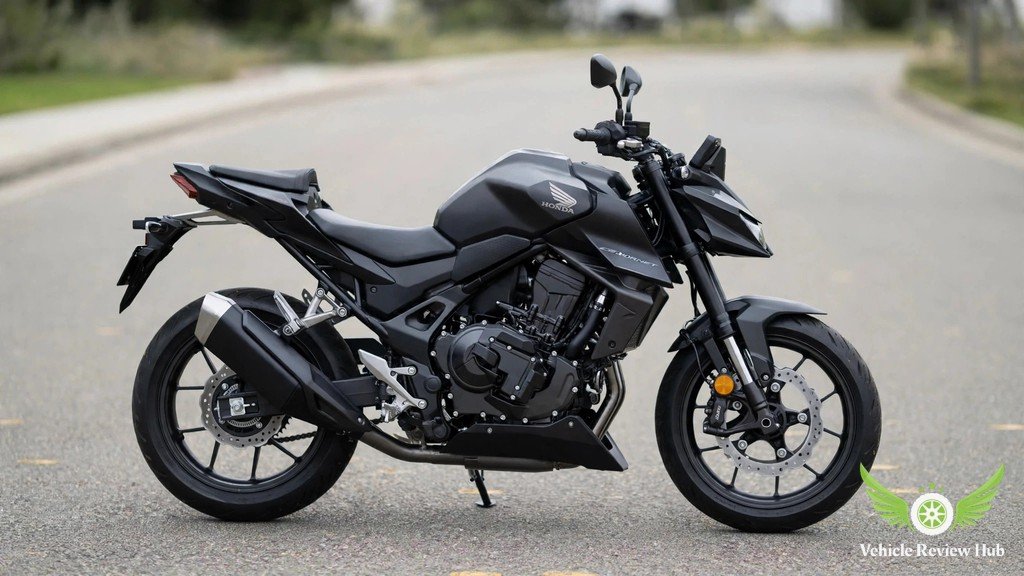
US Launch in May 2025: Two Years After the European Debut
Europe launched the CB750 Hornet in 2023, and American Honda followed in May 2025, two years later. The 2025 US bike arrived as a manual six-speed motorcycle in Matte Black Metallic and Matte Pearl White at $7,999 plus $600 destination, and this Honda CB750 Hornet review notes that the wait was worth it: the American bike arrived with the full electronics package, the quickshifter, and the TFT dash that European riders already had. There was no stripped-down American version. For the power and economy numbers behind those years, see our Honda CB750 Hornet performance guide.
2026 E-Clutch Replaces the Manual After One Model Year
The 2026 bike replaced the manual after just one US model year. For 2026 the CB750 Hornet is E-Clutch only in the United States, at the same $7,999 plus $600, in Black and Matte Nightshade Blue, available from February 2026. This Honda CB750 Hornet review stresses what that change is and is not: E-Clutch is an automatic clutch, not a gearbox and not a DCT, and the rider still shifts with the foot lever. The manual bike is therefore a one-year-only US model, which matters for used buyers.
Honda CB750 Hornet Engine and Specifications
The engine is the reason this Honda CB750 Hornet review can recommend the bike so warmly. It is a 755cc liquid-cooled Unicam parallel twin with a 270-degree crank, shared in family terms with the XL750 Transalp but tuned and geared as a streetfighter. It loves revs, sounds eager doing it, and makes its best power at the top of the range — a character this Honda CB750 Hornet review returns to again and again, because it defines who should and should not buy this bike.
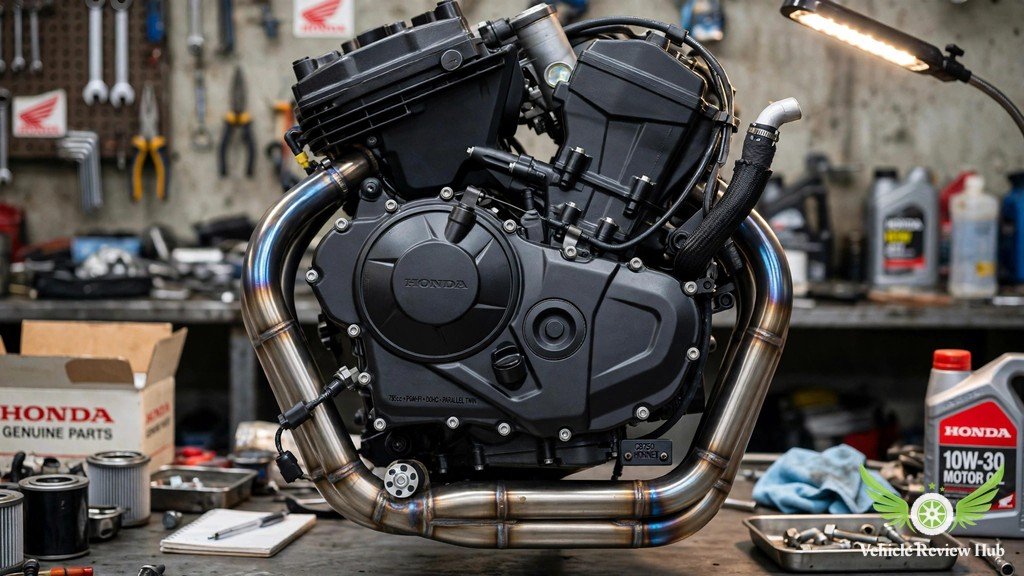
755cc Unicam Parallel-Twin at 11.0:1 With 270-Degree Crank
At the centre of this Honda CB750 Hornet review is a 755cc liquid-cooled Unicam SOHC parallel twin with an 87.0 x 63.5mm bore and stroke, 11.0:1 compression, PGM-FI fuel injection through a 46mm throttle body, and a six-speed gearbox driving the rear wheel through a #520 chain on 16T/45T sprockets. The 270-degree crank gives the firing order an uneven, V-twin-like pulse, which is why the bike feels characterful rather than appliance-smooth. Power figures need three labelled boxes in this Honda CB750 Hornet review, because blending them misquotes the bike. Motorcycle.com’s US dyno test recorded 76.6 horsepower at 8,200 rpm and 50.9 lb-ft at 7,200 rpm at the rear wheel — the most peak power in its three-bike test. The US-market figure quoted from Honda Powersports data is 83 horsepower, though one reviewer notes Honda does not publish a US figure directly, so this Honda CB750 Hornet review quotes 83 horsepower only with that attribution attached. The European crankshaft claim is 90.5 horsepower at 9,500 rpm and 55.3 lb-ft at 7,250 rpm.
Seat Height 31.3 Inches, Tank 4.0 Gallons and Weight by Year
The dimensions in this Honda CB750 Hornet review explain why the bike works for a wide range of riders. The seat is 31.3 inches, the tank holds 4.0 gallons, and the wheelbase is 55.9 inches with 25.0 degrees of rake and 3.9 inches of trail. Weight is year-split and must be quoted that way in this Honda CB750 Hornet review: the 2025 manual claims 422 pounds, the 2026 E-Clutch bike claims 432 pounds, a 10-pound increase for the E-Clutch system, while Motorcycle.com measured its 2025 test bike at 420 pounds. Claimed and measured figures are reported separately here, never blended. The table below gathers the headline figures for this Honda CB750 Hornet review in one place.
| Specification | 2026 Honda CB750 Hornet (USA) | Notes |
|---|---|---|
| Engine | 755cc liquid-cooled Unicam twin, 11.0:1 | 87.0 x 63.5mm; 270-degree crank; 46mm throttle body |
| US dyno (2025) | 76.6 hp @ 8,200 rpm; 50.9 lb-ft @ 7,200 rpm | Motorcycle.com, rear wheel, three-bike test |
| Gearbox / final drive | 6-speed, E-Clutch automatic clutch, #520 chain 16T/45T | E-Clutch is not a DCT or a gearbox |
| Seat / tank / weight | 31.3 in / 4.0 gal / 432 lb claimed (2026) | 2025 manual claimed 422 lb; measured 420 lb |
| Brakes / tyres | Dual 296mm front discs, Nissin radial calipers, ABS; 120/70-17, 160/60-17 | Single 240mm rear disc; narrow 160 rear tyre |
| Summary | 2026: $7,999 + $600 destination | Black or Matte Nightshade Blue; 1-year warranty |
Honda CB750 Hornet Price and Market Availability
Price is where this Honda CB750 Hornet review gets most enthusiastic, because the 2026 bike costs the same as the 2025 bike while adding the E-Clutch system, and it undercuts its closest rivals by hundreds of dollars. A new Hornet at $7,999 plus $600 destination costs $8,599 before tax and fees, against $8,599 plus destination for the Yamaha MT-07 and $9,249 for the Suzuki GSX-8S in 2026.

Honda CB750 Hornet Price in the USA: $7,999 Plus $600 Destination
The 2026 Honda CB750 Hornet costs $7,999 plus a $600 destination charge in the United States, in Black or Matte Nightshade Blue, and this Honda CB750 Hornet review confirmed the same figure across Honda’s own 2026 materials and dealer coverage. The warranty is a transferable one-year limited warranty with optional HondaCare; a two-year European warranty sometimes quoted online is not the American warranty. For used prices, inspection advice, and the one-year-manual trap, see our Honda CB750 Hornet buying guide.
E-Clutch Costs the Same $7,999: Zero Premium Over the Manual
The arithmetic behind this Honda CB750 Hornet review is exact: the 2025 manual cost $7,999 plus $600, and the 2026 E-Clutch bike costs $7,999 plus $600, a difference of exactly zero. Honda charged nothing for the E-Clutch system, which is unusual and worth stating plainly, because on other Honda models new technology usually carries a premium. This Honda CB750 Hornet review stresses what the zero premium means for buyers: there is no financial reason to prefer the manual, only a feel reason, and a used 2025 manual should therefore be judged on its discount against the new E-Clutch bike, not on any claim that the manual is a premium variant. A used manual at near-new money is a bad deal in this Honda CB750 Hornet review’s judgement.
Honda CB750 Hornet Design, Features and Technology
The design story in this Honda CB750 Hornet review is a modern naked bike done without fuss: an aggressive LED headlight, a muscular tank, a short tail, and an upright handlebar that sets the riding position. The electronics, though, are where this Honda CB750 Hornet review finds the bike punching above its price — ride modes, traction control, and a TFT dash that some rivals charge extra for or skip entirely.

Ride Modes, Three-Level HSTC and Five-Inch TFT With RoadSync
The electronics package in this Honda CB750 Hornet review starts with ride-by-wire throttle, which the CB750 pairs with E-Clutch for the first time on a US Honda — an important distinction, because other US E-Clutch bikes use a mechanical throttle. Ride modes are Standard, Sport, and Rain plus two programmable User modes; Honda Selectable Torque Control (HSTC) has three levels and can be switched off; and the 5-inch full-colour TFT display carries Honda RoadSync smartphone connectivity, which Honda USA lists for the 2026 bike. One caution in this Honda CB750 Hornet review: wheelie control appears on some European spec sheets, but it has not been verified on Honda USA evidence for the US bike, so it is not claimed here as a US feature. Testers in the Motorcycle.com comparison did criticise the TFT’s symbol-based menu interface as confusing, and this Honda CB750 Hornet review passes that criticism on rather than hiding it. The video below is Rider Magazine’s 2025 US video review of the Hornet, a genuine magazine test rather than a studio walk-around.
Quickshifter Is Standard in the US and an Accessory in Europe
The quickshifter story splits by year and by market, and this Honda CB750 Hornet review keeps both splits explicit. On the 2025 US manual bike, a bi-directional quickshifter with autoblipper was standard, with three firmness settings. On the 2026 US E-Clutch bike there is no separate quickshifter to price or to inspect, because E-Clutch itself performs up- and downshifts — the system works the clutch automatically while the rider moves the lever. In Europe, by contrast, the quickshifter has been a paid accessory on the manual bike, which is why European reviews sometimes describe it as an option. Used buyers checking a 2026 bike should test E-Clutch operation, including lever override, rather than looking for a quickshifter part. For servicing intervals and the recall paperwork that matters on a used bike, see our Honda CB750 Hornet reliability guide.
Honda CB750 Hornet Riding Experience and Comfort
On the road, this Honda CB750 Hornet review finds a motorcycle that is easy in exactly the places where a middleweight should be easy and exciting in exactly the places where it should be exciting. The riding position is upright and open, the steering is quick thanks in part to the narrow 160-section rear tyre, and the engine rewards a rider who keeps it spinning. The comparison testers called the Honda a “whipper snapper that builds momentum up to its peak,” and this Honda CB750 Hornet review agrees — with one honest caveat about the bottom of the rev range.

Riding Position, Handling and Low-Speed Maneuverability
Low-speed manners are a strength in this Honda CB750 Hornet review. The 31.3-inch seat, the claimed 422 to 432 pounds depending on year, and the wide bar make the bike manageable in car parks, at junctions, and in stop-and-go traffic. Handling is quick rather than lazy: the 55.9-inch wheelbase, the Showa SFF-BP fork, and the narrow rear tyre add up to a bike that steers willingly and holds a line. One honest limit from the comparison test belongs in this Honda CB750 Hornet review: below about 4,600 rpm the Honda felt “sleepy” in town next to the Yamaha, and the ergonomics scored worst of the three bikes, with the most compact rider triangle — tall riders should sit on one before buying. The suspension is preload-only at the rear, with no rebound adjustment, so heavier riders cannot dial it in as finely as on some rivals.
Highway Comfort, Passenger Use and Everyday Practicality
Highway riding is the compromise in this Honda CB750 Hornet review, and it is a compromise shared by every naked bike. Without a fairing, wind blast grows with speed, and sustained fast highway work asks more of the rider than the same engine in faired form would. The engine is unstressed at highway speeds, sixth gear is tall enough for relaxed cruising, and the 4.0-gallon tank gives a usable range — Motorcycle.com tested 40.3 mpg, which works out to about 161 miles per tank, and that figure is covered in detail in our Honda CB750 Hornet performance guide. Passenger use is adequate rather than generous, so two-up touring is not this bike’s job. Everyday practicality is otherwise strong in this Honda CB750 Hornet review: the bike is narrow, light enough to push into a garage, and simple to care for.
Honda CB750 Hornet Review: Pros, Cons and Verdict
The verdict in this Honda CB750 Hornet review is a simple trade: the most peak power in its comparison test, modern electronics, and a $7,999 price, in exchange for a softer low end, a compact riding position, and brakes that testers found low on feel. That suits experienced riders and ambitious newer riders; only riders who live below 5,000 rpm or who are very tall should look elsewhere first.

Main Advantages and Limitations of the Honda CB750 Hornet
Advantages in this Honda CB750 Hornet review: a rev-happy 755cc twin with the most peak power in its test; E-Clutch at zero premium on the 2026 bike; ride modes, three-level HSTC, and a TFT with RoadSync; a 31.3-inch seat and light weight; and a $7,999 price that undercuts the MT-07 and GSX-8S. Limitations are equally clear: soft low-end response below 4,600 rpm; the most compact rider triangle in its test; brakes with plenty of feedback but not much power, the weakest feel category in the comparison; a confusing TFT menu interface; preload-only rear suspension; and a 4.0-gallon tank that limits range to about 161 miles at tested economy. None is a defect, but all of them are buying information.
Weight Rises 422 to 432 lb and Cycle World’s Best Streetbike Award
This heading carries the two facts that close this Honda CB750 Hornet review. First, weight rises from 422 pounds claimed on the 2025 manual to 432 pounds claimed on the 2026 E-Clutch bike — 10 pounds for the E-Clutch system, against a measured 420 pounds for Motorcycle.com’s 2025 test bike — and this Honda CB750 Hornet review reports claimed and measured figures separately rather than blending them. Second, Cycle World named the CB750 Hornet its Best Middleweight Streetbike for 2025, exactly that award and exactly that year — not Bike of the Year, and not a 2026 award. At $7,999 plus $600 destination for 2026, with E-Clutch included at no extra cost, this Honda CB750 Hornet review calls the Hornet the smartest buy in the middleweight naked class for riders who value revs, equipment, and value over outright low-end muscle.
Honda CB750 Hornet Review FAQs
Direct answers to the questions buyers ask most in this Honda CB750 Hornet review, covering price, specs, the E-Clutch switch, and everyday ownership.
How much does the Honda CB750 Hornet cost in the USA?
The 2026 bike costs $7,999 plus a $600 destination charge, in Black or Matte Nightshade Blue, notes this Honda CB750 Hornet review. That is the same sticker as the 2025 manual, so E-Clutch adds no premium.
Is the Honda CB750 Hornet sold in the United States?
Yes. This Honda CB750 Hornet review confirms the US launch in May 2025, two years after the European debut, with the 2026 bike switching to E-Clutch only.
What is E-Clutch on the Honda CB750 Hornet?
An automatic clutch, not a gearbox or a DCT, says this Honda CB750 Hornet review. The rider still shifts with the foot lever while the system works the clutch, and on the 2026 bike E-Clutch also performs quickshifter duties.
How much horsepower does the Honda CB750 Hornet make?
Motorcycle.com’s US dyno test recorded 76.6 rear-wheel horsepower at 8,200 rpm, reports this Honda CB750 Hornet review. The US-market figure quoted from Honda Powersports data is 83 horsepower, and the European crankshaft claim is 90.5 horsepower — three separate boxes, never averaged.
What is the seat height of the Honda CB750 Hornet?
The seat is 31.3 inches, with a 4.0-gallon tank and a claimed 432 pounds for the 2026 E-Clutch bike, per this Honda CB750 Hornet review.
Does the Honda CB750 Hornet have a TFT display?
Yes, a 5-inch full-colour TFT display with Honda RoadSync connectivity, says this Honda CB750 Hornet review. Testers found its symbol-based menus confusing, which is worth knowing before you buy.
Is the Honda CB750 Hornet good for beginners?
It suits ambitious newer riders with training, says this Honda CB750 Hornet review, but its rev-happy top end and 76.6 rear-wheel horsepower make it more bike than a first-timer strictly needs. A CB500 Hornet is the gentler Honda naked.
What is the difference between the 2025 and 2026 Honda CB750 Hornet?
Mainly the clutch, in this Honda CB750 Hornet review: 2025 is a manual with a standard quickshifter, 2026 is E-Clutch only at the same $7,999, 10 pounds heavier, with new colours.
Did the Honda CB750 Hornet win an award?
Yes — Cycle World’s Best Middleweight Streetbike for 2025, says this Honda CB750 Hornet review. That is the exact award and year, not a Bike of the Year title.