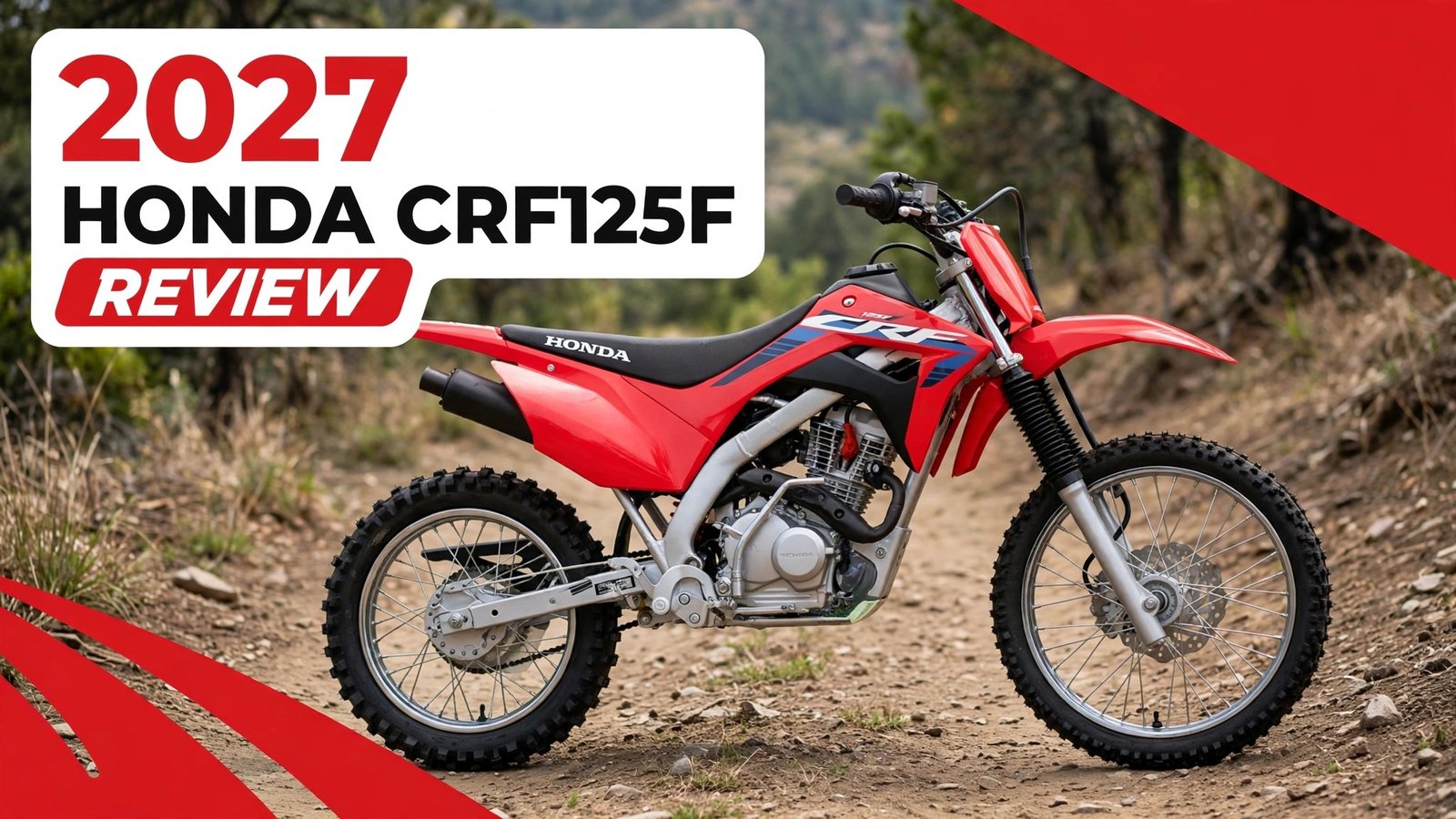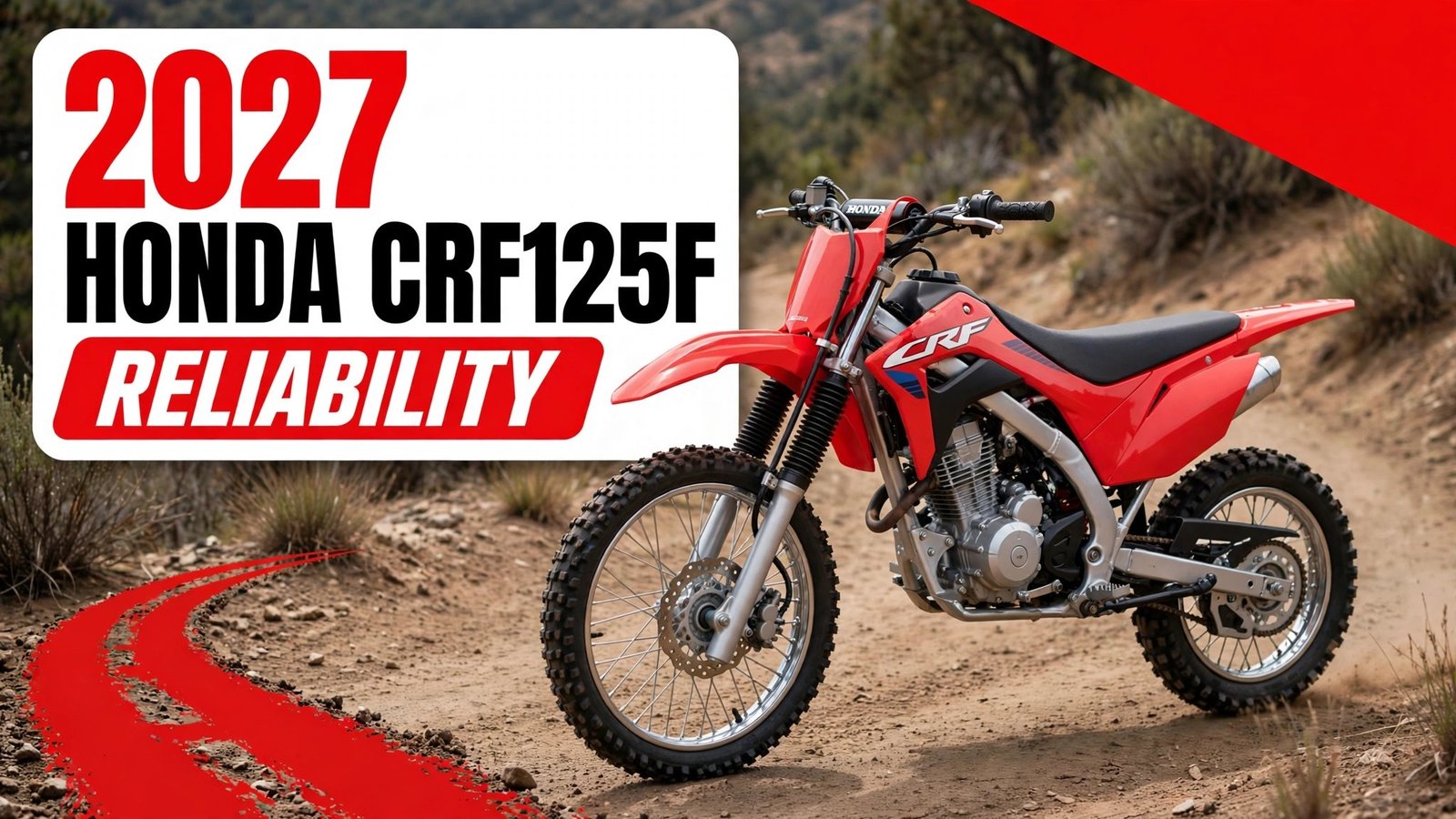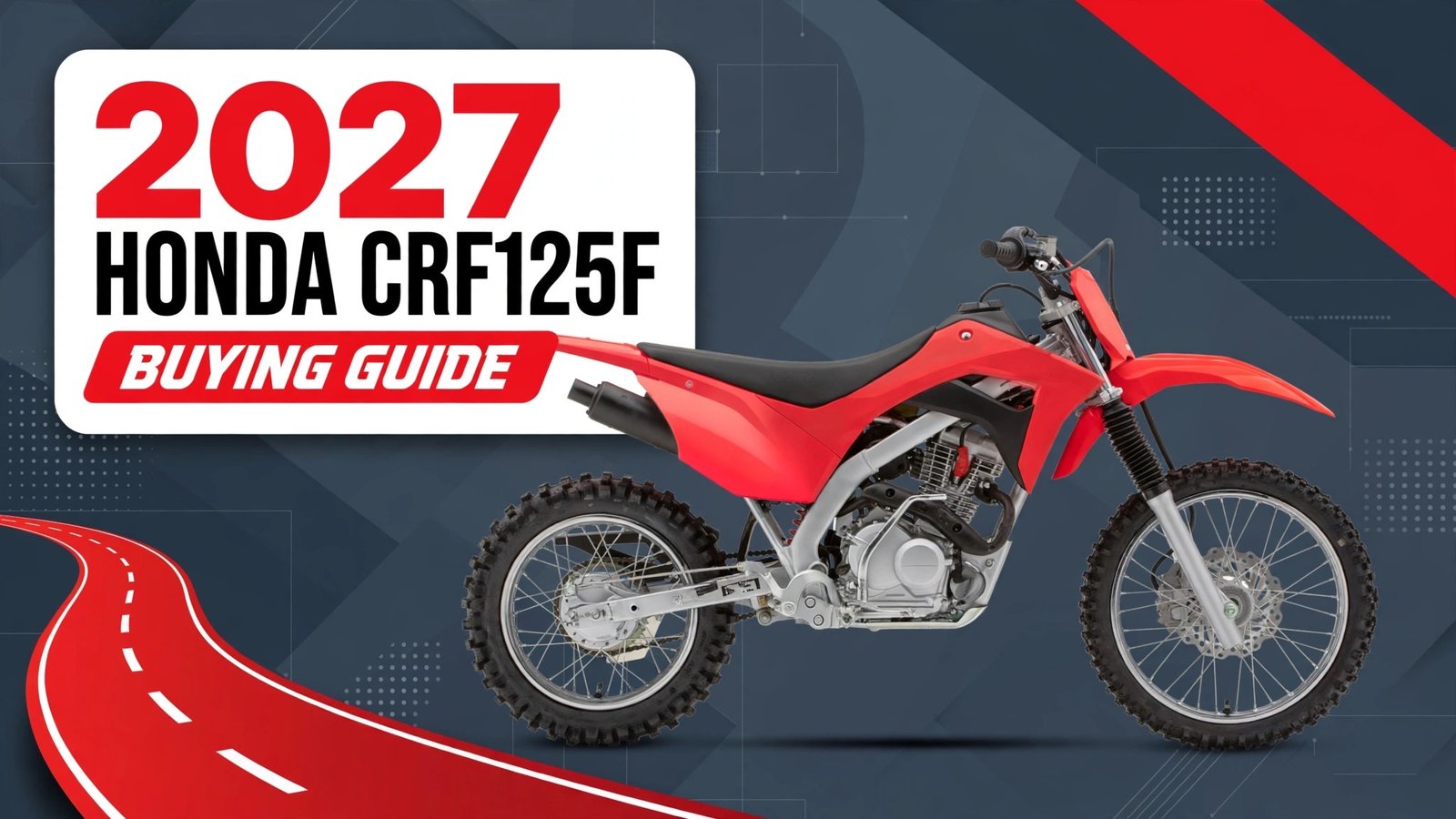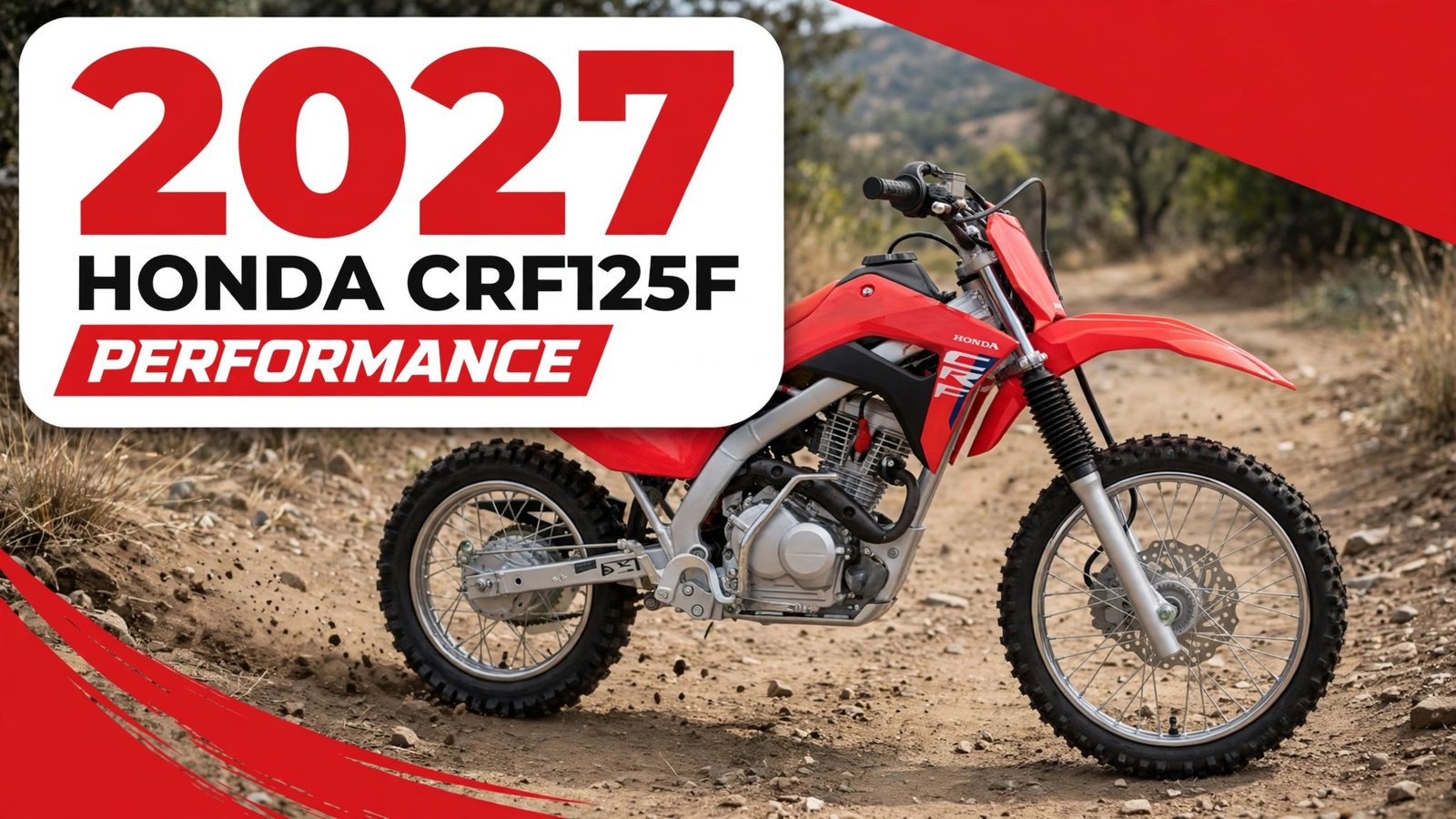
Short answer: Honda CRF125F performance is learner-bike performance, and that is a compliment, not a complaint. This Honda CRF125F performance guide starts with the honest headline: a 124.9cc air-cooled four-stroke single tuned for bottom-end torque, a four-speed manual gearbox, a top speed of roughly 45 mph by owner estimates, and no tested horsepower, torque, or MPG figure from Honda or any reputable outlet. The 2027 bike costs $3,599 plus $300 destination in standard form, and this Honda CRF125F performance guide measures it the only fair way: by how easily a new rider learns clutch control, climbs a trail hill, and rides all afternoon without drama.
One framing fact belongs up front in this Honda CRF125F performance guide: do not shop this bike on numbers it does not publish. Honda lists no horsepower, no torque, and no MPG for the CRF125F, and any page that prints those figures as tested facts is dressing up estimates. What it does offer is verified: fuel injection since 2019, electric start with a kick backup, 194 pounds standard, and a forgiving powerband praised since 2014. For the full model story, see our Honda CRF125F review.
Honda CRF125F Engine Performance and Power Delivery
Engine performance on the CRF125F is about delivery, not output. The little single makes its modest power low in the rev range, where a learner needs it, and deliberately gives up at the top, where a learner does not. This Honda CRF125F performance guide treats that trade as the design, not a flaw.
Honda Publishes No Horsepower or MPG Figure at All
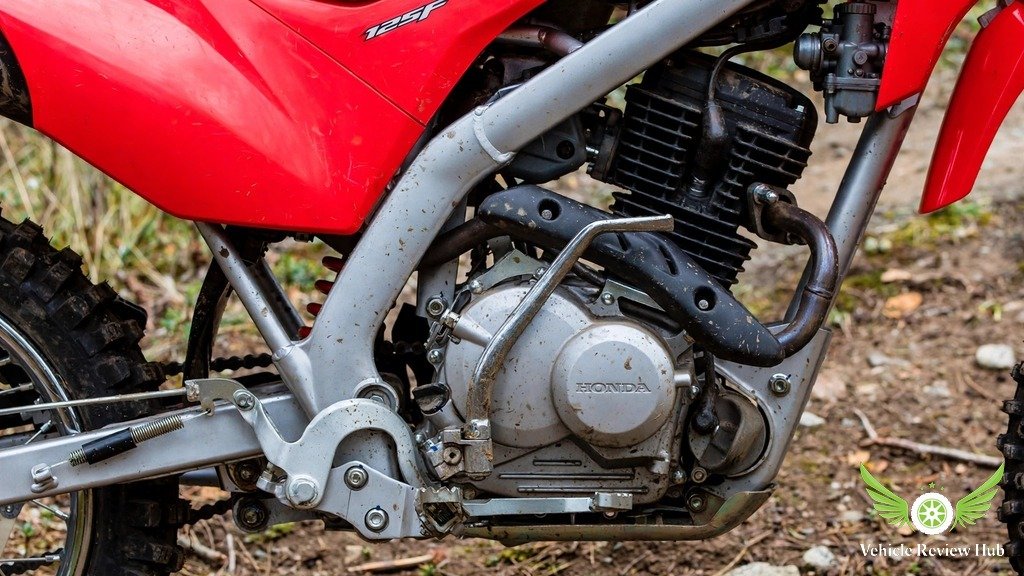
Honda publishes no horsepower or MPG figure at all for the CRF125F, and this Honda CRF125F performance guide states that plainly because it shapes every other claim in the article. Honda’s 2027 CRF125F page confirms the spec list and its gaps: the engine is a 125cc air-cooled single-cylinder four-stroke, and the page simply does not publish power figures. So this Honda CRF125F performance guide never prints a horsepower number as a Honda figure, never prints a dyno result, and never converts trail range into an MPG rating. The performance story has to come from the engine’s character, its gearing, and what testers actually felt — and on those points the record is consistent and useful.
The 8.9 HP Figure Circulates Only on Non-US Aggregators
The 8.9 HP figure circulates only on non-US aggregators, and this Honda CRF125F performance guide labels it exactly that way. The number — 8.9 hp at 7,500 rpm with 10.2 Nm (about 7.5 lb-ft) of torque at 4,500 rpm — appears on spec-sheet aggregators such as MotorcycleDB and wBW, labelled by MotorcycleDB as an editorial estimate, not lab tested. Other pages disagree: 1000PS prints 9 hp at 7,000 rpm, while Motocross Hideout prints roughly 6 hp. This Honda CRF125F performance guide does not average those estimates, does not pick the flattering one, and does not present any of them as a tested result. The 4,500 rpm torque peak is at least consistent with Motorcycle.com’s 2014 launch test, which praised bottom-end torque, but consistency is not a measurement. What can be said with confidence about Honda CRF125F performance is mechanical: a 124.9cc air-cooled SOHC two-valve single, 52.4 by 57.9 mm, 9.0:1 compression, a 22 mm Keihin PGM-FI throttle body since 2019, and a four-speed manual gearbox. The 9.5:1 compression figure that circulates on some comparison tables is a misprint, checked against Honda’s own 9.0:1 spec, and so is any “four-valve” wording for this two-valve engine.
| Engine item (Honda spec pages) | Standard CRF125F | Big Wheel CRF125FB |
|---|---|---|
| Engine | 124.9cc air-cooled SOHC two-valve single | Same engine, same gearbox |
| Bore and stroke / compression | 52.4 x 57.9 mm / 9.0:1 | 52.4 x 57.9 mm / 9.0:1 |
| Fuel system / gearbox | 22 mm PGM-FI (2019+) / four-speed manual | 22 mm PGM-FI (2019+) / four-speed manual |
| Final drive | Chain, 13T/46T (3.538) | Chain, 13T/49T (3.769) |
| Summary | Honda CRF125F performance: same engine, different gearing | The $400 Big Wheel premium buys size, not power |
Honda CRF125F Top Speed and Acceleration
Top speed and acceleration are the two questions every buyer asks first about Honda CRF125F performance, and both have the same honest answer: no instrumented test exists, so the guide reports owner estimates and explains the gearing that sets the ceiling.
No Instrumented Test Exists: Owner Estimates Around 45 MPH
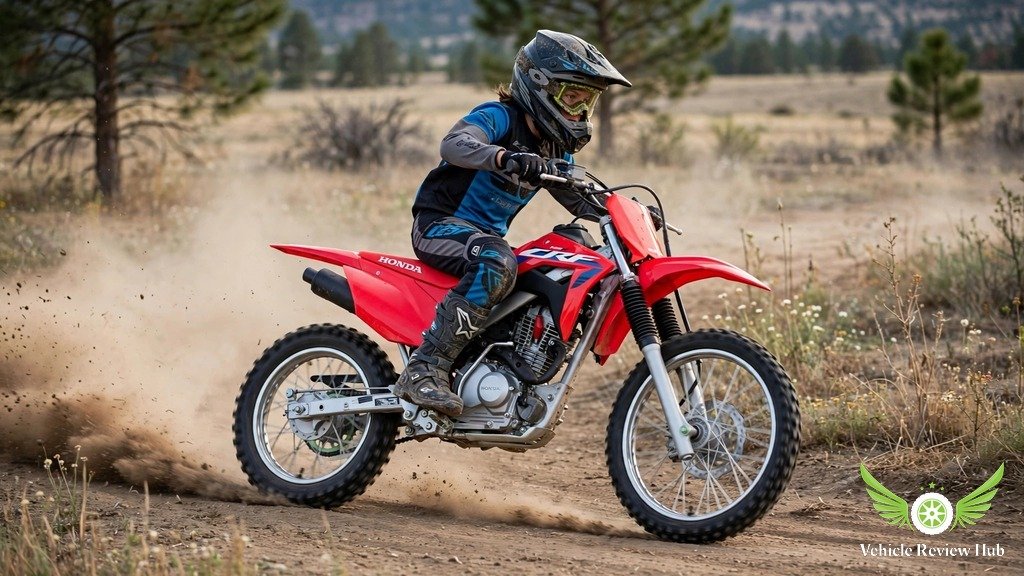
No instrumented test exists for CRF125F top speed, and owner estimates cluster around 45 mph on flat ground for a stock bike. Motocross Hideout prints about 45 mph on a stock CRF125F on flat ground, and this Honda CRF125F performance guide treats that as the anchor estimate. Motocross Hideout’s CRF125F guide also confirms the broader ownership picture: a simple air-cooled engine, a four-speed manual clutch, and a bike built to be reliable and easy to ride. Some owner pages stretch the estimate to 50 to 55 mph, depending on rider weight and terrain. Acceleration is likewise unmeasured: no magazine runs a timed 0 to 30 or quarter-mile test on a learner trail bike, and this Honda CRF125F performance guide refuses to invent one. What testers do describe, consistently, is brisk low-speed pull: the bike gets off the line cleanly, climbs without clutch abuse, and feels quicker than its size suggests at trail speeds. That is the acceleration that matters for Honda CRF125F performance, because nobody buys this bike for drag-strip numbers.
The 65 MPH Figure Online Is Junk: Do Not Publish It
The 65 MPH figure online is junk, and this Honda CRF125F performance guide rejects it explicitly rather than repeating it with a shrug. A top-speed aggregator prints 65 mph for the CRF125F, but no test supports it, and the bike’s own gearing argues against it: a four-speed gearbox with short trail ratios (first gear 3.181, fourth 0.916, final reduction 3.538 on the standard bike) runs out of gear long before 65 mph, and a 125cc air-cooled single tuned for bottom-end torque has neither the rev ceiling nor the power to push a knobby-tired trail bike to highway speed. That is gearing-limited performance, not a defect, and it is exactly what a learner bike should do — it keeps a new rider at trail speeds instead of tempting highway speeds the chassis was never built for.
Honda CRF125F Mileage and Fuel Economy
Mileage on a CRF125F is measured in trail hours and afternoons, not miles per gallon. The tank is small, the engine sips fuel, and the honest range answer comes from the tank size, never from a converted MPG claim.

No Tested MPG Exists From Any Reputable Outlet
No tested MPG exists from any reputable outlet for the CRF125F, and this Honda CRF125F performance guide will not manufacture one from anecdotes. The EPA does not rate off-road motorcycles, Honda publishes no economy figure, and no magazine runs a measured fuel loop on a bike with no odometer and no road use. What Honda CRF125F performance does offer on fuel is genuinely good news for owners: a small, efficient, fuel-injected single that runs on regular gas and stretches a gallon a long way at learner speeds. For the service habits that keep that economy honest, see our Honda CRF125F reliability guide.
The 1.0 Gallon Steel Tank and Real Trail Range
The 1.0 gallon steel tank is the whole fuel story, and this Honda CRF125F performance guide frames range around it honestly. Since 2019 the tank is steel with an integrated fuel pump and fuel filter, plus a low-fuel light on the handlebar — a real improvement over the carbureted years, when a rider guessed at remaining fuel. One gallon sounds small, but at trail-learner pace it covers a long afternoon: several hours of stop-start trail riding, practice drills, and hill climbs, with the low-fuel light giving fair warning before the bike goes dry. The Big Wheel carries the same 1.0-gallon tank, so there is no range advantage to the bigger bike — only size, travel, and seat height change.
Honda CRF125F Real-World Riding Performance
Real-world riding is where Honda CRF125F performance earns its reputation. The bike is not fast, and it does not pretend to be — it is easy, forgiving, and confidence-building, exactly what a first manual-clutch bike must be.

First Gear Chugs Steep Hills: Motorcycle.com’s Test Note
First gear chugs steep hills, and that phrase comes from a real test, not marketing copy. Motorcycle.com’s 2014 launch review at Hungry Valley put a 13-year-old tester on a steep hill, and the report was plain: put it in first, and it chugged all the way up. Motorcycle.com’s 2021 CRF125F review repeats the same character: a forgiving engine, an easy clutch, and bottom-end torque tuned for learners. That bottom-end bias is the core of Honda CRF125F performance: clean pull from just off idle, so a new rider can take off without stalling and climb a hill in first gear without momentum tricks. For a learner, that low-speed tractability matters more than any top-speed figure, and it is why the CRF125F has stayed Honda’s default recommendation for riders moving up from an automatic-clutch mini bike.
Fourth Gear Runs Out Quickly: Gearing Limits Explained
Fourth gear runs out quickly because the gearing is short on purpose, and this Honda CRF125F performance guide explains the maths rather than apologising for it. The ratios are 3.181/1.705/1.238/0.916, primary 3.250, final 3.538 standard (3.769 Big Wheel, 13T/49T vs 13T/46T). That spread gives a low first gear for hills and starts, close middle gears for trail work, and a fourth gear that is barely overdrive — so the bike reaches its comfortable cruising speed early and then stops gaining. The video below in this Honda CRF125F performance guide is BrickNick’s 2020 CRF125F redesign review, honestly labelled as an owner review, not a dyno or instrumented test.
The Big Wheel’s taller final reduction (3.769) trades a little top speed for a little more low-end pull, which suits its taller, heavier rider, but neither bike is geared for speed. Fitting a smaller rear sprocket for more top end is not advised on a learner bike: taller gearing makes starts harder and hills tougher for exactly the rider the bike is built for.
Honda CRF125F Handling, Braking and Stability
Handling on the CRF125F is light, low, and forgiving — the chassis equivalent of the engine’s bottom-end torque. The bike weighs under 200 pounds, sits low, and steers easily, which is why new riders trust it quickly. This Honda CRF125F performance guide keeps the praise honest, though: the suspension is soft trail suspension, not race suspension, and it has clear limits.

220mm Front Disc and a 95mm Rear Drum: No ABS
The 220mm front disc and 95mm rear drum, with no ABS anywhere, are the verified braking facts for Honda CRF125F performance, and they suit the bike’s weight and speed. The front brake is a hydraulic disc with a two-piston caliper; the rear drum is simple, sealed against mud, and easy to service. There is no ABS on any year. Chassis numbers: 31 mm fork, 5.9/6.7-in travel; Pro-Link shock, 5.5/6.6-in; 17/14 wheels standard, 19/16 Big Wheel; 29.1/30.9-in seats. Motorcycle.com’s 2021 review called the suspension ideally set up for its ideal rider over washboard and whoops at learner speeds. Ground clearance is 8.3 inches standard and 10.3 inches on the Big Wheel, enough for trail ruts without making the bike feel tall.
Fast Kids Bottom the Suspension: It Is Not a Race Bike
Fast kids bottom the suspension, and this Honda CRF125F performance guide says so plainly because overselling the chassis would mislead buyers. The fork and shock are non-adjustable, softly sprung trail units built for learner speeds and lighter riders. A small rider cruising trails will never notice the limit; a bigger, faster kid hitting whoops and jumps at speed will bottom both ends, and that bottoming is the bike’s way of saying the rider has outgrown it. Motorcycle.com’s 2021 review made the same point: once the rider jumps significantly, it will probably be time for an upgrade. That is the honest ceiling of Honda CRF125F performance. The bike is a trail bike for learning, not a motocrosser, and it carries no race-bike hardware: no adjustable clickers, no linkage trickery, no oversized brakes. Parents of a fast-growing teenager should weigh the Big Wheel or accept a bigger bike within a season or two. For the buying maths behind that decision, see our Honda CRF125F buying guide.
Honda CRF125F Performance Compared With Other Trail Bikes
Comparison is where Honda CRF125F performance becomes a buying decision. The bike competes on price, fuel injection, warranty, and dealer network — not on power, because nobody in this class publishes power worth comparing.

Honda CRF125F vs Yamaha TT-R125LE and Kawasaki KLX140R
Honda CRF125F versus the Yamaha TT-R125LE and Kawasaki KLX140R is a close fight on paper and a clearer one in the showroom, once prices are year-labelled. The 2027 Yamaha TT-R125LE costs $3,599, exactly tying the 2027 Honda standard at $3,599 plus $300 destination, with a 124cc engine, electric start, and a five-speed gearbox against Honda’s four — the Yamaha’s extra gear is its genuine advantage, giving a slightly wider spread, while the Honda answers with fuel injection and a six-month transferable warranty. The 2027 Kawasaki KLX140R family costs more across the board: KLX140R $3,799, KLX140R L $4,099, and KLX140R F $4,449, all for a 144cc engine that out-displaces the Honda but costs $200 to $850 more than the standard CRF125F. Total Motorcycle’s 2027 coverage confirms the Honda’s two-size lineup and 50-state off-road legality. WebikeWorld’s overview calls it a mid-size trail bike with smooth, confidence-inspiring delivery. On Honda CRF125F performance terms, the Honda wins on value and ease, the Yamaha on gearbox breadth, the Kawasaki on displacement — none on power, because none of these makers publishes power worth ranking.
| Trail bike (2027, year-labelled) | Price + destination | Honda CRF125F performance verdict |
|---|---|---|
| 2027 Honda CRF125F (standard) | $3,599 + $300 = $3,899 | FI, four-speed, 194 lb, six-month warranty |
| 2027 Honda CRF125F Big Wheel | $3,999 + $300 = $4,299 | Same engine, taller seat, more travel |
| 2027 Yamaha TT-R125LE | $3,599 (plus destination) | Five-speed advantage; ties Honda on price |
| 2027 Kawasaki KLX140R / L / F | $3,799 / $4,099 / $4,449 | 144cc advantage; costs more than the Honda |
| Summary | Honda CRF125F performance: value and ease over power | No maker here publishes power to rank |
Is the Honda CRF125F Suitable for Beginner Riders? Yes
Is the Honda CRF125F suitable for beginner riders? Yes — with the trail-bike qualifications this Honda CRF125F performance guide has carried throughout. The case is strong: a light, forgiving manual clutch, 194 pounds standard, a 29.1-inch seat, bottom-end torque that forgives clumsy starts, electric start with a kick backup, and fuel injection. The smaller CRF110F review covers the automatic-clutch step below this bike, for riders not yet ready for a manual clutch at all. Qualifications apply: adult supervision for youth riders, proper gear, and off-road-only riding. The last word on Honda CRF125F performance is simple: it is not the fastest, most powerful, or most advanced trail bike, and it never tries to be. It is the easiest 125cc trail bike to learn on, at a fair price, with Honda reliability behind it — and for its rider, that is the performance that counts.
Honda CRF125F Performance FAQs
Direct answers to the Honda CRF125F performance questions buyers and new riders ask most, with every figure labelled by source and model year.
How much horsepower does the Honda CRF125F make?
Honda publishes no horsepower figure, says this Honda CRF125F performance guide. The circulating 8.9 hp figure is a non-US aggregator estimate, not lab tested, and other pages print 9 hp or roughly 6 hp — never average them.
What is the Honda CRF125F top speed?
There is no instrumented test, says this Honda CRF125F performance guide. Owner estimates cluster around 45 mph on flat ground, up to roughly 50 to 55 mph on some owner pages. The 65 mph figure online is junk.
What MPG does the Honda CRF125F get?
No tested MPG exists from any reputable outlet, says this Honda CRF125F performance guide. Range is framed from the 1.0-gallon steel tank in trail hours, never as an MPG rating.
What engine does the CRF125F have?
Honda CRF125F performance starts with a 124.9cc air-cooled SOHC two-valve single, 52.4 by 57.9 mm, 9.0:1 compression, a 22 mm PGM-FI throttle body since 2019, and a four-speed manual gearbox.
Is the CRF125F fuel-injected?
Yes from 2019 onward, says this Honda CRF125F performance guide. Bikes from 2014 through 2018 used a carburetor; never pay fuel-injection money for a carbureted bike.
How fast does the CRF125F accelerate?
No timed acceleration test exists, says this Honda CRF125F performance guide. Testers describe brisk low-speed pull and clean takeoffs, with fourth gear running out quickly because of short trail gearing.
Does the CRF125F have a five-speed gearbox?
No, says this Honda CRF125F performance guide. The CRF125F has four gears only; the Yamaha TT-R125LE rival has five, which is a genuine Yamaha advantage.
What is the difference between the standard CRF125F and the Big Wheel?
Size, not power, says this Honda CRF125F performance guide. The Big Wheel adds 19/16 wheels, more suspension travel, a 30.9-inch seat, and 13T/49T gearing for $400 more; the engine and gearbox are identical.
Does the CRF125F have ABS?
No, says this Honda CRF125F performance guide. Braking is a 220 mm front disc with a two-piston caliper and a 95 mm rear drum, with no ABS on any year.
Is the CRF125F good for beginners?
Yes, says this Honda CRF125F performance guide, with qualifications: light clutch, low seat, forgiving bottom-end power, and electric start make it a genuine learner bike, but it is still a real motorcycle needing supervision, gear, and off-road-only riding.
Is the CRF125F street legal?
No, says this Honda CRF125F performance guide. The CRF125F is 50-state off-road legal but never street legal in any US state, and it cannot be plated.
How much does the 2027 CRF125F cost?
Honda CRF125F performance value starts at $3,599 plus $300 destination for the 2027 standard bike, and $3,999 plus $300 for the 2027 Big Wheel — unchanged from 2026.