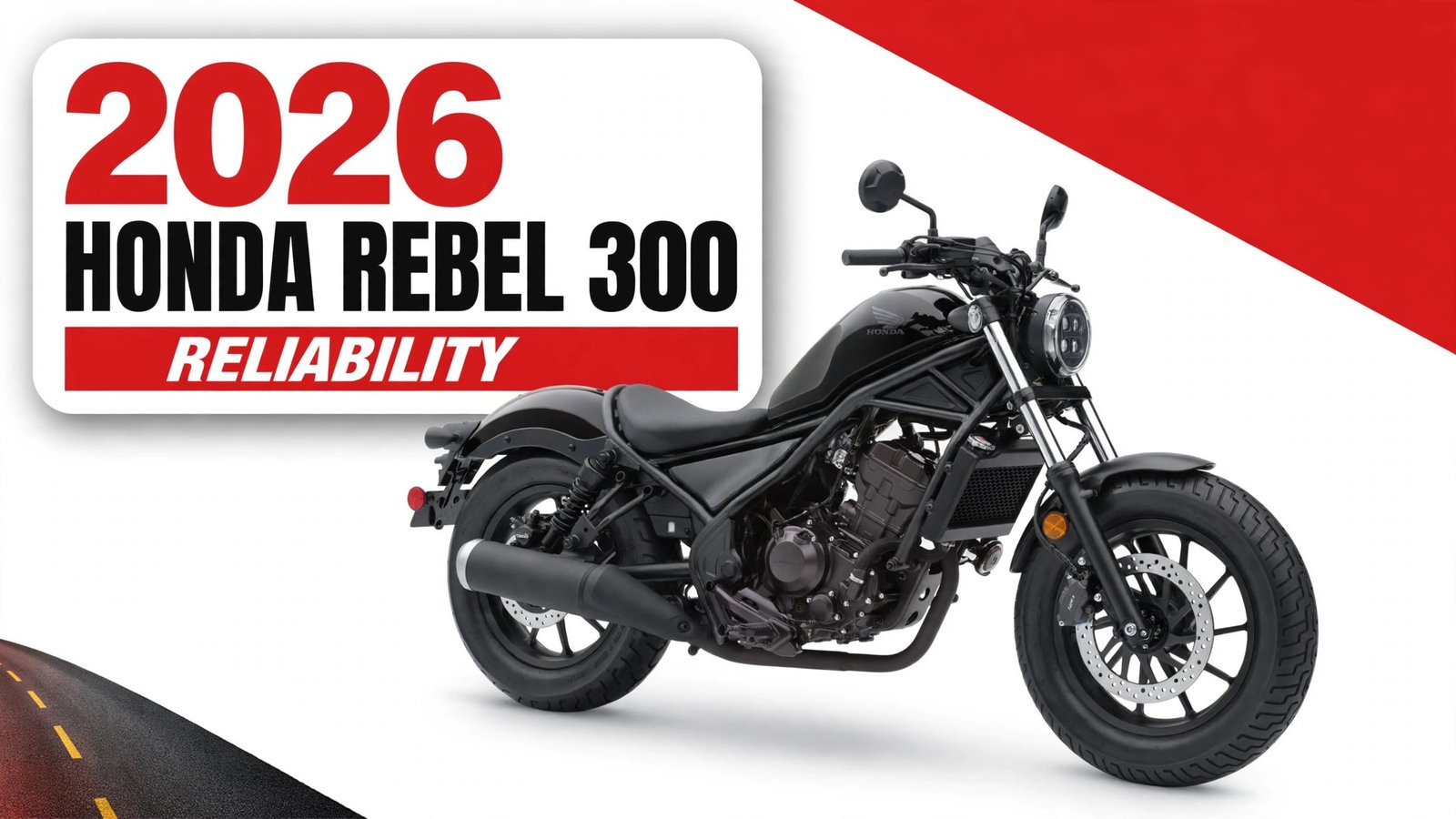
The Honda Rebel 300 has spent nearly a decade doing motorcycling’s least glamorous job: starting every morning, surviving new riders, and asking for very little in return. That is the core of Honda Rebel 300 reliability. The bike is built around a proven 286cc liquid-cooled single, a simple steel frame, and a short list of possible faults. It has no ride modes, no complex electronics, and no exotic materials. What it does have is a consistent maintenance schedule, documented recalls any buyer can check by VIN, and a wear list dominated by chain, tires, and learner drops.
Honda Rebel 300 Reliability Overview
In short, Honda Rebel 300 reliability is reassuring: no confirmed pattern of major engine or chassis failure. The longer version is more useful, because Honda Rebel 300 reliability is decided less by the engine and more by maintenance history, previous use, and whether the known recalls have been dealt with — the same manual-first discipline behind our Africa Twin reliability guide. That gap between a kept bike and a neglected one is Honda Rebel 300 reliability in practice.

Why There Is No MCN Owner Rating for the 300 and the 500 Data Differs
Buyers searching for an MCN owners’ reliability rating for the Rebel 300 will not find one: no MCN owner rating for the 300 surfaced in our research, even though MCN rates the bigger Rebels at 4.6 out of 5. Those numbers belong to different motorcycles and must never be transferred to the 300: the 500 is a 471cc parallel twin, the 300 a 286cc single. The missing MCN score is a data gap, not evidence of a problem: judge Honda Rebel 300 reliability from the manual, the recall record, and owner reports.
How Mileage, Maintenance History and Previous Use Affect Reliability
On a Rebel 300, the odometer tells you less than the service record does. The engine is understressed and intervals are long, so a 20,000-mile bike with a full history and clean chain beats a 4,000-mile bike that sat unridden for two years with a dry chain and dead battery. For Honda Rebel 300 reliability, previous use matters more than usual: many used examples were learner bikes, dropped, chain-neglected, or stored without a tender. High mileage alone is not a red flag, since there is no confirmed pattern of engine, gearbox, or frame failure beyond the recalled circlip batches. High mileage means wear items have accumulated, so chain, tires, brake pads, fork seals, and battery become inspection priorities for Honda Rebel 300 reliability.
Honda Rebel 300 Common Problems and Wear Items
There is no long list of dreaded faults on the Rebel 300 — itself a finding for Honda Rebel 300 reliability. The problems fall into three buckets: learner-drop damage, wear items, and owner-reported niggles never confirmed as defect patterns.

Learner Drops, Chain Neglect and Wear Items to Inspect First
Start with drops. A bike down at parking-lot speed usually shows bent levers, scuffed bar ends, a scratched exhaust, and marked fenders. Check handlebar straightness, lever action, and fork tubes for dents or leaking seals. Drop damage is normally cosmetic, but work the controls rather than just looking at them: a bent lever can hide a fatigued perch or stretched cable. Then look at the chain, the single most consequential wear issue for Honda Rebel 300 reliability. The manual calls for chain checks and lubrication every 600 miles; owners who treat it as fit-and-forget pay with a stretched chain, hooked sprocket teeth, and tight spots that make the bike surge. Check slack at several points along the lower run, midway between the sprockets: the manual specifies 25 to 35 mm, and warns not to ride above 50 mm.
Clutch, Gearbox Circlip Recall History, Battery and Electrical Checks
For Honda Rebel 300 reliability, start with the clutch: pre-2026 models use a conventional cable unit needing 10 to 20 mm of lever freeplay per the manual. Freeplay drift is the usual cause of a clutch that drags or slips, and it is a five-minute adjustment. Owner reports mention a shift lever that occasionally drops or sticks and makes neutral hard to find; one forum poster put the shift pedal and linkage shaft at around $25. Treat that as an owner report, not a confirmed pattern. The 2026 E-Clutch uses actuators so the rider can pull away and stop without the lever; it is too new for long-term data. Outside the recalled 2018–2019 circlip batches, no confirmed gearbox failure pattern has emerged. On the electrical side, owner reports describe hard starts and a flashing FI light traced to a weak battery or switch fault; test the battery under load, clean the terminals, and insist on a cold start, since a healthy battery is a small but real part of Honda Rebel 300 reliability.
Honda Rebel 300 Maintenance Schedule and Servicing
The Rebel 300’s service schedule is a strong reliability argument: long intervals, simple fluids, no dealer-only procedures for routine jobs. Figures below come from the CMX300 owner’s manual. For Honda Rebel 300 reliability, each mileage figure carries a calendar limit that wins for low-mileage bikes. That discipline is the backbone of Honda Rebel 300 reliability.

First Service at 600 Miles, Oil Every 8,000 Miles or 12 Months
The first service falls at 600 miles, the most important the bike will ever have: oil, fasteners, controls, and chain inspection after initial stretch. Skipping it, or buying a bike without a documented first service, is the clearest early warning sign. After that, Honda Rebel 300 reliability depends on oil every 8,000 miles or 12 months, whichever comes first, using SAE 10W-30 meeting API SG or higher and JASO T 903 MA (Pro Honda GN4), with a capacity of 1.6 US quarts including the filter change. Ignore generic sources quoting 6,000 miles; that figure does not match the manual. Between services, check the oil level with the bike upright on level ground, and keep records: a stamped book converts a maintenance claim into evidence for Honda Rebel 300 reliability. The 2020 Rebel 300 owner’s manual maintenance schedule shows the interval table in full.
Valve-Clearance Inspection Every 16,000 Miles and Plugs at 32,000
Valve-clearance inspection is due every 16,000 miles, and it is the big-ticket item because it requires mechanical skill and access to the top of the engine. Most Rebel 300s change hands before their first valve check. The interval is an inspection, not an automatic adjustment: clearances are measured, and shims are changed only if a valve is out of specification. A bike approaching 16,000 miles without a valve-check record should be priced to reflect that service. For Honda Rebel 300 reliability, note also: spark plugs at 32,000 miles, coolant every three years. Nothing below needs exotic tools except the valve check — exactly why Honda Rebel 300 reliability holds up so well in private hands.
| Service item | Interval (Honda owner’s manual) | Notes |
|---|---|---|
| First service | 600 miles | Oil, fasteners, controls, chain |
| Engine oil and filter | Every 8,000 miles or 12 months | 10W-30, API SG+, JASO MA; 1.6 US qt |
| Drive chain check and lubrication | Every 600 miles | Slack 25–35 mm; do not ride above 50 mm |
| Valve-clearance inspection | Every 16,000 miles | Inspect; adjust if out of spec |
| Spark plugs | 32,000 miles | Per manual schedule |
| Brake fluid | Every 2 years | Flush, not top-up |
| Radiator coolant | Every 3 years | Per manual |
| Clutch lever freeplay | Check at each service | 10–20 mm; pre-2026 models |
Honda Rebel 300 Tires, Brakes and Suspension Maintenance
Tires, brakes, and suspension are where a Rebel 300’s condition is most visible. None of these systems is complicated: every check below can be done in a driveway with basic tools, and every worn part is cheap by motorcycle standards. Staying on top of them is a large part of Honda Rebel 300 reliability.
Tire Condition, Pressure, Tread Wear and Replacement
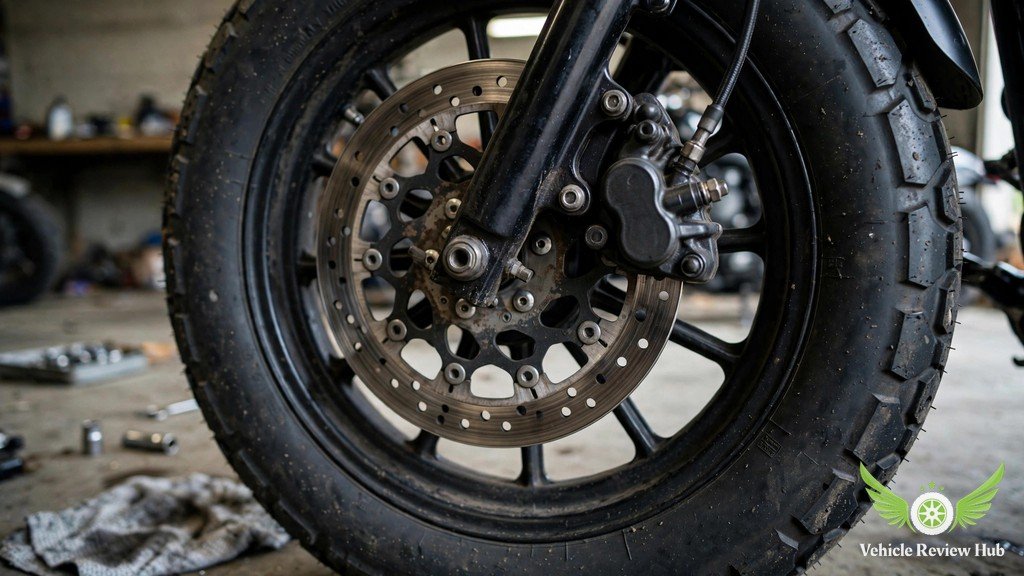
The Rebel 300 runs fat 16-inch rubber: a 130/90-16 front and a 150/80-16 rear, Dunlop D404 as stock. Check full-width tread and squared-off commuter profiles. On a low-mileage used bike, age matters more than tread: check the DOT date code, and replace any tire older than five years regardless of tread. Pressure is the cheapest item in Honda Rebel 300 reliability: check it cold, before every ride until you know the bike, always to your model year’s manual figure. Under-inflation wears the shoulders and hurts fuel economy; over-inflation shrinks the contact patch and wears the centre. Neglected tires quietly undermine Honda Rebel 300 reliability.
Brake Pads, Brake Fluid Every Two Years, Forks and Shock Checks
Braking is a single 296mm front disc and 240mm rear disc, each with a single caliper, ABS by model year and code. Inspect pads from below the front caliper and from the rear, replacing any pad worn to its indicator, always as a pair. Brake fluid is hygroscopic, absorbing moisture over time, so the manual’s two-year interval is a flush, not a top-up: old fluid lowers the boiling point and corrodes the system from inside. A spongy lever or dark fluid means it is overdue. Brake upkeep is unglamorous, but it is part of Honda Rebel 300 reliability. The front is a 41mm fork, and here Honda’s own pages disagree: the 2025 specification page lists 4.8 inches of front travel, while the current page lists 5.5 inches. The rear dual shocks have five-position preload adjustment and 3.7 inches of travel on Honda’s pages. We name that conflict rather than choosing one silently; the checks are unchanged for Honda Rebel 300 reliability: look for fork-seal leaks, test rear shock damping, and adjust preload for your weight and load.
Honda Rebel 300 Maintenance and Ownership Costs
The Rebel 300 is cheap to keep, and that cheapness supports Honda Rebel 300 reliability: when servicing costs little, owners do it. The bike takes just 1.6 quarts of oil, wears one small tire at each end, and needs no valve work until 16,000 miles. The costs that surprise new owners are tires, chains, batteries, and catching up on deferred maintenance.

Fuel, Routine Servicing, Tires and Replacement Parts
Fuel is the smallest running cost. The tank holds 3.0 gallons; published tests put real-world economy in the high-50s miles per gallon, with some owner reports higher, and Honda’s older 78 mpg estimate is best treated as a lab-era figure. A seven-year ownership review of the Rebel 300 anchors the long-term side of Honda Rebel 300 reliability:
For Honda Rebel 300 reliability, routine servicing is modest: an oil and filter change needs little oil and one filter, and chain service needs cleaner, lubricant, and a few minutes every 600 miles. Tires are the largest routine consumable: a pair fitted costs more than a year’s oil changes, so price tire condition into any used purchase. Parts availability is a genuine strength for Honda Rebel 300 reliability: shared chassis with the Rebel 500, a deep dealer network, and widely available pattern parts.
Repair Expenses, Parts Availability and Long-Term Ownership Costs
The headline finding for Honda Rebel 300 reliability: major repair expenses are rare — no fragile electronics, no costly transmission fault outside recalled batches, no recurring engine issue. The bills that do arrive are predictable: valve service at 16,000 miles, chain and sprockets when adjustment runs out, a battery every few years, tires when age or wear demands them, and brake fluid every two years. Costs stay low partly because the bike holds value well, with constant demand from new riders. Dealer prices vary by region, so get a written quote for the 600-mile, 8,000-mile, and 16,000-mile services before you buy. That predictability is itself a form of Honda Rebel 300 reliability.
How to Keep a Honda Rebel 300 Reliable
Keeping a Rebel 300 reliable means small jobs on time and checking the recall list before you buy: a clean chain, fresh oil, correct pressures, and a battery never left flat. The routine below is the secret of Honda Rebel 300 reliability.

Preventive Maintenance, Chain Care Every 600 Miles and Inspections
For Honda Rebel 300 reliability, build the habit around the 600-mile chain interval, the most frequent job and the easiest to forget. Clean and lubricate the chain every 600 miles, and after any ride in rain, checking slack at several points and adjusting to 25 to 35 mm. Inspect the sprockets at the same time, and replace the chain the moment the adjuster runs out of travel or tight spots appear. Between chain services, run a short pre-ride check: tires and pressures, brake lever feel, lights, oil level with the bike upright, and a look for fresh leaks. Storage deserves the same discipline: a bike that sits for winter without preparation comes back with a dead battery, a dry chain, and stale fuel, and those three items account for most springtime reliability complaints. Connect a battery tender, fill the tank, and keep tires at full pressure. On 2026 E-Clutch bikes, have the actuator system checked at service intervals, and send any warning light or clutch-behaviour change to a dealer. That dealer-first rule for new technology protects Honda Rebel 300 reliability.
Recall Checks: Circlip 19V-412, Reflector 21V-382 and Handlebar 26V-500
Four safety campaigns name the Rebel 300; check all four by VIN. The doc heading names three campaigns; the fourth, the 2023 oil-plug recall, is included because a full NHTSA check turns it up. All recall repairs are free at a dealer, and a completed recall is a positive, not a black mark. Checking them is a non-negotiable part of Honda Rebel 300 reliability for any used purchase.
The circlip fault (19V-412) could misalign a gear, shifting from neutral into gear on starting or seizing the transmission and rear wheel. The reflector fault (21V-382) is a rear reflector too dim for the federal lighting standard. The oil-plug fault (23V-261) can let the crankcase plug come out and spray oil onto the exhaust or rear tire. The handlebar fault (26V-500) is a lock screw that can loosen, detach, and lodge between frame and steering stem, interfering with steering. A 2024 buyer must also check the earlier handlebar recall 26V-146, since 2024 models are excluded from 26V-500. The table gives each campaign’s Rebel 300 scope and remedy for Honda Rebel 300 reliability, with the source linked in the campaign name.
| Campaign | Rebel 300 scope (NHTSA) | Remedy (free at dealer) |
|---|---|---|
| 19V-412 (KK3) — circlip | 2018: 1,262 units; 2019: 868 units | Replace transmission main shaft |
| 21V-382 (KM3) — rear reflector | 2020: 608 units; 2021: 2,144 units | Replace rear reflector |
| 23V-261 (KP2) — crankcase oil plug | Certain 2023 only: 1,461 units | Replace right crankcase cover |
| 26V-500 (KU8) — handlebar lock screw | 2017–2023: 19,007 units; 2025–2026: 245 units | Replace lock screw, apply thread lock |
| Plus the earlier handlebar recall 26V-146 (March 2026): 2024 buyers must check this campaign by VIN, since 2024 models are excluded from 26V-500 (see the 26V-500 summary). | ||
Run the VIN check before you pay, and file the recall paperwork with the service record. A Rebel 300 with all four campaigns cleared, a documented 600-mile first service, and a clean chain is about as safe a used beginner bike as the market offers — the practical meaning of Honda Rebel 300 reliability.
Honda Rebel 300 Reliability FAQs
Direct answers about Honda Rebel 300 reliability, from the manual, the recall record, and owner evidence.
How good is Honda Rebel 300 reliability?
Excellent. Honda Rebel 300 reliability rests on long intervals, cheap parts, and free recall remedies, with no confirmed pattern of major failure.
What is the most common problem with the Honda Rebel 300?
Chain neglect: for Honda Rebel 300 reliability, the chain needs attention every 600 miles. Learner drops are the top cosmetic issue; owner reports also mention clutch drift and battery hard starts.
Does the Honda Rebel 300 have an MCN owner reliability rating?
No MCN owner rating for the 300 was found. MCN rates the 500 and 1100 at 4.6 out of 5, but those figures belong to different motorcycles and must not be applied here.
Which recalls affect Honda Rebel 300 reliability?
Four campaigns, all checked by VIN: 19V-412 (circlip, 2018–2019), 21V-382 (reflector, 2020–2021), 23V-261 (oil plug, certain 2023), 26V-500 (handlebar screw, 2017–2023 and 2025–2026); plus 26V-146 for 2024 models.
How often does a Honda Rebel 300 need an oil change?
For Honda Rebel 300 reliability: every 8,000 miles or 12 months, whichever comes first, after the 600-mile first service. Use SAE 10W-30, API SG or higher, JASO MA; 1.6 US quarts with the filter.
When does the Honda Rebel 300 need a valve-clearance check?
Every 16,000 miles. An inspection, not an automatic adjustment: shims change only if a valve is out of specification, so price it into any bike nearing that mileage without a record.
How does chain care affect Honda Rebel 300 reliability?
More than any other single habit. Clean and lubricate every 600 miles, keep slack at 25 to 35 mm, never ride above 50 mm, and replace chain and sprockets together when tight spots appear.
What are the Honda Rebel 300 tire sizes and brake specifications?
For Honda Rebel 300 reliability: 130/90-16 front and 150/80-16 rear tires; single 296mm front and 240mm rear discs. ABS varies by year and code: CMX300 non-ABS, CMX300A ABS.
How often should brake fluid be changed on a Rebel 300?
Every two years, as a full flush for Honda Rebel 300 reliability, not a top-up. Old fluid absorbs moisture, lowers the boiling point, and corrodes the system.
Is the 2026 Honda Rebel 300 E-Clutch reliable?
Unknown long-term: new for 2026, so no durability data exists. Honda Rebel 300 reliability for E-Clutch bikes means scheduled actuator checks and dealer attention for warning lights.
What should I inspect first on a used Honda Rebel 300?
In order: VIN against all four recalls, service record (especially the 600-mile first service), chain and sprockets, tire age, brakes, fluid, cold start, and learner-drop damage. Cheap, widely available parts support Honda Rebel 300 reliability further.