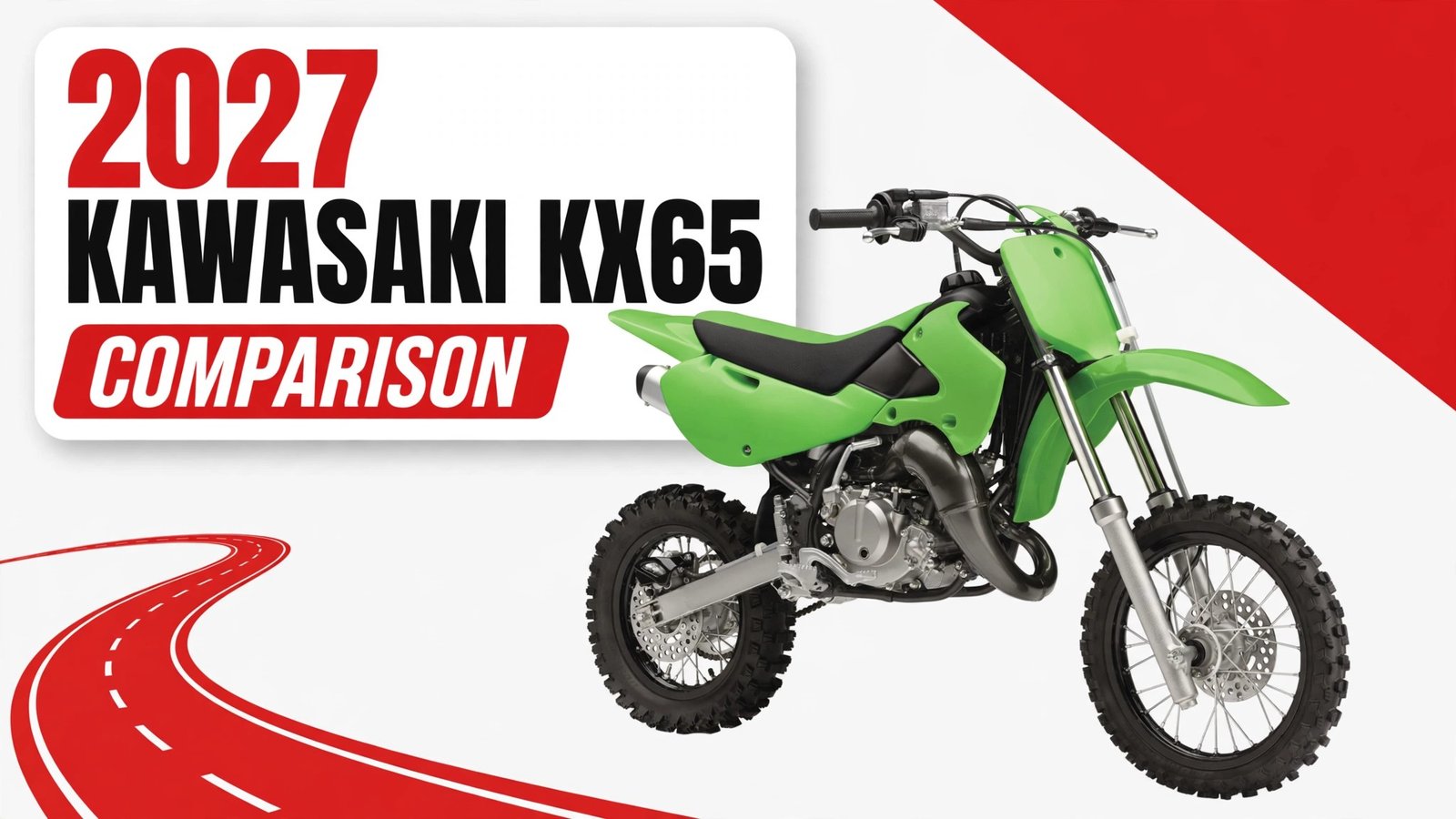
Four 65cc motocrossers, one starting gate, and a $1,750 spread between the cheapest and the dearest. The 2027 Kawasaki KX65 costs $4,249 before destination — $250 less than the Yamaha YZ65, $1,650 less than the KTM 65 SX and $1,750 less than the Husqvarna TC 65 — and it is also the oldest design in the group, fundamentally unchanged since its 2002 revision. This Kawasaki KX65 comparison puts the four bikes side by side on price, power and hardware, using the manufacturers’ own 2027 figures and the only US dyno test that ever measured three of them.
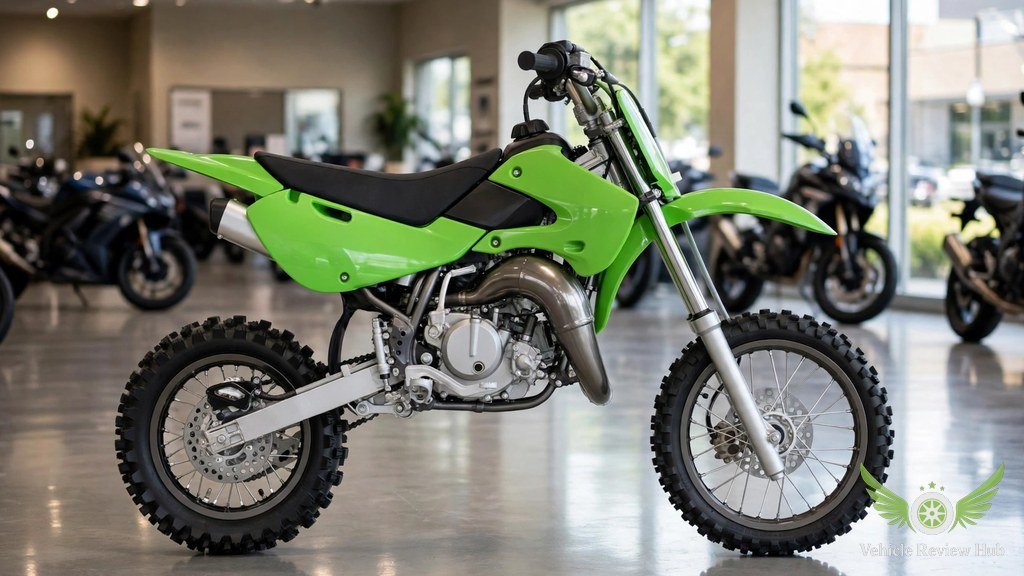
The short answer in this Kawasaki KX65 comparison is that the KX65 wins on price and loses on power. Motocross Action’s 2018 dyno put it at 13.77 hp against the YZ65’s 17.45 hp and the KTM’s 16.52 hp, and it has the least suspension travel and the least adjustability of the four. But it is also the only one of the four with a rising-rate linkage rear suspension. The rest of this Kawasaki KX65 comparison works through the four bikes one rival at a time, then totals the money.
Kawasaki KX65 Overview and Its Closest Rivals
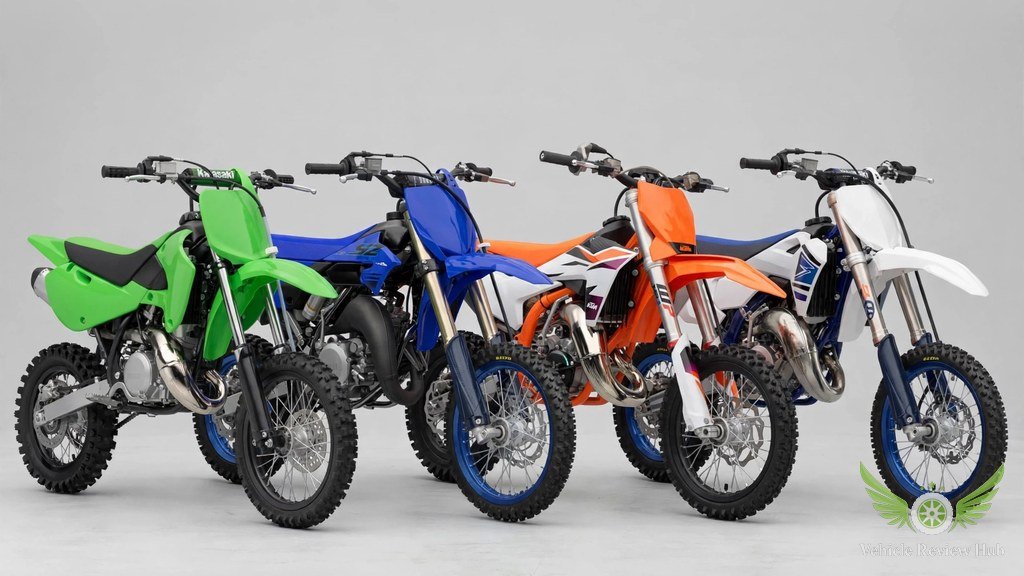
The four bikes in this Kawasaki KX65 comparison are the four 65cc motocrossers sold new in the USA for 2027 with a full manufacturer presence: the Kawasaki KX65, the Yamaha YZ65, the KTM 65 SX and the Husqvarna TC 65. All four are liquid-cooled 64–65cc two-stroke singles on 14/12-inch wheels, all closed-course competition bikes with six-speed manual clutches. The Cobra CX65 was not checked for the linkage claim and is not one of this comparison’s three named rivals.
Cheapest, Softest, Oldest
Cheapest is not close in this Kawasaki KX65 comparison. The KX65’s $4,249 MSRP undercuts the YZ65 by $250, the KTM by $1,650 and the Husqvarna by $1,750, and the delivered gaps are wider still — $4,564 against $4,819, $6,324 and $6,424. Oldest is clear too: the KX65 was all-new in 2000 and revised in 2002; the YZ65 arrived in 2018 and the Austrian platform was redesigned for 2024. Softest needs a qualification. The KX65 has the least suspension travel at both ends — 8.3 inches front and 9.4 inches rear against the YZ65’s 8.5 and 10.6 and the Austrians’ 8.46 and 9.98 — the only conventional (non-inverted) fork in the group, and the only fork with rebound-only damping. No maker publishes spring rates, so “softest” here means least travel and least adjustability, and that is how this Kawasaki KX65 comparison uses the word.
How the Four Bikes Differ at a Glance
The table below is the whole Kawasaki KX65 comparison in one place, built from the four makers’ own 2027 figures.
| Item | Kawasaki KX65 | Yamaha YZ65 | KTM 65 SX | Husqvarna TC 65 |
|---|---|---|---|---|
| MSRP (2027) | $4,249 | $4,499 | $5,899 | $5,999 |
| Destination / freight | $315 | $320 | $425 | $425 |
| Delivered (2027) | $4,564 | $4,819 | $6,324 | $6,424 |
| Engine | 64cc 2-stroke single, reed valve | 65cc 2-stroke single, YPVS power valve | 64.9cc 2-stroke single, PCEV | 64.9cc 2-stroke single, PCEV |
| Bore × stroke | 44.5 × 41.6 mm | 43.5 × 43.6 mm | 45 × 40.8 mm | 45 × 40.8 mm |
| Carburettor | 24 mm Mikuni VM24SS | 28 mm Keihin PWK28 | 24 mm Mikuni VM 24 | 24 mm Mikuni |
| Transmission | 6-speed, wet multi-disc manual clutch | 6-speed close-ratio, wet multiplate clutch | 6-speed, wet multi-disc, Formula hydraulic clutch | 6-speed, DS clutch, Formula hydraulic clutch |
| Seat height | 29.9 in | 29.7 in | 730 mm = 28.7 in std; adjustable 715–760 mm (28.1–29.9 in) | 730 mm = 28.7 in std; same adjustable ergonomics |
| Dyno power (MXA 2018) | 13.77 hp | 17.45 hp | 16.52 hp | Not tested |
| Weight | 126.1 lb w/o fuel, 132.2 with | 134 lb wet | 119.7 lb w/o fuel, ~127 wet | 119.7 lb w/o fuel, ~127 wet |
| Fuel capacity | 1.0 gal (3.8 L) | 0.9 gal (3.4 L) | 1.19 gal (4.5 L) | 1.19 gal (4.5 L) |
| Front suspension | 33 mm conventional, rebound-only; 8.3 in | 36 mm KYB USD, fully adj.; 8.5 in | WP XACT 35 mm USD AER; 8.46 in | WP XACT 35 mm USD; 8.46 in |
| Rear suspension | Uni-Trak linkage; 9.4 in | KYB linkless, fully adj.; 10.6 in | WP XACT PDS; 9.98 in | WP XACT PDS; 9.98 in |
| Brakes | 180 mm F/R, single-piston | 198/190 mm, wave rotors | 198/180 mm, Formula hydraulics | 198/180 mm waved, Formula hydraulics |
| Wheels / tyres | 14 in F / 12 in R; 60/100-14, 80/100-12 | 14 in F / 12 in R; Maxxis 60/100-14, 80/100-12; blue Excel rims | 14 in F / 12 in R; Maxxis MX-ST 60/100-14, 80/100-12 | 14 in F / 12 in R; Maxxis 60/100-14, 80/100-12 |
| Electronic aids | None (CDI only) | None (digital CDI only) | None rider-selectable — no map switch, no launch control, no TC (plug-in ignition-timing map connector only) | Same as KTM — none rider-selectable |
| Warranty | Sold as-is — no warranty | 30 days, limited | 1-year warranty from MY2027 | 1-year warranty |
Note: Figures in this Kawasaki KX65 comparison are the makers’ own 2027 numbers unless marked. Dyno power is Motocross Action’s 2018 test — the only US dyno that measured three of these four bikes; the 2024-redesigned Austrians were not in that test, Destination charges are dealer- or motorcycle.com-sourced, never Kawasaki- or Yamaha-published figures; the Yamaha’s $320 comes from dealer listings. The KTM’s bore and stroke (45 × 40.8 mm) come from motorcycle.com plus the Husqvarna table, not KTM’s own page. Husqvarna’s model page disagrees with its spec table on fuel capacity (0.92 gal vs 4.5 L) and fork travel (205 mm vs 215 mm) — this Kawasaki KX65 comparison follows the spec table on both.
Carson Brown lines up all four 65s in this shootout — the Yamaha YZ65, the Cobra CX65, the Kawasaki KX65 and the GasGas MC 65 — for lap times and rideability. The other two bikes are the Cobra and the GasGas, not the KTM 65 SX or Husqvarna TC 65 (the GasGas shares their Austrian platform). The KX65 comes out simple and fun, but last on lap times.
Kawasaki KX65 vs Yamaha YZ65
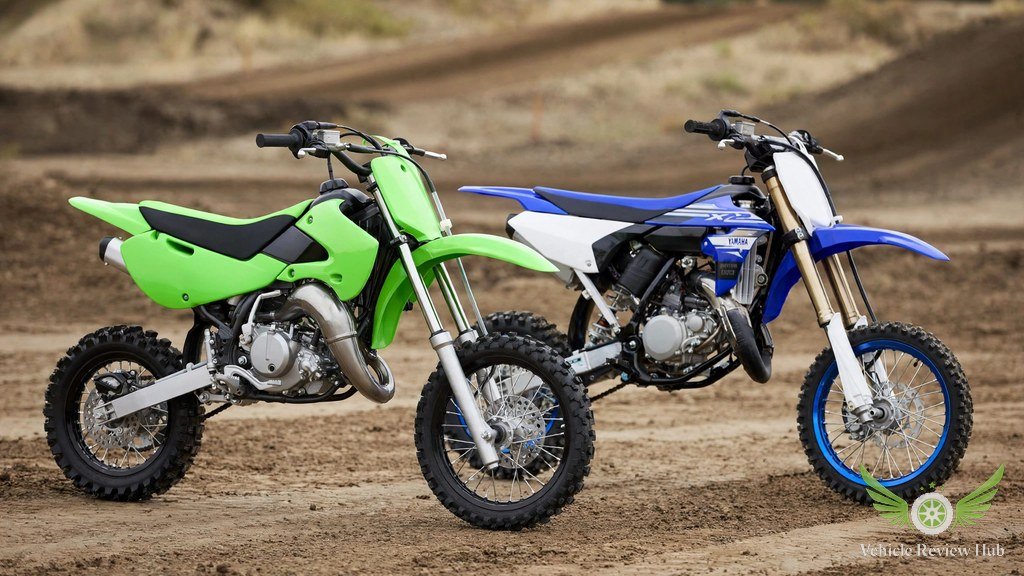
The Yamaha is the KX65’s closest rival on price and its clearest rival on power: $250 more on MSRP and $255 more delivered, for the strongest engine in the class on the only dyno that ever measured these bikes, plus the best suspension of the Japanese pair — the default alternative in this Kawasaki KX65 comparison for a family that can stretch the budget by a few hundred dollars.
Engine, Specs and Performance Side by Side
Motocross Action’s 2018 test measured the YZ65 at 17.45 hp against the KX65’s 13.77 hp — the Yamaha makes 3.68 hp more, or 26.7% more at peak — and MXA described the KX65 as “as much as 4 horses down on the 65SX and YZ65 at virtually every point on the curve,” calling it “25 percent less power across the board.” That “25 percent” is MXA’s curve-wide wording, not exact peak arithmetic: on peak figures the KX65 is 21.1% below the YZ65. The Yamaha’s advantage comes from its YPVS power valve — the KX65 has none — and a bigger 28 mm Keihin PWK28 carburettor against the KX65’s 24 mm Mikuni VM24SS, as our Kawasaki KX65 review verifies. The Yamaha also out-suspends the Kawasaki: a fully adjustable 36 mm KYB inverted fork (8.5 in) and a fully adjustable linkless KYB rear shock (10.6 in). The KX65’s one hardware win in this pairing is its Uni-Trak rising-rate linkage rear suspension — the YZ65’s rear shock connects straight to the swingarm — and its 180 mm discs are the smallest brakes in the class, against the Yamaha’s 198/190 mm wave rotors. There is no tested top speed for either bike in this Kawasaki KX65 comparison, and no maker publishes a claimed power figure for either one.
Price, Equipment and Which Suits Which Rider
The Yamaha costs $4,499 plus a $320 destination charge — $4,819 delivered against the KX65’s $4,564 — so the power and suspension advantage is priced at $255 delivered. Equipment is otherwise close: six-speed manual clutches, no lights, no instruments, no electric start on either bike. The one equipment gap that matters to a buyer in this Kawasaki KX65 comparison is the warranty: Yamaha gives a 30-day limited warranty covering the engine, frame, swingarm and monoshock, while the KX65 is sold as-is with no warranty at all in the USA. Buy the Yamaha for power and suspension: a rider who is already fast will feel the $255 immediately. Buy the Kawasaki for price and simplicity: a first 65, a younger or lighter rider, or a family that wants the cheapest bike in the class and the only linkage rear suspension in the group. The KX65’s piston and ring set costs $96.83 and $46.06 from Partzilla, checked November 25, 2026; the Yamaha’s parts prices were not verified here.
Kawasaki KX65 vs KTM 65 SX
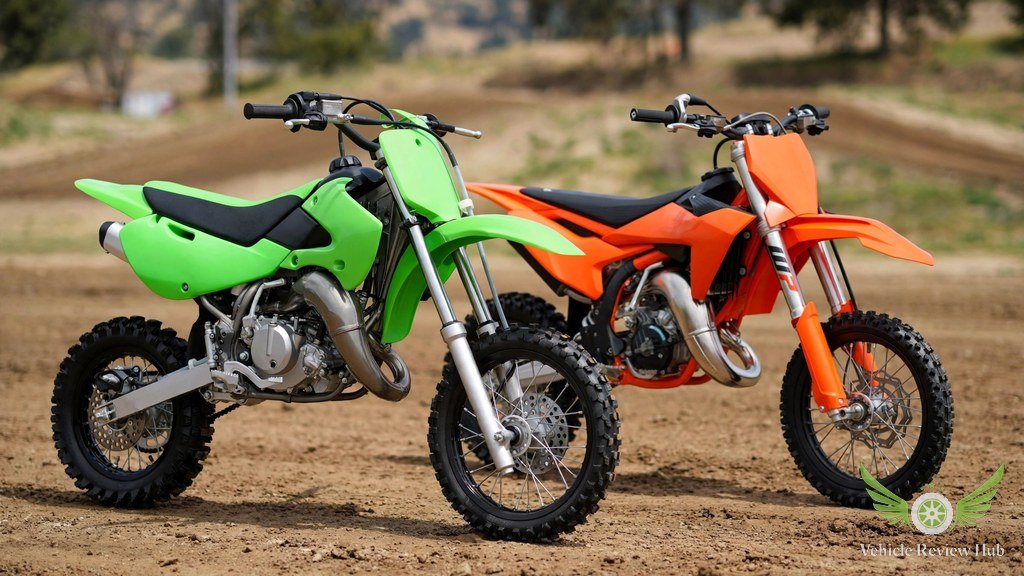
The KTM is where the price gap stops being small: $5,899 plus $425 freight, $6,324 delivered — $1,650 more than the KX65 on MSRP and $1,760 more delivered. What that money buys is the most modern 65 in the class: a platform fully redesigned for 2024, an air fork, a hydraulic clutch and the lightest weight in this Kawasaki KX65 comparison.
Engine, Specs and Performance Side by Side
The KTM’s 64.9cc single carries a PCEV power valve and a 24 mm Mikuni carburettor, and on Motocross Action’s 2018 dyno it made 16.52 hp against the KX65’s 13.77 hp — 2.75 hp more, or 20.0% more at peak, with the KX65 sitting 16.6% below the KTM’s peak figure. One caveat in this Kawasaki KX65 comparison: the 2018 dyno tested the pre-redesign KTM, and no dyno of the current 2024 bike was found. The hardware gap is wider than the power gap. The KTM runs a WP XACT 35 mm upside-down AER air fork with 8.46 inches of travel and a WP XACT PDS rear shock — no linkage — with 9.98 inches, plus a Formula hydraulic clutch where the KX65 uses a cable-operated wet multi-disc clutch. The KTM is also the lightest bike in the group at 119.7 lb without fuel, roughly 127 lb wet against the KX65’s 132.2 lb with fuel, and it carries the biggest tank at 1.19 gallons against the KX65’s 1.0. Its seat adjusts from 28.1 to 29.9 inches. The KX65’s answer in this Kawasaki KX65 comparison is its rising-rate linkage rear suspension — the KTM’s PDS shock bolts straight to the swingarm — and a $1,760 delivered price advantage.
Price, Equipment and Which Suits Which Rider
The KTM’s equipment list reads like a bigger bike’s: air fork, hydraulic clutch, adjustable ergonomics and a one-year Premium Manufacturer’s Warranty from model year 2027, where the KX65 is sold as-is with no warranty. But in this Kawasaki KX65 comparison, $1,760 delivered buys the KX65’s piston-and-rings service (parts $142.89) more than twelve times over. Buy the KTM for the modern platform: a rider already racing at the sharp end of the 65 class, whose family can absorb the $6,324 delivered price. Buy the Kawasaki for the budget: a first 65, a younger rider, or a family that wants the cheapest way into the class and is happy to trade the air fork and the warranty for $1,760 in the bank. Our Kawasaki KX65 performance guide works through the dyno gap in full, including the peak maths behind MXA’s “25 percent” wording.
Kawasaki KX65 vs Husqvarna TC 65
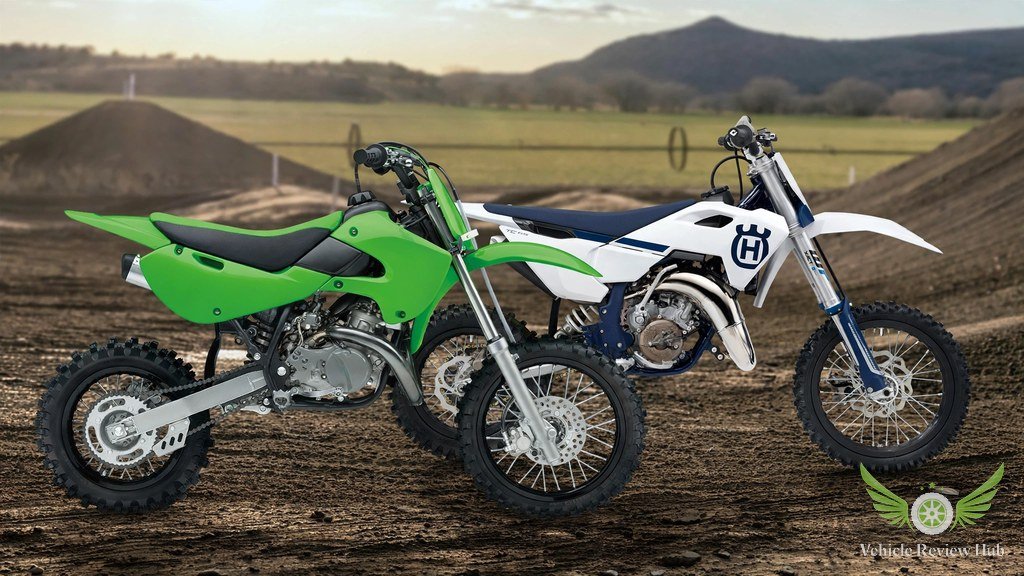
The Husqvarna is the most expensive bike in this Kawasaki KX65 comparison and, mechanically, the KTM in different clothes: the TC 65 shares the KTM’s engine, chassis, suspension, brakes, weight, seat height and tank, and costs $100 more than the KTM and $1,750 more than the KX65 on MSRP. The question here is whether the white-and-blue Austrian is worth $1,860 more delivered than the green Kawasaki.
Engine, Specs and Performance Side by Side
There is no dyno of the TC 65 to quote: Motocross Action’s 2018 test measured the KTM but not the Husqvarna, and no other US dyno of the TC 65 was found. The TC 65’s engine is the KTM’s engine — 64.9cc, 45 × 40.8 mm bore and stroke, PCEV power valve, 24 mm Mikuni carburettor — and the 2018 KTM figure of 16.52 hp is the nearest measured proxy, 2.75 hp above the KX65’s 13.77 hp. The rest of the spec sheet in this Kawasaki KX65 comparison is a copy of the KTM’s: WP XACT 35 mm upside-down fork with 8.46 inches of travel, WP XACT PDS rear shock with 9.98 inches and no linkage, 198 mm front and 180 mm rear waved discs with Formula hydraulics, 119.7 lb without fuel and a 1.19-gallon tank. Husqvarna’s own model-page copy disagrees with its spec table on two figures — tank 0.92 gal vs 1.19 gal, fork 205 mm vs 215 mm — and this Kawasaki KX65 comparison follows the spec table on both, as it matches the KTM platform.
Price, Equipment and Which Suits Which Rider
At $5,999 plus $425 freight — $6,424 delivered — the TC 65 is the dearest bike in this Kawasaki KX65 comparison, $1,750 more than the KX65 on MSRP and $1,860 more delivered. The $100 premium over the KTM buys white-and-blue bodywork, black-anodised bars with ODI grips, DS clutch branding and the 2027 revised power valve; everything mechanical is shared. Buy the Husqvarna for the package: the KTM platform with the Husqvarna’s look, bars and dealer, for $100 over the KTM and $1,860 over the Kawasaki. Buy the Kawasaki for the same reasons as in the KTM pairing — price above all — with one extra note: the TC 65’s $1,750 MSRP gap is the only one of the two Austrian gaps that works out to $1,750. The KTM’s MSRP gap is $1,650; on delivered prices neither Austrian gap is $1,750.
Kawasaki KX65 Price and Value Compared
Price is where this Kawasaki KX65 comparison is decided for most families. The table below totals the money on 2027 figures, with every gap measured against the KX65.
| Bike (2027) | MSRP | Destination / freight | Delivered | Gap vs KX65 (MSRP / delivered) |
|---|---|---|---|---|
| Kawasaki KX65 | $4,249 | $315 | $4,564 | — |
| Yamaha YZ65 | $4,499 | $320 | $4,819 | +$250 / +$255 |
| KTM 65 SX | $5,899 | $425 | $6,324 | +$1,650 / +$1,760 |
| Husqvarna TC 65 | $5,999 | $425 | $6,424 | +$1,750 / +$1,860 |
Note: MSRP figures are the makers’ own 2027 numbers — Kawasaki’s spec sheet for the KX65, Yamaha’s for the YZ65, KTM’s dealer pricing for the 65 SX and Dirt Bike Magazine’s 2027 press-release pricing for the TC 65. Destination charges are dealer- or motorcycle.com-sourced, never Kawasaki- or Yamaha-published figures; the Yamaha’s $320 comes from three independent dealer listings. The KX65’s MSRP has been $4,249 flat since 2024 (some guides print $4,199 for 2024; Kawasaki’s own sheet says $4,249). Kawasaki also offers up to $200 holiday cash plus up to $700 in factory savings on 2025–2027 KX65s through December 31, 2026.
Austrians Cost $1,750 More
The heading is exact for one bike and one measure only. The Husqvarna TC 65 costs exactly $1,750 more than the KX65 on MSRP — $5,999 minus $4,249 — and that is the only $1,750 gap in this Kawasaki KX65 comparison. The KTM 65 SX costs $1,650 more on MSRP ($5,899), and on delivered prices the gaps grow to $1,760 for the KTM and $1,860 for the Husqvarna, because the Austrians carry $425 freight against the KX65’s $315. The Yamaha’s gap is smaller: $250 on MSRP, $255 delivered. What the $1,750 buys in this Kawasaki KX65 comparison is the 2024-redesigned Austrian platform: air fork, hydraulic clutch, adjustable ergonomics, lightest weight, one-year warranty. What it does not buy is a measured power advantage over the KX65 on any current dyno, because no dyno of the current Austrian bikes was found.
Running Costs and Resale Value Compared
Running costs are where the KX65’s age turns into an advantage in this Kawasaki KX65 comparison. Its service schedule is short and public: piston and rings checked every 5 races (12.5 hours) and replaced at 10 races (25 hours), transmission oil every 3 races (7.5 hours), the NGK BR10EG plug replaced every 3 races, the air cleaner cleaned after every race — and the parts are cheap and published, with a piston at $96.83 and a ring set at $46.06 from Partzilla, checked November 25, 2026, or $142.89 together. Fuel is premix at 32:1 on a 1.0-gallon tank. The rivals’ parts prices were not verified here, so no running-cost winner is claimed on parts alone — but the KX65’s simplicity (no power valve, no air fork, no electronics) is a real advantage for a family doing the work at home. Resale is the honest gap in this Kawasaki KX65 comparison: no verified resale data was found for any of the four bikes, and none is printed here. Our Kawasaki KX65 reliability guide covers the service schedule and the two CPSC recalls in full.
Kawasaki KX65 Comparison Verdict and US Alternatives
The verdict of this Kawasaki KX65 comparison is not that the cheapest bike is the best bike — it is that the cheapest bike is the best bike for the most families. The KX65 gives up power to every rival on the only dyno that measured them, and suspension travel and adjustability to all three, and comes with no warranty at all. In return it costs $250 less than the Yamaha and $1,650–$1,750 less than the Austrians, and it is the only bike here with a linkage rear suspension.
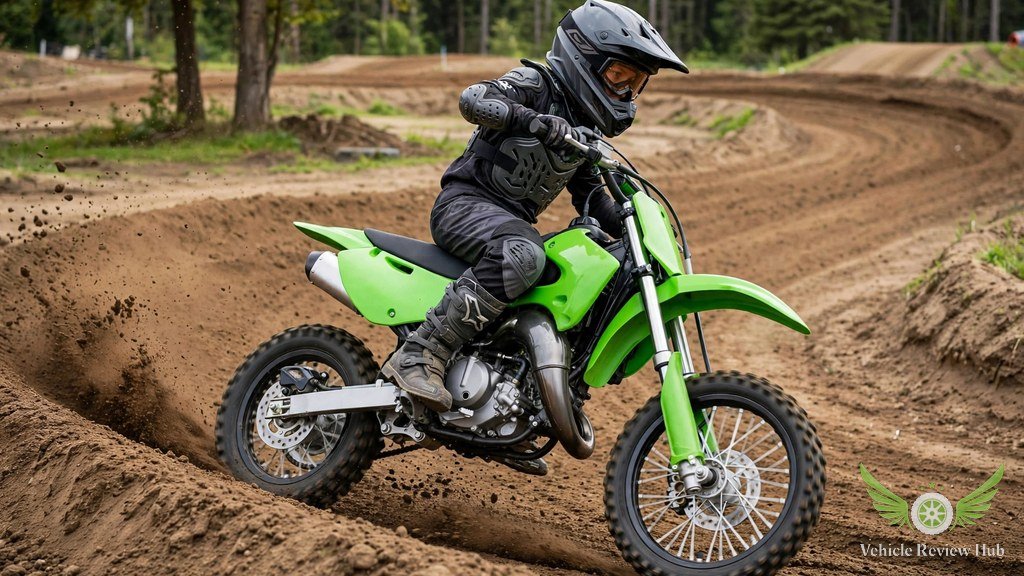
Verdict: The Teaching Bike
The KX65 is the teaching bike in this Kawasaki KX65 comparison. A young rider learns clutch, gears, braking and racecraft on a machine that is forgiving to ride and cheap to fix, and a family learns the sport without a $6,000 commitment. None of that makes the KX65 a bad bike. It makes it the honest entry point, and the bike a family buys when the rider, not the spec sheet, is the unknown.
KX85 Step-Up Is $5,314
The step up from a KX65 is the KX85, and the figure in this Kawasaki KX65 comparison is a delivered price, not an MSRP: the 2027 KX85 lists at $4,999 plus the same $315 destination charge, which is $5,314 delivered. That is $750 more delivered than the KX65’s $4,564 — about the same money the step up to an 85 will cost later. The large-wheel KX85 L is $5,199 plus $315, or $5,514 delivered. The KX85 is a different class of bike — an 84cc two-stroke with a 28 mm Keihin carburettor and a power valve, where the KX65’s carburettor is the 24 mm Mikuni — and it is the natural next bike for a rider who has outgrown the 65 class on power rather than on size.
Kawasaki KX65 Comparison FAQs
These are the questions US buyers ask when choosing between the 2027 KX65 and its three rivals, answered from the verified facts in this Kawasaki KX65 comparison.
Which bike is cheapest in this comparison?
The Kawasaki KX65 by a wide margin in this Kawasaki KX65 comparison: $4,249 MSRP ($4,564 delivered). The Yamaha YZ65 is $4,499 ($4,819 delivered); the KTM 65 SX is $5,899 ($6,324 delivered); the Husqvarna TC 65 is $5,999 ($6,424 delivered). This Kawasaki KX65 comparison totals every gap in the price table above.
Which bike is the most powerful?
On the only dyno that tested three of them (Motocross Action, 2018): Yamaha YZ65 17.45 hp, KTM 65 SX 16.52 hp, KX65 13.77 hp. No maker publishes claimed power for any of the four, and the 2024-redesigned Austrians were not in that test.
Which bike is the lightest?
The KTM 65 SX and Husqvarna TC 65 at 119.7 lb without fuel (about 127 lb wet), against the KX65’s 126.1 lb without fuel (132.2 lb with fuel) and the YZ65’s 134 lb wet — the Austrians are the light ones in this Kawasaki KX65 comparison.
Do the Austrians really cost $1,750 more?
Only the Husqvarna, on MSRP: $5,999 minus $4,249 is exactly $1,750. The KTM costs $1,650 more on MSRP ($5,899). On delivered prices the gaps are $1,760 for the KTM and $1,860 for the Husqvarna, because the Austrians also carry the $425 freight charge. This Kawasaki KX65 comparison qualifies the heading in the price section above.
KX65 or YZ65 — which suits which rider?
The YZ65 costs $250 more on MSRP, makes 3.68 hp more on the 2018 dyno, has a power valve and fully adjustable KYB suspension — but only a 30-day warranty. The KX65 is cheaper, has the only linkage rear suspension in the group, and is sold as-is with no warranty — the budget pick in this Kawasaki KX65 comparison. Buy the Yamaha for power and suspension; buy the Kawasaki for price and simplicity — that is the short version of this Kawasaki KX65 comparison.
What is the step up from a KX65?
The KX85: 2027 MSRP $4,999 plus a $315 destination charge is $5,314 delivered — and that $5,314 figure is the delivered price, not the MSRP. The large-wheel KX85 L is $5,199 plus $315, or $5,514 delivered. This Kawasaki KX65 comparison labels the figure delivered in the step-up section above.