The 2027 Kawasaki KX65 is the cheapest proper junior motocrosser in the United States, and this Kawasaki KX65 performance guide measures what that $4,249 buys on the track. The headline is short: on the only American dyno test ever published for the bike, the 64cc two-stroke makes 13.77 hp, and no reputable publication has ever timed its top speed or measured its fuel economy.
That thin test record is the story of this Kawasaki KX65 performance guide. Kawasaki publishes no power figure, no top speed and no mileage for the KX65, so what follows is built on the one dyno that exists, the verified specifications, and honest labels wherever a number does not exist.
Kawasaki KX65 Engine Performance and Power Delivery
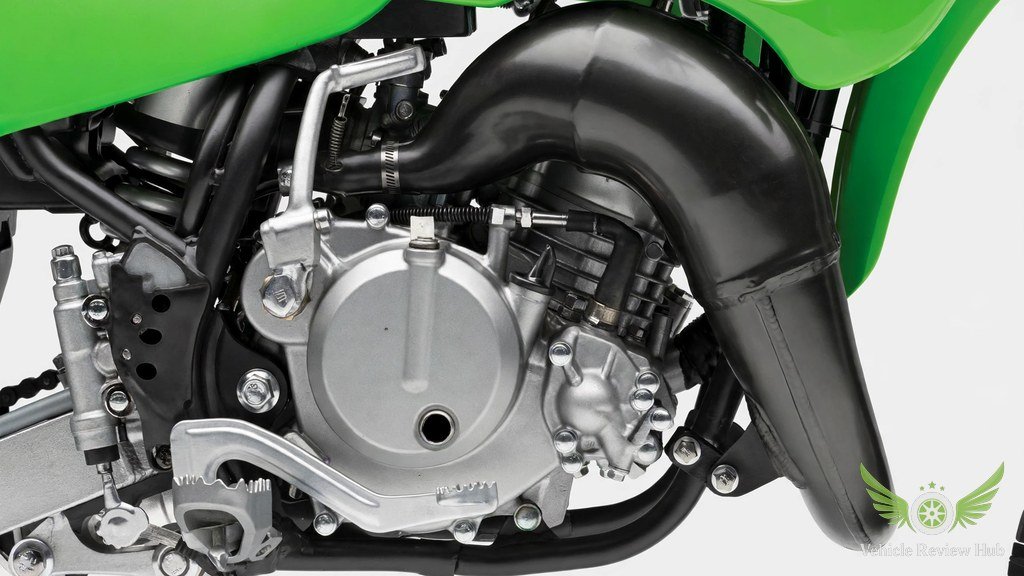
Power is where any Kawasaki KX65 performance discussion has to start, because the engine is the bike’s weakest point against its rivals. The 64cc liquid-cooled two-stroke single (bore × stroke 44.5 × 41.6 mm, compression 8.4:1), fed by a 24 mm Mikuni VM24SS carburettor through a reed valve, is a simple, proven unit, and it is also the least powerful engine in the 65cc class on the only measurement anyone has published.
| Bike (2018 test) | Peak power, MXA 2018 dyno | Gap to the KX65 | Power valve |
|---|---|---|---|
| Kawasaki KX65 | 13.77 hp | — | None |
| Yamaha YZ65 | 17.45 hp | +3.68 hp (+26.7%) | YPVS |
| KTM 65 SX | 16.52 hp | +2.75 hp (+20.0%) | PCEV |
Note: Figures are from Motocross Action Magazine’s 2018 YZ65 race test, the only US dyno test of a KX65 ever found. The dyno brand and the peak rpm were not named by MXA, so this Kawasaki KX65 performance guide does not invent them. The 2018 test used then-current bikes.
Only US Dyno: 13.77 hp
The only American dyno figure for the KX65 comes from Motocross Action Magazine’s 2018 YZ65 race test, published on December 2, 2018. MXA’s own words are worth quoting exactly: “The YZ65 is a strong engine. It pumps out 17.45 horsepower. In comparison, the 2018 KTM 65SX makes 16.52 horsepower and the 2018 KX65 makes 13.77.” That sentence is the entire published dyno record for the KX65 in the United States. No other US dyno test of the bike surfaced in any search, and no maker publishes a claimed power figure for any of the four 65cc bikes.
Two things about the figure need saying plainly. First, MXA never named the dyno brand or the rpm at which the 13.77 hp peak was recorded, so this Kawasaki KX65 performance guide does not invent either one. Second, other figures circulate on secondary sites — CycleChaos prints 17.03 hp at 12,500 rpm, autoevolution prints 12 hp for the 2012 model, and a manuals summary prints 14 hp at 11,500 rpm — but none cites a source or a test, so none is used here. The 13.77 hp figure is the only one with a named publication, a named test and a verifiable quote behind it.
A later MXA shootout does not help the KX65’s case either. The 2023 YZ65 versus TC 65 shootout dyno recorded 16.90 hp at 11,290 rpm for the Yamaha and 15.77 hp at 11,200 rpm for the Husqvarna, but no KX65 was dyno tested in that shootout, so no current rival dyno exists to set against the KX65.
25 Percent Down on Rivals
The heading is MXA’s wording, and this Kawasaki KX65 performance guide keeps the attribution in the same sentence. MXA wrote that “The KX65 engine is as much as 4 horses down on the 65SX and YZ65 at virtually every point on the curve — and when you are talking about bikes that only make 17 horses, that is 25 percent less power across the board.” That is a curve-wide description, not exact peak arithmetic: the KX65 is 21.1 percent below the YZ65 peak (13.77 hp against 17.45 hp) and 16.6 percent below the KTM peak (13.77 hp against 16.52 hp), while the YZ65 makes 26.7 percent more than the KX65 at peak.
The honest way to read the gap is that MXA’s “25 percent” describes the whole power curve, where the KX65 trails by up to four horsepower almost everywhere, and the peak maths lands a few points either side of it. What matters for a buyer is the direction, not the decimal: on the only dyno that tested three of the four bikes, the KX65 was last. The Yamaha runs a YPVS power valve and the KTM and Husqvarna run a PCEV power valve, while the KX65’s 64cc single runs without one. The KX65 also gives away carburettor size to the Yamaha, which runs a 28 mm Keihin PWK28 against the Kawasaki’s 24 mm Mikuni VM24SS.
None of this makes the KX65 slow: thirteen and three-quarter horsepower in a bike that weighs 126.1 lb without fuel is a serious amount of speed for a child. But for a parent comparing dyno sheets, the gap is real, it is measured, and it is the first thing this Kawasaki KX65 performance guide tells them.
Kawasaki KX65 Top Speed and Acceleration
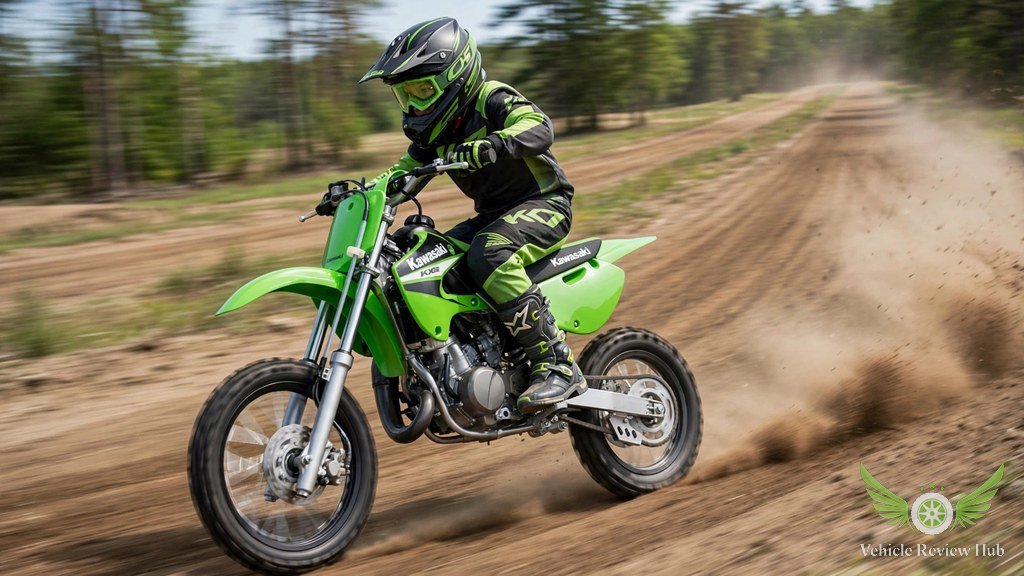
Top speed is the question every parent asks and the one no test answers, so this Kawasaki KX65 performance guide states the gap plainly instead of filling it with a guess. No reputable publication has ever tested the KX65’s top speed, and no timed acceleration run exists either.
No Tested Top Speed Found
There is no tested top speed for the KX65 in any reputable publication. The figures that circulate online all come from unsourced aggregators, and they do not even agree: CycleChaos prints 59 mph, BikeTopSpeed prints 51 mph, and ZigWheels prints 51 kmph, about 32 mph and plainly inconsistent with the other two. None of the three cites a test, a rider, a track or a method, so this Kawasaki KX65 performance guide prints none of them as a top speed.
The only real-world speed reading found anywhere is an anecdote, and it is labelled as one here. In September 2026, the Instagram account @povo250_ posted a 2013 KX65 with a bar-mounted GPS speedometer climbing to about 73 mph on a paved rural road. That is not a test: the rider was an adult, well over the bike’s 121 lb weight limit, the gearing was unknown, and a bar-mounted GPS is not a timing device. It proves nothing about the bike’s tested top speed, and it is not printed here as one.
There are good reasons no test exists. The KX65 is a closed-course competition motorcycle, not a road bike, so magazines test it on lap times and dyno runs rather than top-speed runs. Top speed on a 64cc bike also depends heavily on gearing and rider weight: a child under the 121 lb limit and an adult over it will see very different speeds on the same bike. Any single top-speed number would hide all of that, which is why no serious publication has printed one.
No Timed Runs Exist
The same gap covers acceleration. No timed 0–60 run, no quarter-mile test and no published lap time for the KX65 alone exists anywhere this Kawasaki KX65 performance guide could verify. The Carson Brown 65cc shootout video includes lap times across four bikes, but no published timed-run figure for the KX65 itself comes with it, so there is nothing to quote. Estimates from aggregator sites are not tests.
What buyers can use instead is the dyno record and the gearing. The 13.77 hp figure and the 3.68 hp gap to the Yamaha tell a parent more about how the bike accelerates than any invented 0–60 time would, and the six-speed manual clutch tells them how the bike asks to be ridden: kept on the pipe, shifted often, and ridden hard. That is the useful truth about its acceleration, and it comes from the test record rather than from a stopwatch that never ran.
Kawasaki KX65 Mileage and Fuel Economy
Fuel economy is the second number that does not exist for this bike, and this Kawasaki KX65 performance guide says so rather than repeating an aggregator’s guess. The KX65 is a premix racer: its fuel is mixed with two-stroke oil by hand, and neither Kawasaki nor any American test has published a miles-per-gallon figure.
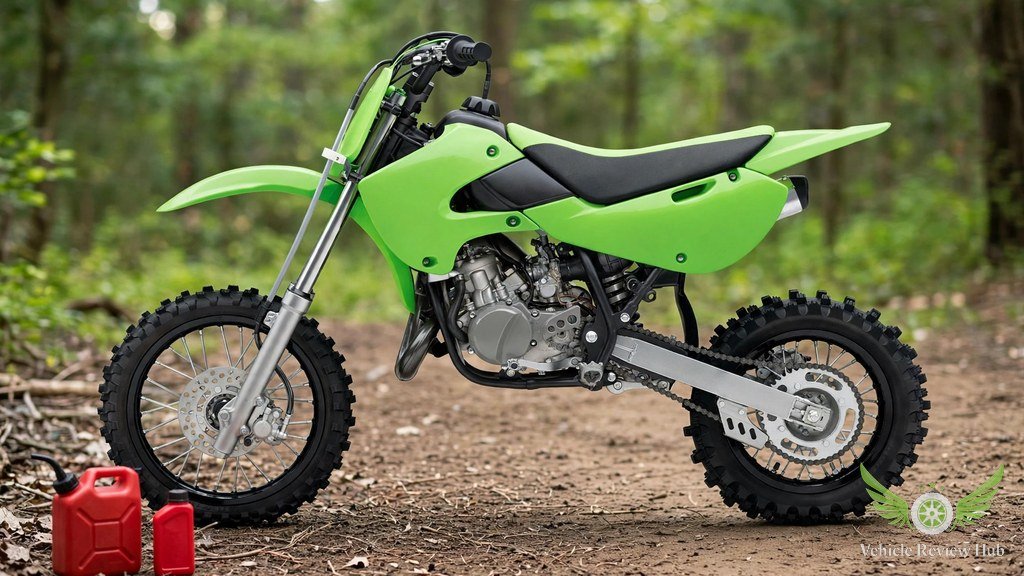
| Fuel item | Kawasaki KX65 figure |
|---|---|
| Fuel | Unleaded petrol, minimum 90 AKI (US) |
| Oil mix ratio | 32:1 (gasoline to two-stroke oil) |
| Oil per gallon of fuel | 4 fluid ounces |
| Oil per litre of fuel | 31 mL |
| Fuel capacity | 1.0 gal (3.8 L) |
| Miles per gallon | None published |
Note: Mix ratio and fuel grade are from the 2019 owner’s manual (page 25) and the Kawasaki service manual, both verified. No MPG figure is published by Kawasaki or by any US test, so this Kawasaki KX65 performance guide prints none.
No MPG for a Premix Racer
There is no MPG figure for the KX65 anywhere reliable. Kawasaki’s 2024, 2025, 2026 and 2027 spec sheets carry no MPG field at all, and no American test has measured one. The only number in circulation is ZigWheels’ claim of 30 kmpl, about 70 mpg, printed with no source behind it. This Kawasaki KX65 performance guide does not use it.
A single MPG number would mislead anyway. A premix race bike’s fuel use depends on how hard it is ridden, on the track and on the jetting.
Premix Is 32 to 1
The mix itself is one of the few fuel facts that is fully verified. The 2019 owner’s manual states the gasoline-to-engine-oil mixing ratio as 32:1, about 31 mL of oil per litre of gasoline or 4 fluid ounces of oil per gallon of gasoline, and the service manual records the same 32:1 petrol mix. The fuel is unleaded petrol with a minimum of 90 AKI in the United States. There is no oil injection and no separate oil tank.
Getting the mix right matters to the engine’s performance and its life. Too little oil risks a seizure in a hard-working 64cc single, and too much oil fouls the NGK BR10EG spark plug and smokes the exhaust. The mix is part of what the KX65 teaches a young rider, and it is one more reason this Kawasaki KX65 performance guide calls the bike a teaching machine rather than a turn-key toy.
Kawasaki KX65 Real-World Riding Experience
Numbers alone do not describe how the KX65 feels to ride, so this Kawasaki KX65 performance guide turns to what testers and owners actually recorded — attributed quotes and verified facts only, with no ride impression invented.

Here is the KX65 at race pace, from the rider’s own view: Marshall Thomley, number 59, races the lime-green 65 tagged #kx65 in the Micro 65 Beginner class at WORN Racing Round 6, Fault Line Border Wars, in Horn Beak, Tennessee, on November 22, 2026. The footage is first-person helmet-cam — music over two-stroke engine noise, no narration, just a few brief shouts in English.
The Riding Experience Buyers Actually Talk About
The defining ride characteristic in every comparison is the power deficit. MXA’s 2018 test put it in one sentence: the KX65 engine is “as much as 4 horses down on the 65SX and YZ65 at virtually every point on the curve.” On the track that means a KX65 rider works harder than a Yamaha or KTM rider, keeping the two-stroke on the pipe, using the clutch, and shifting the six-speed gearbox often. The bike rewards a rider who rides it properly and punishes one who short-shifts it.
The used-bike record adds a second lesson. Dirt Bike Magazine’s 2004 teardown of a used KX65 project bike found a “cracked piston skirt and some metal debris in the bottom end”, fork and shock internals whose “internal wear items were used up” — seals, bushings and oil — and a bike that needed new wheel bearings and spokes. None of that is a fault of the design. It is a reminder that a used 65’s performance depends on its maintenance history as much as on its spec sheet, and a tired engine will feel slower than the dyno figure suggests. The maintenance side is covered in full in our Kawasaki KX65 reliability guide.
Enough Up to Intermediate
For a young rider moving up from a 50cc play bike, the KX65’s power is enough through beginner and intermediate club racing. The bike’s job at that stage is teaching: clutch control, gear selection and two-stroke power delivery, learned on a machine that is forgiving to crash and cheap to fix — a piston and ring set costs about $143 on Partzilla, checked November 25, 2026. This Kawasaki KX65 performance guide rates that teaching role as the bike’s real strength.
The honest limit arrives when the rider outgrows the bike, in size or in speed. At that point the step up is the KX85, which our Kawasaki KX65 comparison guide covers in full: the 2027 KX85 costs $4,999 plus a $315 destination charge, $5,314 delivered, against the KX65’s $4,564. The bike’s history is clean too: two recalls, CPSC 01-037 (frame down-tube cracks) and CPSC 01-065 (rear brakes can fail), both from 2000–2001, and none since.
Kawasaki KX65 Handling, Braking and Stability
Where the KX65 gives power away, its chassis gives something back, and this Kawasaki KX65 performance guide rates the handling on the same evidence standard: verified specifications and attributed test quotes.
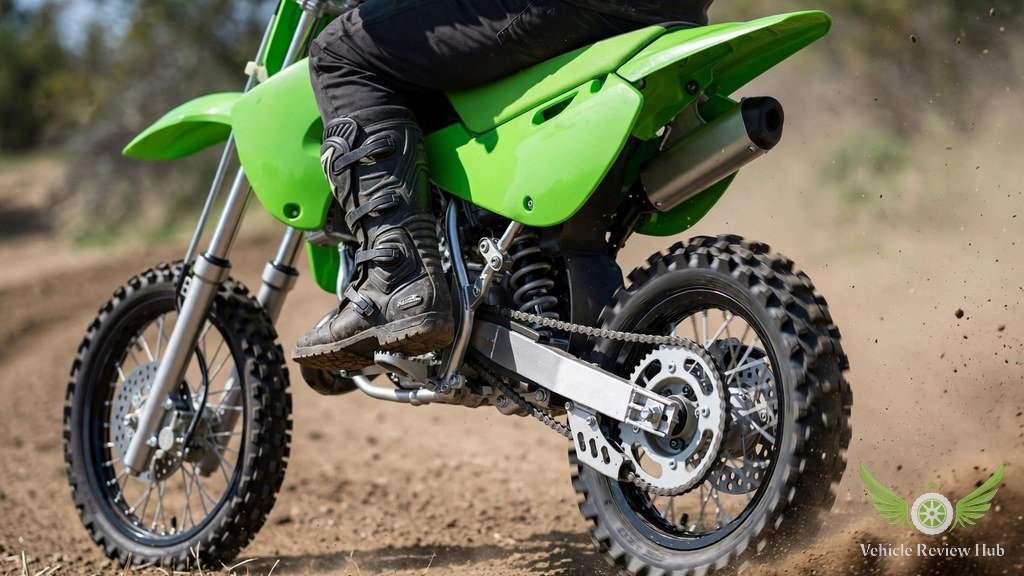
| Chassis item | Kawasaki KX65 | Yamaha YZ65 | KTM 65 SX |
|---|---|---|---|
| Front fork | 33 mm conventional, rebound-only, 8.3 in | 36 mm KYB USD, fully adjustable, 8.5 in | WP XACT 35 mm USD AER air fork, 8.46 in |
| Rear shock | Uni-Trak linkage, preload + rebound, 9.4 in | KYB linkless, fully adjustable, 10.6 in | WP XACT PDS (no linkage), 9.98 in |
| Front brake | 180 mm disc, single-piston caliper | 198 mm wave rotor | 198 mm disc, Formula hydraulics |
| Rear brake | 180 mm disc, single-piston caliper | 190 mm wave rotor | 180 mm disc, Formula hydraulics |
| Seat height | 29.9 in | 29.7 in | 28.7 in (adjustable 28.1–29.9 in) |
| Weight | 126.1 lb w/o fuel / 132.2 lb with fuel | 134 lb wet | 119.7 lb w/o fuel (~127 lb wet) |
Note: Chassis figures are from the manufacturers’ 2027 US specifications. The KX65 is the only one of the four bikes with a linkage rear suspension, and it has the least travel. That trade is central to this Kawasaki KX65 performance guide’s handling verdict.
Only 65 With a Linkage
The KX65’s one chassis advantage is verified, and it is worth stating exactly. MXA’s 2018 test wrote that “Only the KX65 offers a rising-rate shock linkage suspension,” and the same test explained why the Yamaha could skip one: the YZ65 shock is “a link-less design… since the KTM 65SX doesn’t have linkage, Yamaha can get away with it.” The KTM runs a WP XACT PDS mono shock linked directly to the swingarm, and MXA’s 2023 shootout confirmed that “Neither bike comes with a shock linkage.” The KX65’s rear is a bottom-link Uni-Trak single shock with preload and rebound adjustment and 9.4 inches of travel.
One caveat: the linkage claim is verified only against the Yamaha YZ65, the KTM 65 SX and the Husqvarna TC 65 — the Cobra CX65 was not checked, so this Kawasaki KX65 performance guide names the rival set rather than calling the KX65 the only 65cc bike with a linkage outright. What the linkage gives the rider is a rising-rate action that grows more progressive as the shock compresses. What it does not give is travel: at 9.4 inches the KX65 has the least rear travel in the group, against 10.6 inches for the Yamaha and 9.98 inches for the Austrians, and the least front travel too.
Handling, Braking and Stability on Real Roads
The heading says real roads, and the bike’s paperwork says otherwise: the KX65 is a closed-course competition motorcycle with no lights, no instruments and no street legality, so its “real roads” are tracks and practice fields, not public streets. On those surfaces the handling is honest and predictable. The high-tensile steel semi-double cradle frame, the 44.1-inch wheelbase and the 29.9-inch seat height add up to a small, light bike a child can pick up after a fall and control at low speed.
The brakes are the weakest part of the chassis story. Both ends carry a single 180 mm disc with a single-piston caliper, the smallest brakes in the class: the Yamaha runs a 198 mm front rotor and the KTM a 198 mm front disc with Formula hydraulics. No braking-distance test exists for any 65cc bike, so this Kawasaki KX65 performance guide prints no stopping distance. What the specifications do show is that the KX65 asks the least of its brakes, because it is also the slowest bike in the group. Stability is the KX65’s quiet strength: the oldest chassis in the class is also the most proven one, and a young rider learns on it safely.
Kawasaki KX65 Performance Compared With Other Sport Bikes
The dyno table only tells part of the story, so this Kawasaki KX65 performance guide sets the KX65 against its three 65cc rivals on power, suspension, brakes, weight and price.
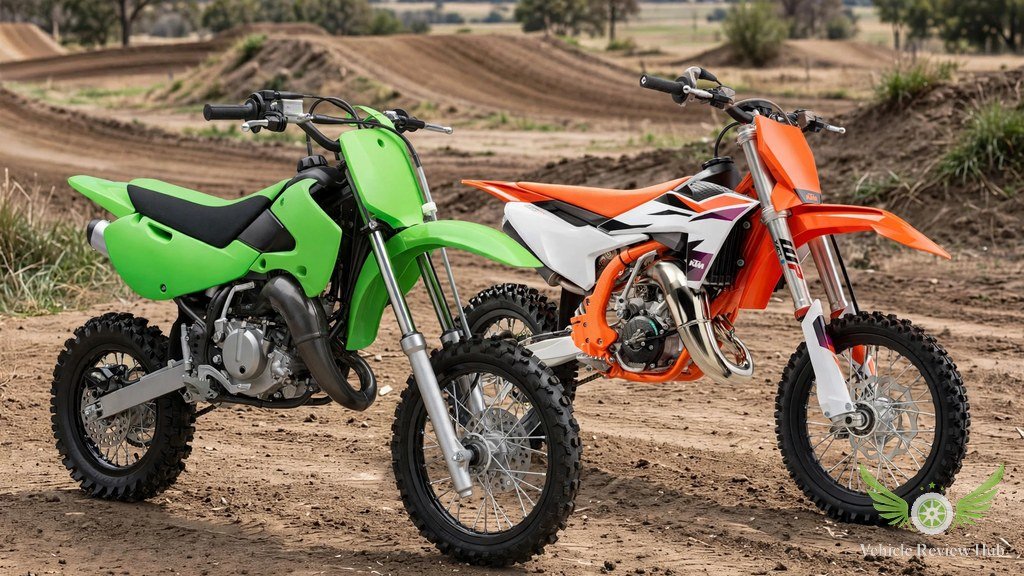
Kawasaki KX65 vs KTM 65 SX
The KTM 65 SX is the bike this Kawasaki KX65 performance guide uses as the speed benchmark. Its 64.9cc single made 16.52 hp on MXA’s 2018 dyno against the KX65’s 13.77 hp, it runs a PCEV power valve the Kawasaki lacks, a WP XACT 35 mm USD AER air fork against the KX65’s 33 mm conventional fork, and 198 mm front brakes against the KX65’s 180 mm discs. It is also lighter at 119.7 lb without fuel against the KX65’s 126.1 lb. For outright Kawasaki KX65 performance, the KTM wins on every measurement except the linkage rear suspension.
The price gap is the KX65’s answer. The 2027 KTM costs $5,899 plus a $425 destination charge, $6,324 delivered, against the KX65’s $4,249 plus a $315 destination charge, $4,564 delivered — a $1,760 gap. One caveat: the Austrians were fully redesigned for 2024, and the 2018 dyno predates that redesign, so the current KTM is likely further ahead on power than the old figures show. The full price and equipment comparison is in our Kawasaki KX65 comparison guide.
Is the Kawasaki KX65 Suitable for Beginner Riders?
Yes — for a beginner it is arguably the best 65cc bike on sale. This Kawasaki KX65 performance guide rates it that way because the bike’s weaknesses are a learner’s strengths: it is the cheapest at $4,249, the simplest with a carburettor instead of fuel injection and no power valve to manage, and the slowest, which is a feature rather than a fault for a young rider’s first real race bike. The requirements are a rider under the 121 lb limit, tall enough for a 29.9-inch seat, and ready to learn a manual clutch and a six-speed gearbox.
To close this Kawasaki KX65 performance guide plainly: the KX65 is not the fastest, newest or best-equipped 65cc motocrosser on sale in 2027, and it does not try to be. It is the cheapest, the simplest and the most honest, and for a young rider’s first real race bike that combination is still hard to beat. Buy the Yamaha YZ65 for power and suspension or the KTM for outright speed, and buy the Kawasaki for price, simplicity and the only linkage rear suspension in the group — that is this Kawasaki KX65 performance guide’s verdict. Our Kawasaki KX65 review covers the price and ownership case in full.
Kawasaki KX65 Performance FAQs
These are the questions US buyers ask about the 2027 KX65’s speed, fuel and handling, answered from the verified facts in this Kawasaki KX65 performance guide.
How much power does the KX65 make?
The only US dyno this Kawasaki KX65 performance guide found is Motocross Action’s 2018 test: 13.77 hp. Kawasaki publishes no power figure.
How far behind its rivals is the KX65?
On MXA’s 2018 dyno the YZ65 made 17.45 hp and the KTM 65 SX 16.52 hp against the KX65’s 13.77 hp. MXA called it “25 percent less power across the board” — curve-wide wording; this Kawasaki KX65 performance guide gives the peak maths: 21.1% Yamaha, 16.6% KTM.
What is the KX65’s top speed?
No tested top speed exists, and this Kawasaki KX65 performance guide prints none. Aggregator figures (51–59 mph) are unsourced — do not trust them.
What fuel and oil mix does the KX65 use?
Premix 32:1, unleaded petrol, minimum 90 AKI in the US. There is no MPG figure, and this Kawasaki KX65 performance guide prints none — it is a premix racer, and Kawasaki publishes none.
Does the KX65 have a power valve?
No. The Yamaha YZ65 (YPVS) and the KTM/Husqvarna (PCEV) have one; the KX65’s 64cc single runs without one, and the gap shows in this Kawasaki KX65 performance guide’s dyno table.
Is the KX65 the only 65 with a linkage?
Yes, among the four bikes: the KX65’s Uni-Trak rising-rate linkage is unique — the YZ65 is linkless and the KTM/Husqvarna run PDS. That linkage is the one chassis advantage in this Kawasaki KX65 performance guide.