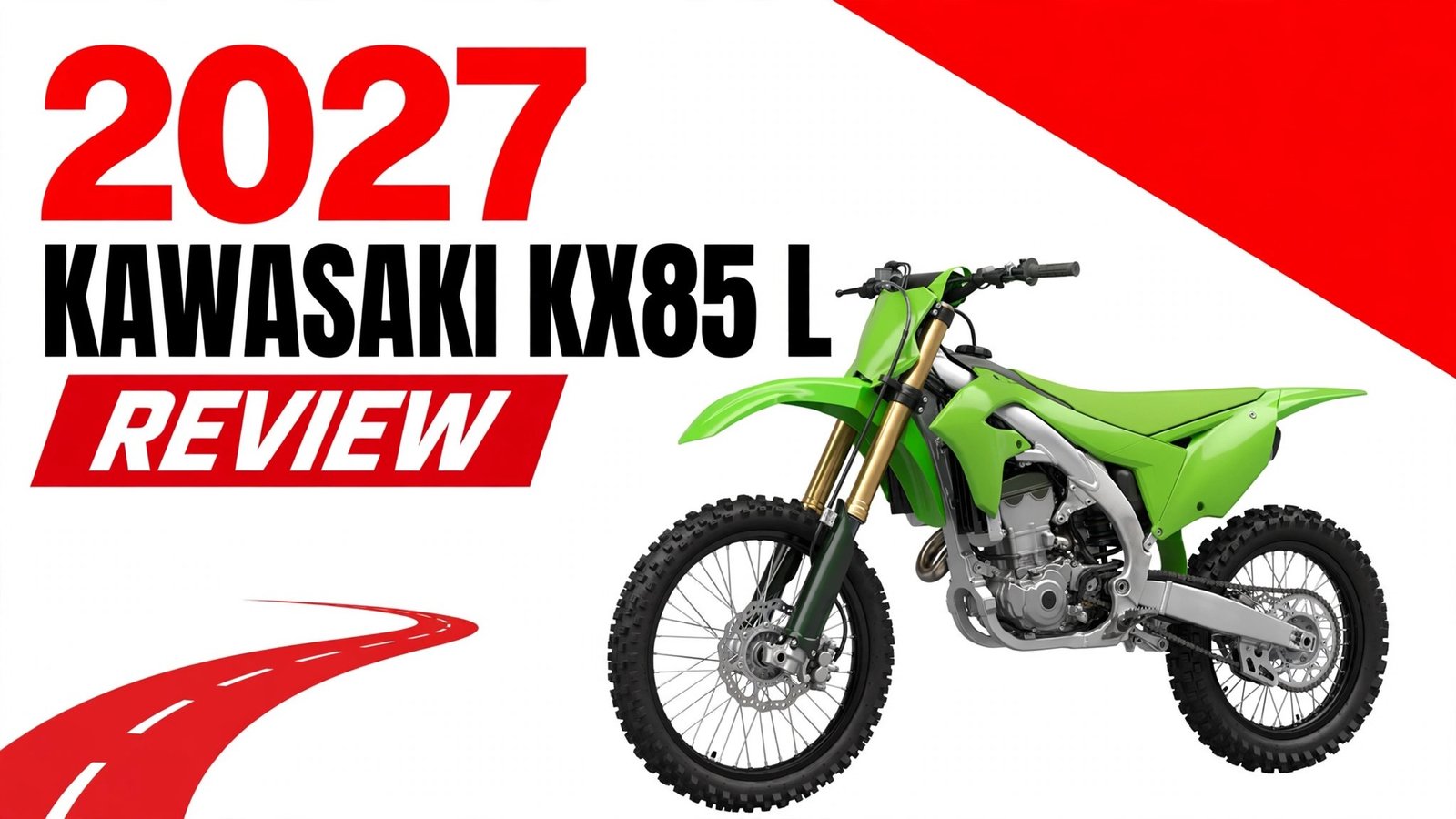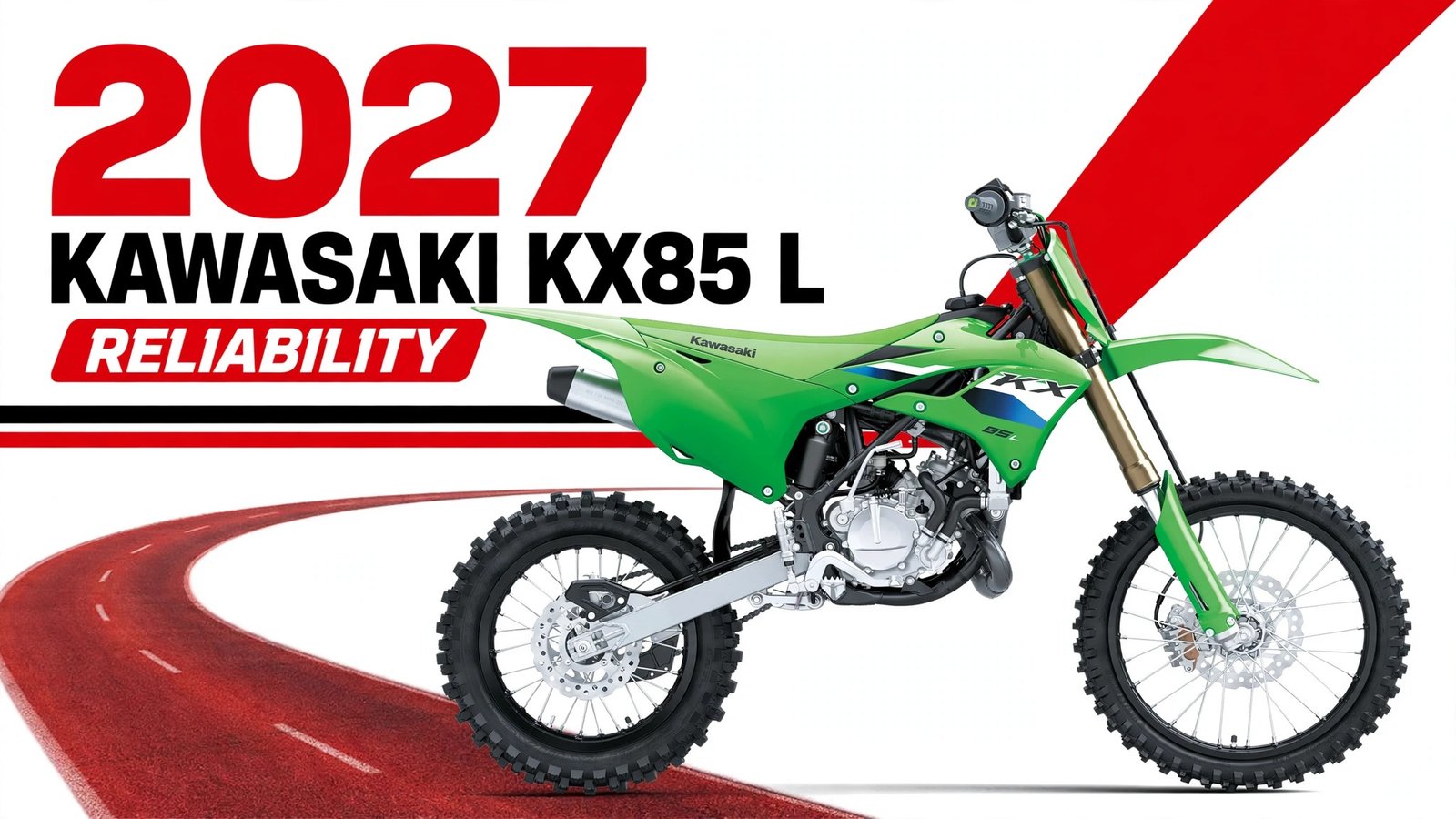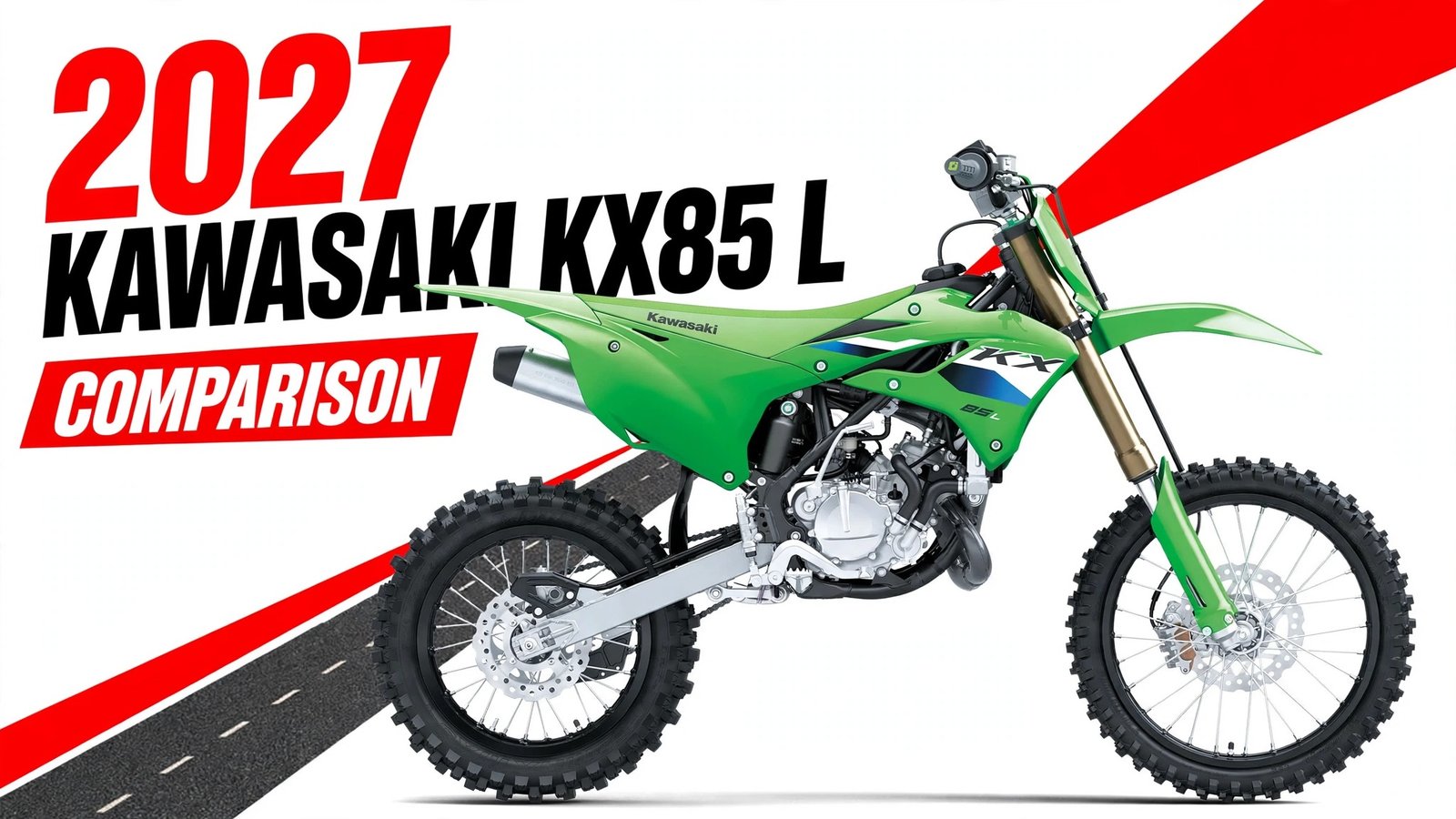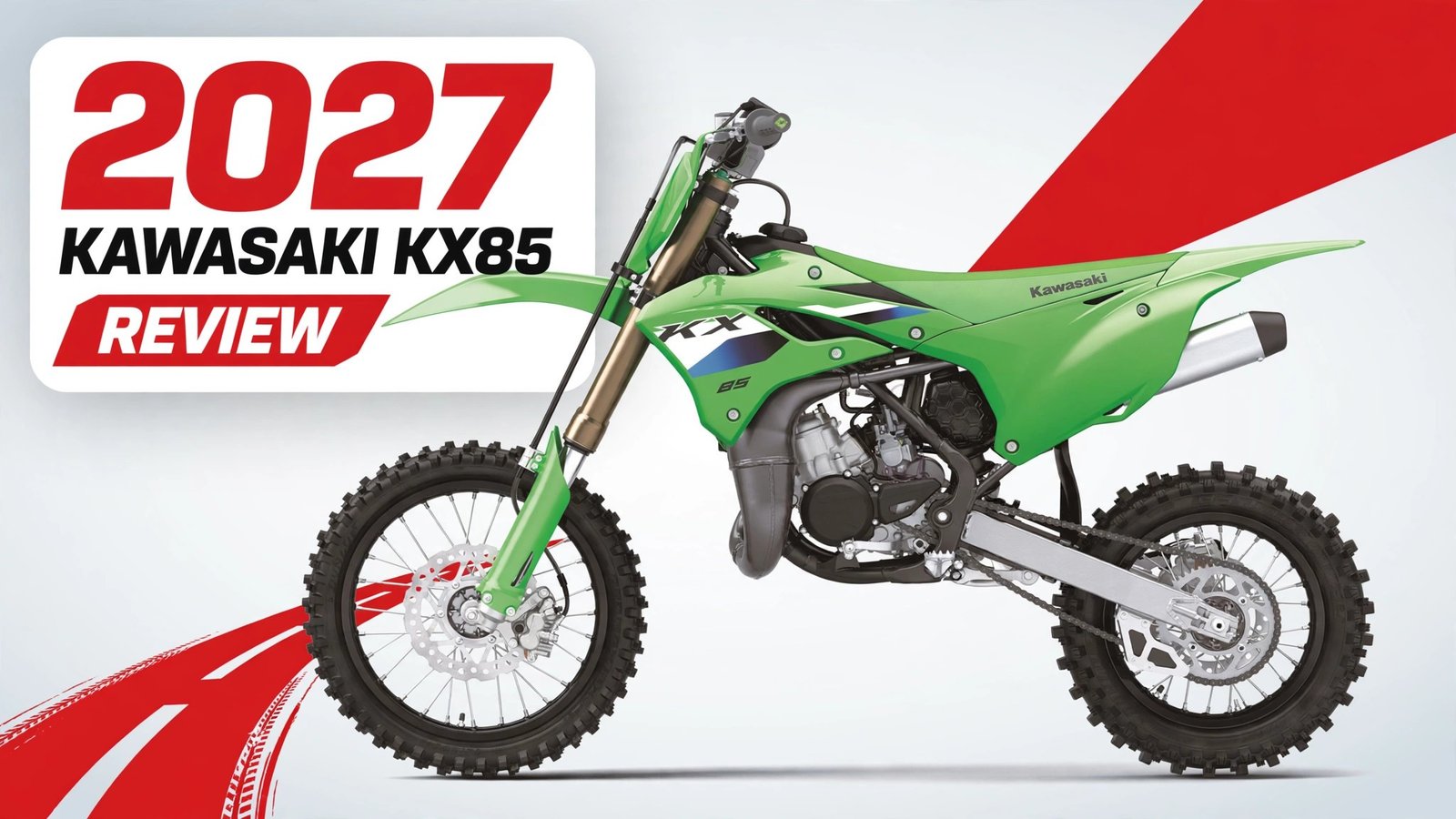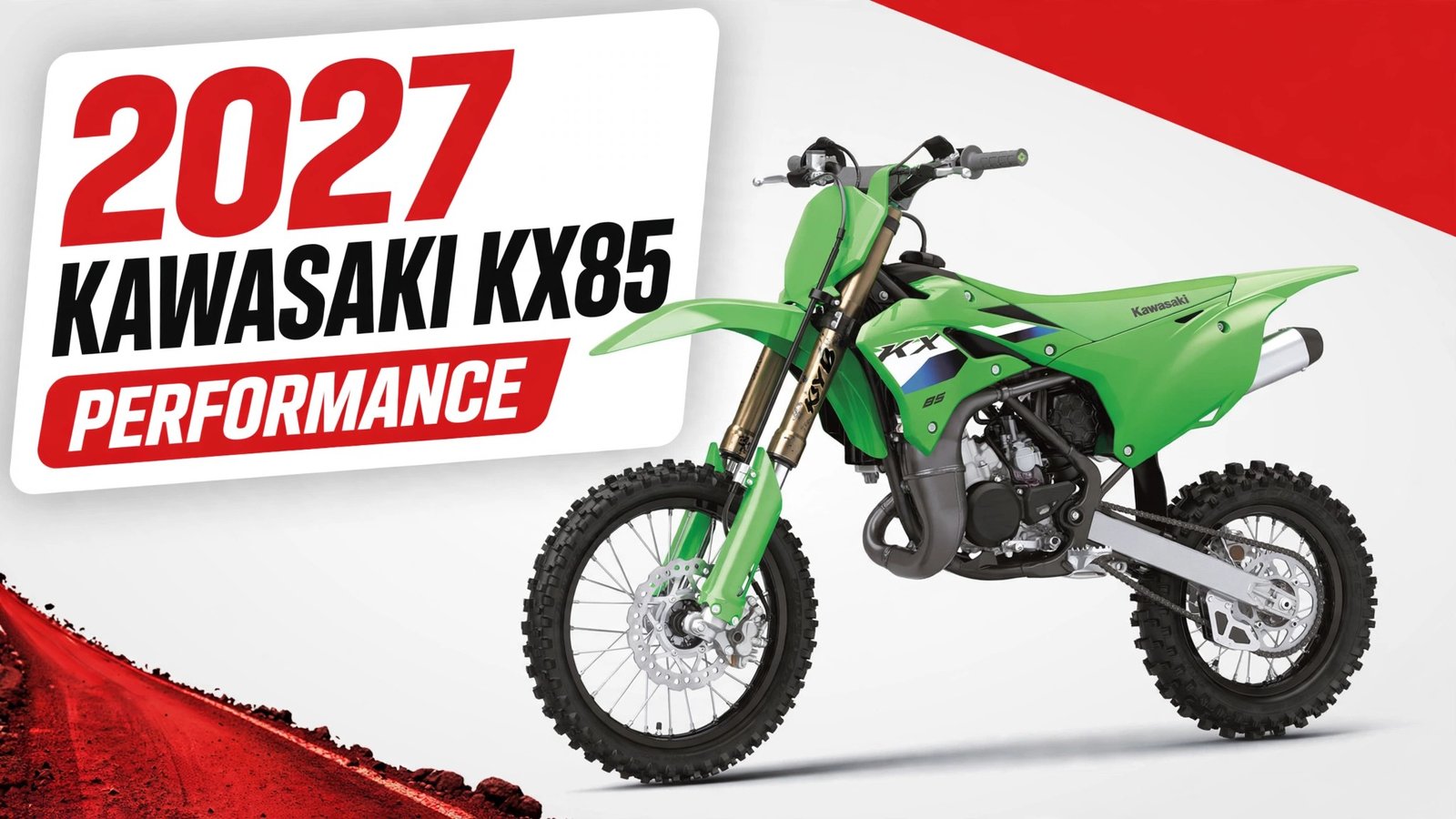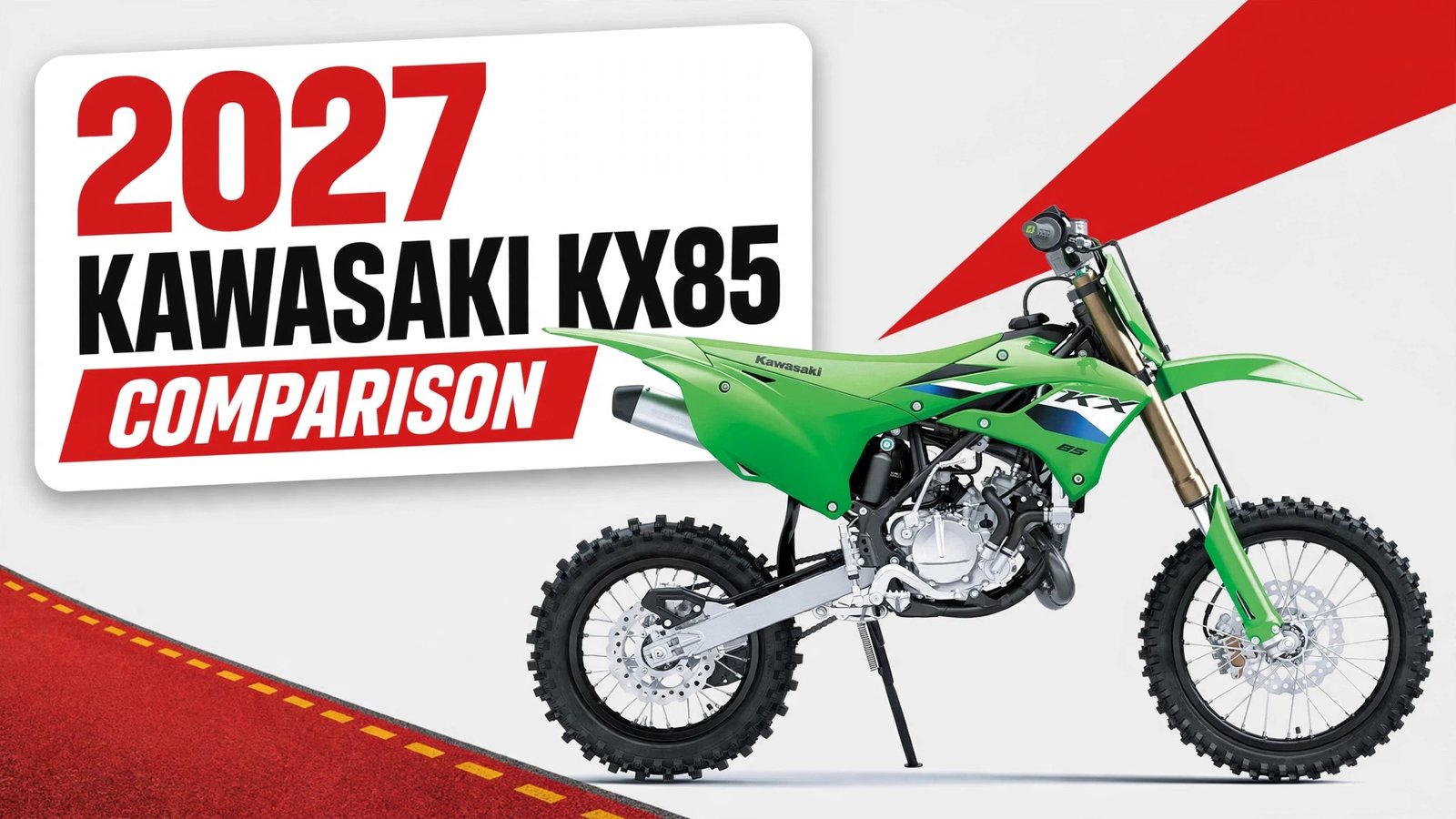
The 2027 Kawasaki KX85 L is a big-wheel 85 with the same 84cc two-stroke as the standard KX85, and its performance story starts with an honest admission: no magazine has ever put the L on a dyno, timed it, or measured its fuel use. This Kawasaki KX85 L performance guide works with what does exist — the standard bike’s dyno figure, the gearing Kawasaki’s own diagrams print, and the chassis the L shares with the KX112 — and labels every number by its source. Readers looking for a dyno chart will not find one here, and this Kawasaki KX85 L performance guide would rather say that up front than print a borrowed number as an L measurement.
The short answer: the L’s engine is the standard KX85’s engine, unchanged since 2014, and the only US dyno of it made 22.68 hp. The L’s shorter gearing should make it punchier off the bottom than the standard bike, and its 12.0 inches of rear travel give it the same suspension as the KX112 — but no test has measured any of that on the L itself, so this Kawasaki KX85 L performance guide says what is known, what is borrowed, and what is still unmeasured. Our Kawasaki KX85 L review covers the price, the specs and the launch in full; this blog is only about how the bike goes.
Kawasaki KX85 L Engine Performance and Power Delivery
The L’s engine is the standard KX85’s engine, and that is both the good news and the limit of this Kawasaki KX85 L performance guide: every power number in this section comes from the standard bike, because the L has never been dyno-tested. What follows is the engine as Kawasaki builds it, the one dyno figure that exists, and how the power gets to the ground. That framing — standard-bike numbers, L context — is how this Kawasaki KX85 L performance guide handles every figure below.
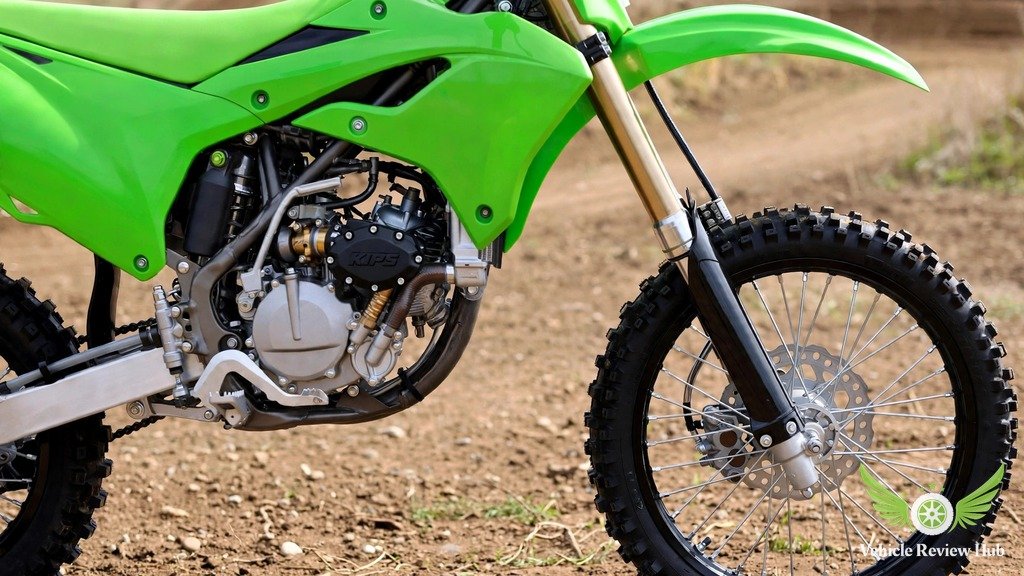
No Dyno of the L Exists
No dynamometer test of the KX85 L exists anywhere — not in MXA, Cycle News, Dirt Bike Magazine, Dirt Rider, Motorcycle.com, or any US publication. Searches for an L dyno return nothing, and the only US tests of the revamped 2026 KX85 line tested the standard KX85 and the KX112, never the L. Kawasaki publishes no horsepower or torque figure for the 84cc engine either — no power field appears on any 2024–2027 spec sheet. That is the first fact of this Kawasaki KX85 L performance guide, and it shapes everything below: the power numbers here are the standard bike’s, labelled as such, because no L numbers exist.
22.68 hp Is the Standard’s
The only US dyno of this engine comes from MXA’s 2014 KX85 shootout, which measured 22.68 hp at 11,500 rpm and 10.02 lb-ft of torque at 10,000 rpm on the standard KX85. The engine is unchanged since 2014 — the same 84cc two-stroke with the KIPS exhaust power valve, the same 48.5 by 45.8 mm bore and stroke, the same 28 mm Keihin PWK28 carburettor — so the figure is a valid datapoint for the engine in the L, but it is still the standard bike’s measurement, not the L’s, and that is the number this Kawasaki KX85 L performance guide uses whenever power comes up. In the same 2014 shootout, the KTM 85 SX made 23.94 hp and the Husqvarna TC85 made 25.36 hp, so the Kawasaki engine was the least powerful of the three on the only US dyno ever run — a gap the 2026 chassis revamp did nothing to close, because the revamp was chassis-only and the engine was carried over unchanged. Ignore the 28.97 hp figure that circulates on aggregator pages: it has no dyno, no test and no attribution behind it. The power-valve story is the engine’s real story — the 2014 revamp and the 2019 KIPS redesign gave it what MXA called its “newfound midrange”, and the 2026 bike keeps that same engine. Two family tests describe how it delivers: Cycle News’ 2026 test of the standard KX85 found it “requires more clutch work than the KTM”, with a narrow high-rev window, while Dirt Bike Magazine’s 2026 test of the KX85 and KX112 found both “run slightly lean from the factory, which can result in a ‘lean bog'”, and recommended Pro Circuit jetting. Both notes describe the family, not the L specifically, and this Kawasaki KX85 L performance guide labels them that way.
| Specification | Kawasaki KX85 L (2027) |
|---|---|
| Engine | 84cc 2-stroke single, KIPS power valve |
| Bore x stroke | 48.5 x 45.8 mm |
| Compression | 10.9:1 (low speed) / 9.0:1 (high speed) |
| Carburettor | 28 mm Keihin PWK28 |
| Gearbox | 6-speed, manual clutch |
| Final drive | 51/13 (3.923), DID 420 chain, 124 links |
| Fuel | Premix 32:1, min 90 AKI unleaded |
| Power claimed | None published by Kawasaki |
| Dyno (MXA 2014, standard bike) | 22.68 hp at 11,500 rpm, 10.02 lb-ft at 10,000 rpm |
Note: All figures from Kawasaki’s 2027 KX85 L spec sheet except the dyno figure, which is MXA’s 2014 test of the standard KX85 — the same engine, labelled standard-bike throughout this Kawasaki KX85 L performance guide.
Kawasaki KX85 L Top Speed and Acceleration
No one has timed the L, and no one has timed the standard bike either — so this part of the Kawasaki KX85 L performance guide is about what the gearing says and what it does not say. The L’s shorter final drive should favour acceleration over top speed, but that is an inference from the gear counts, and this Kawasaki KX85 L performance guide marks every inference as one.

No Tested Top Speed
No top-speed test of the KX85 L exists, and no top-speed test of the standard KX85 exists either — MXA’s 2014 shootout measured dyno figures only. The 78 mph figure on aggregator pages is unsourced and should not be trusted, and no Kawasaki KX85 L performance article should print it as fact. No 0–60 mph time, no quarter-mile time and no top-gear roll-on figure has ever been measured for either bike. The one acceleration-adjacent fact is the gearing: the L runs a 51-tooth rear sprocket with a 13-tooth front (51/13, or 3.923) against the standard’s 51/14 (3.643), a shorter final drive that favours acceleration over top speed — but that is a gearing inference, not a measured figure, and this Kawasaki KX85 L performance guide labels it as one.
No Shootout Entry Either
The L has never been entered in an 85cc shootout. The 2025 MXA 85cc Mini-Cycle Shootout predates the L’s US launch and has no L in it. The Carson Brown six-bike 85cc shootout from August 2026 names the standard KX85 in its description; whether the L appears anywhere in it is unverified. No print shootout of the L exists. For context, the 2014 MXA shootout — the only US dyno — placed the KX85’s 22.68 hp behind the KTM’s 23.94 hp and the Husqvarna’s 25.36 hp, so the family has never won a power shootout, and the L has never even entered one — which is why this Kawasaki KX85 L performance guide has no shootout result to report.
Kawasaki KX85 L Mileage and Fuel Economy
A premix two-stroke race bike is the wrong machine to ask about mileage, and nobody has — this Kawasaki KX85 L performance guide prints no MPG figure because none exists. What exists is the premix ratio, the tank size, and the arithmetic between them.
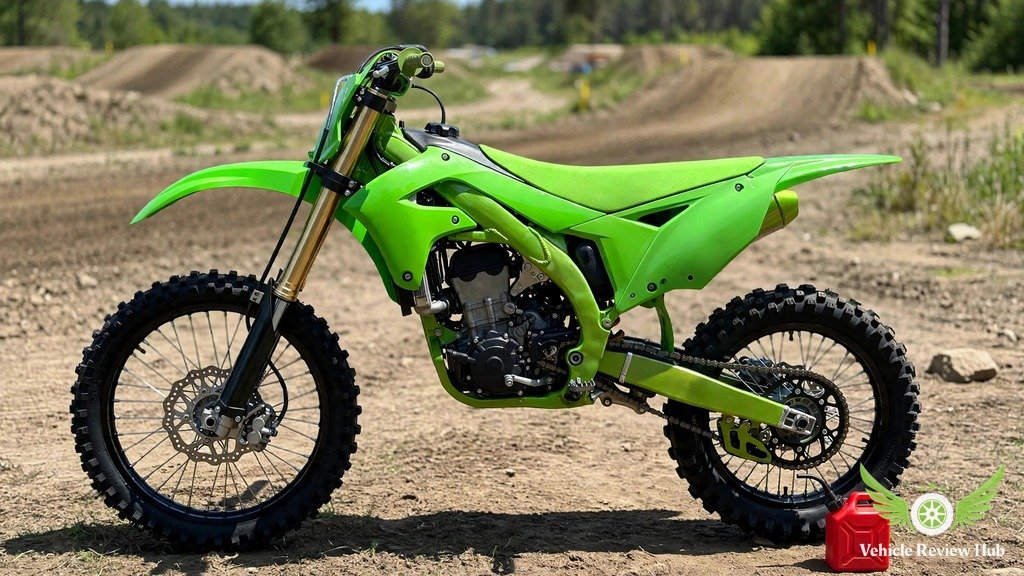
No MPG for a Premix Racer
No MPG figure for the KX85 L exists anywhere — no US test, no magazine, no manufacturer claim. Kawasaki publishes no fuel-economy figure for the bike. It is a premix two-stroke race bike, not a road bike, so mileage was never tested, and this Kawasaki KX85 L performance guide will not invent a number. For scale only, and not as an L figure: Cycle World’s 2023 test of the KLX140R — a four-stroke trail bike — returned 67.7 mpg, a number that says nothing about the L except how different the two machines are.
Premix Is 32 to 1
The owner’s manual specifies petrol mix at 32:1, with 16:1 for break-in, and a minimum of 90 AKI unleaded fuel. The L’s 1.32-gallon tank takes 5.28 ounces of two-stroke oil per full tank at 32:1. Do not carry the KX65’s figures across here — the KX65 runs a different transmission-oil capacity (0.5 L against the KX85’s 0.7 L). The premix ratio is one of the few numbers in this Kawasaki KX85 L performance guide that needs no label at all: it comes from the family manual, and the L shares the standard’s engine and fuel system outright.
Kawasaki KX85 L Real-World Riding Experience
No magazine has ridden the L, so this section of the Kawasaki KX85 L performance guide is built from the two real tests of the 2026 family — Cycle News and Dirt Bike Magazine, both of which rode the standard KX85 and the KX112 — plus the spec-sheet proof that the L is the KX112’s chassis with the 84cc engine. Everything here is labelled by its source, the rule this Kawasaki KX85 L performance guide never breaks.
Vital MX’s test below covers the standard KX85 and the KX112 — the KX85 L itself is never ridden or shown, and the presenters say so on camera — but the two bikes share the L’s engine, fork and chassis, so their track impressions are the closest real-world test of the L’s platform that exists.
The Riding Experience Buyers Actually Talk About
The only real ride tests of the 2026 family are Cycle News (standard KX85 + KX112, July 2026) and Dirt Bike Magazine (KX85 + KX112, 2026). Neither rode the L. Cycle News’ tester was 15-year-old Myles Abbott — 118 lb, 5 feet 5 inches, racing a TC85 and a KTM 105 — who found the standard 85 needed more clutch work than the KTM, with a narrow high-rev window, and that the KX112 handled its bigger wheels well. Dirt Bike Magazine found both the 85 and the 112 run slightly lean from the factory, which can cause a “lean bog”, and recommended Pro Circuit jetting to richen fuel delivery across the powerband. Neither test measured top speed, 0–60, or MPG. One caution about Cycle News: its spec table lists the L/112 trail figure of 4.6 inches for the standard KX85 too, but the standard’s trail is 4.1 inches — do not copy its table. And where the dealer page Moto-HouseMX claims the KX85 has a “broad, forgiving low-end”, trust the tester who rode the bike: Cycle News says the powerband is narrow and high-revving. Those are family observations, labelled as such — not L impressions, and this Kawasaki KX85 L performance guide does not present them as one.
Same Chassis as KX112
A line-by-line diff of Kawasaki’s own 2027 spec sheets shows the L and the KX112 differ in exactly six places: model name, MSRP ($5,199 against $5,799), displacement (84cc against 112cc), bore and stroke (48.5 by 45.8 mm against 52.5 by 51.6 mm), compression (10.9:1/9.0:1 against 9.9:1/8.6:1), and curb weight (164.5/172.4 lb against 164.9/172.8 lb — 0.4 lb). Everything else is identical: the 43 mm KYB fork with 10.8 inches of travel, the Uni-Trak rear shock with 12.0 inches, the 240/220 mm petal brakes, the 70/100-19 and 90/100-16 tyres, the perimeter high-tensile steel frame, the 29.2-degree rake with 4.6 inches of trail, the 51.6-inch wheelbase, the 1.32-gallon tank, the six-speed gearbox, the 28 mm Keihin carburettor, ERGO-FIT and Lime Green. The L is the KX112 chassis with the 84cc engine — 0.4 lb lighter and $600 cheaper — which is why the KX112’s ride impressions are the closest available stand-in for how the L handles, and why this Kawasaki KX85 L performance guide treats them as family evidence, not L evidence.
Kawasaki KX85 L Handling, Braking and Stability
The L’s handling numbers are all verified — fork, shock, brakes, wheelbase, rake and trail — but no road test exists, because the L is a closed-course competition bike, not a street-legal machine. This part of the Kawasaki KX85 L performance guide reads the geometry and adds the family tests’ chassis notes, labelled as such — the same labelling rule the guide applies to every figure in the blog.
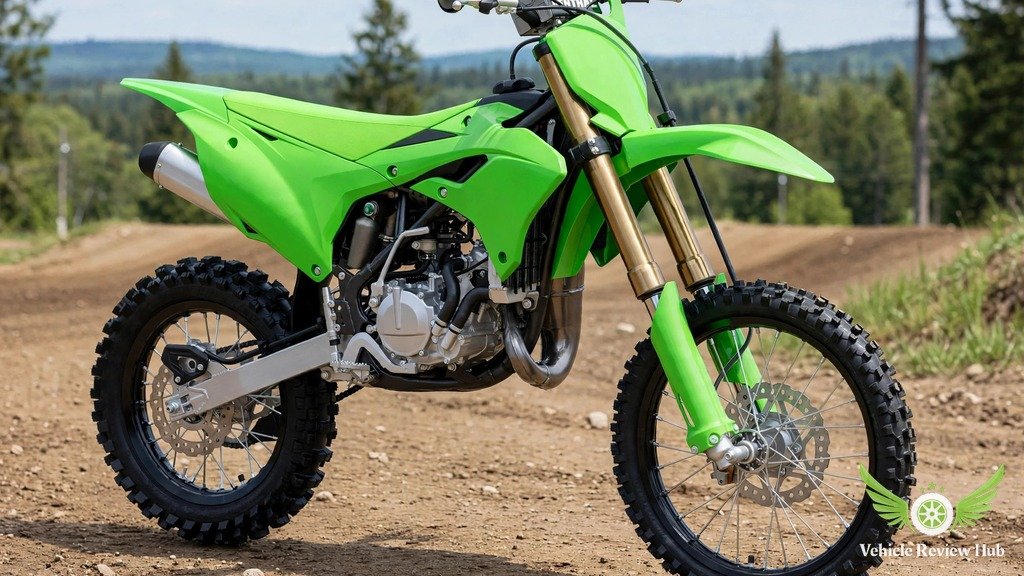
Rear Travel Up 1.2 Inches
The L’s rear travel is 12.0 inches against the standard’s 10.8 — a 1.2-inch gain — while the fork travel is unchanged at 10.8 inches on both bikes. The gain comes from a revised Uni-Trak linkage rod, not from a longer swingarm: Kawasaki’s January 2026 press release says the revised linkage rod increases rear wheel travel from 10.8 inches to 12 inches on the KX85 L and KX112, matching full-size KX models. The rear shock itself also changed — rod diameter up from 12.5 to 14 mm, cylinder length from 380 to 390 mm, plus a high-speed compression adjuster — but the travel gain is the linkage rod’s work. Up front, the 43 mm inverted KYB fork carries compression and rebound adjustment with 10.8 inches of travel, identical to the standard bike. The fork and shock numbers are the most solid figures in this Kawasaki KX85 L performance guide, because they come straight from Kawasaki’s spec sheet.
Handling, Braking and Stability on Real Roads
There is no road test of the L, and there cannot be one: the bike is a closed-course competition machine, not street-legal, with no lights, no instruments and no electric start. Its handling case rests on geometry — a 51.6-inch wheelbase, 1.8 inches longer than the standard’s, 29.2 degrees of rake with 4.6 inches of trail (the standard’s trail is 4.1 inches, so the L’s is 0.5 inches longer), and 13.0 inches of ground clearance — plus the family tests’ chassis notes. Cycle News found the KX112, which shares the L’s chassis exactly, handled its bigger wheels well, and the L’s 12.0 inches of rear travel now match full-size KX models. The brakes are the standard’s — a single 240 mm petal front disc with a dual-piston Nissin caliper and a single 220 mm petal rear disc with a single-piston caliper — and the bigger wheels do not get bigger brakes. No spring-rate figure exists for the L in any Kawasaki source, so this Kawasaki KX85 L performance guide prints none.
Kawasaki KX85 L Performance Compared With Other Sport Bikes
Four 2027 big-wheel 85s, no published power figure between them — that is the honest starting point for this Kawasaki KX85 L performance comparison. The only dyno-anchored numbers in the class are the 2014 MXA figures, twelve years old, for an engine that is unchanged on the Kawasaki side. The table below keeps every figure labelled by its source.
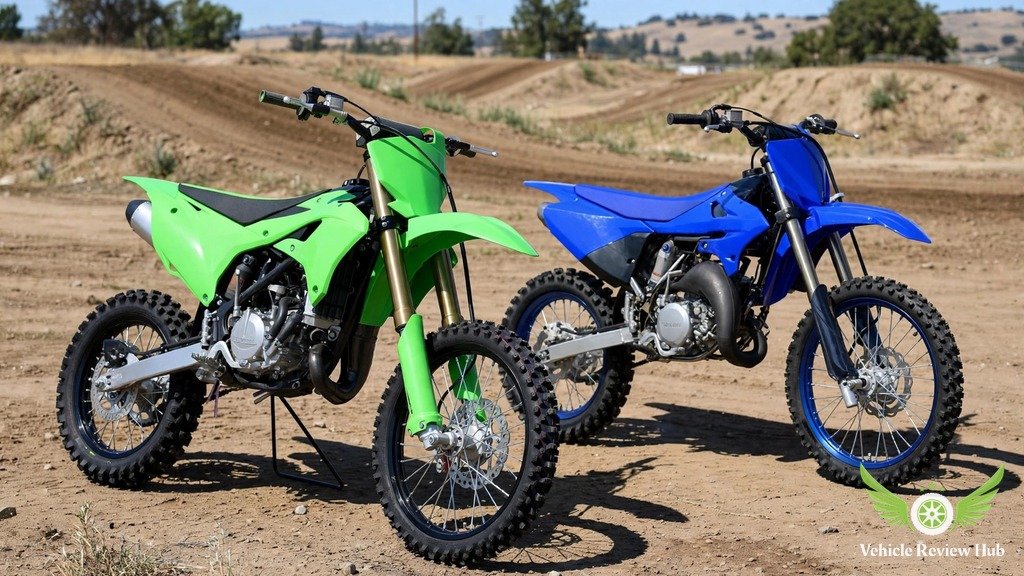
Kawasaki KX85 L vs Yamaha YZ85LW
On paper, the L and the YZ85LW are the two Japanese big-wheel 85s, and neither maker publishes a power figure for its bike. The Yamaha’s 85cc engine runs a 36 mm KYB fork — fully adjustable, but 7 mm smaller than the L’s 43 mm KYB — with a KYB single shock giving 11.3 inches of rear travel against the L’s 12.0, and 220/190 mm brakes against the L’s 240/220 mm. The Yamaha’s seat is taller at 34.8 inches against the L’s 34.1, and it weighs 165 lb wet against the L’s 164.5 lb without fuel — a comparison of two different weight measures, so read it as near-parity rather than a verdict. The Yamaha costs $5,399 on MSRP, $200 more than the L’s $5,199, and Yamaha’s own model page prints a $320 destination charge for a $5,719 delivered total, against the L’s $5,514 delivered on the dealer-sourced $315 figure. No dyno of the YZ85LW exists either, so the comparison rests on hardware, not horsepower — and on hardware, this Kawasaki KX85 L performance guide puts the L ahead on fork, travel and brakes.
| Bike (2027) | Engine | Front fork | Rear travel | Brakes | Seat height |
|---|---|---|---|---|---|
| Kawasaki KX85 L | 84cc 2-stroke | 43 mm KYB | 12.0 in | 240/220 mm | 34.1 in |
| Yamaha YZ85LW | 85cc 2-stroke | 36 mm KYB | 11.3 in | 220/190 mm | 34.8 in |
| KTM 85 SX 19/16 | 84.9cc 2-stroke | WP XACT 43 mm | 11.4 in | 240/220 mm | 34.3 in |
| Kawasaki KX112 | 112cc 2-stroke | 43 mm KYB | 12.0 in | 240/220 mm | 34.1 in |
Note: 2027 figures from Kawasaki, Yamaha and KTM’s own model pages. No maker publishes a power figure for any of these bikes; the only dyno-anchored numbers are MXA’s 2014 figures — KX85 22.68 hp, KTM 85 SX 23.94 hp — labelled standard-bike and 2014 throughout this Kawasaki KX85 L performance guide. The KX112 shares the L’s chassis exactly; the YZ85LW weighs 165 lb wet and the KTM 152.1 lb without fuel.
Is the Kawasaki KX85 L Suitable for Beginner Riders?
No. The owner’s manual is blunt: the bike is “a high performance off-road motorcycle designed for experienced young riders. It is not suitable for beginners.” It has a manual clutch, a narrow high-rev powerband, and no beginner aids — the same traits that make it a race bike make it the wrong first bike. A young rider starting out belongs on one of Kawasaki’s four-stroke youth bikes, the KLX110R or KLX140R, with their automatic-clutch options and forgiving delivery — not on an 84cc two-stroke that needs clutch work to stay in its powerband. That is the final word of this Kawasaki KX85 L performance guide on who the bike is for: a growing rider who already knows how to ride one.
Kawasaki KX85 L Performance FAQs
The questions US buyers ask about the 2027 Kawasaki KX85 L’s performance, answered from the verified figures in this Kawasaki KX85 L performance guide.
How much horsepower does the Kawasaki KX85 L make?
Kawasaki publishes no power figure, and no dyno test of the L exists. The only US dyno of this engine is MXA’s 2014 test of the standard KX85 — 22.68 hp at 11,500 rpm — and the engine is unchanged since 2014, so that figure is the best available datapoint for this Kawasaki KX85 L performance guide, labelled standard-bike.
What is the top speed of the Kawasaki KX85 L?
No tested top speed exists — no magazine or manufacturer has measured it. The 78 mph figure on some aggregator pages is unsourced; do not trust it — and this Kawasaki KX85 L performance guide prints no top-speed figure at all.
What is the fuel economy of the Kawasaki KX85 L?
No MPG figure exists for the KX85 L — no test has measured it and Kawasaki publishes none. It is a premix two-stroke race bike, not a road bike, so mileage was never tested, and this Kawasaki KX85 L performance guide prints no MPG figure.
What is the premix ratio for the Kawasaki KX85 L?
32:1 (break-in 16:1), per the family owner’s manual. The 1.32-gallon tank takes 5.28 oz of 2-stroke oil per full tank.
Is the KX85 L the same chassis as the KX112?
Yes. A diff of Kawasaki’s own 2027 spec sheets shows the L and KX112 differ in exactly six places — name, MSRP, displacement, bore/stroke, compression and 0.4 lb of weight. Everything else, including the 12.0-in rear travel and 19/16-in wheels, is identical — the chassis fact this Kawasaki KX85 L performance guide leans on most.
Is the Kawasaki KX85 L good for beginners?
No. The owner’s manual says it is “a high performance off-road motorcycle designed for experienced young riders. It is not suitable for beginners.” It has a manual clutch, a narrow high-rev powerband and no beginner aids.